A syncline exposed in a roadcut at Hancock, Maryland. Photo courtesy of Ron Schott.
Finally, the Geology Word of the Week has returned! I took about six weeks off because I was very busy with my wedding and thesis. Six weeks ago, I had announced that the next Geology Word of the Week would be S is for Schist. However, I kept trying (and failing) to write the schist post. Schist is such an important and fun geology word, and I want to take the time to write up the post properly. When the letter “S” rolls around in 26 weeks, I should be finished with my thesis (fingers crossed) and have plenty of time to write up a proper post. So, schist has been moved to the next alphabet. For now, I present… S is for Syncline!
Note: I modified the definitions below after some discussion in the geoblogosphere.
def. Syncline:
A fold in a sequence of rock layers in which the younger rock layers are found in the center (along the axis) of the fold. Syncline is closely related to the word anticline, which is a fold in a sequence of rock layers in which the older rock layers are found in the center (along the axis) of the fold.
def. Synform:
A concave upward (U-shaped) fold in a sequence of rock layers. The lower (and generally younger) rock layers are found at the center (along the axis) of the fold. Synform is closely related to the word antiform, which is a convex upward (upside-down U) fold in which the upper (and generally older) are found at the center (along the axis) of the fold. In the field, many synforms are also synclines. An overturned syncline is called an “antiformal syncline.”
The easiest way to understand synclines and anticlines is to look at a diagram, such as the one below:
Beginner geologists often confuse synclines and anticlines. Remember: A syn makes you grin!
Like many geological structures, synclines and anticlines form at various scales in the field. They can form over vast regions or within a single outcrop or hand sample. Sometimes, small folds are called “synclinal folds” rather than synclines.
Here’s a few more pictures of synclines:
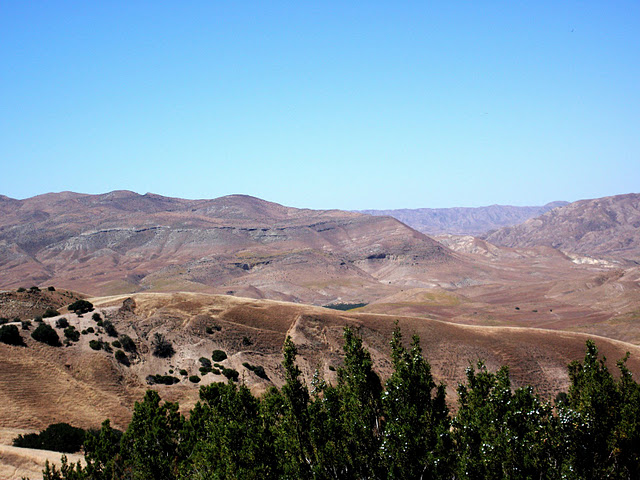
A syncline in Calico, California. Photo courtesy of Ron Schott. A syncline in San Bernadino County, California. Photo courtesy of Ron Schott.A syncline in Fair Haven, Vermont. Photo courtesy of Ron Schott. The Vallecitos Syncline, central California. Photo courtesy of Timothy Sherry.A syncline in Torres del Paine National Park in Chile. The lake in the foreground is Lago Nordenskjöld. Photo courtesy of Ryan Anderson.
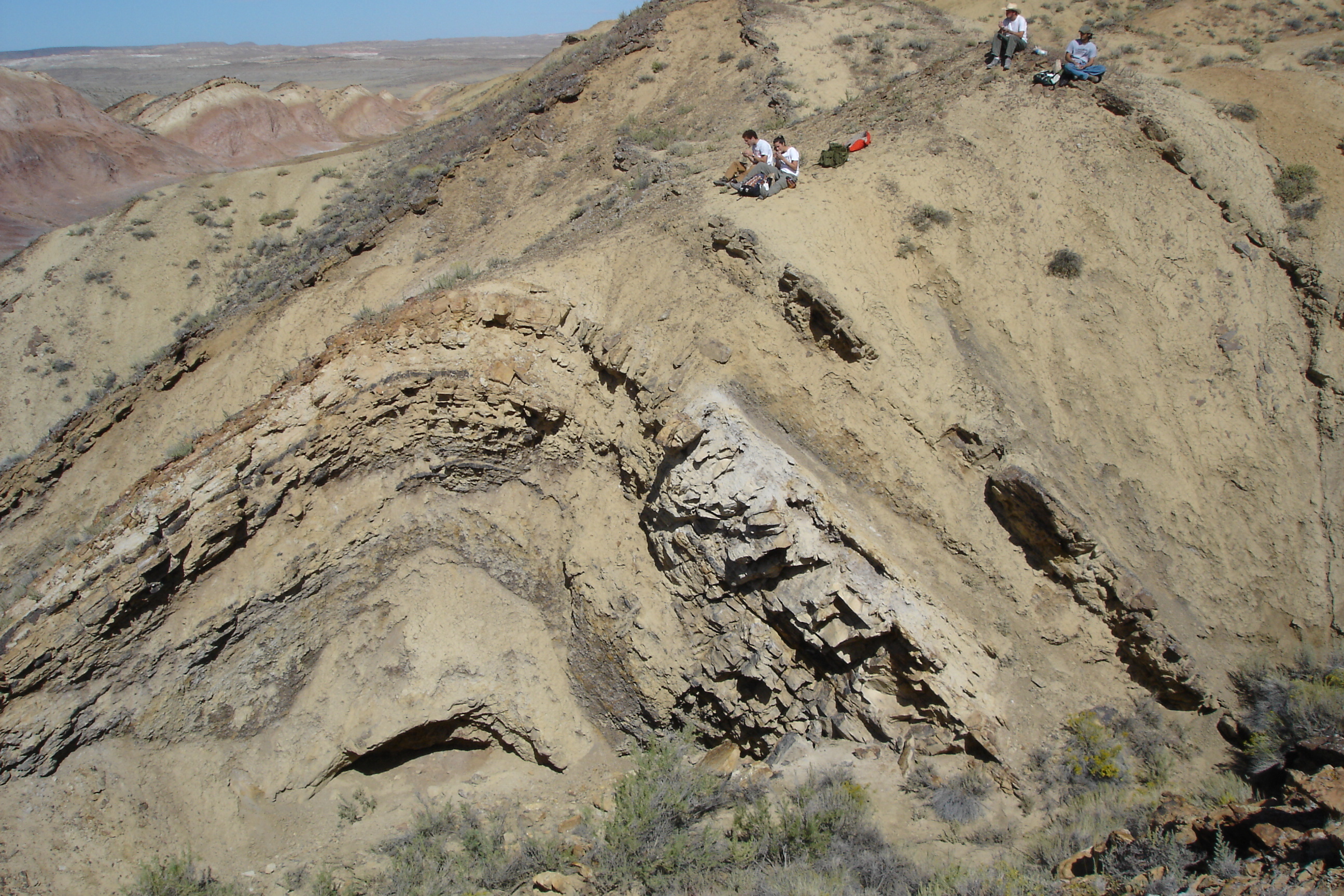
And here’s an anticline:
An anticline in Wyoming.
Finally, I have a question for the geoblogosphere: What is more important for distinguishing anticline vs. syncline: the general shape (right-side-up U or upside-down U) or the age of the rocks? What if there’s been overturn so that folds are forming in a sequence where the younger rocks are the lower layers and the older rocks are the upper layers? Please feel free to discuss this topic in the comments below.
Question answered. But please feel free to continue the discussion below.
For the past few years, I’ve been teaching myself how to knit. I don’t have too much time for knitting in the midst of travel and writing and working on my PhD, but I usually have a knitting project or two that I work on while watching a movie on the weekend. I’m not a very advanced knitter– I pretty much just knit scarves and hats. A few months ago I tried to knit slippers for my husband, but I ended up with three different size slippers. Oops. Recently, though, a friend of mine introduced me to the knitting patterns from Jean Greenhowe Designs. These designs are fantastic– all you have to know how to do is knit, purl, increase, and decrease. There are no complicated stitches or instructions, and there are hundreds of adorable little creatures and other knick-knacks. Since most of the items in the patterns are small, they knit up fairly quickly… unlike that sweater I started once and probably won’t ever finish. Some of the designs are a too cutesy for my taste– for example, the scarecrows and clowns. In fact, I’m sure that I won’t ever knit one of the clowns because clowns used to terrify me as a child. However, I do like many of the patterns, including some of the delightful Christmas ornaments and other decorations. For my first Jean Greenhowe project, I recently made two of the mini Christmas stockings (free pattern available here), and they’ve come out very well. I plan to use the mini stockings to decorate the first Christmas/Newtonmas/Saturnalia tree that my husband and I will have together.
Now that I’ve mastered the simple mini stocking, I plan to move onto more advanced Christmas decorations. Originally, I was going to move on to a Snowman or perhaps a Santa Claus. But then I discovered that Jean Greenhowe has DINOSAUR knitting patterns in her book “Toy Collection.” So, now I plan on knitting mini dinosaurs with Christmas scarves. I just ordered the pattern book, and I can’t wait for it to arrive. I think these knitted dinosaurs will make excellent Christmas decorations and also excellent Christmas gifts for my geologist friends.
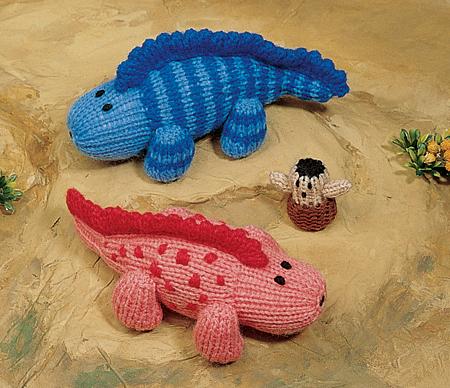
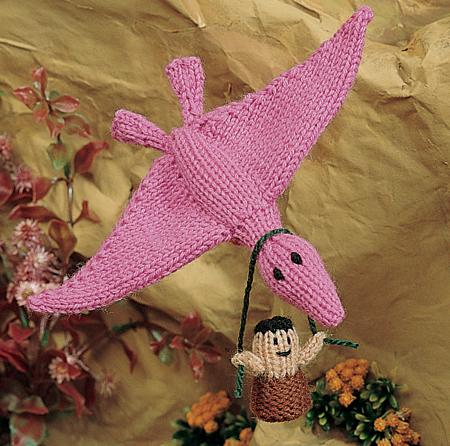
I’ll post pictures of my own dinosaurs once I knit them, but for now here are some pictures taken from Jean Greenhowe’s website. I plan to try to knit all of these dinosaurs, scientifically inaccurate Cavemen friends and all! Meanwhile, can any paleontologists (maybe Brian Switek?) help me identify these knitted dinosaurs species? I think there’s a T-Rex and a Pterosaur, but that’s about all I can say.
Sorry for taking awhile to post this October Accretionary Wedge. My thesis has been keeping me fairly busy recently!
Back at the beginning of October, I issued this call for an Accretionary Wedge:
Dress Barbie as a geologist for Halloween! To participate in this month’s accretionary wedge, purchase a Barbie (I think they sell for about $10) or, better yet, acquire one from a friend, thrift shop, or garage sale. If you can’t manage to find a Barbie, any doll will do! Then, construct a geologist costume for Barbie. You can recycle bits and pieces of Barbie clothing or you can make new clothes using cloth, yarn, paper… anything really! If you want, you can also find or make some props for Barbie. For example, if you want to dress Barbie as a seismologist, make her a seismometer out of cardboard. Paleontologist Barbie already exists, but feel free to make another (perhaps more realistic?) Paleontologist Barbie if you want.
Several people rose to the challenge of dressing Barbie as a geologist. For my entry, I decked Barbie out in full laboratory safety gear as Geochemist Barbie:
Geochemist Barbie thinks chemistry is fun!
Over at Musings of the Midnight Fox, Reynardo presented the fantastically dressed and adventurous Volcanologist Barbie:
Geologist Barbie thinks rock gardens are just dreamy.
Can I move in there, Dana? Those rock gardens look fantastic!
Thanks to everyone who participated in Accretionary Wedge #39. Be sure to click on the links above to view more pictures of these geologist Barbies… and Fred.
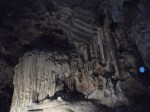
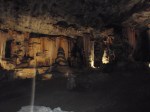
I haven’t yet received a reply to my letter to Dr. Sheldon Cooper about why geology is a real and valuable science and why caves are interesting, but that’s okay. For those of you who agree that caves are interesting, I thought I’d share some pictures from my most recent spelunking trip.
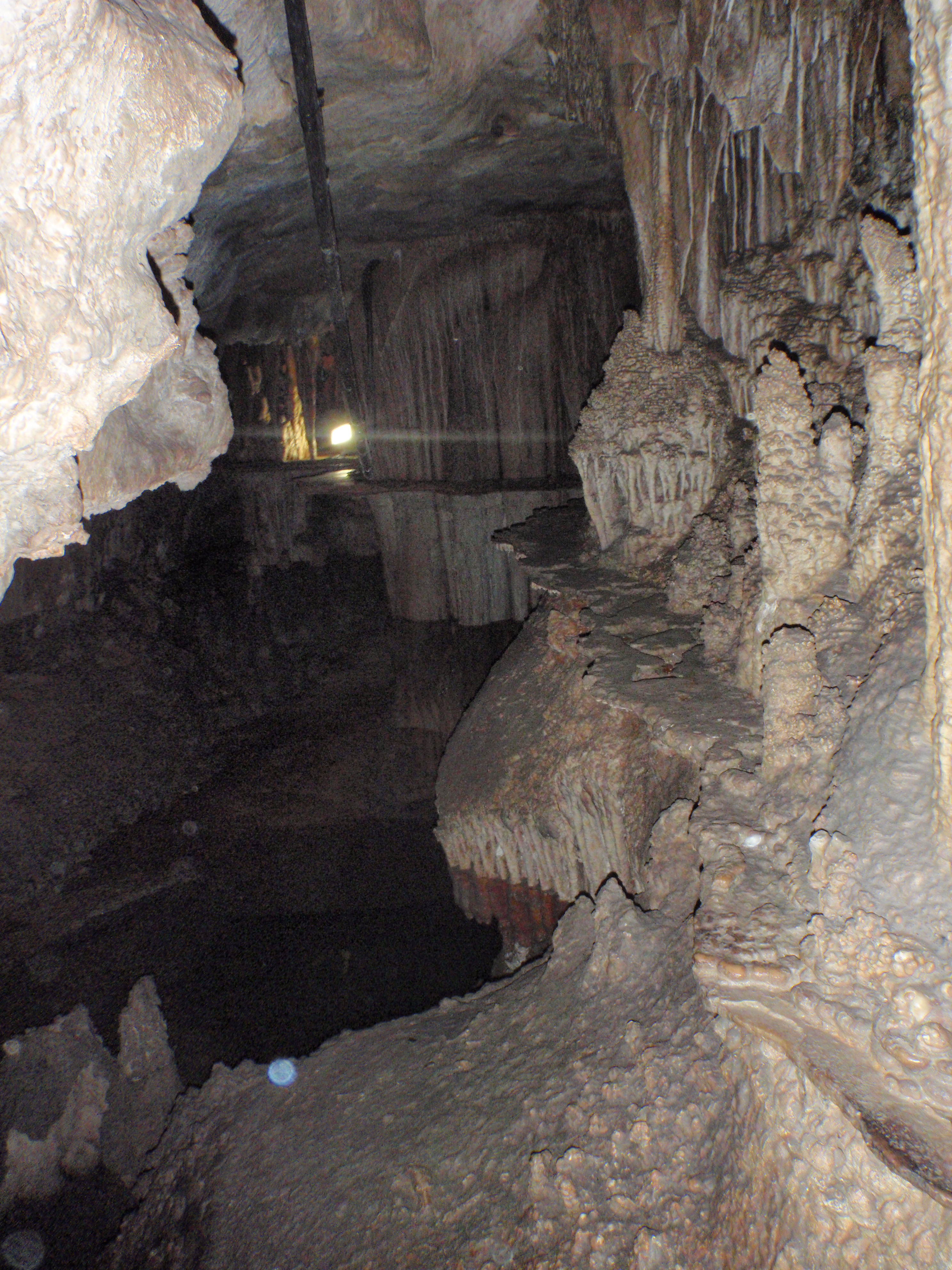
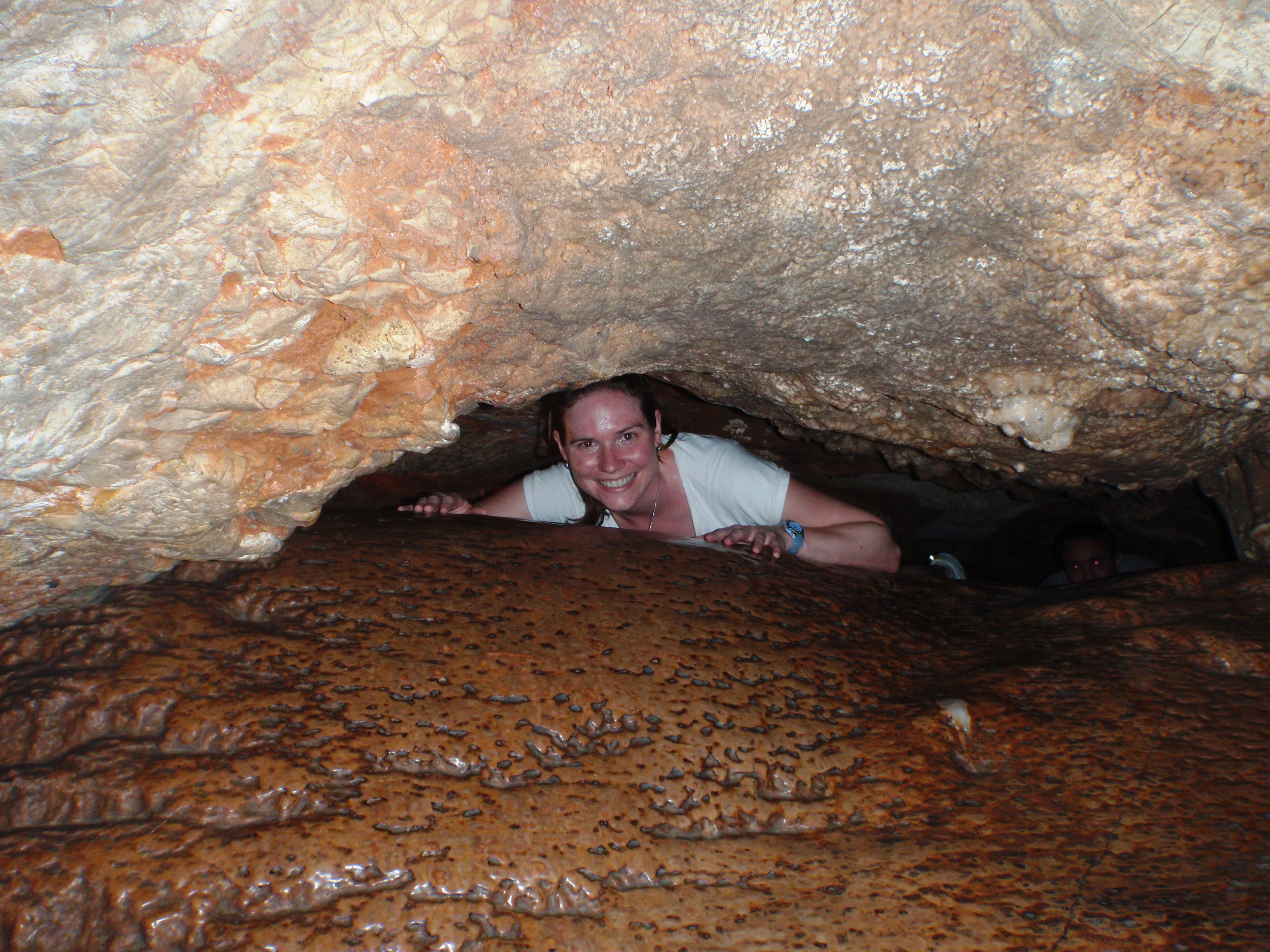
Back in September, my husband and I took a weekend trip to Outdshoorn, South Africa, where I rode an Ostrich and also saw some weatherstones. We also visited the Cango Caves, a large, beautiful, and impressive network of limestone caves. We visited the excellent (though slightly worn-down) geology exhibit at the Interpretive Center (or Centre, to be properly South African) and then went on a guided tour of the caves. We decided to go on the “Adventure Tour.” We were pleasantly surprised to discover that the “Adventure Tour” is actually fairly adventurous, even for two adventurous geologists! My 6’3″ husband actually had some trouble making his way through some of the tight squeezes.
Below are some pictures (albeit not the best since they were taken with a waterproof point-and-shoot camera) from our adventure tour through Cango Caves. Enjoy! Click on any of the pictures in the gallery below for a larger version.
Exploring Cango Cave, South Africa, September 2011.
Dear Dr. Sheldon Cooper,
Let me first say that I greatly admire the documentary “The Big Bang Theory” that follows the daily lives of you and some of your scientific colleagues* at Caltech. “The Big Bang Theory” provides refreshing, mentally stimulating programming in a time when television is, sadly, dominated by fluffy reality TV shows about weddings, cakes, and orange-colored inhabitants of the Jersey Shore who will probably develop melanoma in their early 30s. With rare exceptions, TV has really gone downhill ever since “Firefly” was canceled. Your delightful documentary and “Game of Thrones” are the only shows I regularly watch on television these days. I recently tried adding the promising-sounding “Terra Nova” to my TV-watching schedule, but unfortunately the painfully cliché dialogue and pervasive scientific inaccuracies can only be moderately compensated for by CGI dinosaurs. I’m afraid I may have to abandon my attempts to follow “Terra Nova”, which makes me all the more grateful that I can watch your documentary. Furthermore, I imagine that footage from “The Big Bang Theory” will provide valuable information for the historians who will write your biographies after you win the Nobel Prize in Physics for your innovative and brilliant work in String Theory. I actually wish you would go into more detail about your work in theoretical physics, which sounds fascinating. Much as I enjoy watching you and your friends play games such Klingon boggle, Wii Bowling, and Dungeons & Dragons– past times that I also find entertaining– and watching your amusing interactions with your neighbor Penny and various friends and family members, I do wish that more of your documentary would focus on your scientific achievements.
However, the actual purpose of this letter is not simply to praise your documentary and your work as a scientist. As I’m sure you understand, unfortunately it is sometimes necessary to follow non-optional social conventions. In this case, I am following the social convention of providing compliments prior to providing criticisms. Now that I’ve provided an entire complimentary paragraph, let me move on to my criticism. Actually, I have more of a demand than a criticism. To put it simply: Stop saying that geology isn’t a real science.
Perhaps making up 26 dimensions in order to make your mathematics work out isn’t real science. Ever thought about that, Sheldon?I am a geologist, and I take offense that you consider me a “dirt person” and “not a real scientist.” Firstly, the term is “soil scientist” not “dirt person.” Secondly, geology is a perfectly legitimate, interdisciplinary science that requires advanced knowledge and synthesis of the fields of biology, chemistry, mathematics, and– yes– even physics. Geologists must be polymaths, which makes geologists elite scientists in my completely unbiased opinion. For hundreds of years, geologists have made concrete and important contributions to science. Let me list just a few of these contributions below:
The Age of the Earth:
Without the science of geology, people might still believe that the Earth has a Biblical age of only a few thousand years**. In the 1600s and 1700s geologists such as Nicolas Steno and James Hutton helped scientists understand that Earth must be millions of years old if the weathering and sedimentation processes operating in the Quarternary were responsible for forming the Earth’s landscape. “The Present is the Key to the Past” is a simple but extremely useful concept that was introduced by these early geologists. Admittedly, one of the first scientists to try to calculate (inaccurately, I might mention) the age of the Earth was physicist Lord Kelvin, who came up with an age of 100 million years based on cooling properties. However, Lord Kelvin overlooked radioactive heating***, so his calculated age was far too young. Fortunately, geochemists eventually determined that the Earth has an age of 4.54 billion years based on radiometric dating of chondrite meteorites and also Pb-Pb isotope systematics.
Plate Tectonics:
The theory of plate tectonics was developed by geologists in the 1950s and 1960s. Since you live in southern California dangerously close to the San Andreas fault, perhaps you are not fully familiar with the importance of this theory. After brushing up on the theory, perhaps you will want to consider moving to a more tectonically-stable region of the planet. Personally, I recommend southern Africa.
Science on the Moon:
The only scientist ever to travel to the Moon is geologist Harrison Schmitt, a Caltech alumnus. Clearly, NASA has great respect for the science of geology. Don’t you think that NASA would have sent a physicist to the moon if they considered physics more important?
I could go on, but I think you understand my point. Let me conclude my letter by stating that I think your disrespect for the fine science of geology limits your own scientific endeavors. For example, in one of the early episodes of your documentary you completely overlook the potential for scientific research in caves. As you and your friend Leonard are walking down the stairs to attend a department party, you complain about how at the last department party you were forced to listen to a professor talk about spelunking for 45 minutes. You then rhetorically ask, “Do you know what’s interesting about caves, Leonard?” and then answer your own question with the simple reply, “Nothing.”
Really, I’m shocked at your lack of knowledge regarding caves. A simple Wikipedia search would inform you that there are dozens of reasons why caves are both interesting and scientifically important. To assist you in filling this gaping hole in your scientific knowledge, I’ve listed a few examples below.
A Few Reasons Why Caves are Interesting:
-Many important archaeological artifacts and fossils have been discovered in caves, which tend to preserve items by protecting them from the environment. As an example, important Austrolopithecus africanus fossils have been uncovered in the Sterkfontein Caves in South Africa.
-Study of speleothems (chemical precipitates which form in caves), which form slowly over thousands of years, provides important information about Earth’s paleoclimate, a topic which is very important to understand in light of the rapid anthropogenic climate change which has been occurring since the Industrial Revolution.
-Study of troglobites (cave-dwelling animals) is a rich and very important field of biology that can provide insights into evolutionary adaptation such as the enhancement of non-vision senses such as hearing, taste, and touch.
-Deep, well-shielded caves provide excellent environments in which to observe neutrinos. If I were a physicist, I would want a cave lair where I could set-up and monitor my neutrino experiments.
-Caves contain bats, which are one of nature’s most elegant and interesting creatures. Personally, I find bats’ use of echolocation particularly fascinating. Based on your strong interest in Batman, I imagine you must also find bats very interesting.
Those are just a few of the many, many reasons why caves are interesting.
Now that I have explained why geology is an important and very legitimate science and why caves are fascinating and important scientific research environments, I hope you will reconsider your rash disregard for geology and geologists. Perhaps you will even consider collaborating on some scientific projects with geologists. Caltech has one of the world’s best geology departments, and I would be very interested to see your brilliant mind turned to some of the important outstanding questions in geology. For example, geophysicists do not understand Earth’s magnetic field reversals very well. I imagine that your expertise in theoretical physics could be very useful for providing insight into why and when Earth’s magnetic field reverses. You may wish to pursue this topic for personal reasons since an unexpected geomagnetic field reversal could prove very detrimental to your standard of living.
I look forward to receiving your reply to this letter.
Sincerely,
Evelyn Mervine
PhD Candidate in Marine Geology & Geophysics
MIT / Woods Hole Oceanographic Institution Joint Program
*I realize that you may view “scientific colleagues” as somewhat strong wording. After all, Howard is just an engineer.
**I think that some of your relatives in Texas still believe this. Can you please try to educate them on this matter?
***Probably because radioactivity hadn’t been discovered yet, but surely a smart physicist should have discovered radioactive heat prior to endeavoring to calculate Earth’s age from cooling models.
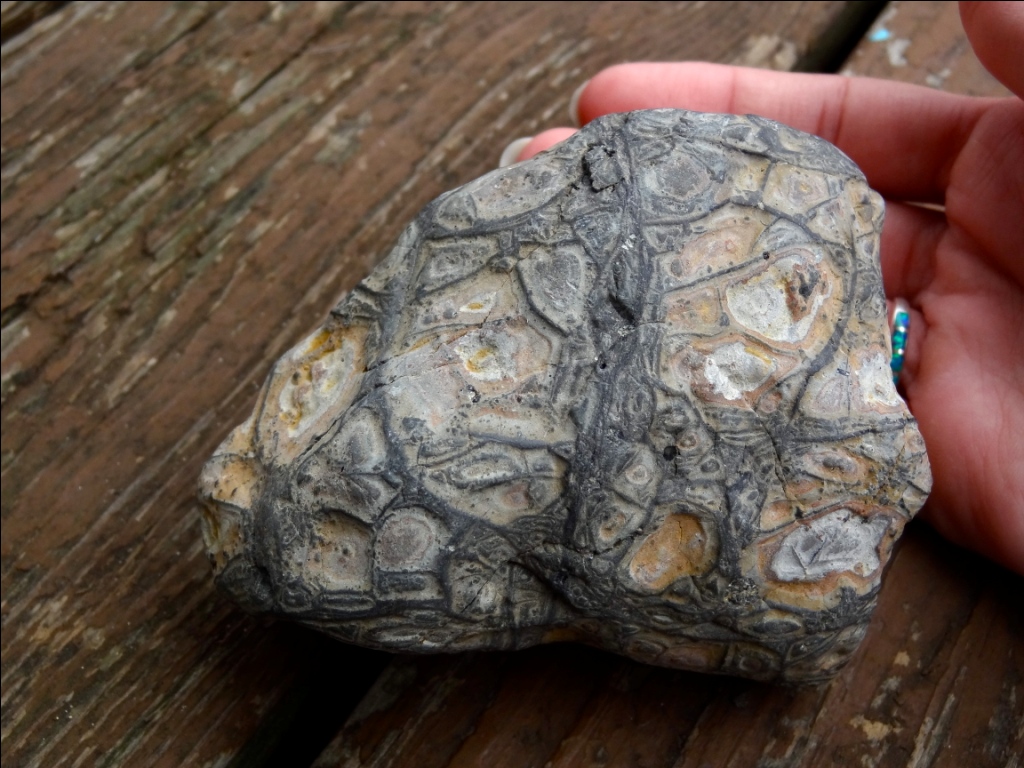
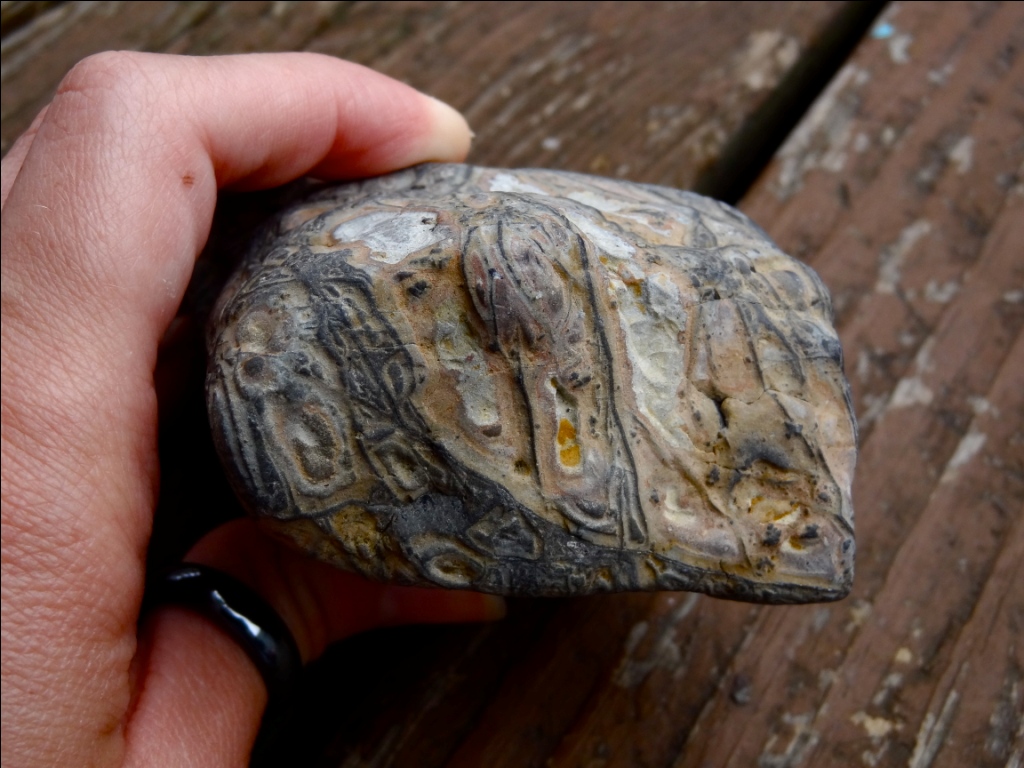
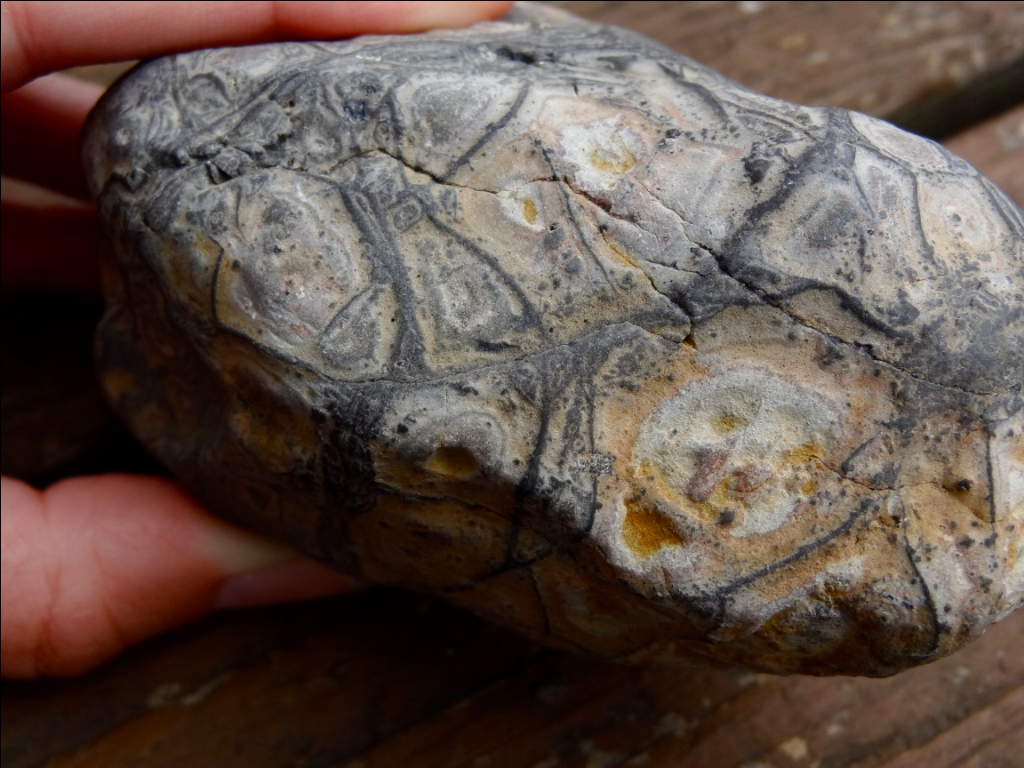
Time for another mystery rock! This one was sent to me by Jess back in July. Jess, I’m sorry this took me so long to post. I blame my thesis… and wedding busyness… and also the fact that this rock actually has me stumped. I’m afraid that I can’t provide too much more insight into what this rock might be, other than that I think it’s sedimentary. Not very helpful, I know. I’m hoping that other geologists in the geoblogosphere can provide some more useful insight.
Here’s Jess’s original message to me:
Hello Evelyn!
I would SO appreciate your expertise in figuring out what kind of rock I have. My husband and I just recently took a trip to Traverse City, MI, and I found this rock about a mile from the shore in Lake Michigan. We took it to a few rock shops, and one owner said he had only seen a couple in the past, and that is was a jasper-hematite “blend”. He also said that one man brought one in, wanting to find out if he could tumble it, and because it is so hard, the shop owner told him it would take about 9 months to tumble. The man cut his rock in half with a wet-saw, which reportedly took about 6 hrs. to cut all the way through. The pattern on the outside is apparently the same throughout the rock. I’m barely able to scratch it with a roofer’s nail, and despite thorough cleanings it still smells faintly of sulfur (?). If there are any other details you need, please let me know! I would LOVE to know what this rock is, if you could help me out. Rock-hounding is an absolute passion of mine… determining what it is I’ve found is half the fun for me, but this time I’m stumped! Thank you either way:)
-Jess
Well, I’m stumped, too, Jess! Hopefully some other geologists can help us out.
Here are several more pictures of the mystery rock:
Mystery Rock #4, Photo 2. Mystery Rock #4, Photo 3. Mystery Rock #4, Picture 4. Mystery Rock #4, Photo 5. Mystery Rock #4, Photo 6. Mystery Rock #4, Photo 7. Mystery Rock #4, Photo 8.
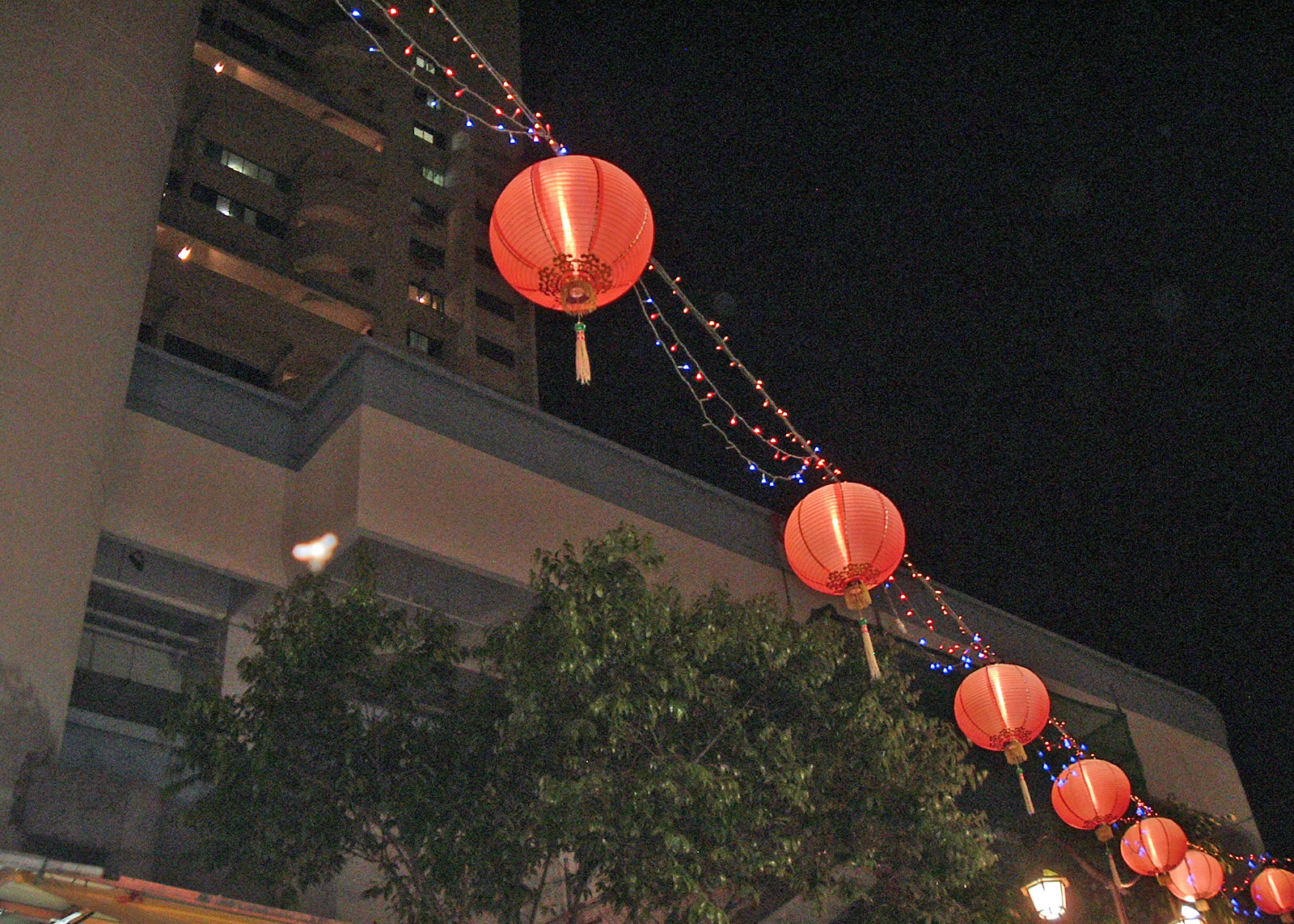
Paper lanterns above the streets of Chinatown, Singapore, August 2007.
Today is my one-year blogaversary! Georneys began on November 2nd, 2010 with my post “Welcome!” The information in the welcome post has since been replaced by the “About Georneys” tab above. My first real blog post was “Geology Word of the Week: A is for Alluvium.” Over the past year, I’ve cycled through nearly two alphabets of geology words, shared photographs from various geological journeys, written about the Japan Earthquake, taken breaks from geology to blog about the Fukushima nuclear power plant disaster, written about graduate school trials and tribulations, suggested various “holiday rocks” (though I recently forgot Halloween! Eek!), participated in a few Accretionary Wedges, put up funny pictures and old bits of writing from my youth, pondered mystery rocks sent in by readers, mused over topics ranging from statistics to mass spectrometers, and expressed (very vocally) my disdain for Young Earth Creationists. I wasn’t quite able to post a Geology Word of the Week every week, but I did fairly well. I only missed seven weeks: four weeks during the interviews with my father about Fukushima, and three weeks recently when I was busy with my wedding. Never fear! The Geology Word of the Week will resume this week with S is for Schist.
I’ve had a wonderful first year of blogging. I’ve especially enjoyed the interactions I’ve had with other geobloggers and also with many of my blog readers. I feel very honored that my young blog was invited to join AGU Blogosphere. I think this is a wonderful home for my blog. As I finish up my thesis over the next few months, my blogging may occasionally be somewhat sparse, but I’ll do my best to at least keep up with the Geology Word of the Week and other tidbits as time permits. Here’s to another wonderful year of blogging!
Wedding picture courtesy of Christine Watters Photography, Cape Town.
You are born into a name, which helps define and demarcate your identity. If you are lucky, your parents will provide you with a wonderful name, such as Evelyn Martinique Mervine. If you are unlucky, your parents will provide you with a less-wonderful name, such as a long one that contains both the word “Herbert” and the symbol “IV.” My husband may or may not have such a name. In many ways, your name provides more information about your parents and your family than it does about you. For instance, if your parents named you River, they are probably hippies… or possibly kayakers. You often grow into your first name (and your family) so that the name suits you. Your last name hints at your family origins. O’ Xs usually originate from Ireland while Mc Xs and Mac Xs usually originate from Ireland or Scotland. Lees and Yangs usually originate from Asian regions. Al Xs usually come from the Middle East. Before you meet a person, you usually assess the person by his or her name. From two words– a first name and a last name– you start to form an image in your mind of the person; you envision, subconsciously sometimes, how the person looks and talks and acts. You find yourself slightly surprised when Mary Chang turns out to have blonde hair, blue eyes, and a Chinese husband. Not always used, middle names often provide surprising new information. In elementary school we used to play guessing games to figure out our classmates’ middle names. I remember being proud when no one could guess my own. Middle names are mothers’ maiden names, important family names that didn’t make the cut for a first name, important place names, and names the parents would have given as a first name if they had been braver.
You respond to your name, automatically. Your head turns when you hear your name behind you, and you stall your actions for a few moments before realizing that someone you don’t know is calling to his child. At least, I do. Except, in my case, the person I don’t know in the supermarket is usually calling to his grandmother. Perhaps Johns and Marys– or, these days, Aidens and Isabellas– don’t automatically turn their heads in supermarkets to their name, but those of us with less-common names usually do.When I was born in 1984, Evelyn was considered an old lady name and was not very popular for newborn babies. I was named after my great grandmother, and I’m very proud of my name. However, there are not too many Evelyns my same age. Evelyn was the name of the wife of the elderly Wal-Mart greeter and of the Nursing Home residents I visited during my Middle School volunteer hours, not of my classmates. My classmates growing up were Jennifers and Jessicas and Ashleys; Michaels and Christophers and Matthews. I encountered one other Evelyn in high school, and another one in college. When I attended undergrad, there were two Evelyns in a student body of 4,000. Evelyn has recently made a comeback as a popular name for babies. Perhaps my own children will attend school with Evelyns.
You may love and admire your name, as I do. I like my first name because I liked my great-grandmother. Also, Evelyn is an ordinary name without being too ordinary. My middle name is fairly uncommon, at least in the United States. My mother selected the name Martinique because she admired Josephine, the first wife of Napoleon. My mother considered naming me Josephine, but she didn’t really like the name. Josephine was born on the island of Martinique, so my mother eventually decided on that name, which forms nice alliteration with my last name. I don’t care as much for Napoleonic history as my mother does. However, I do very much like volcanoes, and I share the name Martinique with a very exciting volcanic island that periodically erupts in a dramatic fashion. I believe the name Mervine is of Celtic or Welsh origin. The Mervines have been in the Pennsylvania area since the 1700s, and apparently we have a coat of arms. Like many Americans, I am a mutt. I think I am a French-German-Scottish-English mutt. On both my maternal and paternal sides, I am descended from immigrants who arrived in the United States prior to the Revolutionary War, but over the years we’ve mixed with more recent immigrants. I suppose I could join the Daughters of the American Revolution if I wanted, but I’ve always found the organization somewhat silly. America is a country of immigrants. All Americans are children of the American Revolution, whether their families immigrated in the 1700s or 7 years ago. I’m not exactly sure where the name Mervine fits into my mutt history, and there are other family names with which I identify, such as Graham and MacPhearson and Sinclair and Wehr. For me, the important part is that Mervine comes from my father, a man whom I admire very much. The name was passed down to him from my grandfather, a man I vaguely but fondly remember from my childhood, and from my great-grandfather, whom I never met but with whom I exchanged handwritten letters for several years after my grandfather died. I still have these letters tied together with string in my old room in my parents’ house.
You may change your name, as your identity evolves. My own nickname “Evy” (pronounced like “Evie”) originated when I was in high school. The name was borrowed from the character Evelyn “Evy” Carnahan from the 1999 Movie “The Mummy.” This movie came out when I was a sophomore in high school, and my friends and I adopted the nickname “Evy” for me. In college I was mostly known as “Evelyn,” but my closer friends called me “Evy.” When I started grad school, I introduced myself as “Evy” in orientation, and the name stuck. My advisors and grad school friends know me by this name. When I start a professional job, I plan to go by “Evelyn,” again reserving “Evy” for close friends and family. My husband dislikes his name, so he chose a new first name for himself– “Jackie,” which is tangentially derived from “John,” which is one of his two middle names. He only goes by his real first name when necessary for travel or paperwork.
Others may change your name, which you may or may not like. I was a very clumsy child, so my classmates used to call me “Avalanche,” which I strongly disliked. My sister calls me– affectionately, most of the time– “Evilyn.” Many people shorten my name to “Ev.” My husband selected his own variation of Evelyn, and he’s the only one who uses that variation. You are often stuck with the nicknames selected for you by others. I suppose it’s just best to accept them.
You may also reach a time when there is social pressure to dramatically change your name, and you feel conflicted. In Western culture, women traditionally discard their last name– their maiden name– and adopt the last name of their husband upon marriage. I’ve always felt uneasy about this traditional name shift. A part of me bristles angrily at the expectation that women must adopt their husbands’ names. Another part of me used to wistfully write Mrs. Evelyn So-and-So on my old school notebooks. A part of me wants to rebel and make my husband change his name. Another part of me is giddily happy to adopt part of my husband’s name, since I love him so much and the name represents a little part of him. The biggest conflict for me comes when deciding what to name our children, if we have any. Hyphenating the children’s last names is always an option, but I think that hyphenated names often sound clumsy. Also, what do you do for the second generation of hyphenated names? Do you double hyphenate? I know a family– whom I admire very much– with four children. The parents each kept their last names, and they alternated the last names for their children. That is, two of the children have their mother’s last name, and two of the children have their father’s last name. But what do you do if you have only one child? Or three? Jackie and I aren’t even sure if or when we’ll have children, but I’ve already agonized about our children’s last names. Why should the children automatically be given my husband’s last name? Why is this socially expected? Why is there no obvious and simple alternative to the paternal name lineage?
You may decide, ultimately, that it is okay to change your name– and also okay not to change it. As many of you know, I was recently married a little over a week ago. Actually, our legal wedding at Home Affairs was a little over two weeks ago. When the marriage officer asked me what I would like my new surname to be, I hesitated. I had already decided what I was going to do, but I doubted myself even then. A flood of emotions rushed forth. Did I really want to do this? I was so nervous that I nodded when the marriage officer asked if I wanted a hyphenated (or “double-barrel” as they say here in South Africa) last name. I definitely did not want an awkward, double-barrel last name. Hyphenated names work well for many women, but it wasn’t what I wanted. I recovered and told the marriage officer that I wanted to take my husband’s last name which, legally, I have done. Actually, I’ve decided to add an extra name, so my legal name is now Evelyn Martinique Mervine X. I figure that if my husband can have four names and a suffix, I can have four names, too. I will also be (hopefully) adding a prefix sometime in the next few months. My husband and I joke that we’ll have to be known as Dr. and Mr. X. So, I guess I am breaking convention after all. I have also decided to retain Evelyn Mervine as my professional writing name, so that’s the name you’ll continue to see on this blog and on anything I write in the future, from blog posts to scientific papers. Should my husband and I choose to have children, we will likely give them the last name X. However, I will continue to pass the name Mervine along through my writing progeny, which– like children*– will hopefully outlive me. Unless I decide to write a series of racy romance novels. That I might do under my married name or, more likely, a pen name.
*Don’t worry. Given a choice between saving my child and my manuscript, I’ll choose my child.
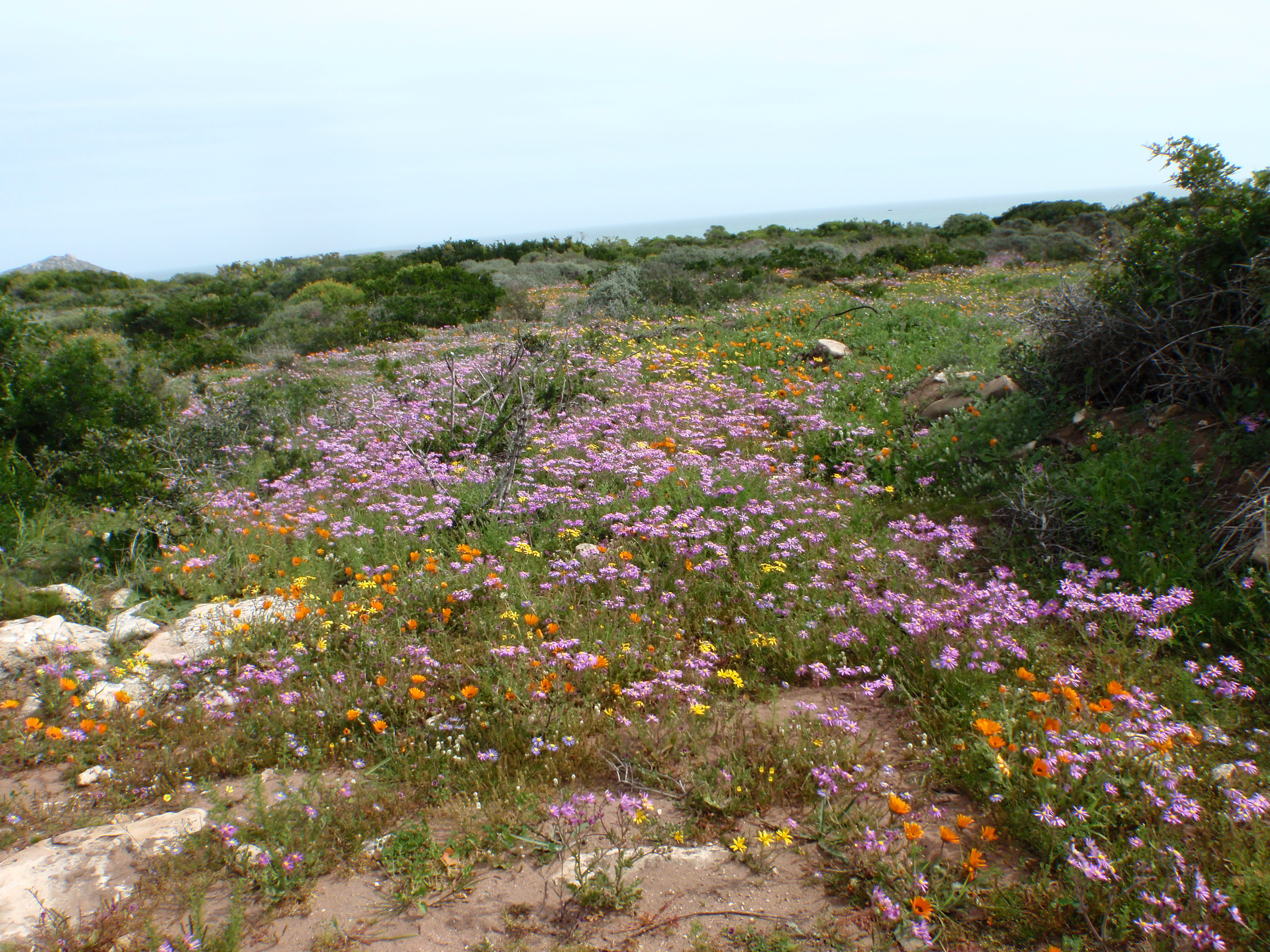
A field of lavender flowers. That's the ocean in the distance!
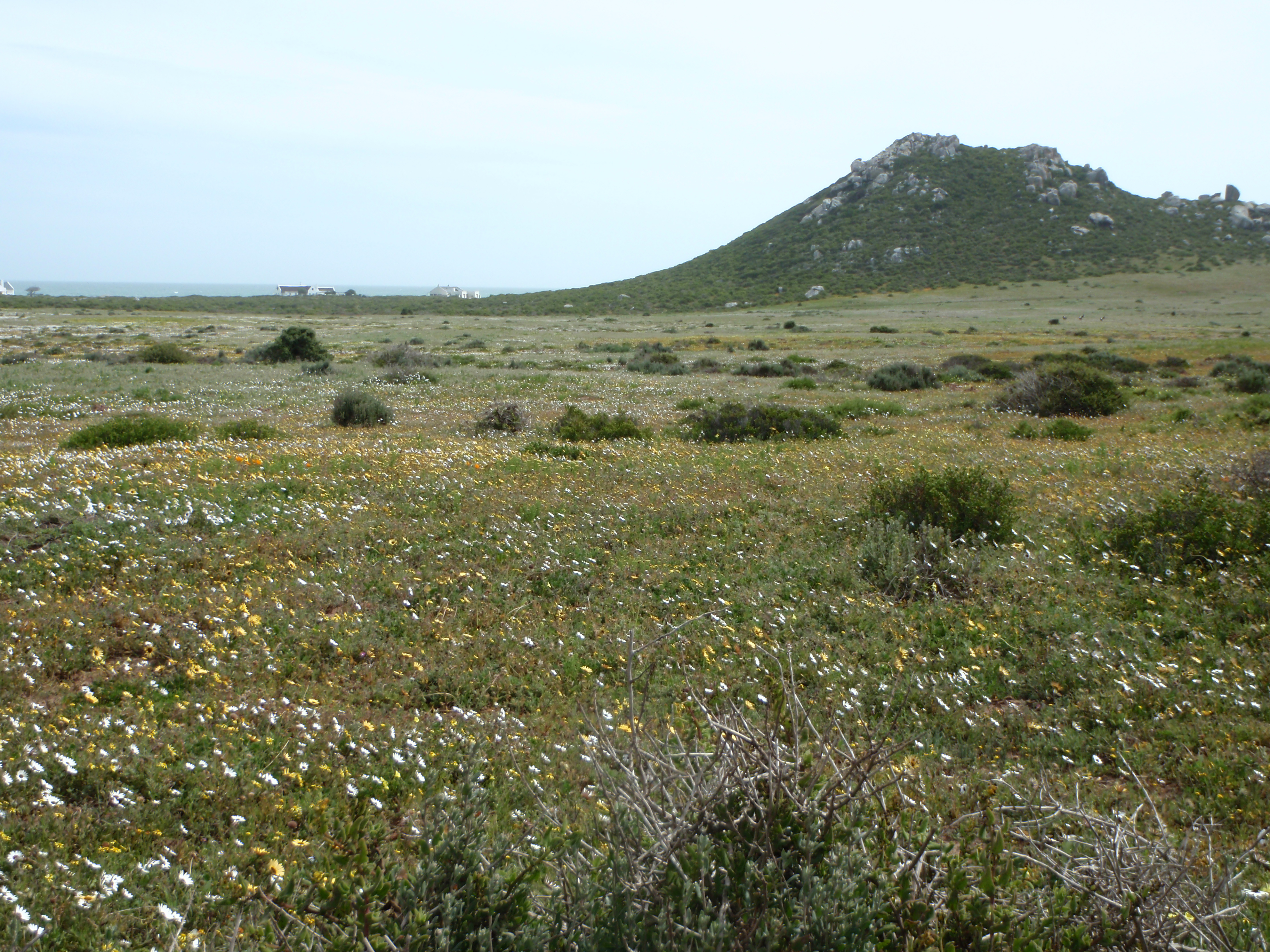
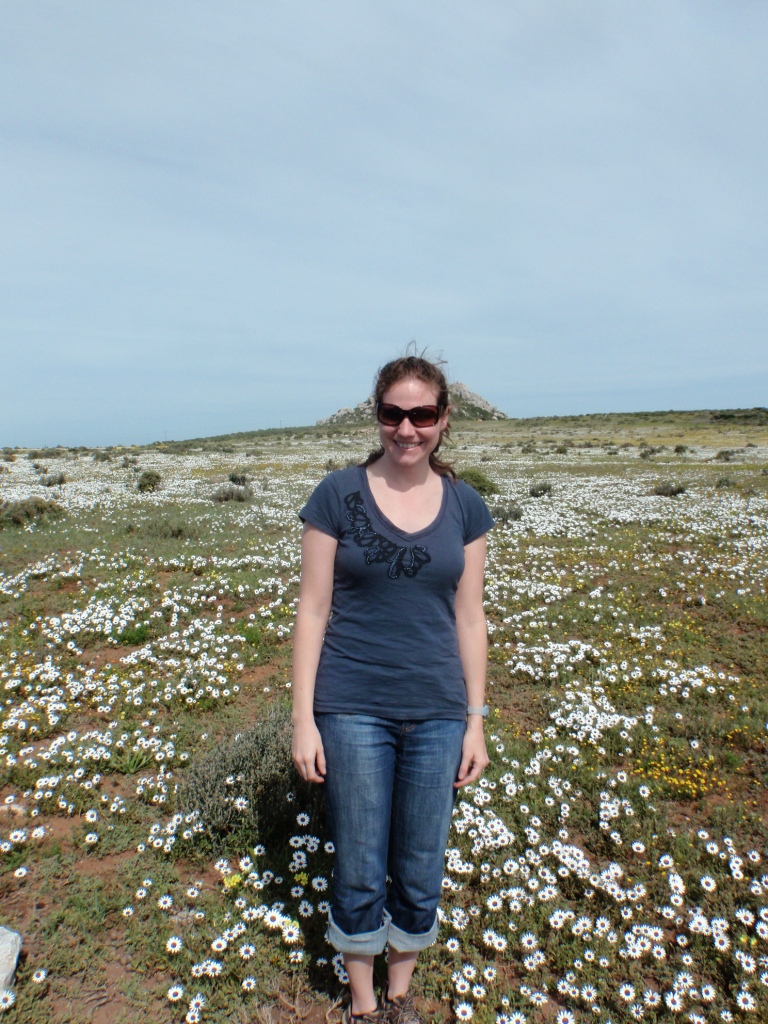
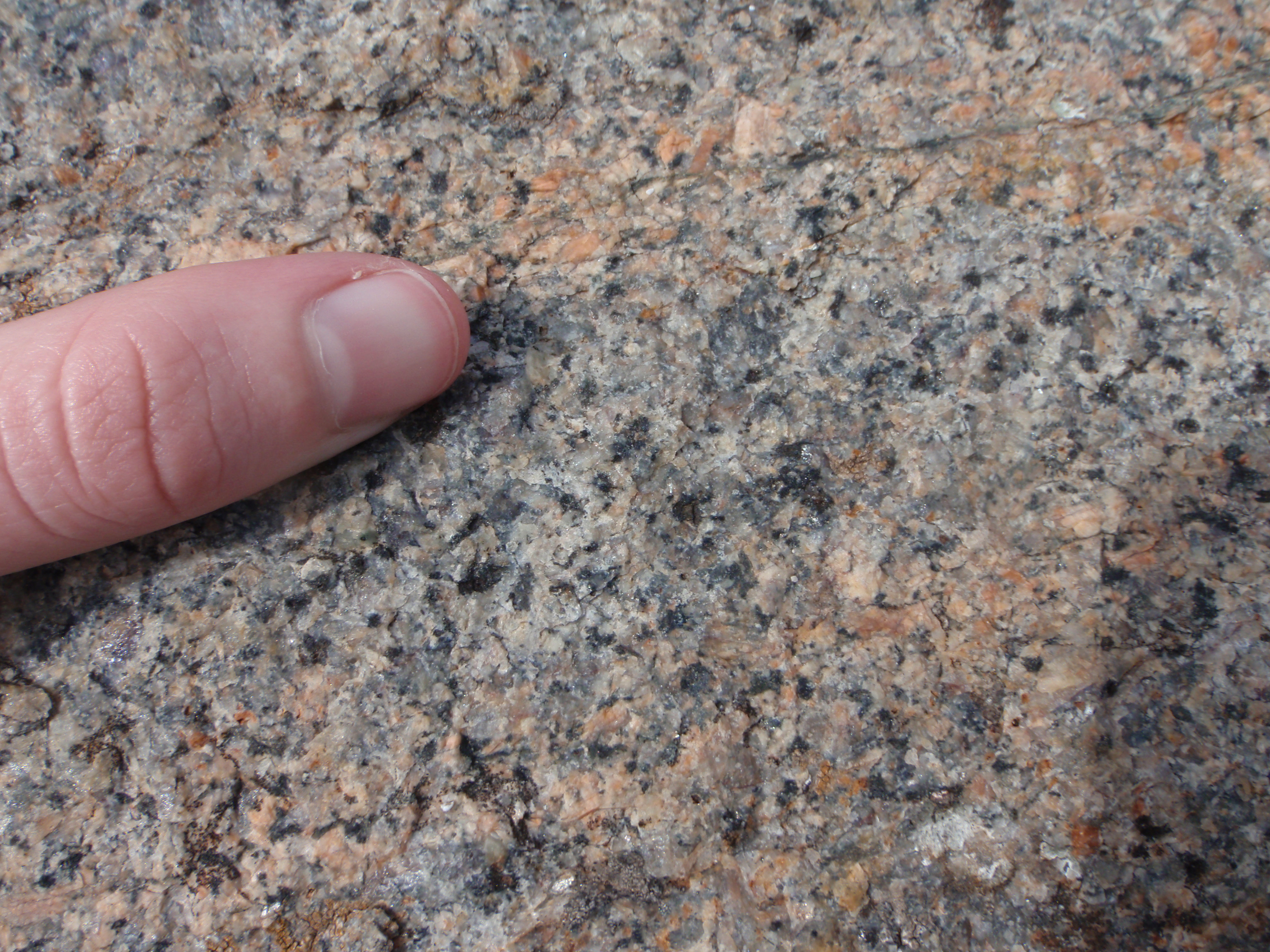
About a month ago I posted some pictures from a Saturday picnic at Langebaan Lagoon, which is located in the West Coast National Park just north of Cape Town, South Africa. I promised to post a few more pictures of our visit to the park. Here they are… mostly, these are pictures of the beautiful September flowers. The flower season in the park is brief– a little over a month– but spectacular. Enjoy!
A field of flowers with a granite hill in the distance. White and yellow flowers. Field of flowers, houses, ocean. Not a bad place to live! Human for scale. Oh, wait... does that only work for rock pictures?Beautiful beach. There were whales hanging out in this little bay!Cluster of orange flowers. Okay, not a flower, but a close-up of the Cape Granite, which is found as small, rounded hills throughout the park. This is a geology blog, after all!Moar granite!A final view of the flowers.... pretty!
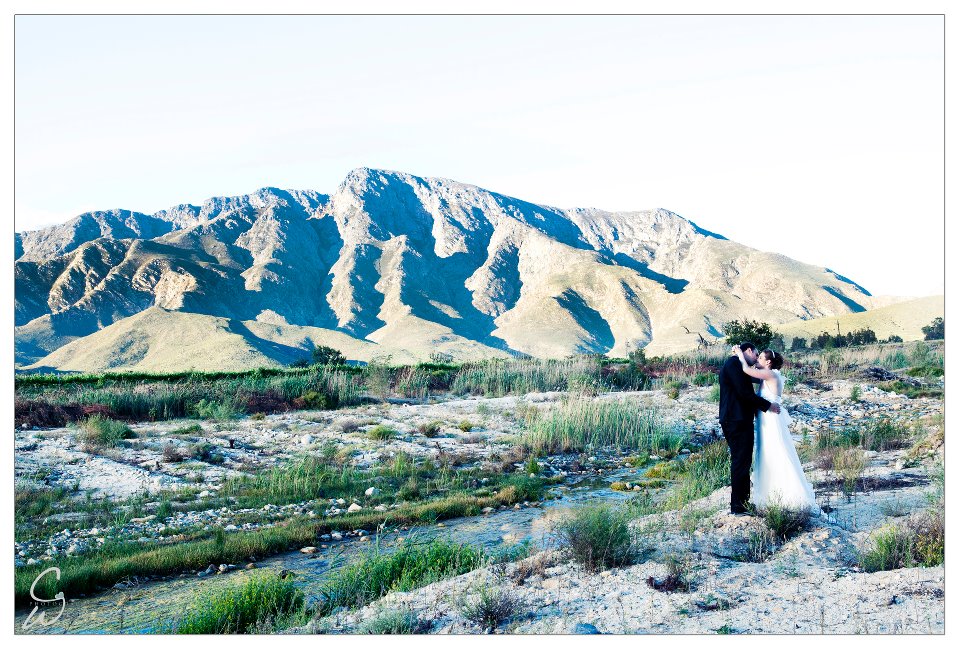
A perfect day in Nuy Valley. Photo by Christine Watters Photography.
Look! Sandstone in the Cape Fold Belt! Oh, and some sort of married couple in the foreground.
The photograph is by Christine Watters Photography. I highly recommend her to anyone in the Cape Town area. My husband and I are still entertaining friends and family, but I’ll be returning to regular blogging in a week or so.

































 Georneys
