Red and white sandstone with casinos in the far distance, Las Vegas, July 2011.
For the final picture in geology picture-a-day week here at Georneys, I’ve selected a landscape from Red Rock Canyon, Las Vegas. The canyon’s name originates from the color of fossilized sand dunes that have been oxidized, converting the Fe (iron) in the rock from a 2+ to 3+ charge, which changes the color of the sandstone from white-tan to bright, rusty red. Recently, Red Rock Canyon was in the news because hikers stumbled across some dinosaur footprints, the first to be found in Nevada.
Although I am not generally very fond of cities or casinos, I have a soft spot in my heart for Las Vegas. In fact, I travel to Las Vegas often. I’ve traveled to Las Vegas a couple of times for geology field trips, and every year I spend a few days in Las Vegas to attend The Amaz!ng Meeting, a meeting founded by James “The Amaz!ng” Randi— a conjurer, writer, advocate for reason, and fighter of pseudoscientific nonsense. I’ve known Randi for many years, and I spent a couple of semesters back in undergrad working for him as an intern. I feel very fortunate to be able to call him a dear, dear friend. If you aren’t familiar with Randi’s work, I highly recommend reading some of his books. Some of them are even available for Kindle— and on sale for the holiday season!
As much as I enjoy seeing Randi and attending The Amaz!ng Meetings, the sparkle, fluorescence, garish carpeting, temperature control, liquor scent, smokey haze, and ching-ching-ching of a Las Vegas casino start to drive me crazy after a day or two. So, whenever I attend The Amaz!ng Meeting, I try to escape to Red Rock Canyon for an afternoon or two. Red Rock Canyon is about a half hour drive from the casinos and provides a peaceful, beautiful, and geologically interesting escape. Over the years, I’ve even led a few geologic field trips to Red Rock Canyon for Amaz!ng Meeting attendees. I’m not sure if I’ll be able to attend the 2012 Amaz!ng Meeting, but if I do I’ll be sure to take a quick trip out to the red, red rocks.
Here are some more pictures from my 2011 visit to Red Rock Canyon. I never did write up a post about the geology of Red Rock Canyon, but I promise to do so sometime! And, in case you missed them, here are my other geology pictures from this week: Monday, Tuesday, Wednesday, and Thursday.
Well, that wraps up geology picture-a-day week. I’ve enjoyed posting these geology pictures so much that I’m actually going to add a new weekly feature to Georneys: the Monday Geology Picture! Every Monday, I’ll post an interesting– and perhaps pretty– geology picture from my georneys (geological journeys) that will help inspire and motivate me for the work week ahead. As I finish up my PhD over the next few months, I’m not sure how much time I’ll have for regular blogging. I’ll do my best to blog when I can– mostly when I need a study break, I imagine– but I’m going to cut myself a little bit of slack over the next few months. If the Geology Word of the Week doesn’t appear some weeks, it’s because I’m feeling overwhelmed by my thesis. I should be able to keep up with a weekly geology picture, though– and hopefully some other more substantial posts now and then!
I hope you’ve enjoyed the pictures this week! Thanks to everyone who joined in and also posted geology pictures on their geoblogs. I’ve enjoyed seeing all of your pictures as well. If you haven’t already participated, it’s not too late to post a Friday Geology Picture!
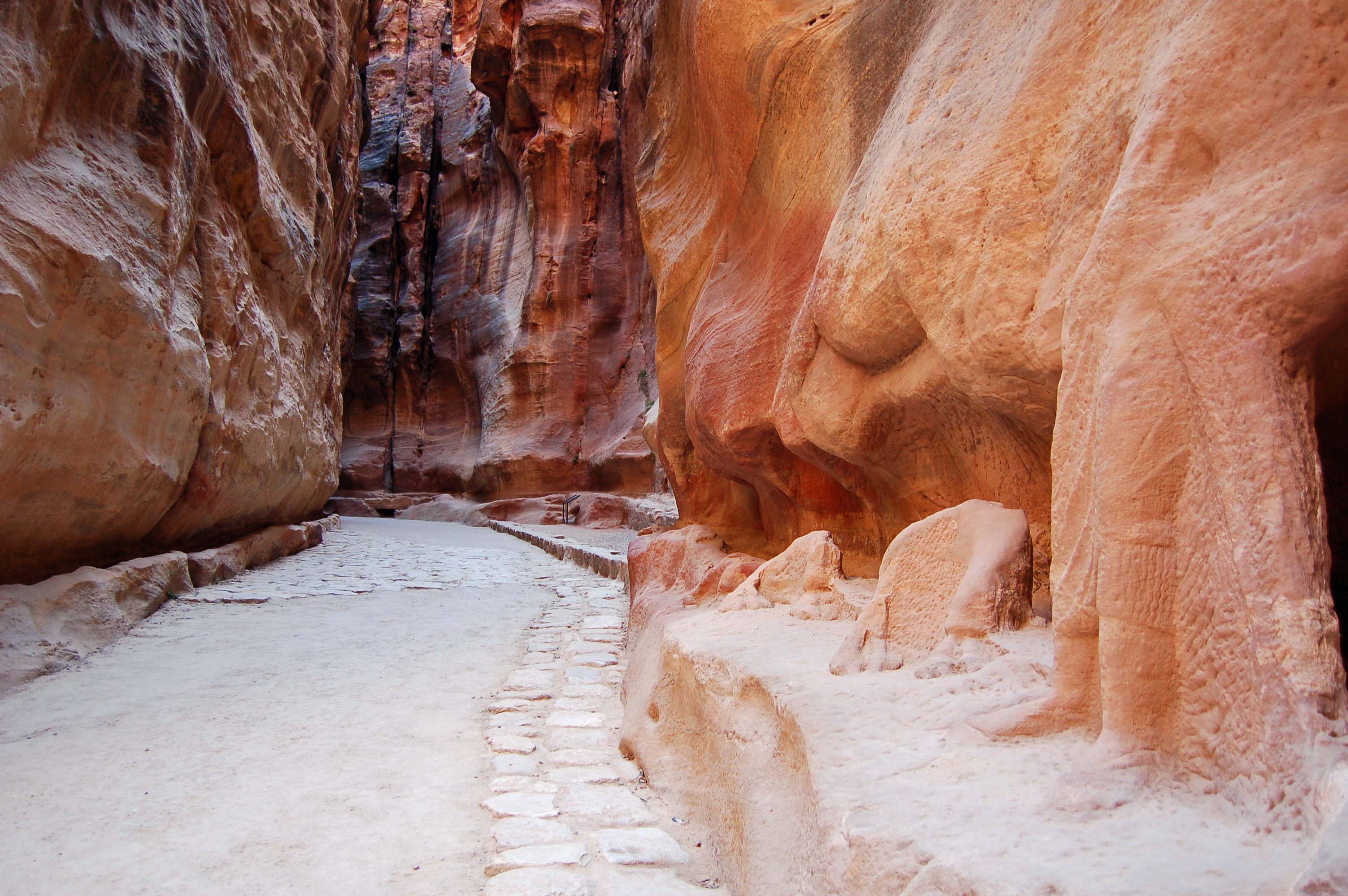
Remnants of ancient statues carved out of the sandstone walls of the Petra Siq, Jordan, August 2007.
Geology picture-a-day week continues here at Georneys. Today’s geology picture comes from one of my favorite places on Earth: Petra, Jordan. Petra is an ancient Nabatean city nestled in a broad valley that is protected by steep sandstone terrain. Petra is accessed by the Siq, a narrow canyon through the sandstone. The geology of the Siq is impressive enough: the walls of the canyon reveal beautiful, red rose colored sandstone which contains cross-bedding, concretions, quartz veins, and other interesting textures. However, the Siq is made even more impressive by the archaeological artifacts it contains: ancient water aquaducts that run along the sides of the canyon (see the background of the above picture), windswept stairs leading to small niches carved out of the rock, and even remnants of what must have been large and impressive statues. In the picture above, you can see the remnants of a sandstone statue of a man leading a camel– but only feet and hooves remain. The small archaeological artifacts found in the Siq hint at the impressive wonders that are found within the city of Petra itself; the Siq teases visitors and leads them along in anticipation.
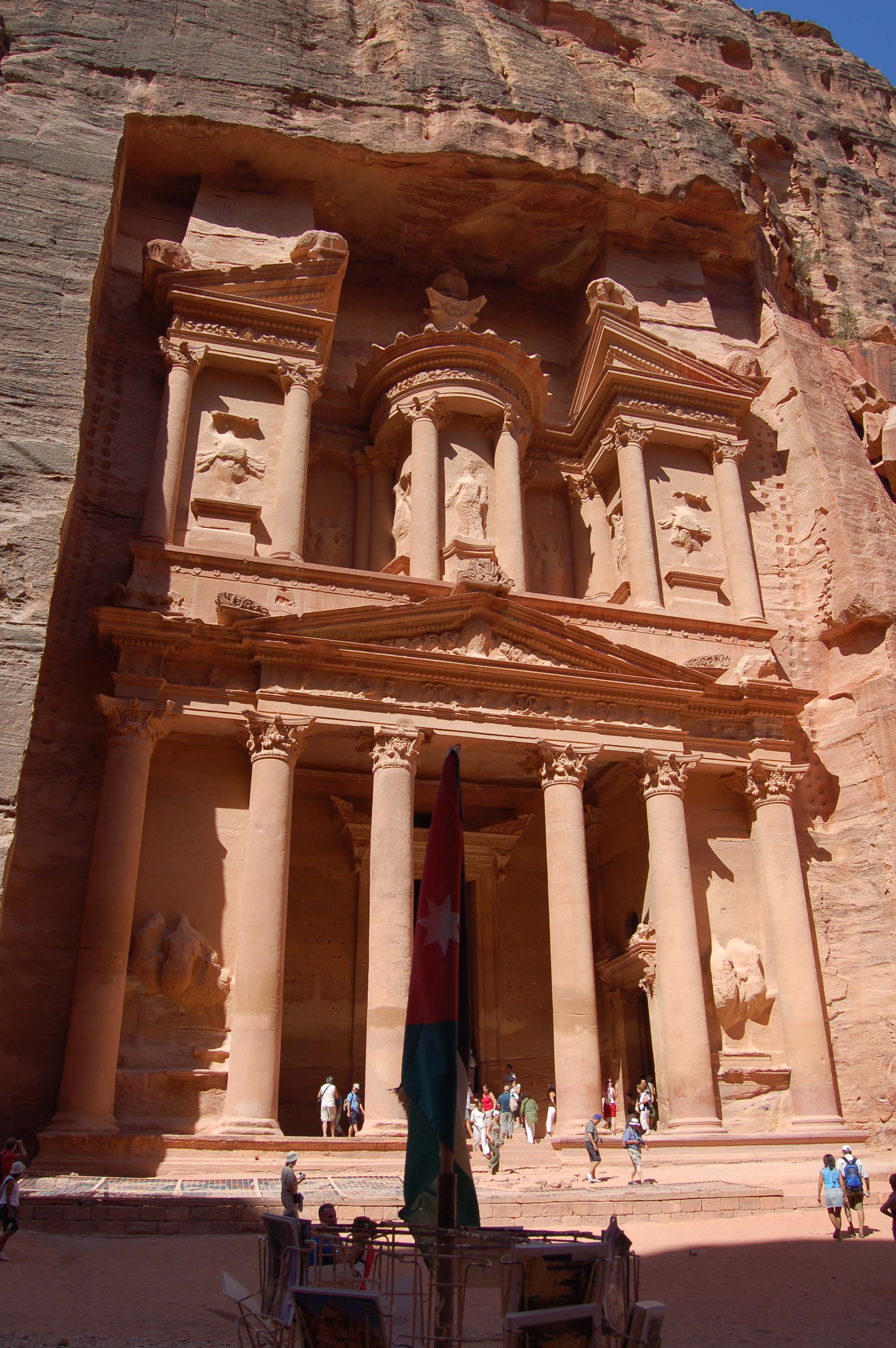
For those of you who have never heard of the Petra or the Siq before, you might recognize the end of the Siq as well as the impressive Al-Khasnah or “The Treasury” building from the movie Indiana Jones and the Last Crusade. Petra and The Treasury were also visited by my favorite cartoon explorer: Tintin! Speaking of Tintin, is anyone else excited for the Tintin movie that’s coming out very soon? I am!
Here’s what Tintin saw when he reached the end of the Siq:
And here’s what I saw in 2007 when I reached the end of the Siq:
The end of the Siq revealing a sliver of The Treasury. Petra, Jordan, August 2007.Astonished tourists gazing on The Treasury for the first time. Petra, Jordan, August 2007.The Treasury! Petra, Jordan, August 2007.
Petra is a truly remarkable place, both in terms of geology and archaeology. I could spend days upon days there. Here’s a few more pictures from my 2007 visit to Petra.
And, in case you missed them, here’s my other geology pictures from this week: Monday, Tuesday, and Wednesday. If you follow my twitter feed, I’ve been trying to retweet the geology pictures posted by other geobloggers. If you haven’t already, feel free to join geology picture-a-day week, even if you missed the first part of the week. The more geology pictures, the better!
Geology students investigating the underside of a large coral boulder, Barbados, June 2009.
Geology picture-a-day week continues here at Georneys. Today’s picture shows an impressive boulder of coral on a beach in Barbados. The lowermost part of the boulder has been undercut by wave erosion, providing a perfect nook for some geology students to take a closer look at the fossilized coral preserved in the boulder. The top part of the boulder has some soil and vegetation that has developed– a miniature island ecosystem!
I visited this Barbados beach in 2009 as part of a class field trip for the Geodynamics Course at Woods Hole Oceanographic Institution. Graduate school is hard work sometimes, but the field trips have definitely been a nice benefit! As part of the yearly Geodynamics Course, I’ve been on three field trips– one to Costa Rica, one to Barbados, and one to Switzerland and Italy.
Here’s a closer look at the fossilized coral in the boulder in the above picture:
A close-up view of the coral boulder, Barbados, June 2009. No scale- sorry ab0ut that!
If you missed them, here’s Monday’s picture and Tuesday’s picture. Several geobloggers have joined the geology picture-a-day meme. Even if you missed the first two days, feel free to join in today!
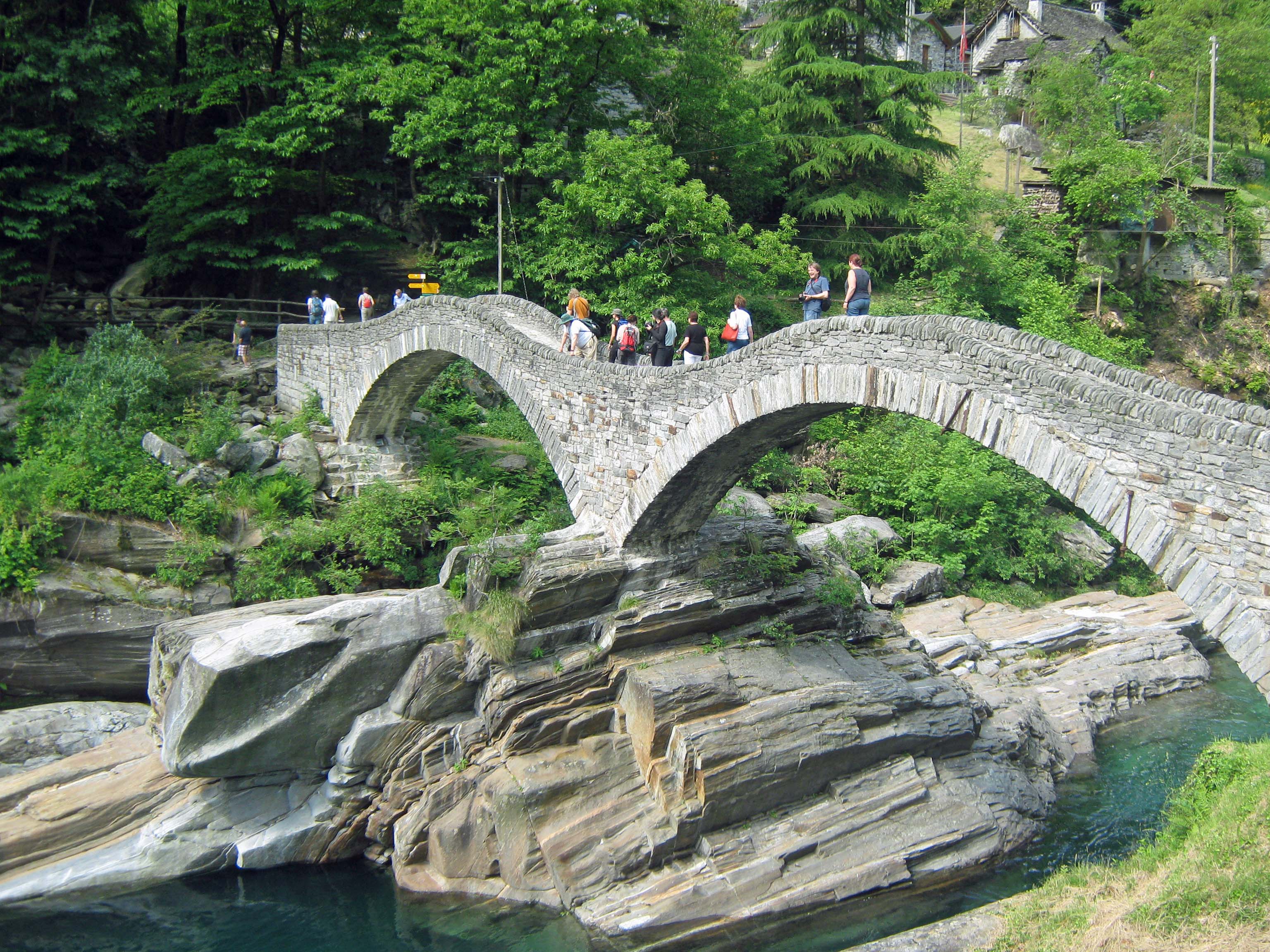
An old stone bridge spanning the Verzasca River, Lavertezzo, Italy, June 2010.
Since I’m too busy for regular blogging, this week is geology picture-a-day week here at Georneys. Several other geobloggers have also decided to join me in this blogging meme. Feel free to start today, even if you didn’t post a picture yesterday.
Today’s geology picture is of a beautiful, old double arch bridge spanning the Verzasca River at Ponte dei Salti in Lavertezzo, Switzerland. The middle part of the bridge rests on a small section of uplifted gneiss. The Verzasca is a fast-moving mountain stream that has carved a narrow, V-shaped valley in the crystalline bedrock, which is gneiss of both sedimentary and igneous origin. The river is renowned for its bright color (turquoise in places), beautiful rocks (the gneiss ranges from light brown to gray, with the colors intermingling), and deep pools. The pools are so deep that they are often frequented by divers.
I visited the Verzasca River back in 2010 as part of a class field trip for the Geodynamics Course at Woods Hole Oceanographic Institution.
Well, I’ve fallen somewhat behind with my regular posting, such as the Geology Word of the Week. I’m afraid that these final few months of my PhD are going to sometimes keep me from regular blogging. These last few months are tough! Over the past few weeks, I have been very busy finishing up the very last of my labwork for my thesis (yay!), traveling between Cape Cod and Cape Town (yet again!), and also taking on important blogging tasks such as writing up my strong opinions on science kits for girls and coming up with the Georneys What to Buy a Geologist for Christmas: 2011 list.
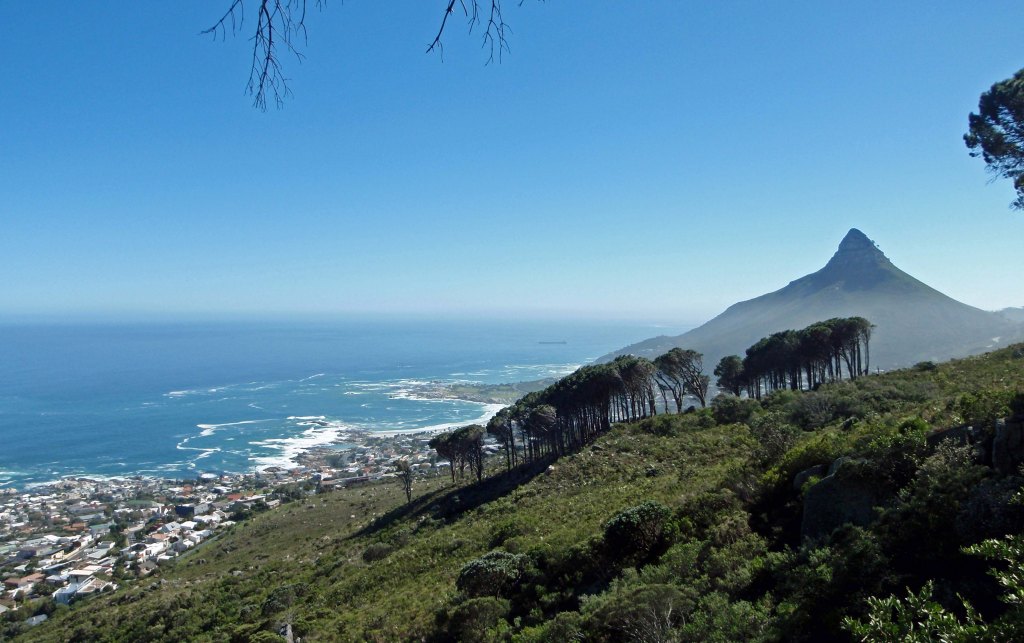
This next week is going to be very busy with work, and I’m afraid I just won’t have time for substantial blogging. I’ll try to write up another Geology Word of the Week post next weekend. Meanwhile, to keep this blog active, I’ll post a pretty geology picture every day this week, starting with the beautiful Cape Town inselberg picture above. I’m sure that many other geobloggers and blog readers are feeling very busy finishing up tasks in time for the festive holiday season. Hopefully, these pretty pictures will help keep us motivated to finish out the year’s work.
Have you also been neglecting your geoblog recently and been feeling stressed? Is there just not enough time for blogging this week? Feel free to also post a picture-a-day with me this week, if you want. Everyone loves pretty geology pictures!
Do you have a geologist (or several) in your family, and you’re not sure what to buy them for Christmas? Good news! The Georneys “What to Buy a Geologist for Christmas” (or Chanukah, Newtonmas, etc.) 2011 gift guide is here.
Update: Matt Hall over at the Agile* blog also has lists of good gifts for geologists, with a focus on geophysicists. Here’s the 2011 list and here’s the 2010 list.
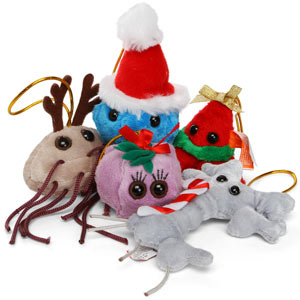
For the geobiologist in your family, I recommend the Plush Microbe Holiday Ornament Set, which is going to adorn my own Christmas tree this year (thanks for the early Christmas present, mom!). Aren’t these little microbes extra cute when they’re all decked out for the holidays?
Cost: $20 / set
Gift #3: A Map from the USGS Store:
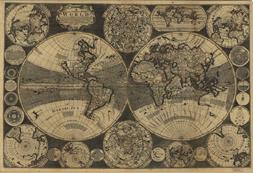
A New and Correct Map of the World, circa 1702. Image from USGS Map Store Website.
Did you know that the United States Geological Survey has an incredible online map store? When my geologist husband and I were furnishing our new apartment, we spent a few hours drooling over the gorgeous maps in this store. Geologists do love maps! I’m especially fond of the historical maps, such as the one above which is “A New and Correct Map of the World” from 1702. My husband and I decided to put this map in our living room, and it looks great!
Cost: Variable, generally $15 – $30
Gift #4: Knitted Dinosaurs:
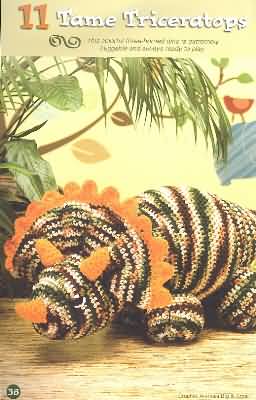
A crocheted triceratops. Image taken from the Frugal Knitting Haus website.
Is your geologist also a knitter? Or are you a knitter? Then I recommend purchasing dinosaur knitting patterns and either giving the pattern to your geologist knitter or knitting one of the dinosaurs yourself.
There are actually several dinosuar knitting patterns on the market, but for a simple set of patterns I recommend ordering Jean Greenhowe’s book “Toy Collection,” which contains several dinosaur patterns. In the US this booklet can be ordered from Frugal Knitting Haus for about $10. If you crochet rather than knit, Frugal Knitting Haus also has a booklet containing dinosaur crochet patterns— on sale for only $5!
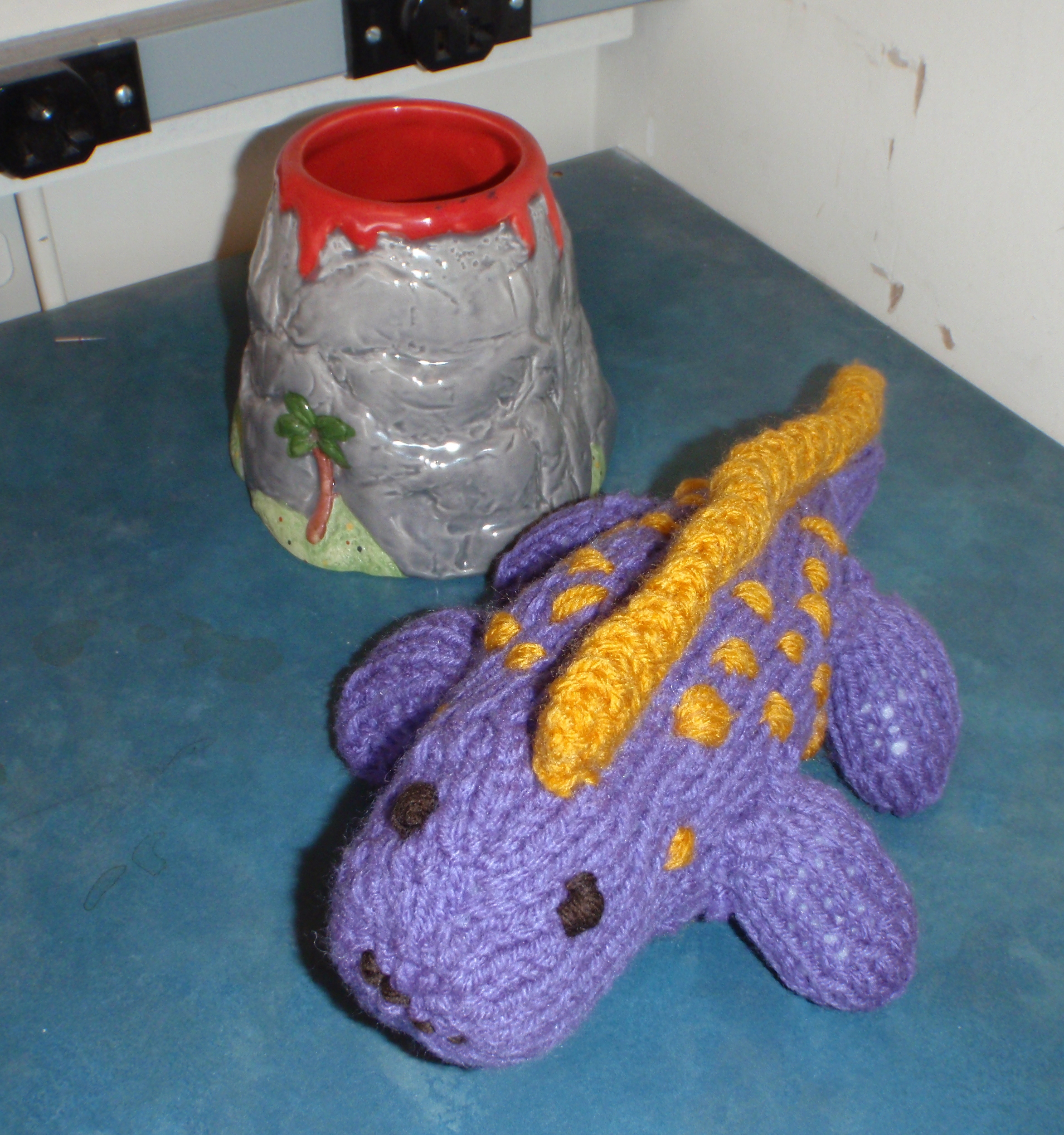
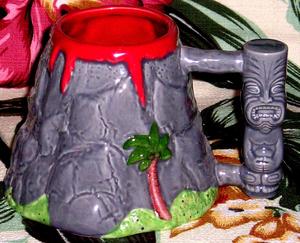
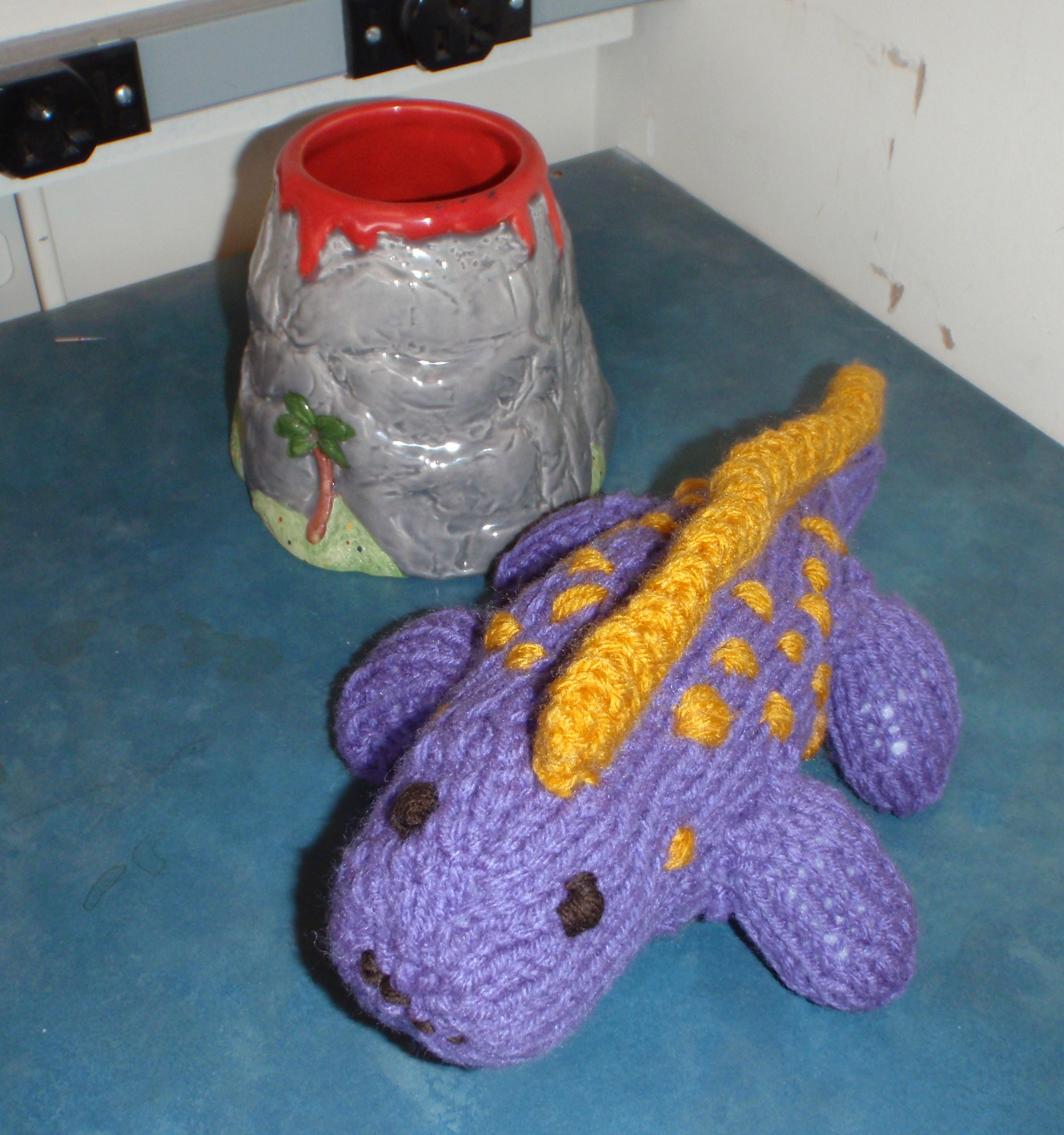
The volcano mug in the picture above with the knitted dinosaur was a gift from a friend a few years ago. Google informs me that this mug is the Hot Lava Java Volcano Mug. The mug has unfortunately been discontinued, but you can find the mug for sale on ebay.
Cost: About $20 – $30 on ebay
Gift #6: Paleontologist Barbie:
Palentologist Barbie thinks digging for fossils is fun!
Another ebay gem is Paleontologist Barbie. Every geologist should own a geologist Barbie! I purchased my very own Paleontologist Barbie on ebay for about $30. If you’re on a budget or want to cater to a specific geology subdiscipline, find or buy an inexpensive Barbie and make your own geologist Barbie.
Cost: About $30 on ebay
Gift #7: Alvin Deep-Sea Subermsible Keychain:
Alvin Keychain. Image taken from WHOI store website.
The marine geologist in your family might enjoy a present from the online store of my home institution of Woods Hole Oceanographic Institution (WHOI). From this online store you can order all sorts of neat WHOI gear, including T-shirts, mugs, and toys. One of my favorite items in the store is a keychain of the deep-sea submersible Alvin.
Cost: $7.95 (for the Alvin keychain)
Gift #8: Geology Jewelry from Surly-Ramics:
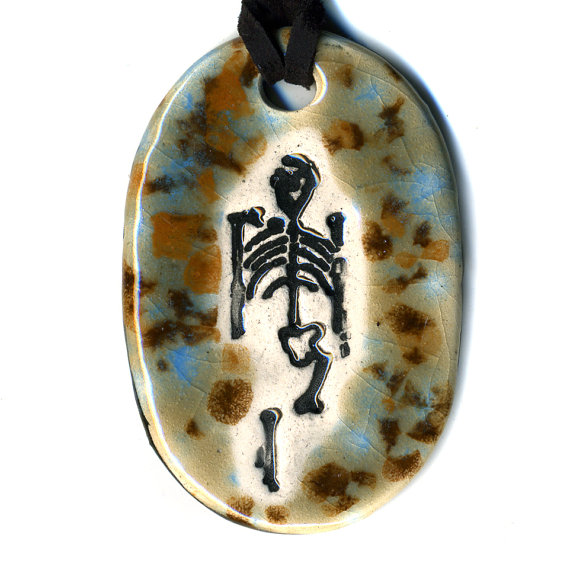
Lucy Fossil Skeleton necklace from Surly-Ramics.Trilobite necklace from Surly-Ramics.
I recommended my friend Amy’s trilobite jewelry in last year’s gift guide, and I’ll recommend it again this year. I’ll also recommend her dinosaur jewelry and her Lucy fossil skeleton jewelry. Amy also has a variety of other scientific themed jewelry– be sure to browse her Etsy shop. Amy can also take special orders if there’s something particular you have in mind. Just send her an email.
Cost: $20 – $30
Gift #9: Kindle Touch:
The Kindle Touch. Image taken from Amazon.com.
Geologists generally travel fairly often. An ereader such as a Kindle is a great gift for the traveling geologist who wants some reading for the airplane or that field season. I just ordered myself a Kindle Touch as a Christmas gift to myself, and I’m extremely happy with it. I’ve never owned an ereader before, and I’m amazed at how many books I now have at my fingertips on the extremely lightweight Kindle Touch. Also, the battery seems to last a very long time– weeks, depending on use. I’m definitely going to take my Kindle with me on all my travels.
If you want to give a really great gift, load the Kindle Touch up with some geology-themed books. See some suggestions for books in my 2010 “What to Buy a Geologist for Christmas” lists.
Does your geologist already own an ereader? Then a perfect gift would be a waterproof cover that allows your geologist to take the ereader in the field even when weather conditions are less-than-ideal.
Cost: Kindle Touch– $99 – $149 ; Waterproof Case– $20 and up
What geologist doesn’t want a poster of a detailed geologic timescale? That timescale is sure to come in handy when trying to remember those pesky geologic ages. Geologic timescale posters can be ordered from a variety of places. For example, the Subcommission for Stratigraphic Information of the International Commission on Stratigraphy has a few timescale posters for sale here.
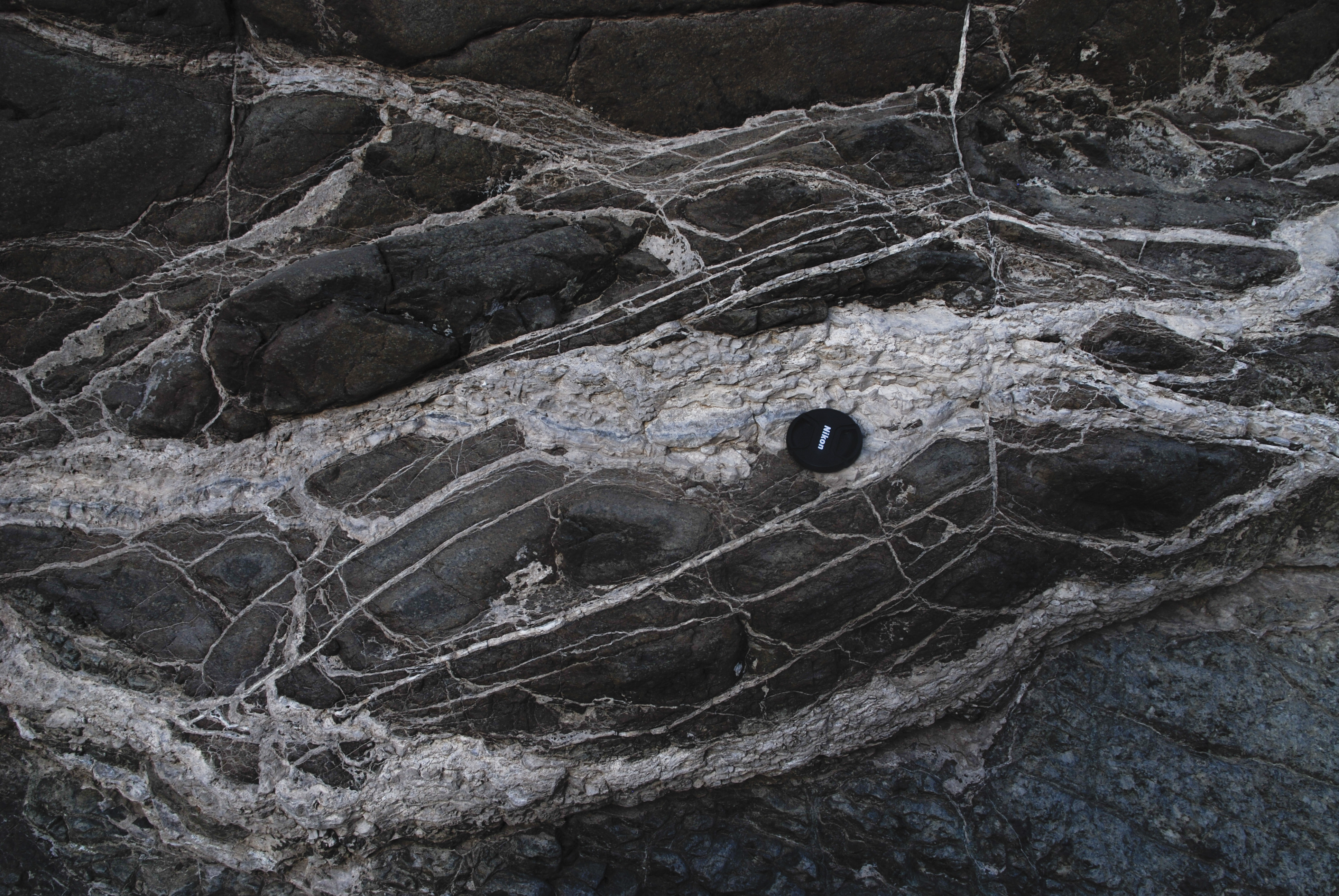
Lens Cap for scale on a carbonated peridotite outcrop in Oman, 2009.
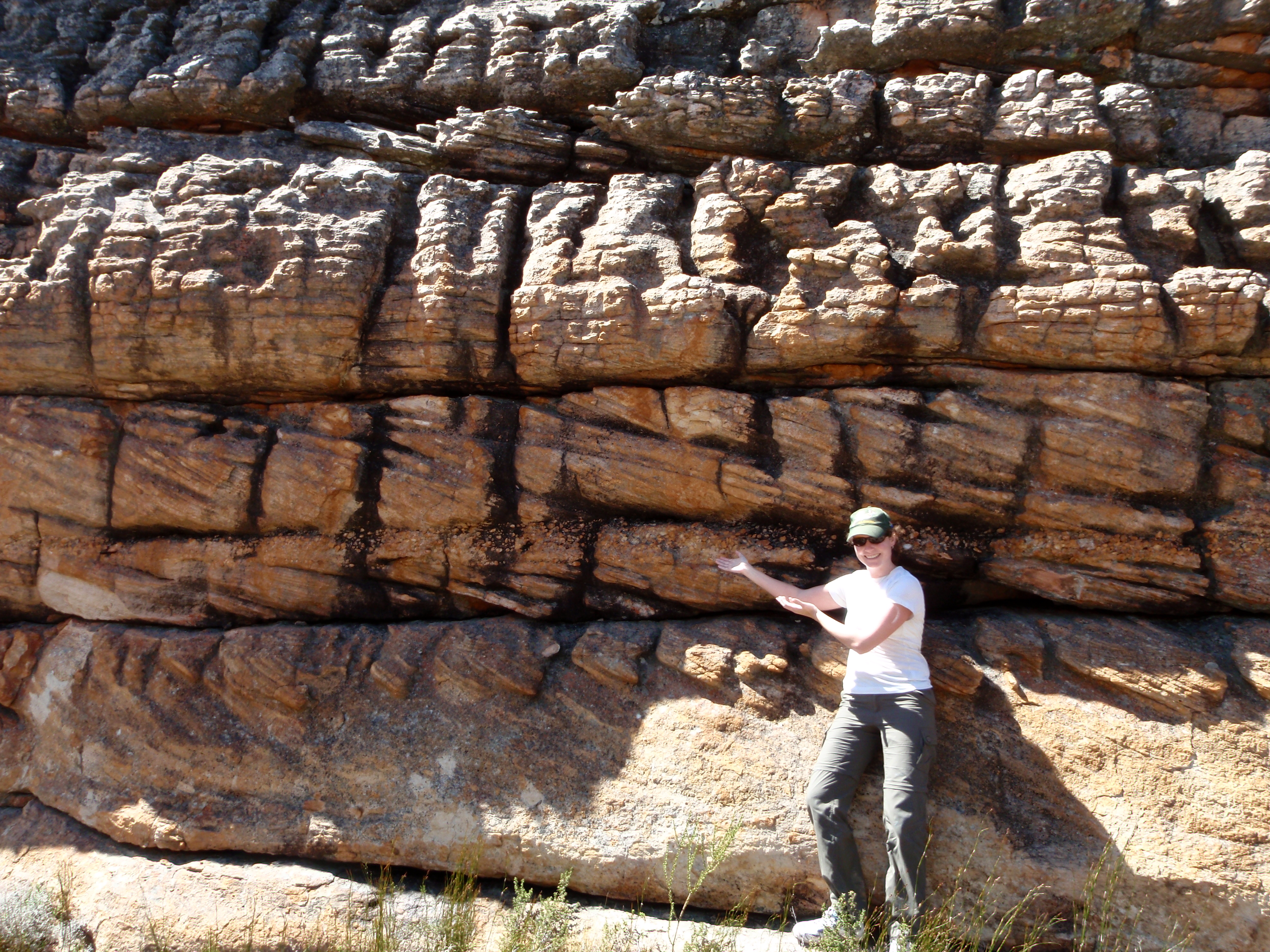
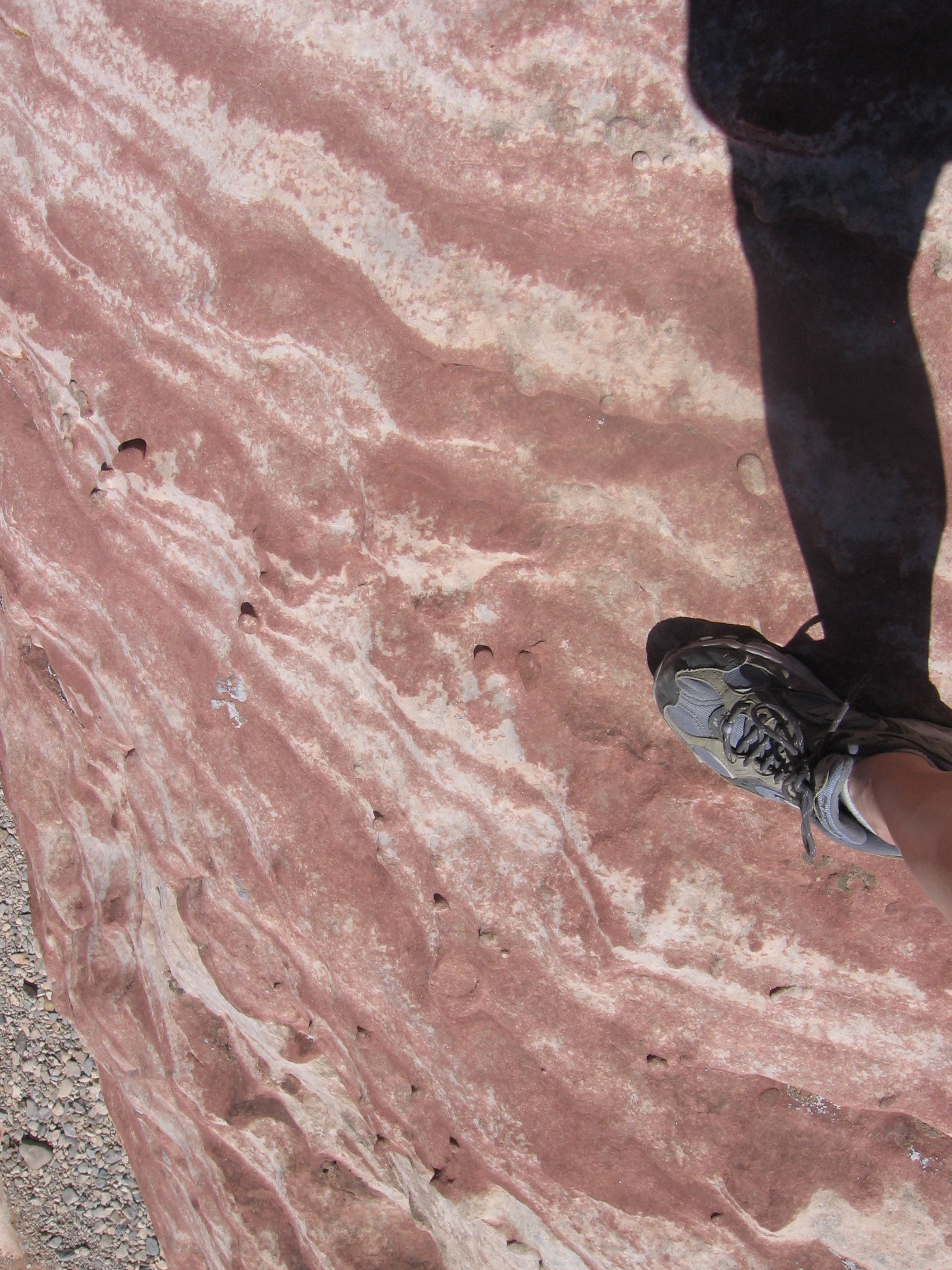
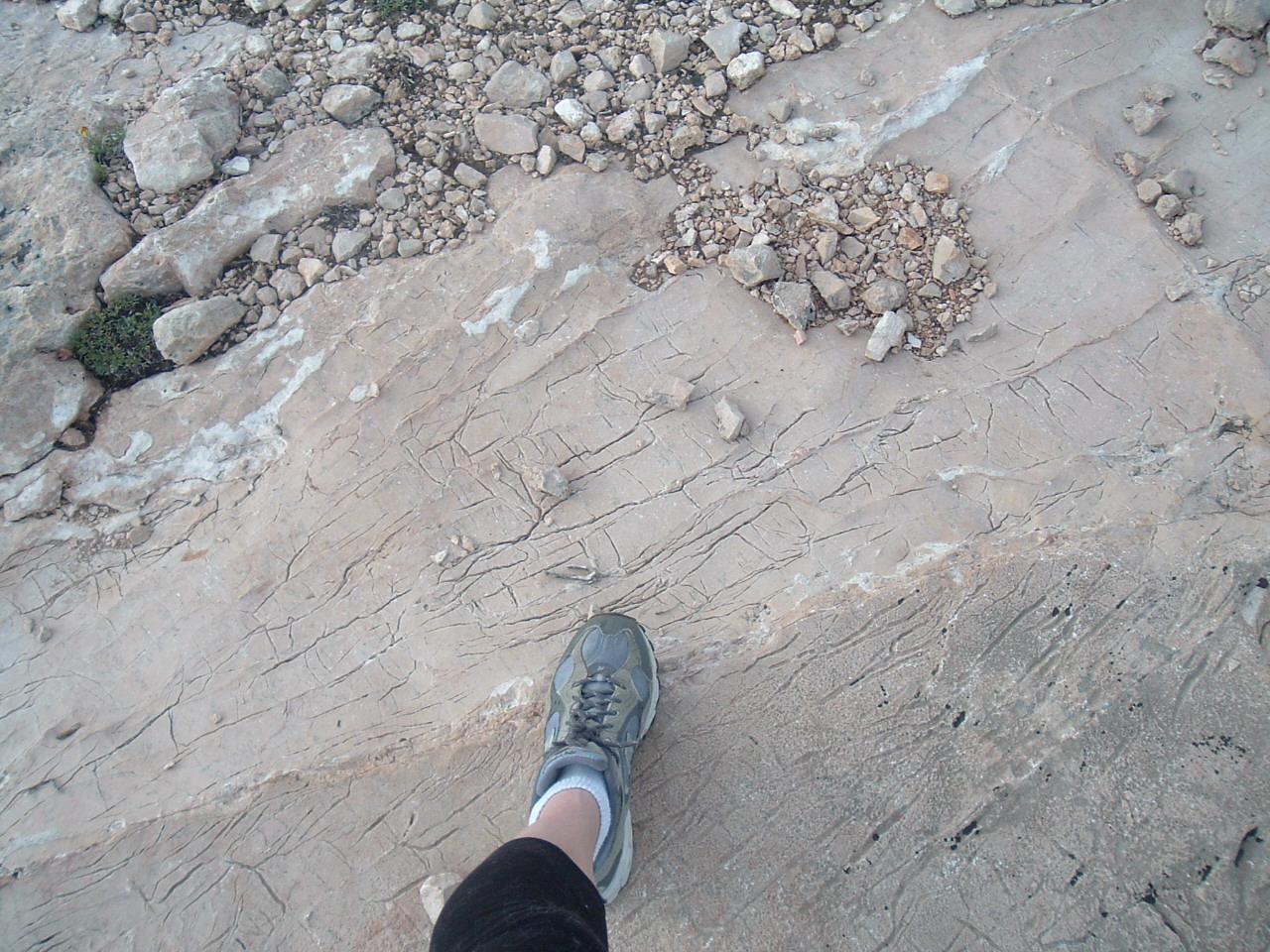
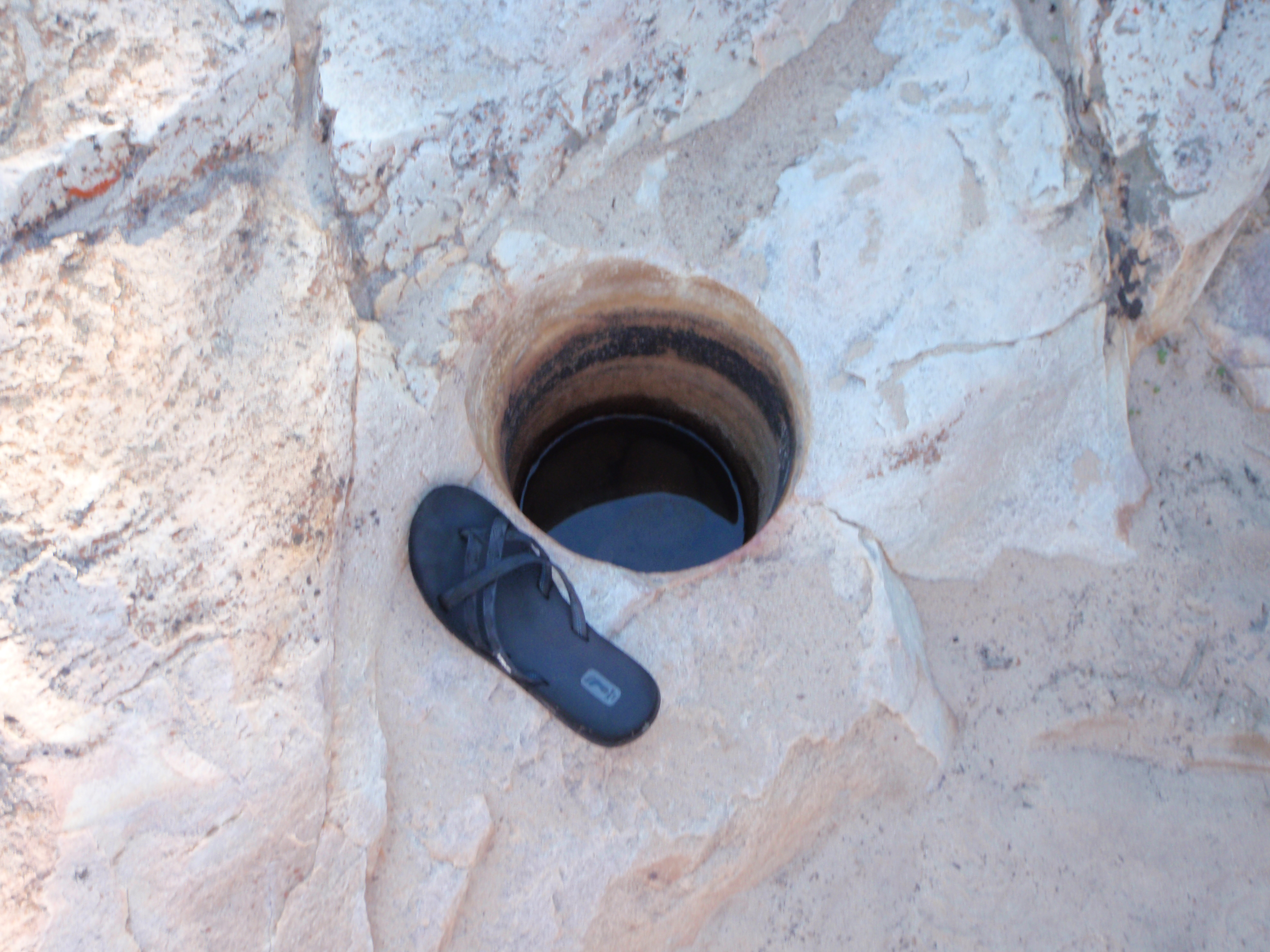
When geologists take photographs of rocks, they often include items to indicate scale. When I’m doing fieldwork, I generally use a ruler or a hammer to indicate scale. Sometimes, I use other items such as my field notebook or my camera lens cap. When I’m not doing fieldwork and I wander across some interesting rocks, I use anything available to indicate scale– from flip-flops to coins to my own hands and feet.
Below are a collection of scale pictures taken during my geological wanderings over the past several years. You can read some of my musings on scale in this older post of mine The Scale of Things.
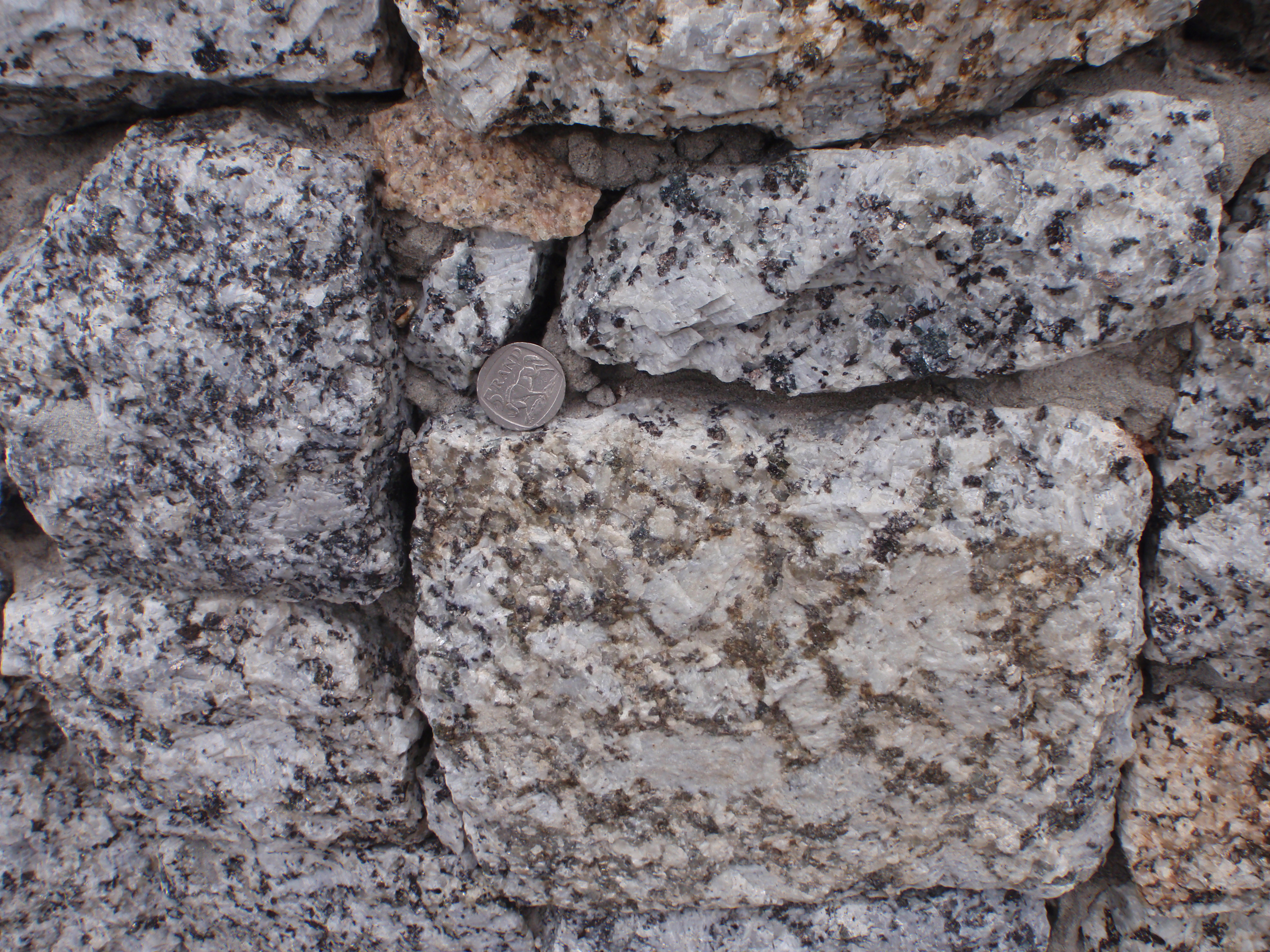
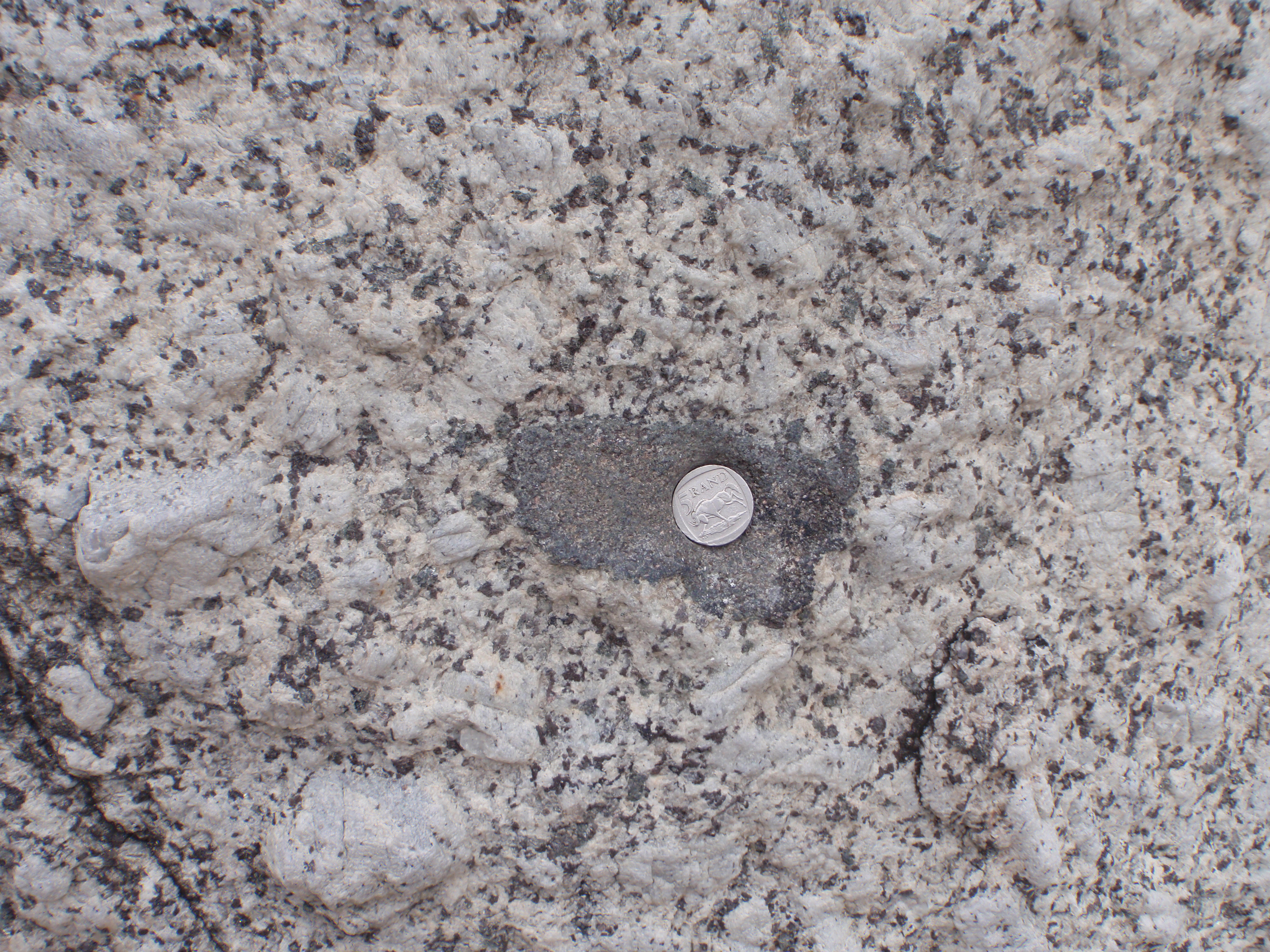
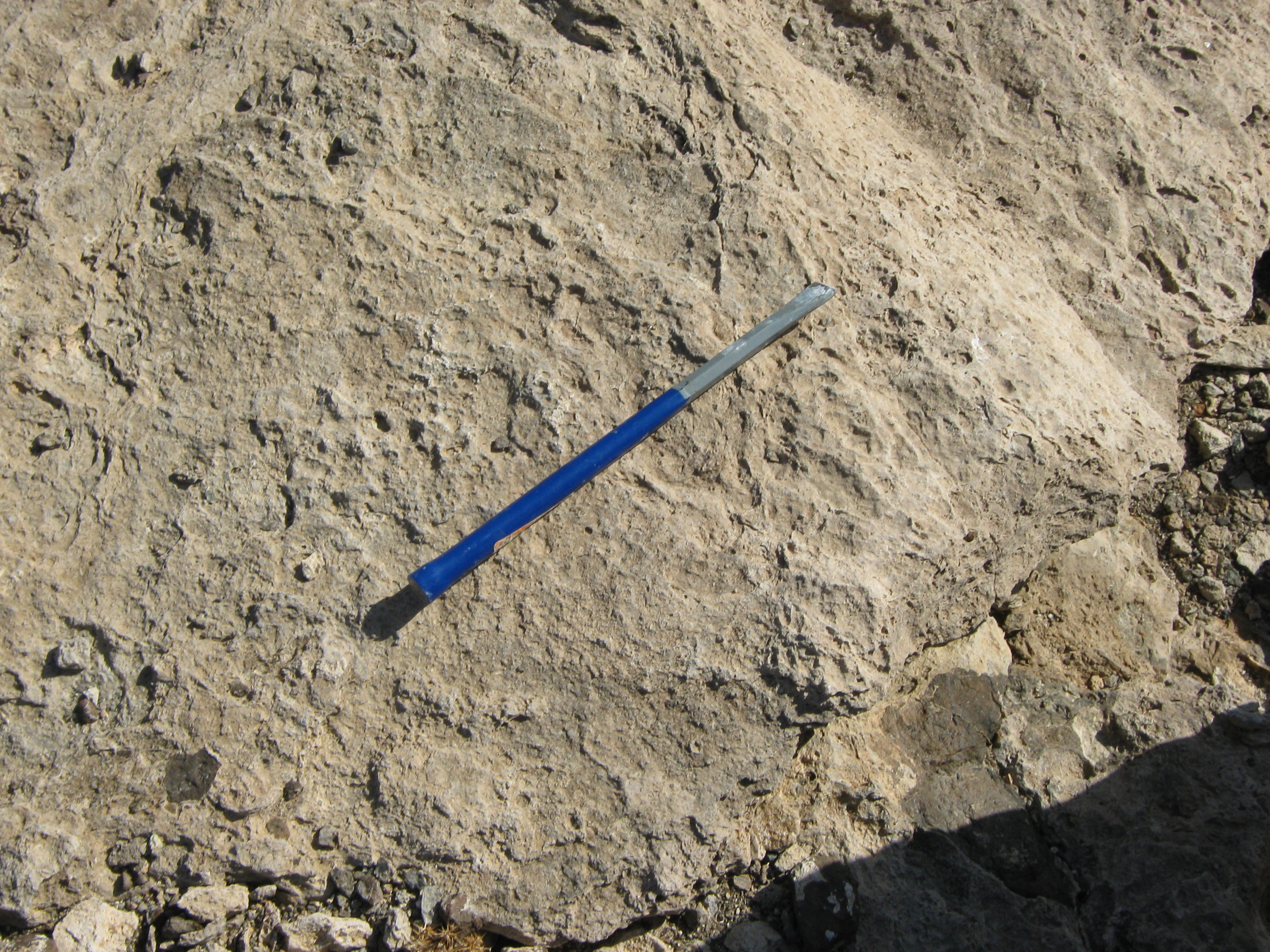
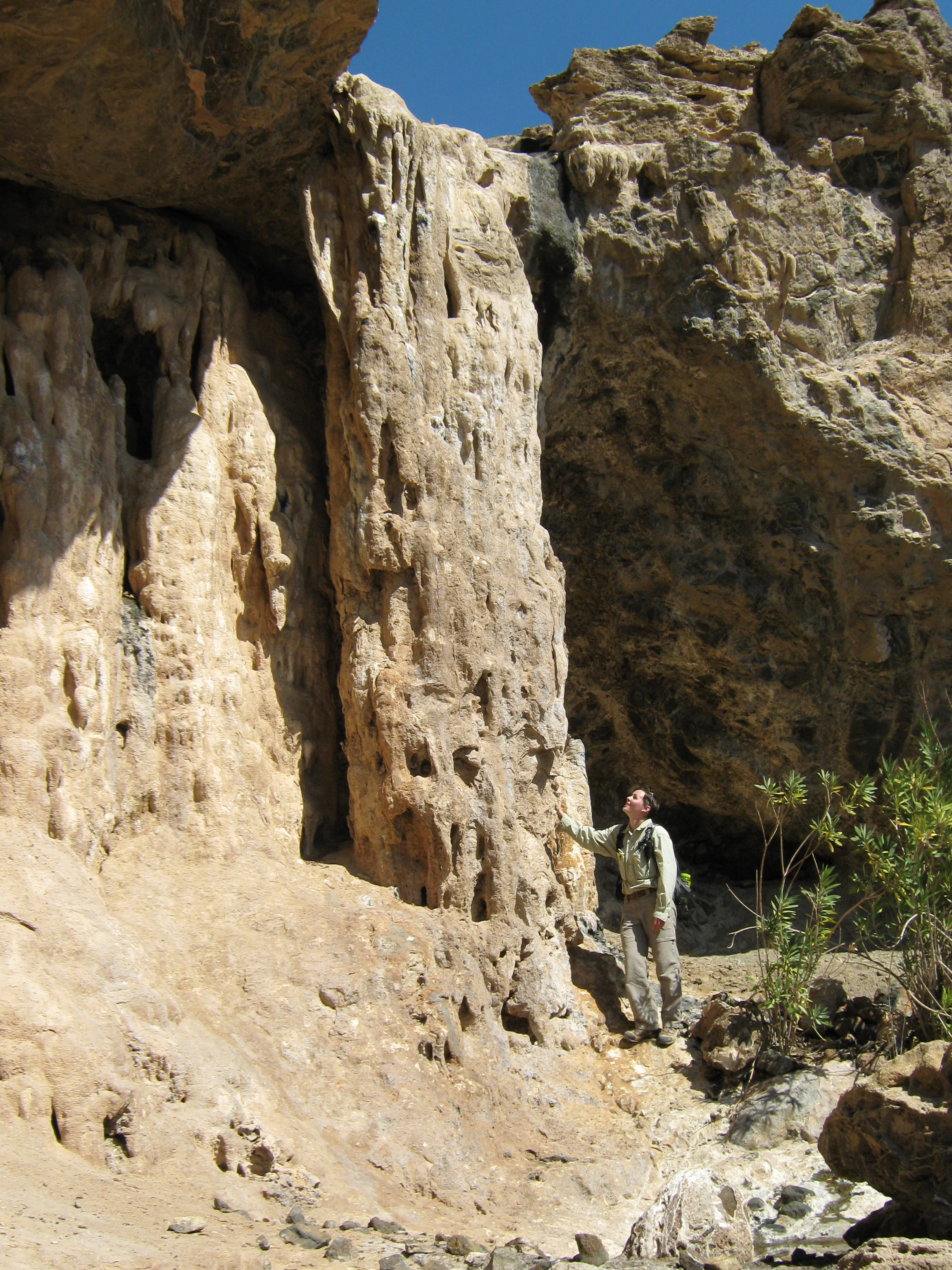
Hand for scale on a sedimentary outcrop showing filled-in burrows (trace fossils), South Africa, 2011.Ruler for scale on a manganese-covered basalt boulder, Indian Ocean, 2007.Coin for scale on a granite wall, South Africa, 2011. Coin for scale on a xenolith in granite, South Africa, 2011.Hand for scale holding granite saprolite, South Africa, 2011. Finger for scale on a loosely-consolidated sedimentary rock, South Africa, 2011. Chisel for scale on a travertine deposit, Oman, 2009. Geologist for scale next to a travertine pillar, Oman, 2009.Field notebook for scale on carbonated peridotite, Oman, 2009. Sharpie pen for scale next to a carbonate-serpentine vein in peridotite, Oman, 2009.Hammer for scale on top of a travertine formation, Oman, 2009.Bottle (trash found in stream) for scale in an alkaline streambed, Oman, 2009.Rite-in-the-Rain ruler for scale on carbonated peridotite, Oman, 2009.Geologist for scale in front of some sandstone cross-bedding, South Africa, 2010.Hand for sale next to some rock art hands on sandstone, South Africa, 2010.Foot for scale on sandstone, Red Rocks, Nevada, 2011.Foot for scale on limestone, Wyoming, 2011.Sunglasses for scale on sandstone, South Africa, 2009.Geologist for scale in front of sandstone cross-bedding, South Africa, 2009.Flip-flop for scale next to a pot hole, South Africa, 2011.
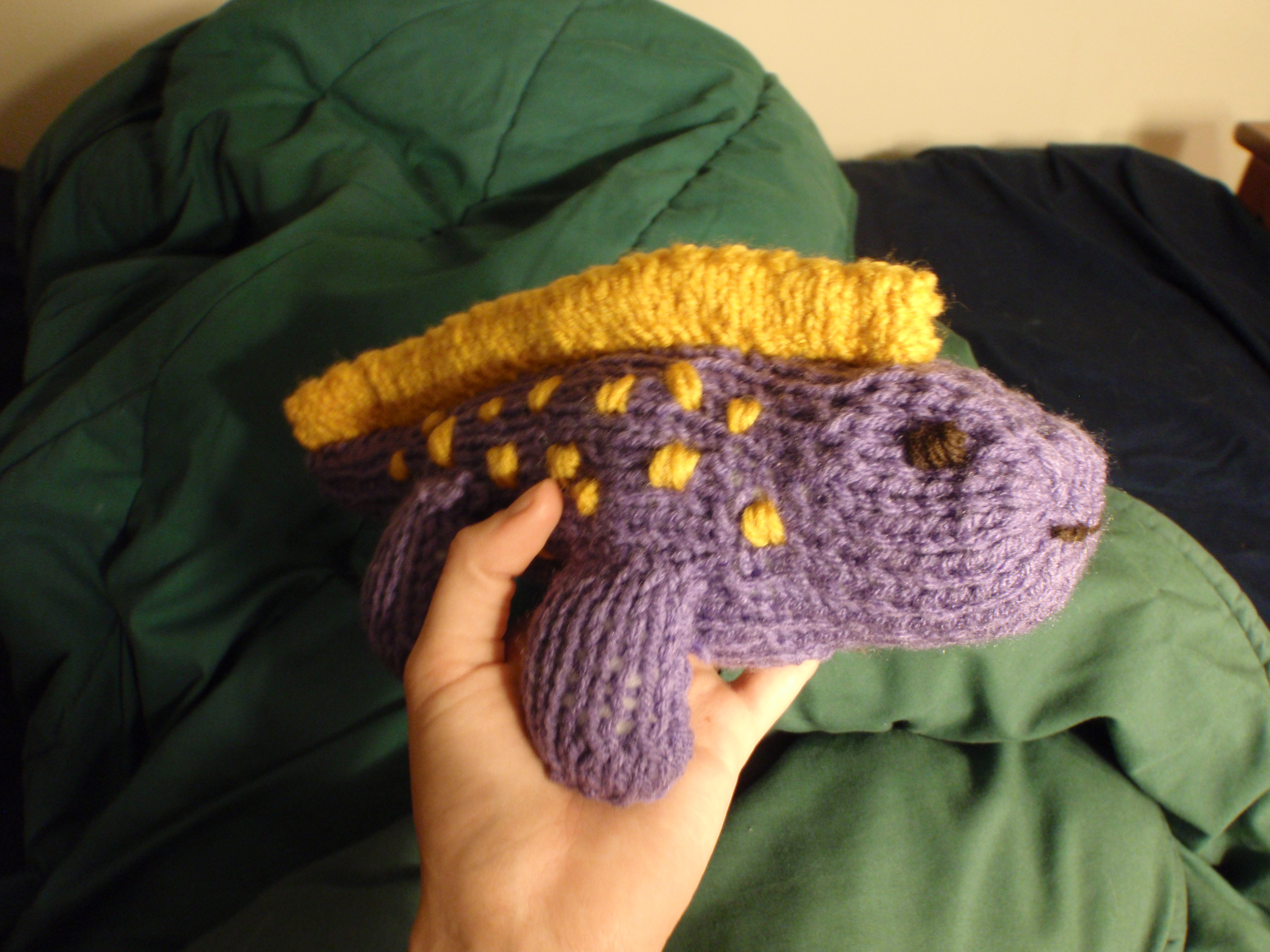
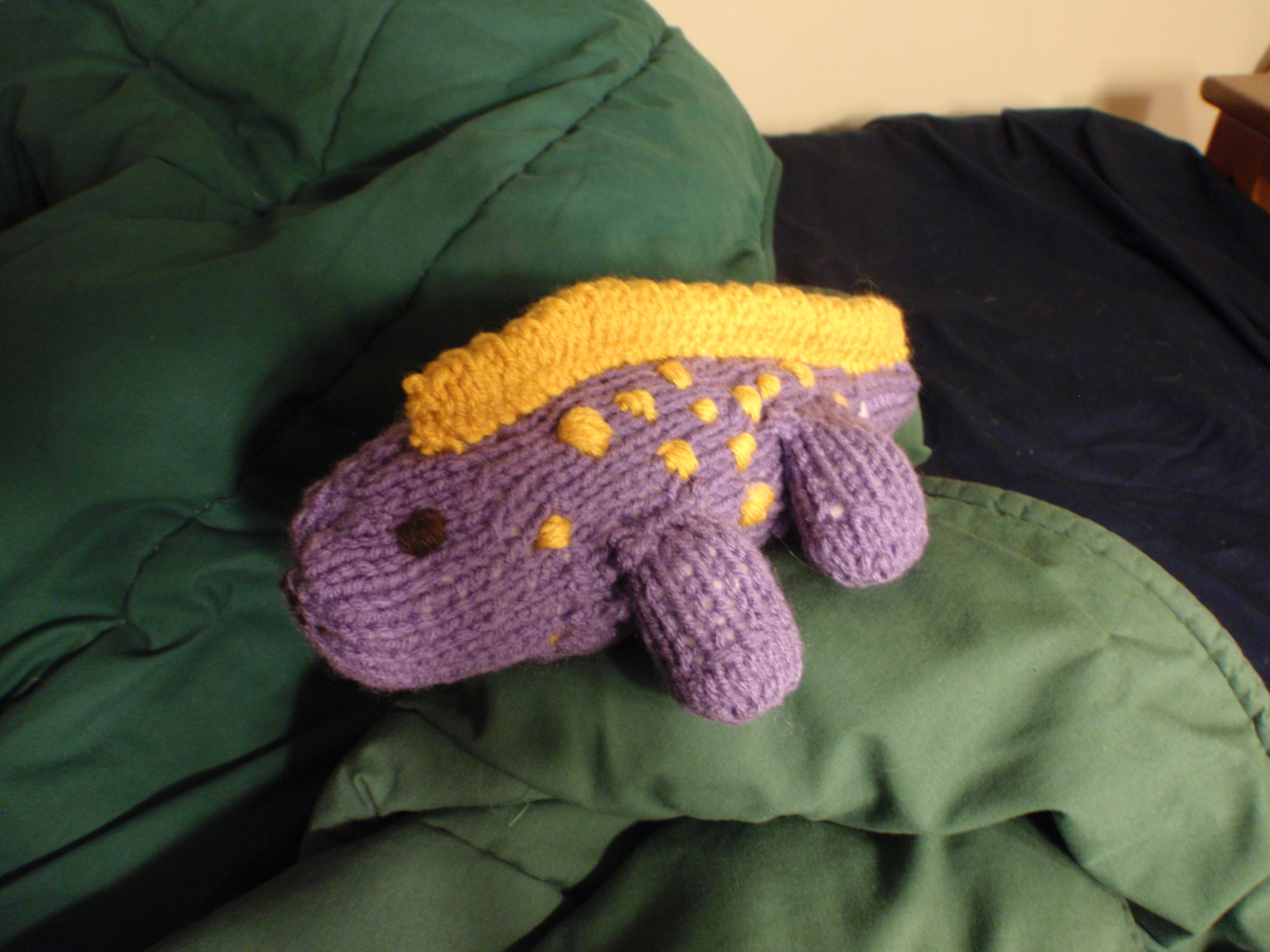
In my office this morning I have a new friend– the first knitted dinosaur I made from Jean Greenhowe’s dinosaur knitting patterns. I mostly knitted this dinosaur on Thanksgiving Day, and I just fnished him up last night. I’m quite proud– I’m really a novice knitter, but I think the dinosaur turned out quite well despite a few mistakes here and there. I’m not exactly sure of the dinosaur species. The knitting book calls this dinosaur pattern “The Pink Spotted Dinosaur,” so I suppose my creation could be called the “Purple and Yellow Spotted Dinosaur.” I’m not quite finished yet– I still want to knit this little guy a miniature Christmas scarf. After I finish decking out Purple and Yellow Spotted Dinosaur for the holidays, I’ll move on to the T-Rex or the flying dinosaur. However, I might not have much time for knitting until Christmas… much work to do!
Here’s a few more pictures:
Exploring a green jungle of comforter.Rawr!Trekking back the other way across the comforter.
In general, I am a big fan of science kits and simple science experiments for kids. When I was a child, I had a great time growing my own rock candy on strings in jars and messing up the kitchen with baking soda and vinegar volcanoes. For Christmas one year, my friend down the street received a dinosaur science kit. We spent a whole afternoon excavating some fake dinosaur bones from plaster, and we had a great time.
I think that kids can learn quite a bit from science kits (I really like the ones made by The Smithsonian) and simple science experiments with everyday materials. Kids also really like these experiments, which are fun and can (I hope) inspire a few kids to become scientists– or at least become more science literate. For my own science outreach in elementary schools, I’ve done classroom experiments involving materials such as mentos and diet coke, dry ice and water, and various sticky, viscous substances. When I demonstrate these and other experiments, the kids always have a great time– and hopefully learn a little bit of chemistry, physics, and geology in the process.
In my own research, I take labwork and experiments quite a bit more seriously, but I still enjoy them very much. Even though I am now a veteran scientist and my labwork has become routine, I still find myself smiling when my phenolphthalein indicator turns pink. I still enjoy watching beads of liquid nitrogen roll across the laboratory floor then vaporize after I discard the remainder of my cold traps when working in the carbon dating lab. I still find myself surprised and amazed at the microscopic spots I produce after my column chemistry to isolate various elements. I still take a somewhat childish joy and interest in attacking (destroying, really) my rocks with various acids during dissolutions. Labwork is hard work– and often monotonous– but it can also be very fun.
Ideally, science kits for kids should show kids the fun parts of science experimentation and labwork and should also teach a little about science and the scientific method. In a good science kit the science has to be done carefully, and in the right order, for the the fun part (the explosion… the crystal candy… the potato clock… the slime…) to work. In general, as I said above, I am a big fan of properly designed science kits for kids.
However, I find the “Science Kits for Girls” manufactured by Wild! Science horrifying. Below are a few reasons why. The following is somewhat stream-of-consciousness. Sorry for that, but these kits make me upset. Also, I don’t have much time to write this post because I need to return to my real labwork.
1. Science Isn’t Segregated, So Why Should Kids’ Science Kits Be?:
Science is not segregated in real life (my own lab is a mixture of men and women), so why should it be segregated in science kits? To give them the benefit of the doubt, perhaps Wild! Science means well and wants to encourage more girls to become interested in science. I care very much about encouraging young girls to become interested in science, and I’ve personally benefited from targeted programs that encourage girls and young women to pursue science. My participation in Women in Science and Engineering (WISE) programs in both high school and college helped give me the foundation and confidence to succeed in science, first in college and now in graduate school. Female mentors– through both formal and informal programs– have helped me greatly during both my undergraduate and graduate studies. Without strong female mentors, I do not think I would be able to complete my PhD. I can understand supporting and encouraging young girls and women in science because– let’s face it– being a scientist is still more difficult for women than for men. Sexism still abounds, both in academia and industry.
However, I think that having segregated science kits for girls and boys sends the wrong message. This seems to suggest that girls and boys are better at “different” types of science or that they should approach science in “different” ways or that they think “differently.” I may have had support from female mentors, but the science that I do– and the science that my female mentors do– is no different in approach or quality or anything else from the work that our male counterparts do. Do we have “girl” and “boy” physical constants? Do we have “girl” and “boy” chemical equations? Do we have “girl” and “boy” rocks? No, we do not. Gender shouldn’t matter in science (okay, maybe in biology, but it certainly shouldn’t matter if the scientist is a girl or a boy).
2. If You Do Segregate Science Kits, At Least Don’t Give the Girls Lame Experiments:
I really don’t think that science kits should be segregated by gender, but if you are going to segregate them at least make the experiments for girls NOT SO LAME. Why do girls have kits such as “Lip Balm Lab”, “Perfect Perfume Lab”, and “Aroma Art” (They even call it art!!! Nothing against art, but this is supposed to be a SCIENCE kit) while boys have kits such as “Physics and Chemistry”, “Hyperlauncher”, and “Weird Slime Lab”?
Forget lip balm and perfume, I want a hyperlauncher and weird slime. These kits remind me of two of my childhood disappointments: 1. the girl toys at McDonald’s were always much lamer than the boy toys, and 2. I wasn’t allowed to join the Boy Scouts.
Let me elaborate a little on that second childhood disappointment. I’ve always been very interested in nature and the outdoors. In my childhood neighborhood, a family of four boys lived down the street, and they were all enrolled in the Boy Scouts. I used to play with these boys, and I would sometimes help them with their Boy Scout projects. One day, I decided I wanted to become a Scout. However, I was not allowed to join the Boy Scouts, so I joined the Girl Scouts*. I was very disappointed that we mostly did arts and crafts rather than build race cars and make fires. So, I dropped out of the Girl Scouts and asked my mom for kayaking lessons instead. As many of you know, I recently married a South African, and he is a Springbok Scout (like an Eagle Scout). Since 1999 the South African Scout Association has been co-ed, so if we have a daughter one day she will be able to join the Scouts… and not the “girl” version of the Scouts.
To return to the science kits, I actually find the titles of the girl kits very disturbing. Apparently, girls are only interested in science related to beauty (“Aroma Art”, “Bath Bomb Factory”, “Beauty Salon”, “Beauty Spa Lab”, “Lip Balm Lab”, “Luxury Soap Lab”, “Perfect Perfume Lab”, “Perfumed Designer”, “Beautiful Blob Slime”) or pretty crystals which also have to be magic (“Amazing Crystal Lagoon”, “Magical Crystal Oasis”, “Mystic (Krazy) Crystals”, “Snow Flake Factory”). First off, adding “Krazy” in parentheses in-between the words “Mystic” and “Crystal” is just silly. Secondly, why does “girl” science have to be just about beauty and pretty crystals? Why should girls only be interested in science which makes them beautiful or which is beautiful? Girls and young women already have enough pressure on them about their appearance, thank you very much. Now they have to worry about beauty when doing science experiments? Your ability as a scientist has nothing to do with your physical attractiveness!!! Why don’t the boys have “Deodorant Lab” or “Muscle Building Lab”?
Some of the science experiments themselves actually don’t seem too bad. For example, there is a slime-making kit for both girls and boys. However, the girls kit is titled “Beautiful Blob Slime” while the boys kit is titled “Weird Slime Lab.” Why isn’t the boy slime blob handsome? Similarly, the soap-making kit is titled “Luxury Soap Lab” for the girls and “Joke Soap” for the boys. I think that some of the boys titles are actually pretty stereotypical as well. But why segregate at all? Why not just have the “Cool Slime Lab” and the “Fun Soap Lab” that are made for both boys and girls?
3. Woo-Woo Crystal “Science”:
Gender aside, I take issue with all of the names of the crystal science experiments. Why are the crystals “mystic” and “magical”? Do crystals have to be “mystic” and “magical” to be interesting or beautiful? When I write a geology paper, do I write about my “mystic” crystals? No, I do not. Crystals are neither mystic nor magical. The crystals in these science experiments do not form through magic. They form through CHEMISTRY and PHYSICS following scientific laws and principles. I thought the whole point of crystal science experiment kits was to teach a little about how crystals form (for example, slow growth for big rock candy crystals), not to imply that crystals form through magic! There’s already enough woo-woo pseudoscientific nonsense about crystals out there. We don’t need science kits to promote it, too! Probably the explanation books for these experiments do go into some legitimate crystal science, but the titles are bad regardless.Why not show kids how crystal science is beautiful and neat… and can make tasty candy?
Okay, my stream-of-consciousness ranting is over now. What do you think? Are girls and boys science kits a bad idea? Are the girl science kits as lame as I think they are? And, finally, to help me be less depressed and angry about these kits, what are your favorite science experiments for kids?
*Note: I hope not all Girl Scout troops are so lame, but the group I joined was pretty bad. Also, there’s the whole religious issue with the Girl and Boy Scouts, but that’s a different discussion.
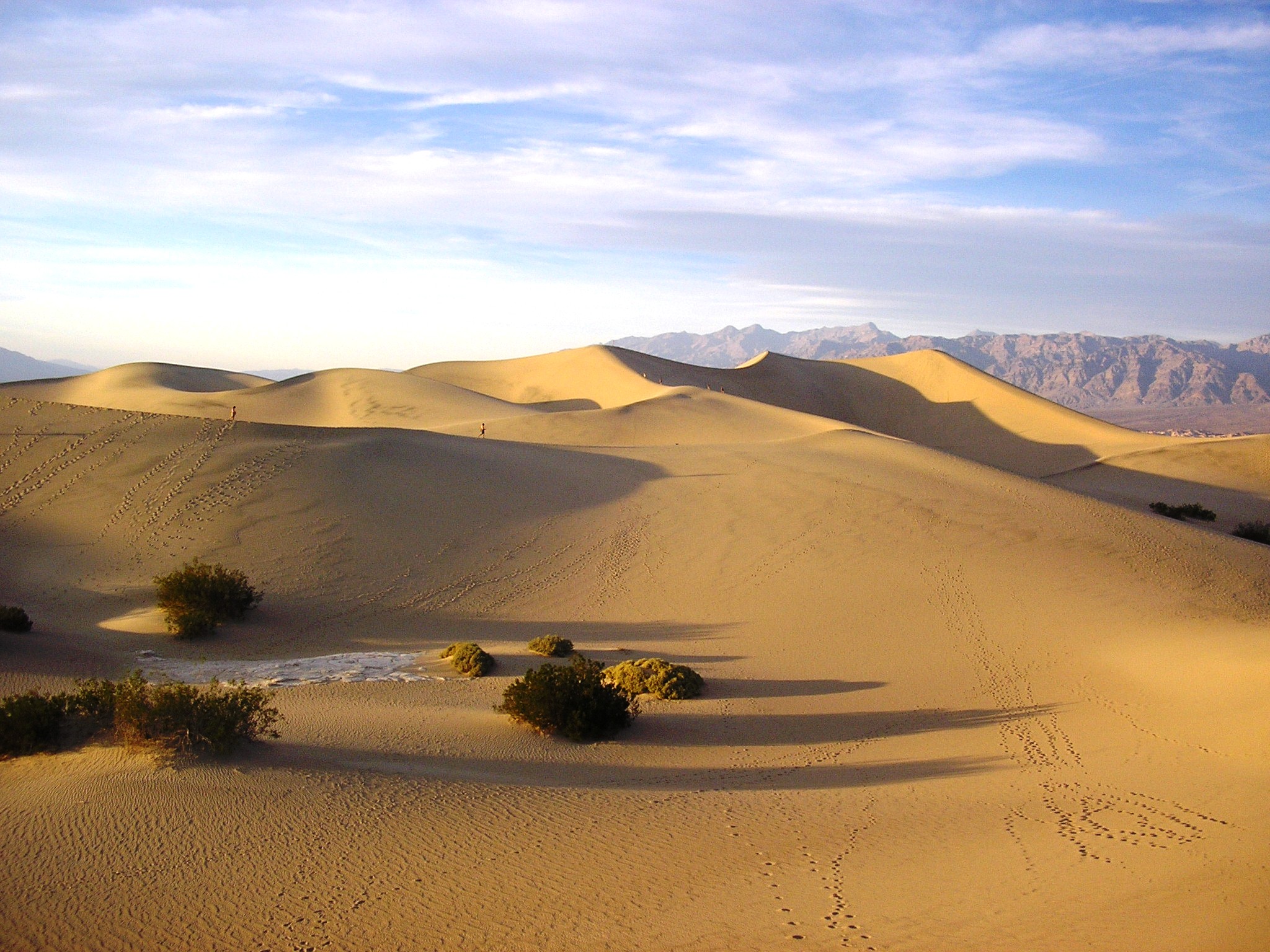
A sand dune in Death Valley, California. Fall 2005.
I noticed that there has been a sand dune meme wandering around the science blogosphere over the past week or so.
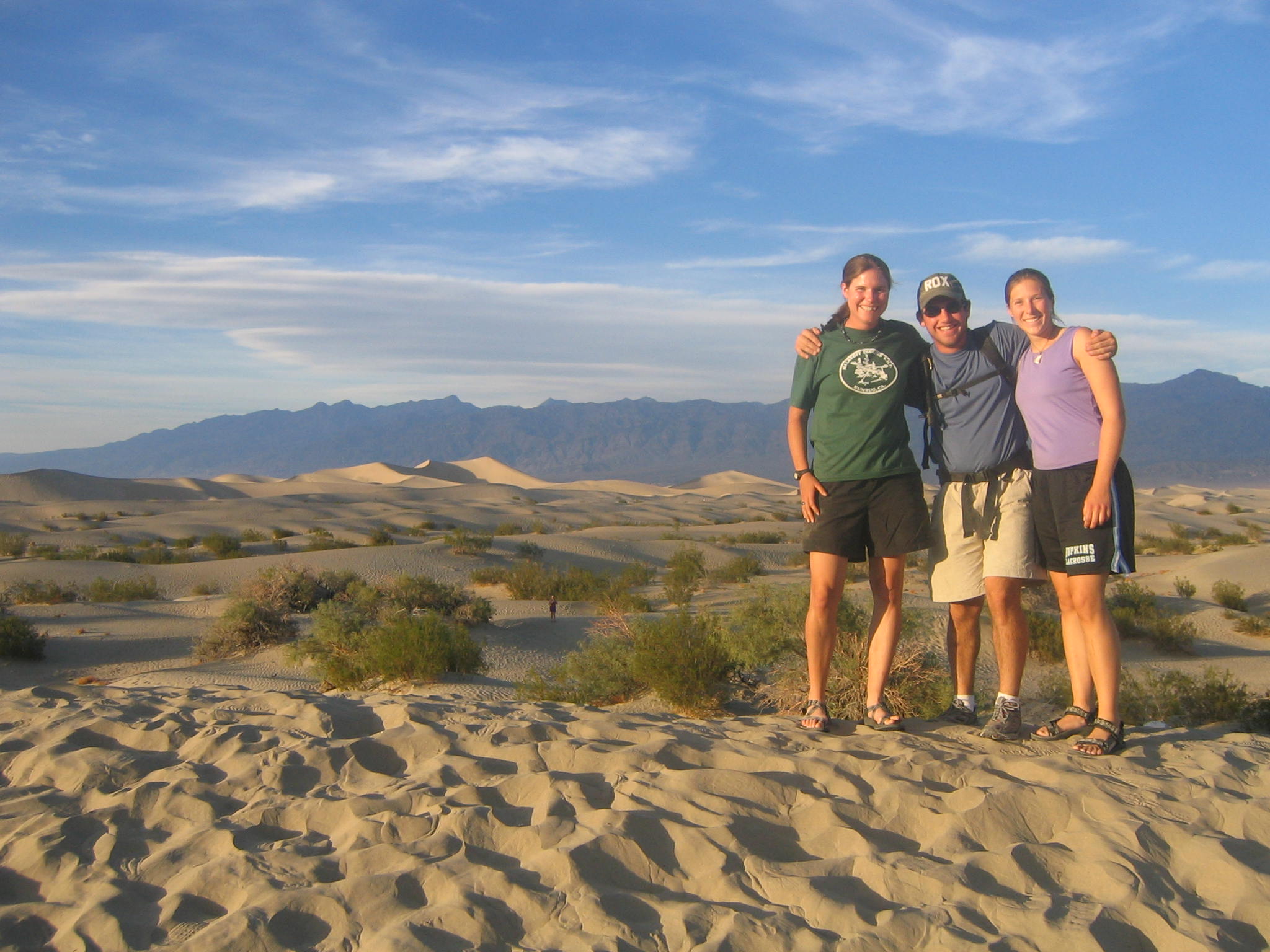
Here is my contribution to the meme– some pictures of sand dunes in Death Valley, California. I visited these sand dunes near sunset after a long day of mapping with my undergraduate fieldwork program in Fall 2005. Our instructors had promised we could visit the dunes once we finished working, but by the time we finished we only had an hour or two of light left. So, we had to race out to the dunes, first by driving and then by walking or running as quickly as we could on the soft sand. We spent a few minutes tumbling and rolling down the dunes then made our way back to the vans as darkness fell.
Sand dunes in Death Valley, California. Fall 2005. More sand dunes in Death Valley, California. Fall 2005. With some classmates on the trek out to the dunes. Death Valley, California. Fall 2005.Climbing a sand dune. Death Valley, California. Fall 2005.

























 Georneys