Happy Valentine’s Day, everyone! For those of you who are grumpy on Valentine’s Day, here’s a heart of stone. For the geologists, this heart of stone that should make you slightly less grumpy. There are some good stones in there, including gabbros, purple calcite, nummulite-bearing rock, and some excellent shell fossils.
I’ve had a busy Valentine’s Day. I’m tired from spending 12 hours working on my thesis, but at least it was a good, productive day. My husband is away at sea, so at least I’m not missing a romantic evening. Although my two cats are seeking cuddles at the moment, so perhaps I’ll make them my valentines.
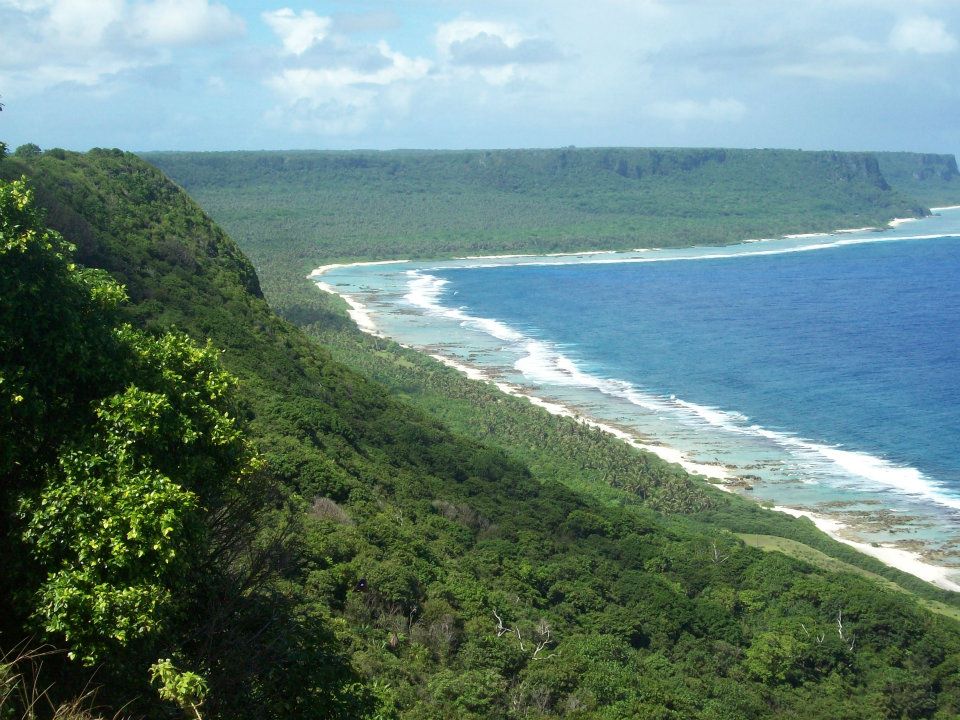
Tarague Embayment, Guam. Photograph courtesy of Jason Vanover.
My cousin Jason is in the Air Force, and he’s currently stationed on the island of Guam, which has some fantastic geology and also some gorgeous beaches. He’s been sharing some pictures of his travels around Guam, and I must admit I’m somewhat jealous of his travels. Perhaps I’ll have a chance to visit Guam one day. There certainly seems to be plenty of great geology to see there!
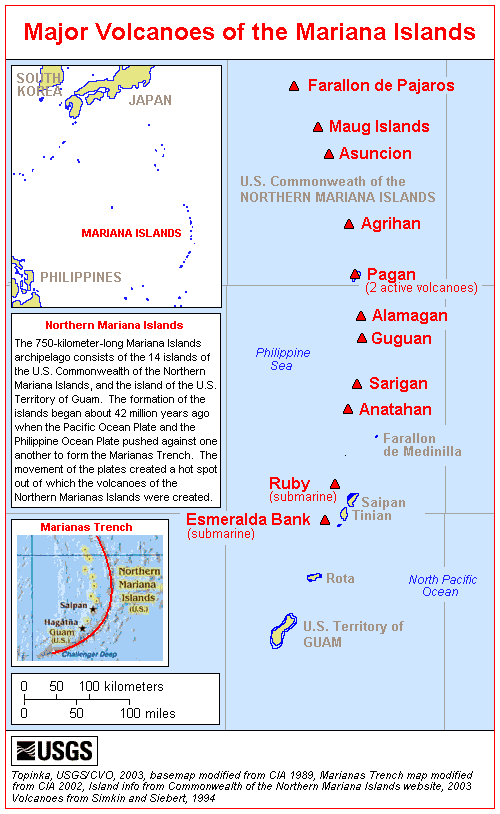
Guam is a volcanic island that is located at the southern end of a chain of volcanic islands associated with the Izu-Bonin-Mariana Arc, which formed as a result of the subduction of the Pacific Plate underneath the Philippine Sea Plate (and also the tiny Mariana Plate). Associated with the Izu-Bonin-Mariana Arc is the Mariana Trench, where the deepest part of Earth’s oceans is located. The volcanic islands of the Izu-Bonin-Mariana Arc formed as a result of volatiles being released from the subducting Pacific plate. These volatiles (mostly water and carbon dioxide) lowered the melting temperatures of the mantle underneath the arc, producing melts which created the volcanic islands.
Because Guam hasn’t been volcanically active in about 10 million years, there has been time for carbonates (limestones) to form on top of some of the volcanics, and there are abundant coral reefs located offshore. One place where some impressive carbonate deposits have formed on Guam is Tarague Embayment, which is shown in this week’s geology picture. The rocks are a little hard to see since they’re covered under thick green vegetation. Underneath that vegetation, though, there is a limestone cliff that was formed in the Pliocene-Pleistocene (within the last 5 million years or so).
My cousin Jason took some pictures during his visit to Tarague Embayment, and he was kind enough to let me share them here. Thanks, Jason!
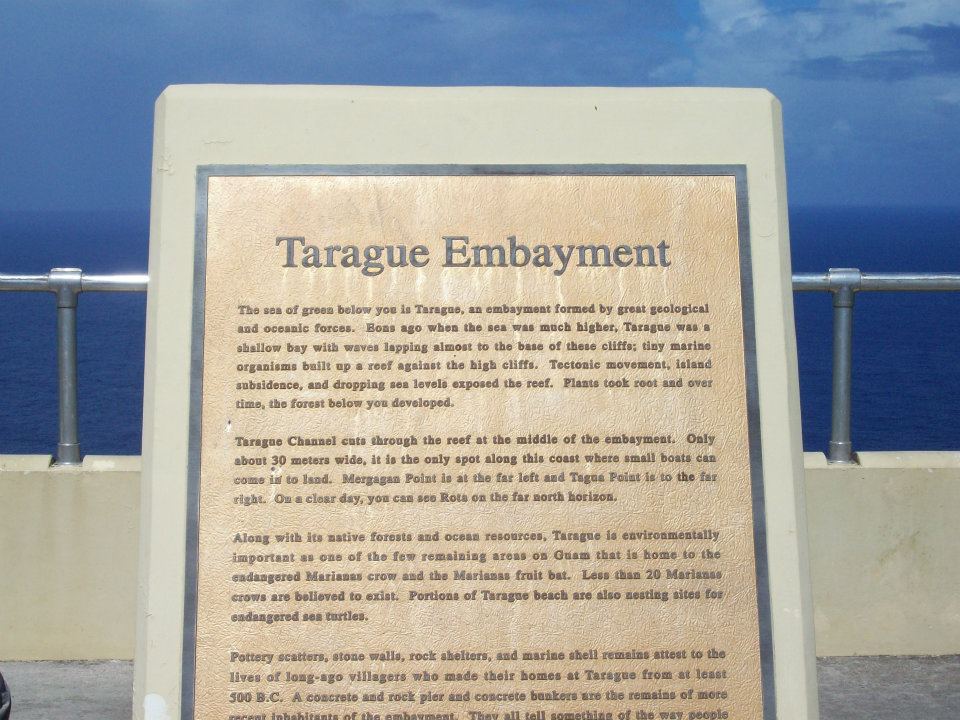
Here’s a picture of a sign at the embayment with a little bit of geological information:
An information sign at Tarague Embayment. Photograph courtesy of Jason Vanover.
And here’s a picture of my cousin, looking handsome in his Air Force uniform:
My cousin hanging out at the embayment. Photograph courtesy of Jason Vanover.
Sorry, ladies! My cousin is happily married and has a beautiful little girl.
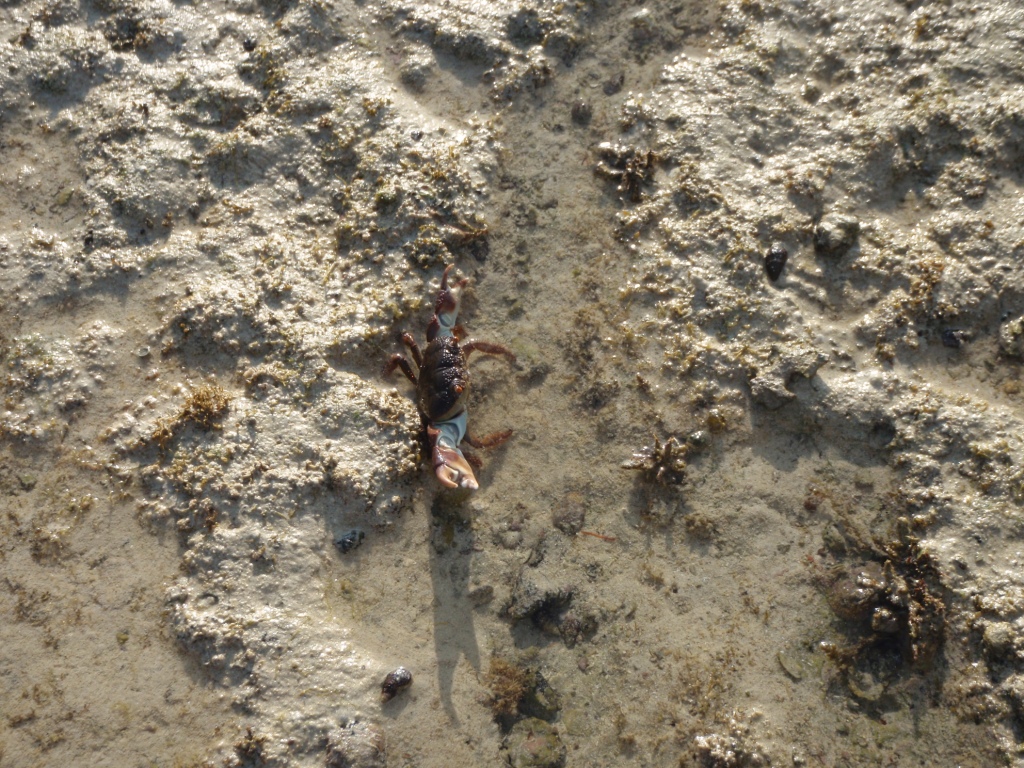
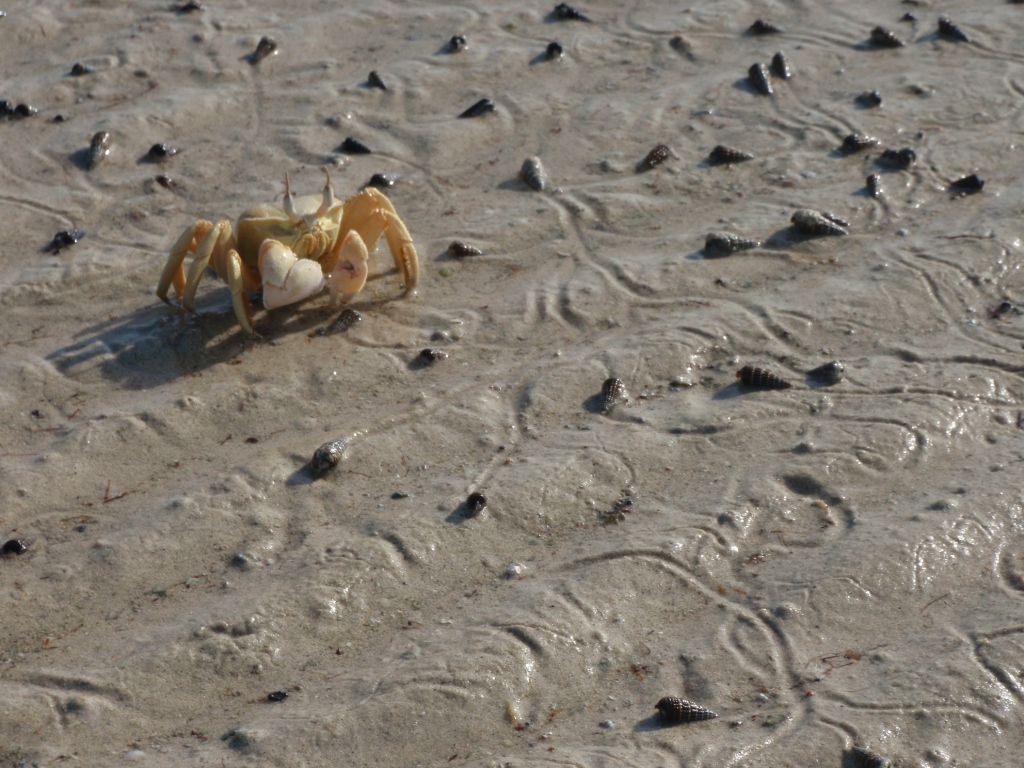
"En garde!" says Mr. Red Crab. Barr Al-Hikman, Oman, January 2012.
My post yesterday about the crab houses in the sand at Barr Al-Hikman turned out to be quite popular, so I thought I’d share some more pictures of crabs and crab houses and other crab life traces which I observed at Barr Al-Hikman. In addition to the Ocypode saratan “ghost” crab (thanks for the identification help, Tony Martin!), I observed at least two other species of crab at Barr Al-Hikman.
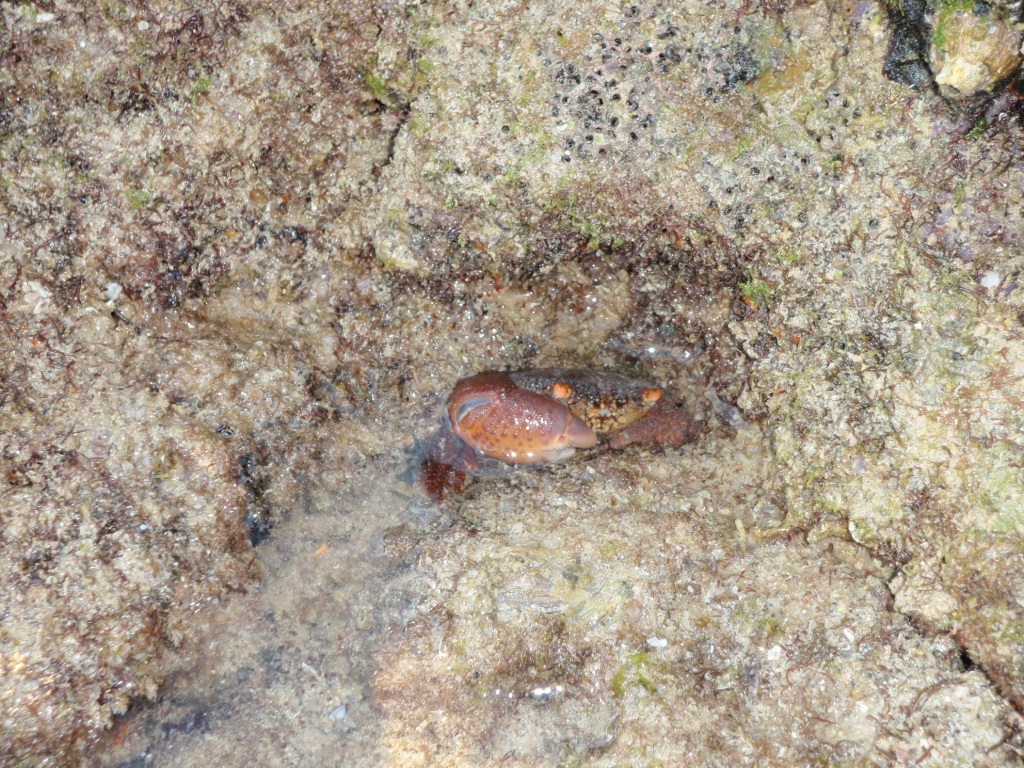
The first species is a dark red colored crab that I observed when walking out on some of the modern coral and carbonate deposits. These crabs were scuttling about everywhere, but if you came too close to them they would dart into small cracks and crevices in the carbonates and put up their big claw defensively.
Mr. Red Crab looks ready for a fight, doesn’t he? Barr Al-Hikman, Oman, January 2012.
Hiding in a crevice… with a big claw for protection! Barr Al-Hikman, Oman, January 2012.
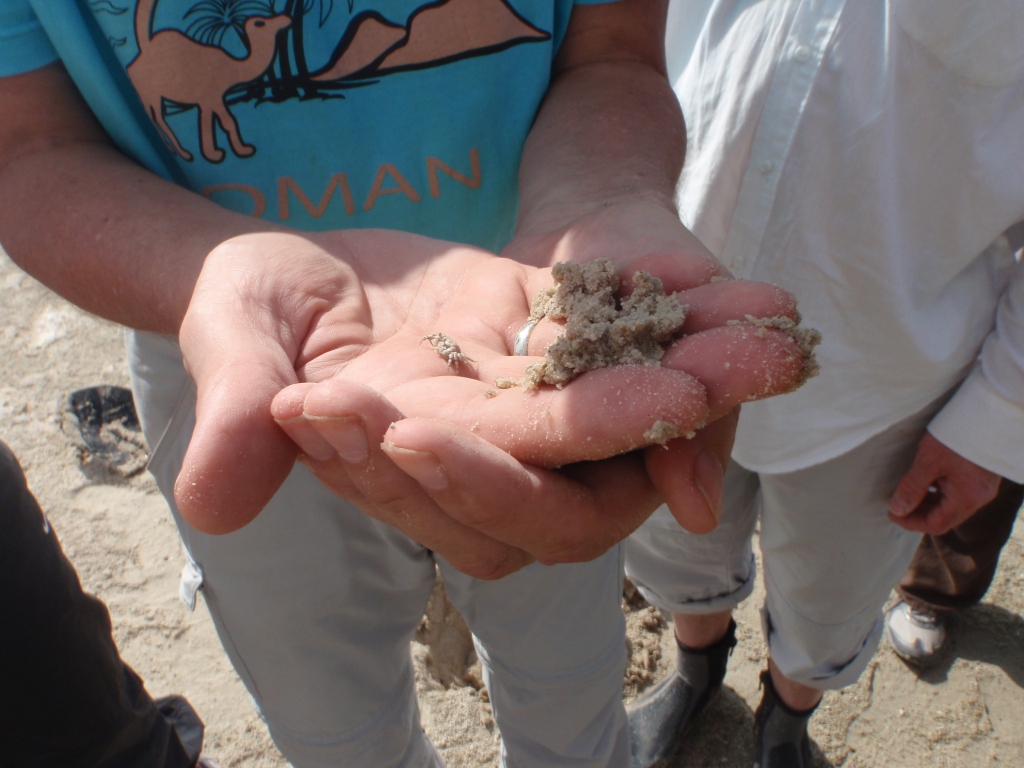
The second species of crab which I observed is a very tiny, tan-colored crab. We actually pulled this poor little guy out of his home. On several of the beaches, we noticed small holes surrounded by small balls of sand. The field trip leaders informed us that these the little balls of sand are called “sand bubbles” and that they are produced by the tiny crabs that live in the little holes. The sand bubbles are made by the crabs when they emerge from their holes during low tide to search for bits of food that have been brought in by the recent high tide. After they search through a few grains of sand, the crabs roll the sand grains into a tiny ball so that they don’t search the same sand grains again. Smart behavior, if you ask me! Sand bubbles can leave some spectacular patterns and designs on the beaches, as show in this article.
We were curious to see one of the little crabs responsible for the sand bubbles, so we decided to dig one of the little crabs out of his (or her?) “safe” little home. We took a shovel and started turning over some sand. Before long, we found a little crab. After inspecting him for a minute or two, we returned him to the beach, where he quickly dug himself back into the sand. I feel bad that we disturbed the little guy and destroyed his home, but it was neat to see him!
Crab holes and sand bubbles, with an Arabic Coca-Cola can for scale. Barr Al-Hikman, Oman, January 2012.Another view of the crab holes and sand bubbles. Barr Al-Hikman, Oman, January 2012.Digging out the poor little crab. Barr Al-Hikman, Oman, Janaury 2012.
“En Garde, giants!” says Mr. Little Crab. Barr Al-Hikman, Oman, January 2012.
Another view of Mr. Little Crab. Barr Al-Hikman, Oman, January 2012.
I’m not normally that interested in biology. Generally, I find biology stuff such as vegetation annoying since it covers up the interesting rocks. However, I enjoyed meeting these two crabs: Mr. Red Crab and Mr. Little Crab. Can anyone identify these two crab species and tell me more about them?
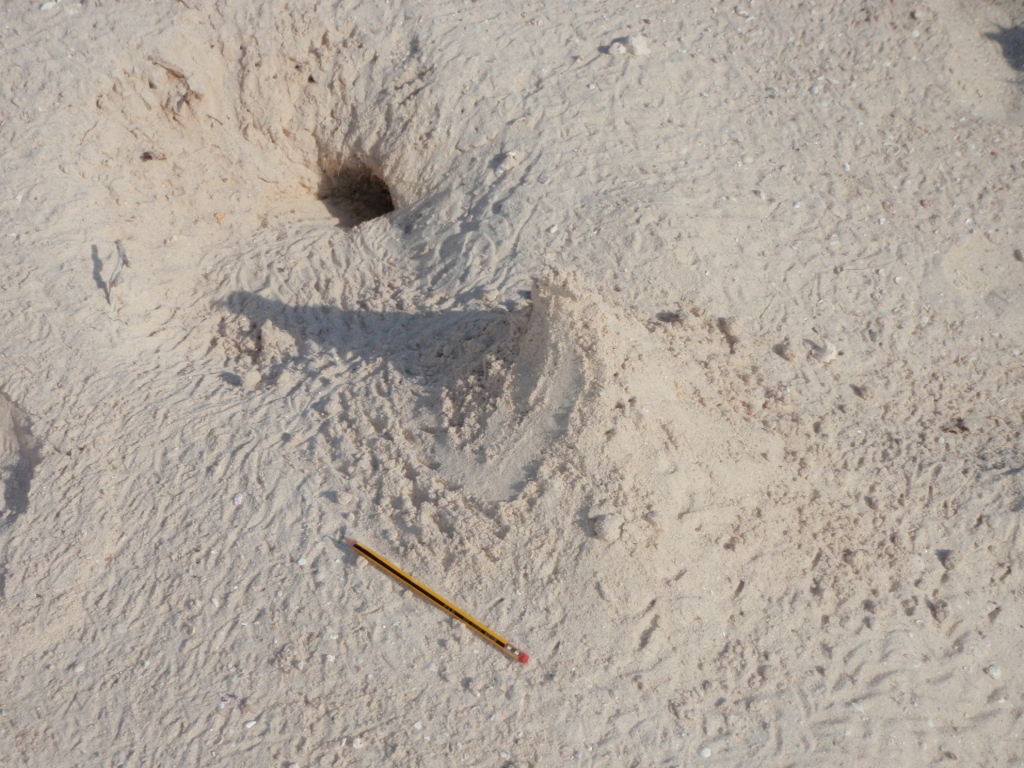
Crab house in the sand #1. Barr al-Hikman, Oman, January 2012.
Last month I participated in a three-day geology field trip to Barr Al-Hikman, a peninsula in Oman. On the peninsula there are numerous beautiful beaches and interesting geological features such as sabkhas and paleolagoons. We visited the peninsula to look at some recent carbonate deposits and also to investigate some modern beach features, such as the coral reefs located just off shore and the traces left on the beach by various modern critters. Yes, we went to the beach for three days. Being a geologist is fun sometimes! Seriously, though, looking at modern life traces gives geologists a better sense of how to identify trace fossils in the geologic record. If you want to learn more about traces and trace fossils, I recommend Tony Martin’sblog and forthcoming book Life Traces of the Georgia Coast. I’m certainly looking forward to the book!
I don’t normally study life traces or trace fossils, so looking at these traces in Oman was new and exciting for me. I don’t know much about the traces– other than what the field trip leaders told me– but I thought I’d share some pictures of some life traces I saw at Barr Al-Hikman. In this post I’m sharing some pictures of holes with piles of sand next to them. Apparently, these holes were dug by crabs. I’m not sure of the exact species. Does anyone know? I spotted a likely suspect a few meters from the holes.
Crab house in the sand #2. Barr al-Hikman, Oman, January 2012.Numerous crab holes and piles of sand, with our Land Cruisers in the distance. Barr Al-Hikman, Oman, January 2012.A likely suspect for the house-builder. And look at those traces being left by the living shell thingies (yes, I am the worst biologist ever). Barr Al-Hikman, Oman, January 2012.Mr. Crab... and some geologists in the background. Barr Al-Hikman, Oman, January 2012.
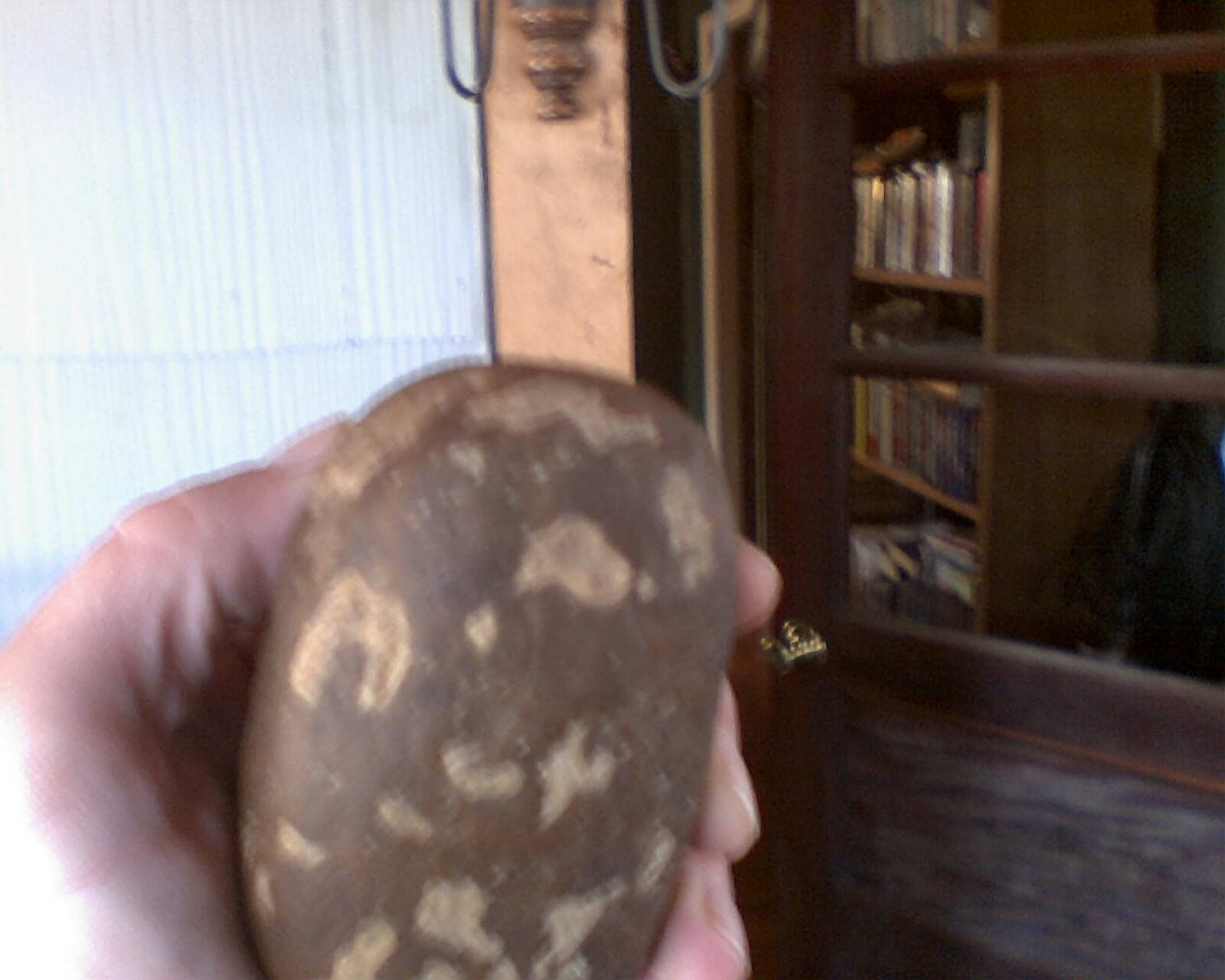
Back in December, Diego emailed me pictures of an interesting looking, rounded rock that has some lighter markings on it that look like pictures.
Diego wrote:
Hello Evelyn,
My name is Diego, and since you like to study rocks, I do have one for you! I was told it was sediment that created the pictures on the rock.
Is it possible? What would you do if you have found this rock? Any ideas would be most helpful. And do what you want with the pics.
Enjoy the Holiday and the New Year. I am in no hurry for the answer, and if you need more pics, will send. Or if you like I will send it to you as long as you don’t break it! If this helps; at 60x it looks to be sand turned into glass.
Thanks for your time.
Sincerely,
Diego
I wrote back to Diego to ask him for a little more information about his rock. Specifically, I wanted to know where he found the rock in order to obtain a little bit of regional context. Diego wrote back that he found the rock in Winona, Kansas. He says that the rock came from the bottom of a ~25 ft deep hole and that he picked up the rock when he was helping a friend repair some sewage lines. Diego has had the rock for 7-8 years and is fascinated by the light-colored patterns on the rock. He’s shown the rock to people over the years, and they’ve seen many things in the patterns, such as:
Clouds, face, sun/moon, cave/house/mountain, bird, worm and the last thing on the bottom the kids actually got that one. One said it was an angel, another said it was a dancer, and one boy said it was someone riding a dog! Who knows though, all say it looks like a bear.
Diego is curious if some geologists can help identify his rock. I thought I’d write down my ideas here and then perhaps some other geologists can write down their ideas in the comments.
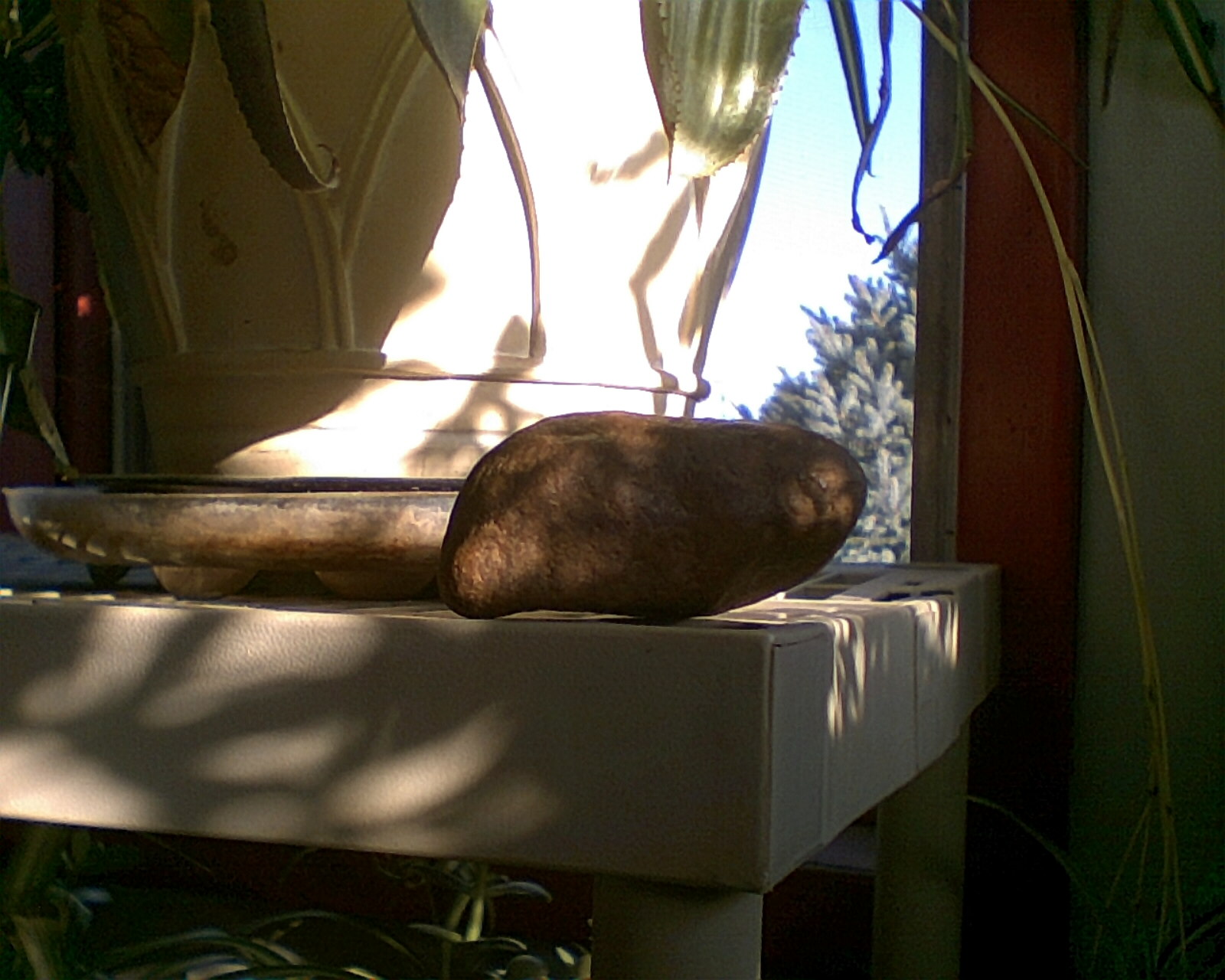
Here are some more pictures of the rock:
Mystery Rock #6, Picture #2. Mystery Rock #6, Picture #3. Mystery Rock #6, Picture #4.
Diego, I appreciate you willingness to send me the rock, but I don’t think that will be necessary. However, I’m afraid that in order to truly identify your rock it may be necessary to break it. There appears to be a weathering rind on the rock, and in all honesty I’m not sure I can fully identify it without seeing the less-weathered interior. If you’re willing to break even a small piece off the rock to expose the interior, that would be very helpful!
With the pictures I have so far, though, let me try to do some basic identification. As always, let me start with the basic identification questions. Then I’ll move on to a few more specific questions.
Is the rock natural or manmade?
Based on the morphology and weathering of the rock, I’d say that this is a natural rock. The rounding of the rock gives me a clue that this rock has spent some time in a stream or other body of water, which eroded and smoothed the rock.
Is the rock igneous, sedimentary, or metamorphic?
Because of the brown weathering rind, I’m afraid I cannot definitely identify the rock type. Many different types of rocks develop similar-looking brown weathering rinds. If I had to guess, however, I’d say that this is either a fine-grained igneous rock such as basalt or some type of sedimentary rock.
So, what is the rock?
The rock is a rounded cobble which spent some time in a stream or other body of water. The rock has also clearly been weathered producing a brown weathering rind. The rock is probably igneous or sedimentary.
What are those strange markings on the rock?
I’m actually not completely sure. Diego, perhaps you could send through some slightly higher resolution photographs which are close-ups of those lighter patches? Those markings could be places where the lighter interior of the rock is being revealed or, perhaps, they are places where a secondary infill has been deposited. One interesting thing I noticed is that the lighter markings are absent from at least one side of the rock.
Why do those strange markings look like pictures?
I believe that those markings are natural rather than manmade. The fact that the markings look like pictures is probably just a result of the pattern-seeking nature of the human brain. The human brain looks for patterns everywhere– that’s why people see, for instance, an image of the Virgin Mary in a grilled cheese sandwich. Personally, on quiet days I like looking for patterns in the clouds– it’s remarkable what patterns the human mind can detect in natural objects such as clouds.
To summarize, this mystery rock is still somewhat of a mystery. We know that the rock is a cobble which spent some time being rounded and weathered in a stream or other body of water. The rock also appears to have a brown weathering rind that obscures identification of the specific rock type. The light-colored markings on the rock are most likely natural, but I’d have to see a higher-resolution photograph or the rock in person in order to identify them further.
To help further identification of the rock, here are some things which Diego can do:
1. Break off a small piece of the rock or saw the rock in half, if he’s willing. This will be the best way to further identify the rock.
2. Take some higher resolution pictures of the rock, particularly of the light-colored areas.
3. Show the rock to a geologist in person. Are there any geologists in the Kansas area willing to look at Diego’s rock?
That’s all I have to say. Diego, if you’re willing to break your rock and then send me pictures– or even just send higher-resolution pictures of the rock’s surface– I’d be happy to devote another post to this mystery rock.
What do other geologist think about this rock? Also, if you want to see any of my previous mystery rock posts, you can find them here.
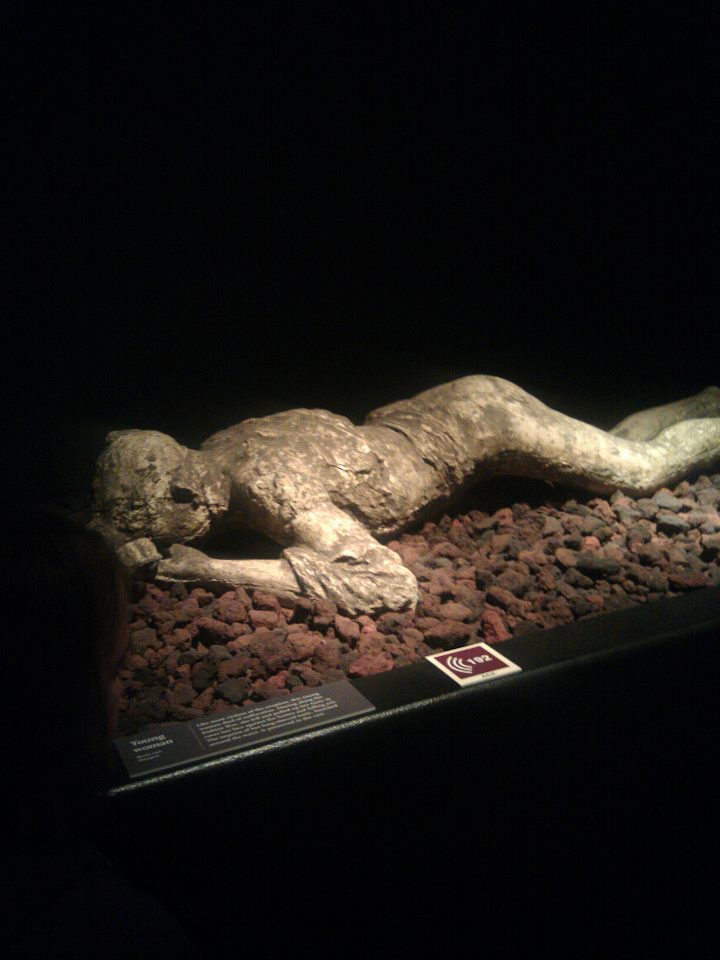
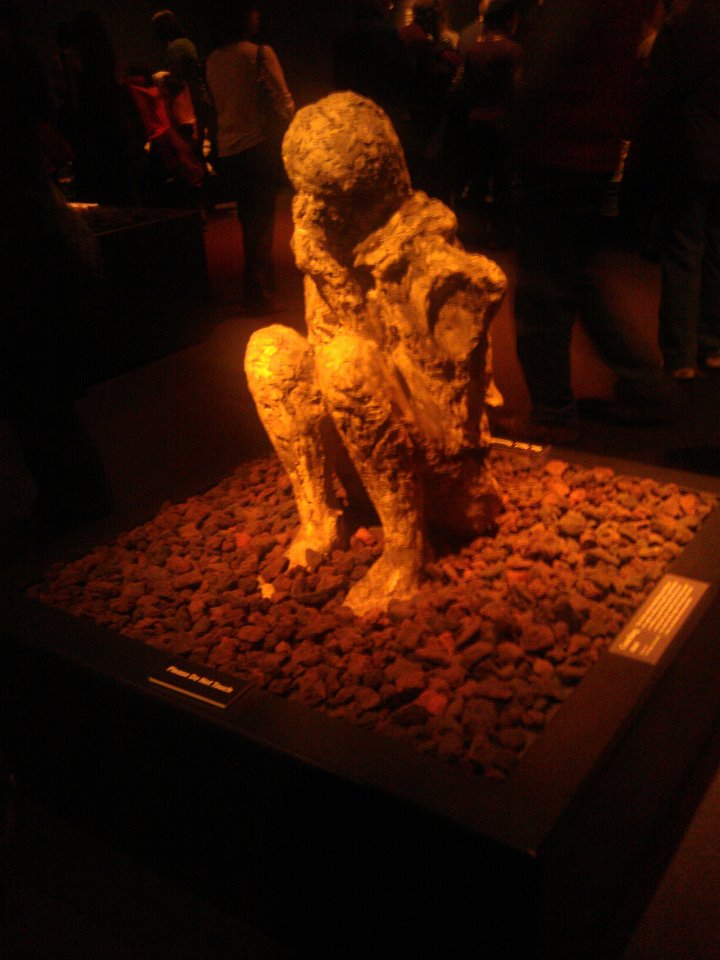
A plaster cast of the void left by a body that was buried in volcanic ash during the 79 AD eruption of Pompeii. From an exhibit at the Boston Museum of Science, January 2012. Photo courtesy of Travis Roy.
Today’s geology picture is courtesy of my friend Travis, who visited the “A Day in Pompeii” exhibit at the Boston Museum of Science this past weekend. This exhibit looks great and runs through February 12th. If you’re in the Boston area, you should check it out! Unfortunately, I’m going to miss the exhibit since I won’t be back in the Boston area until March. I’m very sad that I’m missing the exhibit. One of these days, I’ll have to take a georney to actual Pompeii. Pompeii is definitely high on my list of geological sites I want to visit.
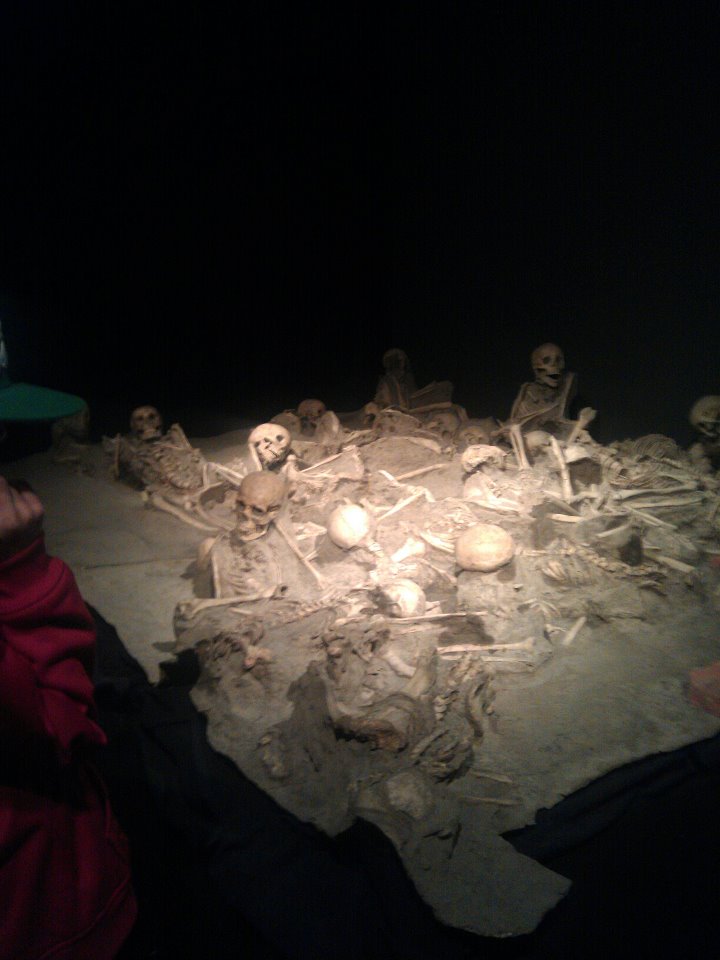
Here are a couple more pictures from the Boston Museum of Science exhibit, courtesy of Travis:
Another plaster cast of a void left by a buried body. From an exhibit at the Boston Museum of Science, January 2012. Photo courtesy of Travis Roy.A pile of bones. From an exhibit at the Boston Museum of Science, January 2012. Photo courtesy of Travis Roy.
A scary-looking children's book about global warming.
When I was visiting my friends in Abu Dhabi a couple of weeks ago, we had dinner at a local mall just before I headed to the airport for my flight home to South Africa. As we were leaving the mall, I bought myself a few children’s books in Arabic. After I finish up my PhD in April, I’m hoping to work through these Arabic children’s books as a way to help me dust off and improve my Arabic. As I was selecting books in Arabic, my eye caught this very scary book on global warming. I think this book will give children– and possibly also adults– nightmares. But maybe that’s a good thing considering that climate change denialism is rampant throughout the world, especially the United States. Coming from the US, I was actually very impressed that South Africa has frequent government-sponsored ads (billboards, radio ads, TV ads) that try to educate people about climate change, probably largely because of the recent climate change talks in Durban.
Climate change is scary, just like the cover of the above children’s book. Having 7 billion humans on the planet emitting tons of CO2 and using up all kinds of other natural resources is scary. Anthropogenic CO2 emissions are affecting Earth’s climate and this is a cause for concern. Period. People are welcome to argue about the details, such as just how much sea level might rise and how badly different cities will be affected. People are welcome to argue about the best ways to combat climate change. People are welcome, even, to argue about if we should do anything at all to combat anthropogenic climate change. I have no problem with productive, intelligent discussions on the matter, and I respect people’s opinions on how much– or little– action we should take to combat anthropogenic climate change. However, I do have a problem if you say anthropogenic climate change doesn’t exist. Anthropogenic climate change is a reality, and denying that anthropogenic climate change exists is just as bad (scientifically) as denying that evolution exists. However, an alarmingly high number of people deny that anthropogenic climate change is real. In fact, the National Center for Science Education (NCSE), an organization that for years has advocated and fought to have the scientific theory of evolution taught in schools in the United States, is now tackling the issue of teaching climate science in schools as well. Bravo, NCSE. I wish you well in your endeavors to educate people about climate science. If you run into trouble making people understand why teaching climate science is important, maybe you can scare them by buying a few million copies of the scary global warming book above. Although perhaps there’s some junk science in there (as far as I know, the Earth isn’t going to catch on fire as a result of climate change…), so maybe it would be best to stick with the excellent material already on your website.
Have you seen a great countertop out there? Sure, everyone says it’s “granite”, but you know better. Take a picture, post it on your own blog or send it to me and I’ll post it for you. Do you think you know what it is or how it was formed? Feel free to include your own interpretation and I’m sure others will enjoy joining in the discussion. Ron Schott suggested that we expand the entries by including any decorative stone material that has been separated by humans from its source. This includes buildings, statues, etc. There’s a lot of really unusual stuff out there, so make sure to find a good one.
I think this is a great topic for an accretionary wedge! Anyone who has spent any amount of time with me knows that I am constantly looking at stone countertops, floors, walls, statues, and pretty much anything else made out of rock. Actually, I just visited by good friend Karima in Abu Dhabi, and she and her husband laughed at how I inspected the walls of all of the buildings we visited. I couldn’t help myself– there is some spectacular building stone to be found in Abu Dhabi. I was particularly impressed with all of the amazing building stones used in the Sheikh Zayed Mosque and the Emirates Place Hotel. My friend Karima actually joked that when we visited the Emirates Palace hotel and ate our gold-flaked dessert, I kept looking at the floors and walls rather than enjoying the spectacular ocean and city views. However, I’m actually planning to share pictures of those two buildings in other posts. For this accretionary wedge post, I’m actually going to share some pictures of my friend Karima’s front entryway to her house in Abu Dhabi.
Karima and her family live in a lovely two-story house (with a rooftop balcony) in Abu Dhabi. In front of their house, they have lovely slabs of granite decorating their front steps and entryway. They also happen to have a dark-colored xenolith just in front of their front door! The xenolith caught my eye as soon as I arrived at their house, and it actually reminded me very much of the dark-colored xenoliths I often observe in the Cape Granite here in Cape Town.
Here are some pictures of my friend’s front entryway xenolith:
Dark-colored xenolith in granite. And here's one with my hand for scale.
And here’s a picture of a similar looking dark-colored xenolith in the Cape Granite here in South Africa:
A similar looking dark-colored xenolith in the Cape Granite here in South Africa.
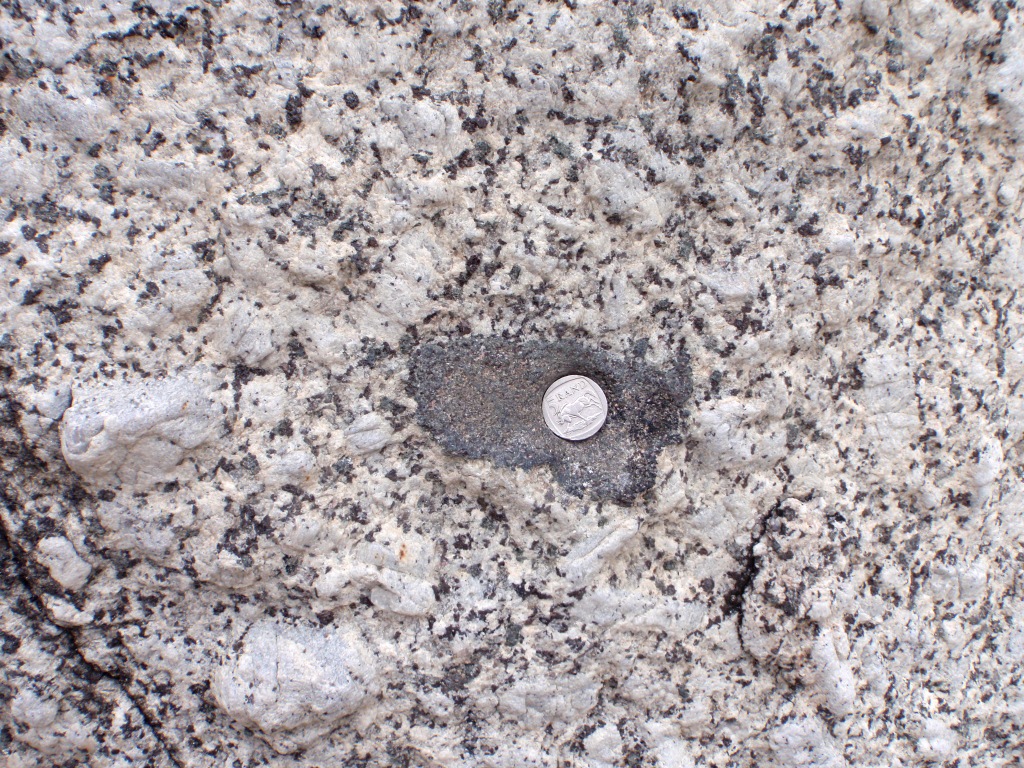
A little dark-colored xenolith (isn’t it adorable?) in Cape Granite, Clifton Beach, Cape Town, South Africa, October 2011.
I’m back home in Cape Town, so I thought I’d post a local picture for this week’s Monday Geology Picture. The above picture shows a small, dark-colored xenolith in the Cape Granite, a 550 million year old granite that has megacrysts (very big crystals) of feldspar. This xenolith is most likely a small piece of the Malmesbury Group, an older group of rocks that consists of alternating grackwacke sandstone and slate that have experienced significant uplift and metamorphism. The above xenolith was observed at Clifton Beach, a fancy beach area known for its bright white beaches which result from the weathering of the Cape Granite. Abundant xenoliths, such as the one above, can be observed in the granite boulders at Clifton Beach. I took the above picture when we took my husband’s cousin around to look at a few geological sites in the Cape Town area .There is a 5-Rand South African coin for scale in the picture; this coin is slightly smaller than an American quarter.
I have a few thesis deadlines looming, so for the next 2-3 months as I prepare for my thesis defense this blog may consist mostly of short picture posts. If time permits, I’ll try to slip in a few geology words and longer posts, but my thesis comes first at the moment. Hopefully the pictures will be enough to tide over my readers as I wrap up this PhD of mine.














 Georneys
