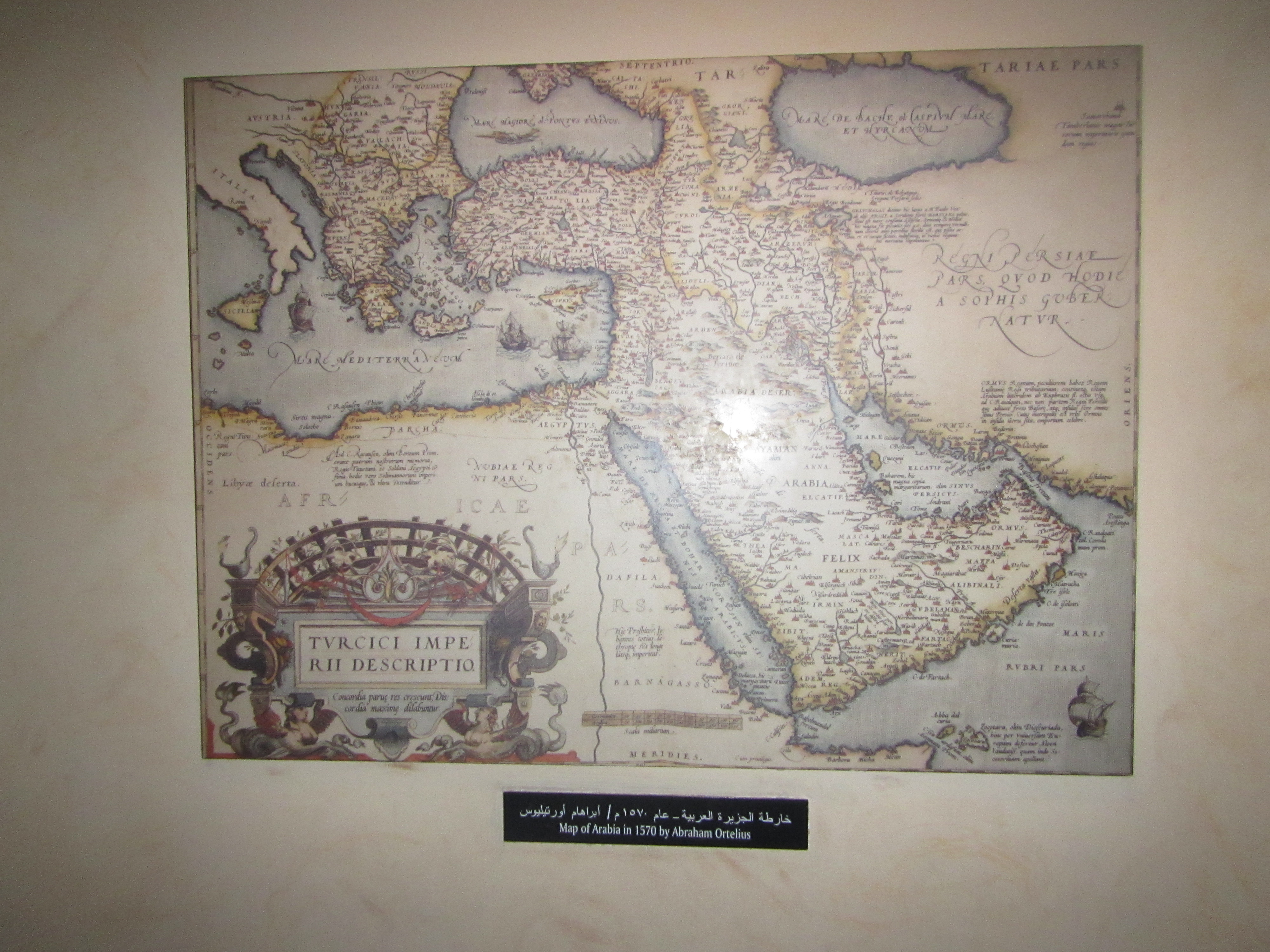
Map of Arabia by Abraham Ortelius, circa 1570. Map print hanging in the Dubai Museum, September 2013.
Back in September 2013 I visited Dubai for one day during a layover when I was flying from Alaska back to South Africa. I was fortunate enough to be able to sleep on the flight from New York to Dubai, so when I arrived in Dubai I took a quick shower at the hotel then headed out to explore for a few hours. I spent some time at the Dubai Museum. The museum is located in a fort that is the oldest building in Dubai and has several interesting exhibits. I’ll blog a little more about my visit to the museum later this week.
For now, I want to share this picture of an interesting map that was displayed in a little nook in one part of the museum. As I was walking through the museum, the map caught my eye, so I took a picture of it. The map is titled “Map of Arabia in 1570 by Abraham Ortelius”. I was intrigued by the map as I thought that 1570 was quite early for such a detailed map to have been produced for the region. When I did some googling after the museum visit, I discovered that the map comes from a book known as the Theatrum Orbis Terrarum (Theatre of the World), which is considered to be the world’s first modern atlas. This atlas was compiled by Abraham Ortelius, a Flemish cartographer and geographer. I’ll have to do some reading on Ortelius– he sounds like he was a very interesting person. According to Wikipedia, he was apparently one of the first people (the first person?) to propose the theory of continental drift… long before Alfred Wegener!
Sometimes, manmade objects become part of the geological landscape. For example, on Noordhoek (which means “North Corner”, in Dutch and Afrikaans) Beach near Cape Town, South Africa, there is a shipwreck at one end of the beach. Two rusted boilers and a ring of metal ribs– sticking up out of the sand like a picket fence– are all that remain of the S. S. Kakapo, a New Zealand steamship that became stranded on the beach in 1900. You can read all about the wreck of the S. S. Kakapo here. In this Anthropocene time discarded manmade objects no doubt have a big impact on the Earth and its various processes. While the remains of the S. S. Kakapo likely have a fairly small impact on the environment, the skeletal shipwreck nonetheless reminds me of the traces we humans leave behind. 114 years after the shipwreck, the ghostly metal outline of the S. S. Kakapo remains.
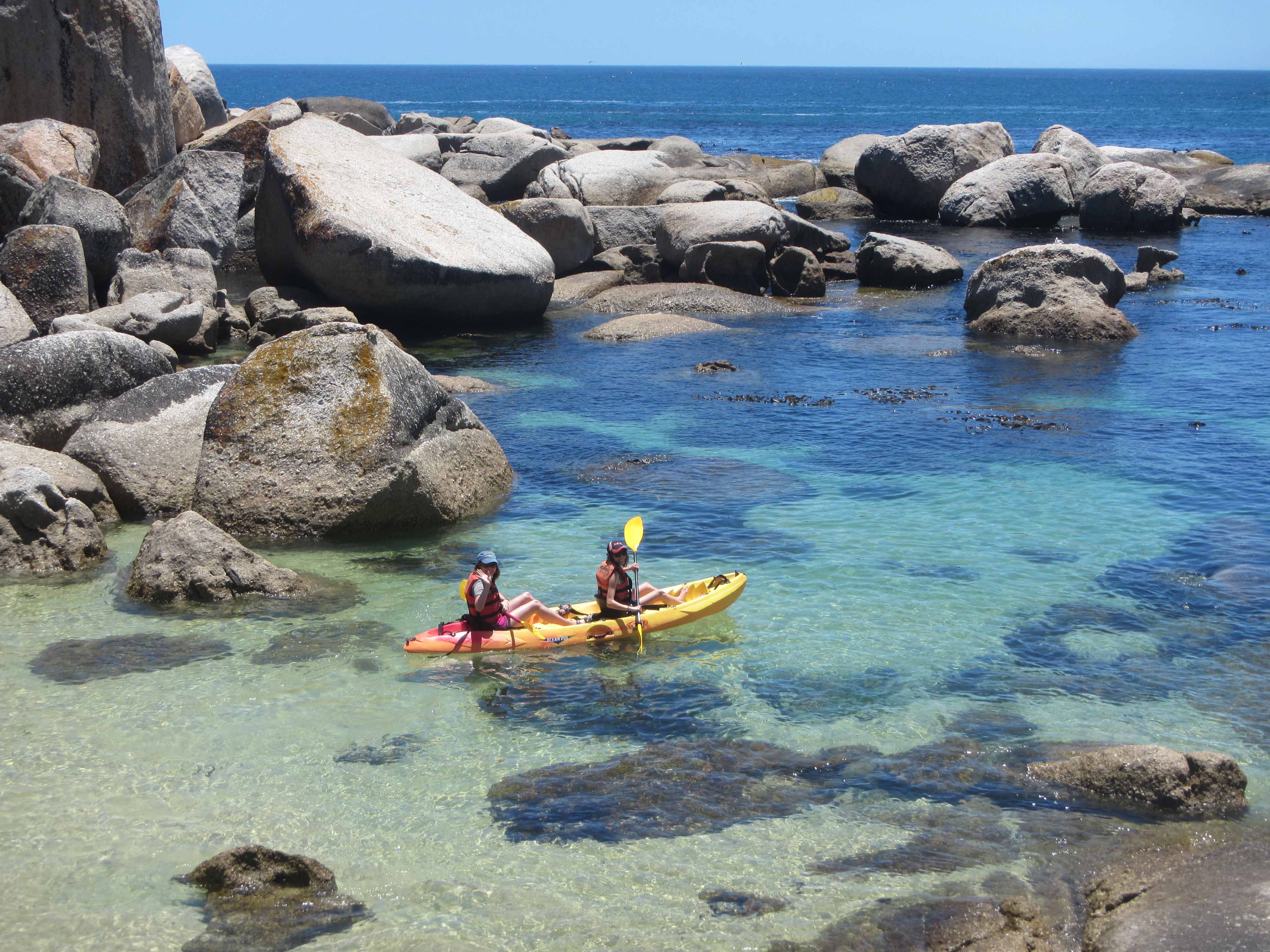
A stunning location for a birthday party. In this picture my friend Kaylee and I check out some of the giant granitoid boulders by kayak.
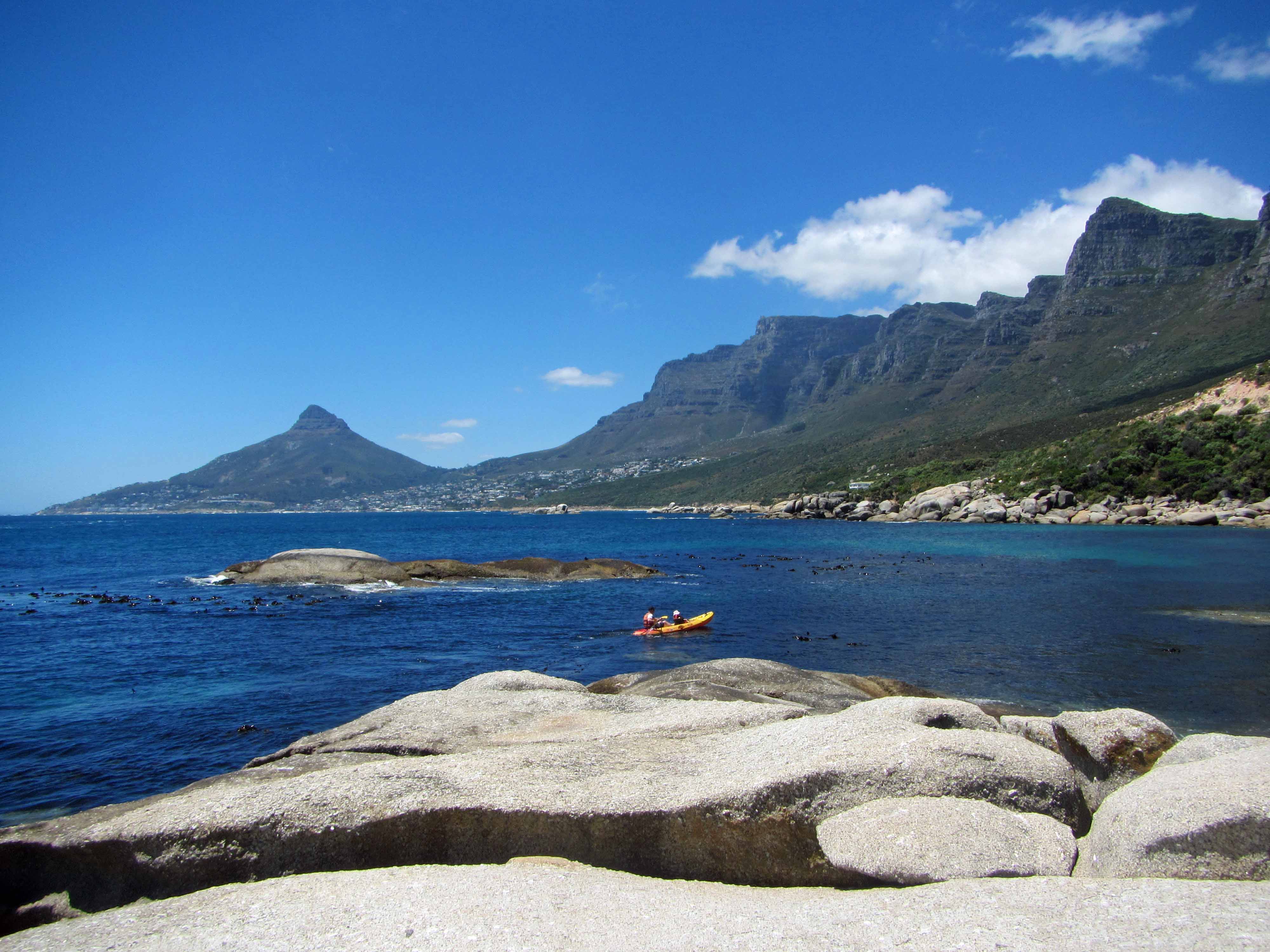
Yesterday was my 30th birthday. Amongst other wonderful things, my husband Jackie organized a surprise birthday party for me at Oudekraal, a beautiful beach (and national park) here in Cape Town. Bordered on one side by gigantic boulders and turquoise-blue waters and flanked on the other side by tall, jagged, gray-green mountains, Oudekraal is a stunning location. Jackie rented a kayak, brought plenty of delicious picnic food, and invited many good friends for my party. The weather was beautiful, and we all had a great time. I’d never been to Oudekraal Beach before, but I hope to return soon!
Here are a few more views of gorgeous Oudekraal:
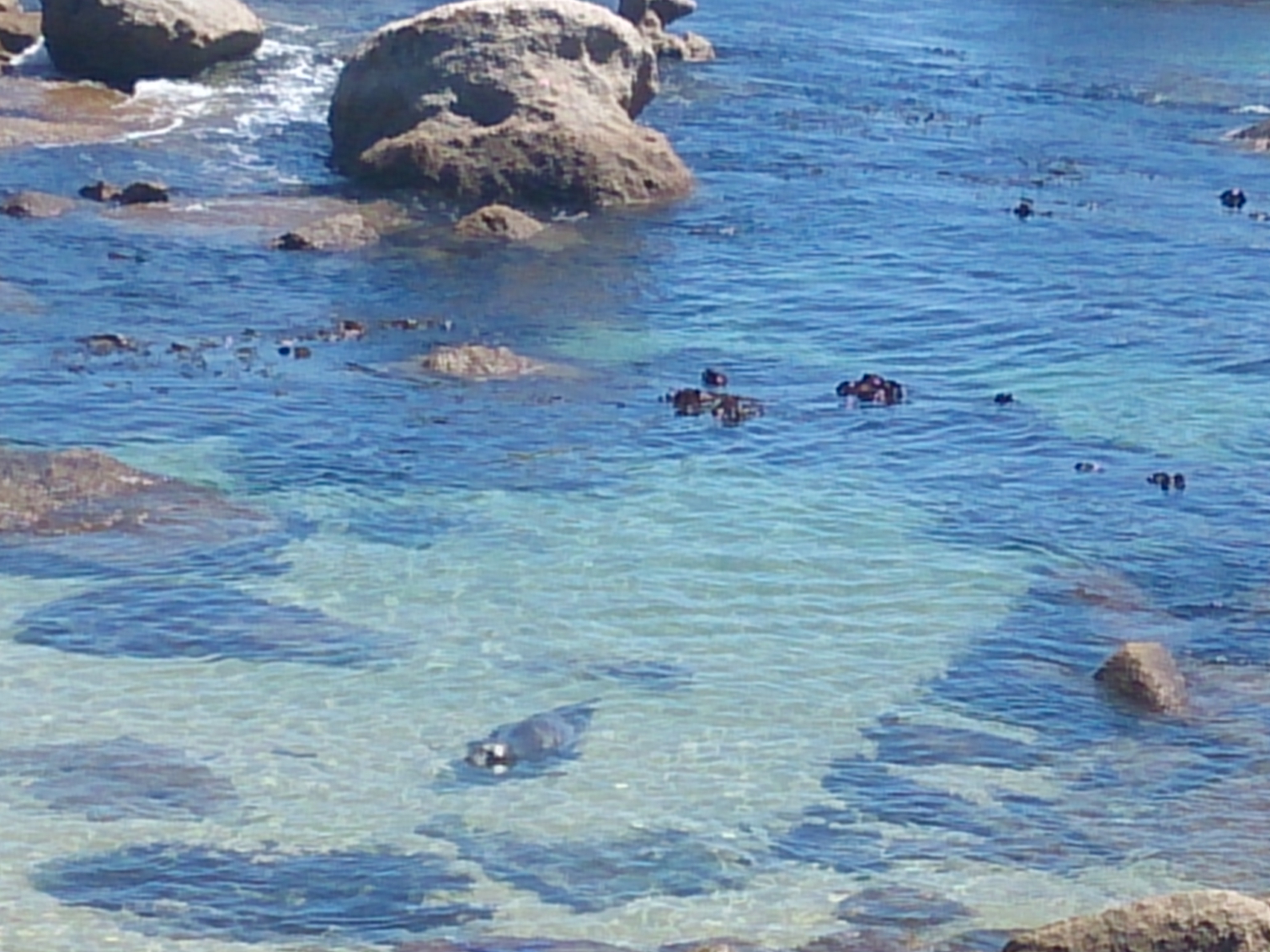
Exploring the bay near Oudekraal Beach.Jagged mountain peaks.A seal came to visit! We saw several seals, actually.A closer view of the seal. Hello!
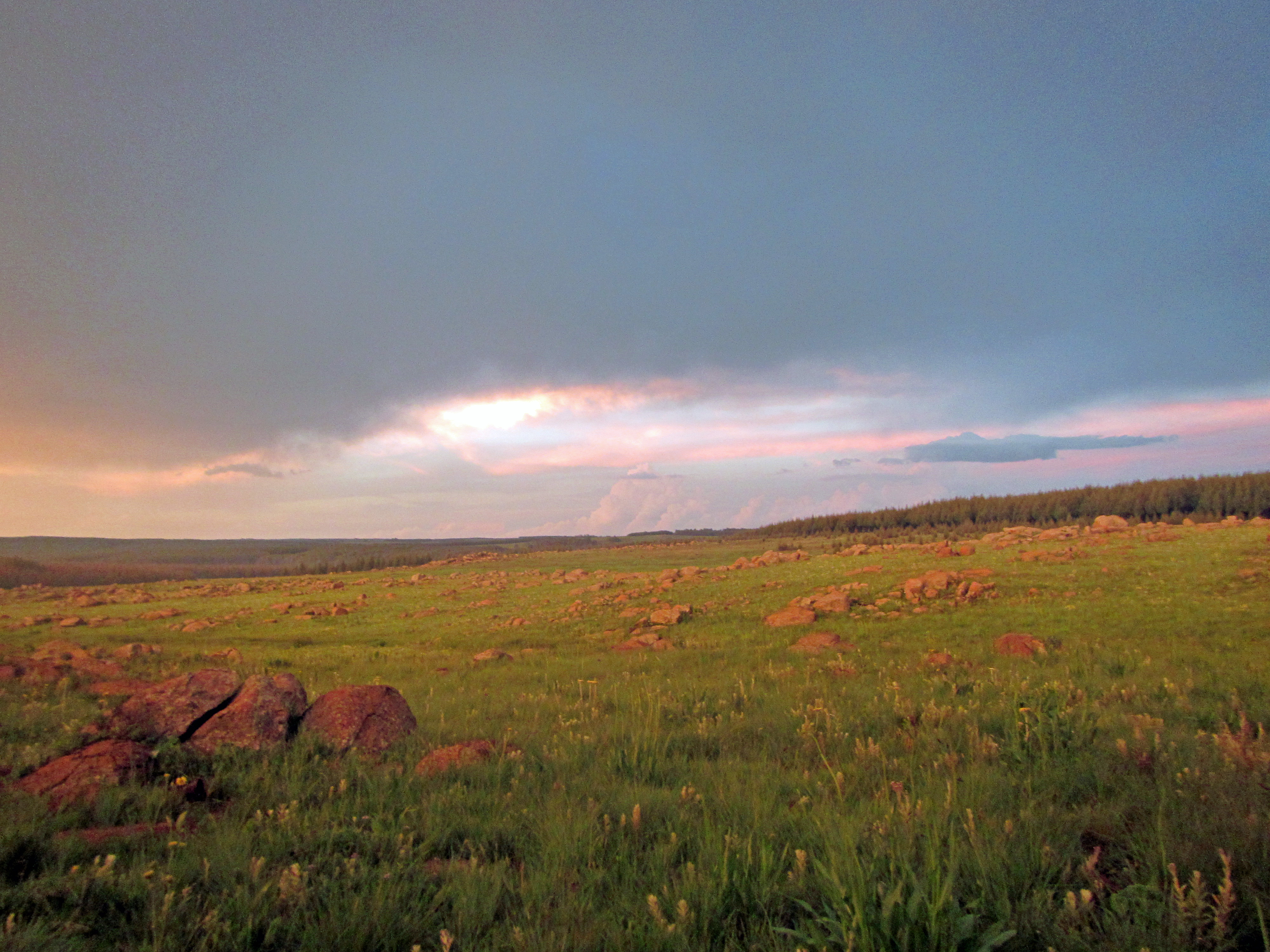
Boulders in a field in the late evening, Dullstroom, South Africa. Picture taken December 2013.
For this week’s “Monday Geology Picture” post I thought I’d share a picture from my trip to Dullstroom in Mpumalanga, South Africa, a few weeks ago. I took this picture as we were driving late one evening, just before sunset. I didn’t take a close look at the rounded boulders dotting the field, but they are probably granitoids or possibly dolerites. Although don’t take my word on that– it’s difficult to identify rocks when driving by them rather quickly!
Below are a few more pictures from a recent walk along the Constantia Nek contour path here in Cape Town. I featured a picture from this same walk in this week’s “Monday Geology Picture” post.
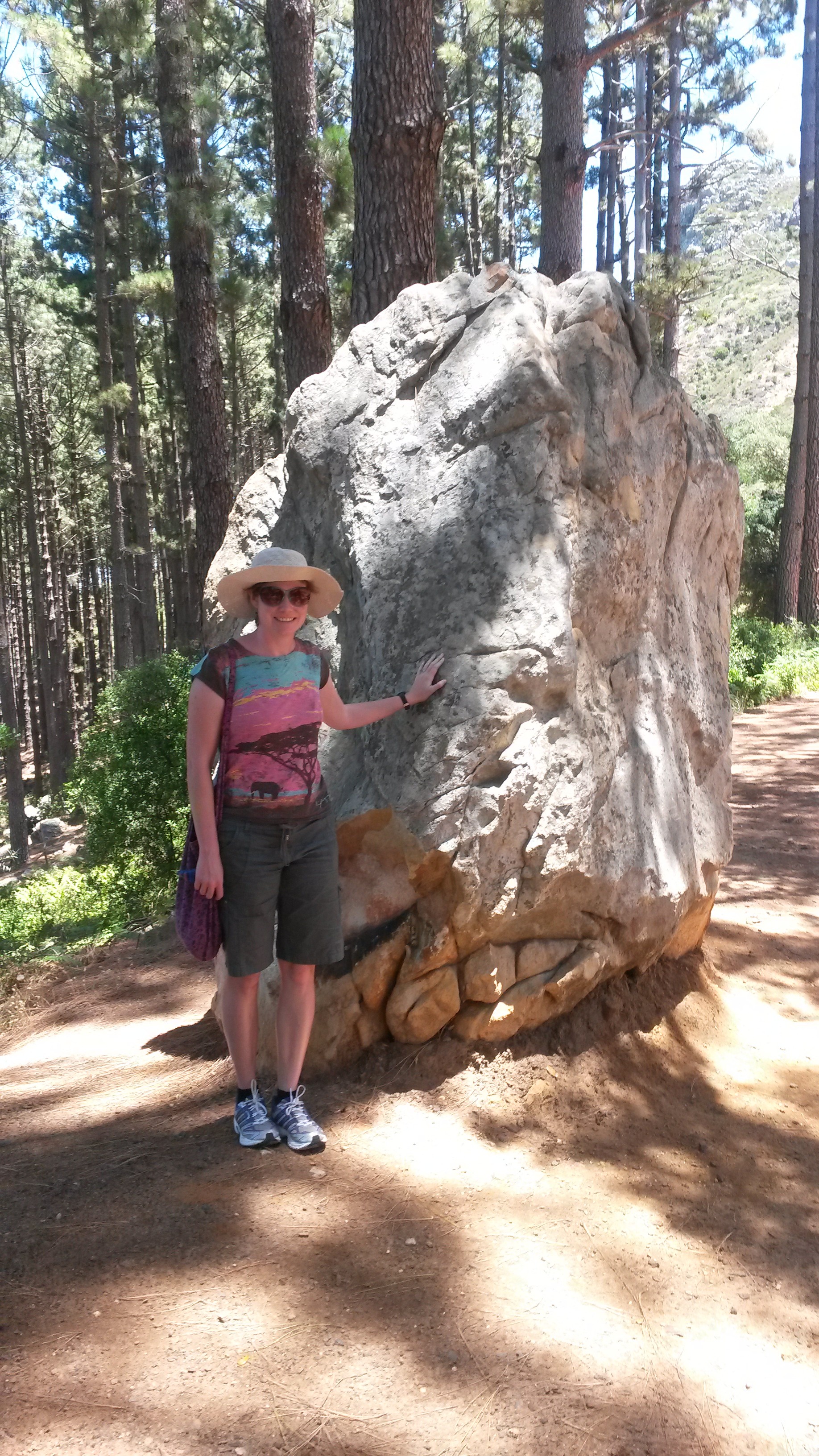
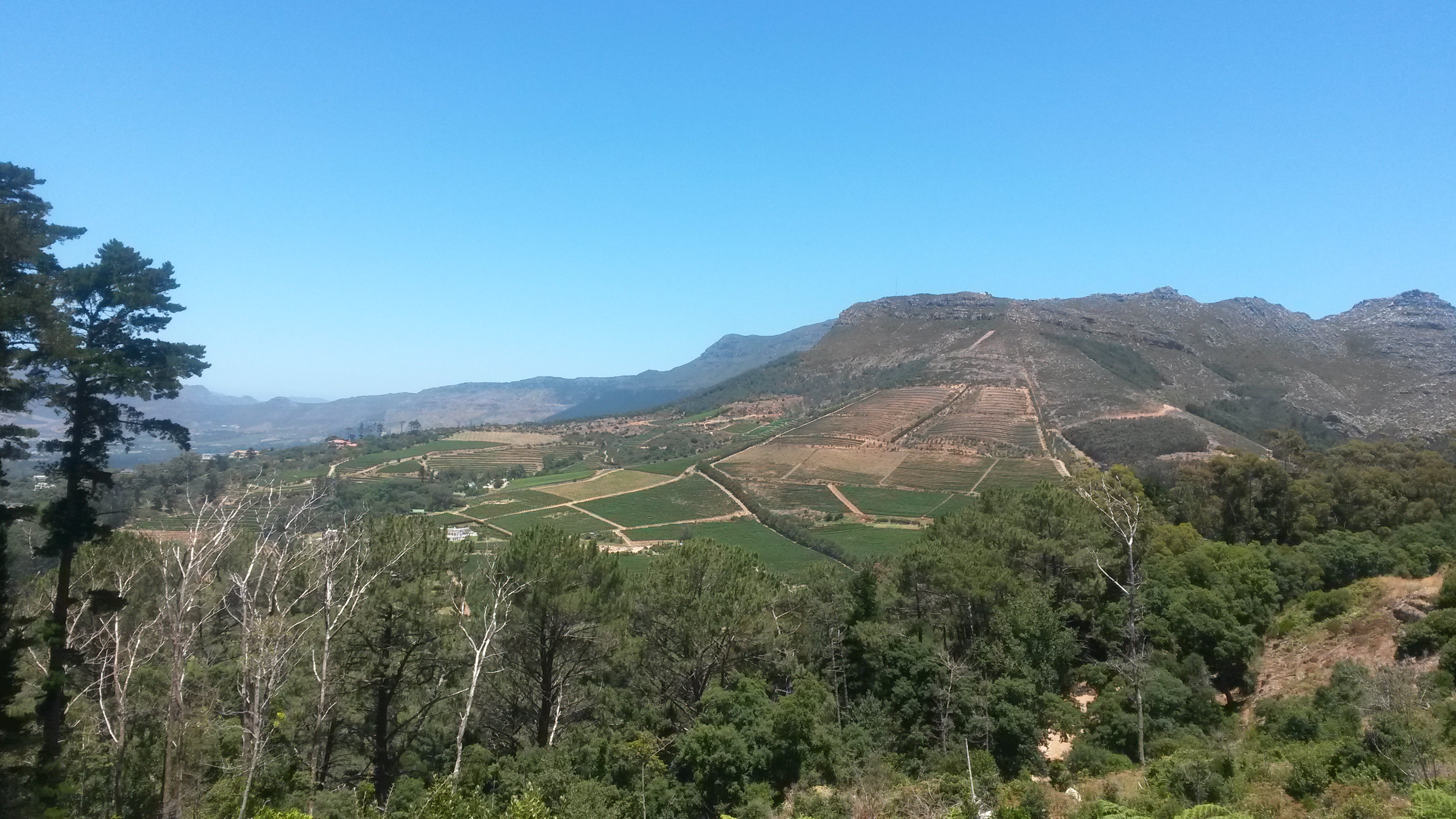
A view of some of Cape Town’s winelands. Picture taken December 2013.Yours truly posing with a boulder of Table Mountain Group quartzite. Picture taken December 2013.A pretty red flower along the path. Picture taken December 2013.
I feel very fortunate to live in a city that has many beautiful walks and hikes. I’ll do my best to explore some more of them– and re-visit some old favorites– in 2014.
The end of another year is here, so that means that it’s time for my annual “Year of Travel” post. Below you can find out where I was fortunate enough to travel to in 2013. You can also see where I traveled in 2010, 2011, and 2012.
Beautiful Hout Bay in Cape Town, South Africa, viewed from Chapman’s Peak Drive. Picture taken September 2013.Sailboats in Hout Bay, Cape Town, South Africa. Picture taken September 2013.A view of some of Cape Town’s winelands from the Constantia Nek Contour Path, Cape Town, South Africa. Picture taken December 2013.
I feel very fortunate to live in such a beautiful city. This year my husband and I made more of an effort to explore Cape Town and its surrounds when our busy schedules permitted.
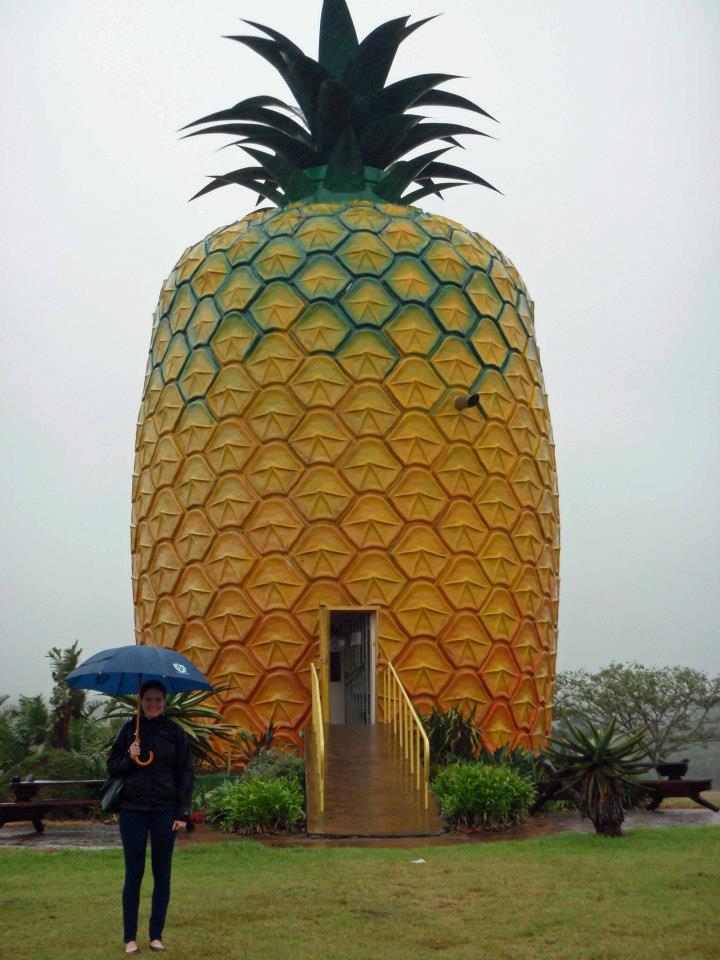
In April I went for a few days to Grahamstown, South Africa to visit my husband, who was studying for six weeks at Rhodes University. Unfortunately, it rained the whole time that I was in Grahamstown, but that didn’t keep us from exploring the area, including the Big Pineapple in nearby Bathurst:
A very big pineapple in Bathurst, South Africa (near Grahamstown). Picture taken April 2013.
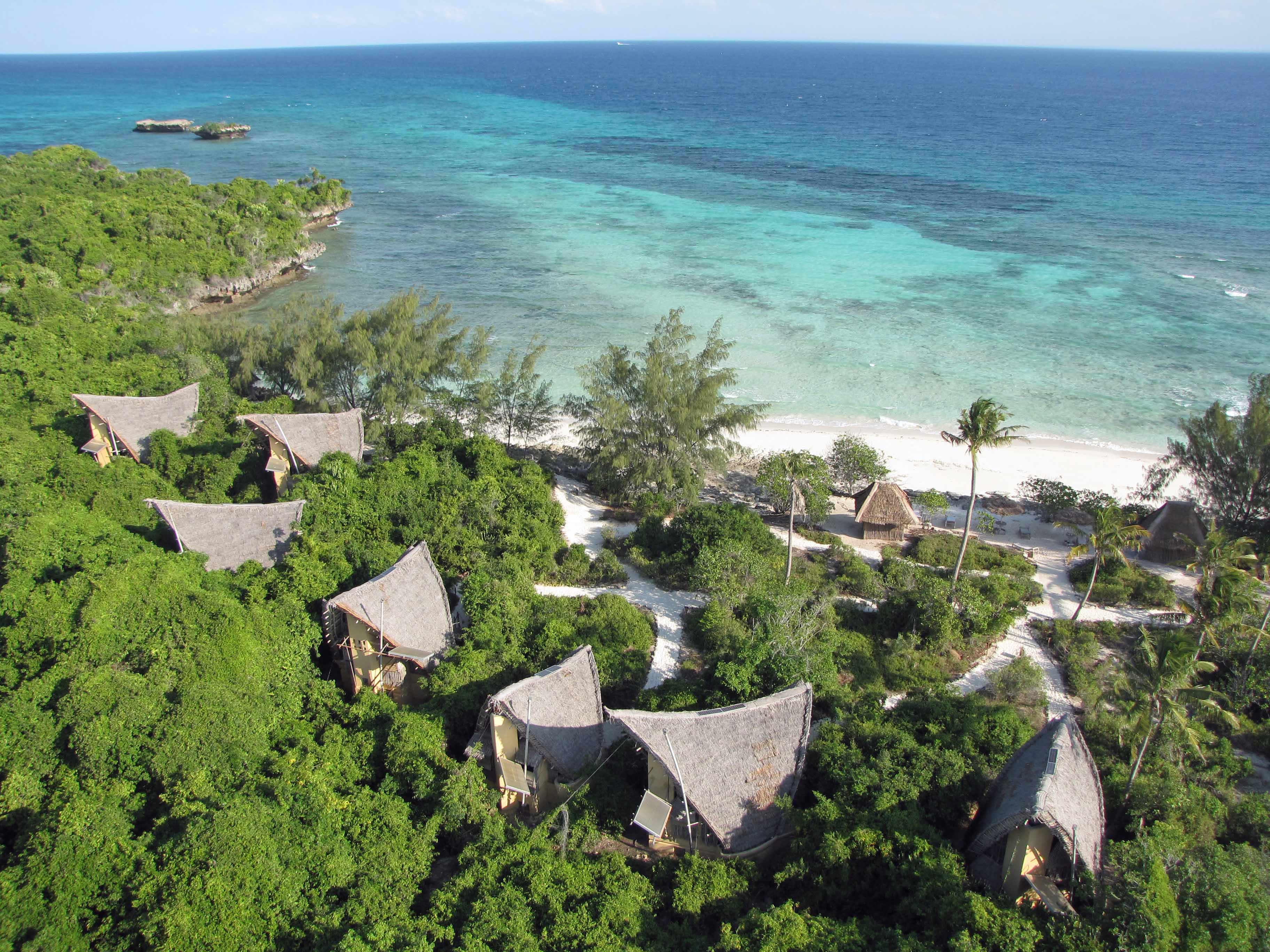
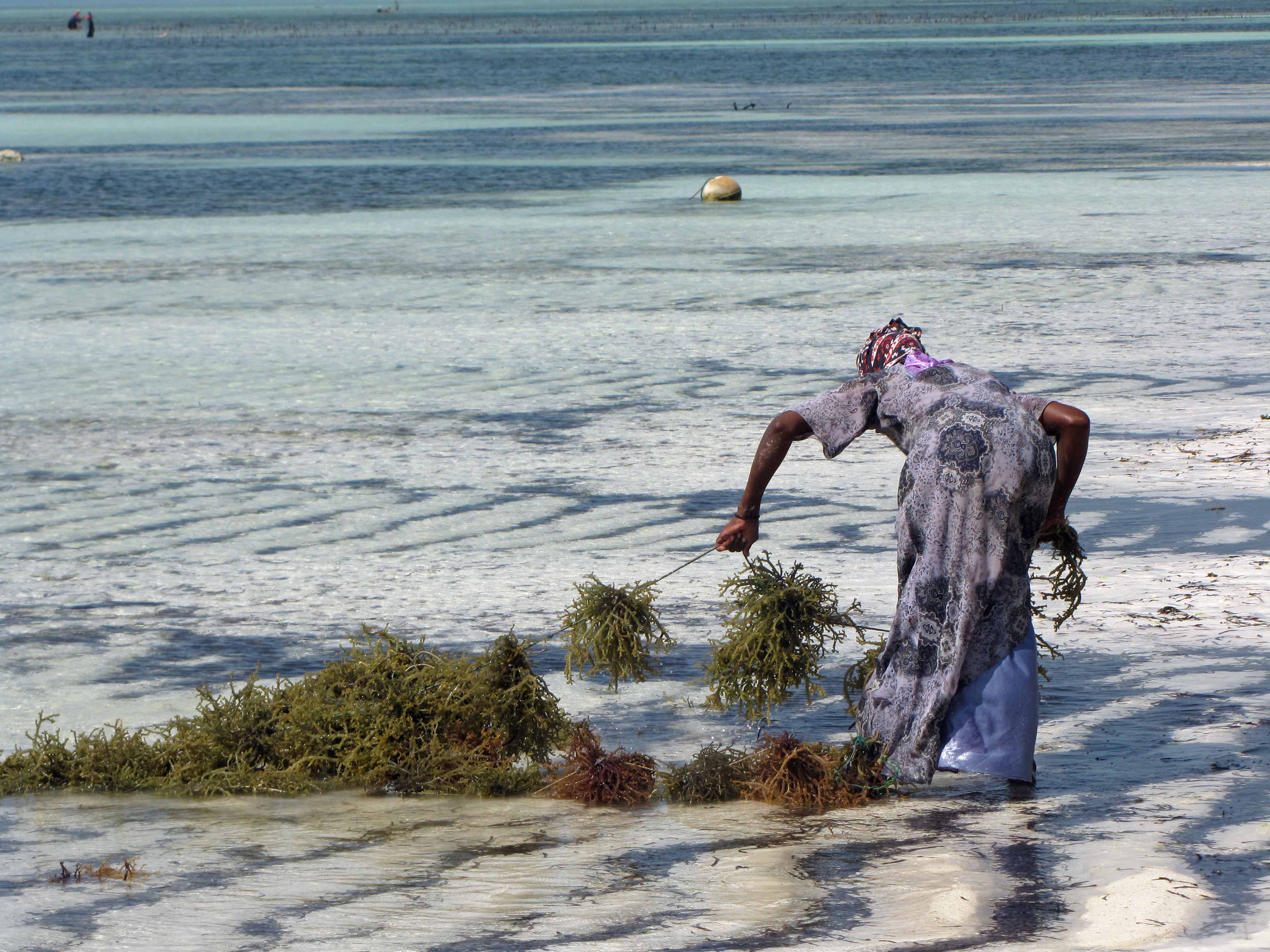
In June my husband and I finally went on a honeymoon (only a year and a half late). We visited the beautiful island of Zanzibar (off the coast of Tanzania) for a little over a week:
Stone Town waterfront, Zanzibar. Picture taken June 2013.Beautiful Chumbe Island, Zanzibar. Picture taken June 2013.A woman gathering seaweed on the beach, Zanzibar. Picture taken June 2013.
A few weeks after our trip to Zanzibar, my husband and I went to the United States for two months– from mid July to early September. Most of the time, we were carrying out field work in Nome, Alaska:
Jackie and I exploring a road outside of Nome, Alaska. Picture taken July 2013.
Before and after our work in Alaska, we also visited my family in New Hampshire:
The view from the Mervine Family lakeside cabin, New Hampshire. Picture taken July 2013.A family of loons on a lake, New Hampshire. Picture taken July 2013.
In September my husband and I spent several days hiking with friends along the beautiful Tsitsikamma Trail in the Eastern Cape, South Africa:
A double waterfall along the Tsitsikamma Trail, South Africa. Picture taken September 2013.
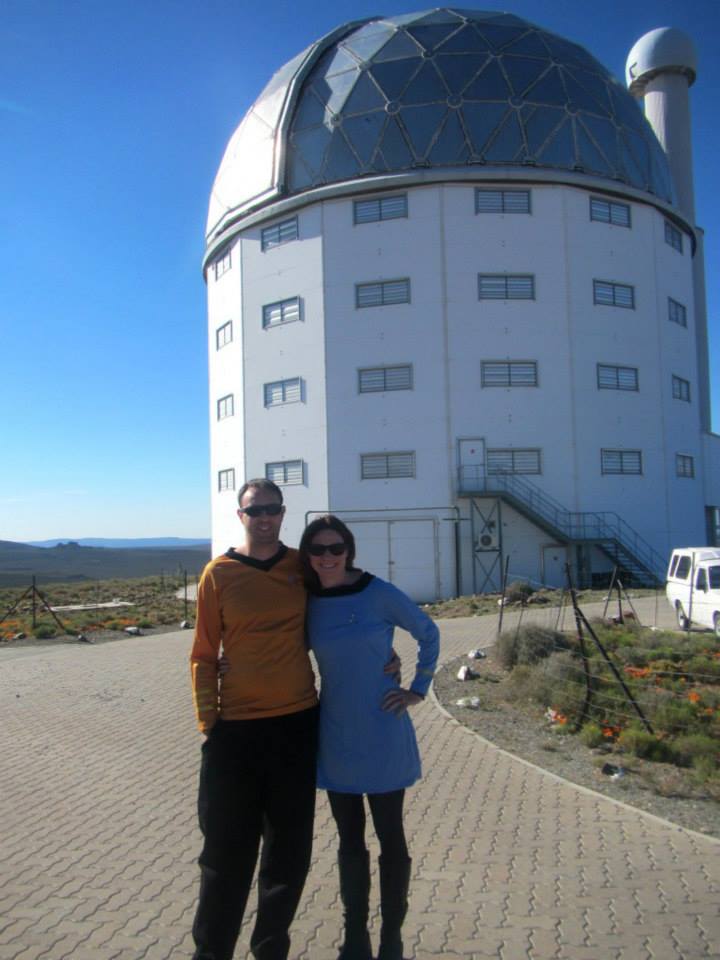
Jackie and I posing in front of SALT. Picture taken October 2013.
We may or may not have worn Star Trek uniforms during our visit.
Last but not least, earlier this month we flew up to Johannesburg, South Africa to visit friends and my husband’s family. We also spent a few days in nearby Secunda and Dullstroom in Mpumalanga:
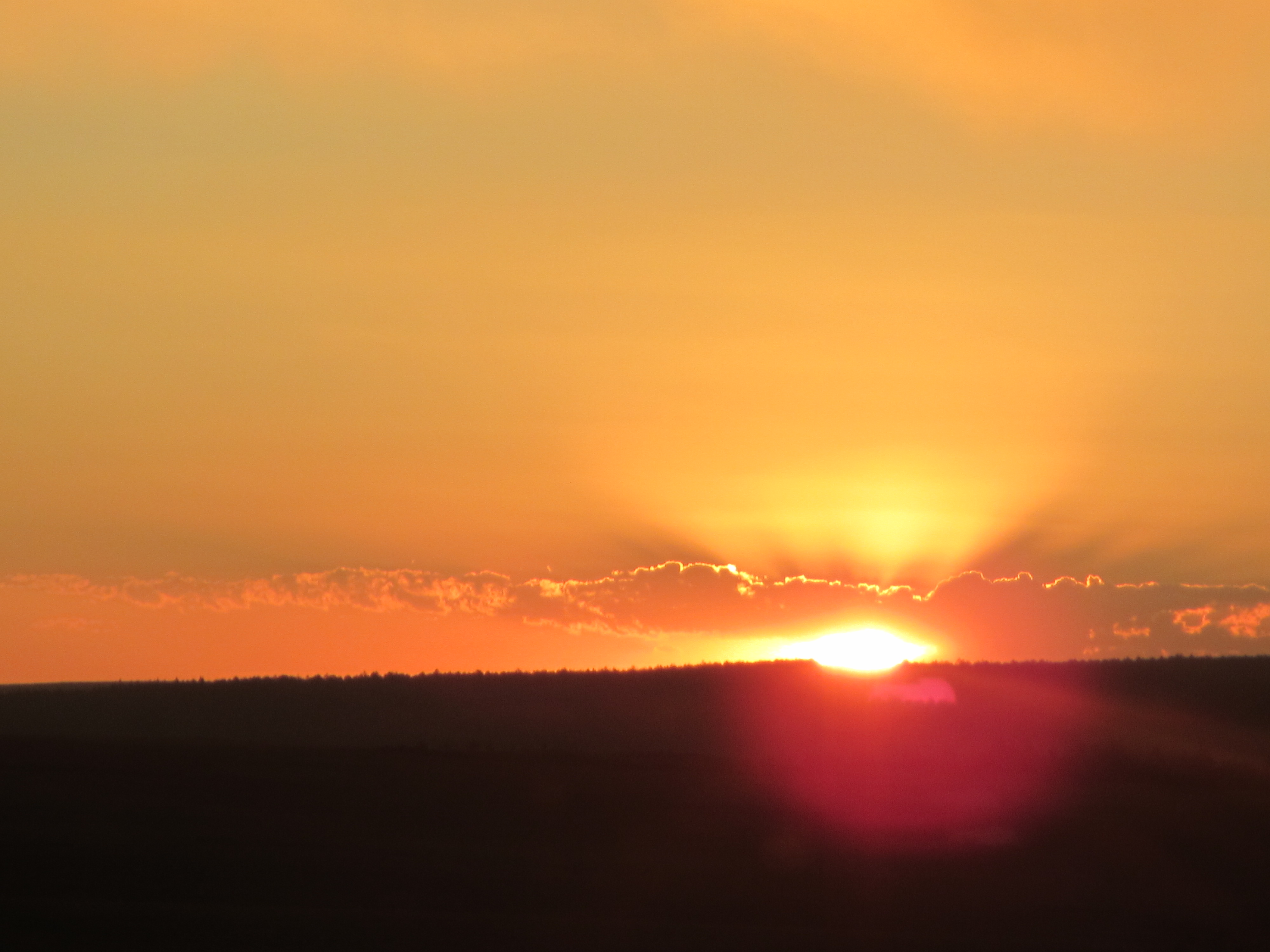
Antelope by the forest in the early evening, Dullstroom, South Africa. Picture taken December 2013.Dullstroom sunset. Picture taken December 2013.
I’m looking forward to another good year of travel in 2014. Happy New Year, everyone!
Two little landslides on Table Mountain. Picture taken December 29th, 2013.
Yesterday my husband and I took advantage of the sunny summer weather here in Cape Town and went for an easy walk along Constantia Nek, a contour path along Table Mountain that eventually leads to the beautiful Kirstenbosch Gardens. Along the walk, I noticed a few small landslides on Table Mountain, including the two shown in the picture above. If you’re looking for an easy and beautiful hike in the Cape Town area, I recommend Constantia Nek. There’s some interesting geology to see along the way… including, at the moment, some landslides.
I’ve been meaning for months to post some pictures from the LASI V Field Trip that I participated in just over a year ago in November 2012. However, despite my best intentions, I never ended up posting some field trip pictures. This is primarily because I lost all of my own LASI V field trip pictures when my laptop and a hard drive were stolen from my apartment back in April. I was quite upset about this and have now diligently backed up all of my computer data online as well as on multiple hard drives. Fortunately, my fellow field trip participants Ben Manton and Stephanie Scheiber were kind enough to send me some of their pictures to share with you here on Georneys.
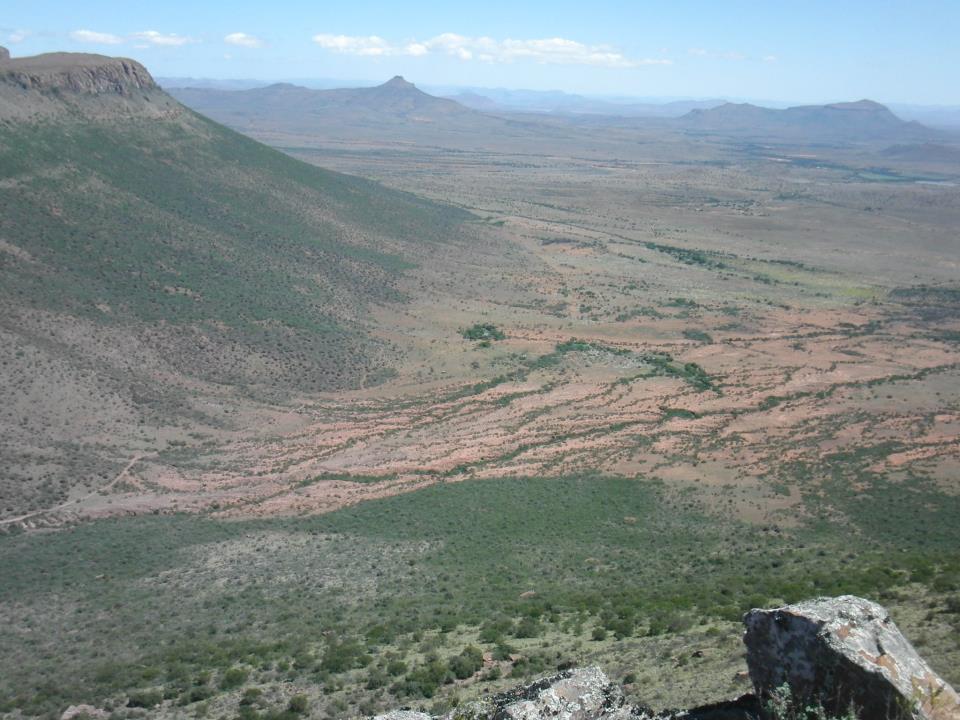
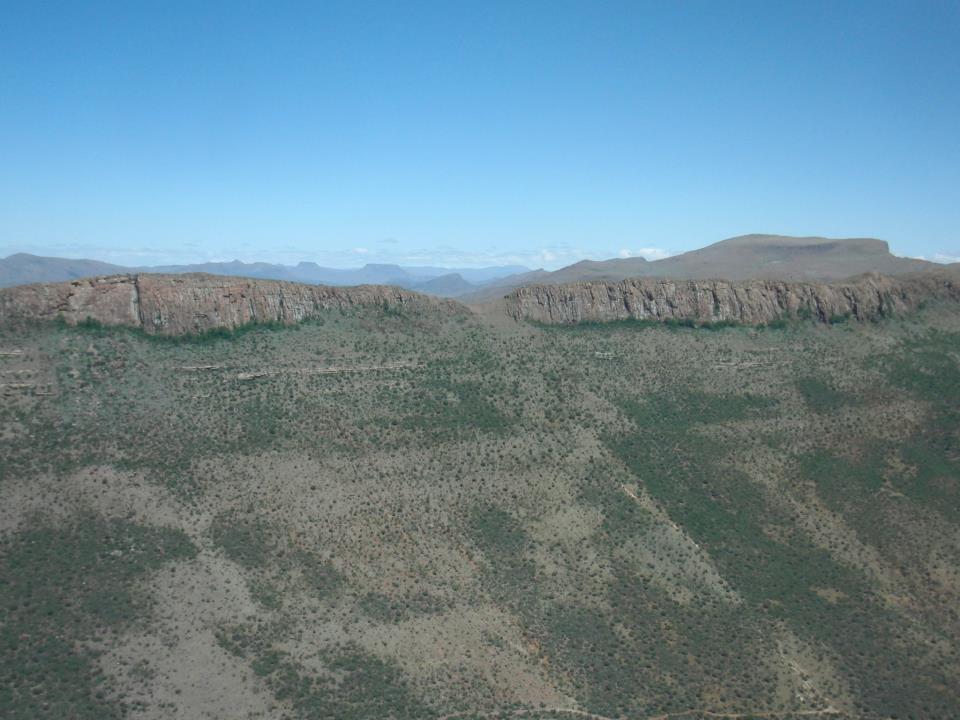
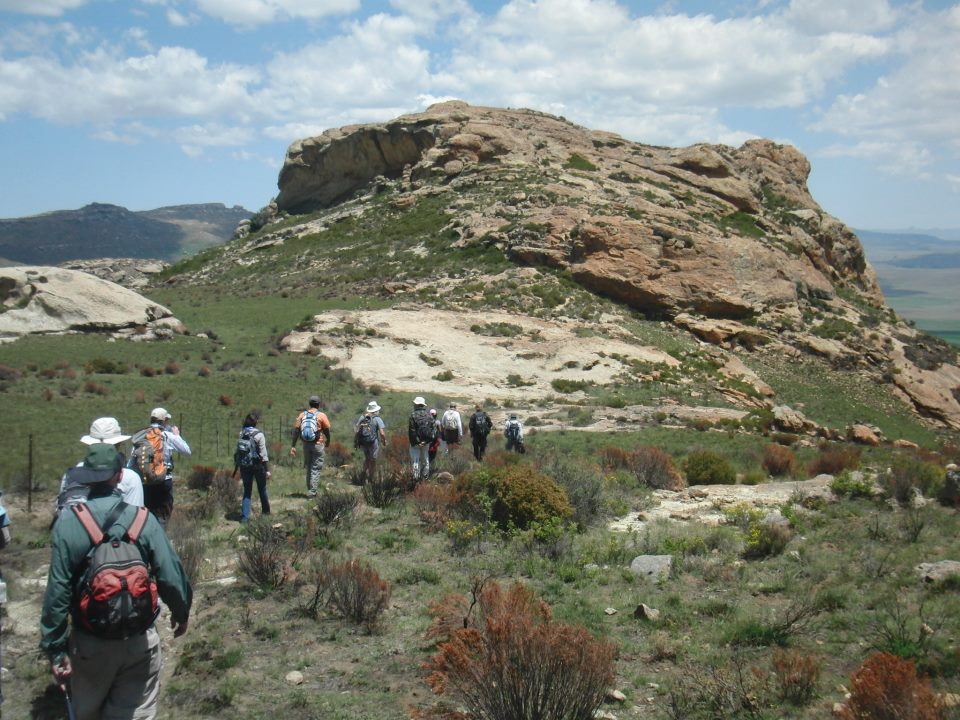
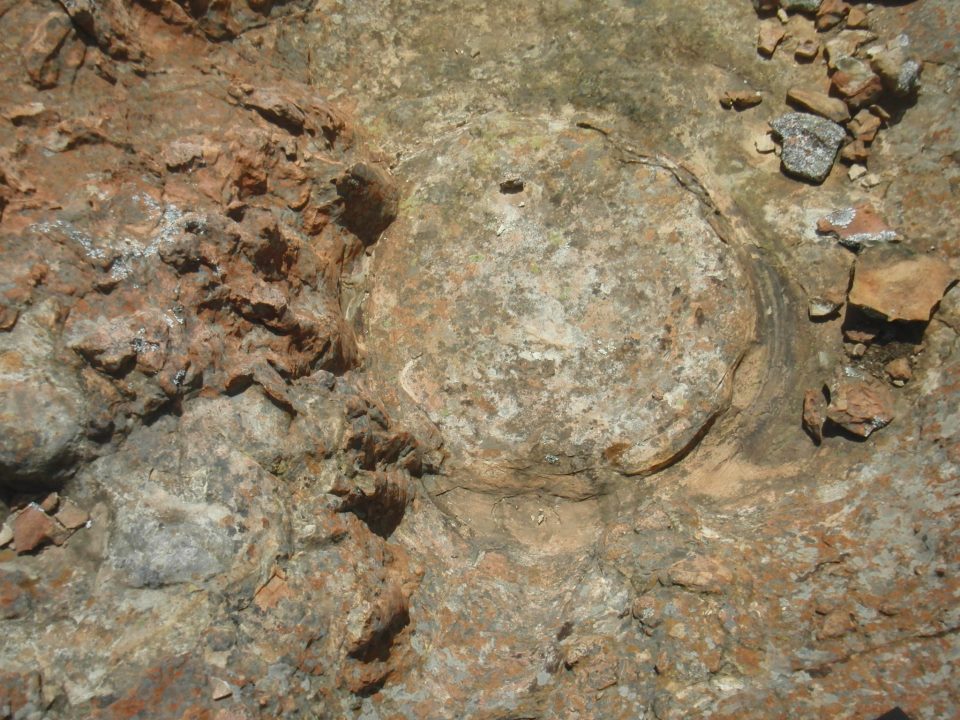
In the interest of wrapping up a few things here on Georneys before the end of the year, I thought I’d (finally!) share some pictures from the LASI V field trip. You can find my previous posts about LASI V here. A good introductory post about LASI V is here. In brief, the LASI V workshop was a gathering of geologists from around the world to discuss the geology of subvolcanic systems such as sills, dykes, and laccoliths. The field trip went to several places in South Africa’s Karoo region to look at large dolerite sills, hydrothermal vent complexes, and other subvolcanic features which have intruded into various sedimentary units.
Without futher ado, here are some pictures from the LASI V field trip:
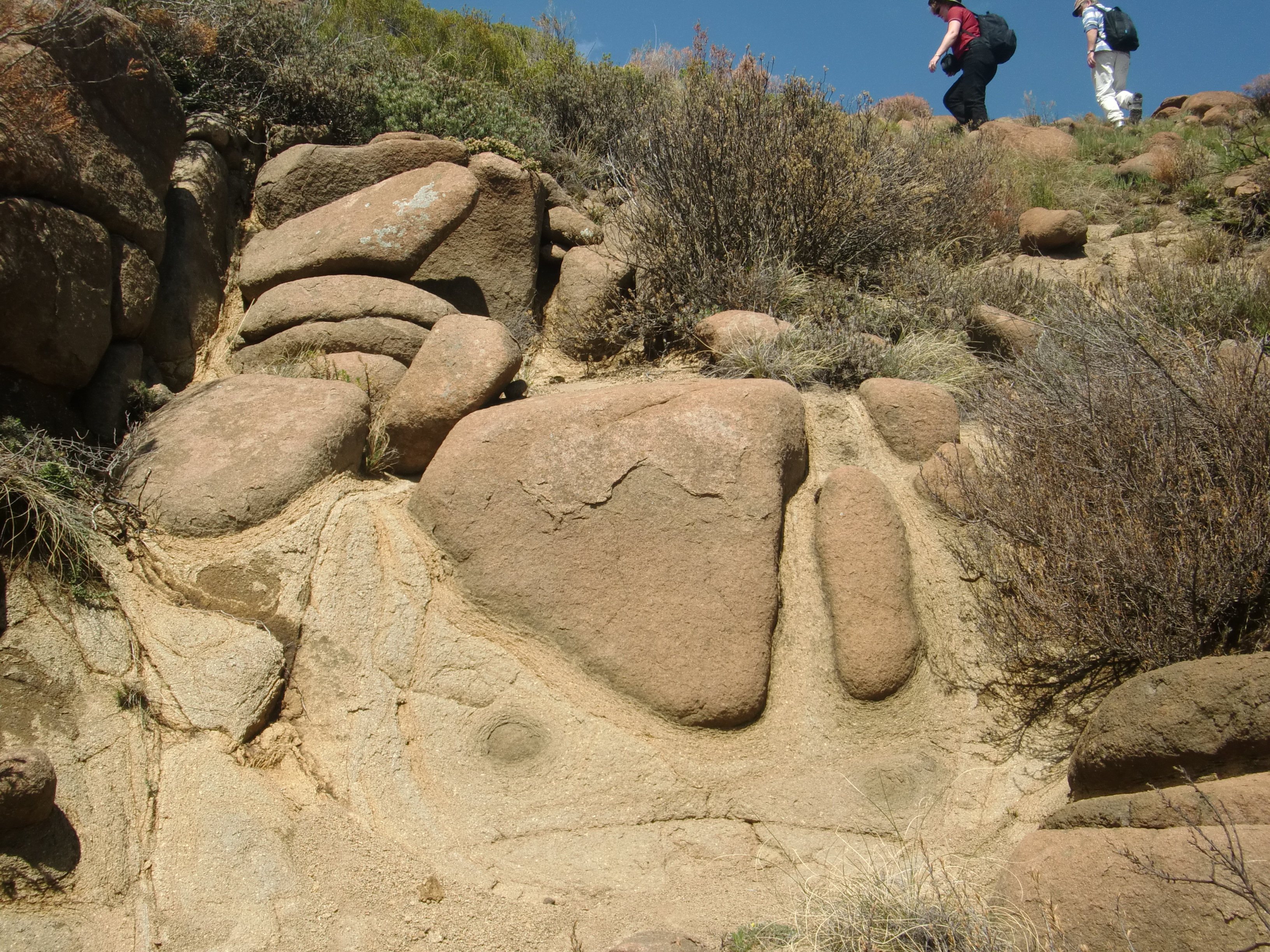
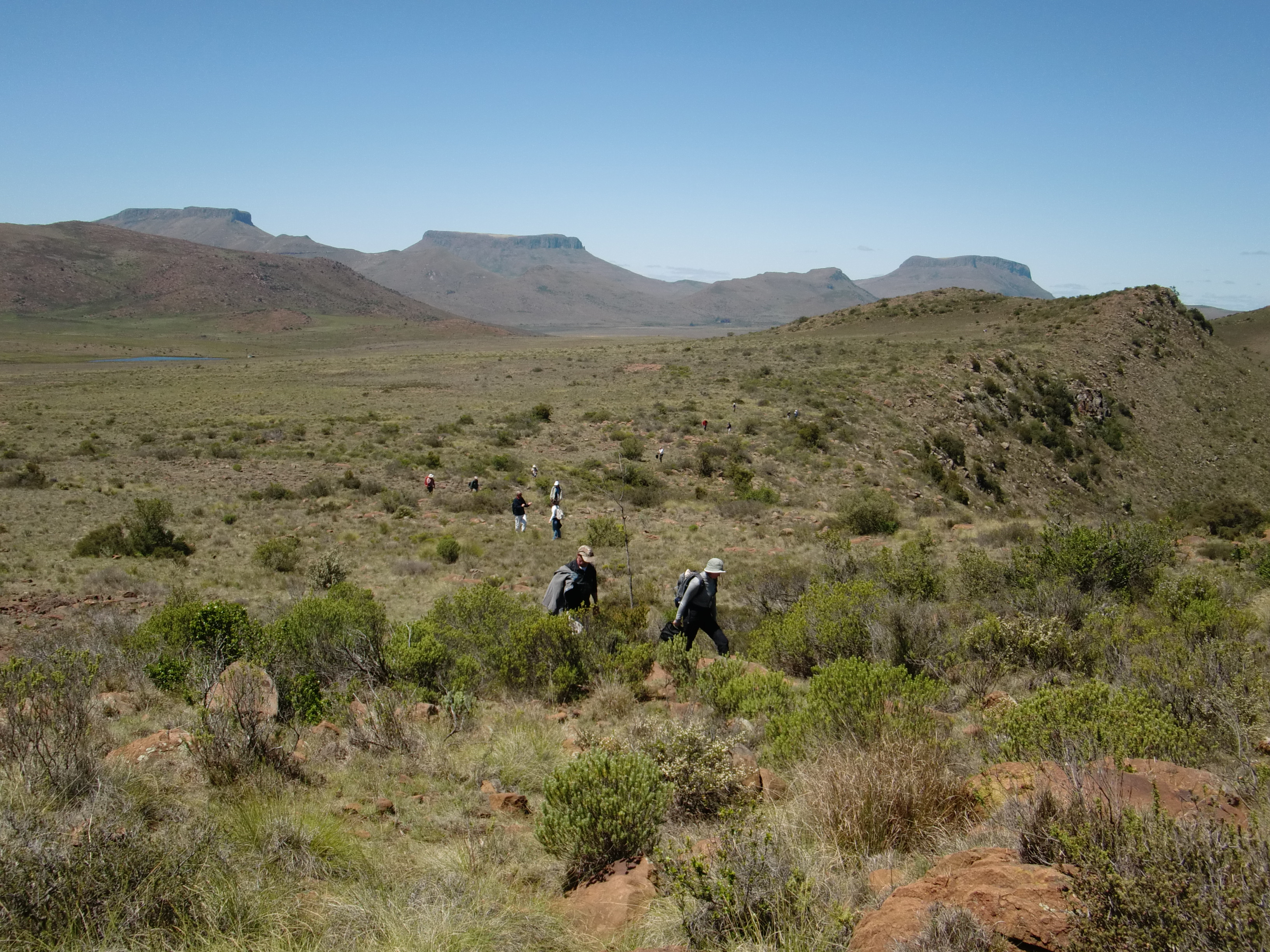
Dolerite sills on top of a hill, with termite mounds in the foreground. Picture courtesy of Ben Manton.The view from the top of a dolerite sill in the Golden Valley region. Picture courtesy of Ben Manton.Impressive dolerite sills in Golden Valley. Picture courtesy of Ben Manton.A beautiful view in the Karoo. Picture courtesy of Ben Manton.Whitkop, a hydrothermal vent feature. Whitkop means “white head” or “white little hill”. Picture courtesy of Ben Manton.Fluid flow features on Whitkop. Picture courtesy of Ben Manton.Circular pipe structures on Whitkop. Picture courtesy of Ben Manton.Checking out some geology (spherical weathering, among other things) on a steep slope. Picture courtesy of Ben Manton.Another beautiful view in the Karoo. Picture courtesy of Ben Manton.Impressive spheroidal weathering of a dolerite sill. Picture courtesy of Stephanie Scheiber.More spheroidal weathering. Picture courtesy of Stephanie Scheiber.Dwyka tillite, one of my favorite rocks! Picture courtesy of Stephanie Scheiber.Another view of Dwyka tillite. Picture courtesy of Stephanie Scheiber.A hydrothermal vent complex… with cows. There are many. many cows and sheep in the Karoo! Picture courtesy of Stephanie Scheiber.A windmill and termite mounds in the foreground, dolerite sills in the background. Picture courtesy of Stephanie Scheiber.Geologists amongst the dolerite sills. Picture courtesy of Stephanie Scheiber.
A snapshot of our Christmas / Newtonmas tree this year. The ornaments are mainly Star Trek ornaments and carved wooden ornaments that I picked up during geological field work in Alaska.
The annual Georneys “What to Buy a Geologist for Christmas” list is a little late this year. Sorry about that– I’ve been extremely busy recently, primarily with work. There are some changes afoot in my professional life– I’ll provide an update on that when I can. I feel that December has just flown by. I can’t believe that there are now only 5 days until Christmas! However, there is still one shopping weekend left before Christmas (or Newtonmas, for those of you who aren’t particularly relgious). So, I thought I’d once again suggest some things that a geologist might like for Christmas. Be sure to also check out the 2010 (Part I and Part II), 2011, and 2012 lists. And happy holidays!
Without further ado, here are some suggestions of what to buy the geologist in your family for Christmas:
For the planetary scientist in the family, a LEGO Curiosity Mars Rover makes the perfect gift! Your family member will first enjoy (as scientists and engineers do) assembling the gift and then will enjoy playing with the gift. No doubt the LEGO Curiosity will become a fixture in your family member’s office or research laboratory.
Buying the LEGO Curiosity is important because the design came into production through voting for a fan-based design on LEGO’s CUUSOO website. Please buy LEGO Curiosity so that LEGO can see that scientific models sell and will consider producing more of them in the future. Personally, I still very much hope that LEGO will produce the Alvin Deep Sea Submergence Vehicle model– so go vote for that model, too!
Unfortunately, the LEGO Curiosity is only being released on January 1st. However, you could make up a little voucher for the gift and put it in a card.
Cost: $29.99
Gift #2: Munsell Color Chart Book
Munsell Soil Color Book. Picture taken from Munsell website.Munsell Rock Color Book. Picture taken from Munsell website.
Geologists, particularly soil scientists, enjoy describing the colors of the samples that they study. The best way to accurately and consistently describe the colors of soils and rocks is to use a color system. One of the best color systems, particularly for soil colors, is the Munsell color system. In order to follow this system, the colors of soils or rocks must be compared to standard color charts, which are available in books published by Munsell. There are two books: one with soil color charts and one with rock color charts.
Cost: $198 for the soil book and $78 for the rock book
Gift #3: 3D Earth Puzzle
Ravensburger The Earth – 540 Piece Puzzleball. Picture from Amazon.com.
Geologists love globes, and many geologists also like puzzles. For the puzzle-loving geologist in your family, a 3D Earth puzzle could be the perfect gift. There are a few companies who make 3D Earth puzzles. The picture above is a nice puzzle by Ravensburger that is available on Amazon.com here.
Cost: $20 to $50
Gift #4: A Geology Themed Book
I’ve suggested geology books before in my “What to Buy a Geologist for Christmas” lists. There are many excellent geology books– both technical scientific books and popular science books. Here are a few geology themed popular science books that I’ve read recently and enjoyed:
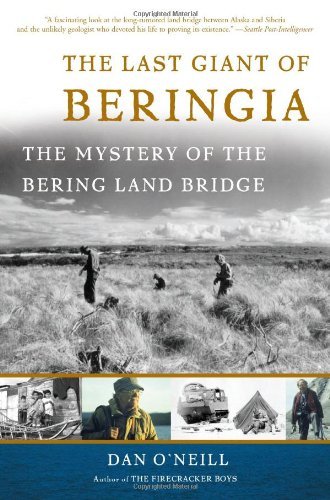
The Last Giant of Beringia book. Picture taken from Amazon.com.
The Last Giant of Beringia: The Mystery of the Bering Land Bridge by Dan O’Neill. This is a book about David Hopkins, a famous geologist who recognized the importance of the Bering Land Bridge and made significant contributions to the understanding of the geological history of the Beringia region.
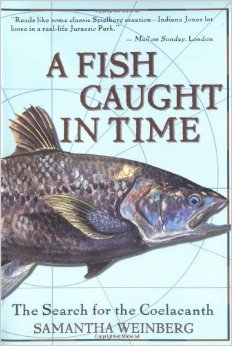
A Fish Caught in Time book. Picture taken from Amazon.com.
A Fish Caught in Time: The Search for the Coelacanth by Samantha Weinberg. This book is about the Coelacanth, a fish that was originally thought to have gone extinct at the end of the Cretaceous but which was discovered alive off the coast of South Africa in 1938.
Diamond book. Picture taken from Amazon.com.
Diamond by Matthew Hart. This is a well-written book exploring diamonds and the diamond industry. The subtitle of the book varies depending on the edition.
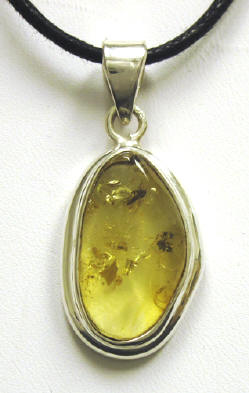
I’ve always wanted a piece of amber jewelry with a fossil insect (or several) inside the amber. I don’t own such a piece of jewelry but hope to some day. While the non-geologists in your family might not appreciate such amber jewelry, the geologist in your family is bound to love such a gift. If you want to make the gift really great, throw in a copy of Jurassic Park. Although it is scientifically implausible that dinosaur DNA could be preserved in an insect fossil in amber, the jewelry and book combination will nevertheless make a super fun gift for a geologist.
Cost: Variable, generally $100 to $250
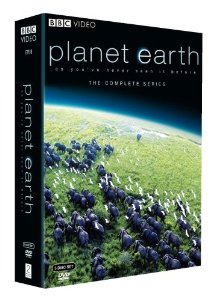
Gift #6: Planet Earth DVD Set
Planet Earth DVD boxed set. Picture taken from Amazon.com.
This BBC documentary series came out in 2007 and features some stunning footage of the Earth in episodes with themes such as “Caves”, “Deserts”, and “Jungles”. The series is currently available for a bargain on Amazon.com.
Cost: $50 to $80 (depending on whether or not it’s on sale)
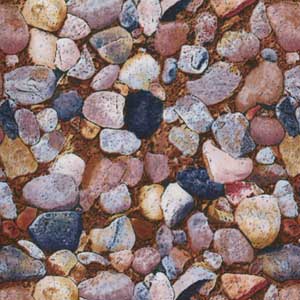
Is the geologist in your family fond of sewing? Or are you fond of sewing? Then why not buy some rock fabric that can be made into a fun tote bag, tablecloth, shirt, skirt, or other item? There are some lovely rock fabrics available. For example, here is one and here is another for sale on the Keepsake Quilting website. Be prepared, however, for some puns about rock fabric.
Cost: About $10 per yard of fabric
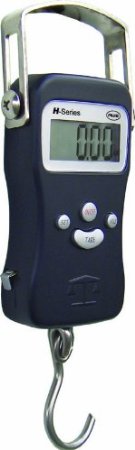
Gift #8: Hanging Luggage Scale
Hanging luggage scale. Picture taken from Amazon.com.
All geologists have had a conversation that goes something like this:
Airport Check-In Agent: Woah. This bag is really heavy. What do you have in here, rocks?
Geologist: Of course. I’m a geologist.
Rocks are heavy, and thus the bags of geologists are often heavy– either with geological samples collected during field work or with souvenir rocks collected during holidays. A portable hanging luggage scale can help the geologist in your family carefully distribute rocks in their various bags in order to avoid airline overweight charges and/or annoying last-minute repacking in an airline check-in queue.
Cost: About $15 to $20
Gift #9: Waterproof and Shockproof Digital Camera
Cannon waterproof and shockproof camera. Picture taken from Amazon.com.
Geologists like taking pictures but often need a sturdy camera that isn’t affected by the elements (rain, sleet, snow) and which can withstand being knocked around in a field bag or accidentally dropped a few feet. Thus, a waterproof and shockproof camera is a great gift for a geologist. Personally, my geologist husband and I own this Canon waterproof and shockproof camera and are very happy with it.
Cost: Variable, generally $100 to $300
Gift #10: Safari Vest
A vest with many pockets. Picture taken from Amazon.com.
When they work in the field, geologists carry many things: notebooks, pencils, rulers, compasses, GPS devices, bottles of acid, hand lenses, snacks, maps, and so on. Geologists often want easy access to the various items that they carry into the field. Thus, a Safari Vest (a vest with many pockets, usually in a tan or green color) is a perfect garment for geologists to wear in the field. If the geologist in your family does not yet own a Safari Vest (or even if they do– the vests wear out after awhile), consider giving them one for Christmas.
A delightful juxtaposition of rock arches and blue sky, Arches National Park, Utah, Fall 2005.
For this week’s “Monday Geology Picture” post I thought I’d share a picture that I took in Arches National Park in Utah back in 2005. This picture shows a rock feature known as “The Double Arch”. Stunning, isn’t it?
I apologize that blogging has been somewhat light recently. Work and a few other matters have been keeping me quite busy. However, I have a few more substantive posts in the works. There are a few things that I would like to post before the end of the year– more soon!

























 Georneys