This week’s “Monday Geology Picture” features a pretty pink rock lamp owned by some friends of mine. Many pink rock lamps are made out of salt crystals. However, this particular rock lamp is made out of a rose quartz crystal. The lamp is placed on top of a flat muscovite crystal.
(Fake) boulders on display at the Cape Town International Airport.
Boulder’s Beach is a popular tourist attraction in the greater Cape Town area. At Cape Town International Airport, a small section of the airport has been decorated to resemble Boulder’s Beach, giant (fake) boulders and all! I enjoy walking past this decorated area every time I travel to the airport. Of course, even better is visiting Boulder’s Beach for real. For example, see some pictures from my visits here and here. I hope that the airport decoration inspires some tourists to go and visit Boulder’s Beach during their visits to beautiful Cape Town.
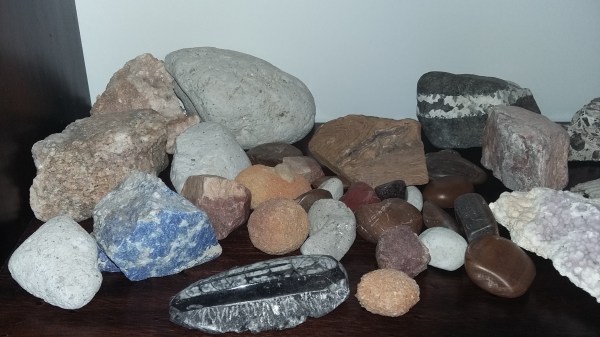
Like many geologists, I like to decorate with rocks. This week’s “Monday Geology Picture” features some rocks on a shelf in my living room. There’s many more rocks on this shelf — this picture just shows a few of them. What do you spot in this picture? Among other things, I see an orthoceras fossil, some volcanic pumice, a botryoidalcarbonate rock, a rock with a vein of gabbro, sandstoneconcretions, and some chert.
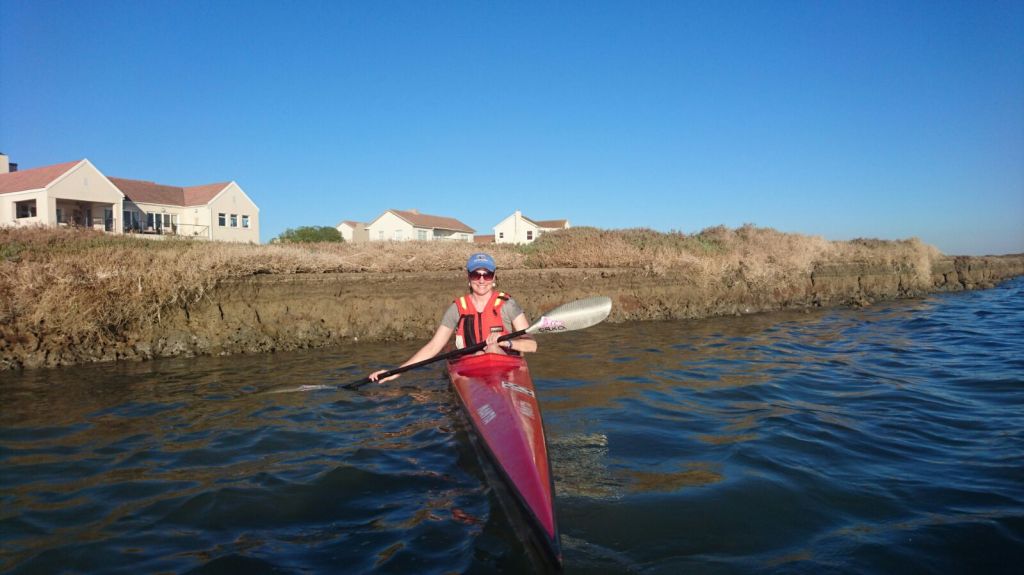
Investigating soil horizons by kayak, Berg River Mouth, South Africa, February 2016.
A few weeks ago I participated in a kayak race on the Berg River a few hours north of Cape Town, South Africa. I went on a short warm-up paddle the evening before the race. While on this paddle, I couldn’t resist checking out some soil horizons that were visible along the river in several places. In the picture above, I am posing next to some soil horizons. You can see the horizons of surface soil and subsoil.The organic soil horizon is also visible although due to drought the vegetation is pretty dry. Geology by kayak is wonderful… it combines two of my favorite things! I should try to see more geology by kayak.
Elephant’s Eye on a rainy Saturday in February 2016.
This week’s “Monday Geology Picture” post features a natural rock formation that resembles an elephant. A small cave named “Elephant’s Eye” is located at the eye of this rock elephant’s head. The elephant consists of Table Mountain Sandstone and is located in the Silvermine Nature Reserve here in the Cape Town region of South Africa. On Saturday I hiked up to Elephant’s Eye with some friends. We hiked on a rare rainy summer day, and we appreciated the cooler weather for our hiking. The scenery on our hike was ethereal and beautiful, although we didn’t have much of a view from the top of the hill! We mostly saw mist. I’ll share some more pictures from our hike later this week.
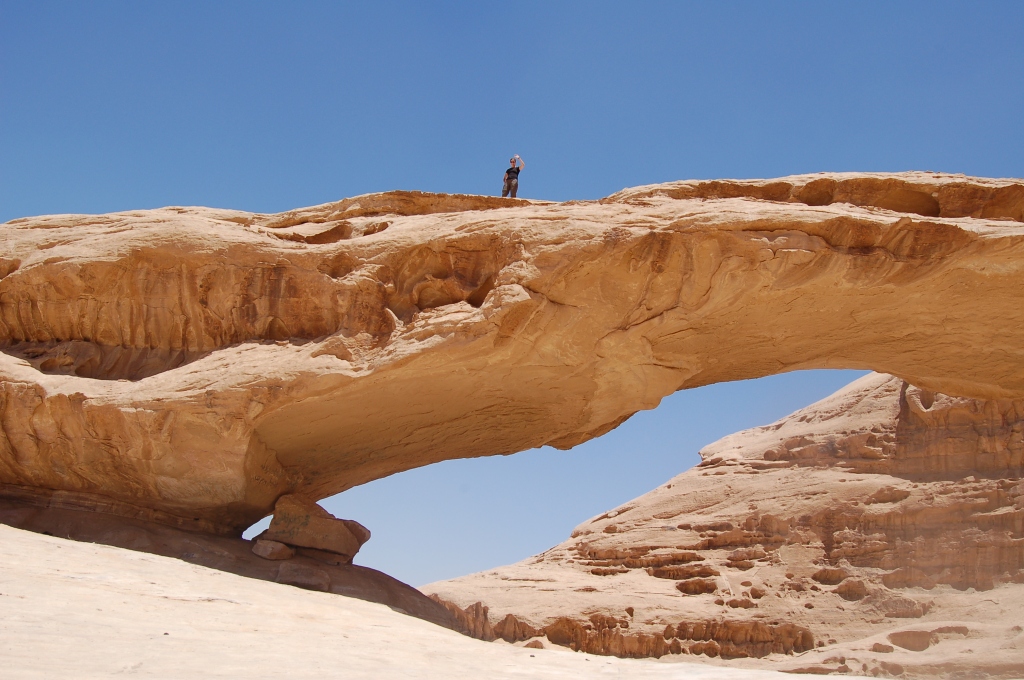
Yours truly on top of a rock arch, Wadi Rum, Jordan, circa 2007.
Ever wonder about the lovely artwork that is featured in my blog title? That artwork was inspired by a real picture, which I’ve decided to feature in this week’s “Monday Geology Picture” post. The above picture was taken in Wadi Rum, Jordan back in 2007. Wadi Rum is a magical place. You can see some more of my pictures of Wadi Rum here.
A great shot of the Great Barrier Reef taken by my husband Jackie Gauntlett. Can you see me in the background?
For today’s “Monday Geology Picture” post I thought I’d share one shot of the Great Barrier Reef that my husband took during our vacation to Australia last year. Stay tuned for some more pictures from that trip! One of the items on my blogging to-do list is sharing some more pictures and information from our Australian adventure.
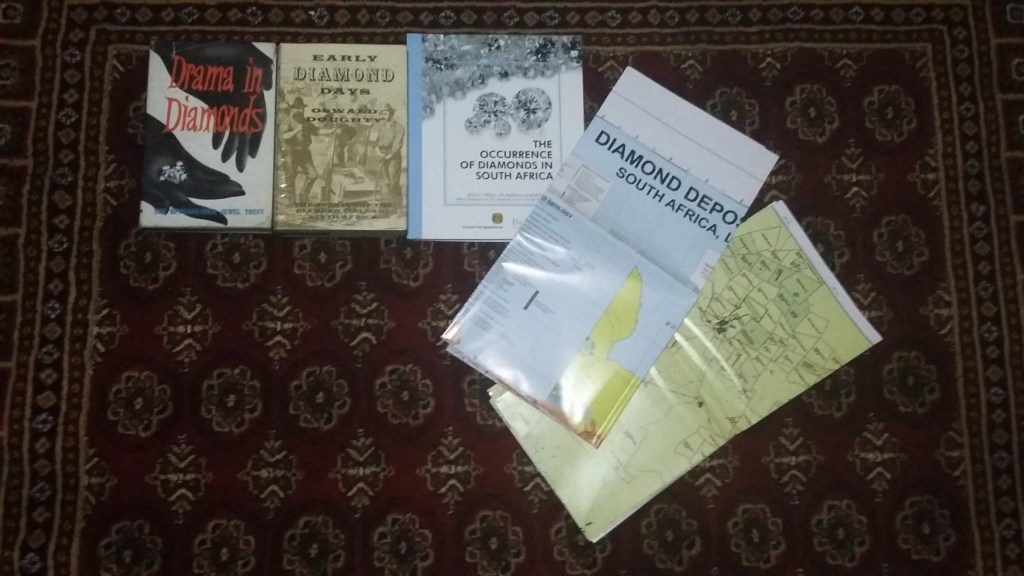
Three books on my reading list… one book comes with two maps!
Since I started working for De Beers a little over two years ago, I’ve slowly but surely been learning all about diamonds and diamond geology. I’ve also been learning about the history of diamond mining in southern Africa and elsewhere in the world. In some other posts, I’ll have to share a little about the books on diamonds that I’ve already read. However, for this week’s “Monday Geology Picture” I thought I’d share a picture of three of the next books on my diamond reading list. I’m particularly excited to read the book on occurrences of diamond in South Africa – it comes with two great maps!
My beautiful Himalayan salt lamp, illuminating our living room at night.
Although I haven’t yet featured such a gift on my annual What to Buy a Geologist for Christmas list, some of my wonderful relatives recently bought me a rock lamp for Christmas. Specifically, they bought me a pink colored Himalayan salt lamp. The lamp consists of a large crystal of salt, or sodium chloride, that is mounted on a pretty wooden stand. The lamp provides a lovely, soft, pale pink light. We turn the lamp on every evening to illuminate our living room, and we sometimes leave the lamp on overnight as a night light.
I absolutely love my salt crystal lamp. I mean, what’s not to love? It’s a rock that’s also a lamp, and that in and of itself is awesome. I really like the look of the lamp and its soft light. I even find looking at the lamp somewhat peaceful. It’s nice to have such a beautiful object in our living room.
All that said, unlike many people I do not believe that my salt crystal lamp has any healing powers… or that it has any substantial health benefits at all. Despite what many people say on the internet and elsewhere, Himalayan salt lamps do not emit significant quantities of ions, nor any sort of other magical “positive energy waves”. Most (probably all) of the supposed health benefits of Himalayan salt lamps are absolute rubbish. I say that as a geologist and not a medical professional, but several people agree with me – for example, see here and here. As someone with geochemical expertise, I can attest that Himalayan salt lamps are certainly not emitting special streams of ions. That is, they’re not emitting any special ions nor high quantities of ions – and turning the lamp on or off won’t significantly impact how many ions the salt crystal in your lamp releases.
At most, my salt crystal lamp slightly decreases my stress level by being a beautiful object to look at. And, really, isn’t that enough?
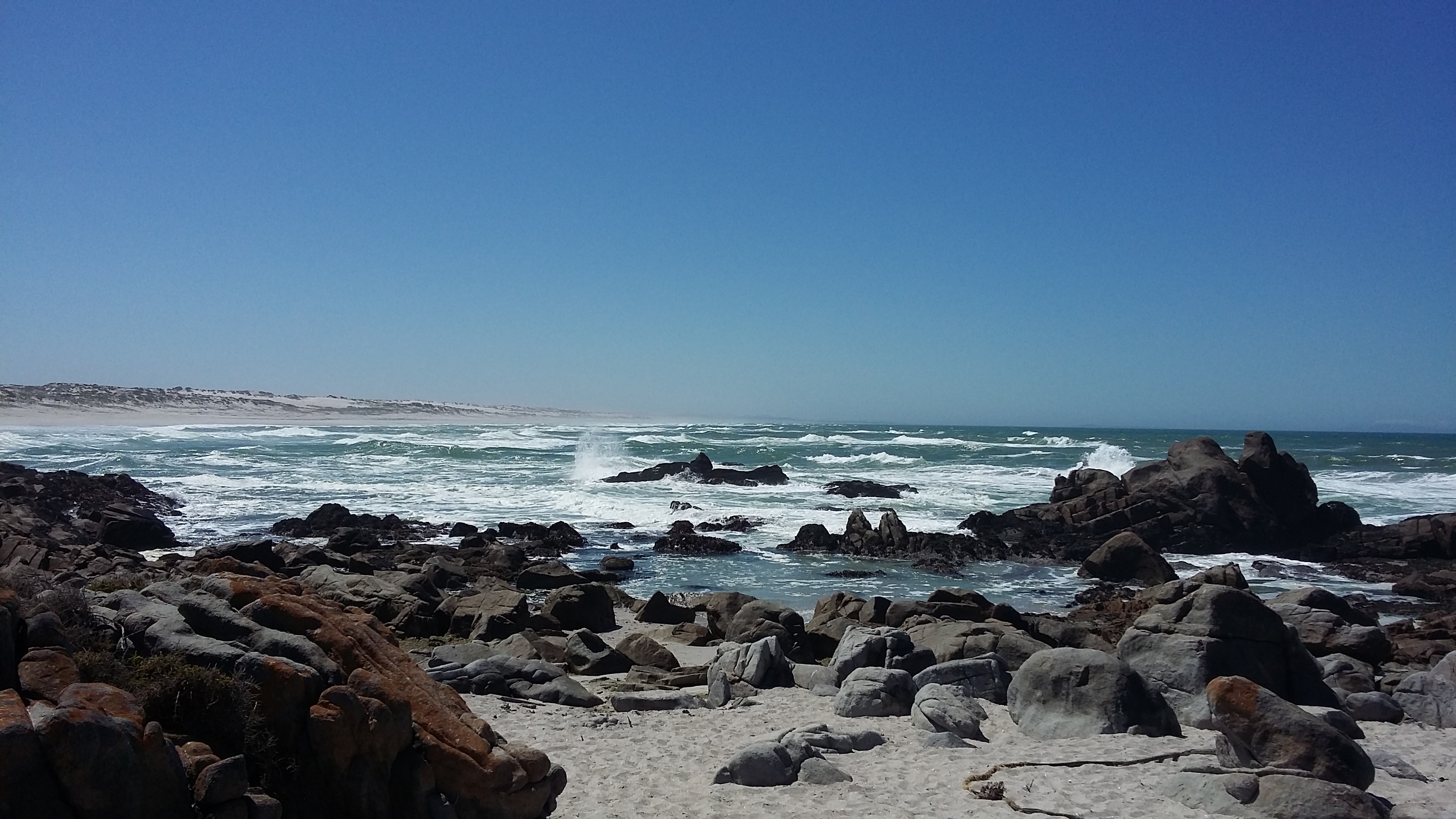
For this week’s Monday Geology Picture, here are some lovely granitoid beach rocks along the Atlantic Ocean at Langebaan, South Africa. I visited Langebaan again this past weekend with some family. Stay tuned for some pictures from the fossil park near Langebaan!






 Georneys