Monday Geology Picture: Gold Train

Posing with the bullion coach at Gold Reef City.

This week I’m sharing a picture of a bullion coach, or a special train that was used to transport gold from the mines in the Johannesburg area to the seaside towns of Durban and Cape Town in South Africa. This particular train is on display at Gold Reef City, a gold mining themed amusement park. You can go and see the train yourself if you visit the park.

Gold theft has long been a problem in the mining industry — and continues to be a problem to this day. Trains such as this are not used anymore (at least not here in South Africa), but for many years heavily fortified trains such as this were the primary way that gold was transported. In addition to the special armor, the train had several guards who lived aboard the train.

Look at the thick doors of the train and the special safe used to store the gold:

Posing with the thick doors of the train. These pictures were taken last year when I was 7 months pregnant with my son.


The gold safe inside the train.

Monday Geology Picture: Pele’s Hair

Pele’s Hair – or “Cheveux de Pele” in French.

For this week’s post, here’s a picture showing a lovely example of Pele’s Hair, which is a type of volcanic glass that consists of fibers or thin strands.

Although I’ve visited many volcanoes (including a few active ones) over the years, I’ve never seen Pele’s Hair in the field. So, I was quite happy to see this excellent example in the volcano museum on Réunion Island. I visited the museum during my vacation to the island last year. If you ever find yourself on the island, visiting the museum is a must. There are all sorts of wonderful displays and examples of different lava types, including this fantastic Pele’s Hair sample.

Monday Geology Picture: Constantia Granite

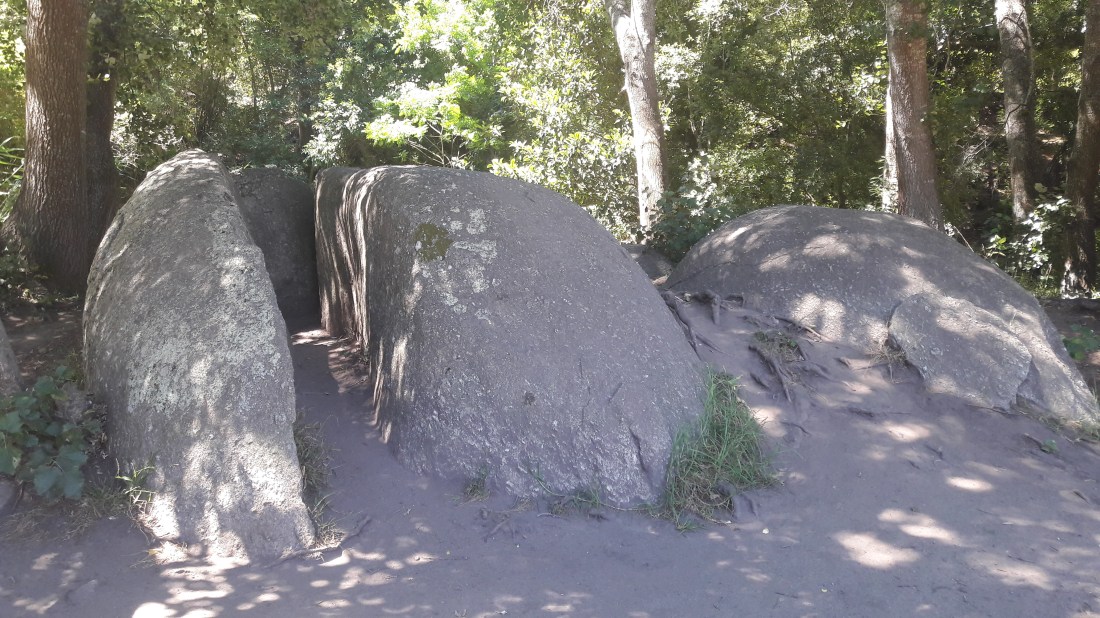
Large granite rocks along a walking trail in Constantia, South Africa. January 2018.

For this week’s post, here’s a picture that I took yesterday during a Sunday afternoon hike with my family. We went for an easy stroll, baby and all, along the Alphen Trail in the Constantia region of Cape Town here in South Africa. My son is 3 months old now, and we’re just starting to go on some easy hikes as a family. The Alphen Trail is more of a walk than a hike, but nevertheless it was nice to spend some proper time outdoors again! In another month or two we hope to embark on some proper hiking.

There is too much vegetation along the Alphen Trail to see much geology, but along one part of the trail I did notice some interesting large granite boulders, which are shown in the above picture. These boulders no doubt belong to the ~550 million year old Cape Granite Suite. Large outcrops or boulders of these granites are commonly seen in the Cape Town area. For example, you can see large granite boulders at some of Cape Town’s beaches. However, I found these Constantia granite boulders interesting due to their weathering. While still quite large, there are clear signs that these boulders are being broken down through weathering. On the right, you can see a nice example of exfoliating granite weathering. On the left, you can see that a large boulder has split in two. In a few parts of the picture, you can see tree roots and other vegetation, which are no doubt contributing to biological weathering of the boulders.

Here’s a close-up view of the exfoliating slab:

Granite boulder, with my foot for scale.

Monday Geology Picture: Vintage Field Vehicle

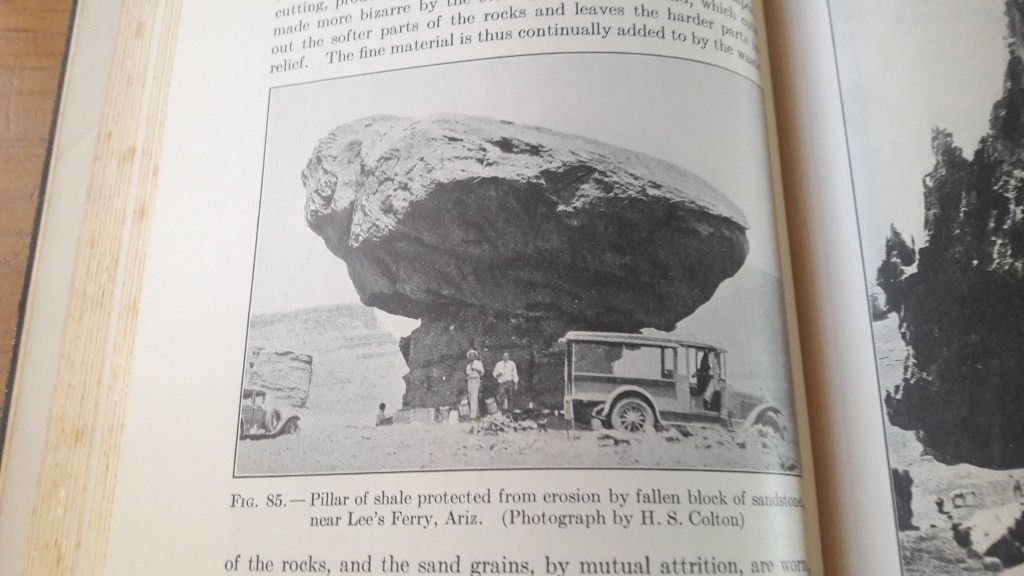
A photo from an old geology textbook. Check out the field vehicle!

I really enjoy looking at old geology textbooks, which often have incredible photos and drawings in them. For example, check out the above photo from an old geology textbook that I picked up at a secondhand bookshop. Look at that vintage field vehicle! Does anyone know what kind of car that is?

The information in old geology textbooks (especially ones published before plate tectonics was understood) is often incorrect, but then again some geology basics – such as rock and mineral descriptions – haven’t changed too much over the past 100 years or so. So, old geology textbooks can still often be useful!

Here are a couple more pictures of the book from which this week’s “Monday Geology Picture” was taken:

Book cover.
Book information.

Monday Geology Picture: Lion’s Head Inselberg

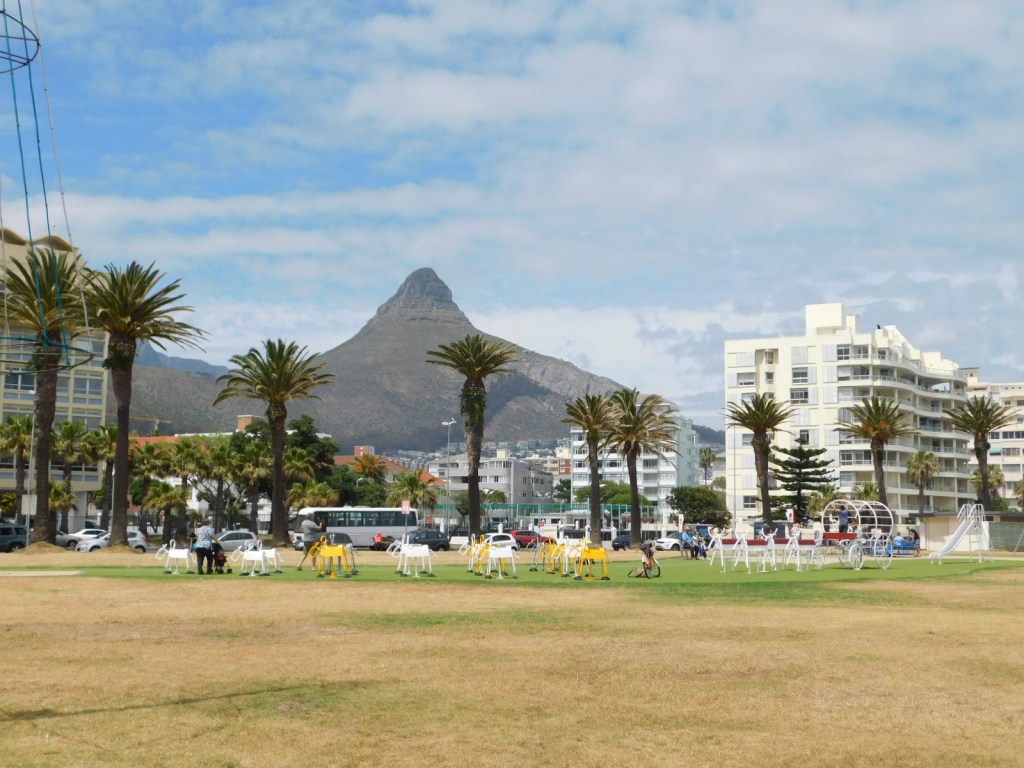
Lion’s Head. Photo taken from Sea Point Promenade, November 2017.

Happy New Year! I’m going to do my best to blog more regularly in 2018, starting with this first “Monday Geology Picture” post. This week I’m sharing a view of Lion’s Head (the distinctive mountain in the background of the picture), an inselberg here in Cape Town, South Africa, the city where I live. I took this picture a few weeks ago during a walk with my family along Sea Point Promenade. Cape Town is a fantastic city — you can see amazing geology even when you’re downtown!

Monday Geology Picture: Garnet Biotite Tabletop

Red garnet and black biotite… in a tabletop! South African coin for scale.

Since re-starting my blogging, I missed a few weeks of weekly pictures. My apologies! Life with a newborn does not leave much extra time, I’m afraid! I’ll try to be more consistent with my blogging in December and going into the new year.

However, I have a great picture for today: a close-up snap of a lovely stone tabletop that I recently saw, believe it or not, at a McDonald’s here in Cape Town — the one near the stadium downtown. You can see some beautiful minerals in this particular tabletop: garnet, biotite, feldspar, and quartz. The dark red garnet and black biotite stand out in particular.

The tabletop was really lovely, with some light and dark gneissic banding.

Here are a couple more views:

Another view of the tabletop.
One last view of the tabletop.

Monday Geology Picture: Inselberg View

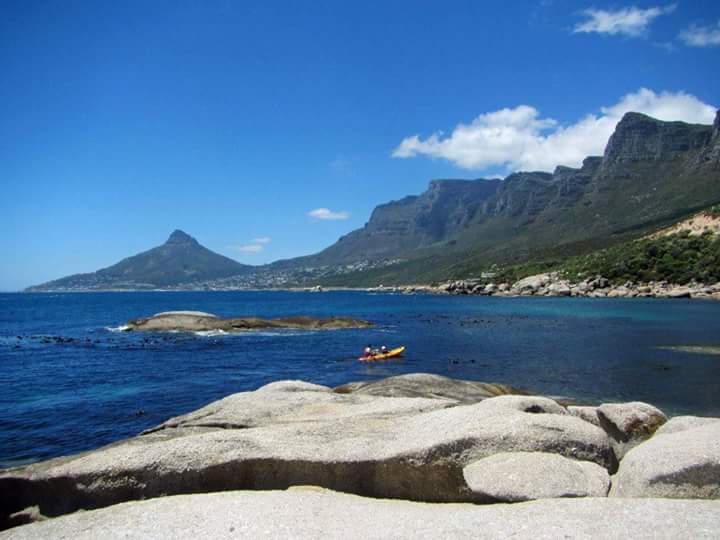
Some fantastic geologic scenery in Cape Town, South Africa: an inselberg (left) and the Twelve Apostles section of Table Mountain (right) in the background, a kayak in the middle, and some granitic rocks of the Cape Granite Suite in the foreground.

For this week’s picture, here’s a lovely view of an inselberg and the Twelve Apostles section of Table Mountain here in Cape Town, South Africa. Note the layers of sedimentary rocks of which the mountain is made. In the foreground, you can see some rocks of the Cape Granite Suite, which is about 550 million years old.

Monday Geology Picture: Basaltic Weathering

Olivine crystals (little yellow-green particles) weathering out of a young basaltic surface.

For this week’s picture, here’s an image of a relatively young basaltic surface weathering. You can see yellow-green olivine crystals weathering out of the dark matrix. Olivine is one of the first minerals to weather out of rocks, so you can tell that these basalts must be young. Older basalts generally don’t contain fresh olivine, at least not any crystals that you can easily identify with the naked eye. I took this picture back in March on Réunion Island, a young volcanic island in the Indian Ocean.