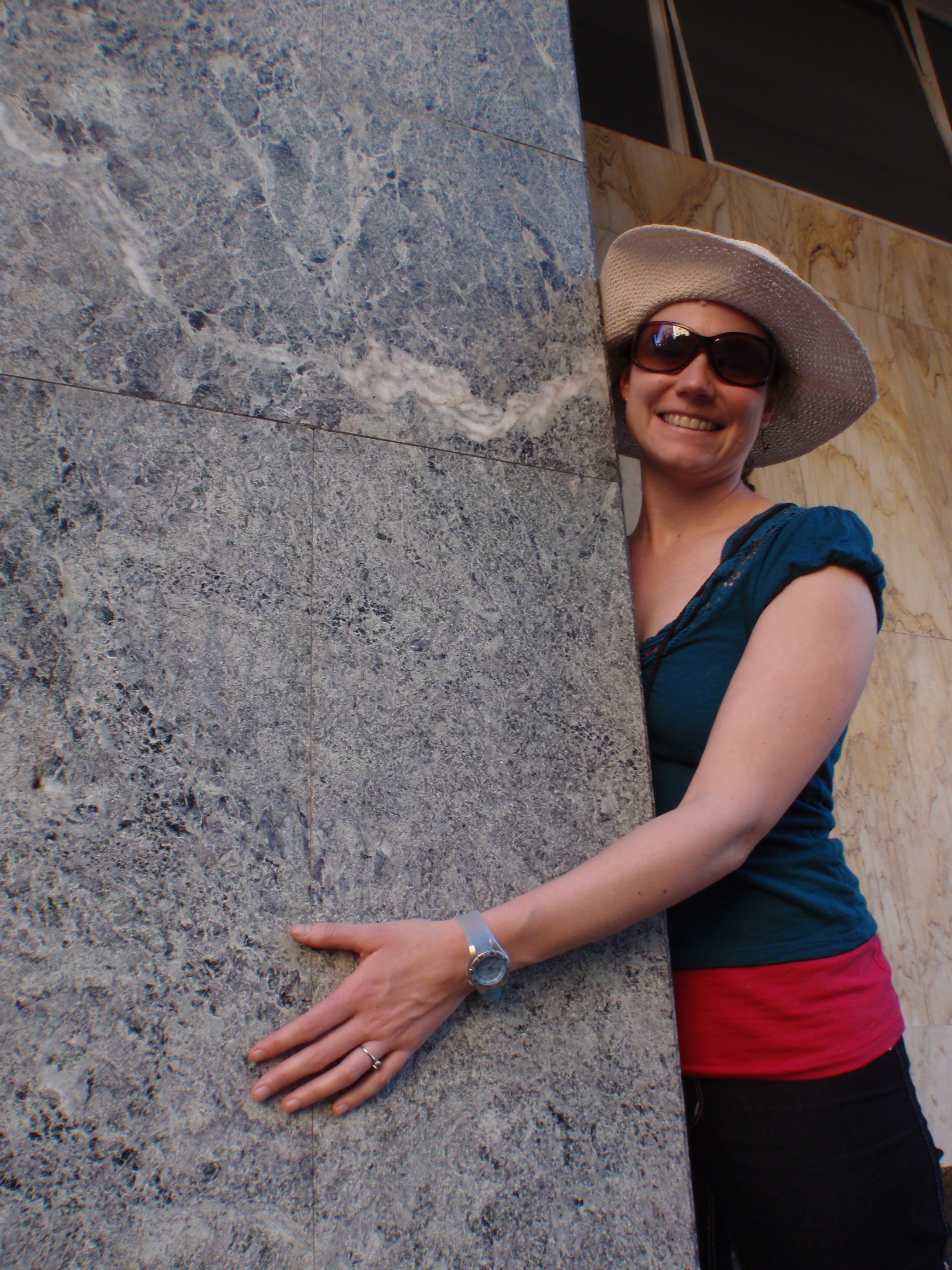
Hugging some building stones in downtown Cape Town, South Africa, April 2011.
My thesis is keeping me super busy, as usual, so there many not be much blogging again this week. However, here’s your Monday Geology Picture– a picture of me showing my appreciation for some green marble building stones displayed in downtown Cape Town, South Africa. Looking at building stones can be fascinating even though it can sometimes be frustrating to examine interesting rocks without field context.
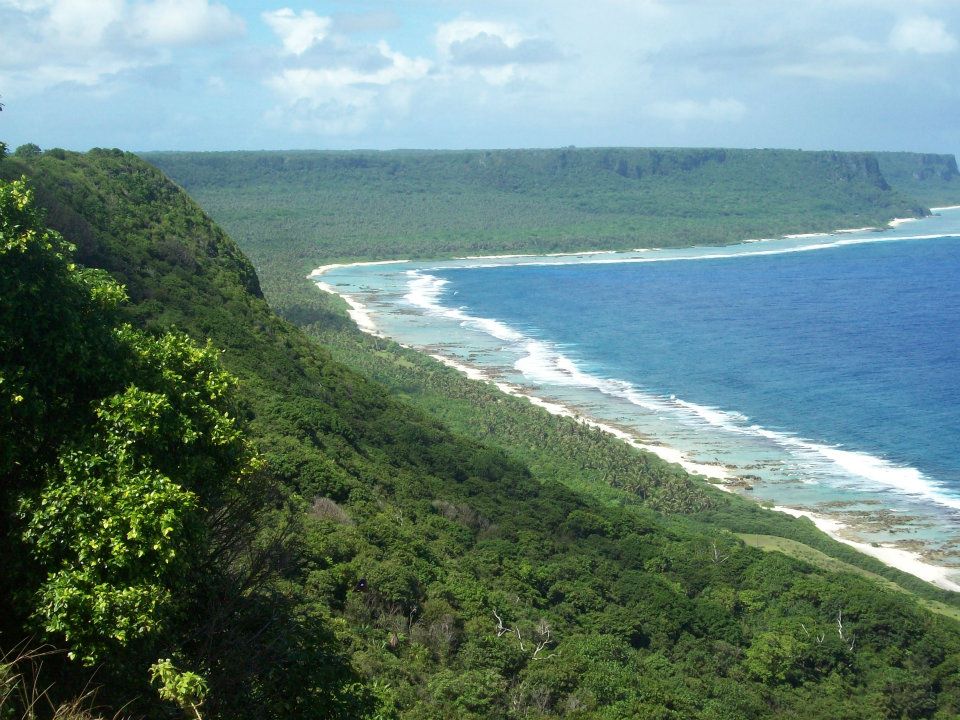
Tarague Embayment, Guam. Photograph courtesy of Jason Vanover.
My cousin Jason is in the Air Force, and he’s currently stationed on the island of Guam, which has some fantastic geology and also some gorgeous beaches. He’s been sharing some pictures of his travels around Guam, and I must admit I’m somewhat jealous of his travels. Perhaps I’ll have a chance to visit Guam one day. There certainly seems to be plenty of great geology to see there!
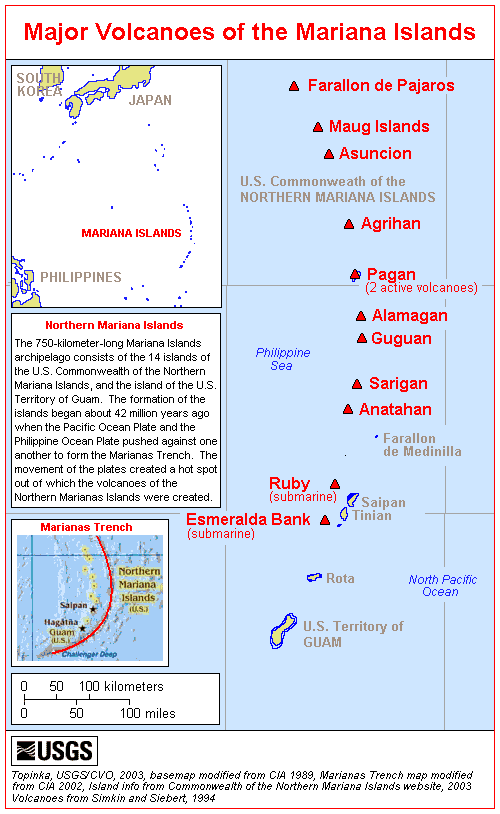
Guam is a volcanic island that is located at the southern end of a chain of volcanic islands associated with the Izu-Bonin-Mariana Arc, which formed as a result of the subduction of the Pacific Plate underneath the Philippine Sea Plate (and also the tiny Mariana Plate). Associated with the Izu-Bonin-Mariana Arc is the Mariana Trench, where the deepest part of Earth’s oceans is located. The volcanic islands of the Izu-Bonin-Mariana Arc formed as a result of volatiles being released from the subducting Pacific plate. These volatiles (mostly water and carbon dioxide) lowered the melting temperatures of the mantle underneath the arc, producing melts which created the volcanic islands.
Because Guam hasn’t been volcanically active in about 10 million years, there has been time for carbonates (limestones) to form on top of some of the volcanics, and there are abundant coral reefs located offshore. One place where some impressive carbonate deposits have formed on Guam is Tarague Embayment, which is shown in this week’s geology picture. The rocks are a little hard to see since they’re covered under thick green vegetation. Underneath that vegetation, though, there is a limestone cliff that was formed in the Pliocene-Pleistocene (within the last 5 million years or so).
My cousin Jason took some pictures during his visit to Tarague Embayment, and he was kind enough to let me share them here. Thanks, Jason!
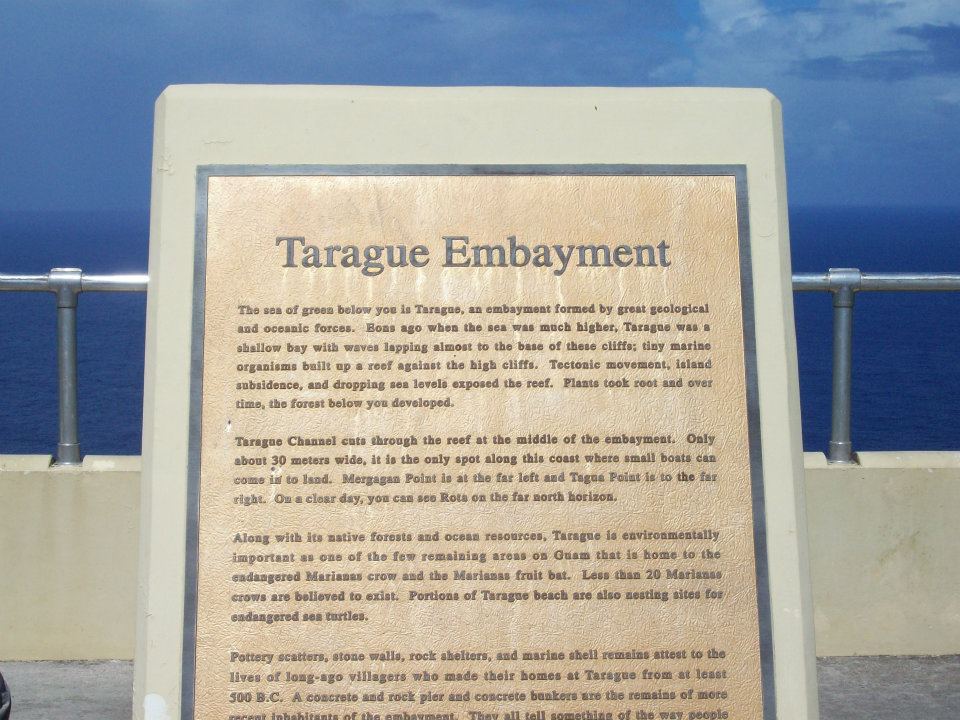
Here’s a picture of a sign at the embayment with a little bit of geological information:
An information sign at Tarague Embayment. Photograph courtesy of Jason Vanover.
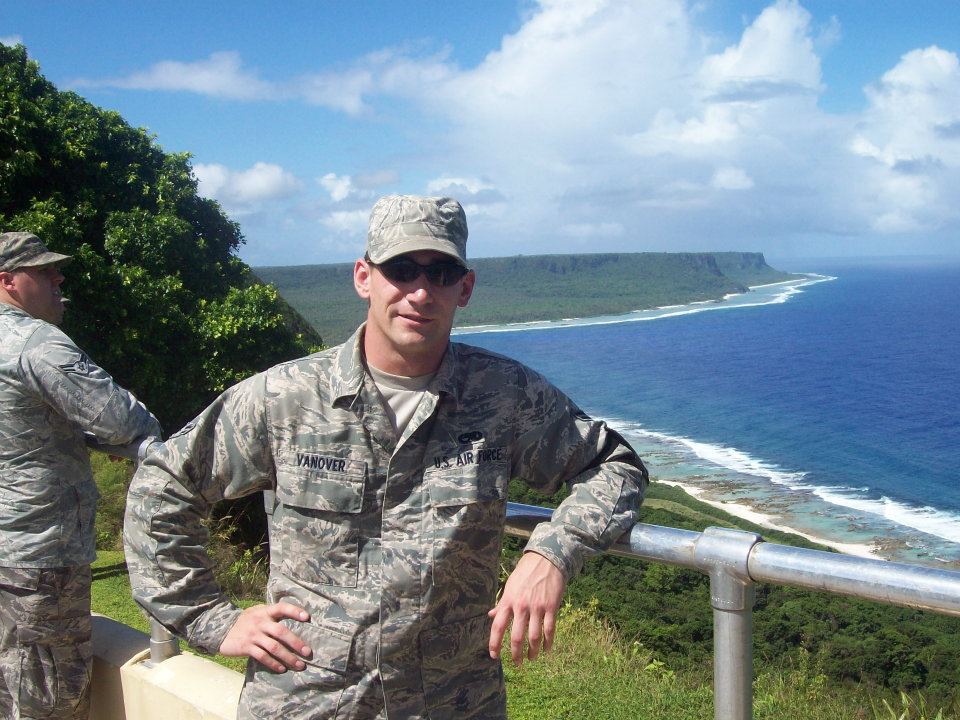
And here’s a picture of my cousin, looking handsome in his Air Force uniform:
My cousin hanging out at the embayment. Photograph courtesy of Jason Vanover.
Sorry, ladies! My cousin is happily married and has a beautiful little girl.
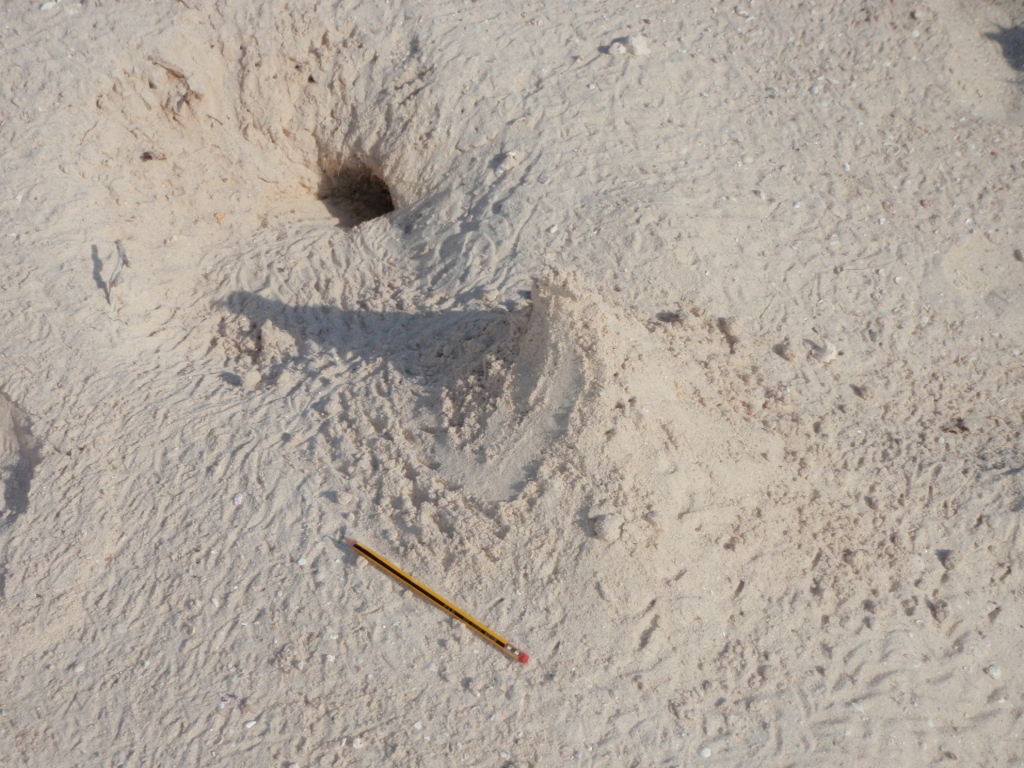
Crab house in the sand #1. Barr al-Hikman, Oman, January 2012.
Last month I participated in a three-day geology field trip to Barr Al-Hikman, a peninsula in Oman. On the peninsula there are numerous beautiful beaches and interesting geological features such as sabkhas and paleolagoons. We visited the peninsula to look at some recent carbonate deposits and also to investigate some modern beach features, such as the coral reefs located just off shore and the traces left on the beach by various modern critters. Yes, we went to the beach for three days. Being a geologist is fun sometimes! Seriously, though, looking at modern life traces gives geologists a better sense of how to identify trace fossils in the geologic record. If you want to learn more about traces and trace fossils, I recommend Tony Martin’sblog and forthcoming book Life Traces of the Georgia Coast. I’m certainly looking forward to the book!
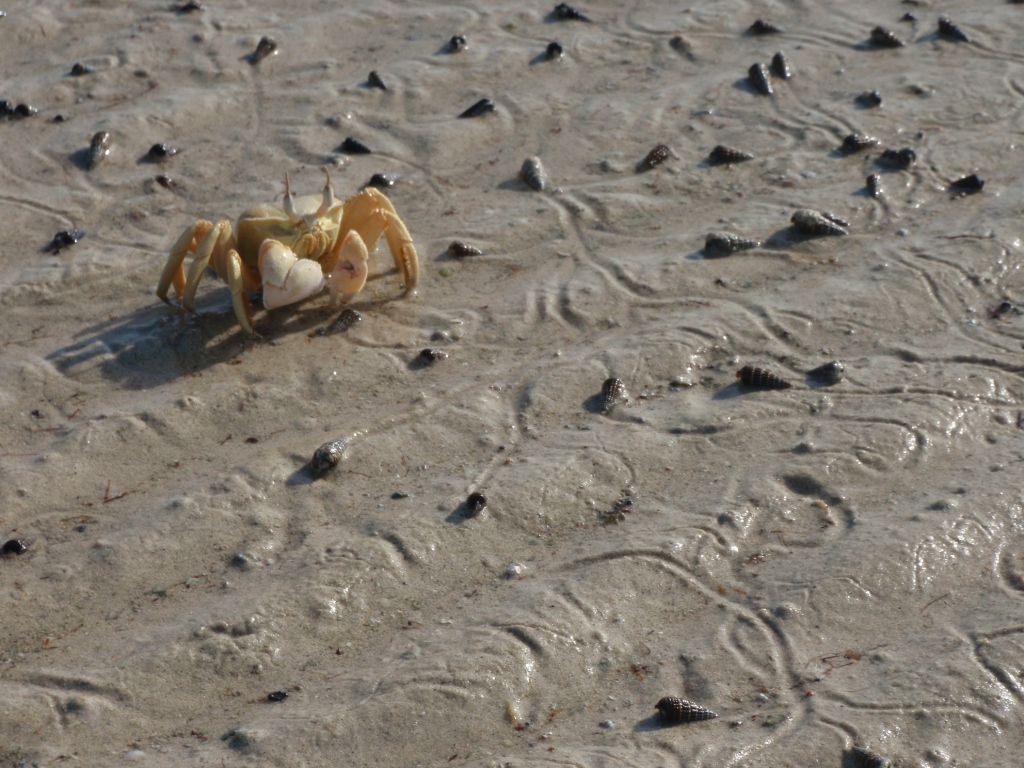
I don’t normally study life traces or trace fossils, so looking at these traces in Oman was new and exciting for me. I don’t know much about the traces– other than what the field trip leaders told me– but I thought I’d share some pictures of some life traces I saw at Barr Al-Hikman. In this post I’m sharing some pictures of holes with piles of sand next to them. Apparently, these holes were dug by crabs. I’m not sure of the exact species. Does anyone know? I spotted a likely suspect a few meters from the holes.
Crab house in the sand #2. Barr al-Hikman, Oman, January 2012.Numerous crab holes and piles of sand, with our Land Cruisers in the distance. Barr Al-Hikman, Oman, January 2012.A likely suspect for the house-builder. And look at those traces being left by the living shell thingies (yes, I am the worst biologist ever). Barr Al-Hikman, Oman, January 2012.Mr. Crab... and some geologists in the background. Barr Al-Hikman, Oman, January 2012.
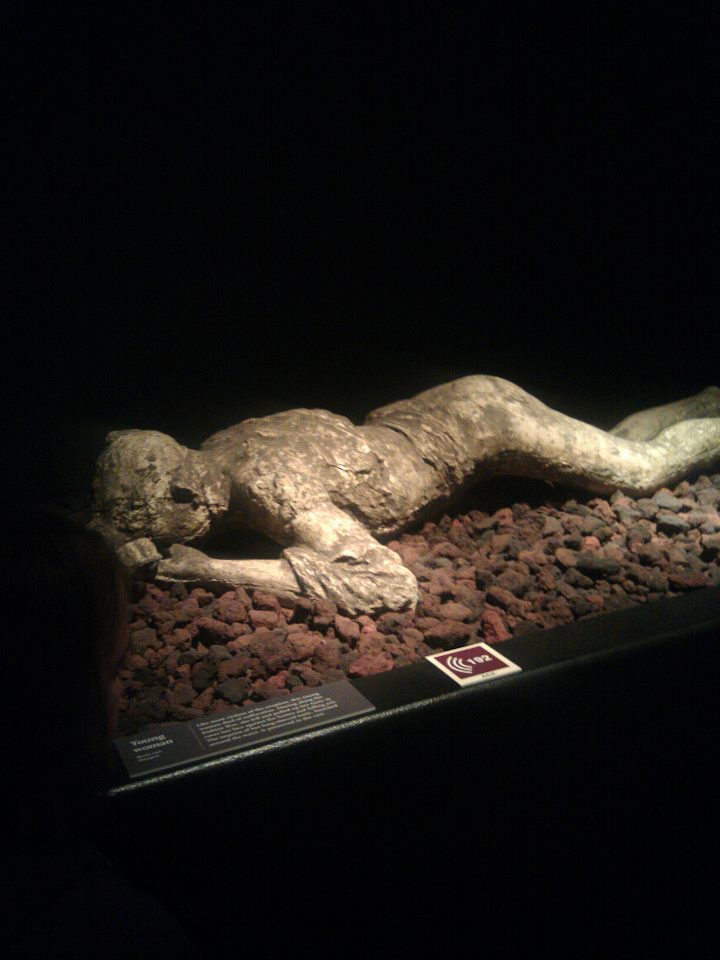
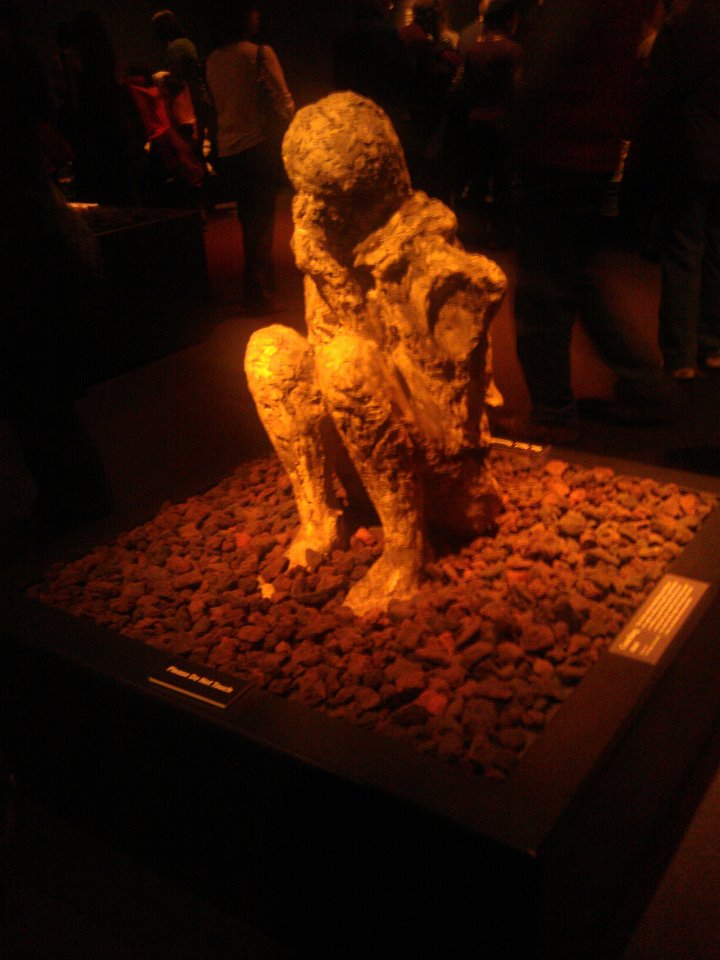
A plaster cast of the void left by a body that was buried in volcanic ash during the 79 AD eruption of Pompeii. From an exhibit at the Boston Museum of Science, January 2012. Photo courtesy of Travis Roy.
Today’s geology picture is courtesy of my friend Travis, who visited the “A Day in Pompeii” exhibit at the Boston Museum of Science this past weekend. This exhibit looks great and runs through February 12th. If you’re in the Boston area, you should check it out! Unfortunately, I’m going to miss the exhibit since I won’t be back in the Boston area until March. I’m very sad that I’m missing the exhibit. One of these days, I’ll have to take a georney to actual Pompeii. Pompeii is definitely high on my list of geological sites I want to visit.
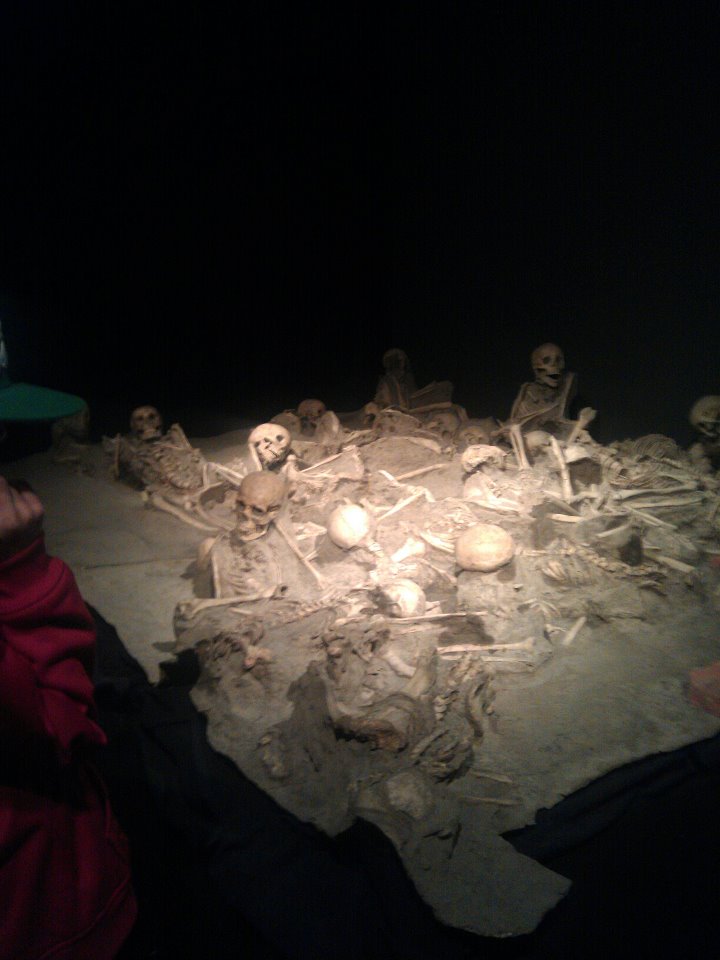
Here are a couple more pictures from the Boston Museum of Science exhibit, courtesy of Travis:
Another plaster cast of a void left by a buried body. From an exhibit at the Boston Museum of Science, January 2012. Photo courtesy of Travis Roy.A pile of bones. From an exhibit at the Boston Museum of Science, January 2012. Photo courtesy of Travis Roy.
A little dark-colored xenolith (isn’t it adorable?) in Cape Granite, Clifton Beach, Cape Town, South Africa, October 2011.
I’m back home in Cape Town, so I thought I’d post a local picture for this week’s Monday Geology Picture. The above picture shows a small, dark-colored xenolith in the Cape Granite, a 550 million year old granite that has megacrysts (very big crystals) of feldspar. This xenolith is most likely a small piece of the Malmesbury Group, an older group of rocks that consists of alternating grackwacke sandstone and slate that have experienced significant uplift and metamorphism. The above xenolith was observed at Clifton Beach, a fancy beach area known for its bright white beaches which result from the weathering of the Cape Granite. Abundant xenoliths, such as the one above, can be observed in the granite boulders at Clifton Beach. I took the above picture when we took my husband’s cousin around to look at a few geological sites in the Cape Town area .There is a 5-Rand South African coin for scale in the picture; this coin is slightly smaller than an American quarter.
I have a few thesis deadlines looming, so for the next 2-3 months as I prepare for my thesis defense this blog may consist mostly of short picture posts. If time permits, I’ll try to slip in a few geology words and longer posts, but my thesis comes first at the moment. Hopefully the pictures will be enough to tide over my readers as I wrap up this PhD of mine.
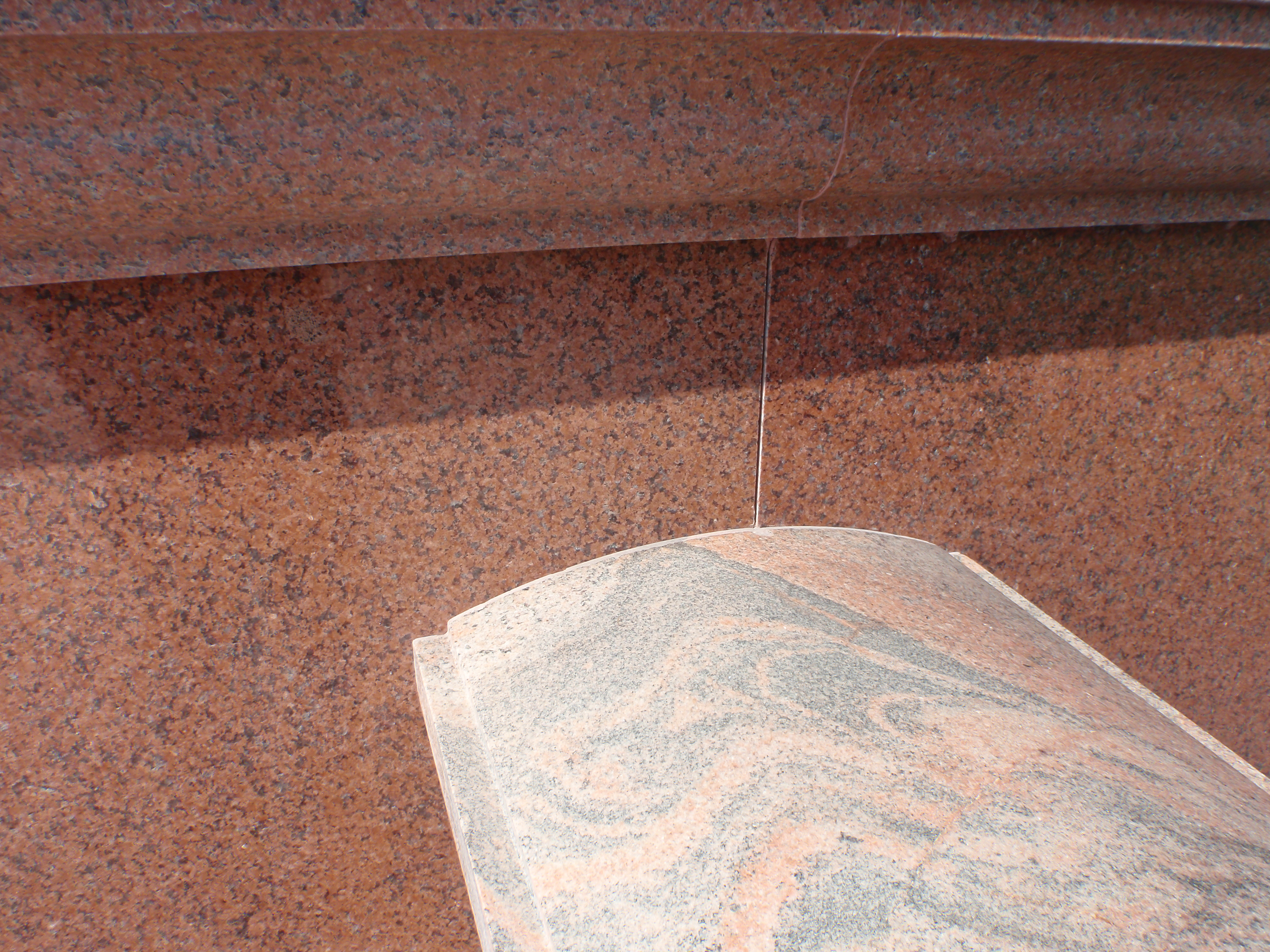
A gneiss staircase outside the Emirates Palace Hotel, Abu Dhabi, United Arab Emirates, January 2012.
I am currently spending the long weekend in Abu Dhabi, United Arab Emirates. I’m visiting some good friends after spending about ten days in Oman to attend the International Conference on the Geology of the Arabian Plate and the Oman Mountains.
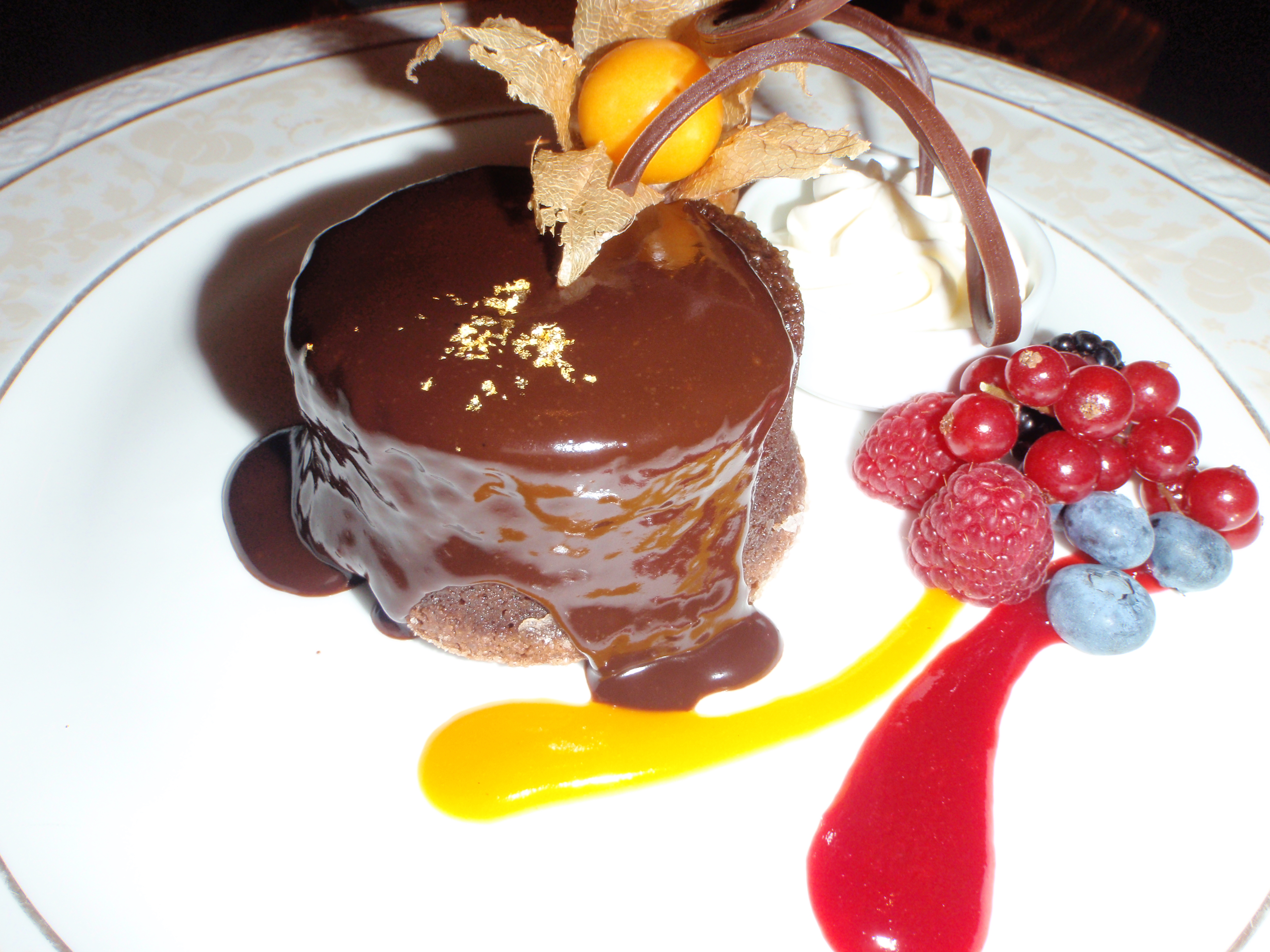
Yesterday my friend Karima and I visited the luxurious Emirates Palace Hotel here in Abu Dhabi. We paid far too much money for a deliciously gaudy lunch, which included a chocolate dessert with genuine 24-carat gold flakes on top!
After lunch we wandered around the hotel a little bit, and I spent most of my time admiring the various ornamental stones which were used in the construction of the hotel. For example, the stairs in front of the hotel are made from a combination of gneiss and K-feldspar granite. I thought it was neat to see the gneiss and the K-feldspar granite (a possible protolith rock for the gneiss) in juxtaposition.
Here’s another view of the staircase:
A closer view of the staircase-- gneiss and granite!
And here’s a picture of our gold-coated dessert. Yes, we ate gold!
Pillow basalts in Oman... with pencil for scale. Samail Ophiolite, January 2012.
I’m currently in Oman for a geology conference, so today’s geology picture is one I recently took here in the Samail Ophiolite. The picture shows some weathered and fractured pillow basalts with a pencil for scale. These are not the best-looking pillow basalts in the ophiolite. The freshest ones are found in the Geotimes sequence up in the northern part of the ophiolite whereas these weathered ones are the best ones you can observe close to Muscat, the capital city of Oman. I apologize that this picture is a bit dark. Unfortunately, we arrived at the pillow basalt outcrop just as darkness was falling. So, I took this picture using my camera flash. Still… spectacular, isn’t it? Seafloor pillow basalts on land, in the middle of the desert!
Bear track, with a Rite-in-the-Rain Geological Field Notebook for Scale, Montana, Fall 2005.
Often, geology fieldwork can be a little bit dangerous. During some undergraduate field mapping in Montana, my classmates and I encountered some bear tracks in the snow. The above picture shows one of those bear tracks with a geological field notebook for scale. For the rest of the day, we kept a careful watch out for bears and tried not to stray too far from the field vans.
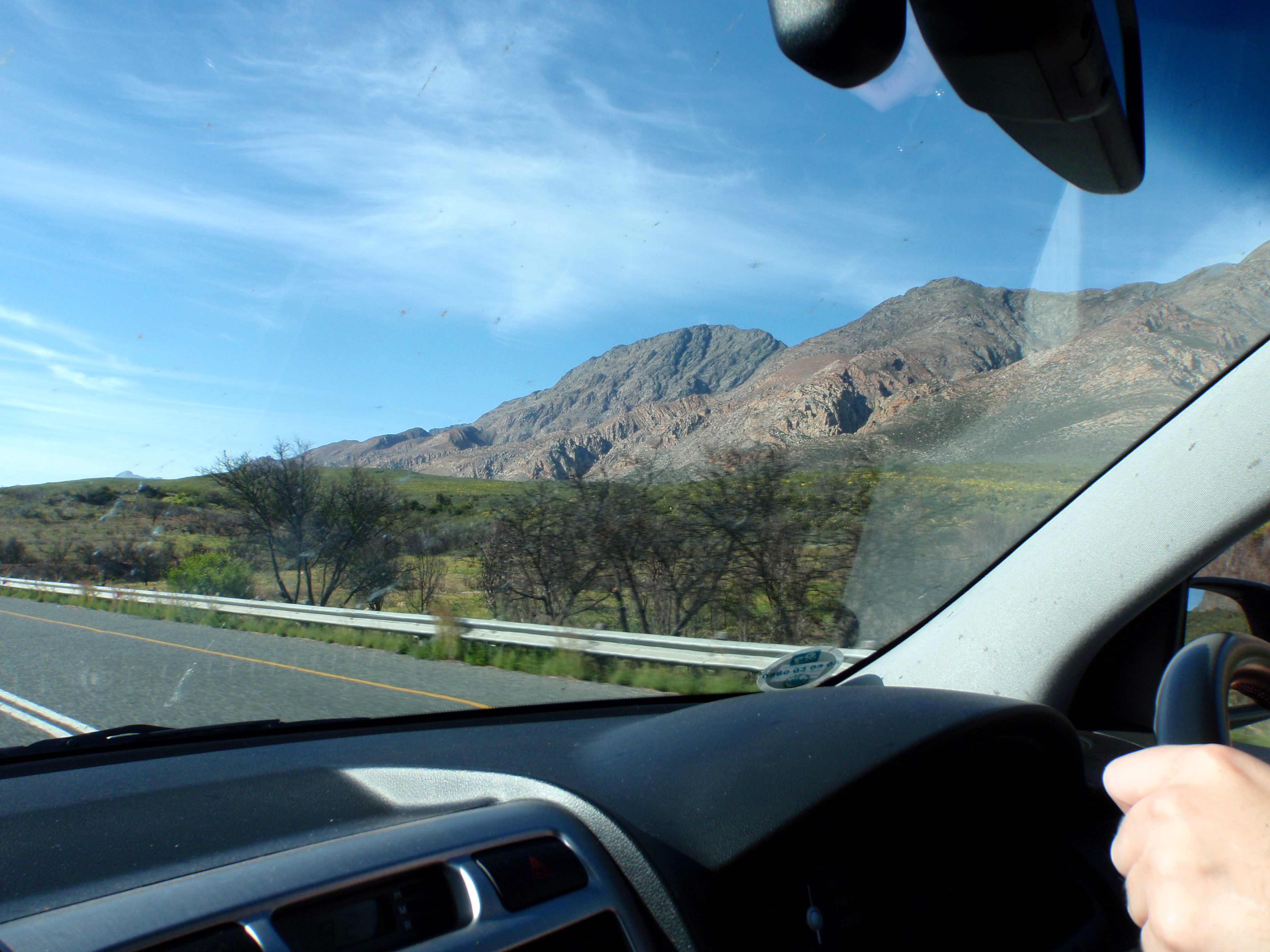
South Africa's Cape Fold Belt viewed through a car window, September 2011.
This week’s Monday Geology Picture shows some geology viewed through a car window. Specifically, the picture shows a glimpse of the magnificently folded and twisted sandstones of the Cape Fold Belt in South Africa. I snapped this picture as my husband and I drove along the N1 road on our way from Cape Town to Oudtshoorn for a long weekend trip. One of my favorite things to do is drive around South Africa with my husband. We often encounter interesting rocks, animals, and plants along the way… and we often stop to take a closer look at them. Even when we don’t stop, I often take pictures through the car windows, such as the picture above. The only reason we didn’t stop for a picture at that moment was that I had already snapped a few dozen roadside pictures of similar rocks. However, I couldn’t resist a quick shot through the window.
One of the things I’m really looking forward to after I finally finish up this PhD of mine is a roadtrip across South Africa. Sometime next year, my husband and I plan to take a couple of weeks vacation and drive from Cape Town to KwaZulu-Natal, where we plan to visit some friends who live in the Drakensberg (note that Drakensberg means “Dragon Mountains”– how could I not want to visit there?). We plan to stop plenty along the way, investigating some local geology of course! I imagine I will also snap many more pictures through car windows.










 Georneys
