Monday Geology Picture: Listwanite Hills in the Sultanate of Oman

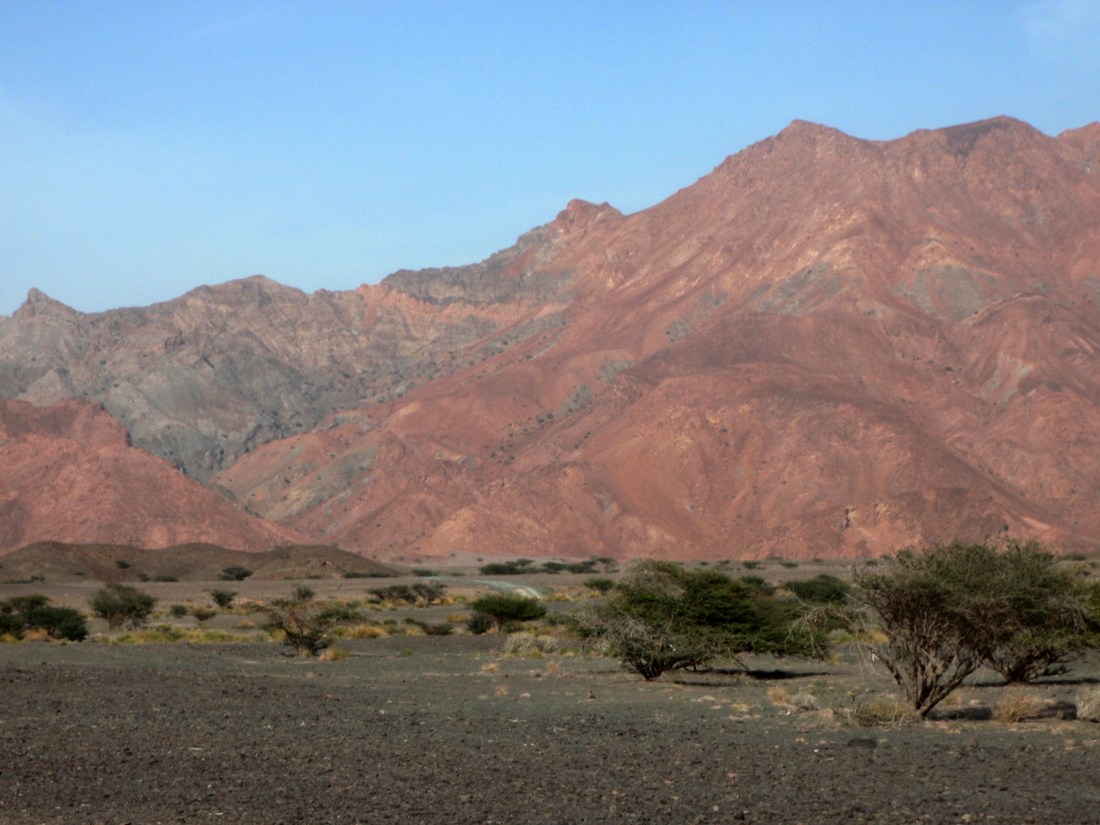
Listwanite hills in the Sultanate of Oman, January 2012. The reddish parts of the moutnain are listwanites while the grayish parts are less-altered peridotites.

Today I am going to share some pictures of listwanite (also sometimes spelled listvenite, listvanite, or listwaenite), an unusual  rock type that I bet even some of the well-educated geologists who read this blog have never seen or even read about. I don’t even think there’s a wikipedia entry about listwanite. Perhaps I’ll write one after my thesis defense next month.

Listwanite forms when ultramafic rocks (most commonly mantle peridotites) are completely carbonated. The pyroxene and olivine minerals found in peridotite commonly alter to form carbonate and serpentine minerals. However, peridotites are usually not completely carbonated. Rather, they typically contain carbonate veins (primarily magnesite; also calcite, dolomite, and other carbonates). Complete carbonation of peridotite means that every single atom of magnesium and calcium as well as some of the iron atoms has combined with CO2 to form  secondary carbonate minerals such a magnesite and calcite. The silica atoms in listwanite are found in quartz. Thus, liswanites consist of quartz (a rusty red color) and  carbonate and also sometimes talc and Cr-muscovite (a mineral known as mariposite/fuchsite).  Geologists are still studying how listwanites form, but they likely form through the interaction of CO2-rich fluids with peridotites at higher than ambient temperatures up to ~200 degrees Celsius. Structural controls (faults and fractures) permit the percolation of the CO2-rich fluids through peridotite, so the formation of listwanites is generally structurally controlled.

Listwanites are important rocks to study for a number of reasons. First of all, listwanites contain large amounts of CO2 which originated from fluids and which is now stored in solid mineral form.  Recently, geologists and other scientists have been investigating the potential of storing CO2 in solid minerals (which are more stable than CO2 stored as a liquid or gas) through carbonation of mafic and ultramafic rocks (see, for example, this Nature Geoscience Progress Article by Matter and Kelemen, 2009). Mafic and ultramafic rocks uptake significant CO2 through their natural alteration processes (that’s what I study for my PhD, so expect more on this in the next year or so as I submit my papers for publication). However, the natural carbonation rates of these rocks are too slow to significantly offset anthropogenic CO2 emissions. Therefore, scientists are currently investigating if it is possible to geoengineer CO2 uptake in mafic and ultramafic rocks so that this CO2 uptake happens more quickly. This could be done, perhaps, by fracturing and heating and injection of CO2-rich fluids. This is already being tested in mafic basalts through the CarbFix Project in Iceland.

However, scientists and engineers still have plenty of work to do in order to figure out the right conditions and protocols for CO2 sequestration in mafic and ultramafic rocks. In order to learn about what conditions lead to complete carbonation of ultramafic rocks, scientists such as Peter Kelemen and Gregory Dipple (and their many grad students and collaborators) are working to learn more about listwanites to see if mother nature can provide some clues.

In addition to the recent interest in listwanites for carbon sequestration efforts, listwanites are also important because they are often associated with economic mineral deposits, particularly gold deposits.

So, now that I’ve explained what listwanites are and why they are important, here are some pictures of listwanites which I observed during my trip to Oman back in January. Listwanites are pretty neat rocks, aren’t they?

A closer view of a listwanite outcrop, with a hammer for scale. Sultanate of Oman, January 2012.
Another view of listwanite up close. Sultanate of Oman, January 2012.
More listwanite. Note the offsets in the carbonate veins. Sultanate of Oman, January 2012.
Another piece of listwanite with offsets in carbonate veins. This sample is gray in color and thus perhaps not fully a listwanite. Sultanate of Oman, January 2012.

How a Geochemist Really Dresses

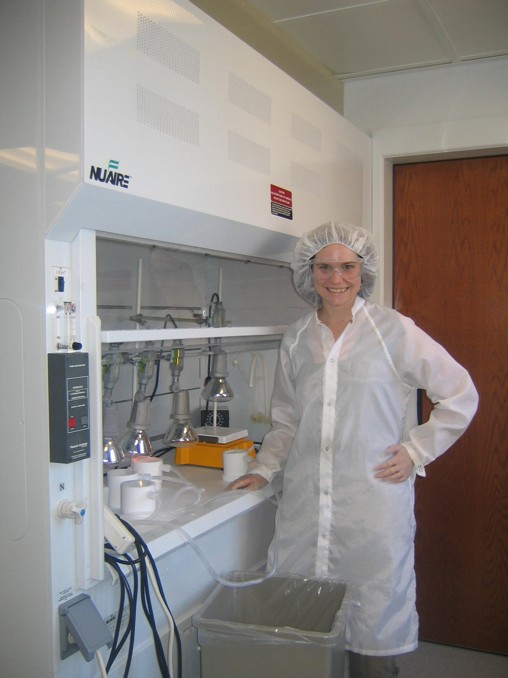
Properly dressed for clean lab chemistry, Dartmouth College, New Hampshire, 2006.

I am a geochemist. For my PhD thesis, undergraduate, and summer internship research, I have spent thousands of hours in geochemistry labs. I enjoy labwork, and I take laboratory safety seriously. When I work in the laboratory, I usually wear an outfit similar to the above. In the above photograph I am wearing an acid-resistant lab coat, long pants, closed-toed plastic lab clogs (out of the picture, but believe me), gloves, safety glasses, and a hair net to keep my long hair out of my way (and also out of my samples). As much as possible, I keep the chemicals I work with inside fume hoods, which protect me from dangerous acid vapors. When I work with especially dangerous chemicals such as hydrofluoric acid or aqua regia, I usually add a full face shield, an extra pair of gloves, and sometimes an extra labcoat or apron to the above outfit. In some labs I wear a full tyvek jumpsuit  rather than a labcoat so that my legs are better protected.

The clothes I wear in geochemistry labs may not always be the most flattering (although, personally, I think I look pretty good in a labcoat), but that’s not the point. The point of these clothes is to protect me from dangerous chemicals. Everyone dresses like this in geochemistry labs (or should), and no one worries over fashion when donning laboratory gear. Why? Because looking fashionable is not particularly important when you are trying to prevent acid exposure. Preventing acid exposure can literally be a matter of life-and-death. Unfortunately, rocks (especially silicate rocks) do not like to dissolve. So, geochemists use a very dangerous acid called hydrofluoric acid to bring them into solution for chemical analysis. Exposure to hydrofluoric acid is initially painless (because it interferes with nerve function), so you often don’t know that you’ve been exposed until hours later, when your flesh and bones have started to dissolve. A large hydrofluoric acid exposure is lethal, so I always, always, always wear my protective laboratory gear when working with hydrofluoric acid and also when working with other, slightly less dangerous acids.

You might be wondering why I’m posting the above photograph and explaining how geochemists generally dress. I am posting this photograph because there has been a disturbing stock photograph titled “lab work” that has been circulating around the science blogosphere recently. Here is the picture:

Image taken from here: http://www.istockphoto.com/stock-photo-13771784-lab-work.php

In the above photograph the female chemist is either (1.) naked or (2.) wearing a strapless top or dress. Neither type of attire (or lack thereof) is appropriate for chemistry. There is far too much skin that could be exposed to dangerous acids. Furthermore, if that beaker contains acid, the chemist really should be handling that beaker under a fume hood. Perhaps that is the problem– maybe the acid fumes have dissolved her clothes? In that case, she really should consider wearing a more acid resistant tyvek suit or coat.

Joking aside, the stock photograph really disturbs me. Is this how we want the general public to view lab work? Why does the female chemist look naked? Is it to make her more attractive? Why is it important for her to look attractive?  I suppose that I understand that stock photos usually feature more-attractive-than-average people, but does she have to look naked to look attractive?

Even Barbie, who is definitely a fashionista, is smart enough to wear proper laboratory safety clothing when doing geochemistry:

Geochemist Barbie takes safety seriously. Image taken from the "Dress Barbie Like a Geologist" Accretionary Wedge here: https://evelyngeorneys.wordpress.com/2011/11/18/accretionary-wedge-39-geologist-barbie/

Geochemist Barbie and I are appalled at the stock photo of the naked female chemist. I really hope that not too many people actually purchase this stock photo. Rather than use that stock photo, I encourage you to– please– rather use a photograph of a real scientist dressed in real laboratory safety gear. If you’re considering purchasing that stock photo, you’re more than welcome to rather take the picture of me (for free!) or of Geochemist Barbie (also free!) in our more realistic laboratory clothing instead. Also, I have a proposal for other chemists: why not post pictures of you in your laboratory clothing, as I have posted here? If you don’t have a blog, I’d be happy to host your picture here at Georneys. I’ve been really impressed with the recent This is What a Scientist Looks Like effort, which was initiated by Allie Wilkinson. Why not start a similar effort, perhaps titled “This is What a Chemist Looks Like” or “This is What Lab Work Looks Like” ?

Geology Word of the Week: J is for Jimthompsonite

Jim Thompson, circa 1979. Image taken from American Mineralogist, 1979, vol. 64: 664.

def. Jimthompsonite:
1. A magnesium and iron-rich silicate mineral found between the chlorite and actinolite zones of a metamorphosed ultramafic body. Jimthompsonite has the formula (Mg,Fe)5Si6O16(OH)2 and an orthorhombic structure. The mineral was named after James Burleigh Thompson, Jr., an eminent mineralogist and petrologist.
2. A wonderful example of scientists having fun with naming– and, in the process, classifying and better understanding– the world around them.

Intermixed jimthompsonite and clinojimthompsonite from Chester, Vermont. Photo by Jeff Weissman and taken from Webmineral.com here: http://webmineral.com/specimens/picshow.php?id=1670&target=Jimthompsonite.

Jimthompsonite is a delightfully ridiculous mineral name. Minerals are often named after people, usually for the people who first discovered them. For example, searching randomly through my mineralogy book, I come across mineral names such as Pentlandite (named for Joseph Barclay Pentland), Vivianite (named for John Henry Vivian), and Covellite (named for Nicola Covellite).

Minerals are also commonly named after places, often their “type locality,” a notable place where the mineral occurs or was first discovered. For example, Andalusite is named for Andalusia, Spain. Mineral names are also sometimes taken from colloquial, historical names– sometimes modified– which existed prior to the mineral being classified scientifically. For example, Beryl comes from Ancient Greek.

Sometimes, minerals that are named in honor of people end up with ridiculous names such as “jimthompsonite.” Why jimthompsoite? Well, thomsonite was already taken, and I suppose thompsonite and thomsonite would have been somewhat confusing. Jamesonite was also already taken. I suppose jamesthompsonite was a slightly more formal option, but for whatever reason the mineral namers went with jimthompsonite, which is simply delightful and probably more reflective of Prof. Thompson, who apparently went by Jim rather than James.

Jimthompsonite? Sounds like something Tintin detectives Thompson and Thomson should investigate!

What’s an even more ridiculous mineral name than jimthompsonite? Clinojimthompsonite, also named after Jim Thompson.

Ridiculous scientific names are not just limited to minerals. Just look at some of the ridiculous Element names (for example, Californium) and asteroid names (for example, #12426 is named “Raquetball”). Isn’t discovering and naming things fun? One of the funnest parts of science, I think.

Here are a few more ridiculous and fun mineral names:

Armalcolite: A mineral discovered on the moon and named for astronauts Armstrong, Aldrin, and Collins.

Znucalite: A mineral rich in the elements Zn, U, and Ca. Sounds like a Dr. Suess mineral, doesn’t it?

Cummingtonite: Supposedly named for the town of Cummington, Massachusetts. Uh-huh.. sure… 🙂

Coffinite: A halloween mineral? It’s uranium-rich and radioactive, so be careful…