35th International Geological Congress: Day #3

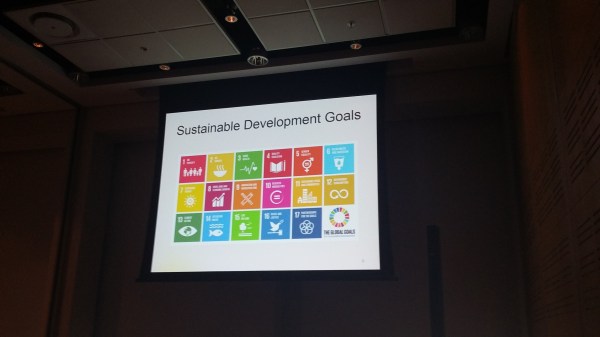
Slide from a talk on sustainability in mining.

Today I’m continuing my blogging about attending the 35th International Geological Congress (IGC) in my home city of Cape Town, South Africa, this week. You can find my first two posts here and here. The congress finished today, but I still need to write up my blog posts about days 3, 4, and 5. I’ll write about Day #3 today and then will write about the last two days over the weekend or early next week.

On Day #3 (Wednesday) of the congress I attended talks on a wide variety of topics. I spent the early morning listening to talks about diamonds and kimberlites, then I spent the late morning attending talks about sustainability in the mining industry, and finally I spent the afternoon attending talks on gold geology.

One of the great things about a large geological conference such as IGC is that you can attend a wide range of talks. At the conference this week I made a point to attend a few talks on topics about which I knew very little. Geology is such an interdisciplinary field that I never know what sort of geological research could be relevant to my own fields of study. It’s great to cross-pollinate ideas across different geological disciplines. Also, I really enjoy learning about new (to me) areas of geology… I find pretty much all geology interesting!

On Wednesday I think that I enjoyed the talks on sustainability in the mining industry the most… although of course I found the talks on diamonds, kimberlites, and gold fascinating, too!

I consider myself to be an environmentalist and a humanist, and I’ve been working in the mining industry for more than four years now. Mining is essential, now and in the future, to provide raw materials required by the rapidly growing population of the Earth. However, mining of course has environmental and social impacts and needs to be carried out in a sustainable manner. As an employee of a mining company, I believe that I have an obligation to strive to make mining more sustainable. The talks on sustainability and the mining industry were extremely informative and useful for me. I hope to learn more about this field of expertise in the future.
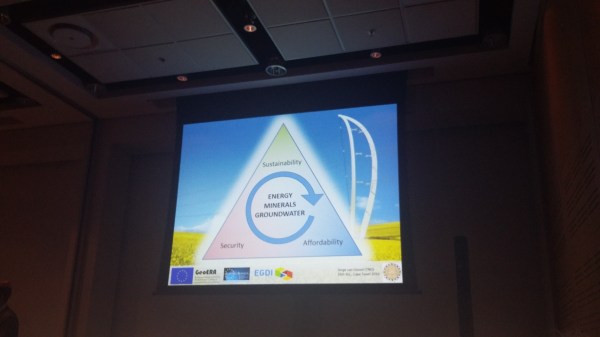
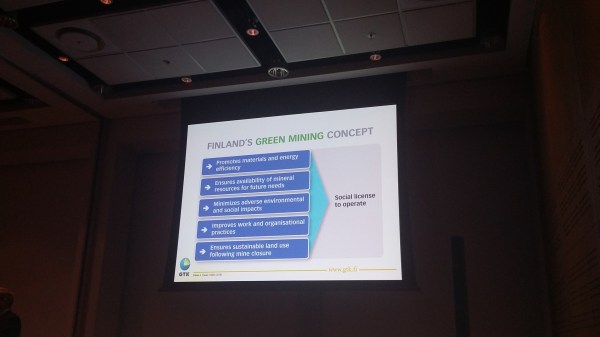
Slide from a different talk on sustainability and mining.
Slide from a third talk on sustainability and mining.
Slide from a third talk on sustainability and mining — this talk was on green mining in Finland.

On the sustainability note, I was pleased to see that there was a donation box for offsetting the carbon footprints of the conference attendees:
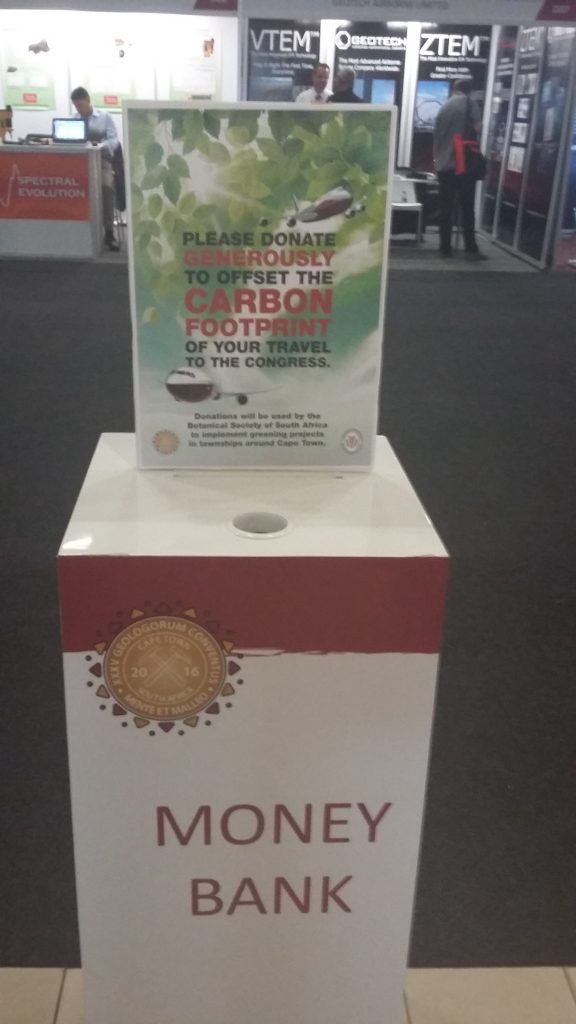
Donation box for offsetting travel carbon footprints.

Travel can have a large carbon footprint, especially if you fly a long distance. For many of the readers of this blog, as a 2013 New York Times article elegantly states, “your biggest carbon sin may be air travel”. I’m not sure that this little donation box substantially offset the travel carbon footprints of the thousands of geologists attending the congress, but it’s a great start — I hope to see more boxes like this in the future, and I hope that people donate to them. At the very least, the prominent placement of this box in the exhibition hall hopefully made people stop and think, even if only for a few moments, about the carbon footprints of their travel.

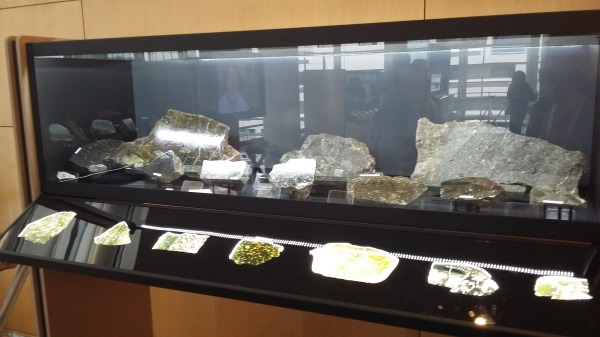
In addition to attending all of the talks, on Wednesday I also spent about an hour touring a fantastic exhibit called Messengers from the Mantle: Diamonds and Craton Roots. I’ll write up a separate post just on the exhibit, but for now here are two preview pictures:
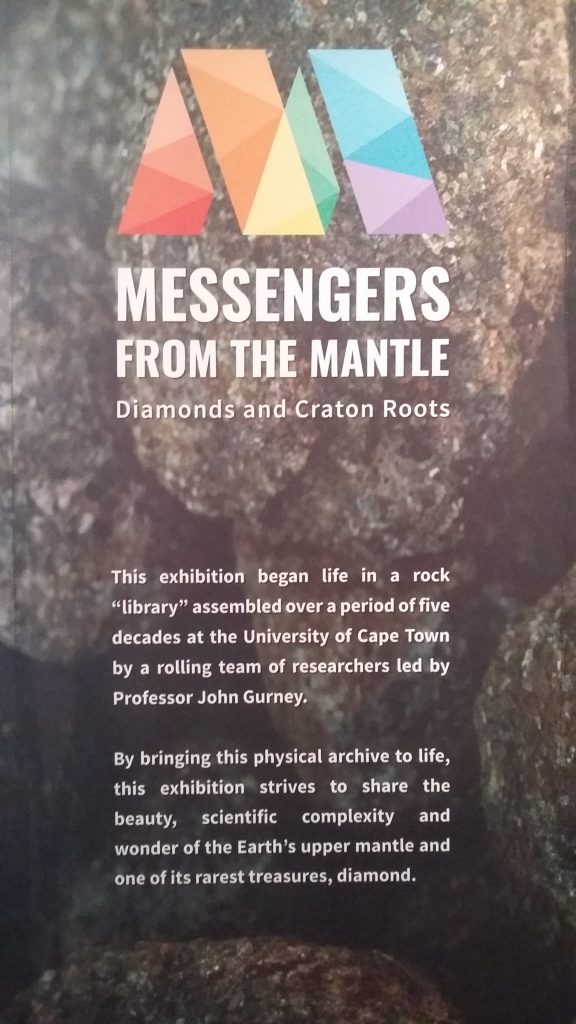
Entrance sign for the "Messengers from the Mantle" exhibit.
Entrance sign for the “Messengers from the Mantle” exhibit.
Kimberlites on display at the "Messengers from the Mantle" exhibit.
Kimberlites on display as part of the “Messengers from the Mantle” exhibit.

That’s all I’m going to write about Day #3… stay tuned for the posts about Day #4 and Day #5!
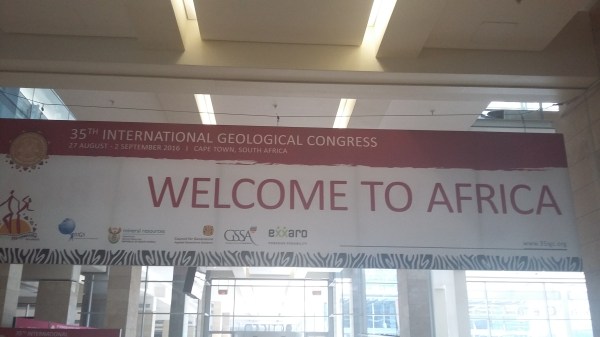
35th International Geological Congress: Day #2

IGC Banner near the convention center entrance.
IGC banner near the convention center entrance.

This post continues my daily blogging about the 35th International Geological Congress (IGC) being held in here in my home city of Cape Town, South Africa. You can read my post on Day #1 here.

Today was another busy day at the congress!
In the morning I attended a few talks on the history of geology and was particularly interested in a talk by Martin Pickford on the history of geological research in the Sperrgebiet or “Prohibited Area” of southern Namibia. Since the discovery of diamonds on the southern coast of Namibia in the early 1900s, access to the Sperrgebiet region has been tightly controlled. Thus, compared to most other places in the world, very few geologists have worked on the rocks found in the Sperrgebiet. Of course, a number of geologists working for or on behalf of the diamond mining companies have spent some time in the Sperrgebiet, but even so relatively few geologists have spent substantial time looking at the detailed geology of the region. Furthermore, the diamond geologists generally focused on the diamonds, and relatively little time and energy have been put into other, more academic areas of geological research. Thus, there is still much to unravel and understand about the geology of the Sperrgebiet.

Through my work for De Beers, I’ve been fortunate enough to visit the Sperrgebiet and to conduct a little geological research there, including some collaborative work with some academic researchers. It’s very exciting to work on an area where there’s still so much to understand about the local geology. I hope that in future years more geologists, including more academic geologists, will have the opportunity to work in the Sperrgebiet.

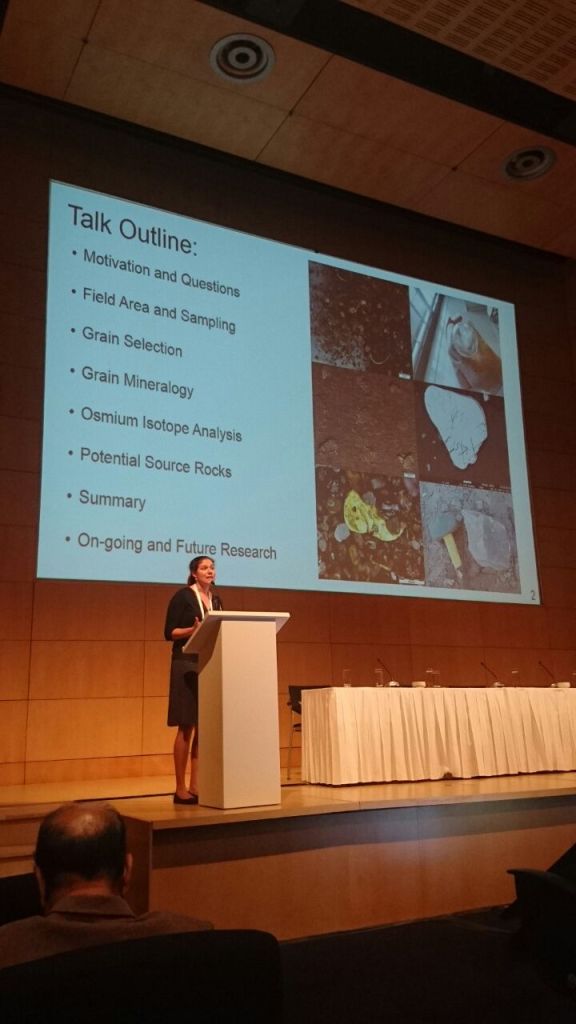
Later in the morning I gave my conference talk, which was about the mineralogy and chemistry of some placer platinum group element and gold grains that have been recovered from diamondiferous sediments offshore of Namibia. My research colleagues and I will be writing a scientific paper about our research, so stay tuned for more details once the paper is published. One of the most exciting aspects of the research is that, to our knowledge, this is the first time that platinum group element and gold grains have been reported in this particular placer, at least in the publicly available scientific literature. I’m very grateful to De Beers and Anglo American for giving us permission to share some of our data with the wider scientific community.

Presenting my talk on placer platinum group element and gold grains from offshore southern Namibia... stay tuned for more once our paper is published!
Presenting my talk on placer platinum group element and gold grains from offshore southern Namibia… stay tuned for more once our paper is published!

After my talk, I attended a very interesting session on some recent geological mapping, as well as some geochronological and geochemical research, that has been undertaken in northern South Africa and southern Namibia, mostly focused on better understanding Namaqua-Natal Province rocks. There was even some discussion of the geology of Fish River Canyon, which I recently hiked with a group of friends. I really enjoyed hearing about some recent scientific research in the canyon… although having just hiked the canyon I cannot imagine having to hike it with heavy rock samples. I found carrying a sleeping bag, some food, and a little extra clothing was difficult enough!

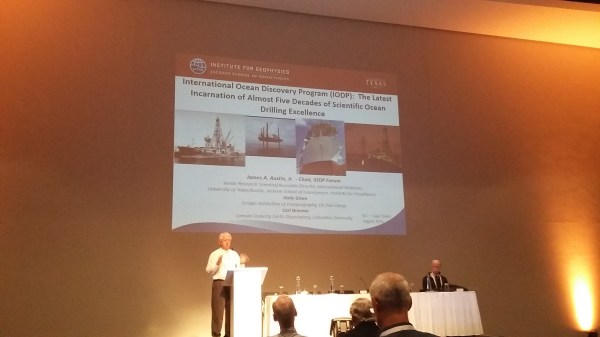
After lunch, I spent most of the afternoon attending the International Ocean Discovery Program (IODP) sessions. I particularly enjoyed the keynote talk by James Austin, who discussed nearly fifty years of oceanographic research that has been undertaken as part of IODP and the related precursor programs, such as the Deep Sea Drilling Project.

James Austin talking about the history of scientific ocean drilling.

That’s all for today… I’ll write some more tomorrow!

Monday Geology Picture: Namibian Desert Landscape

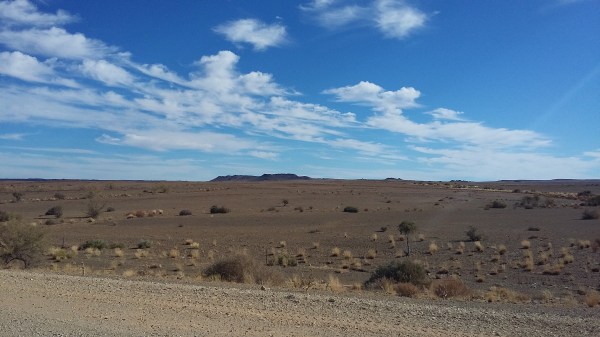
Namibian desert landscape, August 2016.

While I’m busy reviving Georneys, I thought that I should revive my “Monday Geology Picture” posts. Today’s picture features a Namibian desert landscape along the road to Fish River Canyon in Namibia. After I finish blogging about the International Geological Congress, which I’m attending this week, I’ll blog about my recent hike through the canyon. I plan to write up a post on the geology of the canyon, so stay tuned! In the meantime, enjoy this scenic view as a preview.

35th International Geological Congress: Day #1

IGC Exhibition Hall #1.

I’ve been neglecting Georneys over the past few months, due to some travel and an extremely busy workload for my day job as an industry geologist. However, I’m attending the 35th International Geological Congress (IGC) in Cape Town, South Africa (my home city!), this week, and I think that blogging about IGC is the perfect way to revive Georneys and, hopefully, to start to blog more regularly for the rest of the year. I’ll write a little about each day of the congress.

Today was the first day of the congress. I spent the morning registering for the congress, uploading my talk for tomorrow, and checking out the exciting exhibition hall. Then in the afternoon I attended the two opening plenary talks and part of the geochronology session, where I heard two excellent overview talks about Ar-Ar and Re-Os dating. Then I attended some private meetings in the late afternoon and went out to dinner with some geological colleagues in the evening.

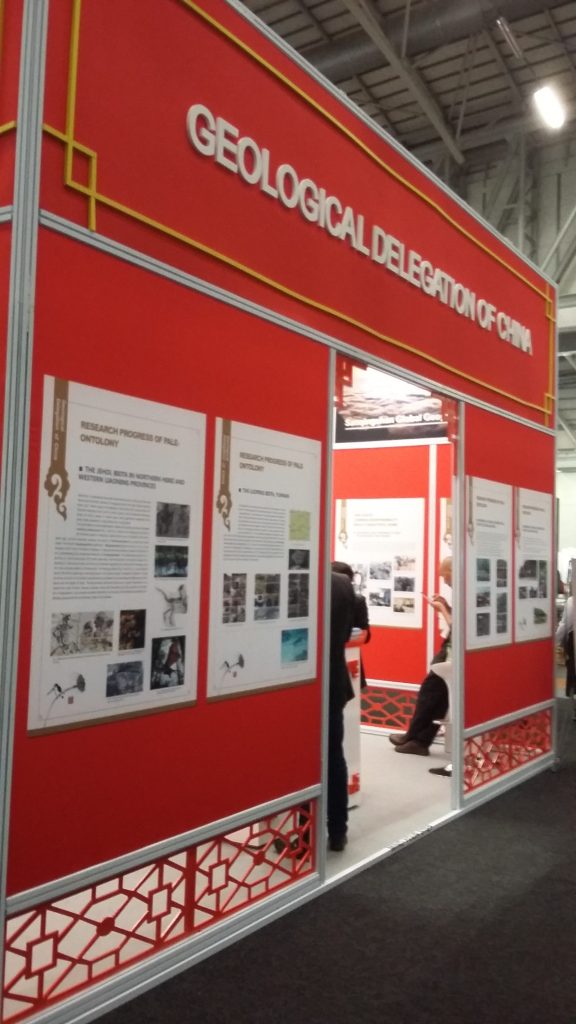
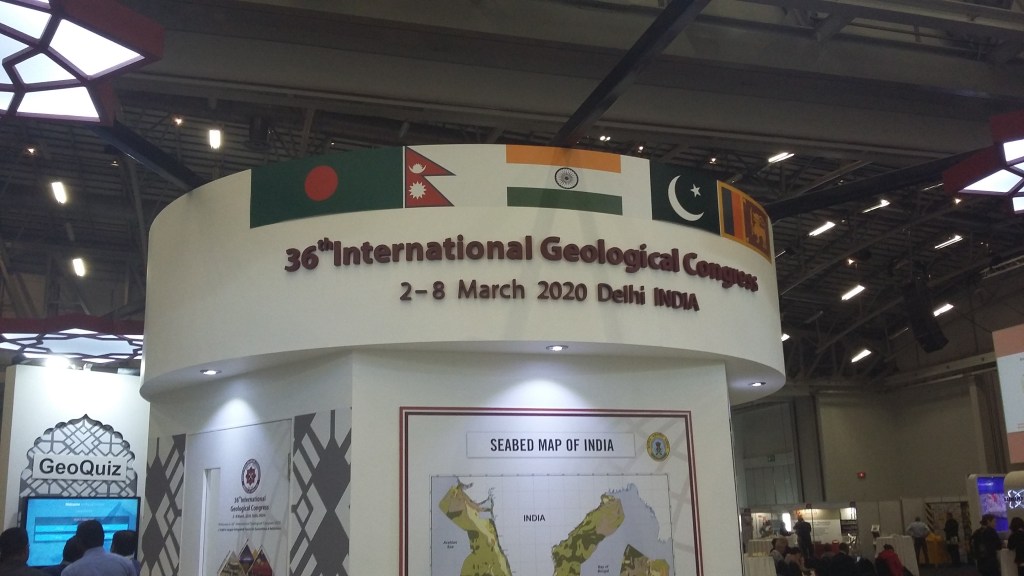
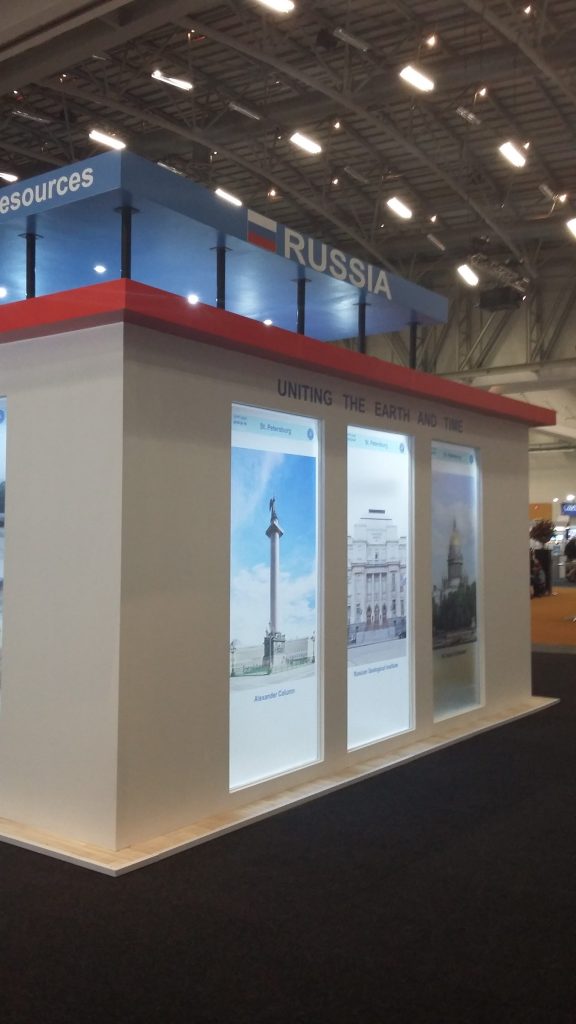
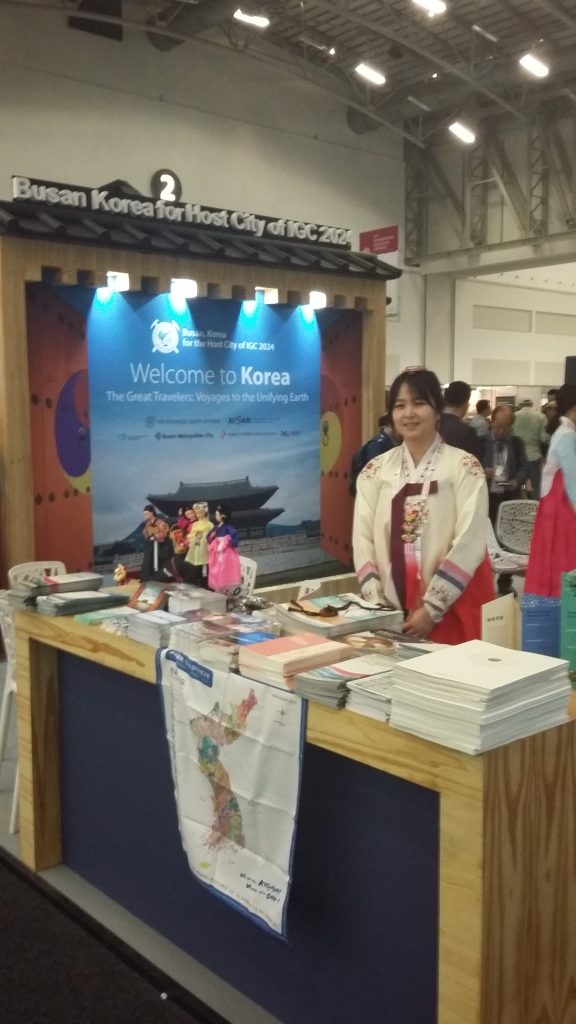
I really enjoyed the two hours or so that I spent in the exhibition hall today, so I thought I’d share a few pictures from some of the stalls that I visited. The stalls highlight that this truly is an international meeting, with geologists from all over the world. Today I visited the stalls of geological organizations from all over the world, including China, Korea, India, Germany, Norway, Russia, and of course South Africa!

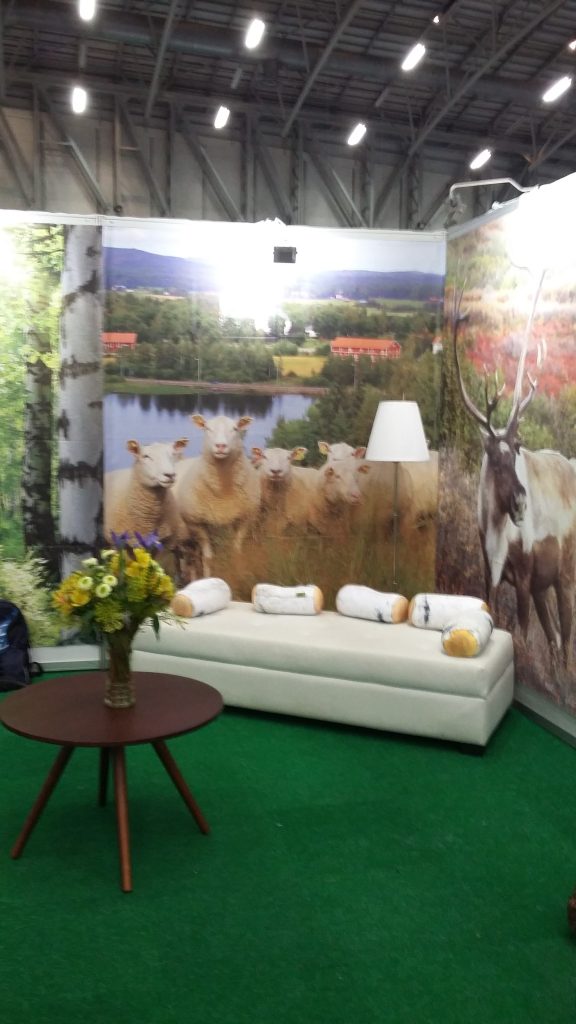
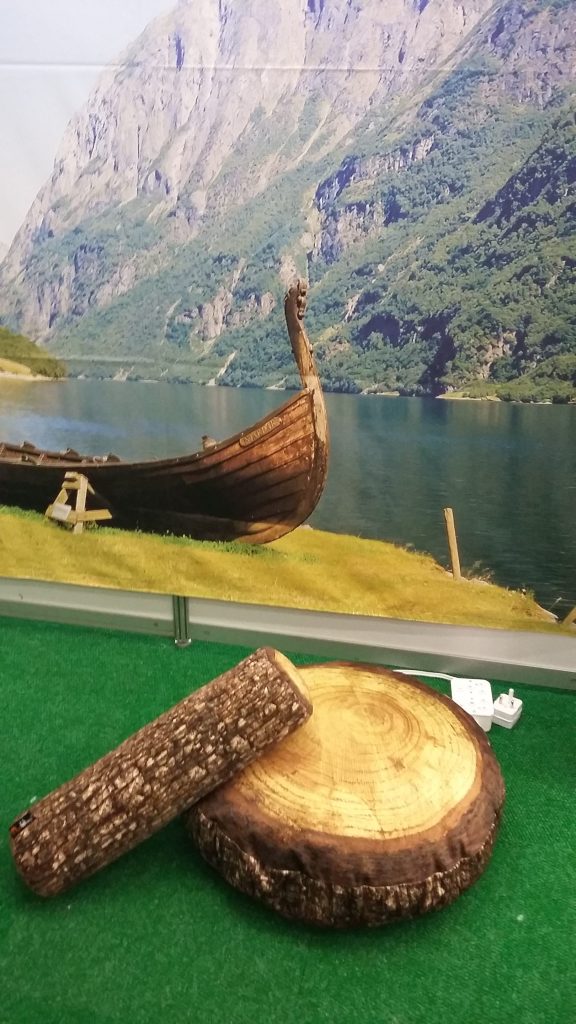
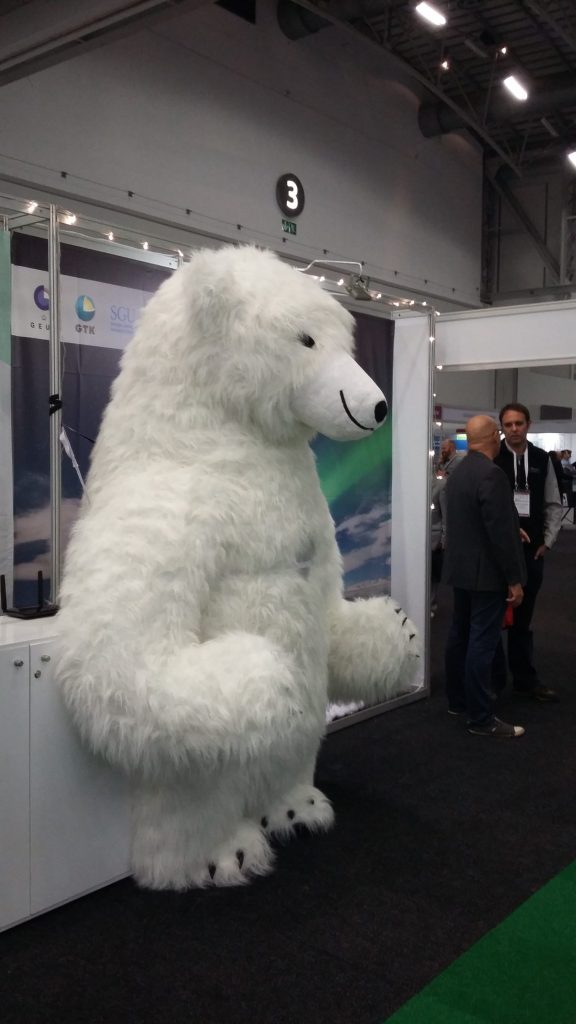
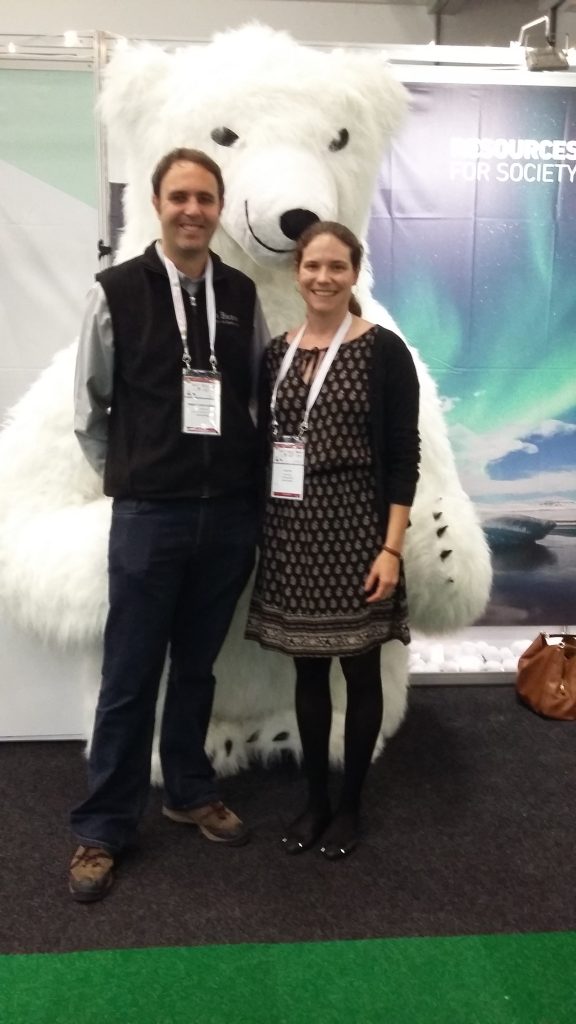
Some of the stalls had some impressive decorations. I think my favorite stall is the one with the polar bear! That stall is run by a group of Scandinavian geological organizations.

I probably only visited a tenth of the stalls today… I definitely need to spend some more time in the exhibition hall later in the week!

Here are a few pictures showcasing some of the international stalls that I visited today:

IGC Exhibition Hall #2.
IGC Exhibition Hall #3.
IGC Exhibition Hall #6.
IGC Exhibition Hall #4.
IGC Exhibition Hall #5.
IGC Exhibition Hall #5. My husband Jackie (also a geologist!) and I posing with the polar bear.
IGC Exhibition Hall #6. My husband Jackie (also a geologist!) and I posing with the polar bear.
IGC Exhibition Hall #7.
IGC Exhibition Hall #7. The next IGC!
IGC Exhibition Hall #8.
IGC Exhibition Hall #9.

That’s all for today… stay tuned for more from IGC tomorrow!

Monday Geology Picture: Green Countertop

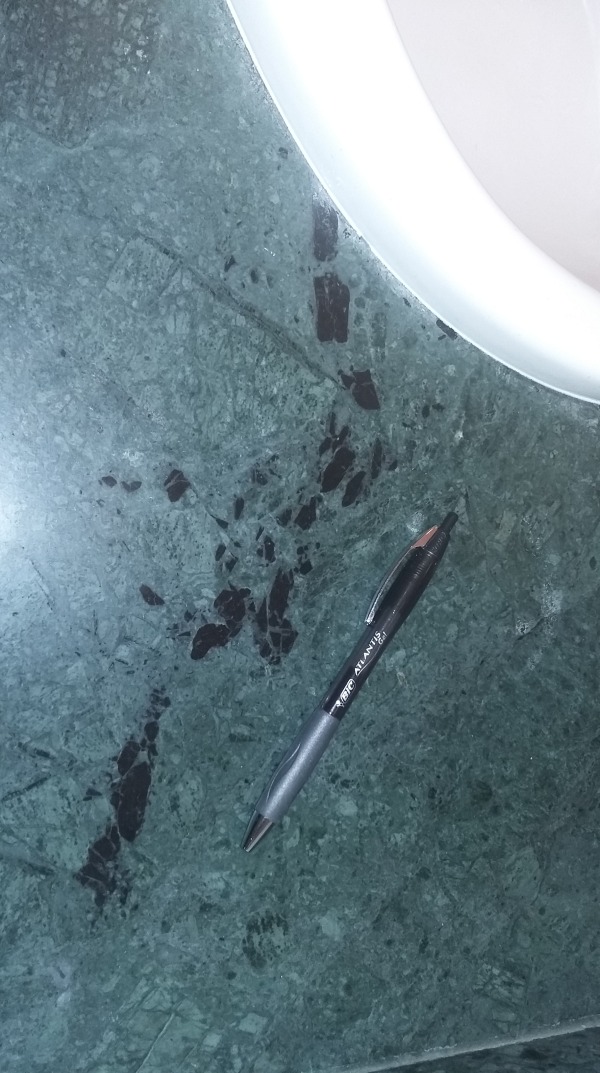
A pretty green decorative rock forms the countertop in my hotel room bathroom.
A pretty green decorative rock forms the countertop in my hotel room bathroom. Click to enlarge. Apologies for the poor cell phone camera picture with flash!

I’m traveling for business at the moment and living out of hotel rooms for a week or so. My current hotel room has a pretty green rock for the bathroom countertop. It’s most likely a green soapstone of some sort. Can anyone identify those interesting black minerals?

Monday Geology Picture: Granite Boulder in the Forest

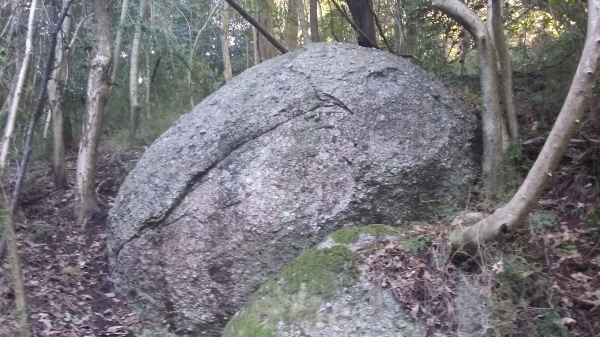
Beautiful granite bolder.

For this week’s “Monday Geology Picture” here’s a shot of a pretty granite boulder that I spotted during a forest hike in the Constantia region of the Cape Town, South Africa. No doubt, this boulder consists of ~550 million year old Cape Granite. There’s no scale in this picture, but the boulder is about 2 meters wide.

KwaZulu-Natal Holiday: The Midlands

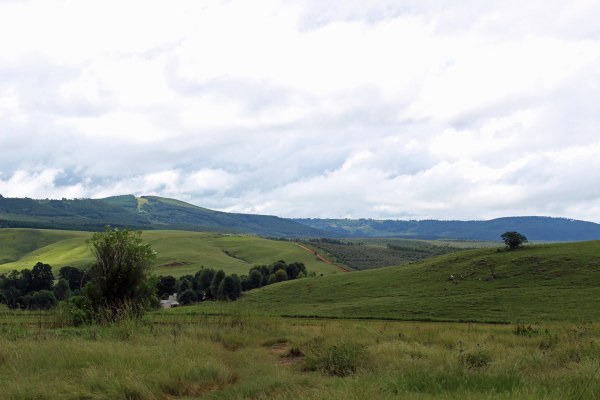
The Midlands #1.
The Midlands #1. Looks like The Shire to me!

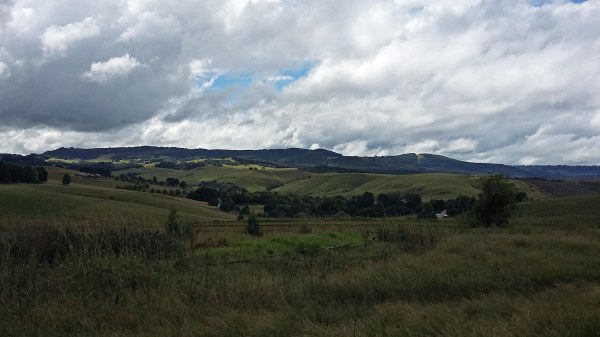
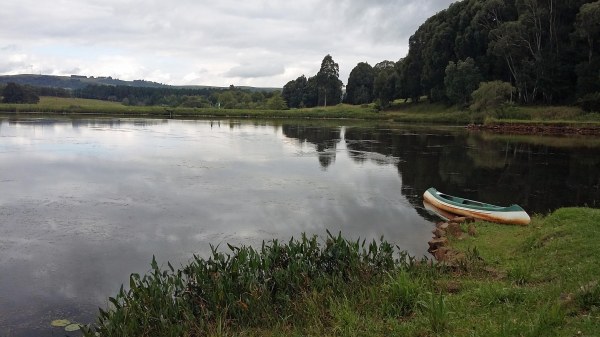
Today I’m sharing some more pictures from our recent holiday in the KwaZulu-Natal region of South Africa. You can see my first post about an impressive waterfall here. Today I’m sharing some pictures from an area known as The Midlands. This region is located inland of Durban and Pietermaritzburg and consists of rolling green hills, a gentle landscape located in between the low-lying, flat coastal area and the elevated, steep landscape of the Drakensberg (Dragon Mountains) region. The landscape is very green (especially when we visited, toward the end of the rainy season) and is covered mostly with fields and small patches of woodland. There are several small villages and a couple of towns located in The Midlands, and there are farms everywhere.

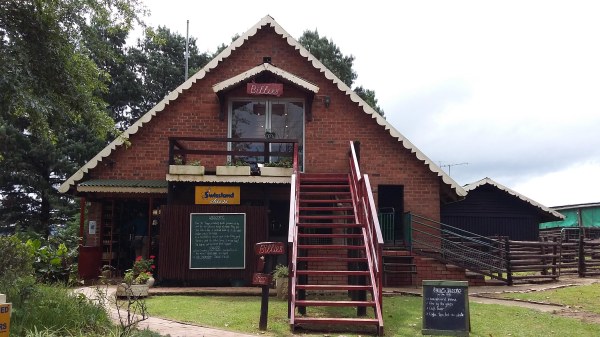
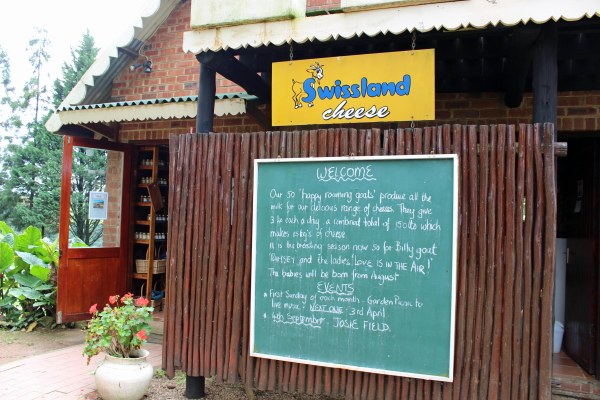
For four nights during our holiday, my husband and I stayed with some good friends of ours in a little town called Hilton, which is located at the edge of the famous Midlands Meander tourist route. In addition to spending some time in Hilton and surrounds, we spent two days exploring farther afield on the tourist trail, driving on various paved and dirt roads and stopping at farms, restaurants, and little shops. It was nice to see so many small businesses, and we did a little shopping to support them. I bought a pair of locally-made leather sandals and some beautiful, soft yarn that was handspun from local sheep. My husband and I also bought some local cheese and honey. It was wonderful to buy some locally made souvenirs rather than plastic ones made in China!

I really enjoyed meandering around The Midlands. The region reminds me of The Shire from J.R.R. Tolkien stories. I kept looking around for Bilbo Baggins and his hobbit friends!

Because of all the greenery, we didn’t see much geology in The Midlands, aside from Howick Falls and the general landscape, of course. Although we didn’t see many good outcrops, from what I understand the rocks of The Midlands are primarily sedimentary rocks of the Beaufort and Ecca groups of the Karoo Supergroup. These rocks are approximately 200 to 300 million years old and have weathered over the years into the gently rolling Midlands landscape. In contrast, the rocks of the Drakensberg include younger ~180 million year old lavas, which comprise the highlands areas. There’s much more obvious and interesting geology to see in the younger, steeper terrain of the Drakensberg… stay tuned for future posts! For today, however, enjoy some scenic images of The Midlands.

The Midlands #2.
The Midlands #2.
The Midlands #3.
The Midlands #3.
The Shire #4. Hobbits must live here.
The Midlands #4. Hobbits must live here.
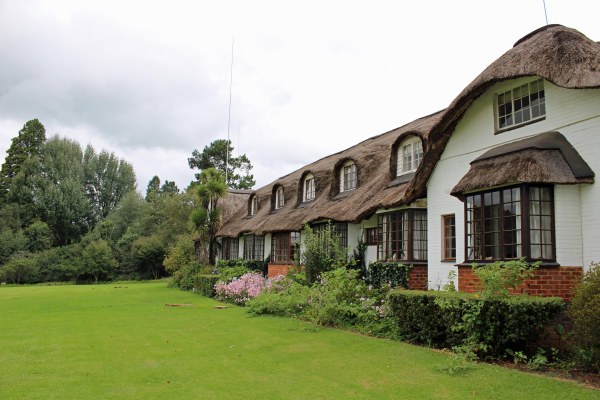
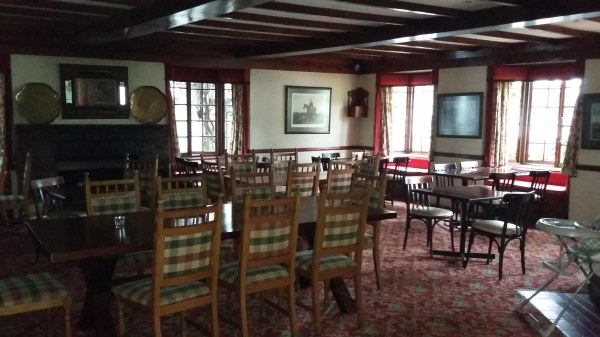
The Midlands #5. An inn fit for adventuring hobbits!
The Midlands #5. An inn fit to serve a meal to adventuring hobbits!
The Midlands #7.
The Midlands #6.
The Midlands #9.
The Midlands #7.
The Midlands #9.
The Midlands #8.
The Midlands #10.
The Midlands #9. Swissland Cheese. We had the most delicious goat cheese here!
The Midlands #12.
The Midlands #10.
The Midlands #11.
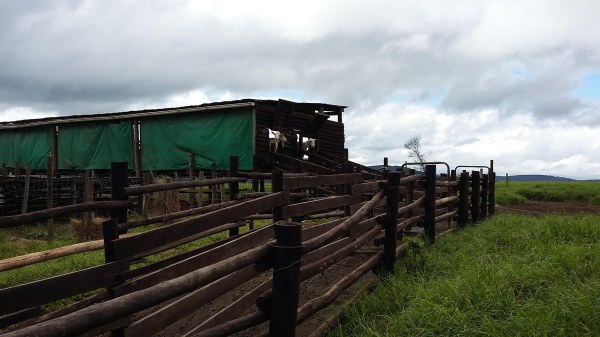
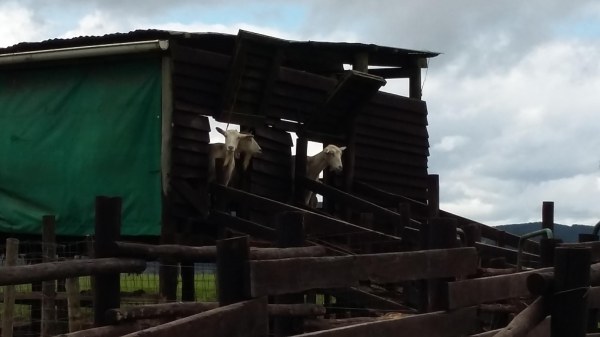
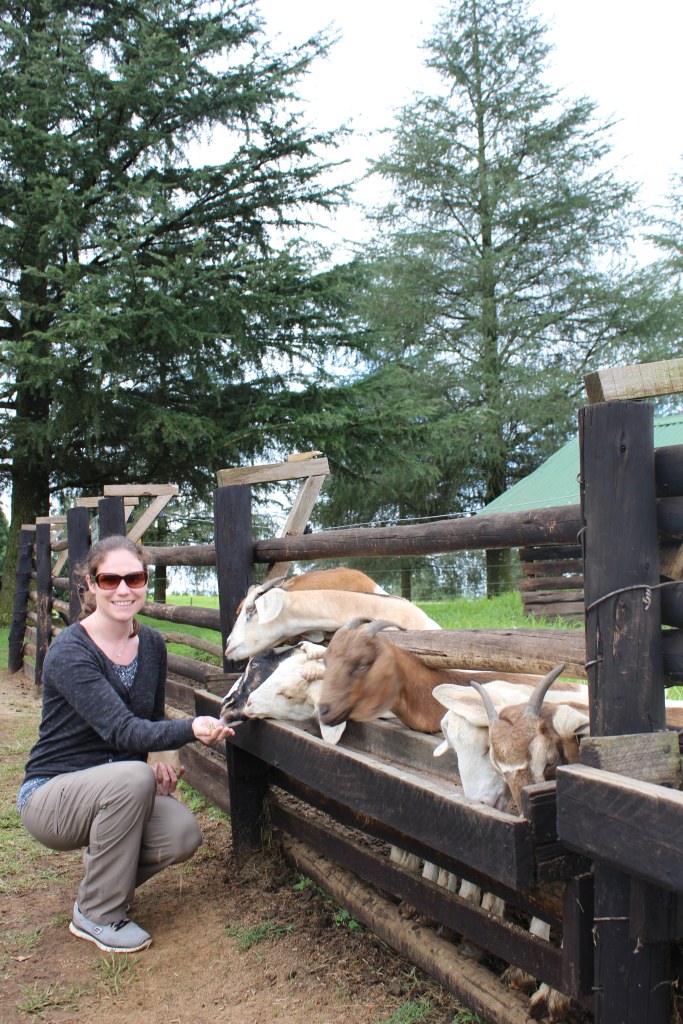
The Midlands #11.The goats!
The Midlands #13.
The Midlands #12.
The Midlands #14.
The Midlands #13. Feeding the cheese-makers!
The Midlands #15.
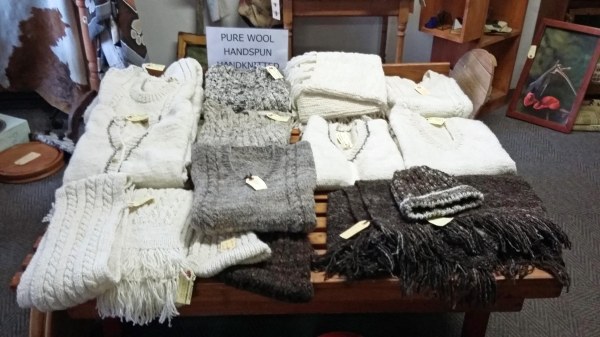
The Midlands #14. Beautiful garments handknitted from handspun yarn from local sheep.
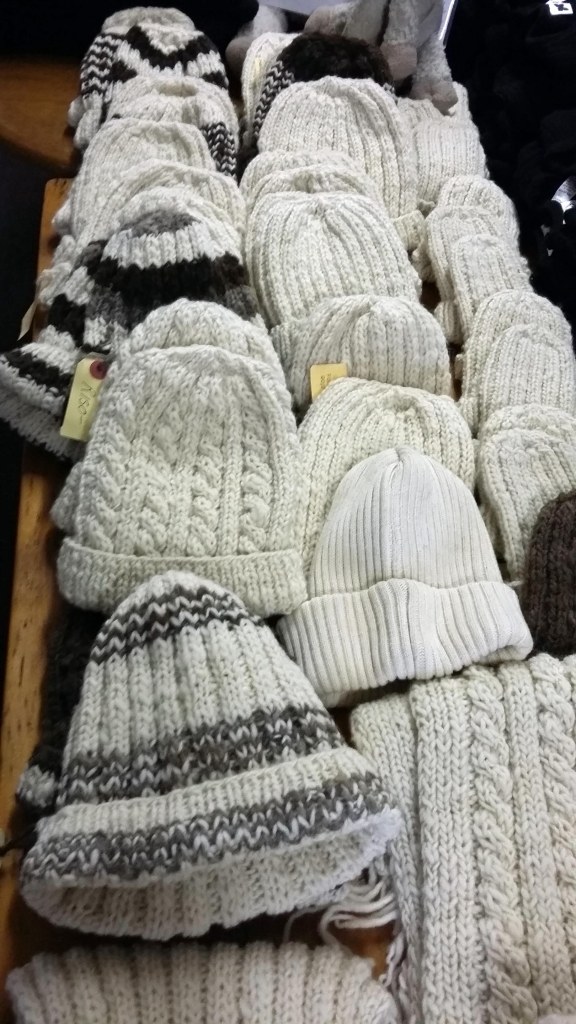
The Midlands #16. More gorgeous handknits. I bought a hat and scarf... and some yarn to knit myself matching mittens!
The Midlands #15. More gorgeous handknits. I bought a hat and scarf… and some yarn to knit myself matching mittens!
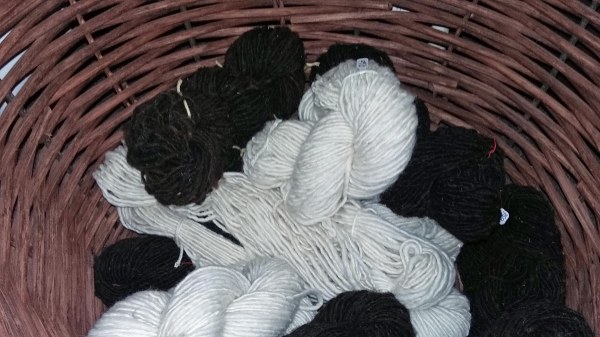
The Midlands #17. Handspun yarn.
The Midlands #16. Handspun yarn.

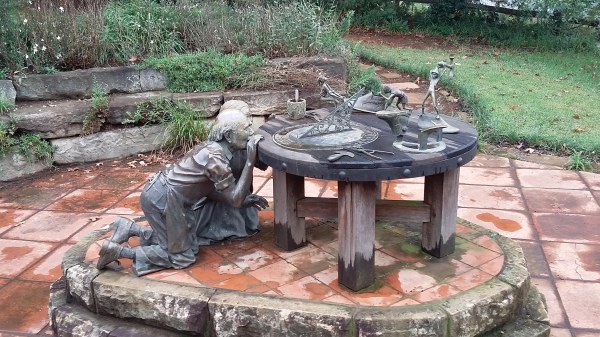
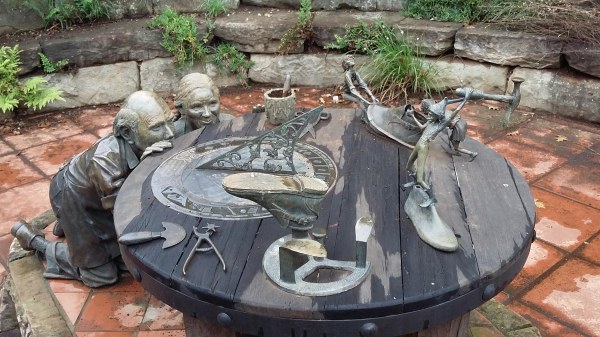
Last but not least, here’s a darling statue that was outside Groundcover, the shoe shop where I bought the leather sandals:

The Midlands #18.
The Midlands #17.
The Midlands #20.
The Midlands #18.

That’s all for today… more soon!

Monday Geology Picture: Folded Mountains in Hermanus, South Africa

A view of Cape Fold Belt mountains from the Hermanus Yacht Club, April 2016.

Over the weekend I participated in a kayak race that was held in the lovely little coastal town Hermanus, South Africa. The race was held on a lagoon with a beautiful background of mountains that are part of the Cape Fold Belt. You’ve seen pictures of this fold belt before here on Georneys. For example, here the belt is featured in one of Callan’s “Friday Fold” posts. However, these mountains are so pretty it’s worth sharing another picture here. Enjoy!

KwaZulu-Natal Holiday: Howick Falls

HowickFalls1
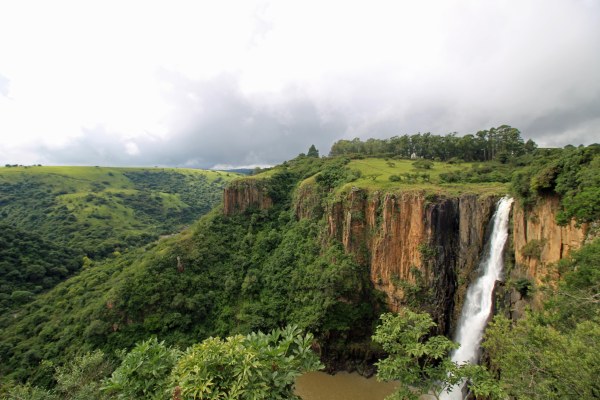
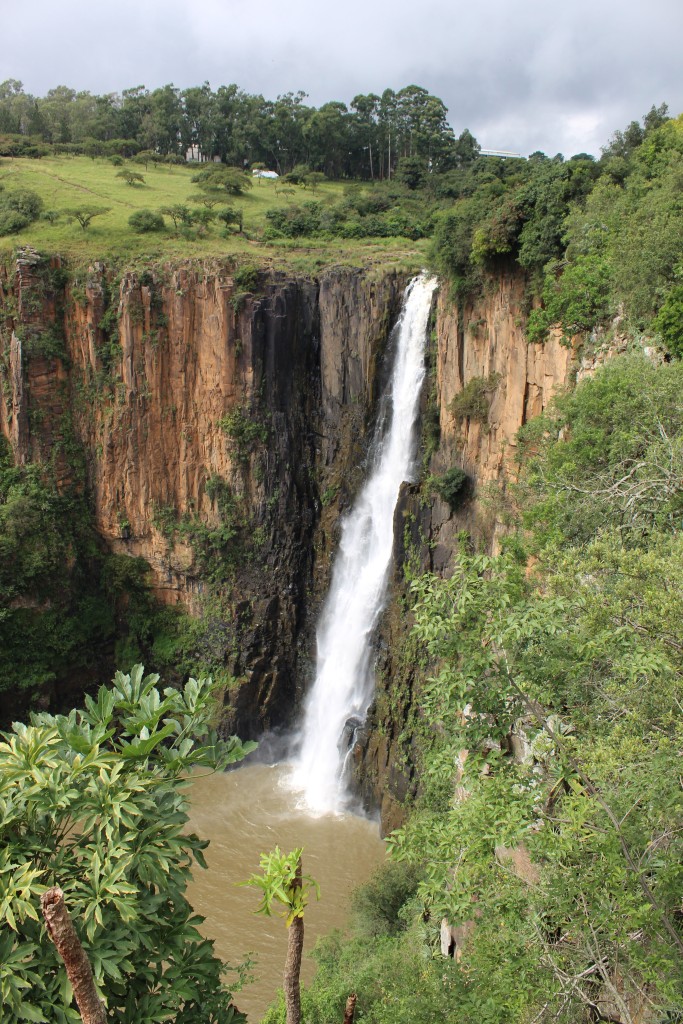
Howick Falls #1.

Over the next two or three weeks I’ll be sharing some pictures from my recent week-long holiday in March to the KwaZulu-Natal province of South Africa. A week is not nearly enough time to fully explore this beautiful part of the world. However, my husband and I managed to see a fair amount! We took a flight from Cape Town (our home city) to Durban and then we drove through to the lovely little town of Hilton, where we stayed with friends for three nights. From Hilton we explored a beautiful part of the country known as The Midlands. Then we drove to the town of Underberg in the Drakensberg, which is Afrikaans for “Dragon Mountains”. On our way to Underberg we took a detour to Kamberg to see some rock art. We spent four nights in Underberg, and one day we went on a day trip up Sani Pass to spend a few hours in the Kingdom of Lesotho.

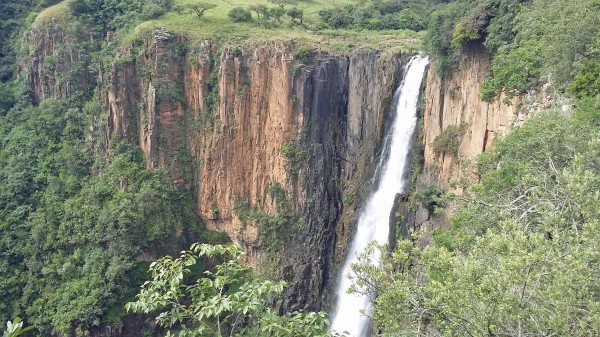
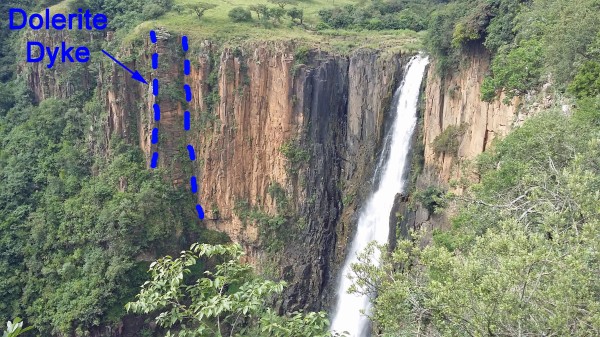
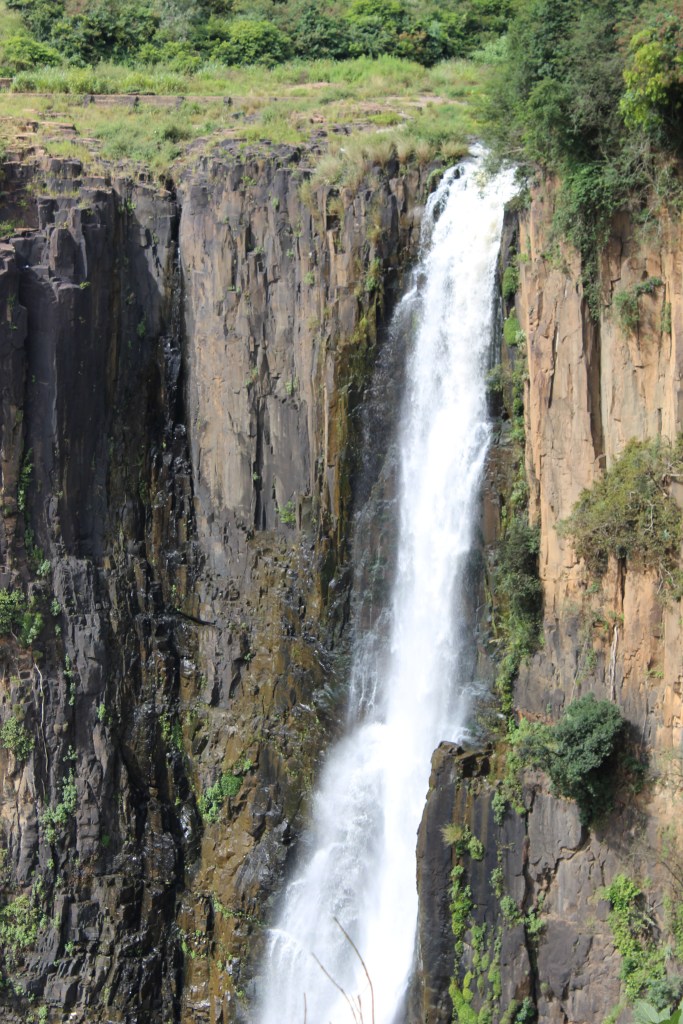
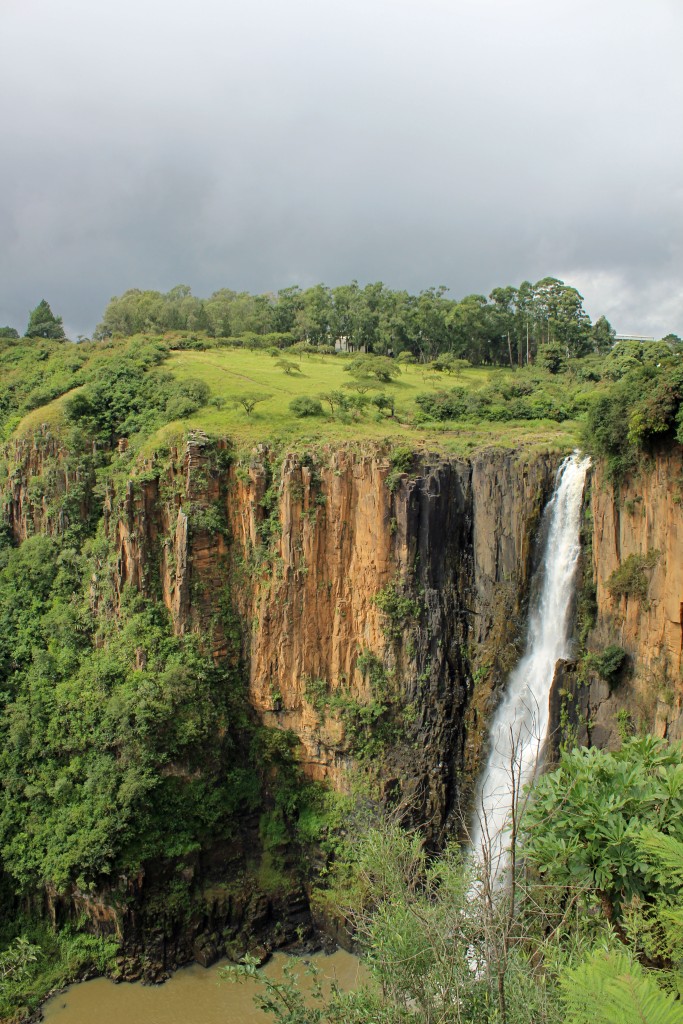
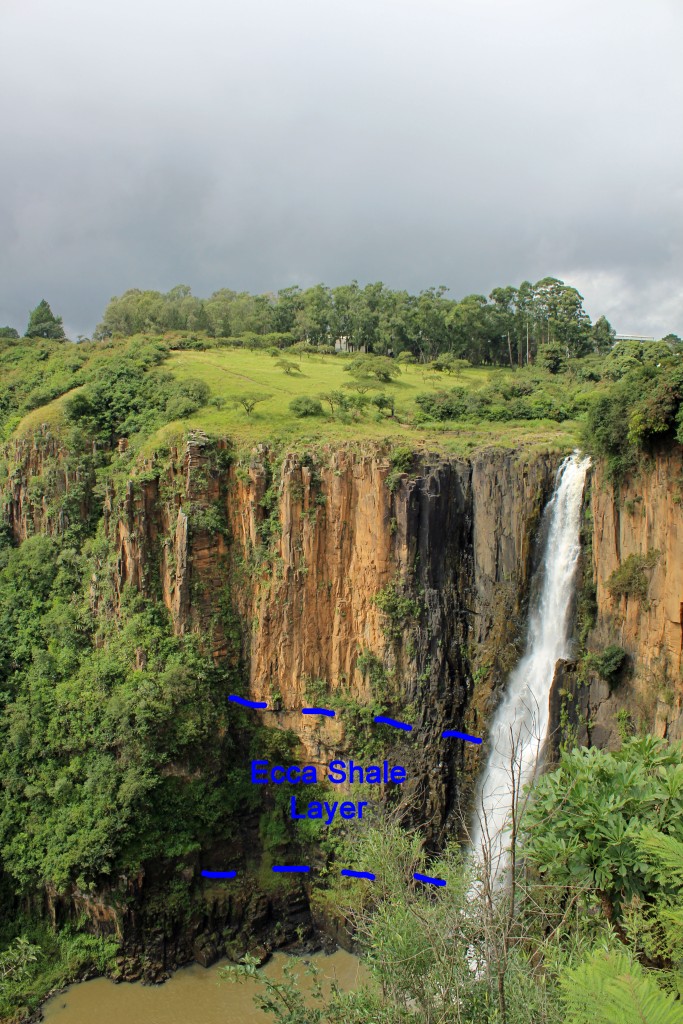
To start off the KwaZulu-Natal holiday blogging, today I’m sharing pictures from our visit to Howick Falls, an impressive waterfall located a short drive away from Hilton. Howick Falls is a 95 m tall waterfall on the Umgeni River. The falls cascade over a cliff composed of dolerite that intruded into Ecca Group sedimentary rocks. Both the dolerite and the Ecca Group rocks are Karoo Supergroup rocks. At the falls, a layer of Ecca shale can be seen sandwiched between sills of dolerite, and there’s also a dolerite dyke.

Let’s take a closer look at part of the cliff:

Howick Falls #2.
Howick Falls #2.

It’s a little difficult to see the boundaries between the dolerite sills and the Ecca shale, but they’re there.

Do you see the dolerite dyke? If not, let me point it out to you:

Howick Falls #3.
Howick Falls #3.

Here’s a closer look at the upper dolerite sill:

Howick Falls #4.
Howick Falls #4.

Here are two more pictures pictures of the falls:

Howick Falls #5.
Howick Falls #5.
Howick Falls #6.
Howick Falls #6.

Do you see the Ecca shale layer in the above picture? Here are the rough boundaries:

Howick Falls #
Howick Falls #7.

As I mentioned, it’s a little difficult to pick out the boundaries from these pictures, but there’s definitely a shale layer in there!

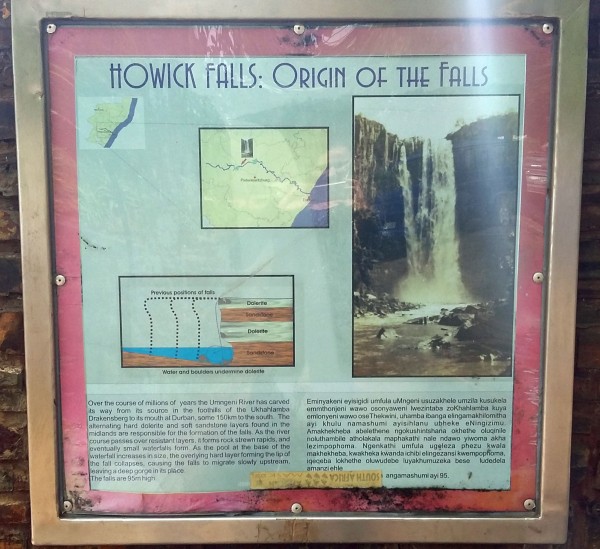
Here are some pictures of an informational sign at the falls:

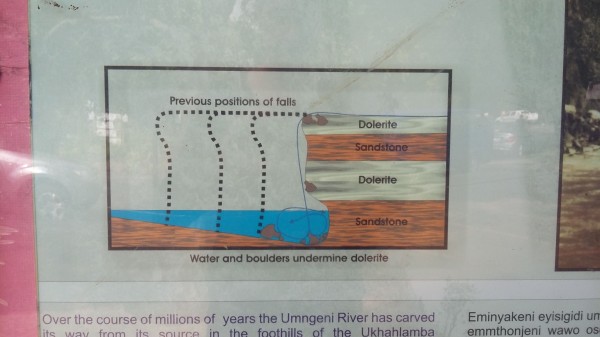
Howick Falls #8. The sign says sandstone but note that the Ecca consists of both shale and sandstone. My one geology book says that a shale-rich Ecca layer is located at Howick Falls.
Howick Falls #8. The sign says sandstone but note that the Ecca Group consists of both shale and sandstone. My one geology book says that a shale-rich Ecca layer is located at Howick Falls. Click to enlarge.
Howick Falls #9. A close-up of the geological diagram on the informational sign.

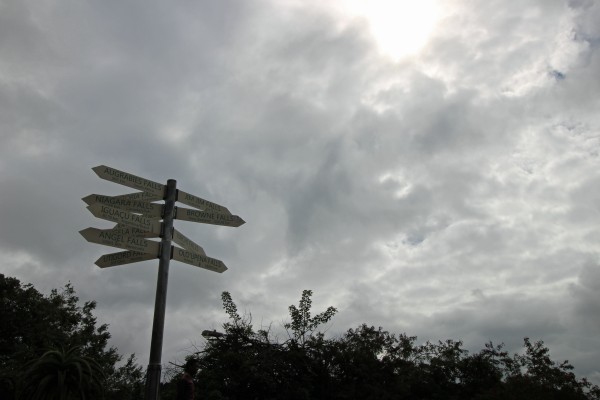
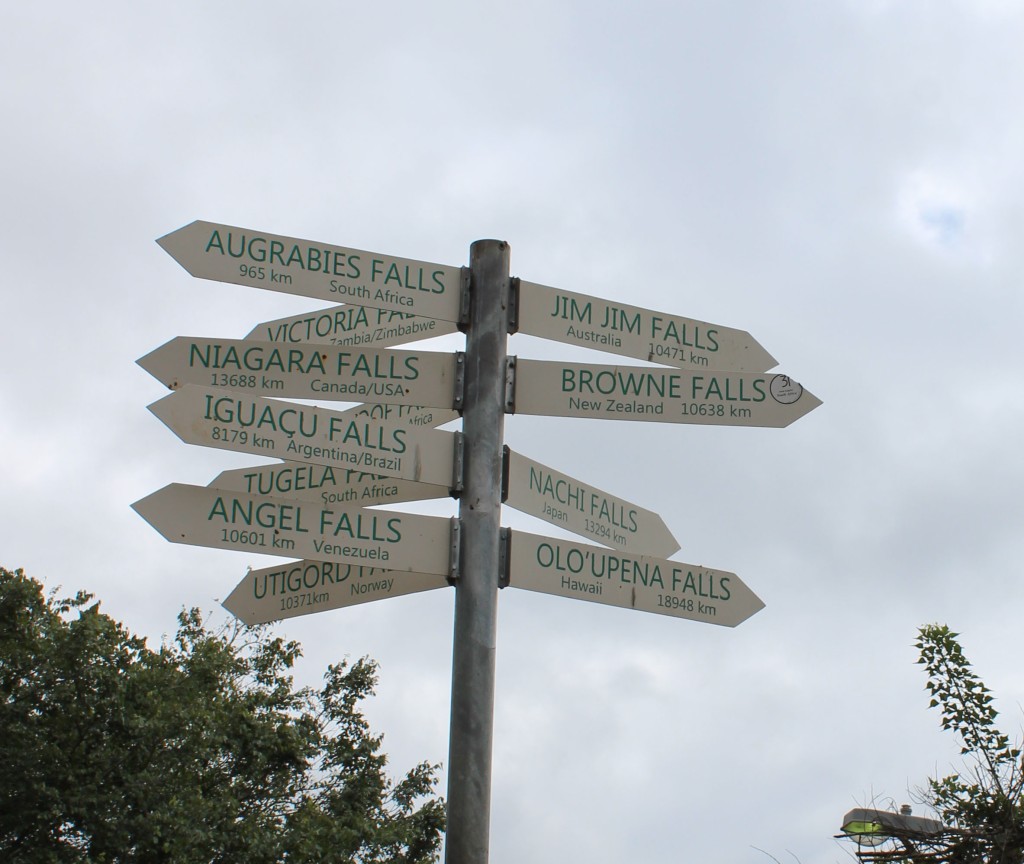
There’s a neat signpost at the falls showing the directions and distances to other famous waterfalls:

Howick Falls #10.
Howick Falls #10.
Howick Falls #11.
Howick Falls #11.

Last but not least, here are some pictures of the beautiful river valley below the falls:

Howick Falls #12.
Howick Falls #12.
Howick Falls #13.
Howick Falls #13.

That’s all for now. Stay tuned for more KwaZulu-Natal adventures here on Georneys!

Monday Geology Picture: Table Mountain Profile

A profile view of Table Mountain, April 2016.

Since I live in Cape Town, South Africa, I often share pictures of beautiful Table Mountain. This week’s “Monday Geology Picture” shows another view of the mountain. I took this picture yesterday during a hike in the Tygerberg Nature Reserve. I’ll share some more pictures from the reserve in a separate post. For now, enjoy Table Mountain!