Mass Spectrometric Musings

I originally wrote this essay in Fall 2006. Revisiting these words, I sadly observe that my reading has degraded seriously since my first year of graduate school. As an enthusiastic first year, I would read isotope books for fun! Now I read mystery novels by the mass spectrometer. Oh, well. To be fair, though, I was really reading the isotope book for a homework assignment.

J.J. Thompson, the inventor of the mass spectrometer. Image taken from here.

Last Saturday [Note: in December 2006], I met up with my friend Rebecca, and we took the train north of Boston to meet up with some friends for a Newtonmas Party hosted by a skeptic friend of ours. On the way out the door, I grabbed some light reading for the way as I wasn’t sure Rebecca and I would end up on the same train. Fortunately, Rebecca and I did meet up and ended up gossiping on the way. Rebecca also made fun of my “light reading for the train.” The book I selected was Geochemistry of Non-traditional Stable Isotopes, a fascinating little volume that I imagine I’ll read cover-to-cover before the year’s end. Really, though, Rebecca, it is light reading… I mean, it’s far better than other books I could have grabbed, such as, Reaction Mechanisms of Inorganic and Organometallic Systems or Thermodynamics of Minerals and Melts, for instance.

As I have a paper due tomorrow on lithium isotopes, my post today is going to have to be about isotopes. For those of you who need a quick review, isotopes of an element are produced because of differences in the numbers of neutrons in the nucleus. Thus, isotopes of an element have slightly different masses that can lead to small, but important, differences in the behavior of an element. For instance, water sitting in a glass will become isotopically heavy over time as lighter 16O and 2H evaporate preferentially over heavier 17O, 18O, and 3H.

Many physical, chemical, and biological processes can lead to isotopic fractionation. Studying ratios of both stable and radioactive isotopes can provide important constraints on these processes. The study of radioactive isotope systems, such as potassium-argon and uranium-thorium, can also be used in the dating of rocks and archaeological samples.

I started reading Geochemistry of Non-Traditional Stable Isotopes for my research paper on lithium isotopes, but I’ve found myself reading bits and pieces of the other sections of the book as well. This book is basically about all the new types of stable isotope systems (lithium, magnesium, zinc, selenium, et cetera) that are now able to be studied because of recent advances in mass spectrometry. The isotopes themselves aren’t really that interesting, but their applications are. Scientists will be able to learn so much more about paleoclimate, volcanology, ocean circulation, biological cycles, et cetera from studying these isotopes.

This little book on stable isotopes is opening my eyes to how recent developments mass spectrometry are revolutionizing isotope geochemistry. I could care less how my car works, but I care a great amount about how mass spectrometers work, for some reason. I’m weird that way. Basically, a mass spectrometer uses electric and magnetic fields to separate isotopes and measure their ratios and concentrations.

These days, the coolest mass spectrometer on the block is a multicollector inductively coupled mass spectrometer (ICP-MS). ICP-MS has many advantages, the greatest of which is that you often don’t have to go through the weeks of painstaking chemistry to separate out an element of interest from a sample. In the old days geochemists had to labor for days in the lab, slaving away over intricate glass columns and probably getting various cancers from the acids and other toxic stuff they used in their chemistry. These days, the modern geochemist can dissolve a rock powder or other sample, dilute the solution with some weak nitric acid, and use a cool flame torch to completely ionize the sample. No chemistry involved, often! Just simple dissolution.

To make life even easier, you can even hook up a laser to your ICP-MS. Besides saying that you “work” with lasers, which is always cool to say, the advantage is that you don’t even need to dissolve your sample! In many cases, you don’t need to prepare your sample at all. You can stick your rock, bone, wood, or even flesh/hair/skin sample in the little box with the laser, and the laser does all the work. Poof! Your sample is ionized. Turned into plasma. Twenty minutes later, you have constrained the chemical and isotopic composition of your sample. The analysis time for your sample has gone from twenty weeks, perhaps, to twenty minutes.

While I oversimplify the ease of laser ICP-MS (you have to worry about matrix effects, for instance), the technology is powerful. As a young geochemist, I marvel in this technology. Yet, I realize that some of the older geochemists  are somewhat skeptical of this new technology.

Partly, I think, it’s a generation gap. Many geochemists claim that their old techniques of laborious, back-breaking, cancer-inducing chemistry and last generation mass spectrometers still produce better numbers. In a sense, that’s true. Many of the older techniques still do produce the best-precision numbers. Yet, for many problems you don’t need super high precision to answer your questions. Why do all the work, then? I think some of the older geochemists are just bitter they had to work for twenty weeks to get the same numbers their grad students get in twenty minutes. However, for the problems which do require high-precision resolution, the new mass spectrometers are catching up. There are still some tricky isotope systems which require laborious chemistry, but even these systems may become easier to measure with time.

For some researchers, I recognize there may also be financial restrictions. The new machines can easily approach a million dollars in cost, and not all labs can afford that. The old machines and techniques may have to do, in many cases.

While I am in general all for new technology and less labwork, I do have to agree with older geochemists I’ve spoken with that the ease with which isotopic data can be generated on these new machines is a little dangerous. These days, mass spectrometers are becoming like magic boxes which produce isotope numbers. You load your sample, press a button on the computer, and walk away. After your coffee break, you have your data, more or less. However, today’s graduate students do not necessarily appreciate the nuances and potential pitfalls of the technology, so troubleshooting is challenging.

Also, the rate at which data is being produced is somewhat dangerous. What good are a hundred numbers, after all, if you have no idea what they mean? Maybe they only had ten numbers in the old days, but they really thought about those ten numbers.

I talk about mass spectrometers because these are the toys which I play with, but there are many other examples of scientitific technology that is both world-changing and dangerous. As good scientists, we should embrace modern technology. But, as good skeptics, we should be careful about the magic boxes of the modern world. At the very least, we should appreciate that collaboration and clear communication between professionals in various specialties will become increasingly important as these magic boxes become fancier and fancier.

And speaking of magic boxes, I think it’s time to go and microwave my dinner in the magic box in the kitchen.
Mystery Novels and Mass Spectrometers

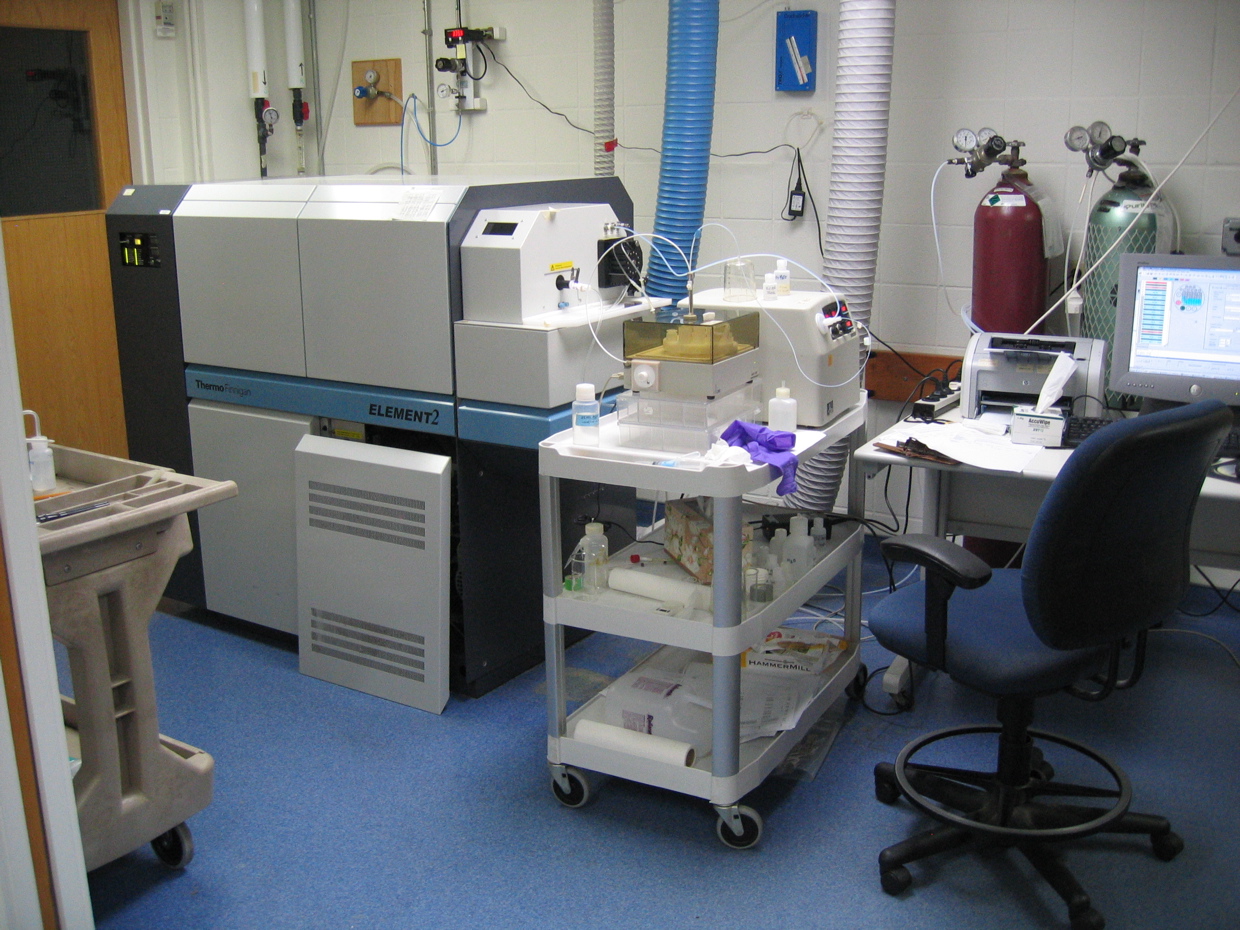
The Element2 mass spectrometer at WHOI. Image taken from here.

This past week geoblogger Callan Bentley of Mountain Beltway reviewed books on time, fallacies, dirt, and climate change. There are some great books in his reviews– some I’ve read already and some I’ve added to my reading list. Alas, I am afraid that my reading list is quite long. I’m very impressed at how many non-fiction books Callan manages to find the time to read. I think Callan must be superhuman– he seems to do so much!

In recent years, I have found that my reading habits have changed somewhat. Since childhood, I have been in the habit of reading every night before bed. I still read most nights before bed, but I’m afraid that both the quantity and the “quality”, so to speak, of my reading has degraded since I started graduate school.

The degradation of quantity is easy to explain. I just don’t have as much time and energy for reading. As for the “quality” of my reading, I read far more “serious” books in high school and undergrad than I do now in graduate school. There are dozens of non-fiction books about geology on my reading list, but I find that I only read two or three of these books a year. Instead, I read science fiction, fantasy, and mystery novels. At least, this is what I read in my free time. I guess that if you count research for my thesis, I do read a fair amount of non-fiction geology in the form of papers, research books, and others students’ theses. I think all the reading I do for my PhD research leaves my brain somewhat tired. Much as I want to select (looking at my bookshelf) a book such as “Volcanoes of the Solar System” for my nightly reading, I am much more likely to pick up a fantasy or mystery novel.
In addition to being a bit burnt out from all my reading for my PhD, another reason I select somewhat lighter books these days is that much of the time I have for reading I also need to periodically be paying attention to other things– namely, chemical separation columns and mass spectrometers.

For example, on Wednesday I spent 10 hours measuring uranium and thorium concentrations on the Element2 Mass Spectrometer here at WHOI. 10 hours is actually a very short day for me on the Element2. Normally, when I run this mass spectrometer I run for 14-16 hours. There are two reasons for this. First, you pay about $1000 per day to use the machine, so you want to maximize this time. Second, it takes two or three hours to set-up and tune the machine. Once the machine is tuned, you want to run as many samples as you can.

When the Element2 is running poorly, I have to pay close attention to every sample and continually re-tune the machine. However, when the machine is running well– as it was on Wednesday– I have about three minutes of waiting time for every blank, standard, and sample I run. I still need to stay at the machine in case there is a problem (unfortunately my samples are too valuable for me to risk automating the analysis), but I don’t have to pay close attention.

I have tried doing various “productive” things during this waiting time such as reading journal articles, reducing data,  and writing parts of my thesis.  However, I have found that trying to be “productive” during the waiting time is futile. Three minutes isn’t enough time to focus and make progress, so I just end up re-reading the same sentence of a paper a dozen times. So, after the first two times I ran the mass spectrometer I gave up on trying to do “productive” activities during this waiting time. However, I found that just sitting there for those three minute stretches (for 12+ hours) is mind-numbingly boring. So, I have found that reading a book– the type of book that can easily be picked up and put down– is a good solution.

Certain types of science fiction, fantasy, and mystery books are perfect for this “pick up and put down” reading. Last year, I made my way through the Sword of Truth fantasy series, much of which I read while waiting for a column to drip or a mass spectrometer to analyze an isotope. Currently, I am making my way through the Elizabeth Peters Egyptian mystery novels. I anticipate that the Peters novels will carry me through the rest of my labwork this year.

The Sword of Truth fantasy series. Image from Wikipedia.
The first Elizabeth Peters Egyptian mystery novel. Image taken from here.

I plan to take a few months off after I finish my PhD before I start either a job or postdoc. This planned break gives me time to join my fiance abroad and go through immigration and such. Also, this break will give my brain some rest after many years of school. Hopefully, during these months off I will tackle a good portion of my reading list– and not just the rest of the Peters mysteries, delightful as they may be.

Sand Structures at Nobska Beach

Nobska sands 1, Woods Hole, December 2010.

Last week my fiance and I went for a long walk around Woods Hole, the village on Cape Cod where I live. On this walk, we stopped at Nobska Beach, a pretty little beach with a view of Martha’s Vineyard. There were footprints everywhere, so clearly others (two-legged humans and four-legged canines) had recently taken a winter beach stroll at Nobska. In the summertime, the beach is usually packed with locals and tourists. When we visited the beach last week, however, it was deserted. We walked along looking at the pretty views of the lighthouse and Vineyard. Soon, however, we became more interested in the sands at our feet than the views above.

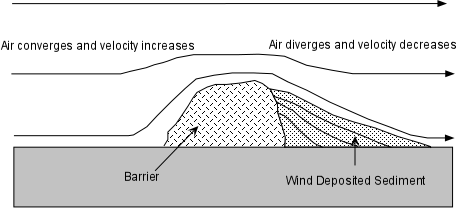
This is because we noticed some interesting structures in the beach sands. Wherever little tufts of vegetation grew out of the sand, miniature sand deposits built up. These structures are formed by the wind, as the diagram below shows. Note that I took the diagram below from this site about sediment transport by wind.

Figure taken from here.

In the Nobska Beach structures, the vegetation is acting as the barrier. The wind (blowing primarily to the southeast, I believe) creates little mini sand structures all over Nobska Beach.

Nobska sands 2, Cape Cod, December 2010.
Nobska sands 3, Cape Cod, December 2010.

I never noticed these structures during my summer visits to Nobska Beach. Perhaps the winter winds make them more predominant or– more likely– they are trodden down by hundreds of summer visitors.

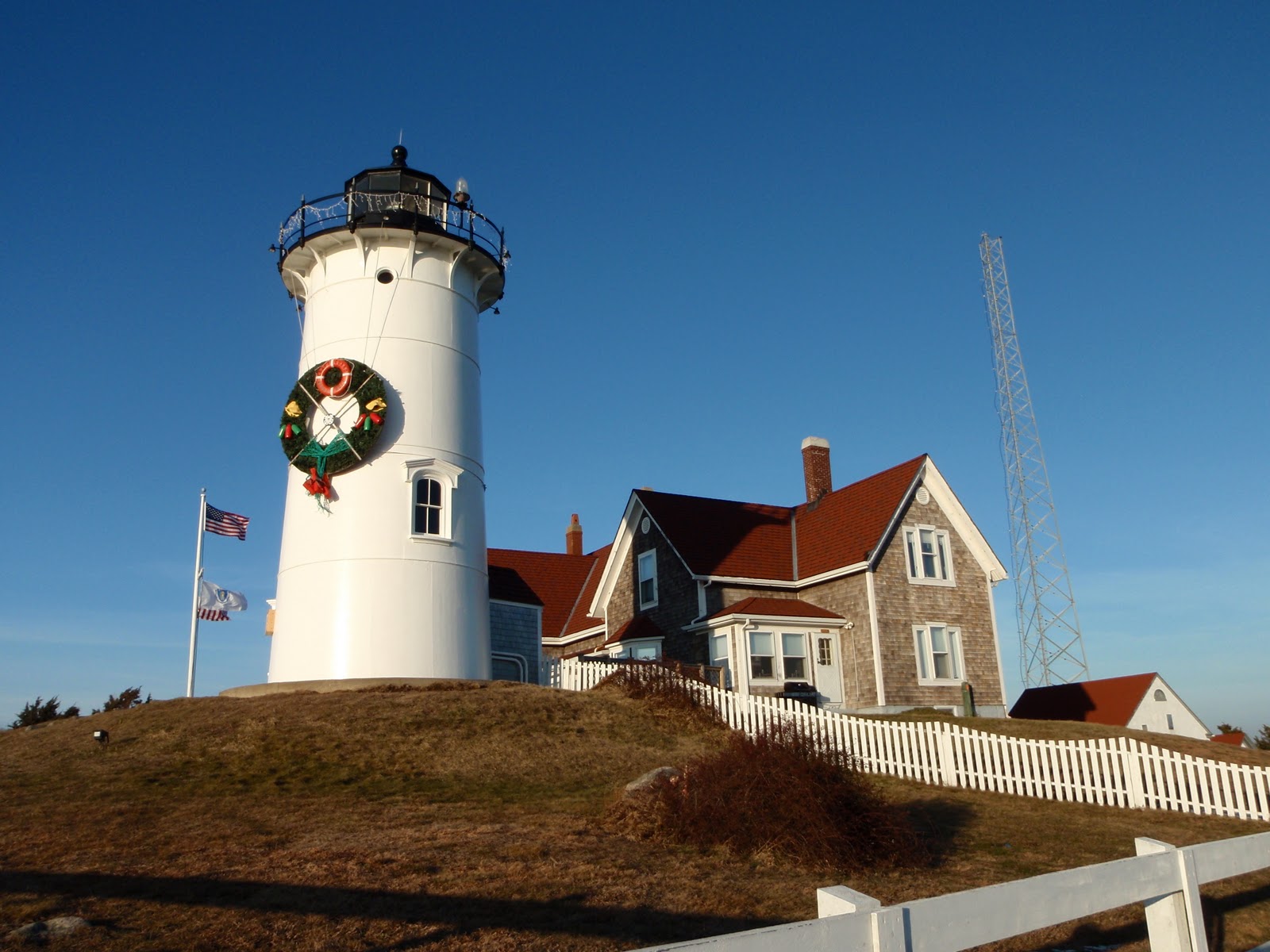
Here’s a picture of pretty Nobska Lighthouse, all decked out for the holidays:

Nobska Lighthouse, Cape Cod, December 2010.

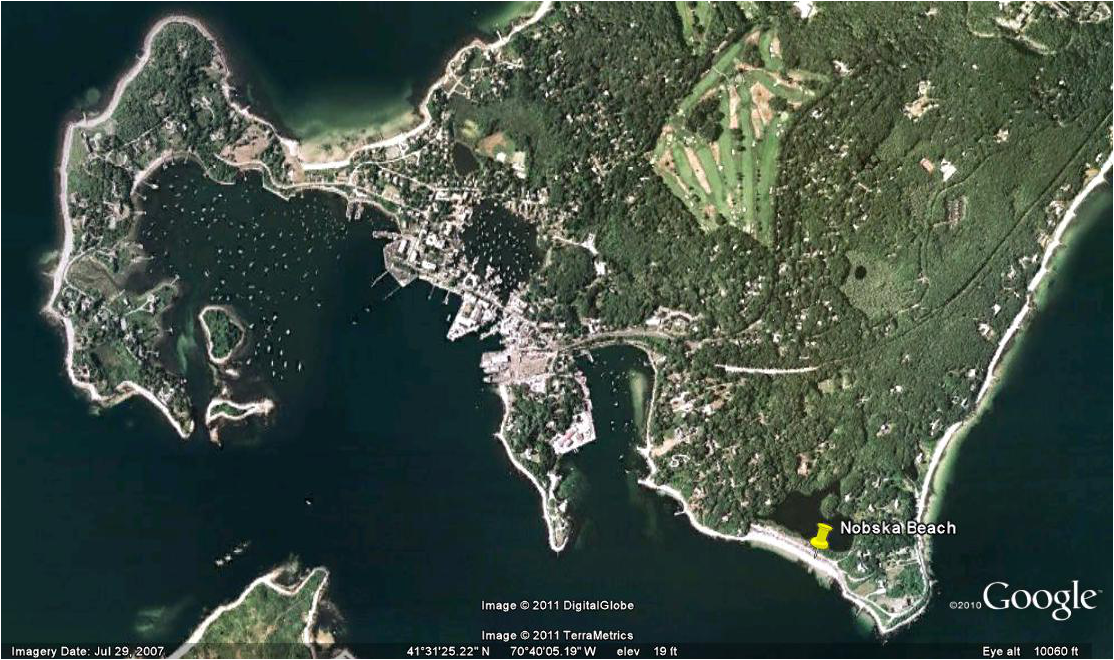
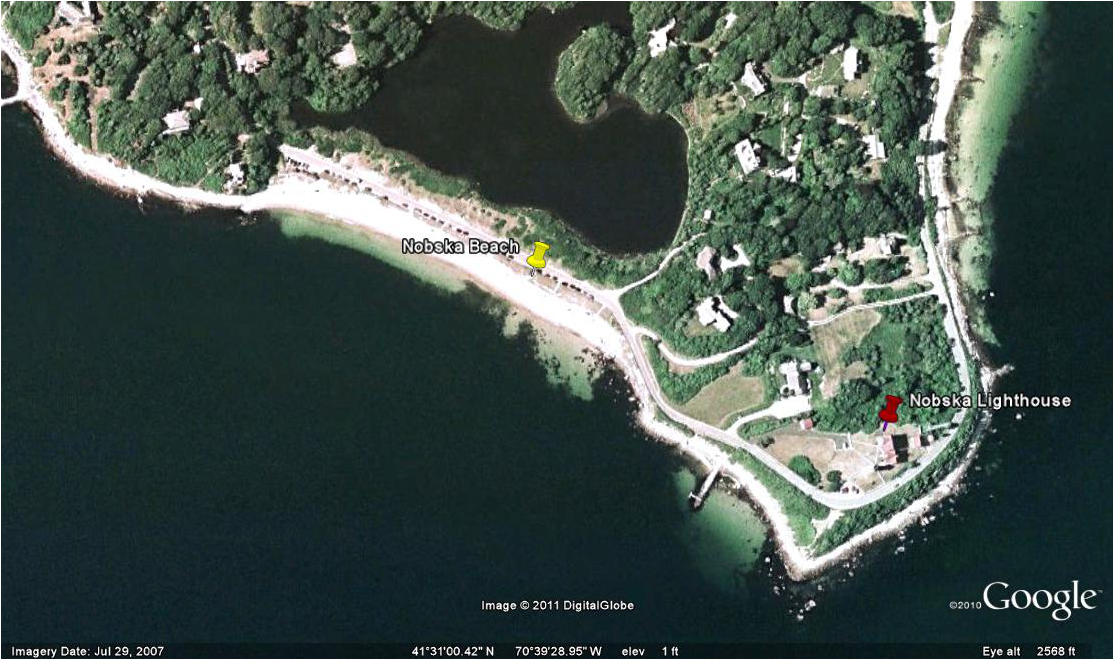
And here are some Google Earth images showing you where Nobska Beach (yellow pushpin) and Nobska Lighthouse (red pushpin) are located. Click on the images below for a larger version.

Geology Word of the Week: J is for Jurassic

An artist’s vision of Sauropods and Iguanodons during the late Jurassic. Image taken from Wikipedia Commons here.

def. Jurassic
1. A geologic period spanning from approximately 200 to 145 million years ago. 
2. A cool adjective to use in everyday life to describe something or someone ancient and/or gargantuan. For example, “My Jurassic professor doesn’t even know how to use a computer. He does all of his lectures in chalk on the blackboard!” and, “Wow, this is a Jurassic portion of french fries! Please help me eat these.”
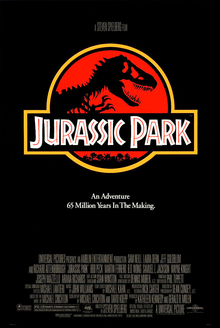
3. A time period when the following dinosaurs were NOT alive: T-Rex,Velociraptors, and Triceratops, the dinosaur stars of the movie “Jurassic Park.” Dinosaurs that WERE alive during the Jurassic period include Sauropods such as Apatosaurus and Brachiosaurus, Theropods such as Allosaurus and Megalosaurus, and –one of my favorite dinosaurs–Iguanodons.

Jurassic Park movie poster. Image taken from Wikipedia.

The movie “Jurassic Park” came out when I was nine years old. For many years, I would visit  my grandmother in South Carolina for two weeks during the summer. My grandmother would spoil me during those two weeks. She would take me horseback riding, buy me toys and junk food, and take me to swim in her neighbor’s pool. She would also sometimes take me to see movies that my parents thought were “too scary” for me. The summer I was nine, my grandmother took me to see “Jurassic Park.” I was so scared that I had trouble sleeping for several nights. In the night I would hear scratching noises (probably my grandmother’s dogs), and I would imagine there were Velociraptors circling my bedroom window. The Velociraptor kitchen scene still spooks me as an adult.

You can watch a video clip of the Velociraptor kitchen scene here.

As a kid the movie “Jurassic Park” scared me to death, but I absolutely loved that movie. I asked for “Jurassic Park” plastic dinosaurs for Christmas, and I used my allowance to buy “Jurassic Park” trading cards. I collected the full set of cards, which are somewhere in my parents’ attic and probably worth a small fortune on ebay. Or maybe not. I imagine dinosaur cards don’t hold quite the same value as baseball cards.

As a young girl interested in science, I was particularly drawn to the female characters in “Jurassic Park”: Dr. Ellie Sattler and young computer whiz Lex. These two females are smart, athletic, and able to keep up with the boys– and more– in the movie. And, of course, they are very pretty in a windswept scientist sort of way. One of my favorite scenes in the movie is when Dr. Sattler sticks her hands in a big pile of Triceratops dung. I thought to myself, as a 9 year old, that I wanted to that kind of a scientist when I grew up– the kind that sticks her hands deep in the Triceratops poop.

Although I am not a paleontologist or even a biologist, I hope that I have become the kind of female scientist who “sticks her hands in the Triceratops poop.” That is, a confident female scientist who is not afraid of a little (or a lot) of dirt.

Dr. Ellie Sattler and the sick Triceratops. Image taken from here.

You can watch the Triceratops poop clip here. The giant Triceratops poop pile is towards the end of the clip.

Alas, as I became older I realized that the movie “Jurassic Park” is riddled with scientific mistakes– and not just the whole crazy premise that dinosaurs can be made from ancient mosquitoes preserved in amber. The Michael Crichton book is somewhat more accurate but still has mistakes. I won’t go into all of the mistakes here, but you can read about the movie’s many inaccuracies here and here.

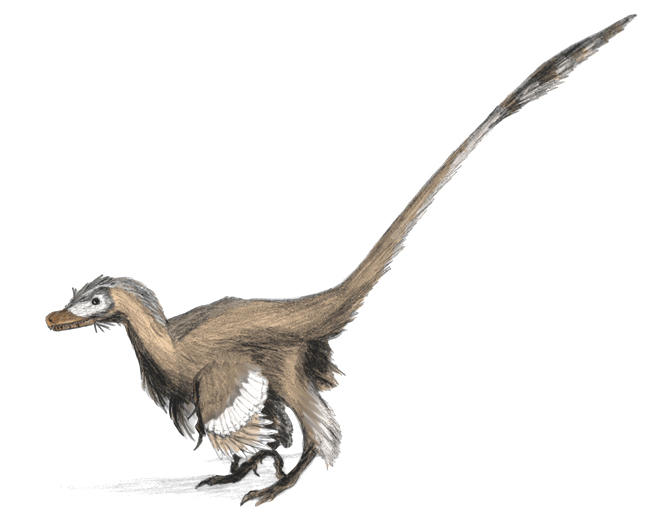
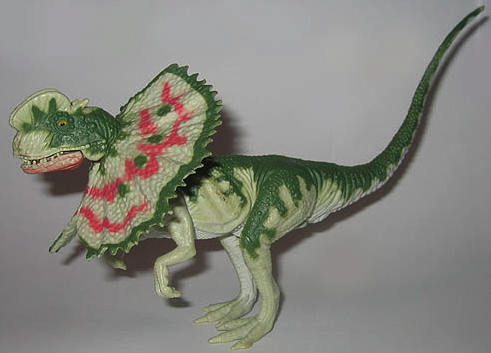
I’ll just go into a few of the “Jurassic Park” inaccuracies here. One of the inaccuracies is, sadly, that the pile of triceratops poop is far too large. Based on coprolites, dinosaur poop was likely smaller than the giant piles portrayed in the movie. So, I guess if I’m ever stuck on a crazy dinosaur theme park island and have to figure out why a dinosaur is sick, I won’t have to stick my hands in quite such a large poop pile. Also, Velociraptors were smaller than portrayed in the movie and were feathered. T-Rex probably could see you, even if you stayed perfectly still. Dilophosaurus (the poisonous spitting dinosaur)  was larger and probably did not have a cool frill. There is also no evidence that Dilophosaurus had any sort of poison spit.

The less-scary but more realistic feathered Velociraptor. Image taken from Wikipedia Commons here.

Despite now knowing the inaccuracies of the frill and the poison spit, I still really like the Dilophosaurus toy I had as a child. I used to make him (her?) spit at my younger sister when she tried to enter my room or when she was annoying me. Sorry about that, sis. By the way, this toy makes a delightfully horrible screeching sound when you move the Dilophosaurus’s front arm.

Dilophosaurus toy, like the one I had as a kid. Image taken from here.
Dilophosaurus in Jurassic Park. Image taken from here.

The biggest mistake in the movie and book? The name of the park. Many of the dinosaurs portrayed in the movie were not alive during the Jurassic period at all. T-Rex, Velociraptors and Triceratops, for instance, all lived during the later Cretaceous period. So, the park should probably have been named “Cretaceous Park” not “Jurassic Park.”

The Scale of Things

Fold for thought, Western USA, Fall 2005.

There are shapes, colors, and patterns everywhere, and I marvel in how the same patterns often exist at vastly different scales.

I have found myself looking at a rockface, admiring the small, swirling, black-and-white folds in metamorphic gneiss or migmatite. Looking out at the wider landscape, I often see the swirls echoed. The thick rock layers composing the mountain are folded over and under much in the same way that the layers in the hand sample sized rock at my feet are folded. The rock has three inch folds; the mountain has three mile folds, perhaps.

In volcanology I also see patterns. Lava lakes, such as those found on the big island of Hawaii, are in many ways analogs for the entire Earth. At the cool surface of these lakes crusts can form. These crusts are moved around and broken up in ways that are similar to the ways in which Earth’s large tectonic plates are moved around. The crusts on lava lakes are rifted, slammed together, and subducted back into the lake. The scale is much smaller and the pace much faster, but in essence the plate tectonics of these lava lakes is not much different from the plate tectonics of the entire Earth.

Since childhood I have spent a great amount of time in a kayak on rivers. After I learned to read whitewater, I became amazed at what I would see in even the smallest of streams and creeks. Wherever water is flowing, there are similar patterns. Three inch waterfalls look very similar to three foot waterfalls which look similar to three hundred foot waterfalls. The eddies, swirls, and rushing water become more powerful at larger scales, but the basic ways in which water flows– in which it pools and falls and carves out landscapes– are the same. A close-up image of the stream in my backyard does not look so different from a distant shot of the mighty Amazon.

I sometimes spend time in the desert, sand grains sparkling below my feet by day, stars sparkling above my head by night. Clearly, a sand grain is much, much smaller than a star, but in the desert I sometimes feel that they must be the same size. In the winter I see sparkles in snowflakes. In the city I see sparkles in cement. These tiny flakes are like stars at my feet. Are the sparkles at my feet really so different from the distant sparkles of gas giants? I wonder, sometimes, if they are.

What are the connections between the different scales of the universe? Are there connections? Is the very large really that much different from the very small?

The different scales of the universe are not easy to grasp and understand. As a chemist, I find my work often resides in small scales that I cannot easily appreciate. The periodic table and different models for the structure of atoms are poor substitutes for “seeing” what is going on at this scale. Even high-tech tools such as electron mircoscopes and mass spectrometers provide only hazy glimpses into this scale of the universe.

Much of the challenge of my science is trying to simultaneously understand the very small and the very large. I study the chemistry of rocks to try to understand the larger picture: the forces and conditions that shape volcanoes, shape the Earth, shape the solar system, shape the universe. In my work I often try to understand something about the very large from the very small and vice-versa.

And, as a scientist, I wonder: how little do things become? How large do they become? Are quarks and galaxies just the tip of the cosmological iceberg? What mysteries remain below and above, within and without? And what are the connections, if any, between the very largest scales and the very smallest scales? These are all still outstanding questions in science. I don’t know that we’ll ever really have an answer, unless there really is a finite limit to the very small and very large.

I also wonder why the different scales of things fascinate me and fill me with such awe and reverence. I certainly don’t think there’s anything supernatural or paranormal going on. Yet, without needing a pantheon of Gods or even a single God or supernatural being or event to explain anything, I find contemplation of the different scales of the universe somewhat magical. I also find it both unsettling and comforting. Unsettling because I do not understand the meanings and connections between these patterns at different scales. Comforting because there is a sort of simple beauty in observing connections between the very large and the very small. Comforting because I have a sort of faith– yes, faith– in science, and I believe that the scientific method is capable of gradually unravelling these mysteries of scale although they may never fully be unravelled.

I highly recommend spending a few minutes today– or any day– marveling in the scales of the universe. For that purpose, I recommend this movie from the website “Molecular Expressions.” At this same website, you can also look at microscopic images of beer from around the world as well as of other materials such as cocktails, computer chips, and moonrocks. You can even order merchandise with your favorite microscopic images. Apparently, the cocktail and beer ties are best-sellers.

A New Year’s Day Rock: Travertine Icings and Scums

Happy New Year!

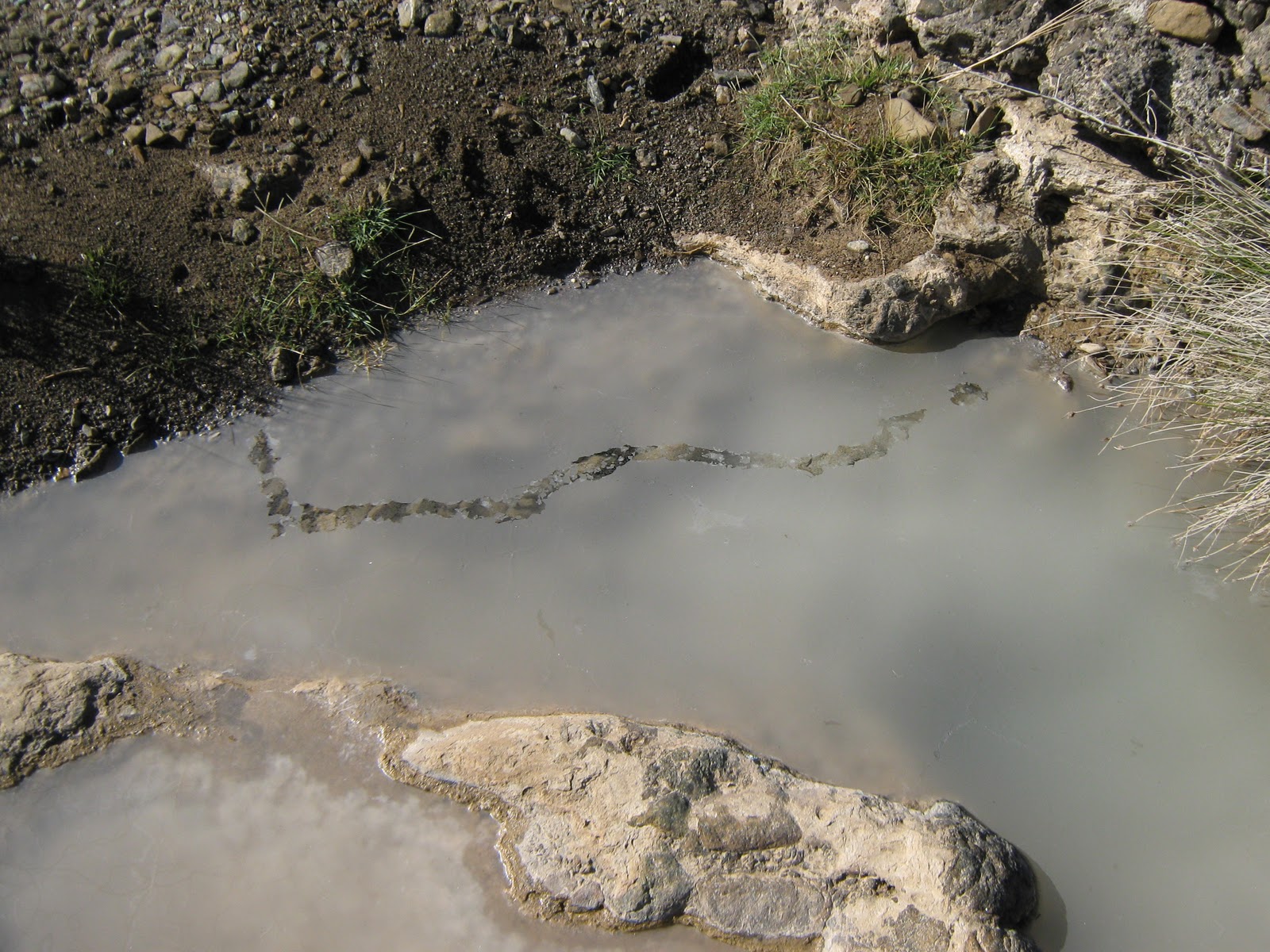
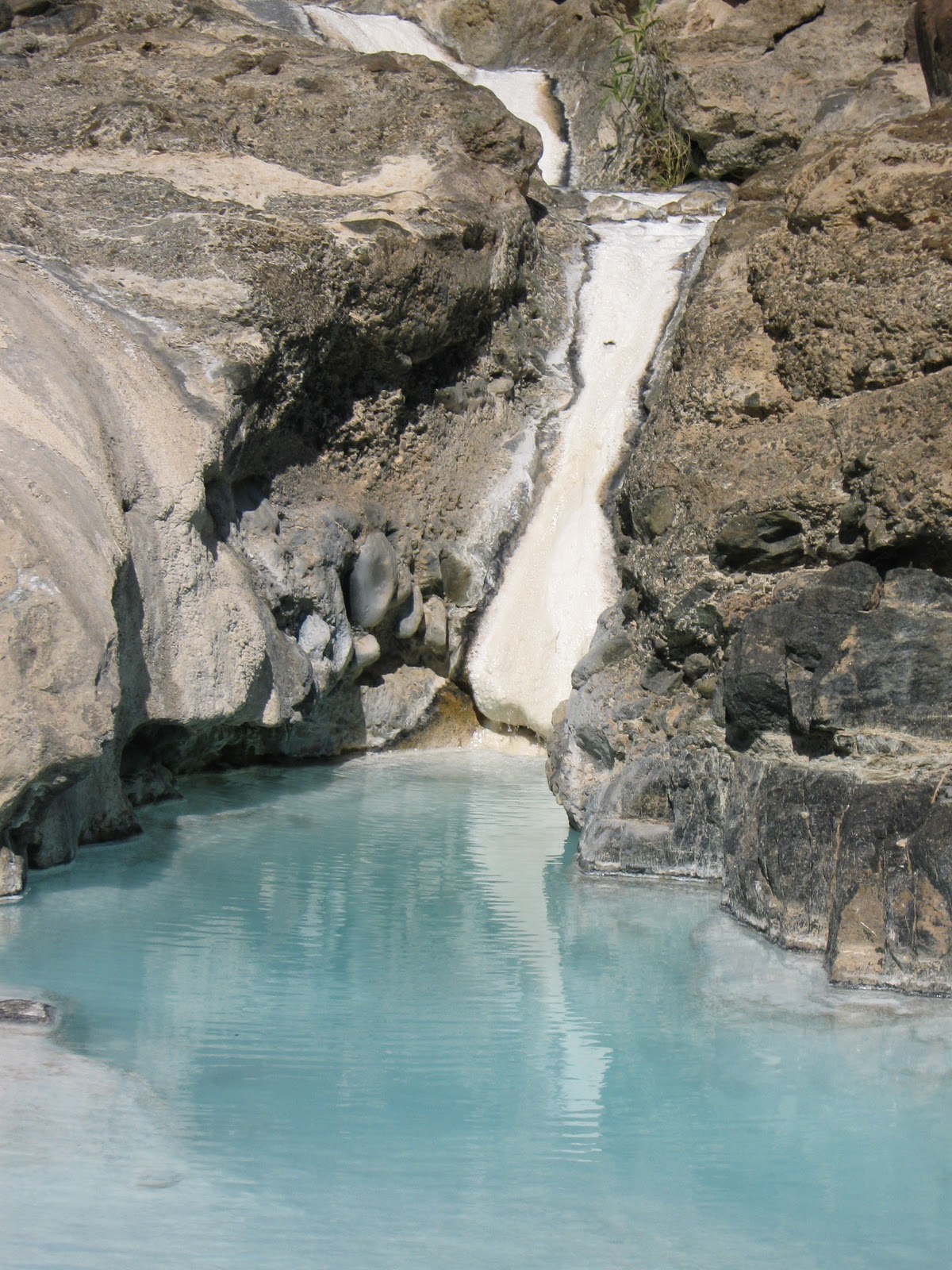
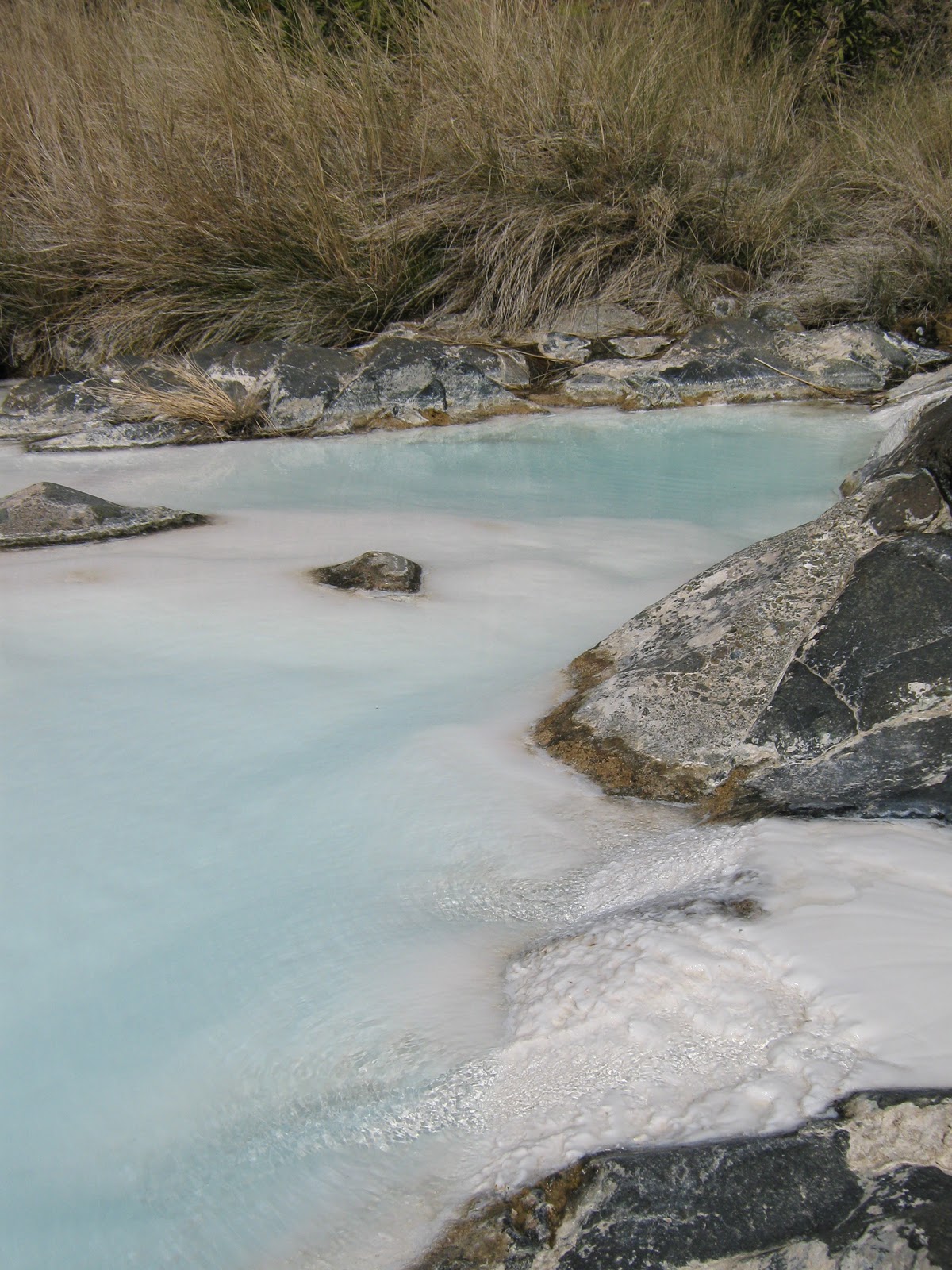
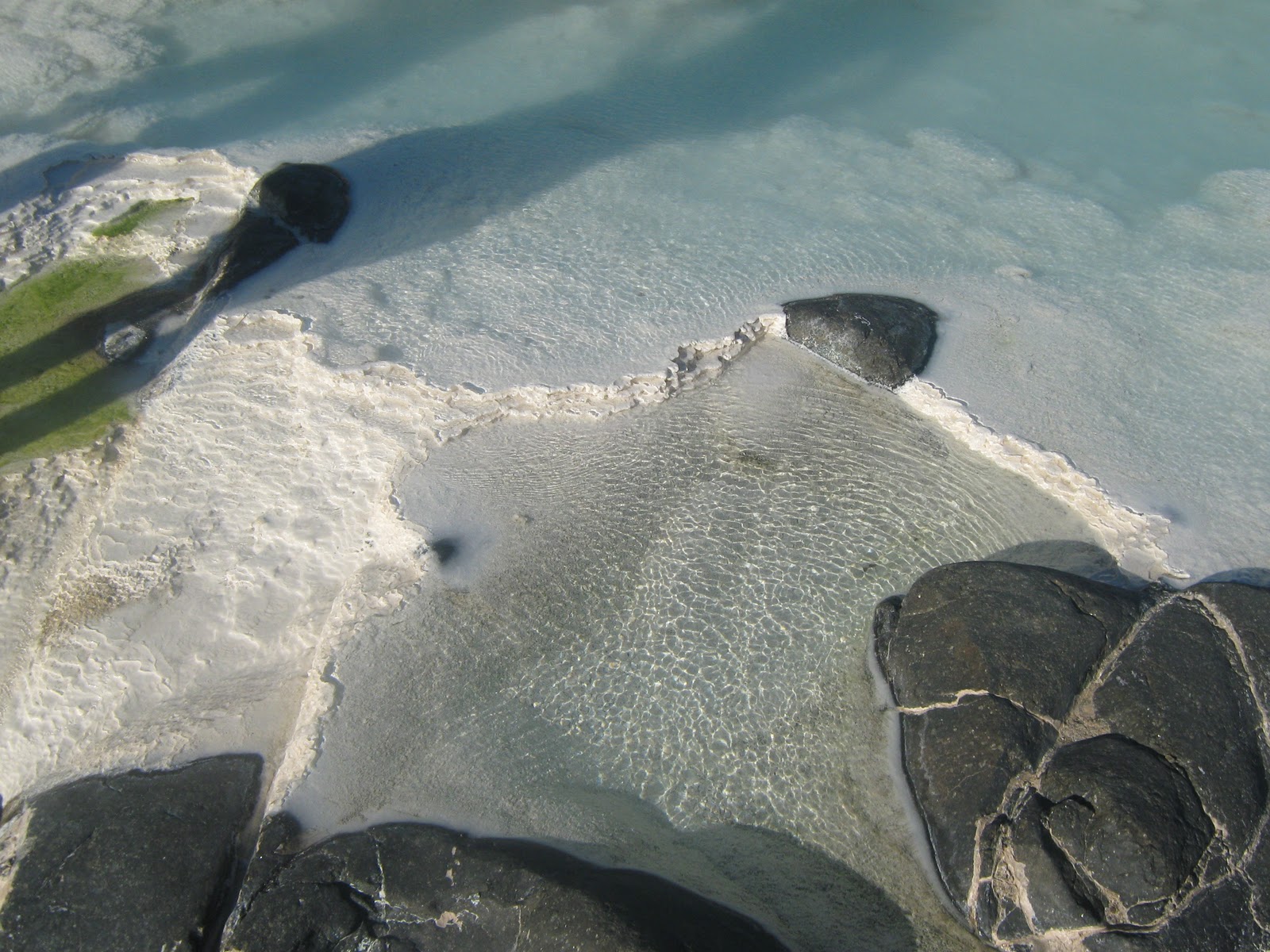
To celebrate the new year, here are some photos of some very new rocks. These travertines in Oman are some of the youngest rocks I’ve encountered in my geological wanderings.

These “icings” and “scums”  are travertines (mostly the mineral calcite) that are precipitating from highly alkaline (pH ~11-12) springs that form when rainwater circulates through mantle peridotite. Thin layers of newly-formed travertine (icings) often float on the surfaces of the alkaline pools. The first year I was in Oman (2009), there was a rare desert rainstorm that pushed the travertine icings to the bottom of the pools. The icings grew back with a few days, so we know that these travertines are very young indeed! Travertine scums often coat the bottoms of the pools, giving the pools a stunning bright turquoise color. 

I am studying the formation of these young travertines- and other types of carbonates- in the Samail Ophiolite in Oman. You can learn more about my thesis research here, and I’ll surely blog more about this research in the future. For now, enjoy these pictures of beautiful, newly-formed, desert travertine icings and scums.

Travertine ice 1, Oman, January 2010.
Travertine ice 2, Oman, January 2010.

Alkaline pool 1, Oman, January 2009.
Alkaline pool 2, Oman, January 2009.
Travertine-coated bottle, Oman, January 2009.

Fish swimming in alkaline water, Oman, January 2009.
Travertine cascade, Oman, January 2009.
Alkaline pool 3, Oman, January 2009.
Alkaline pool 4, Oman, January 2009.
Alkaline pool 5, Oman, January 2009.
Alkaline pool 6, Oman, January 2009.

Travertine ice with travertine terraces, Oman, January 2010.
Submerged travertine terraces, Oman, January 2010.

A Year of Travel: 2010

I am relatively new to the geoblogging scene, but several geobloggers– such as Callan Bentley over at Mountain Beltway and Jessica Ball over at Magma Cum Laude— have posted a summary of their year of travel. I love travel, so I think I will continue their year-end tradition here at Georneys. Thanks to other geobloggers for the idea!

I am very fortunate to have the ability and opportunity to travel often, both for my work and for my personal life. Below is a summary of my 2010 travels. I’ve blogged about a few of these most recent travels. Perhaps I will blog about some of the others in the coming year, particularly since I plan to spend most of my time in lab and then writing up my thesis so that I can graduate!

December 2009 – January 2010: South Africa & Oman
My fiance Jackie lives in his native South Africa, so we commute between Cape Cod and Cape Town to see each other. My advisors are fortunately wonderful about letting me periodically work on my thesis from South Africa. I traveled to South Africa in December 2009 to spend the holidays with Jackie and his family. At the end of December, Jackie and I flew to Oman for a month of fieldwork for my thesis research. Jackie came along as my field assistant. We then flew back to South Africa, where I spent another week before returning to Cape Cod.

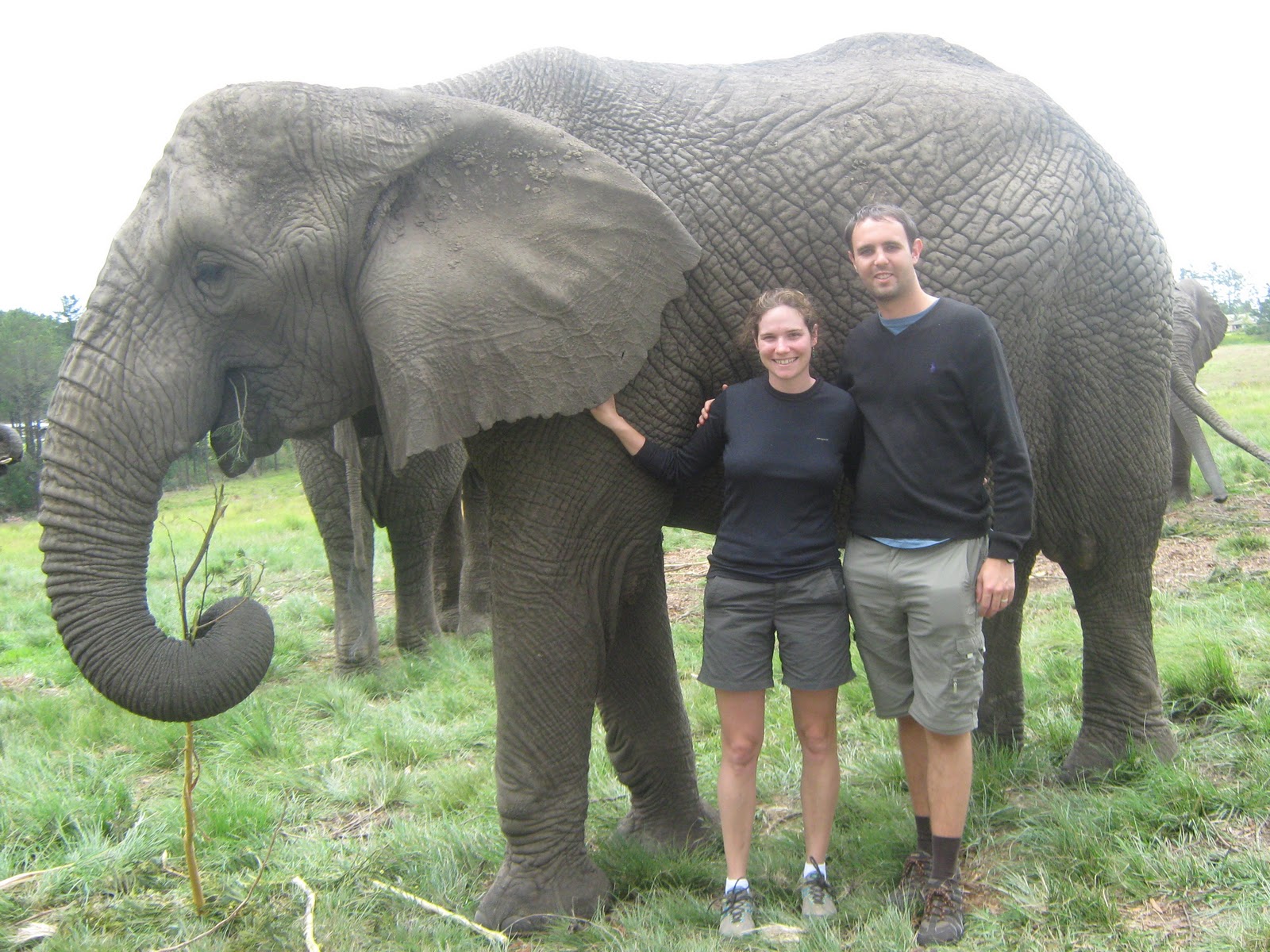
Jackie, an elephant, and I, Knysna, South Africa, December 2009.
Overly excited about the village of Beer Jam, Oman, January 2010.
Early morning camel trek, Oman, January 2010.

May 2010: New York City & Wyoming
Jackie came to visit me in May for two weeks. I had to work, but one of the things I needed to do was drive down to Columbia University to pick up some Oman rocks and visit with colleagues. Jackie joined me on this trip, and we spent a long weekend in New York City. After Jackie left, I flew out to Laramie, Wyoming to spend a week visiting one of my advisors, who is now a scientist at the University of Wyoming.

The incredibly American photo, New York City, May 2010.
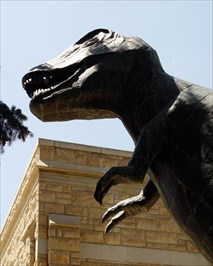
Dinosaur statue outside of the University of Wyoming Geology Museum. Image taken from here.

June 2010: Switzerland, Italy, and Tennessee
In early June, I went on a 10-day geology field trip to The Alps (Switzerland & Italy) as part of the Woods Hole Oceanographic Institution Geodynamics course. Directly after this field trip, I went to present my research at the Goldschmidt Geochemistry Conference in Knoxville, Tennessee.

A snowy hike to the rocks, The Alps, June 2010.
Knoxville Convention Center. Image taken from here.

July 2010: Las Vegas
In July I took a quick weekend trip out to Las Vegas, Nevada for The Amaz!ng Meeting 8. 

The Amazing One and I, Las Vegas, July 2010.

September 2010: South Africa 
I spent the month of September writing my thesis from South Africa. We mostly stayed in Cape Town, but my fiance and I did take a brief trip up to the gorgeous Cederberg Mountains.

Cederberg Mountains, South Africa, September 2010.

October 2010: Falls Church
On my way back from South Africa, I flew home via Washington, DC so that I could attend the 82nd birthday party of an incredible person- my dear friend and mentor James “The Amazing” Randi. Randi survived a cancer scare this year, so the party was a special one. The small, elegant birthday party- held in Falls Church, Viriginia- was wonderful!

Randi, my mom, and I, Falls Church, VA, October 2010.

November 2010: Costa Rica
As I blogged about here, in November I attended the wedding of two good friends at the Arenal Volcano Observatory Lodge in Costa Rica.

Arenal volcano, Costa Rica, November 2010.

December 2010: San Francisco 
Finally, in December I attended the American Geophysical Union Fall Conference in San Francisco, California as I blogged about here and here.

Chinatown, San Francisco, December 2010.

Phew! That’s a fair amount of travel for one year, even if several of the trips were just weekend or extended weekend trips. This next year, I anticipate traveling more to Wyoming and South Africa and perhaps also to San Francisco again for AGU. Otherwise, I will be in Woods Hole working on my thesis…

Happy New Year to you all!

Geology Word of the Week: I is for Ichnite

Fossil dinosaur footprint, Wyoming, Fall 2005.

def. Ichnite:
A fossilized footprint.

An ichnite is a type of trace fossil, which is a fossil that preserves evidence of biological activity but which is not part of an organism’s body. Examples of trace fossils are footprints (ichnites), burrows, and root cavities. Coprolites and other fossilized bodily excretions are also often considered trace fossils.

Footprints are everywhere. Just today, I went for a walk along a Cape Cod beach and there were footprints all over the beach. Footprints are rarely preserved as fossils, but when they are preserved the resulting ichnites can be spectacular. What kid- or grown-up- doesn’t find dinosaur footprints fascinating? Dinosaur (and other) ichnites are also very important for learning about how ancient animals moved.

Footprints on a Cape Cod beach, December 2010.
More footprints on a Cape Cod beach, December 2010.

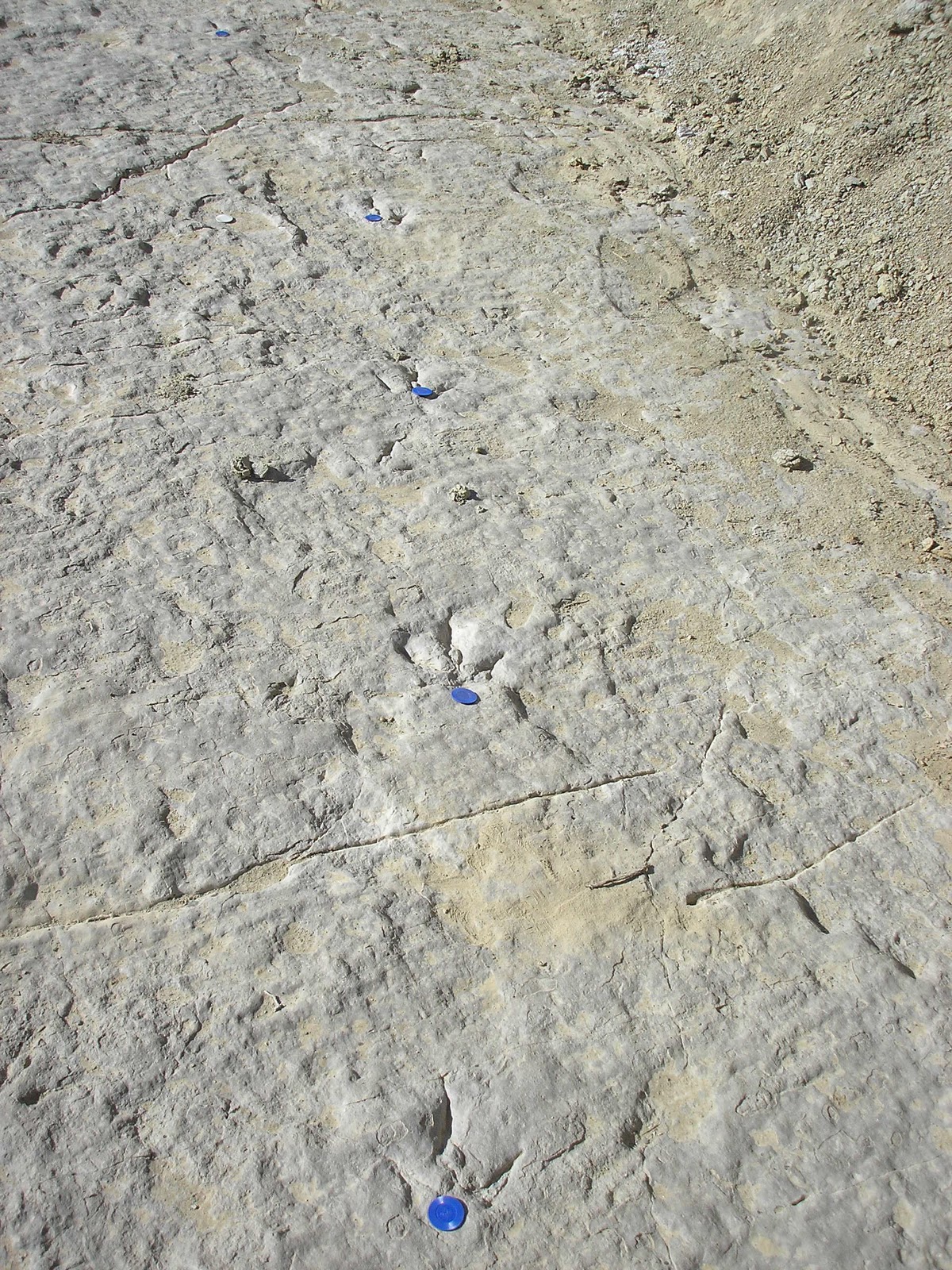
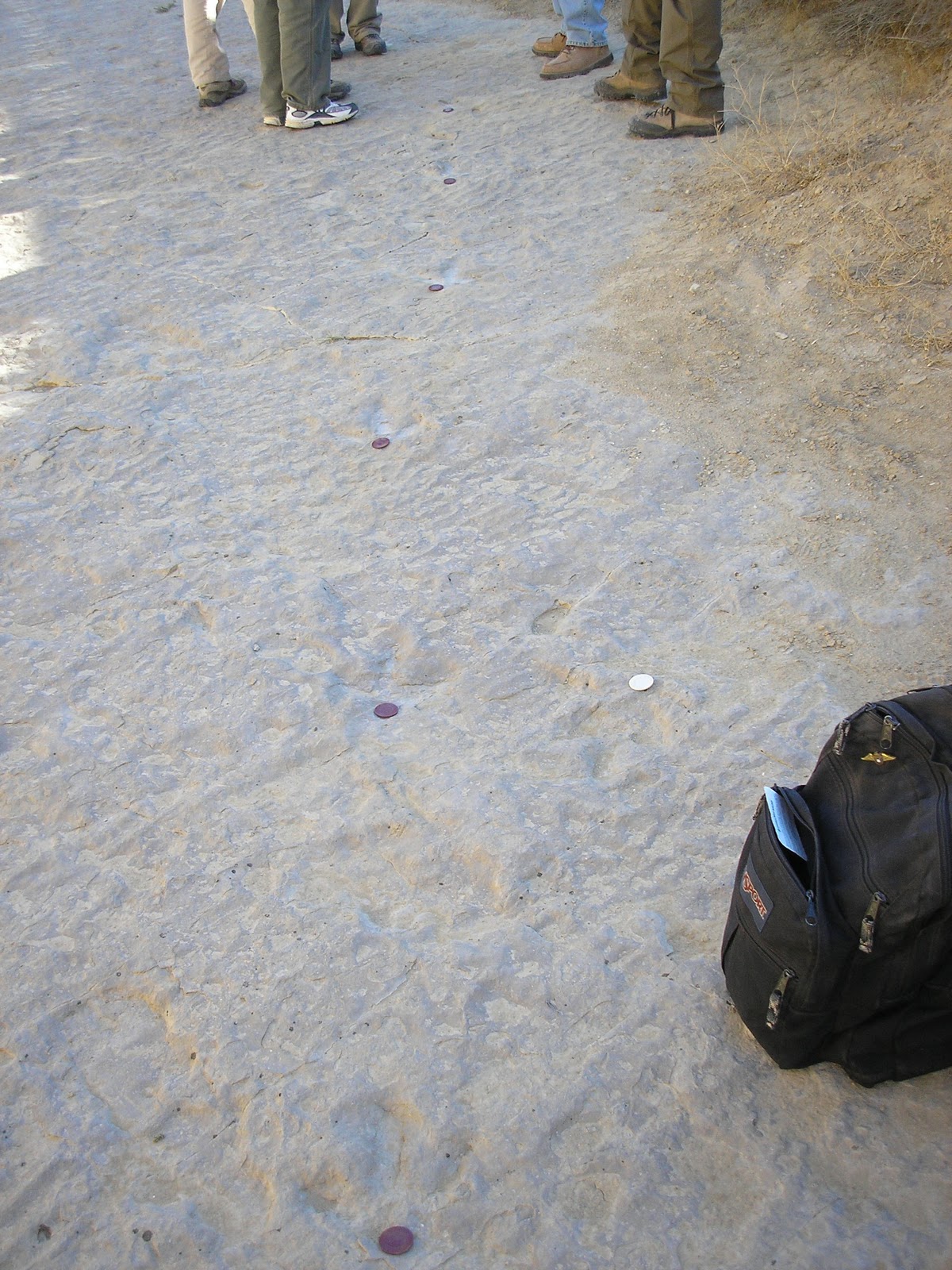
During my undergraduate field camp, we did an exercise where we had to figure out how quickly various dinosaurs moved based on fossilized footprint trails. Using the size of the footprint and the distance between the footprints, you can estimate approximate dinosaur speeds. In field camp we did this for various tracks in Wyoming and Utah. Then, we ran as fast as we could and calculated our own speeds to see if any of us could outrun certain carnivorous dinosaurs. In most cases, we were slower than dinosaurs and would be a likely lunch for any dinosaurs brought back to life Jurassic Park style. Below are a few pictures I took during my undergraduate field camp of some dinosaur ichnites.The footprint fossils are a little difficult to make out from a distance, so we marked them with brightly-colored poker chips.

Fossilized dinosaur footprints, Wyoming, Fall 2005.

I have to say, though, that my favorite type of ichnite is the preserved footprints of ancient man, such as the famous Laetoli footprints in Tanzania. The Laetoli footprints (see pictures below) are 3.6 million years old and were made when Austrolopithecus afarensis walked through volcanic ash. Notice that there are actually two sets of footprints- one smaller, one larger- of two Austrolopithecus afarensis walking side-by-side, perhaps a mother and child or a man and a woman. These footprints show that very early man walked in a very similar way to modern man… even 3.6 million years ago!

Laetoli footprints, Tanzania. Image taken from here.
Laetoli footprint, Tanzania. Image taken from here.

Winter Blizzard

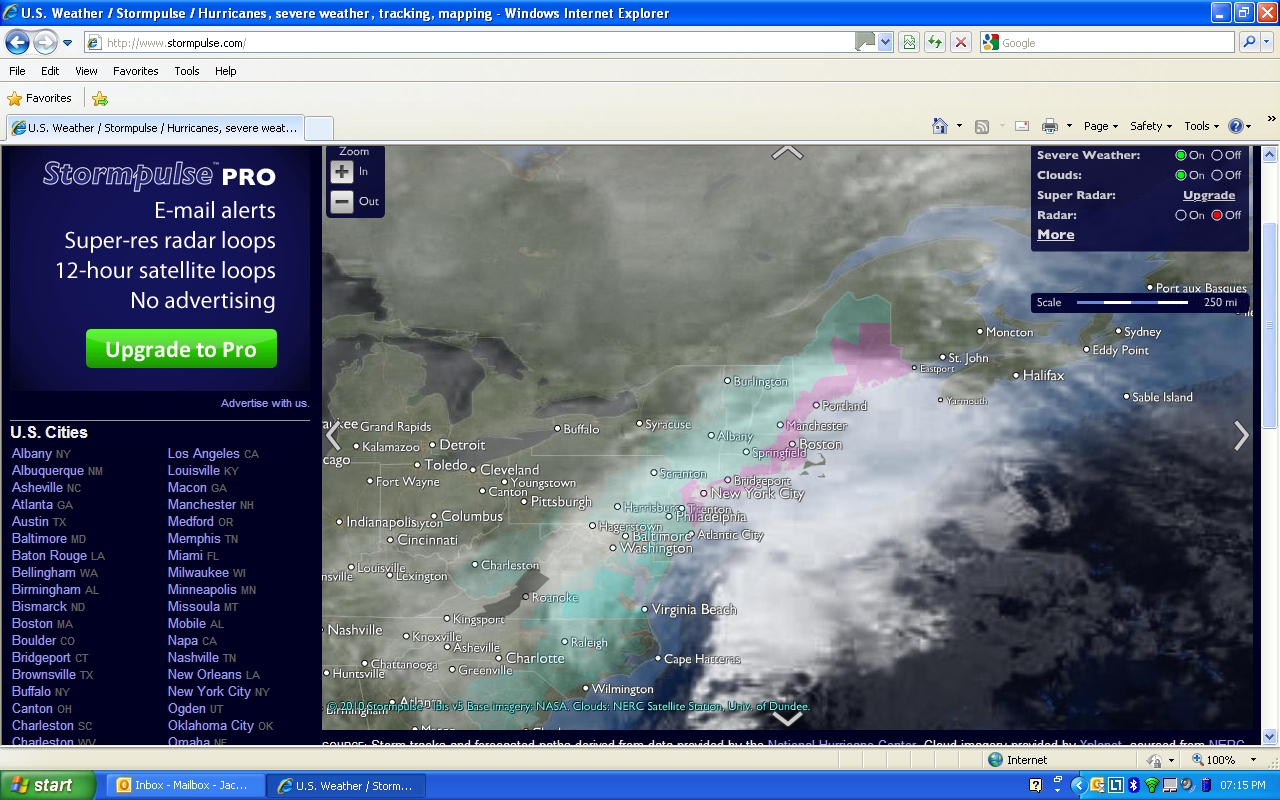
My fiance, my two cats, and I are currently up in New Hampshire visiting my parents and sister for Newtonmas. We have decided not to drive back down to Woods Hole today because of this:

Winter storm from StormPulse. Image taken a few minutes ago. Click on the image for a larger version.

An enormous winter storm is fast-approaching our house in southern New Hampshire.We’ll probably receive a foot to a foot-and-a-half of snow. I think that it’s already wintry mixing on Cape Cod.  I much prefer a foot of snow to a foot of wintry mix, so we’ve decided to stay here in New Hampshire a couple more days.

By this evening we should be able to sled down the driveway and cross-country ski around the neighborhood. Cross-country skiing with my South African fiance is always entertaining. He saw snow for the first time just two years ago, and he is fascinated by “wild ice” as there is only “domesticated ice” in South Africa. He is clueless about winter sports such as skiing and ice skating, though he is very enthusiastic about them. On skis he doesn’t really know how to stop, so he just crashes to stop. He’s improving slowly, though.

Whenever there is a large winter storm or hurricane, I enjoy tracking these storms using StormPulse and the NOAA Storm Tracker.

Storms such as the one about to hit New Hampshire remind me of how fragile we humans and our civilization are relative to the intense power of natural forces such as blizzards. There have been snowstorms all over the globe recently- in the Western USA, all over Europe, and even in Australia— and it’s summer there! These storms are wreaking havoc with holiday travel. Last week, a friend of mine spent three nights sleeping in the Amsterdam airport.

I’m glad that we’re able to weather this winter storm safely at my parent’s house. We have plenty of food and water. There are two gas-burning stoves and plenty of candles and flashlights in case the power goes out. We have skiis, sleds, and snowshoes in abundance. And, of course, we have hot chocolate. What else could we need? Happy snowstorm, for those of you in New England.

A Christmas Rock: Fossiliferous Coal

Merry Christmas & Happy Newtonmas, Everyone!

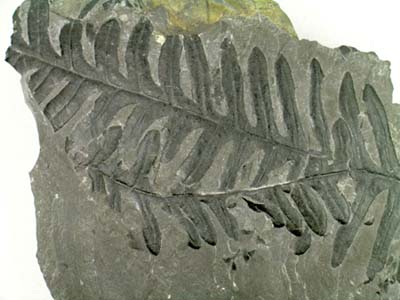
To celebrate, here are some beautiful pictures of coal taken from the interwebs. I’ll take coal rocks like these in my stocking any Christmas!

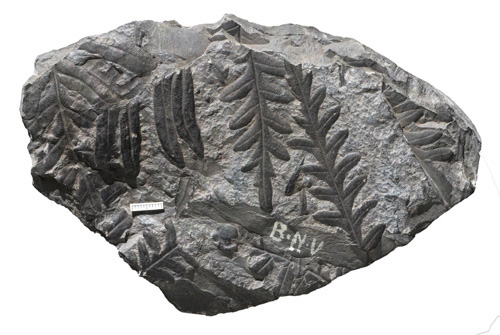
Fossil ferns in coal from Morocco. Image from Wikipedia Commons.
More ferns in coal. Image taken from here.
Even more ferns in coal. Image taken from here.
And even more fossil plants in coal! Image taken from here.
Yet more pretty coal for a stocking stuffer! You can buy fossils like these here.