Caught in a Bad Project

A friend* just sent me a link to this video called “Bad Project,” a parody of the Lady Gaga song “Bad Romance.” I think this video is hilarious! I love the Lady Gaga outfits made out of laboratory supplies.

 Video taken from Youtube.

Since I am currently on my third PhD advisor (I left my first advisor, then my second advisor took a job at another institution- though to his credit he still advises me from a distance), I have had my own graduate school frustrations. Fortunately, I actually have a “good project” and am finally making headway and feeling optimistic about my research. 

However, like many grad students, I have had days where I am so frustrated with graduate school and academia that I daydream about fantasy alternate careers. After awhile, I remember that I really do love geology, and that– despite all the hard work and frustrations– I’m right where I want to be. I’m not yet sure if I’ll “make it” as a professor at a high-pressure research institution (nor if I want to pursue such a career), but I know that I love geology and want to be a geologist, whether it be through working for a company or teaching or research or some combination of the above. 

In moments of stress, grad school friends of mine talk about becoming musicians, artists, novelists, and businessmen. They daydream about opening surf schools, bakeries, and kumquat farms. I think many grad students have fantasy alternate careers that they will pursue “when this whole grad school thing doesn’t work out.”

My own fantasy alternate careers?
-Park ranger or game ranger
-Archaeologist
-Novelist
-Professional kayaker
-Translator
-Owner of an adventure tour company
-Professor of Middle Eastern Studies or Arabic
-Jane Goodall (yes, I want to be Jane Goodall)
-Running a cat rescue shelter (my cat-allergic fiance vetoes this one, though)

What are the fantasy jobs that help you survive graduate school?

*Thanks, Fern!

What Type of Weathering?

Earlier today Callan Bentley over at Mountain Beltway posted these pictures of some rocks with interesting weathering patterns that he’s seen recently.

When I read this post, my first thought was: I’ve seen this type of weathering before!

And my second thought was: What the heck is the name of this type of weathering?

I’m still not sure, though my first idea was liesegang weathering, which is a type of weathering where chemical diffusion creates a ring or rim of rock that is more resistant to physical erosion.

Does anyone know what this type of weathering is called? Is this liesegang weathering or is it something different? Does this type of weathering have a name?

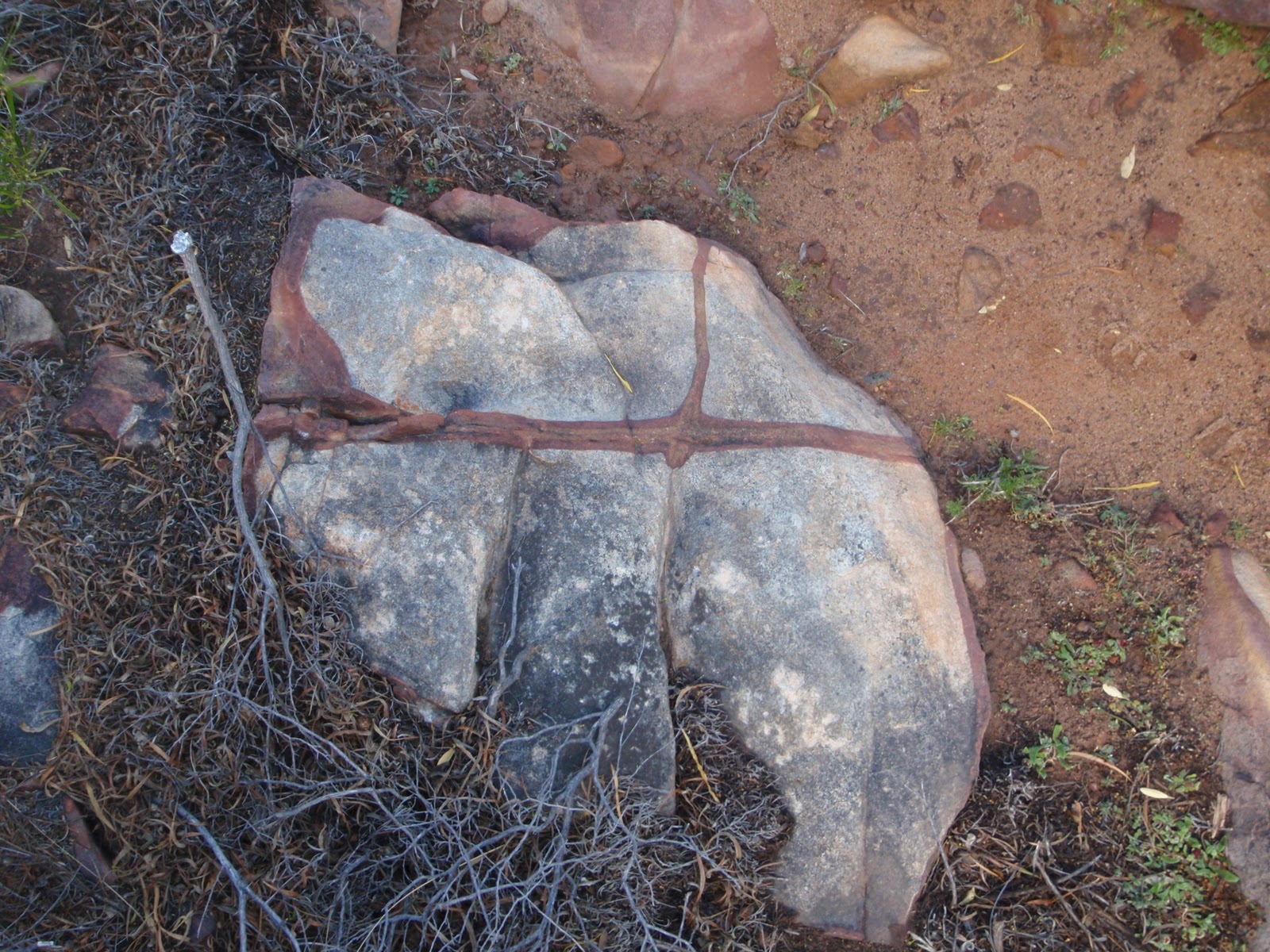
Here are some pictures from Knysna, South Africa of weathering similar to the photos Callan posted. One difference in the rocks below is that iron (which oxidizes to the reddish brown color) is definitely playing a role in this weathering. You can see, though, that the weathering follows fractures similar to the way that Callan’s rocks are weathering. Note the sunglasses for scale. Click on any of the pictures below to view a larger version.

Knysna rocks 1, South Africa, December 2009.

Knysna rocks 2, South Africa, December 2009.

And here’s a similar weathering pattern in a boulder (about a meter across) in the Cederberg Mountains (near the town of Algeria) in South Africa:

Cederberg boulder, South Africa, September 2010.

Update: “Ice Age: Continental Drift”

Adorable Scrat, image taken from here.

Last week I blogged about the forthcoming movie “Ice Age: Continental Drift.” I have not forgotten about my campaign to try to have some plate tectonics science added as a DVD extra or website feature. Below is a letter that I just sent to 20th Century Fox, Blue Sky Studios, and Ray Romano, the main voice actor for the movie. This letter could very well be ignored as the “ramblings of a crazy geologist,” but we’ll see if I receive any response.

If you’d like to support my “crazy geologist” campaign, you can join the facebook group here. If you want to send your own email or letter, below is the contact information that I was able to find. Let me know if you find any better contact information.

Contact Information:

20th Century Fox:
Address:
10201 W. Pico Bld.
Los Angeles, CA 90064
Email: askfox@fox.com

Blue Sky Studios:
Address:
Attn: Public Relations
One American Lane
Greenwich, Connecticut 06831

You can send a message to Ray Romano here.

My Letter: 

Dear 20th Century Fox and Blue Sky Studios,

I am writing to you because I am hoping you might help me find an appropriate contact for someone working on the movie “Ice Age: Continental Drift,” the forthcoming 4th installment in the “Ice Age” cartoon movie series. I am a big fan of the adorable “Ice Age” movies. The teaser for the 4th “Ice Age” movie (available on youtube here) made me laugh and smile, even if plate tectonics by squirrel is a completely ridiculous idea. Indeed, the ridiculousness of the concept is a large part of why I find the clip so delightful.

However, I do worry– a little– about young children believing in plate tectonics by sabre-toothed squirrel after watching this movie. I think most children are smart enough to figure out that plate tectonics doesn’t really happen by squirrel. However, I wonder if there’s any way to talk the people in charge of the latest “Ice Age” movie  into including an extra on the DVD or on their movie website that explains how plate tectonics really works. Even just a two or three minute clip– it could be a cartoon or an interview with a geologist– with a proper scientific explanation would be wonderful. I know that many children watch all of the extras on their favorite movies religiously.

Since so many children will be watching the latest “Ice Age” movie, this could be a great way to educate a large number of children (and maybe even some adults) about how plate tectonics works. Note that I’m not advocating any changes to the movie script. The “Ice Age” movies are delightful because they are so silly. At the same time, I think a scientific extra about plate tectonics would be a great thing to include. This could be a win-win situation– 20th Century Fox and Blue Sky Studios could do some educational outreach, and many children could learn a little science.

If there is anyway you could help me express this idea to the people behind the “Ice Age: Continental Drift” movie, I would be most grateful. To give you a little background on myself, I am currently a 5th-year PhD student working on a Marine Geology & Geophysics degree in the joint program between MIT and Woods Hole Oceanographic Institution. In addition to my research pursuits in geology, I write a geology blog Georneys (http://georneys.blogspot.com/).

If you would like to discuss the science of plate tectonics, I would happy to volunteer my services as a science consultant. I would also be happy to put you in contact with an education professional who has experience teaching plate tectonics to children.

I look forward to hearing from you!

All the best,
Evelyn

[Fancy-schmancy contact information removed]

Neil deGrasse Tyson and “Can We Make it to Mars?”

Neil deGrasse Tyson. Image taken from here.

Last night I watched the first episode of the new season of Nova scienceNOW on PBS. This season, Nova scienceNOW tackles big scientific questions such as “How does the brain work?” and “Can we live forever?” The questions and the science are fascinating. As if that weren’t enough reason to watch, the show is hosted by handsome, supersmart astrophysicist Neil deGrasse Tyson. I have a gigantic crush on Neil deGrasse Tyson. When he starts talking about science, I just melt. Not only is Neil attractive and very smart, he’s also extremely personable. He is excellent at explaining science to the general public, both in his writing– he’s published a number of excellent popular science books on astronomy– and in his public lectures and TV appearances. Neil has an infectious enthusiasm for science that makes you want to learn more about whatever he’s talking about. Also, according to this recent appearance on The Colbert Report, Neil is God. What’s not to love? Unfortunately, Neil is married with two children*, but I still have a crush on him. Fortunately, I can watch Neil every week on scienceNOW.

Here’s the preview for the series:

Video taken from YouTube.

The epsiode of Nova scienceNOW that aired last night was called “Can we make it to Mars?” The show tackled all sorts of problems associated with traveling to Mars. The show explored how to go fast enough to make it there in a reasonable amount of time, how to feed the astronauts for several years, how to make a better spacesuit for exploration, how to create artificial gravity so the astronauts’ bones don’t deteriorate, and other technical obstacles that need to be overcome before we can send humans to Mars. There was also a great interview with Vandi Verma, a remarkable woman who is one of the Mars Rover drivers.

I highly recommend that you watch this season of scienceNOW with Neil deGrasse Tyson. I know I look forward to next week’s episode “Can we live forever?”

*And I am happily engaged to another geologist.

Geology Word of the Week: L is for Lithosphere

Mantle Hills, Oman, January 2009.

def. Lithosphere:
1. The cool, outer layer of the Earth that deforms in a brittle manner.
2. Although often mistaken for the crust, a layer of the Earth that actually consists of both the crust and part of the upper mantle.

Last week I blogged about the notorious PhD general or qualifying exam. A common question that comes up in the general knowledge section of the geology exam is:

“What is the lithosphere?”

Or sometimes:

“What is the difference between the lithosphere and the crust?”

Or sometimes, if the committee members want to trick the student:

“Where in the lithosphere is the MOHO located?”

The lithosphere is a fundamental, but somewhat confusing, concept in geology. The lithosphere is sometimes mistaken for the crust, even by some geology students. However, the lithosphere and the crust are not the same. This is because the lithosphere is defined by physical properties while the crust is defined by chemical (or compositional) properties. The lithosphere consists of the crust AND part of the upper mantle.

When I think about the lithosphere, I think about two sets of words:

Lithosphere and Asthenosphere

and

Crust and Mantle

The lithosphere and the asthenosphere are layers of the Earth which are defined by physical properties. Specifically, the lithosphere consists of “the crust and upper mantle (viscosity >10^21 Pa s) which deforms in a brittle fashion when subjected to a stress of ~100 MPa (Keary, 1996)” while the asthenosphere is “a mechanically weak layer of the mantle immediately beneath the lithosphere, corresponding to the depth range within the Earth where the melting temperature is most closely approached (Keary, 1996).”

In a nutshell: when stressed, the lithosphere breaks but the asthenosphere flows. Basically, the lithosphere is the cool, rigid, outer shell of the Earth that breaks (deforms in a brittle fashion) when stressed. All of Earth’s crust deforms in a brittle fashion. Part of the upper mantle also deforms in a brittle fashion. Thus, both the crust and part of the upper mantle comprise the lithosphere. The asthenosphere, on the other hand, is hot and soft enough to flow (very slowly) rather than break when stressed. The asthenosphere is a solid, but it moves very slowly, like honey or tar.

The lithosphere and asthenosphere make plate tectonics possible. The lithosphere breaks up into tectonic plates, which slowly move over the tar-like asthenosphere.

The depth of the lithosphere-asthenosphere transition varies widely throughout the Earth as it is dependent on the thermal regime. The lithosphere may extend only 2 or 3 kilometers beneath young, hot, thin oceanic crust. However, beneath old, cool, thick continental crust, the lithosphere may be as thick as 250 or even 500 kilometers. Under some very old, very cold, very thick continental cratons, the asthenosphere  may not exist at all.

The crust and the mantle, on the other hand, are layers of the Earth which are defined by chemical (or compositional) properties. Specifically, the crust consists of less-dense crustal rocks (e.g. granites, basalts, gabbros) while the mantle consists of denser rocks (mainly peridotite). Oceanic crust is thin (less than 10 kilometers) while continental crust can be much thicker (70 kilometers or more).

Geologists have actually never directly observed the crust-mantle boundary. No one has drilled a hole deep enough to reach the crust-mantle boundary.  The deepest hole ever drilled on Earth is the Kola Superdeep Borehole, which reached about 12 kilometers in depth. However, because this hole was drilled into thick continental crust, the hole came nowhere near the crust-mantle boundary. I believe that the deepest hole ever drilled in oceanic crust is this approximately 2 kilometer deep hole off the coast of New Zealand. However, since this hole was drilled on the thick, sediment-covered continental shelf, I don’t think this hole came anywhere close to the mantle.  However, other holes in other pats of the oceanic crust have almost– but not quite– reached the elusive mantle.

As far as I know, no hole in either continental or oceanic crust has reached the crust-mantle boundary. Geologists haven’t even managed to drill through the thin (5-10 kilometers) thick oceanic crust to reach the mantle. Really, geologists have only scratched the surface of the planet. They haven’t even directly observed the mantle! The only places where scientists have been able to “see” the crust-mantle boundary are the rare places, such as in Oman, where ocean crust and part of the underlying  mantle has been uplifted onto land through natural tectonic processes.

Since geologists cannot directly observe the crust-mantle boundary (or, for that matter, the lithosphere-asthenosphere boundary), the boundary is defined by geophysical observations. The crust-mantle boundary is called the Mohorovicic Discontinuity or the MOHO for short. The MOHO is a place where seismic P-waves suddenly increase in velocity, presumably because they are able to travel faster through the denser mantle rocks.

So, for those geology students about to take a test or a PhD qualifying exam, remember:

The lithosphere is NOT the same as the crust. Rather, the lithosphere is comprised of both crust and upper mantle.

The MOHO is NOT the lithosphere-asthenosphere boundary. Rather, the MOHO is the crust-mantle boundary.

Reference:
Keary, Philip. 1996. Dictionary of Geology. London: Penguin Books.

A Peridot is Forever

My peridot engagement ring.

As a geologist and a skeptic, I’d like to debunk a popular myth: a diamond is not forever. This clever phrase was coined in 1948 as a marketing slogan for DeBeers, but I cry that it’s false advertising. Diamonds, formed at high-pressures deep within the Earth, are metastable in the low pressures at Earth’s surface. Over many million of years, the carbon atoms in the gemstones will rearrange, converting the diamonds into graphite. Pencil lead, essentially.

A real forever gemstone? Maybe zircon. There are zircons in places such as western Australia that are over four billion years old. Forever is a long time, though, and even zircons eventually degrade. Blue zircons can make really beautiful gemstones, though.

Okay, so maybe I am being too picky; perhaps I’m too much of a geochemical snob. On human timescales, diamonds appear to last forever. To prove a point, though, if I if ever became engaged, I want a peridot ring. Peridots are not forever gemstones. Actually, peridot is one of the most ephemeral gemstones. Peridot is olivine, which is the first mineral to weather in a rock containing this mineral. Olivine weathers quickly because the weak metallic bonds holding together isolated silicate tetrahedra are easily broken down by physical and chemical weathering.

But I like peridots much better than diamonds becaue they’re a beautiful green color, and they remind me of some of my favorite rocks, where peridots can be found. Sure, peridot is not as expensive as diamond, but I personally think that diamonds are overrated. Diamonds, with the possible exception of rare colored diamonds, are not worth what most people pay for them.

Diamonds are somewhat common, actually, and the market for the traditional off-the-shelf diamond engagement ring is artificially controlled. The economist might argue with me. Items are worth whatever people will pay for them. However, geologically, I just don’t see it. I highly recommend the book Diamond: A Journey into the Heart of an Obsession by Matthew Hart for anyone wanting to learn more about diamonds and the diamond industry. This book is an excellent quick read for anyone wanting some evidence that that diamonds are not really worth that much.

And I wonder: why all the hype about diamonds when there are so many other gemstones? Why should everyone have diamond engagement rings? Why can’t some people have zircons or sapphires or peridots, if they want to? Why is it “odd” (in the words of my grandmother) to have anything other than diamond?

Certainly, love and marriage are even more ephemeral than these gemstones, even highly-degradable olivine. These days, the typical marriage is lucky to last five years, so what does it matter which gemstone symbolizes your bond? Any gemstone is likely to last longer than your love. Peridot, one of the shortest-lasting gemstones (often degrading in hundreds to thousands of years), and diamond, one of the longest-lasting (degrading in millions of years), both will last much longer than the average or even the extraordinary marriage. Even if one is lucky and is married for sixty years or more, that peridot gem should still be going strong.

So, why diamonds? On human timescales they aren’t any longer-lasting than other gemstones, and they’re not particularly rare or valuable. I mean, how rare can they be when every young, engaged female has one around her finger?

Yet even my geologist friends, who appreciate the worth (or lack of worth) of diamonds, have diamond rings on their fingers or purchase diamond rings for their fiancees. I guess that so-called tradition might have something to do with it. A girl wants the diamond engagement ring, just as her mother and gradmother had. But are diamond engagement rings really traditional? Not everywhere, certainly. Diamond engagement rings are starting to catch on even in places such as Japan and China, where these rings certainly are not traditional. Why? Clever marketing, in my opinion.

Just a few days ago, a good friend of mine became engaged. Of course, she sent me digital photographs of the diamond engagement ring. I am quite happy for my friend. She’s marrying a great person, and she was so happy on the phone. I told her, quite honestly, that her ring is beautiful. I may not understand why a diamond ring is so important and necessary for an engagement, but I do understand why this ring is so important for my friend and why she is so proud to display it on her finger.

I wouldn’t begrudge her happiness nor the engagement ring she’s been dreaming of for years.
But for me, if I ever decide that it’s time to be married? Peridot. Or maybe zircon… or zoisite… or maybe alexandrite. No, peridot it is. Or maybe blue zircon… oh, I can’t make up my mind. Okay, peridot and blue zircon. But diamond? How conventional and boring!

An addendum:
I originally wrote this blog post back in December 2006. I met my fiance in June 2007, and we became engaged on Friday the 13th, March 2009. We didn’t realize that it was Friday the 13th until some friends pointed this out to us. Since the Friday the 13th superstition is ridiculous, we laughed it off. As a skeptic, I actually find it delightful that we became engaged on this “ominous” day. Almost two years later, we’re still engaged and plan to marry in October 2011. So far, no bad luck.

My peridot engagement ring is the top picture in this blog post. Yes, there are two tiny diamonds on either side of the peridot. My fiance, somewhat ironically, worked for De Beers at the time we became engaged, so he could not resist two teeny tiny diamonds. However, in a few months we will be resetting the ring (I’ll probably rid the ring of the diamonds) and designing a matching wedding band with more peridots. Because, at least for the fifty or sixty years we hope to be married, a peridot is forever.

Geology Word of the Week: K is for Komatiite

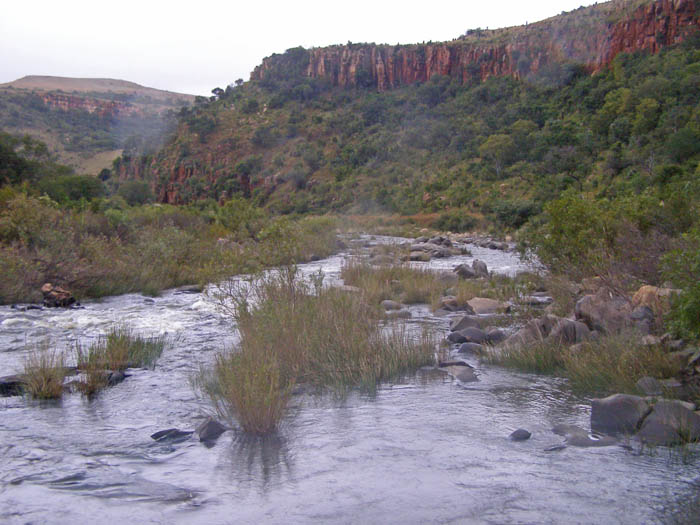
Komati River, South Africa. Image from Wikipedia here.

def. Komatiite:
1. An ultramafic, volcanic rock that is primarily composed of the minerals pyroxene and olivine.
2. A very unusual and rare volcanic rock type that is not produced today. Most komatiite lavas were produced in the Archean (approximately 2.5 to 3.8 billion years ago).
3. A rock type whose hotly– and wetly– debated origin sometimes galvanizes geologists to shouting matches, fist fights, and drinking contests.

Komatiites are ultramafic volcanic rocks. An ultramafic rock is a rock that has very low silicon (SiO2), sodium (NaO), and potassium (K2O) and very high and iron (FeO)  and magnesium (MgO) content, generally greater than 18 weight percent MgO*. For comparison, mafic basalts have about 7 weight percent MgO and felsic rhyolites have less than 1 weight percent MgO.

For those of you who are not used to thinking about mafic verses felsic rocks, let me try to explain the terms simply. A mafic rock is basically a dense, dark-colored rock that is more “primitive” or closer to the composition of the Earth’s mantle. A felsic rock is a less dense, lighter-colored rock that is “more evolved” or less close to the composition of Earth’s mantle. Mafic lavas, such as basalt, are generally produced through fairly high degree melting (about 10-20%) of the mantle. Felsic lavas, such as rhyolite, are produced through lower degrees of mantle melting and/or melting of continental and oceanic crust. Mafic rocks are enriched in heavier elements, such as magnesium and iron, and are depleted in lighter elements, such as silicon (SiO2) and sodium (NaO).

Table of igneous rock types, ranging from ultramafic to felsic. Taken from Wikipedia here. Click on the table to view a larger version.

An ultramafic rock is ultra depleted in silicon and other “felsic” elements and is also ultra enriched in magnesium and other “mafic” elements. Ultramafic rocks are primarily found in Earth’s mantle. Since the mantle represents about 84% of the Earth’s volume, most of the Earth is actually ultramafic. Although not quite correct, you can think about the mafic, intermediate, and felsic rocks that primarily comprise Earth’s crust as the light froth that floated to the Earth’s surface. Most of the Earth is comprised of denser ultramafic rocks– primarily my favorite rock peridotite. Most of the Earth is made of peridotite, which is primarily comprised of the iron and magnesium-rich minerals olivine and pyroxene.

Structure of the Earth. Image taken from here.

Although ultramafic rock makes up most of the Earth, geologists rarely find ultramafic rocks on Earth’s thin crust. This is because when the Earth’s mantle melts to produce magmas, it does not melt 100%. Rather, it generally melts between about 5% and 20%. This partial melting fractionates elements and has the effect of making the melt more felsic in composition than the ultramafic mantle. For instance, at mid-ocean ridges, 10% to 20% melting of ultramafic mantle produces mafic basaltic magmas. Some felsic lavas are actually melts of mafic or intermediate rocks. Whenever you partially melt a rock, it generally becomes more felsic in composition.
 
Understand all this so far? I know that I am putting a large amount of geology terminology in this week’s word of the week. In addition to komatiite, I am also trying to explain the geology words felsic, mafic, and ultramafic and the concept of partial melting. I realize this may be a bit much for my non-geology readers. I promise to return in future weeks to these words and concepts, but for now just try to understand the basics. The reason that I want you to have a basic understanding of these words and concepts is because this will help you to understand why komatiites are so remarkable and rare.

So, we’ve established that when the ultramfic mantle melts today, it generally melts no more than about 20%. This degree of melting produces mafic melts. These magmas make their way to the surface and, if they make it all the way to the surface, they erupt as lavas that eventually cool into mafic volcanic rocks. Today, the most primitive lavas that erupt are mafic basalts. No one has ever observed ultramafic lavas erupt; there are no places on the Earth today where ultramafic lavas are produced.

Before I continue, let me define another pair of geology words: volcanic verses plutonic. A volcanic rock is a rock that forms from the quick cooling of subaerial lavas. Since volcanic rocks cool quickly, they have textures that reflect this quick cooling. A plutonic rock, on the other hand, is a rock that forms from slower, deeper cooling in a place where magmas accumulate, such as a magma chamber. One final set of geology words: magma verses lava. A magma is what you call a melt before it reaches Earth’s surface. When magmas erupt subaerially, they are called lavas. Hopefully, I am done defining geology words now. For all the geologists who read my blog, I apologize for the review. I just want to make sure all my readers are up-to-speed with the terminology I’m using.

Back to the komatiites. Komatiites are ultramafic lavas. Now that you are familiar with the terms ultramafic and lava, you hopefully appreciate how amazing and befuddling komatiites are for geologists who, again, have never observed ultramafic lavas erupting. Komatiites are fairly rare rocks, but they are found throughout the world in places such as Canada and South Africa. Most komatiites were formed billions of years ago in the Archean (approximately 2.5 to 3.8 billion years ago). The youngest komatiites on Gorgona Island, Columbia were formed 90 million years ago, but these very young komatiites are anomalous. Almost all komatiites are billions of years old.

Komatiites were first described in the early 20th century in publications by the geological surveys of Zimbabwe, Canada, and Australia (Middlemost, pg. 101). The first chemical analysis of a komatiite was presented in 1928 in the Southern Rhodesia (now Zimbabwe) Geological Survey Bulletin (Macgregor, 1928). Early studies of komatiites noticed their unusual compositions but did not understand the full implications of these rocks. Remember that plate tectonics and the understanding that Earth’s mantle is composed of ultramafic peridotite were not fully realized until later in the 1960s and 1970s. In the late 1960s the Viljoen brothers described an incredible exposure of komatiite near the Komati River in South Africa (Viljoen and Viljoen, 1969). As you might guess, the Viljoen brothers named komatiites  after the Komati River**.

After the Viljoen brothers study, geologists began to realize the implications of these unusual rocks. They realized that komatiites formed from ultramafic lavas, and they realized that komatiite lavas are not produced today and, furthermore, could not be produced today. Geologists also quickly realized that most komatiite lavas are incredibly ancient, billions of years old. The anomalously young komatiite lavas on Gorgona Island were not discovered by geologists until 1979 (Echeverria, 1980). Komatiites were loosely defined as a rock type until the early 1980s when Arndt and Nisbet (1982) defined komatiites as rocks that:

1. Have a mineral assemblage or chemical composition that indicates an ultramafic composition
and
2. Have structures and/or textures that indicate a volcanic (extrusive) origin.

That is, they are ultramafic rocks that erupted as lavas. But how is this possible? And why aren’t komatiites produced today? Well, geologists have argued about the origin of komatiite lavas since komatiites were first discovered. Geologists agree that ultramafic lavas can only be produced when the ultramafic mantle is able to melt to a greater extent. The degree of mantle melting required to produce komatiite melts is about 50% to 60%, which is far greater than the maximum of about 20% that the mantle melts today. What geologists do not agree on is what conditions led to this much higher degree of mantle melting. There are two hotly– and wetly– debated possibilities.

The first possibility is that the mantle was hotter back in the Archean, when most komatiites were produced. If the mantle used to be hotter back in the Archean, much higher degrees of mantle melting would be possible. The mantle– indeed the entire Earth– was much hotter back in the Archean because of higher amounts of radioactive elements (which have now decayed) and other sources of heat that have now dissipated. However, to form the many komatiites the mantle needed to be hotter by about 500 degrees Celsius, which is a big difference. Also, not all lavas that were produced in the Archean were ultramafic– there were also plenty of mafic basalts produced. So, if the mantle were much hotter, why would komatiite lavas only be produced in certain places?  This leads many geologists to challenge the hot mantle theory for the origin of komatiites.

The second possibility is that the mantle was wet and less hot. Wet rocks– that is, rocks with a large amount of water and other volatiles in them– melt at lower temperatures than dry rocks. So, if the mantle were wetter back in the Archean, it would produce higher degrees of melt even if mantle temperatures were not much higher than today. For instance, some authors propose that mantle temperatures higher by only 100 degrees Celsius or so could produce komatiites in wet subduction zone environments (e.g. Grove and Parman, 2004).

The origin of komatiite lavas is a passionately debated topic in geology. Back when I was a first year graduate student, an older student told me that he purposely didn’t work on komatiites (which his advisor famously studied) because he didn’t want to work on such a controversial rock. I laughed at the comment and wondered how a rock could be controversial. Then, he told me stories about geologists passionately debating their opinions on komatiites. At one conference, scientists started yelling at each other and nearly broke out into a fist fight. Certainly, the passion of komatiite researchers shines through in their papers, which makes them entertaining to read. When studying komatiites, I guess you have to join “team wet” or “team dry.” If you want to read a review of the komatiite debate, an excellent paper (though I have to warn you that this paper comes from “team wet”) is the Grove and Parman (2004) reference below.

You might be wondering how geologists know that komatiites were erupted as subaerial lavas. How do geologists know that these rocks aren’t just plutonic ultramafic rocks that were exposed through uplift or erosion? The answer is that komatiites have textural and structural characteristics that indicate that they formed from lava. For instance, komatiite lavas are particularly known for their beautiful spinifex textures. Spinifex*** is a texture created by elongated olivine crystals that form when olivine cools extremely quickly, a sure sign that komatiites formed from subaerial lavas. I leave you with these beautiful pictures of spinifex texture in komatiite.

Spinifex texture in komatiite. Image taken from here.

*For those of you who are not familiar with the convention, major elements in rocks are always reported as oxides (combinations of an element with oxygen). Oxygen is actually the most common element in rocks and binds with the other elements, so this convention makes sense for rocks. However, those who are not used to thinking about geochemistry and petrology may find this convention a little confusing at first. Don’t worry– after awhile you become accustomed to it. So, if you continue reading my blog, you’ll be an oxide expert in no time!

**As a quick etymological aside, komati comes from the Swati word “inkomati,” which means cow. So, komatiite means “cow rock.”

***Here’s a list of the geology terms I’ve introduced in this post: komatiite, mafic, felsic, ultramafic, mantle melting, volcanic, plutonic, magma, lava, mantle, crust, peridotite, spinifex.

References:

Arndt, N. T. and Nisbet, E. G. (editors) 1982. Komatiites. London: George Allen & Unwin.  

Echeverria, L.M., 1980. Tertiary or Mesozoic komatiites from Gorgona island, Colombia: Field relations and geochemistry. Contributions to Mineralogy and Petrology, vol. 73: 253–266.

Francis, P. and Oppenheimer, C. 2004. Volcanoes. New York: Oxford University Press, 35-36.

Grove, T. L. and Parman, S.W. 2004. Thermal evolution of the Earth as recorded by komatiites. Earth and Planetary Science Letters, vol. 219: 173-187.

Hall, Anthony. 1987. Igneous Petrology. Essex: Longman Scientific & Technical, 341-342.

Kamenetsky, V. S., Gurenko, A. A., and Kerr, A. C. 2010. Composition and temperature of komatiite melts from Gorgona Island, Colombia, constrained from olivine-hosted melt inclusions. Geology, vol. 38, no. 11: 1003-1006. 

Macgregor, A. M. 1928. The geology of the country around the Lonely Mine, Bubi District. Southern Rhodesia Geological Survey Bulletin, vol. 11.

Middlemost, Eric. 1985. Magmas and Magmatic Rocks. Essex: Longman Scientific & Technical, 100-101, 183-185.

Viljoen, M. J. and Viljoen, R. P. 1969. Evidence for the existence of a mobile extrusive peridotitic magma from the Komati Formation of the Onverwacht Group. Geological Society of South Africa, Special Publication, no. 2: 87-112.

A Birthday Rock: Peridotite

Today is my birthday, so I am going to post some pictures of my favorite rock, which is peridotite. One of my committee members often refers to peridotite as “prettytite.” I agree that peridotite– which is comprised primarily of the minerals pyroxene and olivine– is very, very pretty.

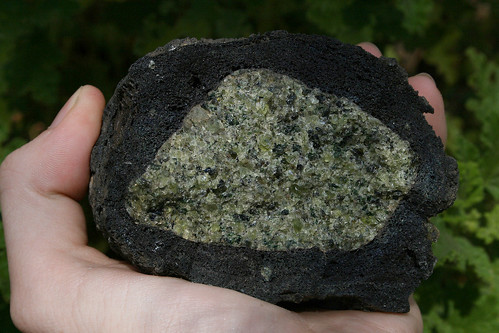
Image taken from here.

Peridotite sometimes contains gem-quality olivine, which is called peridot. Peridot can be made into some beautiful jewelry.

My peridot engagement ring on our engagement day, South Africa, March 2009.

For the past two years, I spent my birthday amidst peridotite hills in the desert of Oman. I can think of no better way to spend my birthday than hiking and doing fieldwork surrounded by my favorite rock. Last year, my committee member (the one who says “prettytite”) and another graduate student Lisa even brought me a cake from a grocery store in Muscat as they had gone back to the city the day before for a meeting. The cake survived– sort of– several hours of driving on rough roads in a Land Cruiser and almost a day in the heat of the Omani sun. They also purchased several New Year’s decorations and noisemakers. After dinner that night, the cake appeared and our simple field dinner turned into a birthday party! Thanks, everyone, for that party. I think it might be my favorite birthday party ever.

This year, I am spending my birthday reducing data (and blogging, I suppose) from my apartment in Woods Hole. Because of the winter blizzard, WHOI is closed today, so I’ve decided to play-it-safe and not brave the roads. For my birthday next year, I hope that I am back in Oman amongst the peridotite.

Birthday hike amongst carbonate-cemented peridotite clasts, Oman, January 2009.
Birthday accommodation, Oman, January 2010.
Sunset on another year, Muscat, Oman, January 2010.

Bee-Bop the General Exam Bear

Bee-Bop on my desk after I passed my general exam, Woods Hole, October 2008.

This is Bee-Bop, the big, furry, creepy, blue toy that PhD students in the Geology & Geophysics Department at Woods Hole Oceanographic Institution (WHOI) pass from student to student. The toy is held in the possession of whomever has most recently passed her (or his, but most geology students right now are female, so I’ll go with her) general or qualifying exam for her PhD. When a new student passes her general exam, Bee-Bop appears on her desk within a few hours– usually when the newly-minted PhD candidate is busy drinking the important post-generals beer or taking the relaxing post-generals nap.

The Bee-Bop toy has been passed down for the past four-and-a-half years that I have been a student at WHOI. I don’t know when the tradition started. If any WHOI graduates read this and know when and how this tradition originated, please let me know. Bee-Bop resided in my office for about two months. I passed my general exam in early October of my third year of graduate school, and I handed over Bee-Bop to another successful PhD candidate in December of that year. I believe that Bee-Bop currently lives in my friend Arthur’s office. Depending on when students take their general exam, they have Bee-Bop for a few days or for a few months.

Most PhD programs have a notorious general or qualifying exam. Some programs even have two such exams! Prior to this exam, you are not, technically, in the PhD program. After this exam, you become an official PhD candidate. The exam varies from institution to institution and from department to department, but usually the exam consists of a general knowledge section, which can be written or oral, and a research section, which is often an oral presentation and accompanying research paper. The general exam is graded by the notorious general exam committee, which again varies from institution to institution. At some places the exam committee is selected by the department whereas at other places the student is allowed to select her exam committee. General exams usually happen at the end of the second year of the PhD.

In the Geology & Geophysics Department in the MIT/WHOI program, the general exam currently follows the guidelines below. Note that these are the guidelines that I followed and which I believe the department still follows but that this is a blog and does NOT represent the official MIT/WHOI rules on the matter.

1. The general exam committee consists of committee members (usually 2-4) selected by the student plus the student’s advisor(s) plus 1-2 committee members selected by the department to serve on all of the general exams in a particular year.

2.  The student must present two 20 minute presentations about two separate research projects. The student must also write two ~10 page research papers, one for each project. The committee members read the papers in advance and then listen to the two presentations. After each research presentation, the committee members can ask questions about the project.

3. After the research portion of the exam is concluded, the committee members are allowed to ask general knowledge questions. Committee members can ask anything they want, though the questions are often within fields (e.g. geophysics, geochemistry, sedimentology, paleoclimate) the student is supposed to be knowledgeable about for her thesis.

Most questions are reasonable, but the committee members will sometimes ask harder and harder questions until they find a question the student cannot answer. Then, they observe how well the student responds to a question she has absolutely no idea how to answer. There are all sorts of rumors about the worst general knowledge questions. Rumored worst questions ever are:

“If your airplane crashed and you were on a life raft in the middle of the Indian Ocean, what kind of science experiments would you conduct?” (To a physical oceanographer)

“What is the moon doing right now?”  (To a student studying lunar basalts)

“If the Earth were two-thirds its present size, how would all of geophysics change?”(To a geophysicist)

4. Because two research projects are required, the general exam happens in the third year, which is a little later than most PhD programs. Students do not take the exam at the same time. Rather, each student takes the exam when she is ready. Thus, general exams are staggered throughout the third year, which gives Bee-Bop time to reside in each student’s office.

5. The general exam varies in length but generally lasts about three hours. Scheduling two hours before lunch is recommended as your committee members become hungry and tend to ask fewer general knowledge questions.

The general exam is really scary and stressful. For about three or four months before my general exam, I was really stressed out. My exam was a little more stressful than most, I suppose, because I was in the process of changing advisors. However, all students (at least ones I’ve observed) stress about their general exam. In my program students who actually make it to their general exam almost always pass. Somehow, the knowledge that you are pretty much guaranteed to pass (at least in the Geology & Geophysics Department) does not make the general exam any less stressful.

Yes, most students pass their general exam here in the Geology & Geophysics Department at MIT/WHOI. This is mostly because advisors don’t let their students take the exam until they are ready. The students in the program are bright (being accepted to the program is the hard part, really), so they are generally quite capable. The students who don’t pass outright usually pass with some conditions. A conditional pass sounds scary, but usually it just means that your committee wants you to take an extra thermodynamics class or write an appendix to one of your general exam research papers. A conditional pass is not a bad thing; such a pass just means that your committee wants to make you a better scientist.

Rarely (in geology, but not in other departments such as engineering), students fail their general exams. There are two versions of this failure. Outright failure (leave the program immediately with nothing) is extremely rare. The second type of “failure” is the committee requiring that the student write and defend a masters thesis. After defending this masters thesis, the committee will then re-evaluate if the student is ready for a PhD. Some students who receive the “masters failure” become frustrated and decide to leave with the masters; others persist and continue with the PhD.

The MIT/WHOI program does not award masters degrees as a matter of course. You cannot apply to be a masters student (unless you are in the Navy, which has a special arrangement), so a silly notion about the MIT/WHOI program is that receiving a terminal masters degree is a “failure.” Clearly, this is a ridiculous notion since a masters degree from MIT/WHOI is considered extremely prestigious by PRETTY MUCH THE WHOLE WORLD. Only in the confining bubble of academia (and not even all of academia) is obtaining a masters degree from MIT/WHOI considered “failure.” Honestly, I don’t think anyone at MIT or WHOI really looks down upon anyone who decides to leave with a masters degree. Nonetheless, since the expectation when you start the program is that you will obtain a PhD, people sometimes whisper in hushed, gossipy tones about so-and-so defending her masters.

Sometimes, students decide to leave with a masters degree even before they take their general exams. There are a number of reasons for this, but most often (from what I’ve seen) a student realizes that she doesn’t want to be a PhD academic. These masters-choosing students leave the program and generally obtain excellent jobs, making their PhD-seeking former classmates extremely jealous of their money and free time.

The general exam is a rite of passage for all students in my program. As with many rites of passage, there are some traditions. Generally, there is cake and a small party and a free-pass from your advisor to sleep in for a week. In my department, we also have Bee-Bop.

I suppose that I should explain a little more about the Bee-Bop toy. I call this toy a bear, but really the toy is some kind of strange space alien mutant baby. I guess it makes me feel better to think about Bee-Bop as a blue bear with a strange head than a mutant alien baby with a blue bear body. Bee-Bop is a ridiculous and very creepy toy. Just looking at the toy is creepy enough. However, to make Bee-Bop even more creepy, this toy does not one but TWO creepy dances. Unfortunately, I did not videotape Bee-Bop’s dances when I had him (her? it?)  in my office. Fortunately, there are many videos of this toy on YouTube. I found several videos by googleing “creepy dancing toy.” Here is a video of an orange Bee-Bop that I like:

Video taken from YouTube.

As you can see, Bee-Bop’s name comes from the sound it makes when it starts its first creepy dance. When I found this video on YouTube, I realized that Bee-Bop’s name is actually Boohbah.  The toy is apparently based on the creepy children’s television show Boohbah, which started in 2003 (UK) and 2004 (US). Thus, I deduct that the Bee-Bop/Boohbah general exam tradition started around 2004.

The Bee-Bop toy is crazy and silly and creepy and always makes me laugh whenever I see it in a classmate’s office. Shortly after my own general exam, I made the Bee-Bop toy dance its creepy dances in my office. The Bee-Bop dances made me break out into hysterical laughter with my officemates. After I survived– and passed– my general exam, laughter was just what I needed.

I hope that the Bee-Bop toy continues to be passed down for many years. If the tradition is ever lost in years to come and some future graduate student in the MIT/WHOI program finds this blog post, please contact me. I volunteer to buy a Bee-Bop toy off ebay (if ebay still exists) and mail (maybe teleport– that would be neat) it to whomever has just passed her general exam.

Plate Tectonics by Squirrel– “Ice Age: Continental Drift”

My friend Arthur just made my day by sending me a link to the teaser for the 4th installment of the “Ice Age” movie series. This clip is adorable but also completely ridiculous scientifically.

“Ice Age: Continental Drift” Trailer taken from YouTube.

This clip makes me smile and laugh, but I do worry– a little– about young children believing in plate tectonics by sabre-toothed squirrel after watching this movie. I think most children are smart enough to figure out that plate tectonics (which isn’t called continental drift, by the way) doesn’t really happen by squirrel. However, I wonder if there’s any way to talk 20th Century Fox and Blue Sky Studios into including an extra on the DVD or on their movie website that explains how plate tectonics really works. Even just a two or three minute clip– it could even be a cartoon– with a proper scientific explanation would be wonderful. I know that many children watch all of the extras on their favorite movies religiously.

If I wrote a letter and tracked down the contact information for the people in charge of the “Ice Age” movies, would other geologists also write letters and help me with my campaign? Note that I don’t want them to change their script– I just want them to include some educational information as a sort of extra. There is plenty of time for this campaign as the movie is not scheduled to come out until 2012. I’ll get started on my research, but please reply below or send me an email if you’d be willing to support my effort– even if it’s just signing a letter that I write to Fox.

Also, I have a few connections to the entertainment industry through some skeptical friends of mine. I’ll do some networking and try to come up with the best way to reach Fox & Blue Sky Studios, the two organizations in charge of this movie.