Mystery Rock #2

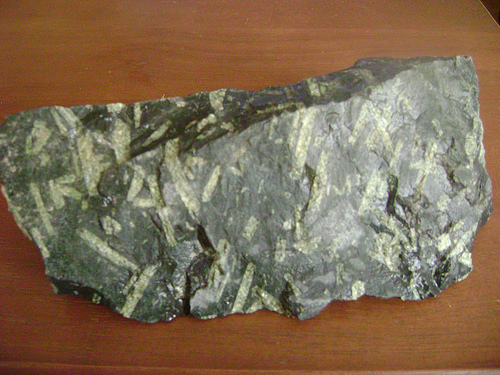
Earlier this month I posted pictures of a mystery rock that were sent to me by one of my blog readers. On Friday I received an email from someone who had been directed to my blog from the Skeptics Guide to the Universe Forum. A friend of this person had found an interesting rock in a rock wall in El Paso, Texas and wanted to know if anyone could identify this rock. Below are some pictures of beautiful Mystery Rock #2:
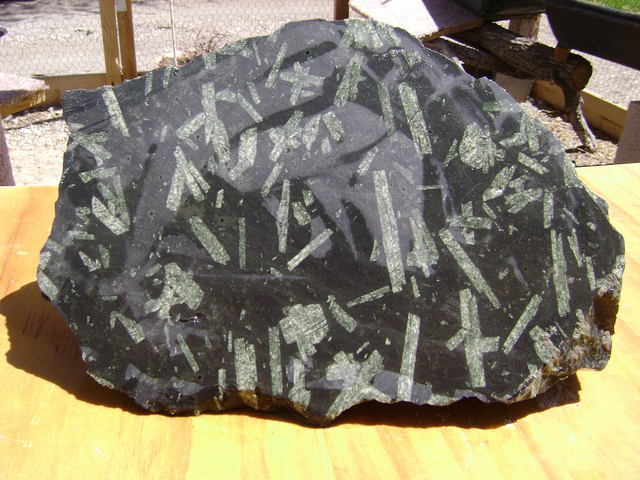
Mystery Rock #2, Photo 1.
Mystery Rock #2, Photo 2.
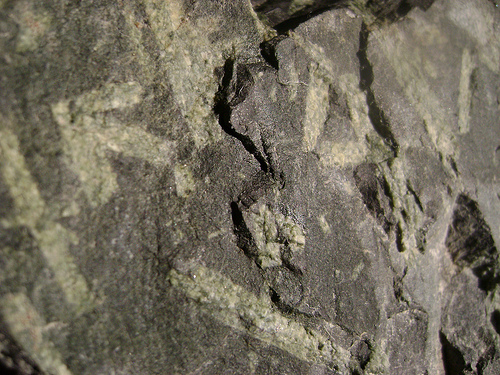
Mystery Rock #2, Photo 3.
Mystery Rock #2, Photo 4.

This rock is a little bit easier to identify than the first mystery rock. Again, though, geologists do find it more challenging to identify rocks from pictures (rather than in person) and from a rock wall (rather than an outcrop).

Let’s go through our identification questions:

-Is the rock man-made or natural?
This is a natural rock.

-Is the rock igneous, sedimentary, or metamorphic?
This is an igneous rock.

-What type of igneous rock is this?
This appears to be a porphyritic igneous rock with phenocrysts of feldspar in a very fine-grained or possibly glassy matrix.

Let me explain some of the terms in the rock description for those of you who are not geologists. Igneous rock literally means “fire rock” and is a rock that solidified from a partially or completely molten state. Igneous rocks either slowly crystallize deep in the Earth or rapidly crystallize on Earth’s surface from molten rock erupted by volcanoes.

Porphyritic is a term used to describe igneous rocks that have a distinct size difference in crystals. In the case of the rock above, there are phenocrysts (large crystals) in a matrix of much smaller crystals. It is a little difficult to tell from the photos, but the matrix seems to be very fine-grained, possibly even glassy. The matrix either consists of tiny crystals that are too small to see in the photos or is glassy, meaning that there are no defined crystals but rather amorphous, unordered solidification.

How to porphyritic igneous rocks form? Well, they generally form when magma that has been slowly cooling for a long time, possibly in a magma chamber, is suddenly erupted to Earth’s surface. Deeper in the Earth where magmas can cool more slowly, large crystals have time to form and grow. Those phenocrysts are quite large (they are so large I’d even venture calling them “megacrysts”), so they had to form through slow growth over a very long time in a magma chamber or similar environment deep in the Earth. Magma takes while to crystallize completely, so sometimes partially-crystallized magmas are brought to Earth’s surface and erupted as lavas. When these partially-crystallized lavas are erupted, the rest of the molten rock cools quickly, and there is no time for large crystals to form.

Minerals crystallize out of magma in a certain order, following something called Bowen’s Reaction Series. In certain magmas, feldspar is one of the first minerals to crystallize out of a magma. My guess is that the large crystals in Mystery Rock #2 are feldspar. It’s always difficult to identify minerals from pictures, but the crystals look like feldspar to me– they are the proper shape, and they exhibit characteristic feldspar twinning. So, my guess is that Mystery Rock #2 formed when magma first spent some time deeper in the Earth and crystallized large feldspar crystals. Then, that magma containing the feldspars was brought to Earth’s surface and erupted. The rest of the molten rock cooled so quickly that there was no time for large crystals to form. Instead, the lava rapidly solidified into very tiny crystals or perhaps even glass, which forms if the cooling is very, very rapid. If the rest of molten rock had had time to slowly cool deeper in the Earth, perhaps the rock would have been something like a granite rather than a porphyritic igneous rock with feldspar phenocrysts.

The person who found this rock also mentioned that the large crystals have a very pretty green hue to them. Feldspar is generally white, brown, gray, or pink, so perhaps I’m missing something, but I believe the green hue is just from alteration of the feldspar crystals.

Other geologists– what do you think? Please weigh in on the identification of Mystery Rock #2.

Finally, to the owner of this rock– this is a truly gorgeous rock. If you ever decide you want to rid yourself of this rock, please give it to a geologist or other rock-lover.

Just a Typical Sunday Morning Conversation at WHOI

I had an interesting conversation with one of the security guards here at Woods Hole Oceanographic Institution (WHOI) just a few minutes ago. The conversation went something like this slightly stylized version:

**************

Security guard: Do you know where Mary* is? I noticed her car wasn’t in the parking lot last night.

Me: Hmm… haven’t seen her recently.

Security guard: I know she’s been working in New York, so I sent her an email to make sure the car was okay. But I got one of those away messages.

Me: Oh yes! That’s right. I forgot– she’s in Antarctica. The car is back this morning. I bet a friend just borrowed it.

Security guard: Antarctica?

Me: She probably has email there.  Don’t worry. She’ll probably reply soon.

Security guard: Antarctica? Isn’t it winter there?

Me: Yes, but I think she’s on a ship.

Security guard: On a ship in Antarctica in winter? Crazy scientists.

**************

Yes, we scientists are crazy. Speaking of which, I need to hurry on to my labwork. On Sunday morning. On a holiday weekend.

*Name changed to protect the identity of the crazy scientist.

Bloggy Changes

As some of you may have noticed, over the past few days I’ve given Georneys a bit of a facelift. I’ve removed the pretty but distracting background picture and changed the post colors from white on gray to simpler (and hopefully more readable) black on white. I’ve also photoshopped my blog text onto my title image, which I cannot seem to center despite my best efforts. I mostly chose the font on the title image because it’s named “Papyrus” and it reminds me of Egypt, a country I very much hope to visit in the next few years.

Let me know what you think. I’m not a graphic designer, but I hope these changes are for the better.

Actually, I’m not really known for my fashion sense or sense of color at all, as the photo below illustrates. My mom recently posted this photo of me (I’m about four years old in the photo) on Facebook. My friends and relatives laughed and posted teasing comments about my outfit, so I replied to them in a Facebook comment:

In my defense, let me say 1. I think that’s a wooly mammoth (and maybe dinosaurs?) on my shirt, and that is awesome; 2.The green socks & pink jellies color coordinate perfectly with my mammoth/dino outfit; and 3.Poor fashion sense is a trait often associated with scientific brilliance.”

That said, I do hope the bloggy changes are better looking than my green-and-pink outfit. Particularly that spidery hair clip.

GeoEvelyn, circa 1988 or so.

Blast from the Past: Carbon Cycle Story

Atom Unit Report Booklet.

I’m finishing up my packing this weekend, so that means it’s time for another “Blast from the Past” post. This is a story narrated by a carbon atom going through the carbon cycle. This story comes from my “Atom Unit” report booklet. Last week I shared a story called “Element Talk Show” with you from this same booklet. Just this evening I noticed that I wrote the date on the back of the booklet. I wrote this booklet in 1994 when I was ten years old and in either 4th or 5th grade.

This is another nerdy, weird story, but at least I had a pretty good understanding of the carbon cycle for a ten-year-old. All spelling, grammar, and punctuation are original.

The Life of a Carbon Atom: 

The Atmosphere:
My life started out easy, in the air. I had the pleasure of being in a molecule with two extremely nice oxygen atoms. I just drifted in the air, happy that I had my full supply of electrons. Perhaps I should introduce myself. I am a typical carbon atom with six electrons. I now am in a carbon dioxide molecule and am just drifting. I waved to my friends, oxygen gas, a molecule of two oxygen atoms (I find oxygen the nicest atom), and nitrogen gas, a molecule of two nitrogen atoms. All of us are in our gas form. I’ve heard stories of becoming solids and many different things, but now I just like the aaaaaaaaaaaaair*. I was being sucked in by something, I was leaving the air. “Goodbye!” my friends yelled, “you’ll like being a solid. Good luck.”
The Plant:
It turned out I was being breathed in by an eggplant. It wasn’t bad being an eggplant, but I prefer being in the air much better. I was in the eggplant for several days. One day the eggplant was picked. I was relieved because it was turning into cold weather and at night frost reached its arms over the eggplant. I remember being put in an icebox and staying there for a day or so. This cold was not like the cold of the frost, but a more gentle concentrated cold.

“Ray, get some eggplants out, Marilyn is going to have company tonight.”

“Not eggplant tonight, Martha. You know Marilyn doesn’t favor eggplant,” he replied.

“I never asked her to eat any. Will you just get ’em out?”

The icebox door opened and I was lifted out and set on a table. The eggplant was cut up into little slices, myself being part of the smallest slice. I was placed on the table with some parsley and the rest of the eggplant. There was not just eggplant on the large white table, but turkey, corn, rolls, butter, salad, potatoes, salt, pepper, napkins, plates, spoons, forks, knives, salad forks, roast beef, and some other things that I haven’t any idea what they are. One of the best things on the table was fried yams.

“Martha! Martha! Where is that producer I invited for dinner? He’s Late!  I’m eager to sign that contract,” Marilyn complained.

“Hello,” a famous hollywood producer walked into the dinning** hall, “this must be Marilyn, Marilyn Monroe.”

“Of course I’m Marilyn Monroe. Who do you think I am? Now what about that contract? Pass the eggplant please.”

I felt the eggplant being bumped around on the platter. A fork was lifted and the eggplant was eaten by Marilyn Monroe!

The Human Body: 
Shining white sharp teeth chewed the eggplant and then Gulp! A long dark passage led straight downward into a larger space called the stomach. I was bumped around and jumbled about. I was not in the human body for long. It was just a couple of hours***. Just as Marilyn Monroe was about to turn out the light for the night, eager to start work on her new movie she took a deep breath, and I caught sight of two very nice oxygen atoms. I had been a bit cranky without my full eight electrons and I was eager to join them. So I did and Marilyn Monroe breathed me out as carbon dioxide.

The Atmosphere Again:
I was free! Happy, in the atmosphere again. I came to know my two oxygen atoms and was very happy in my new molecule. I stayed in this molecule for a few years, floating around and having the time of my life. My molecule rested near the ground, maybe too close because sooner than I knew it I was being sucked up by the roots of some plant.

Rain Forest: 
The roots belonged to some berries. These berries nested in the middle of a vast rain forest. I heard some birds tweeting around me. A leopard pounced on something, catching his prey. I stayed in this plant for a million years or so (I really just lost count) until eventually it was pressed and compacted so much that I turned into a different substance altogether. I still lay in the rain forest until I heard the noise of shovels digging up the ground above me. Finally after such a long time light shone around. For the first time I saw what I was.

Coal:
“This is is it Ricky, coal. We’ll haul in a good bundle for this lot.”

“Would you be quiet? You’re forgetting we have to use some of this in our own research. We’ll sell the rest though. Help me get this out of here.”

I felt bits of coal being lifted up and put into a weird carrier type thing. It was really a compartment of their space mobile used for storing items that were not needed until their next stop.

“What should we try now?” a strange voice asked.

I had been in the coal that had not been sold and now scientists were staring at me through advanced equipment.

“Lets try burning the coal. Ancient Americans often used this process to heat things, but it was most commonly used for cooking things. We are going to take this recreation of what they called bacon and try to cook it in coal and in order to do that we must burn the coal.”

And so I was burned and set free by it. I mixed with oxygen and became carbon dioxide. I was free for the present, but soon I would be in a human or plant. I would never be free from the carbon cycle.

*I think I transcribed the correct number of “a”s here.

**Hee hee first “dinner” now “dinning hall.”

***Not sure about the science of this, but since this is a story narrated by a sentient carbon atom, I’ll roll with it.

My interest in the carbon cycle has continued to adulthood. For my PhD thesis, I study the formation of carbonate rocks in mantle peridotite in the Samail Ophiolite in Oman. These carbonates form when mantle peridotite interacts with carbon dioxide (CO2) and alters to form solid carbonate minerals. Alteration of mantle peridotites to carbonates is a process that naturally removes CO2 from the atmosphere and hydrosphere and stores this CO2 in solid mineral form. So, we call this process a natural “carbon sink” or natural “carbon sequestration.” Understanding natural CO2 storage in carbonate rocks may help geologists and engineers figure ways to artificially store CO2 in carbonate rocks as a way of offsetting anthropogenic CO2 emissions. Today, my understanding of the carbon cycle is slightly more sophisticated than my understanding when I was ten, but, hey, you have to start somewhere.

The carbon cycle is a little more complex than the above story indicates. Perhaps I should write a new story in which the carbon atom cycles through even more reservoirs. For instance, the carbon atom could spend some time in an ocean foram and in a carbonate vein in one of my Oman peridotites. If the carbon atom goes through every possible reservoir, the story could be very long indeed.

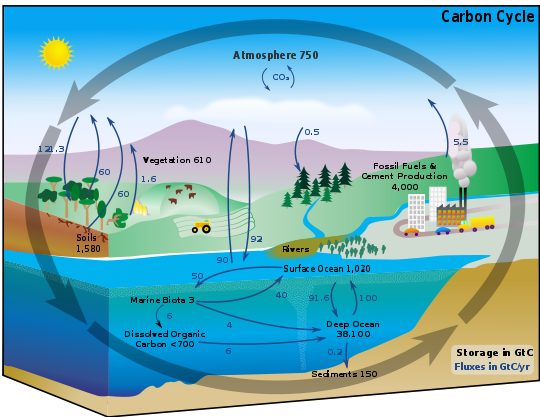
Here are a couple of figures showing the carbon cycle:

First, a pretty one from wikipedia:

The carbon cycle. Taken from Wikipedia Commons here.
Click to enlarge.

Second, a boring but precise (though slightly dated) carbon cycle drawing (and associated table) that I like:

Carbon cycle. From Holser et al. (1988).
Click to enlarge.
Data table for above cycle. From Holser et al. (1988).
Click to enlarge.

Cape Peninsula in Pictures

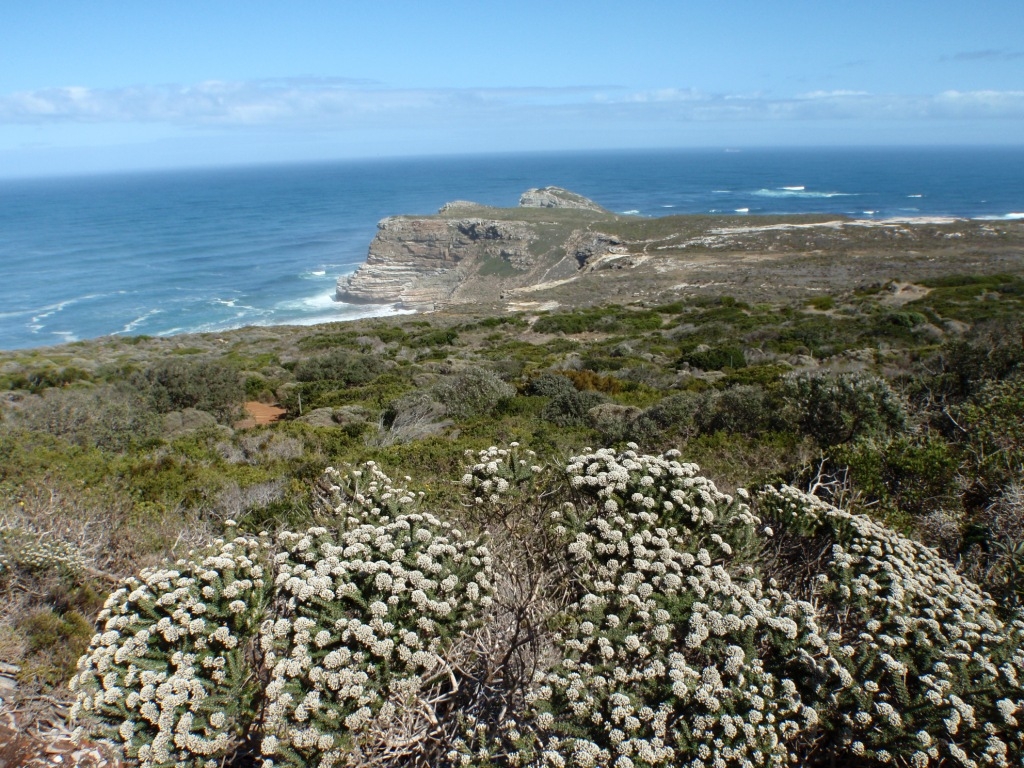
Flowers at Cape Point, South Africa. April 2011.

I’m working late tonight running samples on the mass spectrometer. I’ve been in lab since 8:30am and really should go home, but I’ve decided it’s better to stay up all night and run samples. Okay, maybe not all night. But probably until 2am or 3am. Actually, I’m happy about this long lab day. I spent a good four hours tuning the machine (which is a bit tempestuous, like many mass spectrometers) this morning, and the mass spectrometer is running beautifully right now. The machine is very stable, and the data quality is very high. So, rather than shut the machine down and return in the morning, I’m going to run as many samples as possible. As many of you know, I’m sure, mass spectrometers are usually happiest when they’re constantly being run. So, I don’t want to risk coming in tomorrow and losing all of the tuning and stability. Besides, I’ve been working on difficult chemistry for months, and the mass spectrometry is the final step. With every passing minute I am gathering more data that can be used in my thesis. Very exciting! I can sleep tomorrow.

Fortunately, now that the machine is tuned and running I only need to keep an eye on it and change something every few minutes. So, I have some time to post some more pictures of my recent trip to South Africa.

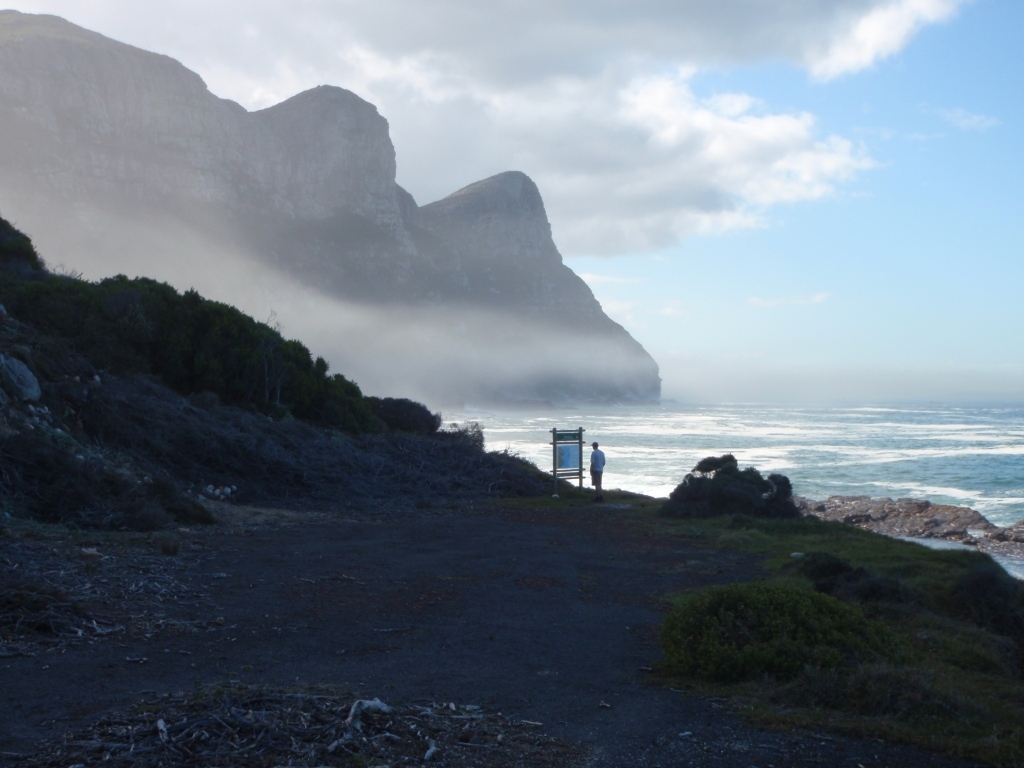
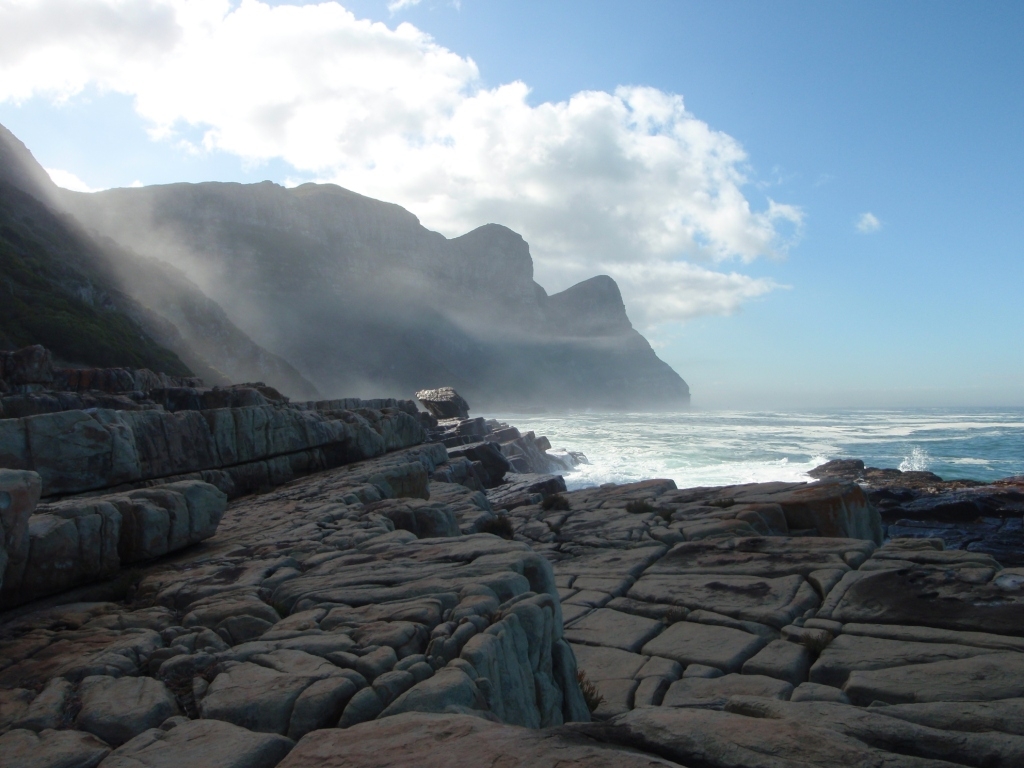
A few weeks ago I blogged about some interesting sandstone weathering that my fiance and I observed at Cape Point, South Africa. Below are some more pictures from our day visit to the Cape Peninsula. If you’re ever in the Cape Town area, I highly recommend visiting the national park located on the Cape Peninsula. The area is gorgeous, and you’re likely to see several different types of wild animals. You can also visit two lighthouses, take a picture next to a sign proclaiming the southwestern-most point of the African continent, see giant white crosses commemorating the voyages of famous explorers, and walk along a beach to a shipwreck. There are also some beautiful visitor centers (or centres, to be properly South African) that have some interesting displays about the history of the peninsula and about some of the local flora and fauna.

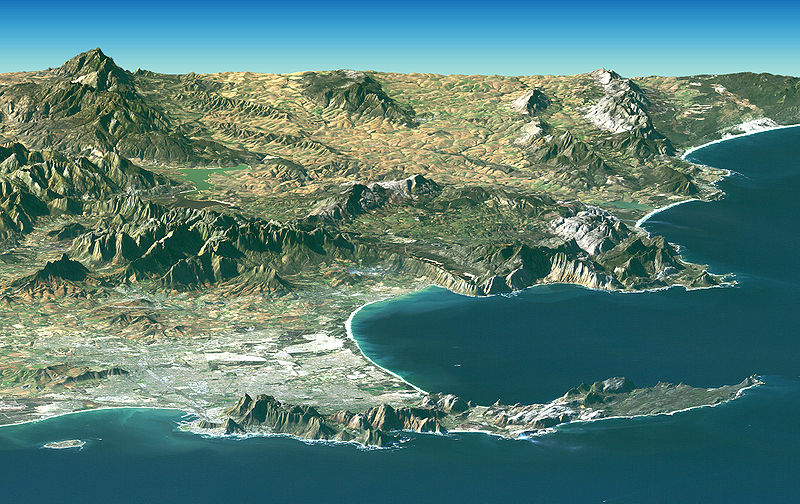
Before moving on to my pictures, here is an amazing satellite image of the Cape Peninsula:

Cape Point Satellite Image. Courtesy of NASA. Taken from wikipedia commons here.

And here’s a nice map showing the location of Cape Point and the Cape of Good Hope (which are both on the Cape Peninsula) relative to each other and the city of Cape Town:

Map showing the Cape Peninsula and surrounding areas.
Taken from Wikipedia Commons here.

Now, on to my own pictures of the Cape Peninsula. First, some pictures of Cape Point:

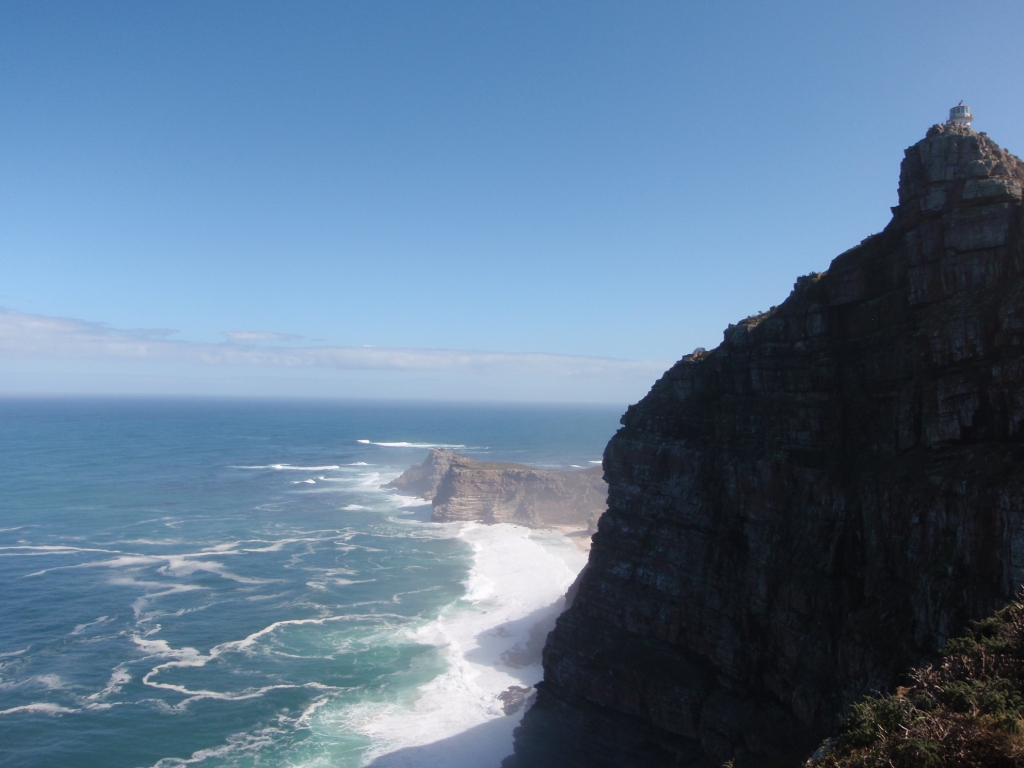
View walking up to the lighthouse. Cape Point, South Africa, April 2011.
View looking out from the lighthouse. Cape Point, South Africa, April 2011.
Looking back on the old lighthouse. Cape Point, South Africa, April 2011.
Lookout point. Cape Point, South Africa, April 2011.
Lookout point and lighthouse. Cape Point, South Africa, April 2011.
Old WWII bunker. Cape Point, South Africa, April 2011.
Ruins of WWII bunkers. Cape Point, South Africa, April 2011.

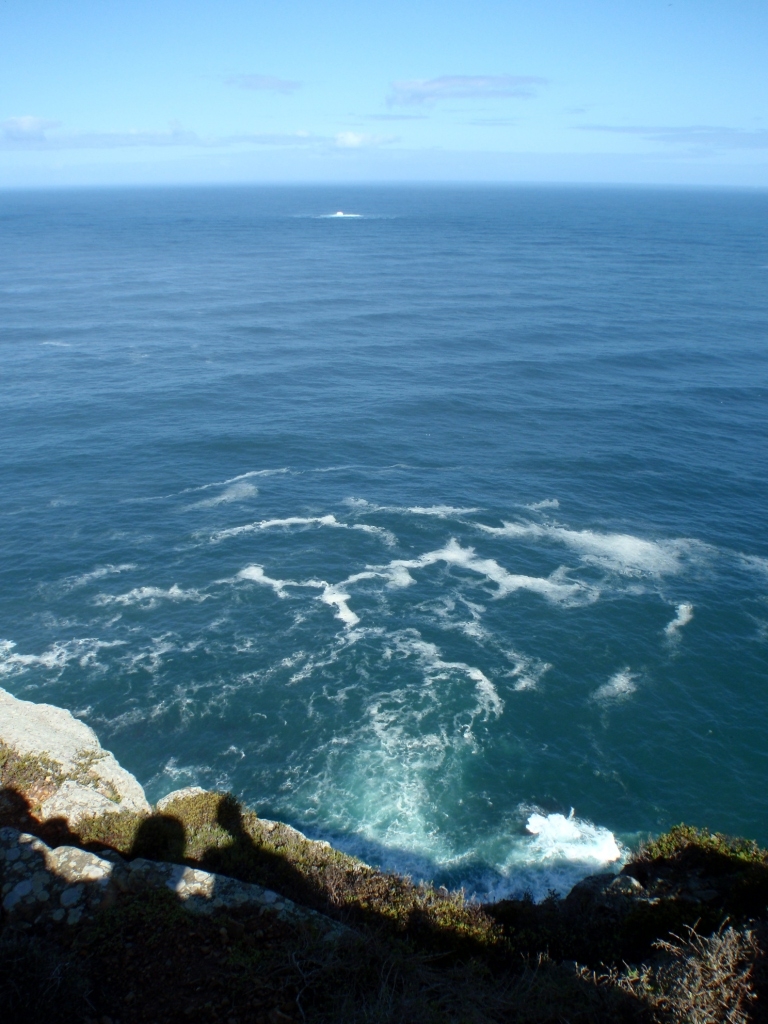
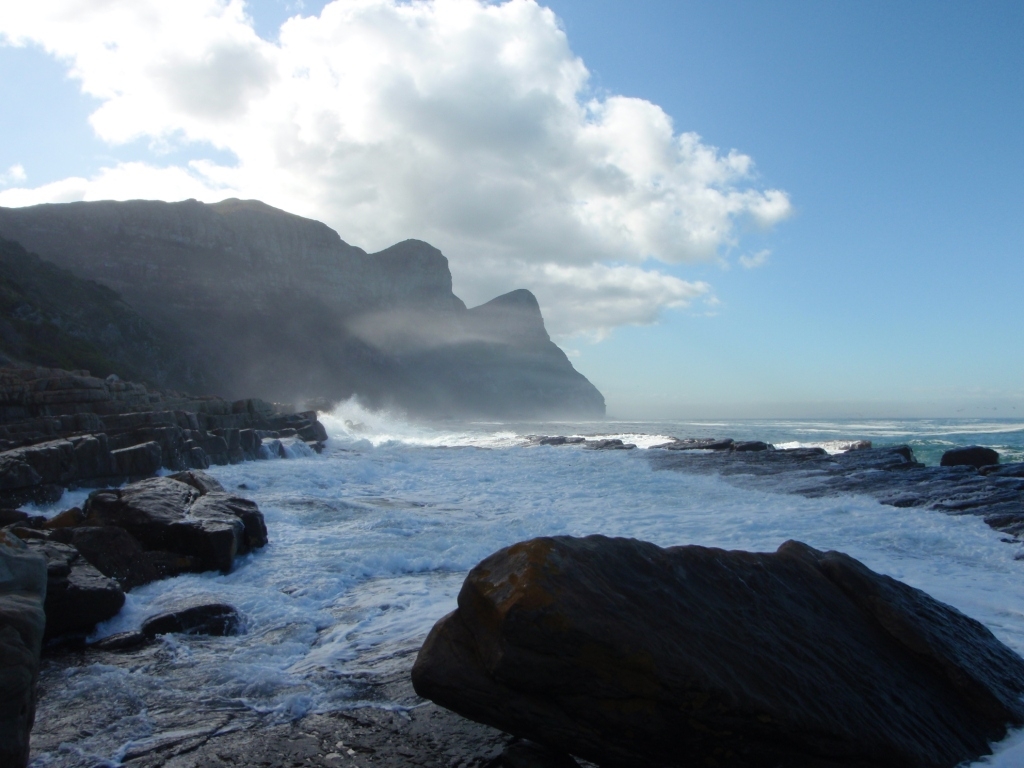
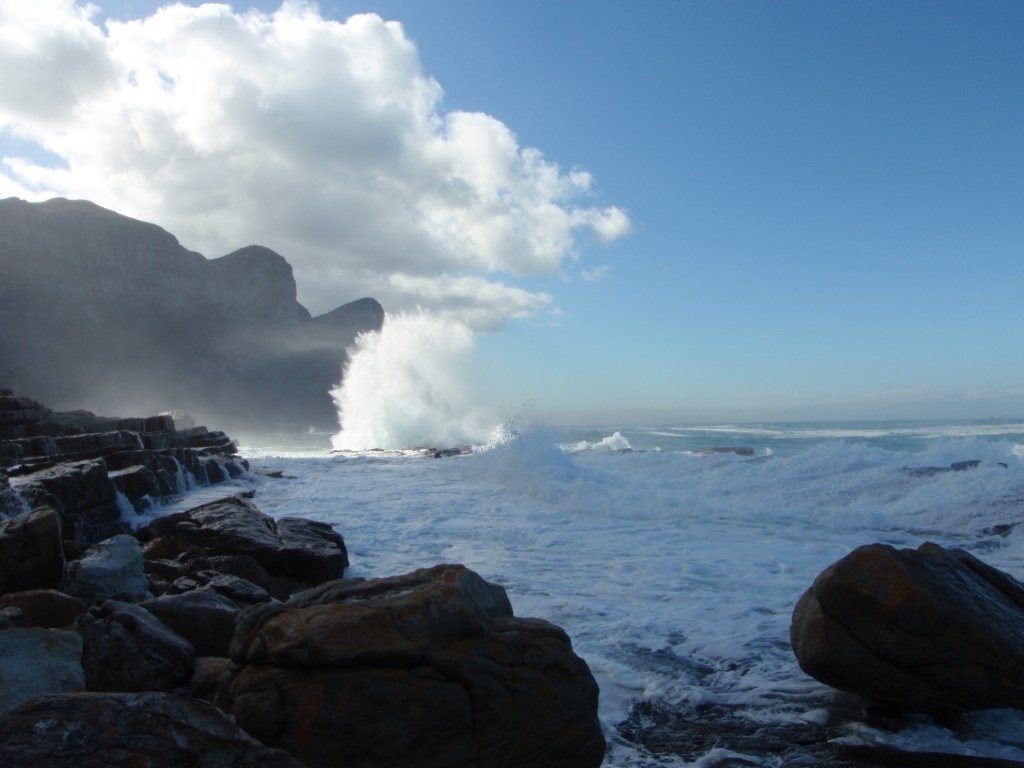
My fiance made fun of me for taking the two pictures below, but they’re cooler than they look. I promise! The waves are splashing just offshore of Cape Point because of an igneous intrusion (granite, I believe), which is a harder rock that doesn’t erode as much as the rest of the seafloor. This particular underwater igneous intrusion is called “Bellows Rock” and is responsible for at least one shipwreck (probably several). Most famously, in 1911 a ship named the Luisitania ran aground on Bellows Rock because the ship’s crew could not see the lighthouse in the fog. There are actually two lighthouses at Cape Point. The old lighthouse (on top of the cliffs in the previous photos and built in1860) is located on higher ground than the new lighthouse. The new lighthouse (low down on the very tip of the point and thus difficult to photograph) was built because the old lighthouse was too high up and often obscured by fog. The new lighthouse was built shortly after the wreck of the Luisitania on Bellows Rock and still guides ships navigating the dangerous waters around Cape Point.

Bellows Rock 1. Cape Point, South Africa, April 2011.
Bellows Rock 2. Cape Point, South Africa, April 2011.

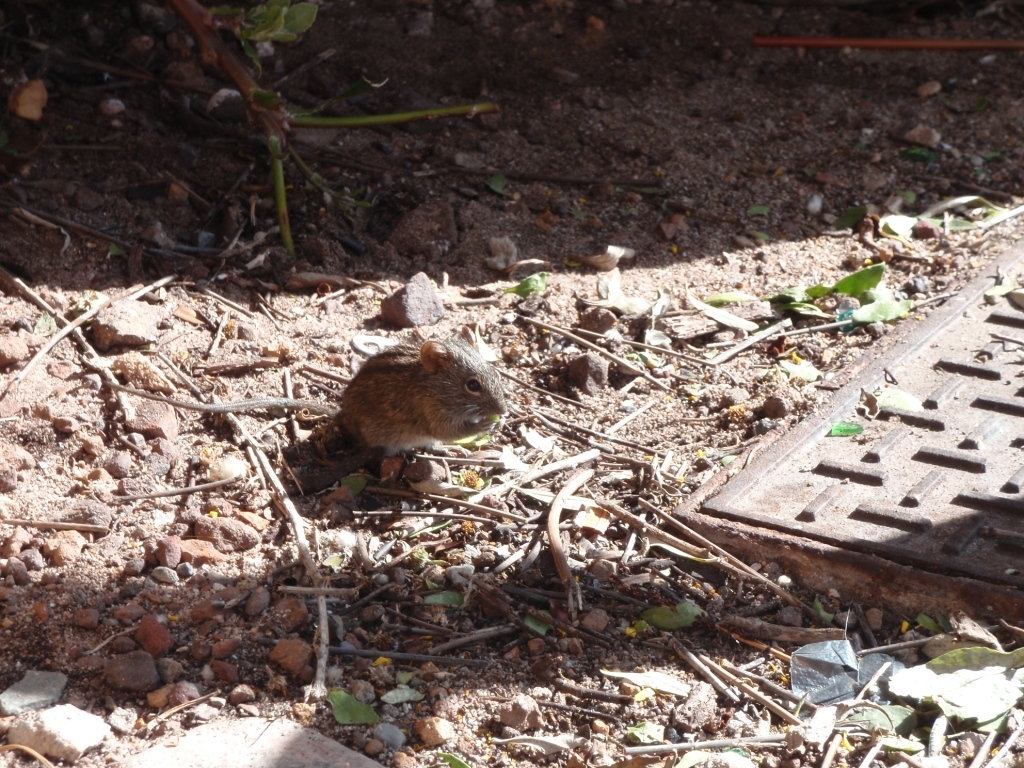
After hiking to the old and new lighthouses, we had lunch at the fancy visitor center (centre) near the Cape Point parking lot.We made some animal friends during lunch: a baboon statue, a bird, and a mouse. Actually, the bird was not our friend. The bird swooped in and– I kid you not– took off with a significant chunk of my fiance’s sandwich, which was in his hand at the time. The bird then perched on a rock near us and glared at us as we finished our lunch in a guarded fashion. As I was making a fool of myself trying to take a picture of the bird thief with tuna (from the sandwich) on his beak, I noticed an adorable little mouse eating crumbs underneath our table. I thought the mouse was cute, but some of the tourists around us did not share the same opinion when I excitedly pointed the mouse out to them.

Baboon statue. Cape Point, South Africa, April 2011.
Lunch thief. Cape Point, South Africa, April 2011.
Crumb-eating mouse. Cape Point, South Africa, April 2011.

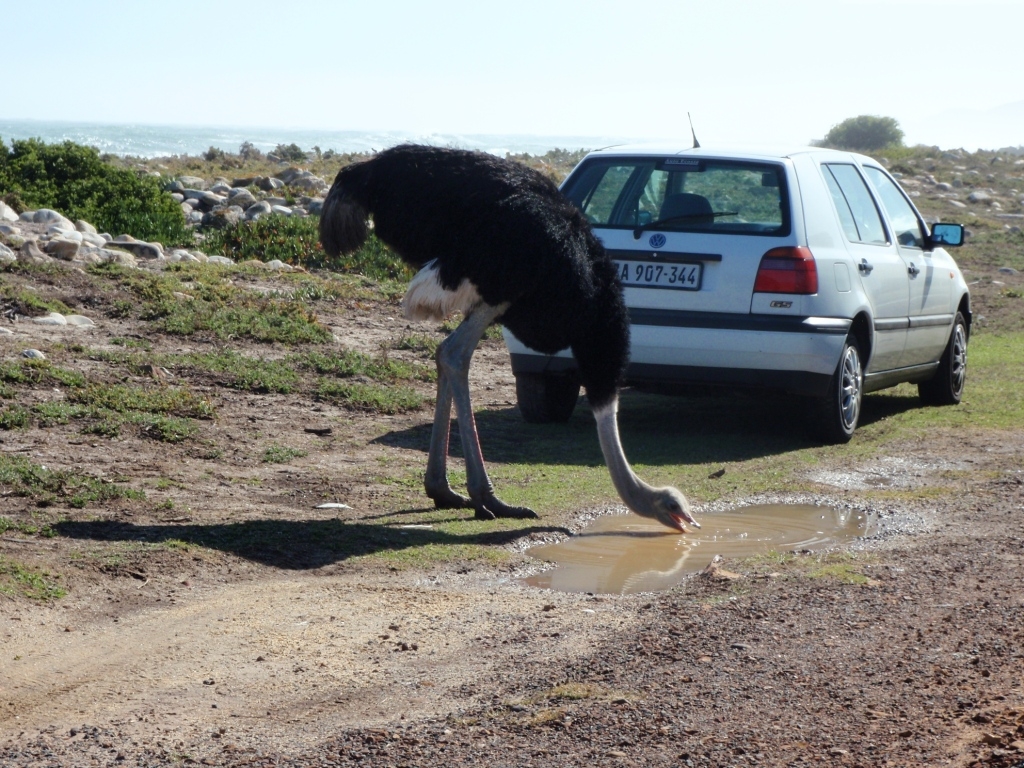
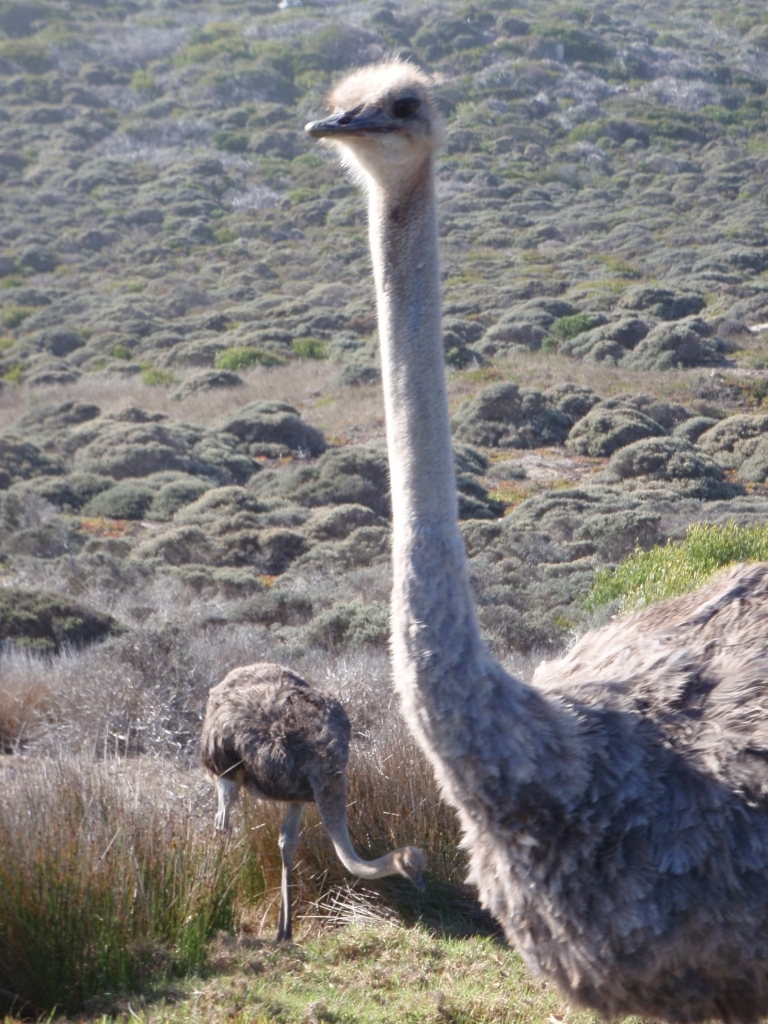
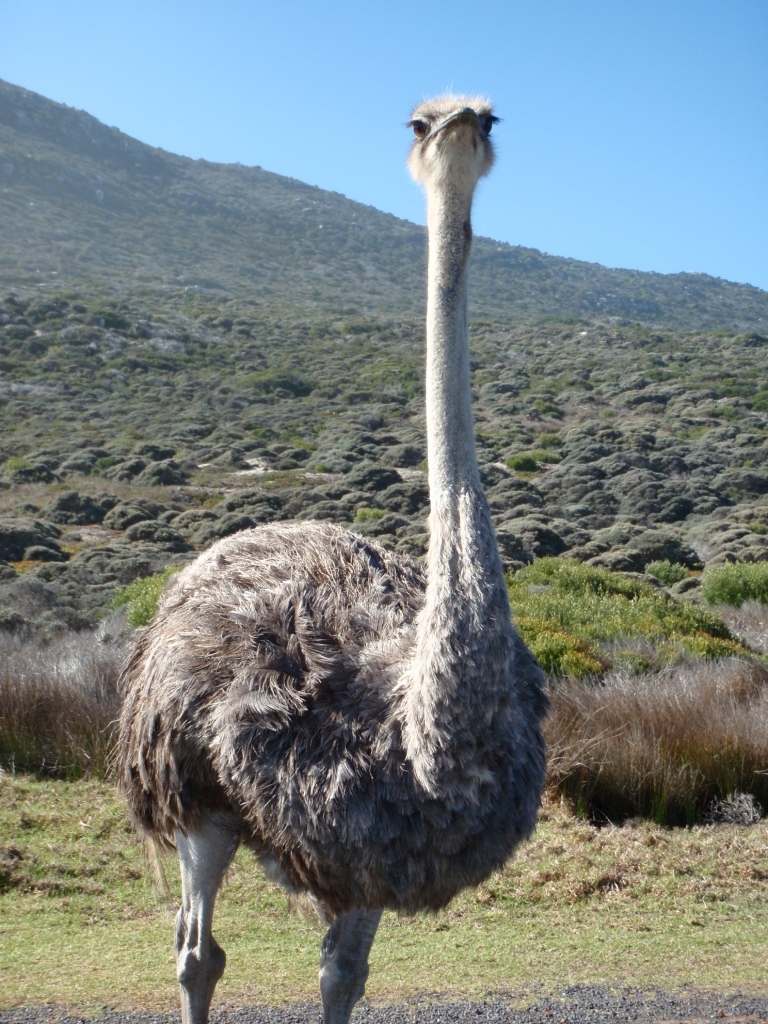
After lunch, we drove the short distance from Cape Point to the Cape of Good Hope (see above map). We took the obligatory picture next to the “South-Western Point of the African Continent” sign. We also encountered some rather naive (idiotic maybe?) Asian tourists on the drive. Part of the road was blocked by wild ostriches. We observed the ostriches safely from our car and patiently waited for the “ostrich jam” to pass. However, several Asian tourists emerged from their vehicles and started chasing the ostriches to take pictures of them. This is not a good idea. Ostriches, especially wild ones (there are also domesticated ostriches in South Africa; ostrich meat is delicious by the way), are dangerous animals. Ostriches can easily hurt or kill you with a peck or kick. A mighty ostrich kick can knock you senseless or rip your chest open. Fortunately, a park ranger came along and told the Asian tourists to return to their vehicles and leave the ostriches alone.

Jackie and I at the South-Western Point of Africa, April 2011.
Ostrich jam. And idiotic Asian tourists. Cape of Good Hope, South Africa, April 2011.
Tourists way too close to the ostriches. Cape of Good Hope, South Africa, April 2011.
Male and female ostrich, Cape of Good Hope, South Africa, April 2011.
Male ostrich. Cape of Good Hope, South Africa, April 2011.
Another ostrich, Cape of Good Hope, South Africa, April 2011.
Ostrich portrait 1, taken safely from the car. Cape of Good Hope,
South Africa, April 2011.
Ostrich portrait 2, Cape of Good Hope, South Africa, April 2011.

After visiting the Cape of Good Hope, we drove to a place called Venus Pools. Actually, we walked part of the way to the pools since the road on the map we had is no longer maintained. We enjoyed walking, though, and the pools were deserted except for us. At both Cape Point and the Cape of Good Hope there are usually large, noisy groups of tourists. The Venus Pools were lovely and quiet, except for the crashes of waves and subsequent rushes of water in the pools. We almost expected to catch a glimpse of Venus herself bathing there.

Male and female ostrich near Venus Pools. South Africa, April 2011.
Old, abandoned parking area near Venus Pools. South Africa, April 2011.
Venus Pools 1, South Africa, April 2011.
Venus Pools 2, South Africa, April 2011.
Venus Pools 3, South Africa, April 2011.
Venus Pools 4, South Africa, April 2011.
Venus Pools 5, South Africa, April 2011.
Venus Pools 6, South Africa, April 2011.
Venus Pools 7, South Africa, April 2011.
Interesting sandstone weathering at Venus Pools, South Africa, April 2011.

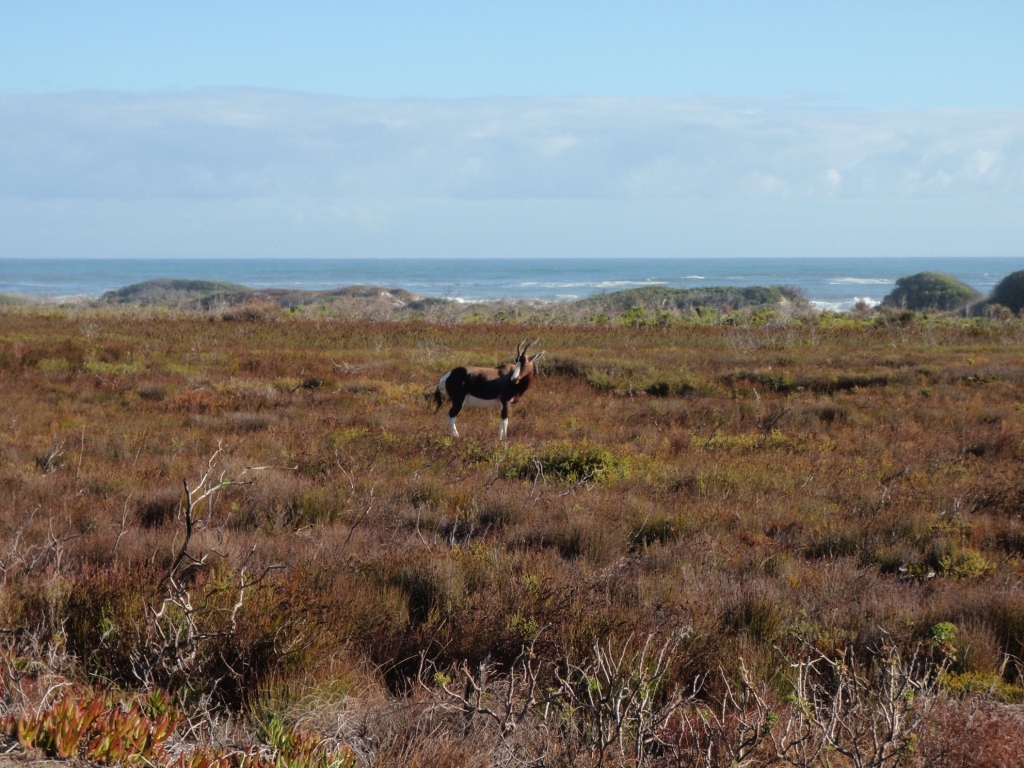
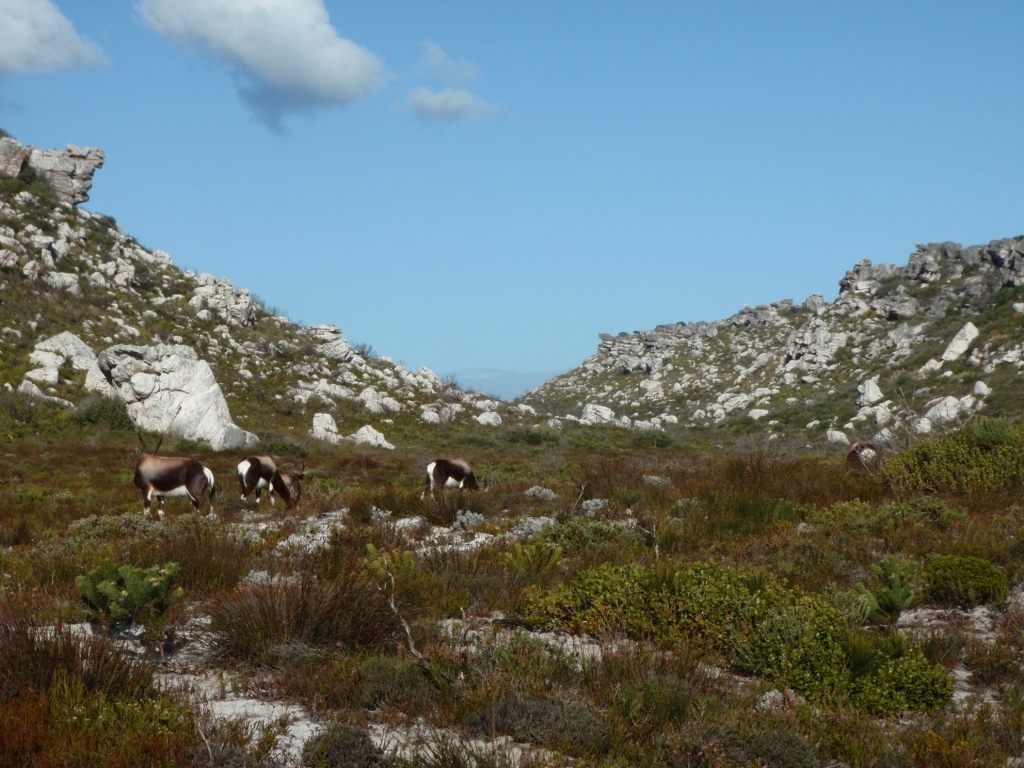
Next, we drove over to a beach where we took a walk to a shipwreck. On the drive, we saw some adorable bokkies.

Bokkie near the road 1, Cape Peninsula, South Africa, April 2011.
Bokkie near the road 2, Cape Peninsula, South Africa, April 2011.
Many bokkies, Cape Peninsula, South Africa, April 2011.
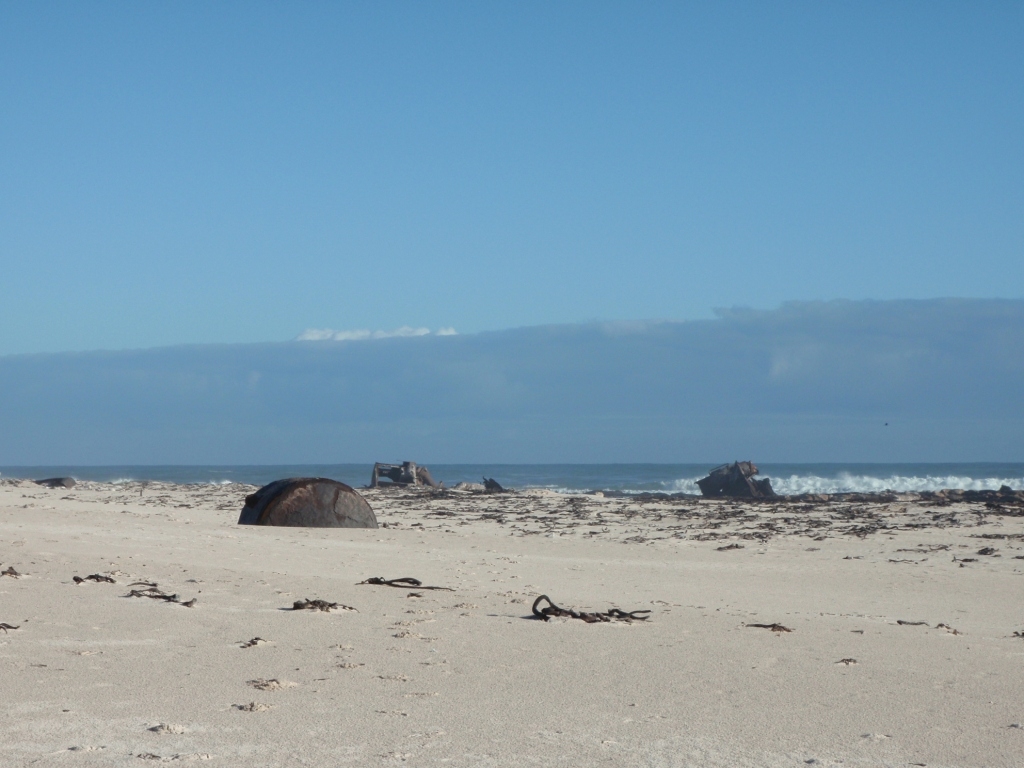
Scattered shipwreck, Cape Peninsula, South Africa, April 2011.
Jackie on a bleached whale bone, Cape Peninsula, South Africa, April 2011.
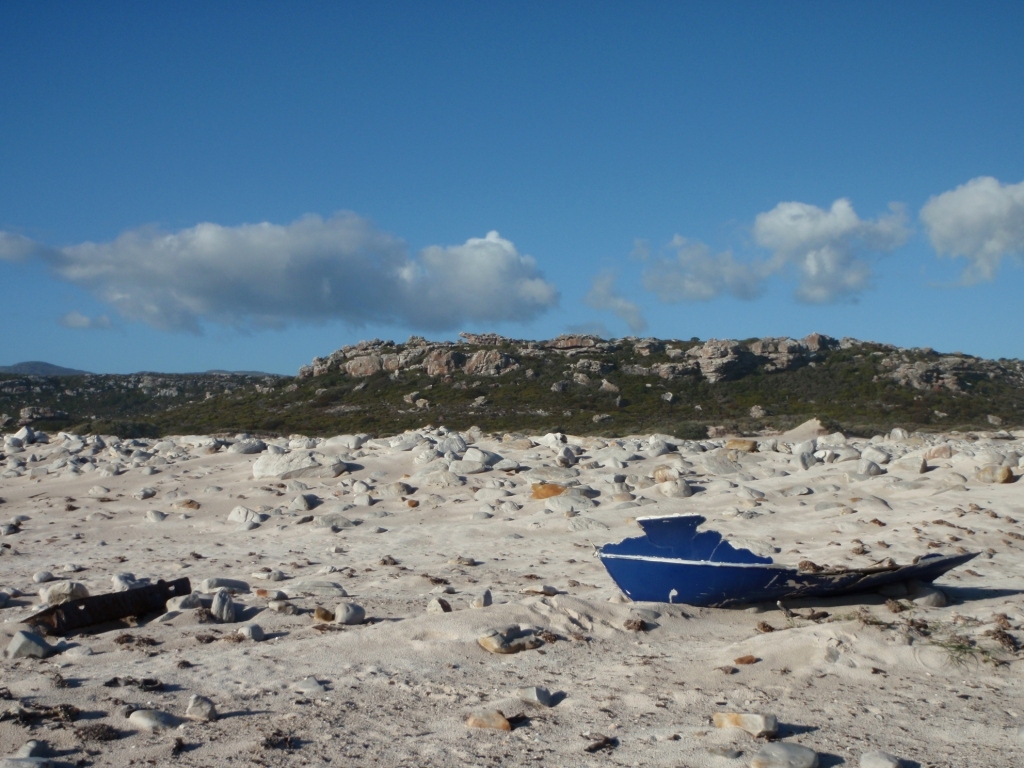
Rowboat mini-shipwreck, Cape Peninsula, South Africa, April 2011.

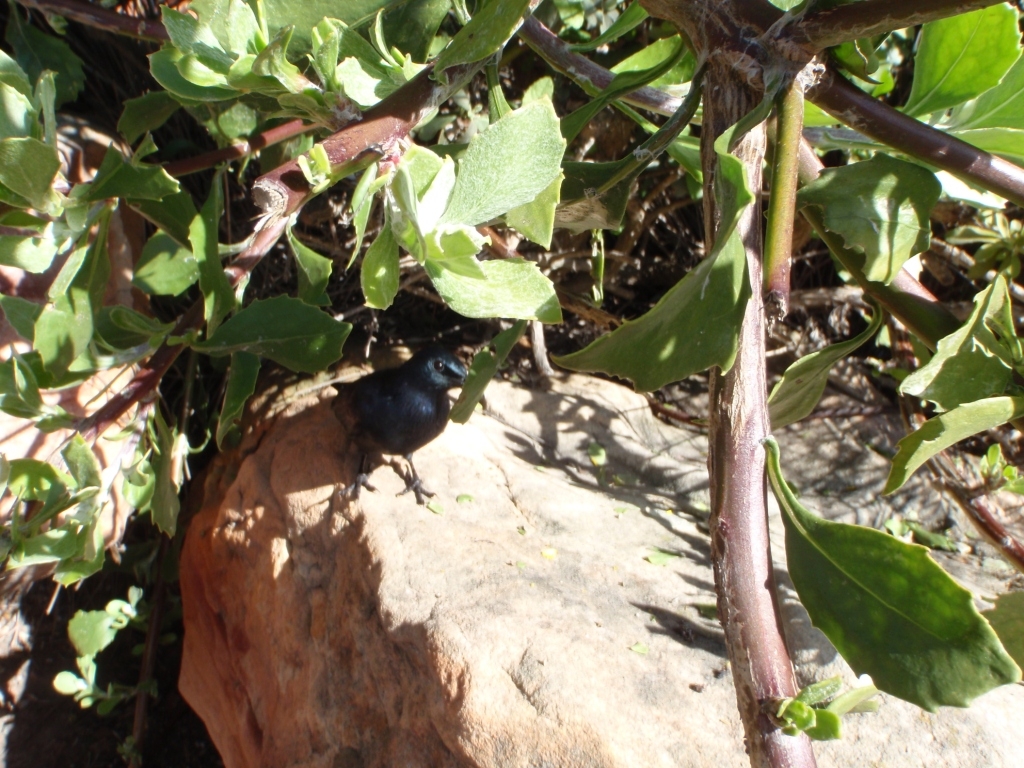
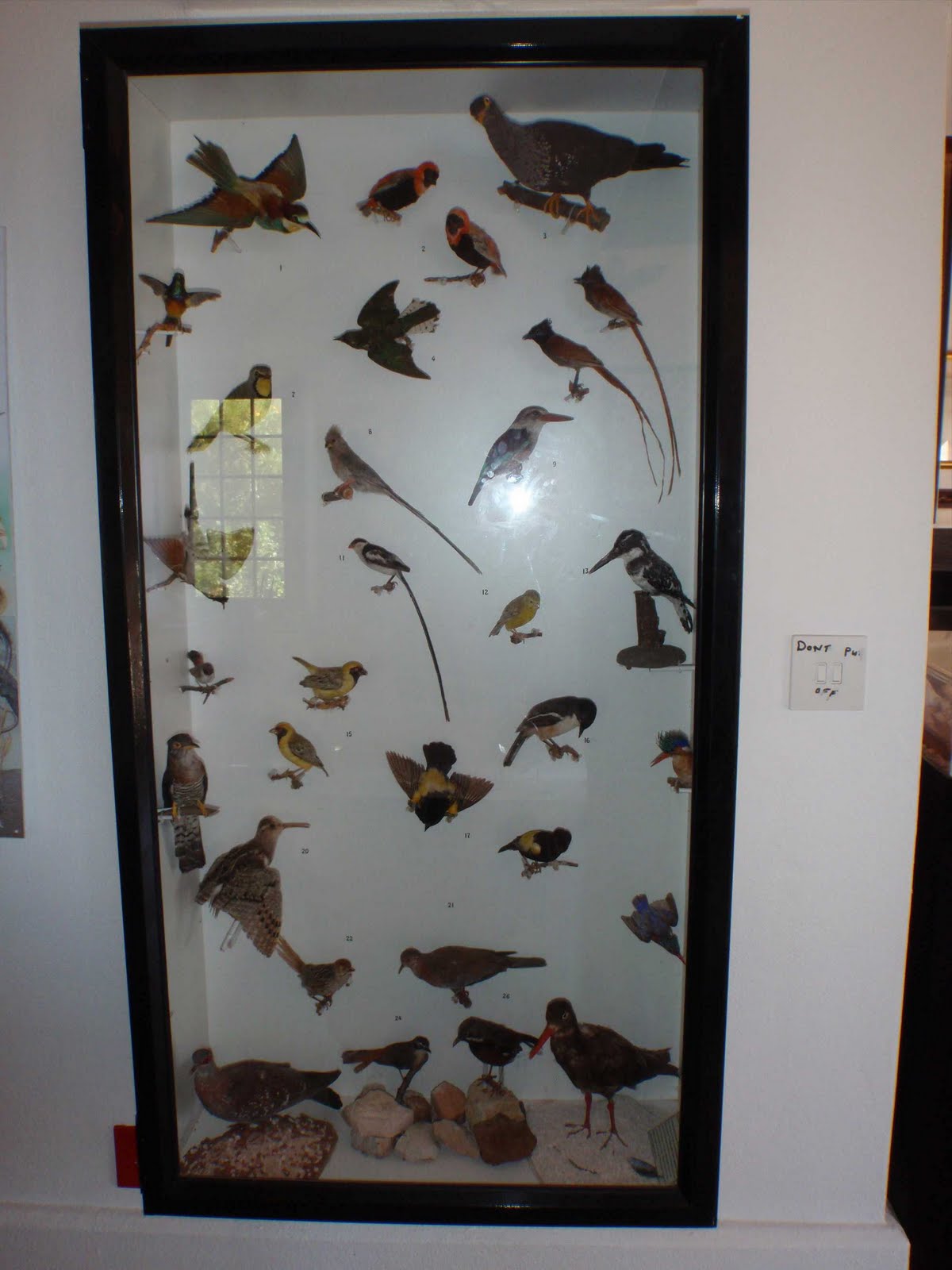
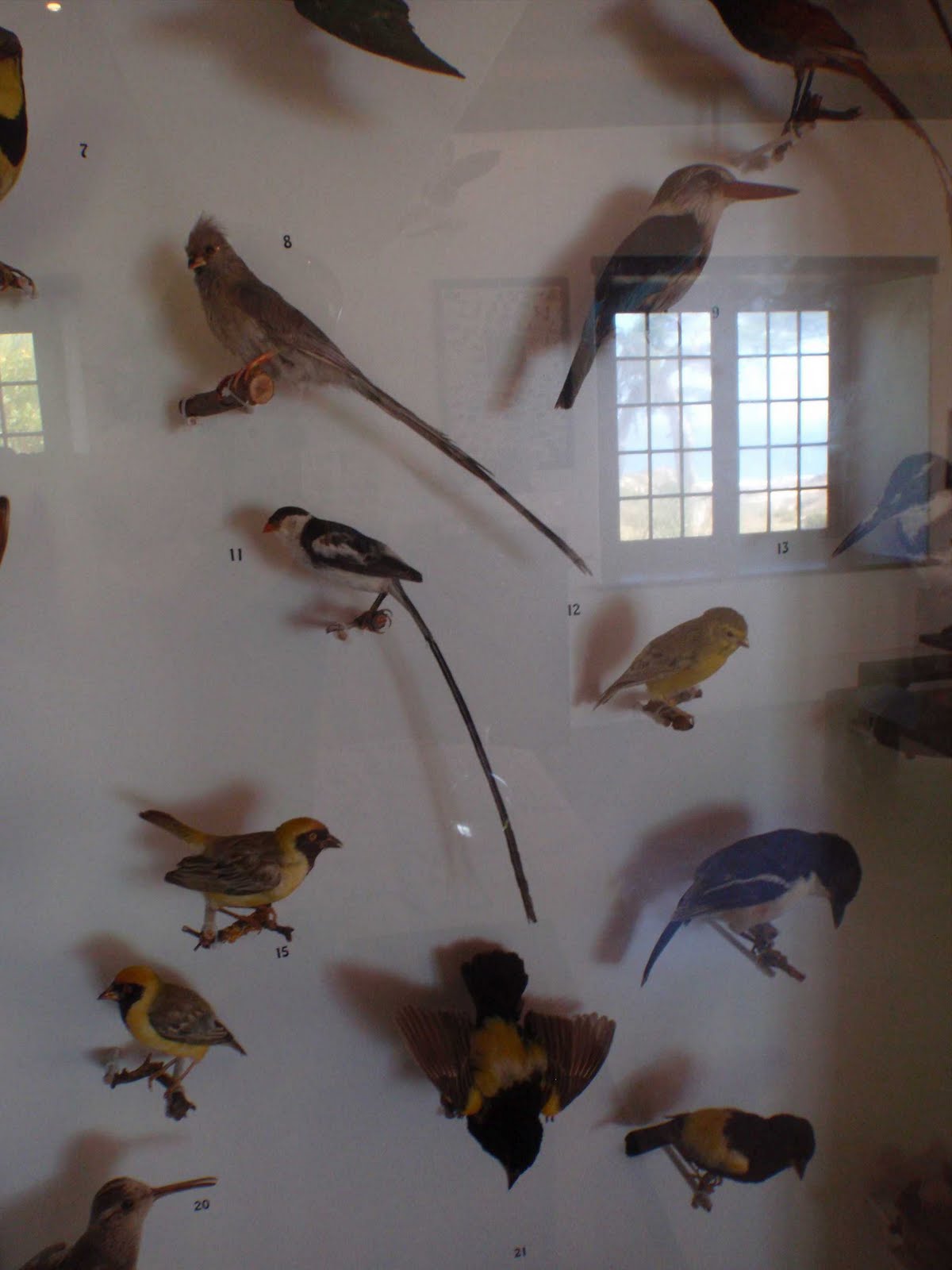
We also went to another visitor center (centre) with a view of one of the giant white crosses. Inside the center were several cases of beautiful stuffed birds. I think I will become a birder when I move to South Africa later this year. I really like the birds with the long tail feathers and the black birds with the bright orange heads. I once spent about an hour taking pictures of one of those orange-headed birds that was hanging out in a shrub Jackie’s parents’ yard. Jackie’s family thought I was crazy. I guess I can understand why they thought I was crazy. The first time Jackie visited me in America, he very excitedly told me to come to the window as there was “the most beautiful bird” outside. There was a blue jay in a tree outside. Blue jays are beautiful, I must admit, but I see them all the time so they seem quite ordinary to me.

Cross from a distance. Cape Peninsula, South Africa, April 2011.
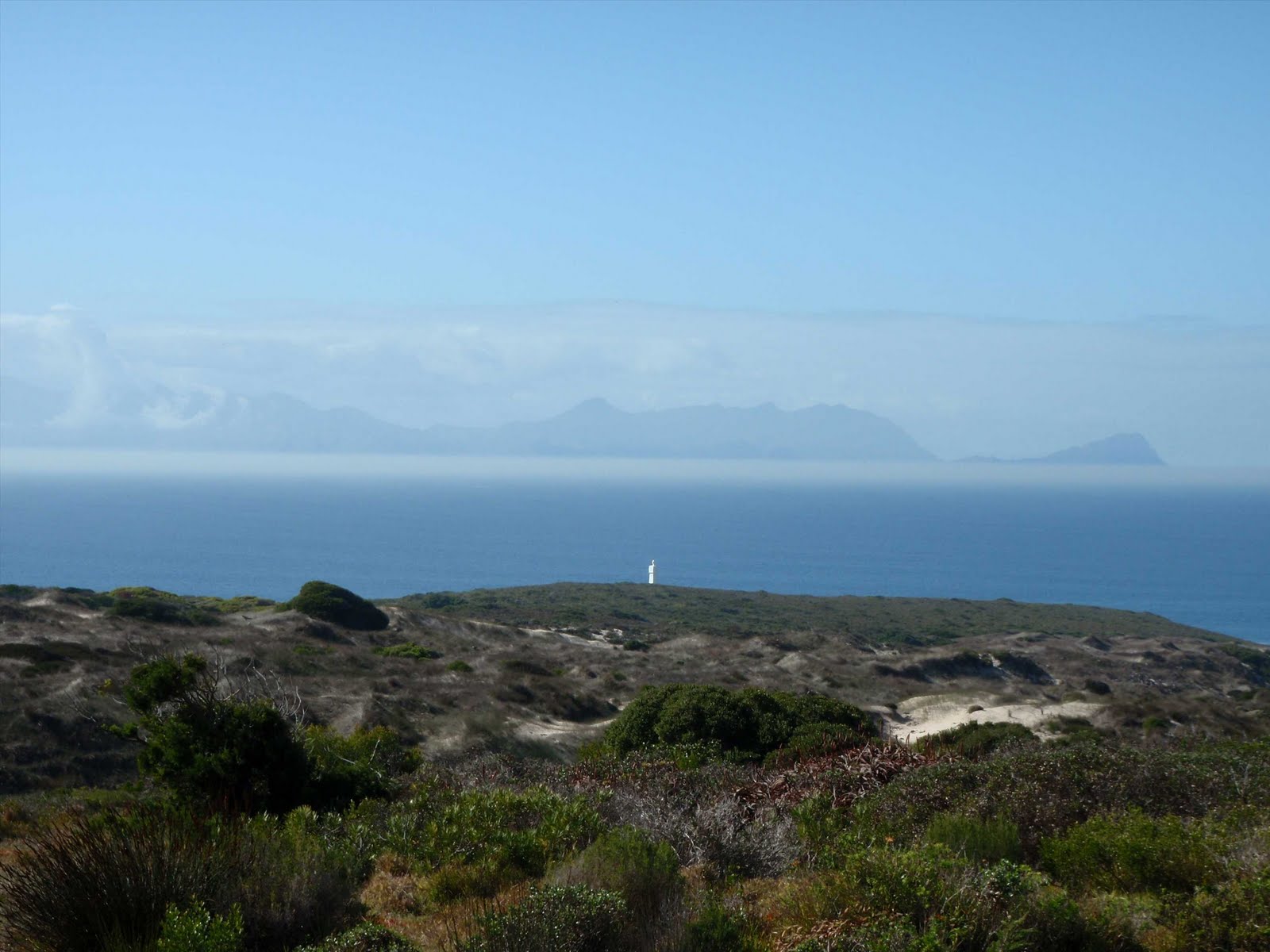
View from visitor center parking lot, Cape Peninsula, South Africa, April 2011.
Gorgeous bird case, Cape Peninsula, South Africa, April 2011.
Look at those tail feathers! Cape Peninsula, South Africa, April 2011.
Seriously, how do those birds with the long tails fly? Cape Peninsula, South Africa, April 2011.
Pretty orange-headed birds. Cape Peninsula, South Africa, April 2011.
More crazy tail feathers. Cape Peninsula, South Africa, April 2011.
Beautiful orange-headed birds. Cape Peninsula, South Africa, April 2011.

3 Quarks Daily Science Blogging Contest

My friend Christie Wilcox over at the blog Observations of a Nerd alerted me to the upcoming deadline for the third annual 3 Quarks Daily Science Blogging Contest.

Are you a science blog reader*? Or writer? Feel free to go over to the comments here and nominate a science blog post that you like for the 3 Quarks Contest. The deadline is May 31st.

Personally, I nominated Anne Jefferson’s fantastic recent post Levees and the Illusion of Flood Control

[Warning: Shameless self-promotion ahead] I’m a fairly new science blogger and a scientist, not a professional writer. However, if you like any of my writings here on Georneys, please feel free to nominate them. Below I’ve listed a few blog posts of mine which I like. [End: Shameless self-promotion]

At the very least, please do go nominate some geology-themed posts! Geology needs to represent in these science blogging contests.

Georneys Posts:
Why are there Earthquakes and Volcanoes in Japan?

Geology Word of the Week: H is for Hotspot

Geology Word of the Week: L is for Lithosphere

Geology Word of the Week: O is for Ophiolite

A Million Random Digits

Technology Anachromisms in Science

*Since this is a science blog, the answer to that question is “yes.”

A Geologist’s Alphabet

Every week (except for the month when I interviewed my dad about Fukushima) since I started this blog back in November 2010 I’ve posted a “Geology Word of the Week.” For some reason I decided it would be fun to cycle through the alphabet from A to Z, and I’ve now accomplished that, writing about words from Alluvium to Zanclean.

Perhaps the alphabet theme is cliche, but I’m having fun with it. So, I think I’ll cycle through the alphabet at least one more time. You can expect another A word (Allochthonous? Alvin? Albite? You’ll have to stay tuned!) next week.

Here’s my first geologist’s alphabet:

A is for Alluvium
B is for (Volcanic) Bomb
C is for Coprolite
D is for Dredge
E is for Eustasy
F is for Fabric
G is for Gondwana
H is for Hotspot
I is for Ichnite
J is for Jurassic
K is for Komatiite
L is for Lithosphere
M is for Magma
N is for Nabkha
O is for Ophiolite
P is for Peridot
Q is for Quaternary
R is for Rock
S is for Speleothem
T is for Travertine
U is for Uraninite
V is for Vesicle (and Vug)
W is for Wadi
X is for Xenolith
Y is for Yardang
Z is for Zanclean

Geology Word of the Week: Z is for Zanclean

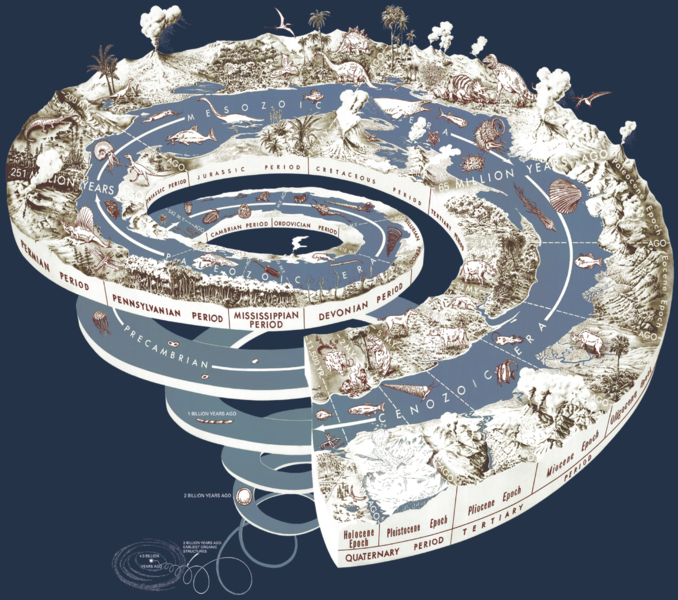
Geologic Timescale Spiral. Image courtesy of USGS. Taken from Wikipedia here. Click to enlarge.

def. Zanclean:
A geologic Age spanning from ~5.33 million years ago to ~3.60 million years ago in the Pliocene Epoch.

Q: What do the words Zanclean, Burdigalian, and Maastrichtian have in common?
A: They’re all Ages of geologic time! So are the Tithonian, Albian, Sinemurian, Norian, and dozens of others.

Never heard of the Zanclean? Don’t worry. I had never heard of it either before I did a little research for this blog post. I have only memorized the geologic timescale through the Epochs, and then only for the Cenozoic (65 million years ago to present).
The Zanclean is defined as the geologic Age which spans from ~5.33 million years ago to ~3.60 million years ago. You might be thinking to yourself that this is a strange bracket for geologic time. Why not just make the Age an even 5 to 3 million years ago? If you look closely at the geologic timescale you’ll notice that the geologic Ages (as well as the Eons, Eras, Periods, and Epochs… but we’ll get to that in a minute) are all different lengths of time that seem random.

The geologic Ages do span inconsistent lengths of absolute time. This is because Ages such as the Zanclean (which was introduced in 1868, according to Wikipedia) were defined long before absolute dating of rocks became possible after the discovery of radioactivity in the late 1800s and the development of radioactive dating of rocks and minerals in the early to mid 1900s. Scientists have only been able to confidently determine absolute ages for rocks since the 1960s or so, and every year techniques for dating rocks become better with smaller error bars.

Remarkably, geologists defined the entire geologic timescale (although standardizing this timescale internationally is still an ongoing process) prior to the development of absolute dating of rocks and minerals. Although the absolute ages were unknown, geologists were able to work out the time periods based on the evolution of the fossil record. The main divisions of time are based on time periods when certain types of ancient organisms lived.

Boundaries between different periods of geologic time often mark periods of mass extinctions where there was a sudden, dramatic change in the fossil record. The most famous example of this is the boundary between the Tertiary and the Cretaceous, also known as the K-T boundary. This boundary ~65 million years ago is marked by a mass extinction event famously known to have wiped out all non-avian dinosaurs. The boundary is known at the K-T boundary because “K” is used for Cretaceous and “T” is used for Tertiary on geologic maps and other places where shorthand is appropriate. Geologists have known for generations about boundaries such as K-T and about ages such as the Zanclean, but it has only been in the second half of the 1900s that they were able to start assigning absolute ages to these geologic times.

I mentioned above that I had never really heard of the Zanclean before. That’s true– I have never bothered to memorize the geologic Ages, one of the smallest divisions of geologic time, and the smallest one recognized by the International Commission on Stratigraphy or ICS. I don’t think I will ever bother to memorize them as I can easily look them up and, honestly, I think it’s a bit silly to subdivide geologic time into such small sections. Whenever I read papers that bother with naming various Ages, I just keep a copy of the geologic timescale nearby. I have taken the time to memorize the larger divisions of geologic time, which are (from largest to smallest): Eons, Eras, Periods, and Epochs. And, as I mentioned previously, I’ve only memorized the Cenozoic Epochs because they’re the only Epochs with names. Otherwise, it’s just “early,” “middle,” and “late,” and I find these very difficult to memorize.

The way that I originally memorized the Periods and so on was through use of mnemonics. My favorite mnemonic for the geologic Periods is Cold Oysters Seldom Develop Many Precious Pearls, Their Juices Congeal Too Quickly which helps me remember: Cambrian, Ordovician, Silurian, Devonian, Mississippian, Pennsylvanian, Permian, Triassic, Jurassic, Cretaceous, Tertiary, Quaternary. For the Cenozoic Epochs, I like the mnemonic Pigeon Egg Omelets Make People Puke Hourly which helps me remember Paleocene, Eocene, Oligocene, Miocene, Pliocene, Pleistocene, Holocene.

So perhaps what I need to remember the Ages is an appropriate (and very long!) mnemonic. I propose a challenge to my blog readers: come up with a mnemonic for the geologic Ages.

The Ages are: CALABRIAN, GELASIAN, PIACENZIAN, ZANCLEAN, MESSINIAN, TORTONIAN, SERRAVALLIAN, LANGHIAN, BURDIGALIAN, AQUITANIAN, CHATTIAN, RUPELIAN, PRIABONIAN, BARTONIAN, LUTETIAN, YPRESIAN, THANETIAN, SELANDIAN, DANIAN, MAASTRICHTIAN, CAMPANIAN, SANTONIAN, CONIACIAN, TURONIAN, CENOMANIAN, ALBIAN, APTIAN, BARREMIAN, HAUTERIVIAN, VALANGINIAN, BERRIASIAN, TITHONIAN, KIMMERIDGIAN, OXFORDIAN, CALLOVIAN, BATHONIAN, BAJOCIAN, AALENIAN, TOARCIAN, PLIENSBACHIAN, SINEMURIAN, HETTANGIAN, RHAETIAN, NORIAN, CARNIAN, LADINIAN, ANISIAN, OLENEKIAN, INDUAN, CHANGHSINGIAN, WUCHIAPINGIAN, CAPITANIAN, WORDIAN, ROADIAN, KUNGURIAN, ARTINSKIAN, SAKMARIAN, ASSELIAN, GZELIAN, KASIMOVIAN, MOSCOVIAN, BASHKIRIAN, SERPUKHOVIAN, VISEAN, TOURNAISIAN, FAMENNIAN, FRASNIAN, GIVETIAN, EIFELIAN, EMSIAN, PRAGHIAN, LOCKHOVIAN, PRIDOLIAN, LUDFORDIAN, GORSTIAN, HOMERIAN, SHEINWOODIAN, TELYCHIAN, AERONIAN, RHUDDANIAN, HIRNANTIAN, KATIAN, SANDBIAN, DARRIWILIAN, DAPINGIAN, FLOIAN, TREMADOCIAN, STAGE 10, STAGE 9, PAIBIAN, GUZHANGIAN, DRUMIAN, STAGE 5, STAGE 4, STAGE 3, STAGE 2, FORTUNIAN.

Phew! I hope I didn’t miss any of the ages. I apologize that they are all written in capital letters. I’m not yelling at you. I just copied and pasted the names from a geologic timescale, and I’m too lazy to change them out of all capital letters.

So, see if you can come up with a long-winded mneumonic. You know, something like:
Campbell gave pretty, zany, messy, terribly sexy, lovable, bright, amazing, cheerful Rachel praises by letters youthfully, tentatively sent. Did Mister Campbell say convincing truths carefully ascertained about beautiful, hauntingly vividly beautiful, tantalizing, kiss-invoking, outstanding, creative, breathtaking, blushing, all-knowing, terrific, pleasing, scintillating, hot Rachel? No. Courage leaves an overwhelmed, inconsolable Campbell. Why?! Campbell wondered. Rachel knows a summer affair grows kinda muted because summer visions tear, famously fragmenting ephemeral, end-bound, primitive love. Perhaps lust graces hot summer times, announces Rachel. However, keep summer dreams dampered, flowing temporally, staying 10, staying 9, painfully gone days, staying 5, staying 4, staying 3, staying 2, forgotten. 

Please improve upon my rather “film noir”, adjective-filled, and, admittedly, very terrible mneumonic. Though, on second thought, I don’t think this (or any) epic mnemonic is going to be that helpful in memorizing geologic Ages. On third thought, memorizing the geologic Ages is stupid. The only reason I can fathom for memorizing the Ages is to impress geology friends at a bar. Maybe I’ll work on it sometime, but honestly I think it’s only marginally more useful than memorizing digits of pi.

Blast from the Past: Element Talk Show

Atom Unit Report Booklet.

Element Talk Show page. Note volcano lamp, James Randi picture, and
artwork (by Randi’s talented partner) in the background. Click to enlarge.

I’ve been sorting through more boxes today (trying to finally pack up all my books and notes!), and I’ve found a box that contains reports, drawings, and other assignments from my elementary school days. I can’t date most of these reports exactly, but they are definitely from my 2nd through 6th grade days. I was a student at a Montessori school in Vermont back then. I actually attended Montessori schools from pre-K through 8th grade. Montessori schools encourage creativity, among other things, and boy did I have some creative assignments. In Montessori school students tend to work on themed units, which can last a week to a few months. During this time, students study and produce work related to that theme.

Here’s a gem of a story, from my report booklet on the “Atom Unit.” I believe that I wrote this story (with my friend Joy) in 4th grade. I was (still am) *such* a weirdo and nerd, even back in elementary school. All punctuation, spelling, and grammar are original. Enjoy!

Update: I just noticed that I wrote the year (1994) on the back of the report. So, I was 10 years old and in either 4th or 5th grade when I wrote this report.

Element Talk Show

Interviewer: Today on E.T.S. we are going to interview Miss Fluorine and here she comes now.

Fluorine: Hello all you fans I’m Fluorine. Any Hydrogens out there? I’m a little jumpy I only have seven electrons.
(sits down)

Interviewer: So what exactly are you?

Fluorine: I’m a gas. They use me in toothpaste as SnF2, stannous fluoride.

Interviewer: So you mean I brushed with you this morning. You are inside this little tube?
(holds up toothpaste tube)

Fluorine: It’s a tight fit, but that’s right.

Interviewer: How nice. What else are you used for?
(Takes a sip of water)

Fluorine: They use me in water for your teeth.

(Interviewer spits out water)
Interviewer: What! I think I just drank your cousin!

Fluorine: That’s all right. I’ve got to go. Ta! Ta!

Interviewer: Now it’s time to have your star reporter Joy with her weekly report. Take it away Joy.

Reporter: Thank you, Evelyn. Mr. Neon was spotted by our cameras at Bob’s Dinner* in the window. He was last seen advertising foods the dinner serves. Let’s see if we can get a word with Mr. Neon.

Neon: It’s Miss Neon.

Reporter: How does it feel to be a light?

Neon: Well it’s a tight fit in this glass tube, but I enjoy giving off my glow.

Reporter: What are you Mr. Neon.

Neon: A Miss Neon, I’m a Miss Neon.

Reporter:  No, I mean what element are you?

Neon: Well, I’m a gas. If I didn’t have an electrical current running through me I’d be colorless, odorless, and tasteless.

Reporter: Anything else? Where are your friends? Perhaps we can get one on our show.

Neon: I’m happy by myself. My outside shell is full of electrons. I don’t make any compounds.

That’s it. If there was another page, it was unfortunately (or maybe fortunately?) lost.

*Yes, dinner, not diner. Hee hee.

GeoLOLCats

Dana Hunter, Callan Bentley, and Lockwood DeWitt have started a new geoblog meme– GeoLOLCats! Seems that many geobloggers have adorable kittehs, and we’re LOLing pictures of cats that have geology themes.

If you’re unfamiliar with LOLCats, see here. For the GeoLOLCats, you can see entries here and here, including some LOLs starring my two beautiful cats Samira (calico) and Zayna (black-and-white with a funny mustache). Like cats and geology? Feel free to join us in this meme!

Just this evening, my cat Samira– who is very fluffy– provided me with another great LOLCats pose. Below are the original picture and my LOLed version.

By the way, the booklet Samira is lying on is a “Rocks and Minerals Unit” report that I put together back in 3rd or 4th grade at my Montessori School. I will be featuring some material from this report in future “Blast from the Past” posts. There’s even a (rhyming!) poem about the rock cycle. I was such a nerd, even back in elementary school.

Samira the fluffy, original photo. Woods Hole, MA, May 2011.

Samira the fluffy, LOLed. Woods Hole, MA, May 2011.