Geology Word of the Week: B is for Brunton

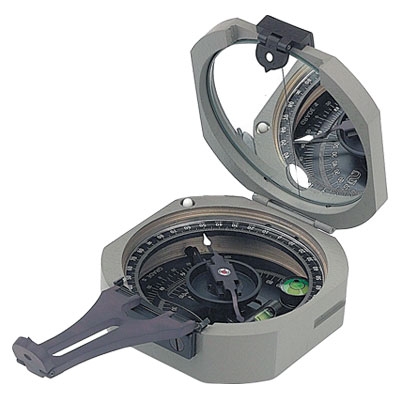
Brunton “Pocket Transit” Compass. Image taken from here.

def. Brunton:
A fancy, highly-precise compass used by geologists (and surveyors, engineers, archaeologists, etc.) for navigation and also to measure the strike and dip of rock layers in the field.

Since I am waiting to board a flight to Wyoming, I thought it would be appropriate for this week’s geology word to be “Brunton.” Brunton compasses are made by the Brunton Company of Riverton, Wyoming. The first Brunton compass was made by David W. Brunton in 1894. Since then, the Brunton compass (often shortened to just “Brunton”) has become standard field equipment for the geologist. Today, the Brunton company makes a variety of compasses and navigational devices. Their “Pocket Transit” compass is the most common compass used by geologists. Personally, I own a Conventional Brunton Pocket Transit as well as a stand-alone Brunton inclinometer called the Clinomaster. Brunton compasses aren’t cheap (the Pocket Transit is about $500), but a Brunton is an important investment for the field geologist.

Geologists use Bruntons for general navigation (like a regular compass, the Brunton has a needle that points to magnetic north) as well as to measure the strike and dip of rock layers. Using a Brunton can be a little intimidating at first, but geology students generally learn all about the Brunton at field camp. After a few days of practice, measuring strikes and dips of rock layers using a Brunton becomes second-nature. Geologists use these strike and dip measurements to make geologic maps. Strike and dip measurements are also useful for understanding the geologic structure and history (e.g. uplift and deformation) of a region. Bruntons can also be used (along with camera lens covers, pencils, field notebooks, hammers, etc.) to provide a sense of scale in pictures of rocks.

Here is a website that teaches you how to use a Brunton to measure strike and dip:
MIT Website on Using a Brunton Compass

Figure showing strike and dip of rock layers. Figure taken from here.

Below are a few pictures of Bruntons in the field. Feel free to add more pictures of you with your own Brunton. Either put a link in the comments or email me the pictures, and I’ll add them to this post.
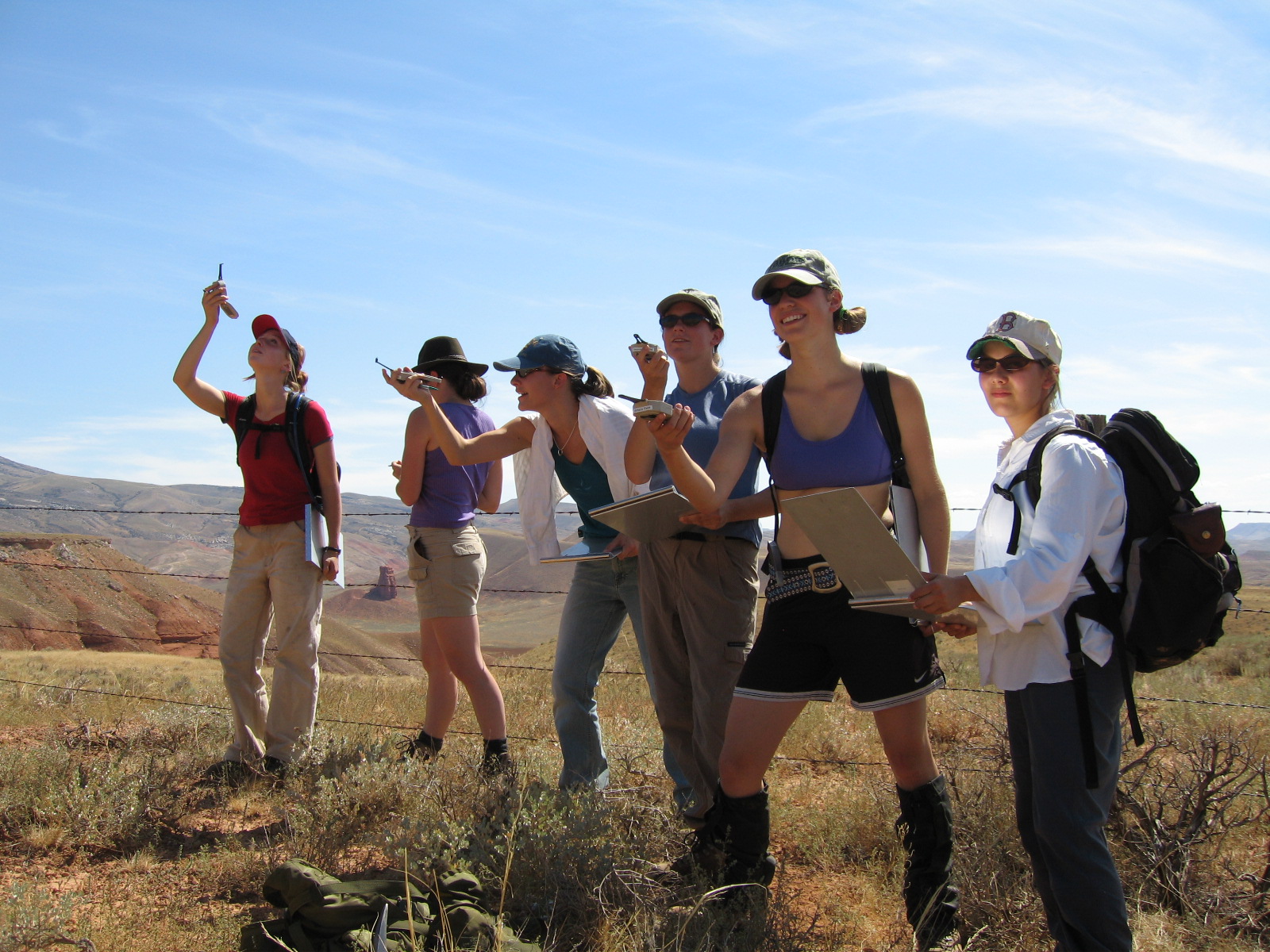
Bruntons can be mystifying at first to geology field camp students. The Stretch
(Dartmouth College’s geology field camp), Western USA, Fall 2005.
Using a Brunton inclinometer to measure a far-off mountainslope angle. A
regular Brunton rests on the rock to show me the direction I am looking,
Oman, January 2009.
Collecting a rock sample with Brunton safely stored in its leather carrying
pouch (at my waist), Oman, January 2009.

Semifinalists Announced in the 3 Quarks Daily Science Blogging Contest

The semifinalists were just announced in this year’s 3 Quarks Daily Science Blogging Contest. These semifinalists are the twenty blog posts (out of 87) that had the most votes in a public voting contest. There are some great posts in there, including one by Anne Jefferson of Highly Allochthonous, one by Brian Switek of Laelaps, and two by my friend (and former Middle School classmate) Christie Wilcox of Observations of a Nerd. Congratulations, everyone!

I am also happy to announce that my post Geology Word of the Week: O is for Ophiolite is one of the semifinal posts. Amazingly, my post received the second-most votes! I am relatively new to the science blogging scene, so I’m humbled and very grateful that so many people voted for me. Most of all, I’m thrilled that– hopefully– many more people are now learning the word “ophiolite,” which is one of my favorite geology words.

There are two more rounds of judging before the winners are announced. First, the editors of 3 Quarks Daily are going to select six posts from the top twenty semi-finalists. The editors may also add up to three “wild card” posts of their own choosing. Then, the top three final winners will be chosen by Lisa Randall.

Whether or not Georneys advances into the final rounds, I’m thrilled to be a semifinalist in the 3 Quarks Daily contest. Thanks again to everyone who voted!

Why We Need Scientific Ocean Drilling

The U.S. National Science Foundation (NSF) recently announced that they will fund only 6 months of scientific ocean drilling on the ship JOIDES Resolution in 2012. There is much need for scientific drilling, but NSF has been debating the expense of ocean drilling in the midst of budget cuts. There’s a chance that NSF may choose not to fund any scientific ocean drilling in the near future (The Integrated Ocean Drilling Program ends in 2013), but for now drilling is cut down to just half the year. Since most drilling expeditions take ~2 months, this means only ~3 drilling expeditions will be funded next year.

As a marine geologist, the cut-back of ocean drilling makes me very sad. Ocean drilling provides much valuable scientific information, much of which cannot be obtain except with drilling.

Why is scientific ocean drilling important? My PhD advisor Susan Humphris explains why in this recent EOS article “The Need for Scientific Ocean Drilling.”

Blast from the Past: The Rock Cycle

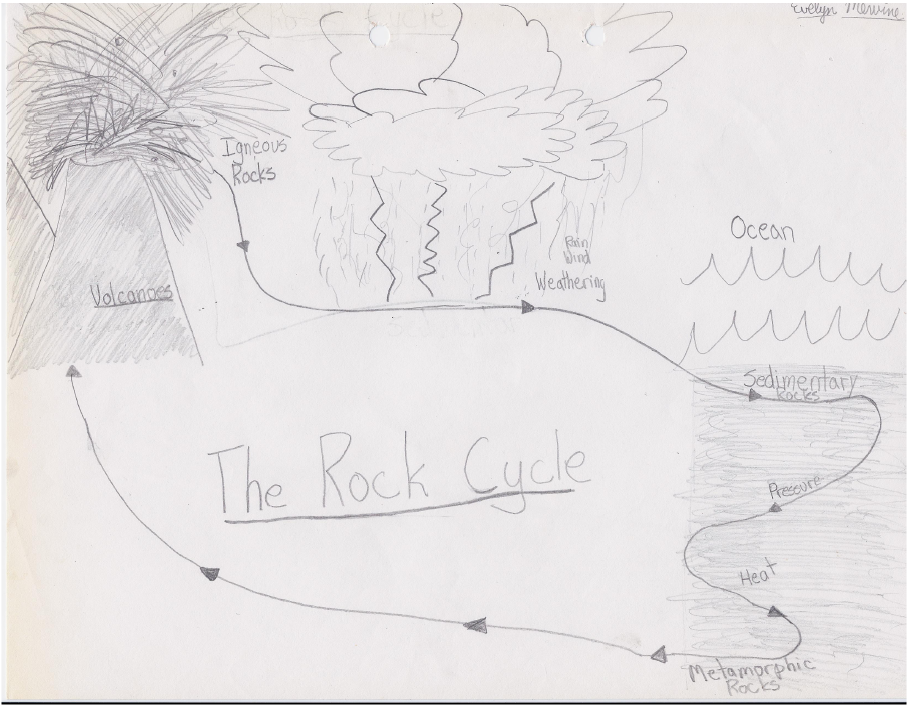
Rock Cycle drawing, circa 1993 or so. Click to view larger.

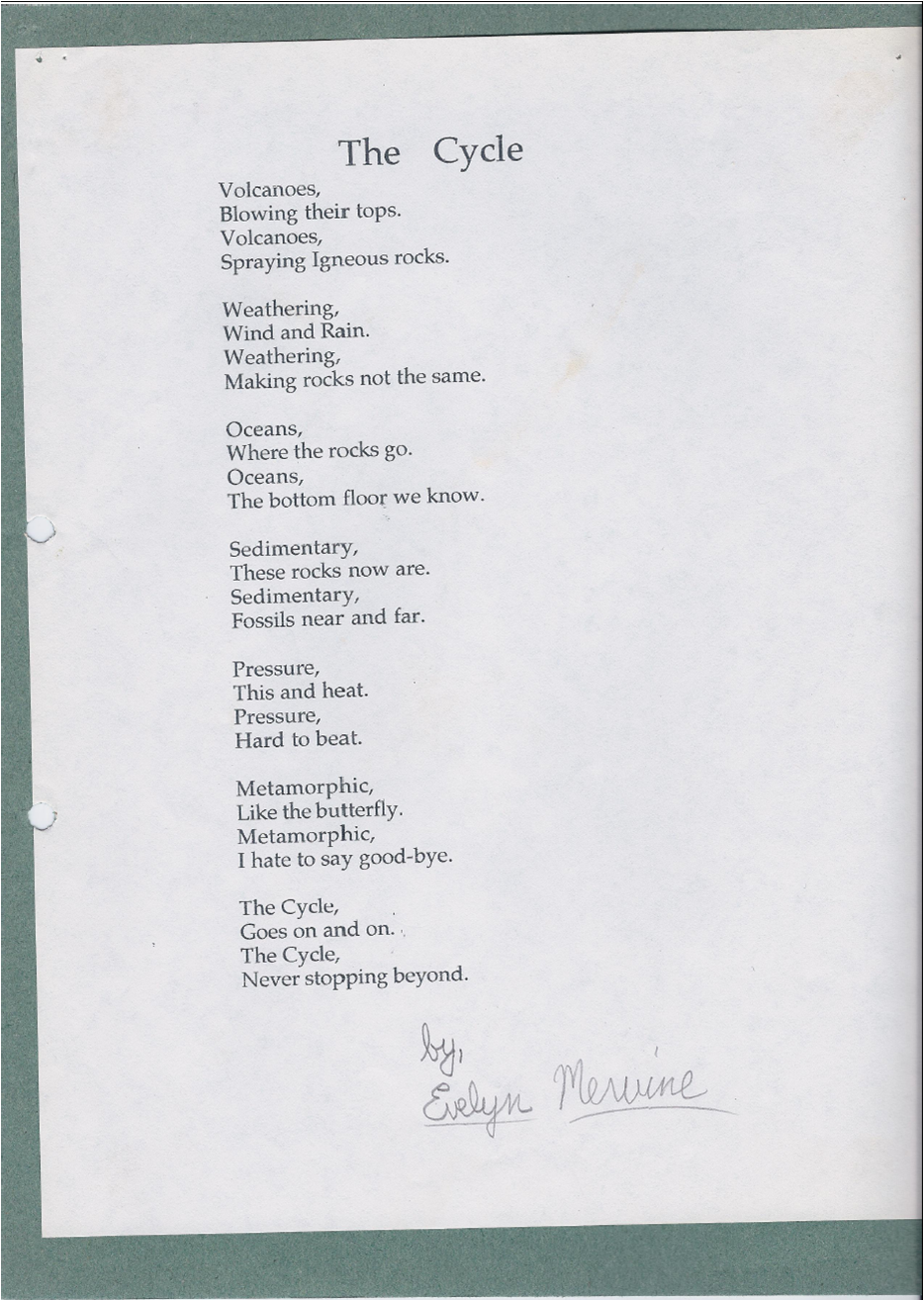
I’m trying to finish up my packing today, so here’s one last gem (for now) from the past: a poem that I wrote in third or fourth grade about the rock cycle. There is also an accompanying drawing (see above). Enjoy!

The Cycle

Volcanoes,
Blowing their tops.
Volcanoes,
Spraying igneous rocks.

Weathering,
Wind and rain.
Weathering,
Making rocks not the same.

Oceans,
Where the rocks go.
Oceans,
The bottom floor we know.

Sedimentary,
These rocks now are.
Sedimentary,
Fossils near and far.

Pressure,
This and heat.
Pressure,
Hard to beat.

Metamorphic,
Like the butterfly.
Metamorphic,
I hate to say goodbye.

The Cycle,
Goes on and on.
The Cycle,
Never stopping beyond.

Rock Cycle poem, mounted on stylish (but faded) construction paper.
Click to view larger.

I think my understanding of the rock cycle was pretty good for a 9-year-old, but in reality the cycle is a little more complex. In addition to the cycle of igneous to sedimentary to metamorphic to igneous, there are other pathways for rock transformation. Igneous rocks can go directly to metamorphic rocks and sedimentary rocks can go directly to igneous rocks. Metamorphic rocks can also become part of sedimentary rocks. The cycle is complex with rocks taking different transformation pathways depending on environmental conditions.

A more realistic rock cycle diagram. Figure taken from here.

Blast from the Past: The Goldilocks Planet

Earth, the Goldilocks Planet. Click to view larger.

On Saturday I am leaving Woods Hole to spend the summer in Laramie, Wyoming. Between now and then I have a zillion things to do. I pretty much have to work constantly prepping samples in lab, running the mass spectrometer, packing, and cleaning out my apartment. Oh, and maybe remembering to eat and sleep now and again.

I’m pretty tired as aside from my trip to South Africa to visit my fiance back in April and a weekend trip to go wedding dress shopping, I haven’t taken any time off since December. I work every weekend and many evenings. Grad school is hard work, that’s for sure! However, there are many benefits to being a grad student. I am paid to explore and travel and do fun things, like go spend the summer in beautiful Laramie. I need to work on data interpretation and writing, but I should be able to take a weekend day off here and there to explore some of the beautiful Wyoming countryside. And there will be NO labwork! I love the lab, but frankly I’m a bit sick of labwork after the last six months of grueling lab labor.

Despite the recent long months of labwork, I love working as a geologist because through my geology work I am able to explore the amazing planet on which we live. Earth is pretty amazing, don’t you know? As my 9-year-old self put it in the drawing above, Earth is the Goldilocks planet– it’s not too hot, it’s not too cold. It’s just right*.

The Goldilocks drawing came from my school report “Space Unit” from 1993.

*Though Carl Sagan might say that Earth only feels like a Goldilocks planet to us because we evolved to live on it. If life exists on other planets, that life probably thinks their planets are pretty perfect, too. Even if those planets are very different from our Earth.

Geology Word of the Week: A is for Accretionary Wedge

Illustration of a convergent plate boundary. I’ve added a red arrow pointing out the
location of the accretionary wedge. Illustration from TASA graphics and taken from here.
Click to view larger.

def. Accretionary Wedge (aka Accretionary Prism, Subduction Complex):
A wedge- or prism-shaped mass of sediments and rock fragments which has accumulated where a downgoing oceanic plate meets an overriding plate (either oceanic or continental) at a subduction zone. The sediment is generally marine sediment that has been scraped off of the downgoing plate by the overriding plate. However, sediment from the overriding plate can also contribute to the accretionary wedge. Fragments of rock from the colliding tectonic plates can also accumulate in an accretionary wedge.  The sedimentary rocks which form at accretionary wedges are deformed, faulted, poorly-sorted mixtures which are often referred to as “melange” (which means “mixture” in French).

Since I’m hosting this month’s Accretionary Wedge Geoblog Carnival and I’m at the letter A in my second geologist’s alphabet, I thought it would be fitting for “accretionary wedge” to be featured as this week’s geology word (phrase) of the week.

An accretionary wedge is basically a hodge-podge collection of various sediments and rocks, scraped up and squished together where two tectonic plates collide and one plate subducts underneath another. The downgoing plate is always an oceanic plate (continental plates don’t really subduct as continental crust is too buoyant), but the overriding plate can be either another oceanic plate (such as the Japan subduction zone) or a continental plate (such as the Cascades subduction zone). The sediments in an accretionary wedge are mostly marine sediments scraped off of the downgoing oceanic plate. Most of the marine sediments on the oceanic plate actually subduct down into the mantle. However, some of the marine sediments pile up and are accumulated into a wedge or prism-shaped pile of sediments where the downgoing plate meets the overriding plate. This scraped-off marine sediment is mixed with other material such as sediments weathered/transported from the overriding plate and fragments of rock broken off of the colliding tectonic plates.

Because the sediments are primarily scraped off of the downgoing plate, accretionary wedges actually accrete new material primarily on the bottom of the wedge. This means the younger sedimentary rocks in an accretionary wedge are generally on the bottom, which is topsy-turvy to the classic Law of Superposition in geology.

The primary rock type which forms at accretionary wedges is a jumbled, fractured sedimentary rock known as melange. I’m not sure why– I guess French sounds smarter and more scientific?

Geologist Donald Prothero describes melange wonderfully in his textbook Interpreting the Stratigraphic Record:

“The most characteristic rock type of the accretionary wedge is melange (French, “mixture”), a mass of chaotically mixed, brecciated blocks in a highly sheared matrix. This deformation and pervasive shearing and brecciation are due to the tremendous compressional and shear forces generated by the downgoing slab [aka tectonic plate]. Melange is so mixed that it shows no stratigraphic continuity or sequence, and blocks and boulders from everywhere are mixed together. Some are exotic blocks from terranes no longer present in the vicinity.”  

Does anyone have any good pictures of melange rocks? If so, post a link below in a comment or send me the pics by email (see sidebar), and I’ll add them to the post. 

I think that Accretionary Wedge is a great name for a Geoblog Carnival, which is a jumbled mixture of blog posts just as a real accretionary wedge is a jumbled mixture of sediments and rocks.

Reference:
Prothero, Donald. Interpreting the Stratigraphic Record. New York: W.H. Freeman & Company, 1990.

Accretionary Wedge #35: What’s Your Favorite Geology Word?

I’m hosting this month’s Accretionary Wedge Geoblog Carnival here at Georneys. Since I write about a geology word every week (see the “Geology Word of the Week” tag on the sidebar or the post “A Geologist’s Alphabet”), I thought it would be fitting to host an etymological Accretionary Wedge. This month’s Accretionary Wedge is easy– if you want you can post just a single word!

The theme for this month is:

What’s your favorite geology word?

You can post just the word if you want. You can also add anything you want– a definition, some pictures related to the word, a story about the word, a poem, a drawing. Anything at all!

I must warn you, though: if you post about a good word, I may use the word in a future Geology Word of the Week post!

To join the geoblog carnival, just write a post on your blog and then link to it in a comment below or in a comment over at the Accretionary Wedge site. If you don’t have a blog, you should start one. If you don’t want to start a blog, just type your word in a comment below. Please submit your entries by the 26th or thereabouts so that I can compile them by the end of the month. Happy blogging!

Finally, be sure to check out last month’s Accretionary Wedge #34: Weird Geology.

Vote for Me in the 3 Quarks Daily Science Blogging Contest

The nominations are in for the 3 Quarks Daily Science Blogging Contest. Now, the general public can vote for which blog posts they like best. The top twenty posts with the most votes will go on to the next round of judging.

If you like this blog or like ophiolites or like me, please go vote for my entry “Georneys: Geology Word of the Week: O is for Ophiolite.” You can vote in the 3 Quarks Daily Science Blogging Contest here. I’m not sure if my post has a chance of winning, but it would be sweet to make it through the voting round to the semi-finals.

If for some reason you don’t like ophiolites (though I don’t know who doesn’t just love ophiolites), I’d also recommend voting for the posts “Highly Allochthonous: Levees and the Illusion of Flood Control” and “Lounge of the Lab Lemming: Dear Hypothesis” as these are two of my favorite recent posts from the geoblogosphere.

Happy voting! I’m spending the evening on the mass spectrometer, but I’ll post the next geology word of the week this weekend.

Tornadoes in Massachusetts

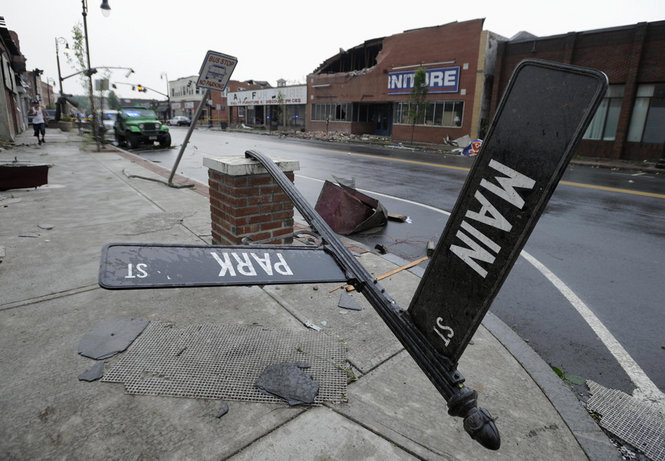
Downtown Springfield, MA after the tornado.
Photo by the Associated Press/Jessica Hill and taken from here.

I am moving out of my Cape Cod apartment this week, and today* my dad drove down from New Hampshire to help me. We spent the early afternoon loading a U-Haul trailer with some furniture items my parents and sister wanted– as well as a dozen or so large boxes of my books and school notes* –and then started on the drive from Cape Cod to New Hampshire via Boston. As we were driving in the Boston area in the late afternoon, we drove through quite the impressive storm. There was downpouring rain and very close thunder and lightning. We drove well under the speed limit, and at times visibility was quite poor. My dad drove the U-Haul, and I followed in my little car with a very long fiberglass racing kayak strapped to the roof. My kayak is very light, and though I tied it on well, I was quite anxious that it might be blown off the roof in the storm. My dad and I passed through at least two distinct thunderstorms, but we made it safely to New Hampshire. My mom was quite fretful for us on the way, however. We didn’t realize why she was so concerned about us until we sat down with a late take-out dinner and watched the news.

This evening a State of Emergency was declared in Massachusetts as a result of at least two tornadoes and severe thunderstorms. At least four people have died as a result of the severe weather. The deaths occurred in the towns of Springfield, Westfield, and Brimfield. Looking at this gallery of images of the destruction, I am surprised that there were not more casualties. Thank goodness, most people were able to take shelter in  basements. There are some incredible stories coming out– people taking random strangers into their basements for shelter, a man who survived a tree and electric line falling on his car, news reporters having to take shelter in the middle of reporting when the thunderstorm became too severe, entire roofs blown away, top floors of brick buildings demolished, short minutes between warning and arrival of the tornado, an interrupted senior prom, people standing outside their demolished homes to prevent looting of what few possessions still remain; the list goes on and on.

I must admit that, personally, I find the recent tornado damage in Massachusetts more shocking than the recent tornado damage that occurred out west in places such as Joplin, Missouri.  The death and destruction in Joplin were much more extensive than in Massachusetts, but I’ve never been to Joplin. However, I’ve been to downtown Springfield, Massachusetts many times. So, I find the images of the destruction of downtown Springfield very unsettling.

These recent tornadoes hit very close to home. My dad and I were very lucky that we did not encounter a tornado, and we really should not have been driving through those storms. We both brushed off the news of the storm, thinking it just another day of showers and thunderstorms. Next time I need to drive through a storm, I’m definitely checking the for tornado warnings beforehand.

Below is an incredible video of the tornado hitting Springfield earlier today. Just look at how that tornado whips up water and debris! Humbling, especially since I’ve driven over that bridge many times and would not have thought twice about driving over the bridge today, even if a thunderstorm were forecast.

http://abcnews.go.com/assets/player/walt2.6/flash/SFP_Walt_2_65.swf

*On Wednesday; I’m actually writing this after Midnight, so very early on Thursday.

**Yes, I hoard books. Whenever I move I find it easy to discard furniture, kitchen items, decorations, and (to a lesser extent) clothes, but I find it very difficult to discard books, even if I’m fairly certain I’ll never read them again. Oh, well. I suppose there are worse traits than being a book hoarder. Thanks, Mom and Dad, for storing all these books in your garage.

A Memorial Day Rock: Marble

Marble headstones at Arlington National Cemetery.
Photo taken from Wikipedia here.

On Memorial Day I always remember the trips I’ve taken to Arlington National Cemetery in Arlington, VA. I still remember my first visit to the cemetery. I was seventeen and applying to the United States Naval Academy. I was down in Washington, DC for the Naval Academy’s Summer Seminar, an intense week that gives Naval Academy applicants a taste of what it’s like to be a Midshipman. After hours of early morning PT with Navy Seals, fitness tests, mini courses, and serious hazing, the visit to Arlington was relaxing in a way. However, seeing row upon row of white marble tombstones also made me wonder if I really wanted to attend the Naval Academy. Was I cut out for this? Was I going to be able to spend enough time doing the science I love so much? Most importantly, was I willing to sacrifice for my country? Make the ultimate sacrifice?

I was admitted– early action– to the Naval Academy, and I almost went there. Some days I regret my decision to attend Dartmouth rather than the Naval Academy, and I wonder how different my life would have been if  had become a Midshipman. I would be stronger, I know. Tougher. Probably less self-centered and selfish. I tell myself that I turned down the Naval Academy because I wasn’t going to be able to do enough science as a Naval Officer, but I know that’s not a complete explanation. I know that I also turned down the Naval Academy because I was afraid. Afraid of war, of being mistreated as a woman, of a minimum eight year commitment, of not being able to follow an order I disagreed with, of fighting in a war I disagreed with, of danger, of violence, of death.

I may have turned down the opportunity to serve my country in the Navy, but I grew up in a military family. Many of my loved ones have served and still serve their country. My grandfather and father were both Naval Officers, and my cousin currently serves in the Air Force. Actually, the Mervine Family has a long history of military service, dating back to Rear Admiral William Mervine. There’s even a Fort Mervine out in California.

I was too afraid to serve and sacrifice for my country, but there are thousands upon thousands upon thousands of people who were not afraid. Or maybe they were afraid, but they served– and sometimes died– anyway. Whenever I am down in the Washington, DC area, I try to make a point of visiting Arlington National Cemetery. Standing amongst thousands of matching marble headstones, I feel sadness, pain, and pride for all those who served and died for the United States of America. I may not agree with all of the wars in which these soldiers fought and died, but I still feel grateful for and humbled by the countless soldiers who sacrificed their lives. To all those soldiers– at Arlington and elsewhere– thank you. We remember you.

Christmas wreaths at Arlington National Cemetery, December 2005.
Photo taken from Wikipedia here.