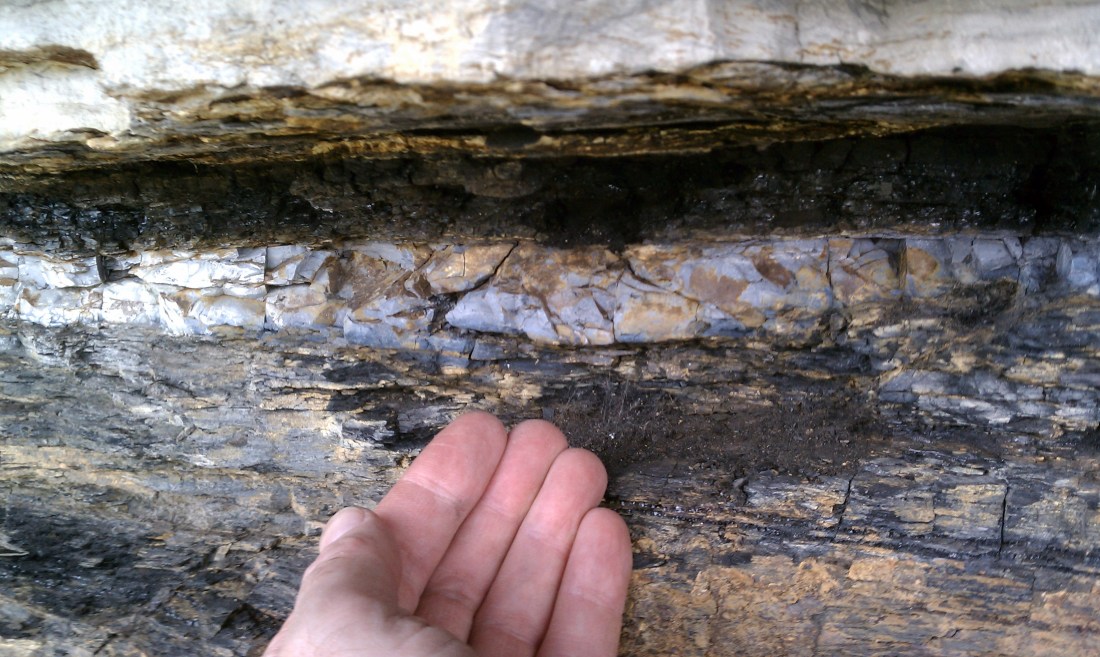
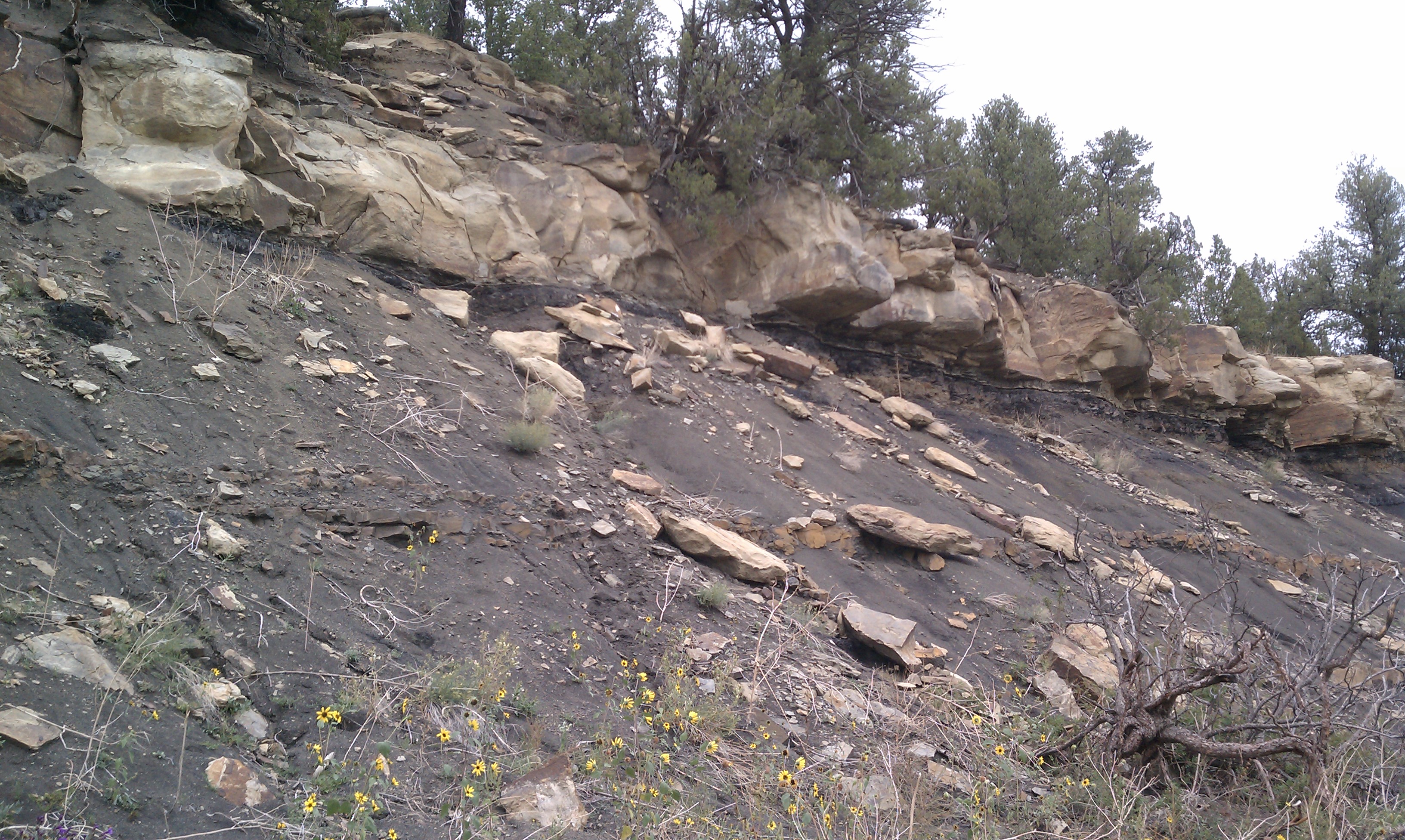
K-T boundary, with a famous astronomer's hand for scale and dramatic effect.The field area where Phil observed the K-T boundary.
This week’s geology picture was sent to me by my friend Phil Plait aka “The Bad Astronomer.” This week’s picture– two pictures, actually– shows the famous K-T Boundary.
Phil explains,
I’ve attached the K/T pic. It was taken in Trinidad Park in southern Colorado, where the boundary is very distinct.
It’s my hand in the 0731 picture. 🙂 0732 puts it in context. The rock above is limestone, and below is coal and other friables. The coal erodes away easily with rain and wind, so it forms that slope, which is murder to climb, like trying to swim uphill. The limestone is much tougher so it forms a cap. As the coal erodes back, eventually the limestone breaks and rolls down the hill. There were big chunks of it lining the base of the slope. All of this used to be underwater a few million years ago.
Thanks for sharing, Phil! I had a busy day with thesis revisions, so I’m posting this week’s Monday picture just in the nick of time… here on the east coast of the USA it’s a few minutes to midnight.
Today is Earth Day. Today is a day when one is supposed to reflect on Earth and the environment, particularly the detrimental impacts that billions of humans have on the environment. So, I thought I would take a little time today to muse about Earth and the environment, post an inspiring video, and make a small pledge.
As a geologist, I think about Earth and the environment all the time, so in a way every day is Earth Day for me. I’ve always been drawn to the outdoors, and my interest in geology began at a young age. I’ve just devoted ten years– four years of college followed by six years of graduate school– to formal study of the Earth, and I’m very satisfied with my career choice. Most recently, I spent several years studying natural carbon sequestration for my PhD research, and I hope that my research will help inform scientists and engineers who work to develop technologies for carbon sequestration that employ storage of carbon in carbonate alteration minerals. One day such technologies may mitigate anthropogenic emissions of carbon dioxide in the atmosphere and, as a result, anthropogenic climate change.
I’ve worked hard to improve my understanding of the planet, and hopefully that will help me to make informed environmental choices to reduce my environmental impact– and maybe inspire others to reduce their impact– where I decide it is worthwhile to do so. As I’ve studied the Earth, one thing I’ve learned is that I don’t blindly support all “environmental” causes. For example, I don’t think that organic farming is practical on a global scale, and I am in favor of many genetically modified foods. With 7 billion humans on the planet, unfortunately we cannot always follow the so-called “best” environmental options; rather, we must make environmental choices.
I think that the best way we can prepare ourselves to make these choices– some of which are going to be very, very tough choices– is through education and research. We need to learn as much as we can about planet Earth, and then we need to apply this knowledge to decide where and how to reduce our impact on the planet. I think that everyone should strive to learn as much as they can about the Earth. I’m not saying that everyone should pursue a PhD in geology, but I think it’s a good idea for people to try to understand some of the basics of how planet Earth operates. Maybe I can help a bit with that through my musings here on Georneys.
I think the worst thing we can do is fight about how to mitigate the impact of 7 billion humans on Earth. Certainly, informed discussion of the options is worthwhile, but I don’t think we should pit various options against each other. We aren’t doing enough to mitigate the impact of humans on the environment, and many of our mitigation ideas may fail, so we need to pursue as many mitigation efforts as possible.
As an example, some environmentalists are critical of geoengineering projects such as carbon sequestration. For these environmentalists, there is concern that carbon sequestration efforts will slow efforts to reduce carbon dioxide emissions. I understand these concerns, and I wholeheartedly support efforts to reduce carbon dioxide emissions. I have no doubt that the future of energy on Earth is renewable energy. However, I am doubtful that renewable energy technologies will be developed quickly enough, affordably enough. I also think it is unfair to force developing countries to not use resources, such as coal, that are at their disposal for development. Therefore, in addition to supporting efforts to reduce carbon dioxide emissions and develop renewable energy, I also heartily support geoengineering projects that aim to sequester carbon dioxide from prior and ongoing emissions. I think that both reduction of emissions and sequestration of carbon are required to mitigate carbon dioxide concentrations in the atmosphere and avert catastrophic anthropogenic climate change. I am hopeful that humans can commit to both reduction and sequestration to make the difference we need.
That said, when considering the large and exponentially growing number of humans on the globe and their large impacts, I find that I can easily become discouraged and depressed. I wonder, sometimes, if I should even bother trying to reduce my own impact on the Earth when I am only one out of seven billion. I also find myself thinking thoughts such as: Does it really matter if I recycle this can when one plane flight between America and South Africa contributes so much more to my carbon footprint? I am also lazy. Very often, I will do things such as drive somewhere when I really could walk, throw something recyclable into the trash if its easier at the time, and neglect to turn off the lights in a room when I’m not there. As Callan points out, if one day my husband and I have children, that will undo (in a way) years of dedicated environmental efforts. A part of me wants to just throw up my hands and give up on all efforts to be environmentally responsible.
Ultimately, though, I have hope for planet Earth and the future of her environment. Humans may be multiplying in large numbers and may be lazy and destructive to the environment, but we are also (I hope, although the recent climate change denialism has me worried) smart. Perhaps I am just naive and young, but I am hopeful that we will be able to use a combination of reduction of impact and geoengineering to keep Earth a reasonably pleasant place to live.
For some inspiration in this regard, below is an incredible video showing how a soon-to-be MIT student sent the tube containing her admission letter to near space. For me, watching this video leaves me hopeful for the future of humans on Earth. If we can inspire the next generation to be curious about our planet and also to have concern for the planet that translates into action through hard work and creativity, then Earth may not be such a bad place to live in the future, after all. Perhaps all we need are a few more smart, curious, hardworking young people like Erin King. I realize that Erin didn’t address the environment in the below video, but I’d sure like to hear her ideas (and the ideas of other smart young people) for how to geoengineer the planet.
Although I am hopeful that humans are smart enough to geoengineer their way out of environmental problems (or at least some of the problems) on Earth today, I also recognize that reduction of impact remains important. I know I can do more to reduce my own environmental impact. As tempted as I may be, sometimes, to give up on my environmental efforts, the hope in me won’t let me. So, I’ll end this post with a pledge:
For the next month (hopefully longer, but I’ll start out with something realistic), I am not going to use a single plastic bag from any store. I’m fairly good about this back home in South Africa, where they actually charge for plastic bags, but I’ve been slacking during my trip back to the United States. I just purchased two cloth bags at the grocery store this evening. I plan to take them everywhere with me during the next month.
Okay, that may be a small pledge, but it’s a start. I’ll report back in a month, hopefully to tell you that I succeeded in this small effort. If you would like to make a similar pledge, please feel free to leave a comment below or to make a pledge on the Earth Day website.
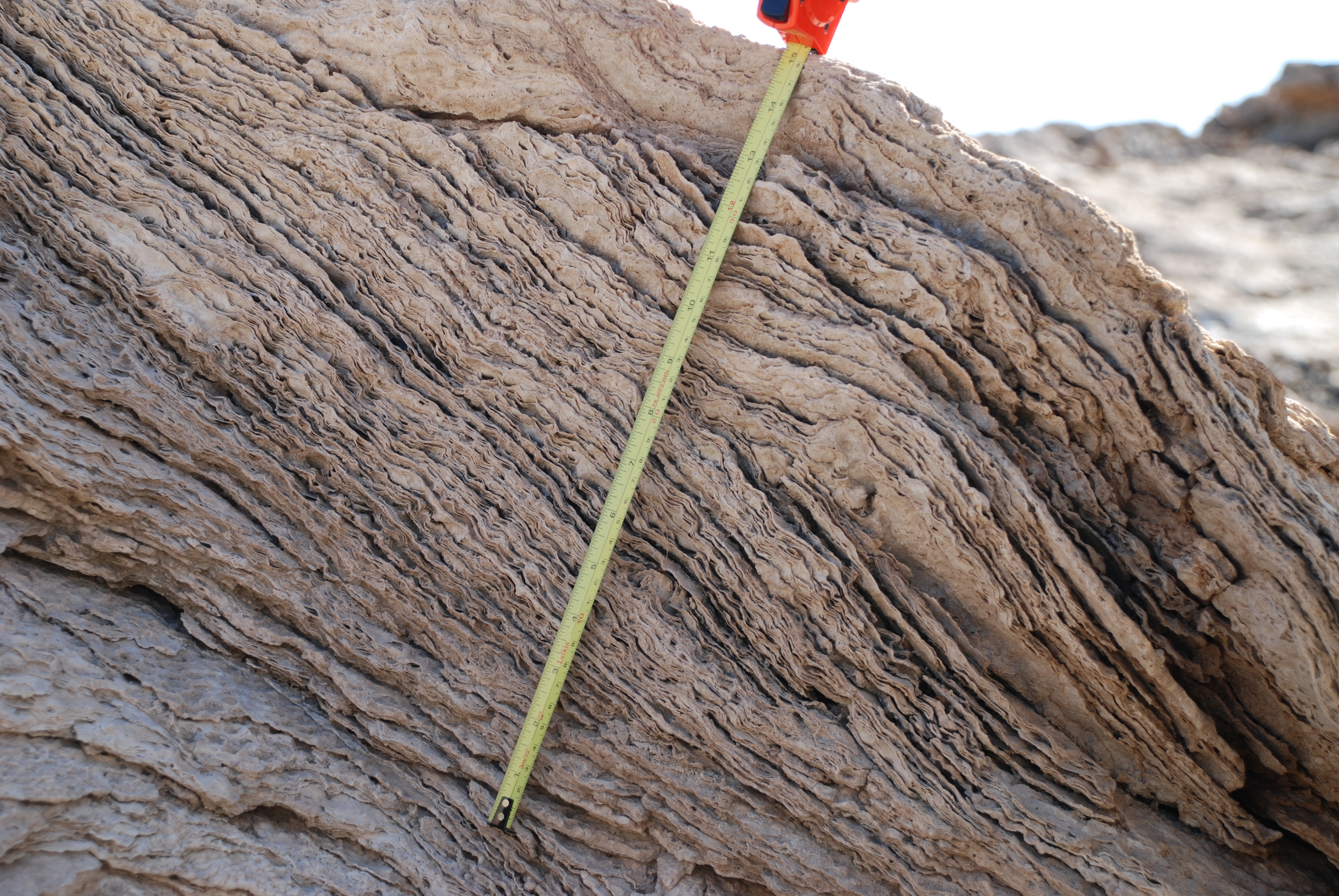
Layers of travertine deposition in the Sultanate of Oman, January 2009.
def. Time:
1. What the clock (or the cesium atom) measures.
2. “The indefinite continued progress of existence and events in the past, present, and future regarded as a whole.” (From Google Dictionary).
3. “A finite extent or stretch of continued existence, as the interval separating two successive events or actions, or the period during which an action, condition, or state continues; a finite portion of time; a period.” (From the Oxford English Dictionary).
4. One of four dimensions in the spacetime continuum.
I have not written a geology word of the week post for 5 months– about 150 days. My last geology word was S is for Syncline back in November. On a blogging timescale, 5 months is an eternity. In fact, a lack of posting for five months is what Ron Schott uses to classify a blog as “dormant” on his Geoblogosphere list. However, on a geologic timescale 5 months is no time at all. The Earth is 4.54 billion years old, and most geologists think on timescales of thousands or millions or even billions of years. To humans, of course, with our paltry lifespan of a hundred years or less, 5 months is a significant amount of time. Months, days, hours, and even seconds are important on human timescales.
However, geologists often use geologic time to put human events in perspective. For example, I’ve taken not quite six years to complete my PhD in geology. In my graduate program six year PhDs are common. When you’re struggling along through graduate school, six years seems like an eternity sometimes. To help relieve the stress, the geology graduate students joke with each other, “Well, on a geologic timescale, of course, this is nothing. Heck, I could take 10 years to complete my PhD and it would still be nothing, geologically speaking.” And then there’s the old stand-by joke: Never loan geologists money… because they’ll pay you back on a geologic timescale.
For those of you who are not familiar, under normal blog conditions I muse about a geology word every week here on Georneys. I first give a definition of the word, and then I explain a little about the importance of the word in geology. I often present a compilation of pictures that illustrate the geology word in action. For example, there were some impressive picture compilations in X is for Xenolith and M is for Migmatite. Pictures are often provided by Geoblogosphere members, by my geology colleagues, and by my twitter followers and blog readers. Geology words are also often proposed by my blog readers and twitter followers, so in a way the geology word of the week is a group effort, and I am merely the editor of an ongoing geologic encyclopedia.
Because humans like patterns and I need some way to focus a very, very long list of geologic words (scientists like words, and geologists are no exception), for my weekly words I work through the alphabet in order. Since the last geology word started with an S, that means this week’s word starts with a T. Next week’s word will begin with a U (feel free to start thinking of suggestions), and in two weeks the word will start with a V, and so on.
From November 2010 (when I started writing Georneys) to October 2011, I was rigorous about posting a geology word every week. However, last October I started to become somewhat busy. I put the geology word of the week on hold for a few weeks to prepare for my wedding at the end of October. I managed to post S is for Syncline in November, but after that I found that I simply didn’t have enough time for the weekly word. I consider blogging a fun (and important) hobby, but in the last few months of my PhD thesis writing, I didn’t have time for any hobbies… or for as much exercise, proper eating, or restful sleeping as I would have liked. Now that the thesis defense is over, I am bringing back the weekly geology word. Depending on travel and other circumstances, there may be a few weeks where I miss a word. However, I’ll do my best to post a word every week. You can help me with that by suggesting words as well as by providing information and pictures for the selected weekly words. I can often be bribed to write about a certain word if someone provides good pictures. As I mentioned above, the geology word of the week really is a team effort.
Although I considered other T words such as tafoni and tektite and tourmaline, after some musing I eventually decided that “time” is a fitting word for the resurrection of The Geology Word of the Week. Time seems an appropriate word because significant time has passed (on a human timescale, anyway) since I last posted a geology word. Also, I have spent much of the last few months thinking about time. Indeed, my PhD thesis even contains the word time. The title of my thesis is: Determining timescales of natural carbonation of Peridotite in the Samail ophiolite, Sultanate of Oman. My PhD is technically in Marine Geology, but if I were to describe my expertise in geology, I would probably describe myself as a geochronologist and geochemist who enjoys using isotopes and other geochemical tools to constrain ages of rocks and rates for various geologic processes.
Time is an interesting concept. Humans intuitively understand time, at least on a certain level. We fundamentally understand time and the passage of time through natural events which take time– the rising and setting of the sun, the rising and falling of the tides, the passage of patterns of stars in the sky, the waxing and waning of the moon. Long ago, time was measured by observing various periodic natural phenomena (such as the waxing and waning of the moon) as well as through use of devices such as sun dials and hourglasses filled with sand. Today, we primarily measure time with various mechanical and electronic devices. However, we also precisely define time and calibrate our artificial clocks by using atomic clocks. The official SI unit of a second is defined as “9,192,631,770 cycles of that radiation which corresponds to the transition between two electron spin energy levels of the ground state of the 133Cs atom.” (from Wikipedia’s article on Time). So, although we now wear various mechanical watches, we still base our understanding of time on the observation of periodic natural phenomena.
Time is a very important concept in geology. Understanding when and how quickly and in what order various geologic events and processes occur is key in understanding how our planet– and other planets– operate. Geologic time began as a relative concept– figuring out the order in which geologic layers were deposited, noting when certain fossil organisms lived and died, determining the order in which minerals crystallize and erode. The discovery of radioactivity in the late 1800s and the development of absolute geologic dating techniques in the 1900s (and continuing to today) revolutionized geology by providing absolute dates and rates for geologic events and processes. Geologists were able to determine the age of the Earth and to add dates to the previously-established (in a relative sense) geologic timescale.
The determination of geologic ages and rates continues to be very important for geologic research. As an example, in my PhD research I worked to better constrain rates of carbonate formation and erosion in the peridotite layer of the Samail ophiolite. Understanding timescales of peridotite carbonation is important because such carbonation represents a natural sink in the carbon cycle. Also, enhanced carbonation of peridotite is one proposed method for carbon sequestration that could offset anthropogenic emissions of carbon dioxide to the atmosphere. However, before scientists can figure out how much we have to speed up natural carbonation of peridotite to offset anthropogenic emissions, they first have to know how quickly peridotite carbonation occurs naturally.
I think about time and use the word time all the time (Example A). Time is an important term for geologists– and scientists in general– to understand and define carefully. I have a good understanding of time in my daily life and also of geologic time. However, when I think more deeply about time– for example, thinking about time as one of the four dimensions of spacetime– I wonder if I really understand time at all. I may have to read up on some theoretical physics and time now that I have a little extra time.
Certainly, there is a part of me that feels amazed that– finally– the time has passed, and I have defended my PhD. Along the way, I felt that my PhD research and progress crept along slow as molasses. Then– all of a sudden– I was ready to defend. Now, I look back and wonder where the time has gone.
About a month ago, I remember being in a state of high-stress and sleep deprivation and panic, wondering how I would survive the next few weeks. And I remember thinking back on other high-stress and important events– my competition in the Junior Olympics as a kayaker, my advanced placement examinations in high school, the SAT, the college admissions process, finals in college, the GRE, the graduate school admissions process, every single math test I took at MIT, my PhD qualifying exams, my wedding, and so on. Months of anticipation and worry and stress preceded each of these events. And yet, time passed, and I survived each event– thrived even, with some– and then afterwards I felt a strange sense of wonder: Was the event truly over? Had I truly survived? Was there nothing more to anticipate? How had the time passed? What now? Along with the wonder, I felt a surreal sense of calm, a satisfied sense of accomplishment. I would relax for awhile, returning to a more normal, less-stressed state. And then, after awhile, I would start anticipating the next event.
The anticipation of my PhD defense was more challenging, by far, than any of the previous important events mentioned in the list above. When I felt overly concerned over the last six months or so, I just took a deep breath and reminded myself of all those other difficult events. Time will pass, I told myself. Time will pass.
Well, time did pass. And I survived– thrived even– during my PhD defense. And now I feel that same surreal sense of wonder and calm. And now I find myself musing over time, for a time at least.
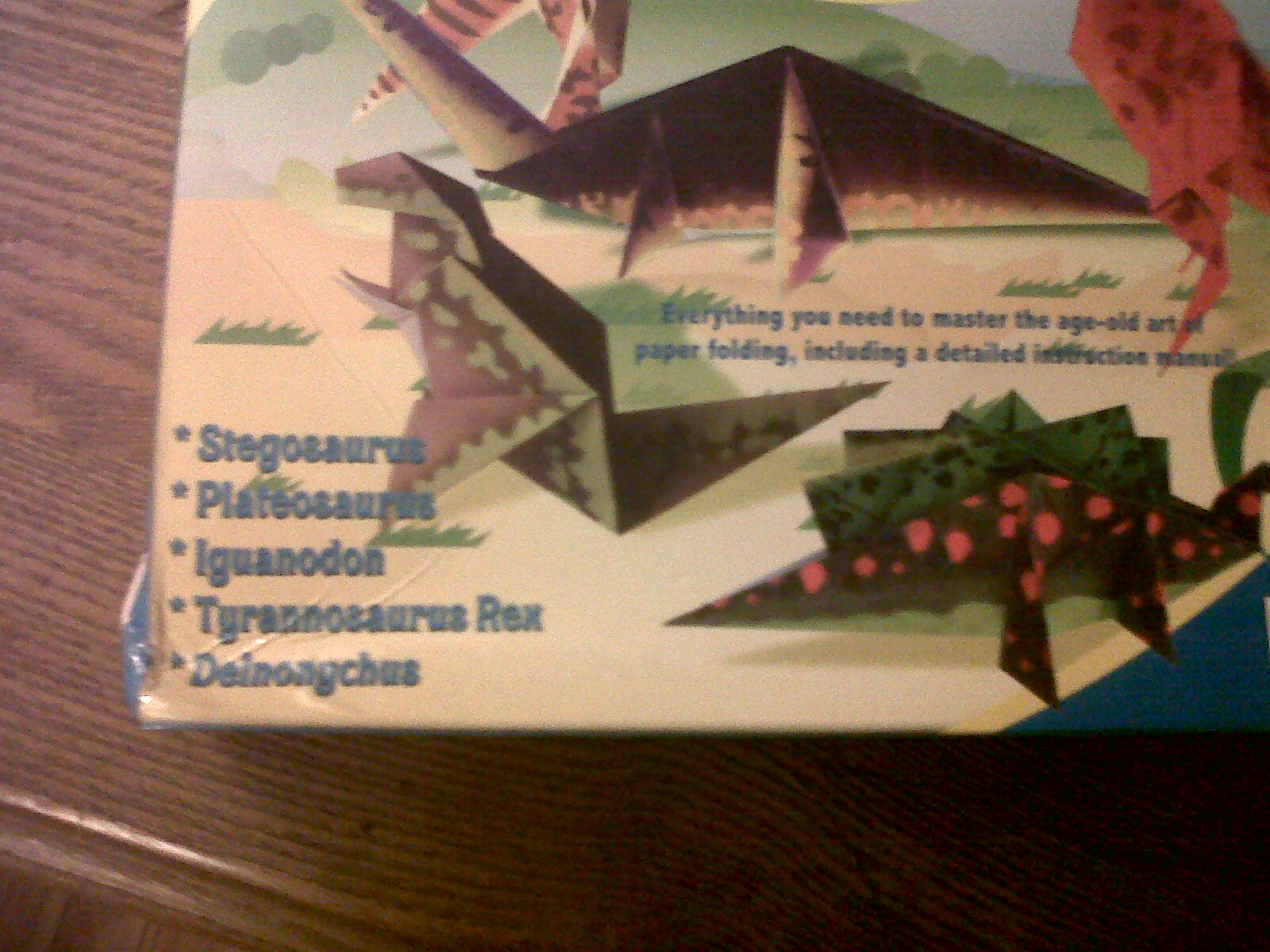
This past weekend during some post-thesis retail therapy, I made a wonderful discovery in the local $1 store: origami dinosaurs! Since the box only cost $1 and my origami skills are lacking, I bought 5 boxes.
Tonight my friend Dan and I attempted our first origami dinosaurs. We started with T-Rex since the instructions looked simpler than the other dinosaurs.
So many origami dinosaurs. How many PhD students (and recent PhD graduates) does it take to figure out the origami instructions?
After some struggling along, our T-Rex creations look *almost* like the one on the box:
At my post-defense party in the WHOI student center.
On Friday the 13th I successfully defended my PhD in Marine Geology in the MIT/WHOI Joint Program. For this week’s geology picture, here I am on Friday with my co-advisors Susan Humphris and Ken Sims at my post-defense party.
Everyone has to call me Dr. Evelyn now… at least for a few days. Then everyone can call me just plain old Evelyn again.
Once I recover from post-thesis exhaustion and finish up my revisions, you can expect the pace of blogging to pick up here slightly. I even plan to resurrect the Geology Word of the Week, so stay tuned!
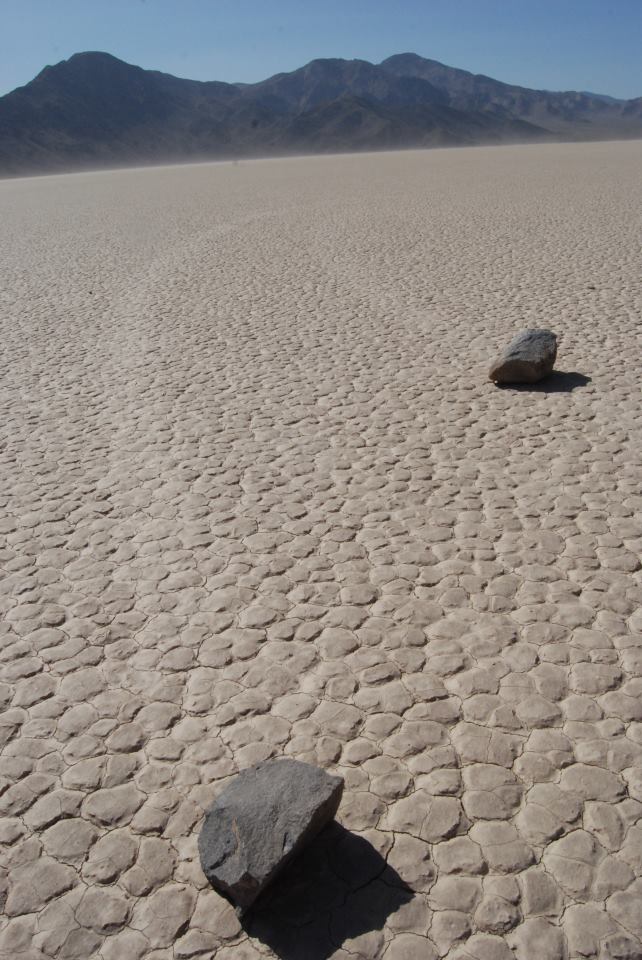
My friends Ray and Katie recently visited Racetrack Playa in Death Valley, and I’ve been drooling over the beautiful pictures of Racetrack Playa and its so-called “sailing stones” which they have been posting on Facebook. Ray and Katie have given me permission to share some of their Racetrack Playa pictures with you here on Georneys. Since I’m a little bit busy this week, I’ll just share one picture with you today. Hopefully, next week– if I’m not too exhausted and busy with thesis revisions– I’ll share some more pictures and even muse over some of the explanations for the mysterious “sailing stones.”
Two sailing stones on Racetrack Playa, Death Valley, California, April 2012. Photograph courtesy of my friends Ray and Katie.
Also note the spectacular mud cracks– perhaps we’ll muse a bit on those, too, in the future.
Someone has been posting these signs all over the Geology and Geophysics Department at Woods Hole Oceanographic Institution and the Earth and Planetary Science Department at MIT:
I can’t believe that I’m actually going to defend my PhD next week. Honestly, it feels somewhat surreal. I guess I’d better make a presentation! And make sure I know my carbon cycle.
MIT/WHOI Joint Program thesis defense presentations are open to the public, so if you’re in the area please feel free to attend.
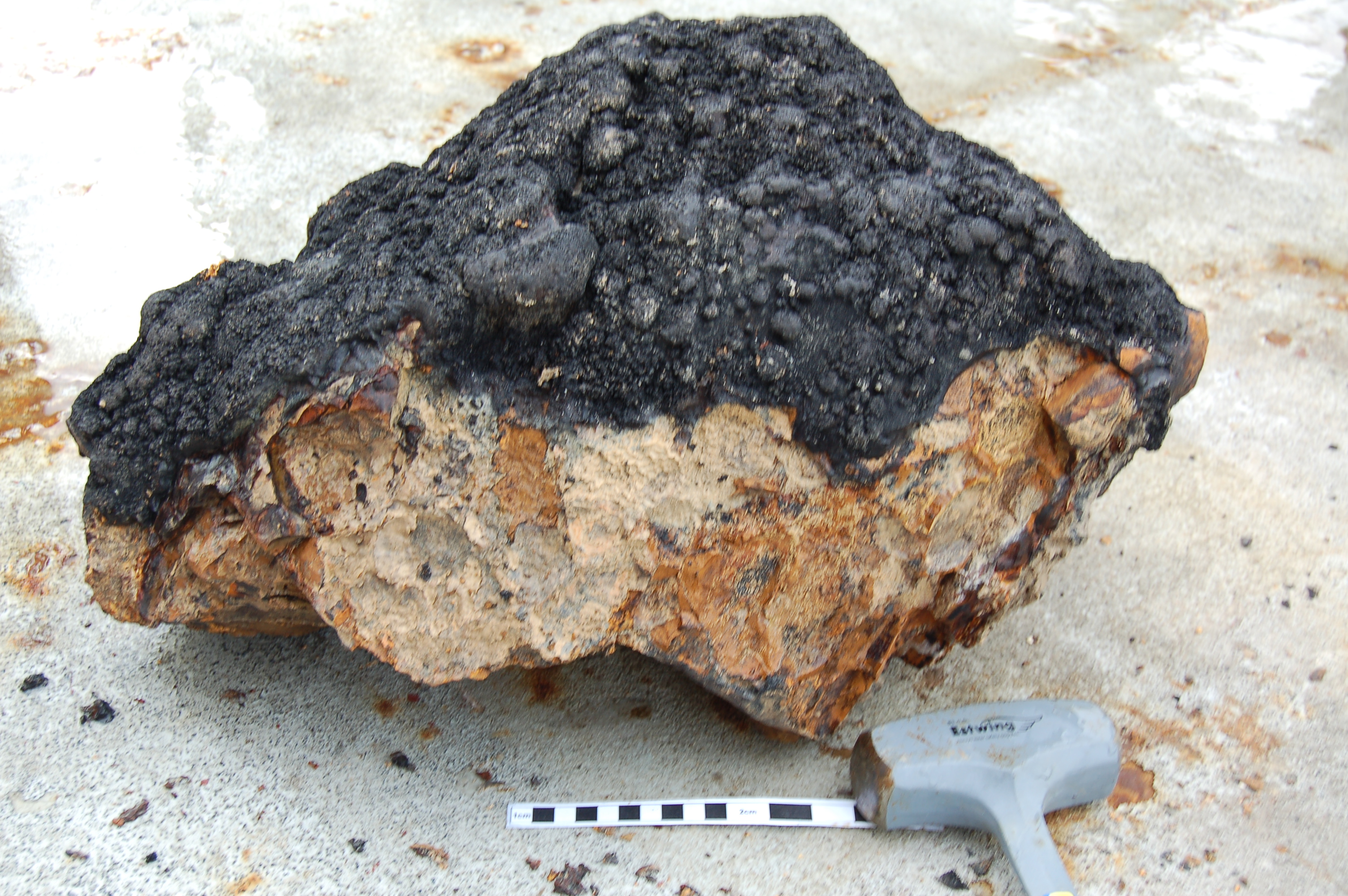
Ferromanganese crusts actually caused some trouble for our rock descriptions. Before we could identify many rocks, we had to chip or saw off the ferromanganese crusts. Actually, due to alteration we had to break or saw apart many rocks in order to expose fresher surfaces that were easier to identify.
A closer view of the boulder and crust, Ninetyeast Ridge, Indian Ocean, 2007.
I’m afraid that rock-breaking became somewhat of a competitive sport on the expedition. Well, I guess there isn’t much else to do (other than describe and sort rocks) on a two month expedition in the middle of the Indian Ocean.
My husband-to-be (on right) and our friend James... trying to impress me with their rock breaking skills. Ninetyeast Ridge, Indian Ocean, 2007.
For this week’s Monday Geology Picture, I thought I would share a picture of peridotite in thin section viewed under a microscope. This particular peridotite originates from the Samail Ophiolite, Sultanate of Oman, and is a weakly-deformed harzburgite that is ~40% serpentinized. You can see the fine network of serpentine veins throughout the sample. The brightly-colored patches are olivine and pyroxene minerals. I really enjoy looking at rocks in thin section– rocks can be so beautiful in thin section, particularly when viewed under cross-polarized light.
Serpentinized harzburgite in thin section, plane polarized light.1 mm scalebarSerpentinized harzburgite in thin section, cross polarized light. 1 mm scalebar.
Botryoidal ferromanganese crust dredged from the Ninetyeast Ridge, Indian Ocean, Summer 2007.
For this week’s geology picture, I thought I would share a picture of a neat botryoidal (grape-like texture) ferromanganese crust that was recovered during dredging along the Ninetyeast Ridge in the Indian Ocean in 2007. Ferromanganese crusts and nodules are commonly deposited in the ocean. They often form botryoidal shapes, such as the example above.










 Georneys
