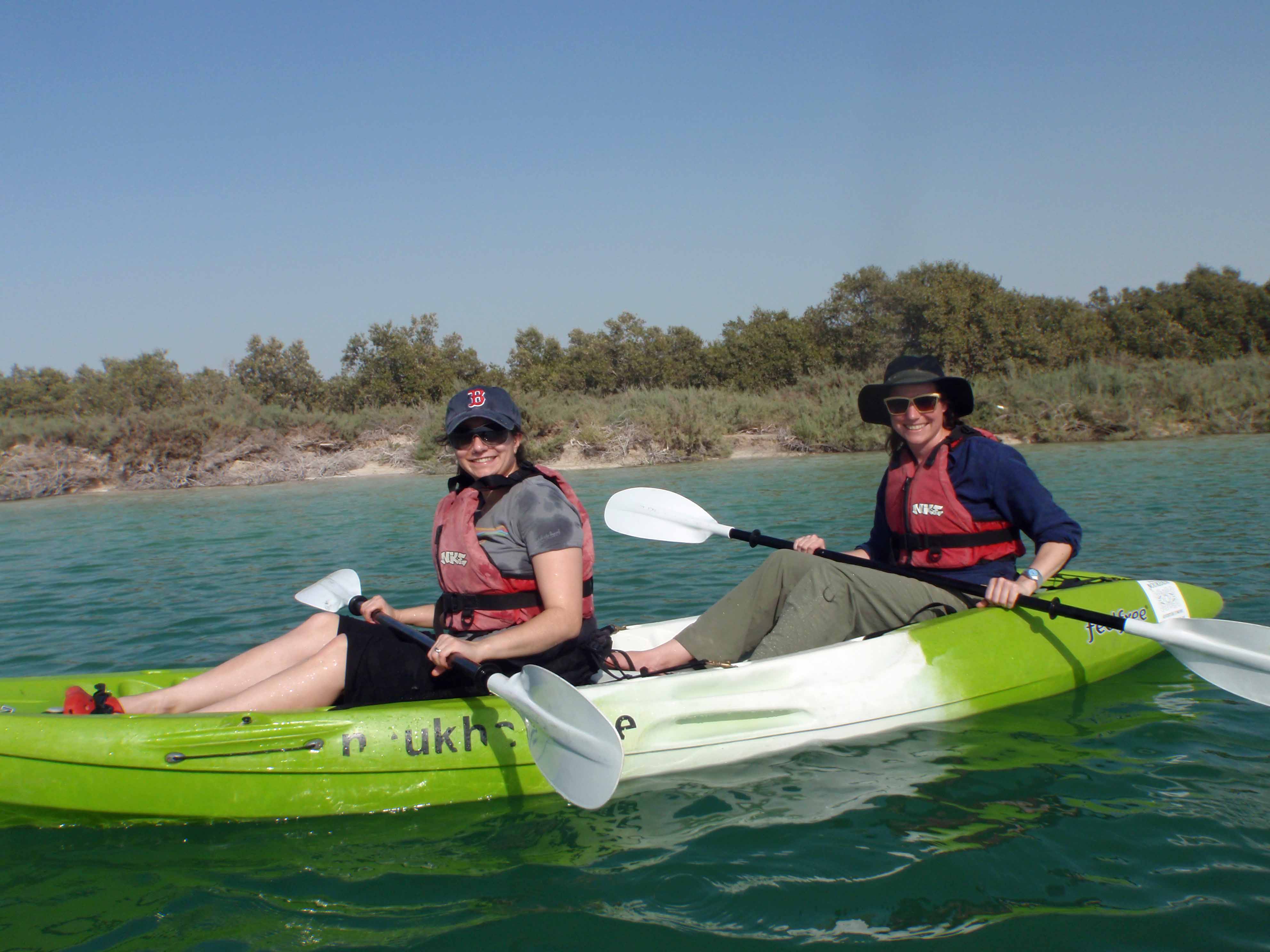
Kayaking with mangroves and the skyscrapers of Abu Dhabi in the background.
Over the next few weeks, I thought I would share some pictures from my trip to Abu Dhabi, United Arab Emirates back in January 2012. I spend a few days in Abu Dhabi after attending a geology conference in the Sultanate of Oman. I went to Abu Dhabi to visit Karima, a good friend of mine from college, and her family. I had a wonderful trip. It was great catching up with Karima and her family. They were wonderful hosts, and I saw many wonderful things in Abu Dhabi and also Dubai. I really enjoyed sightseeing with them, and I saw many great rocks– mostly in the form of decorative stones on various fancy buildings.
During my first day in Abu Dhabi, I went kayaking with Karima, her husband, and son. We went kayaking with a group amongst some mangroves. What a great way to see part of the city and start my trip! I highly recommend a kayaking trip if you’re in Abu Dhabi.
Karima and I in our kayak.A kayaking group.Interesting flora on the beach where we stopped to rest for awhile.
Back in early April I traveled from my home in Cape Town, South Africa to the Eastern Cape, South Africa. I went for a long weekend to visit my husband in Grahamstown. My husband periodically spends several weeks in Grahamstown as he is working (part-time) on his masters degree in Exploration Geology at Rhodes University. I also visited the Eastern Cape back in December. I’m really enjoying exploring the Eastern Cape. I look forward to more visits there in the future and also to sharing some tidbits about my Eastern Cape travels with you here on Georneys. I’ll start by telling you about the giant pineapple. Yes, the giant pineapple.
Unfortunately, it poured down rain all weekend during my April visit to the Eastern Cape. However, my husband and I didn’t let the rain stop us from doing some sightseeing. On Saturday we drove from Grahamstown down to Port Alfred, and we stopped in the little agricultural town of Bathurst along the way.
Map showing the drive from Grahamstown to Port Alfred via Bathurst.
As we were driving along through Bathurst, I was quite surprised to hear my husband say, “Oh, look. There’s the giant pineapple.”
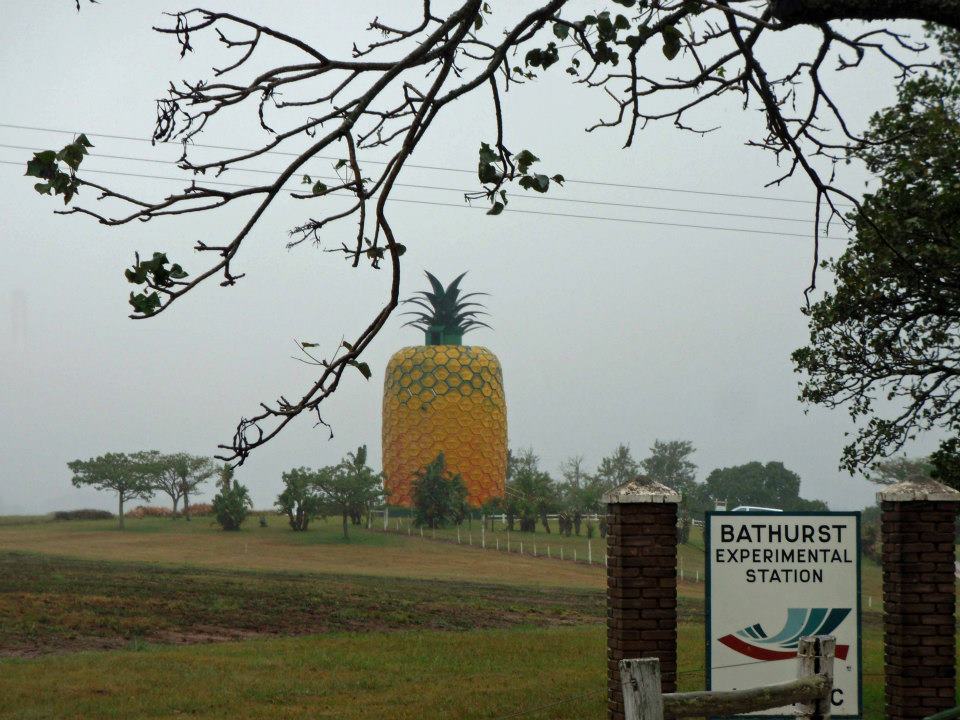
I said, “The what?” and then nearly drove off the road (not really, but my attention was diverted for a moment) when this giant pineapple came into view:
The Big Pineapple in Bathurst. Viewed from the road.
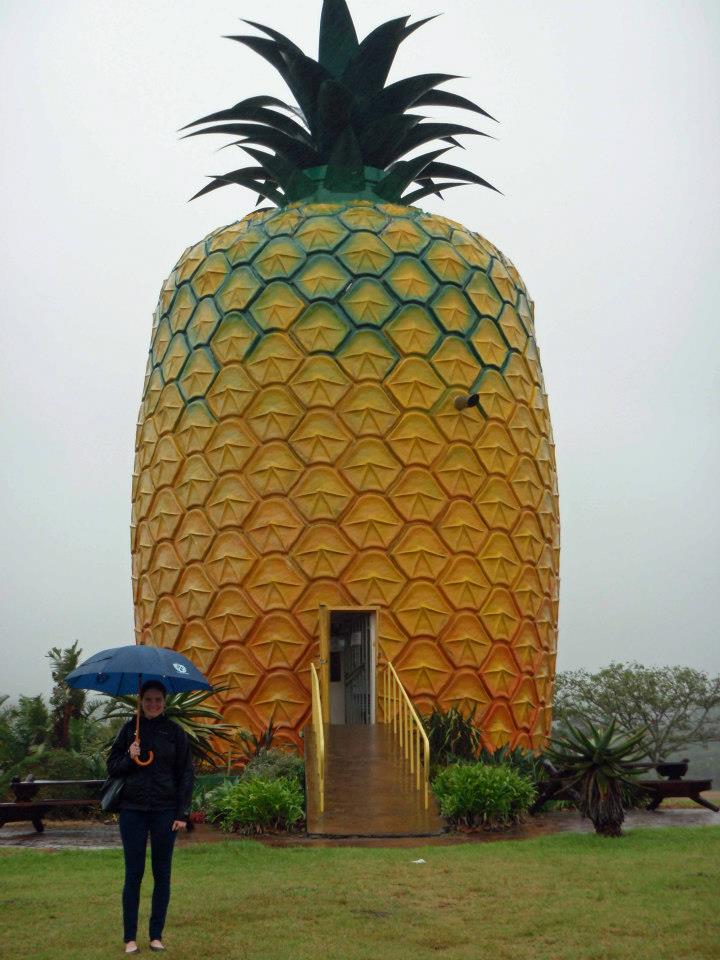
Of course, we had to stop and take a look at what is known as “The Big Pineapple”. Located on a pineapple farm and experimental station, The Big Pineapple is a 16.7 m tall pineapple-shaped building that has three floors. The first floor is a gift shop where you can buy pineapples, various pineapple food items (dried pineapples, jellies, chutneys, etc.), and all sorts of pineapple-themed souvenirs (t-shirts, bags, tea towels, figurines, etc.– we bought a pineapple-decorated sugar bowl). The second floor is a museum with some general information about pineapples and the history of pineapple farming in South Africa. The third floor has a TV showing a movie about pineapples and an observation deck, where you can enjoy the view, which includes fields of growing pineapples. On clear days, you can apparently see the Indian Ocean in the distance. On the cloudy day we visited, however, we couldn’t see beyond the closest fields.
The Bathurst pineapple building is actually a copy of the original “Big Pineapple” in Queensland, Australia. The Queensland pineapple building stands only 16 m tall– the Bathurst pineapple building is a slightly enlarged replica of the Queensland pineapple building. The Bathurst pineapple building was made larger so that Bathurst could claim that they have “the world’s biggest pineapple”.
Here are some more pictures of The Big Pineapple in Bathurst:
A closer view of The Big Pineapple in Bathurst.The Big Pineapple in Bathurst with a car for scale.The Big Pineapple in Bathurst with yours truly and an umbrella for scale.Bathurst hosted The International Pineapple Symposium back in 2005.Experimental pineapple growing is carried out in Bathurst.Informational sign on the second floor of The Big Pineapple in Bathurst.A sign about the building of The Big Pineapple in Bathurst.An old article about the history of pineapple growing in South Africa.A map showing the main areas where pineapples are grown.The view from the top of The Big Pineapple in Bathurst.Another view from the top of The Big Pineapple in Bathurst.
During my visit to The Big Pineapple in Bathurst, I learned two things. First, I learned that pineapples don’t grow in trees. I guess I never really thought about it too much, but I always assumed that pineapples grew in big trees, similar to the way coconuts grow in palm trees. Nope. Pineapples grow on the ground like this:
Pineapples growing on the ground in Bathurst.Another view of pineapples growing on the ground in Bathurst.
The second thing I learned as a result of my visit to The Big Pineapple in Bathurst is that pictures of a giant pineapple building really confuse Facebook’s facial recognition software:
Facebook thinks that every single hexagon on the The Big Pineapple is someone's face. Facebook wanted me to tag dozens of pineapple face friends!
My husband and I enjoyed our visit to the strange and wonderful Big Pineapple in Bathurst. We hope to visit again another time– hopefully on a day when it’s not pouring down rain. Next time we visit, I plan to bring a SpongeBob doll. Or perhaps a SpongeBob costume, if I can find one.
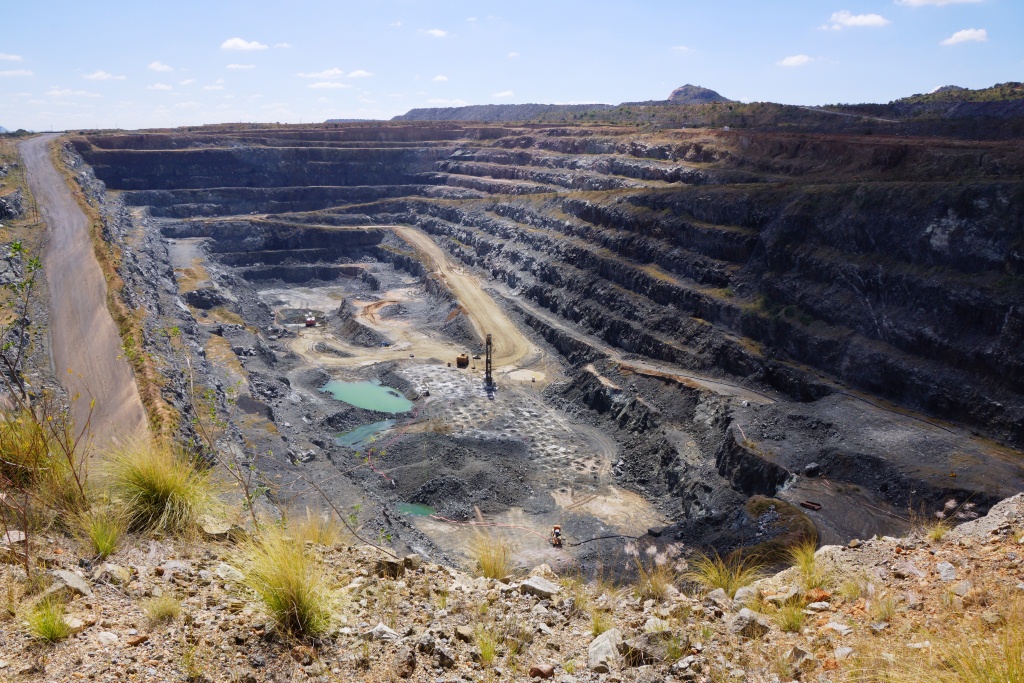
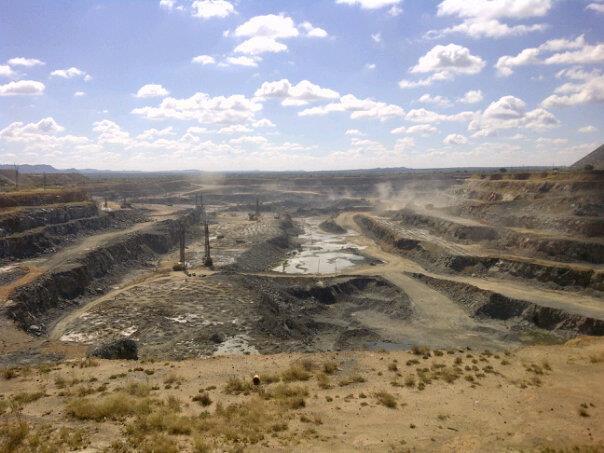
One of the impressive open pits at Mogolokwena Platinum Mine. Picture taken by Jackie Gauntlett.
Today’s Monday Geology Picture and description are courtesy of my husband Jackie Gauntlett, who is sharing another picture from his recent field trip as part of his masters degree in Exploration Geology at Rhodes University.
From Jackie:
Mogolokwena Platinum Mine is the largest platinum mine in the world and is situated on the Northern Limb of the Bushveld Complex in South Africa. This image shows one of four open pits currently being mined by Anglo Platinum on this mine. South Africa holds around 90% of the world’s platinum reserves, and it is envisioned that the Mogolokwena pits could one day extend almost 100 km in uninterrupted length. At the moment, Mogolokwena Mine has a life of mine of 130 years, a number that climbs by decades after every drilling program. At this rate the exploration team had better stop working so quickly as they’re likely to drill themselves out of a job! This mine truly represents a world class platinum deposit.
Figure 1. Pillow lavas. Picture taken by Jackie Gauntlett.
The Barberton Mountainland in north-eastern South Africa is underlain by the some of the oldest and best preserved rocks in the world – the Barberton Greenstone Belt. The rocks of this unique area allow geologists to peer into the world of 3.5 billion years ago. The variety of rocks making up this ancient belt provide some of the earliest evidence for deep bodies of water (pillow lavas – Figure 1), running water and fluvial systems (conglomerate beds and cross-bedding (Figures 2 and 3)), tidal systems (symmetrical ripples, Figure 4) and…our ancestors. The oldest form of life was discovered here, a bacterial micro fossil Archaeospheroides barbertonis and has been identified as being 3.2 billion years old (Figure 5).
Figure 2. Conglomerate. Picture taken by Jackie Gauntlett.Figure 3. Cross-bedding. Picture taken by Jackie Gauntlett.Figure 4. Ripple marks. Picture taken by Jackie Gauntlett.Figure 5. Archean fossils! Picture taken by Jackie Gauntlett.
The Barberton Makhonjwa Geotrail is an amazing initiative, and I urge anyone passing through to spend a day absorbing this unique and spectacular part of South Africa. Check out a description of the trail here.
So, I have been quite negligent recently and missed both last week’s and this week’s Monday Geology Picture. My apologies for that! Life has been very busy with things such as writing a paper and preparing for upcoming fieldwork. To make up for missing the Monday Geology Picture the last two weeks, my husband Jackie is going to share two sets of pictures (one today, one tomorrow) from his recent mining / exploration geology field trip in South Africa.
Without further ado, here’s the first guest post from my husband Jackie Gauntlett:
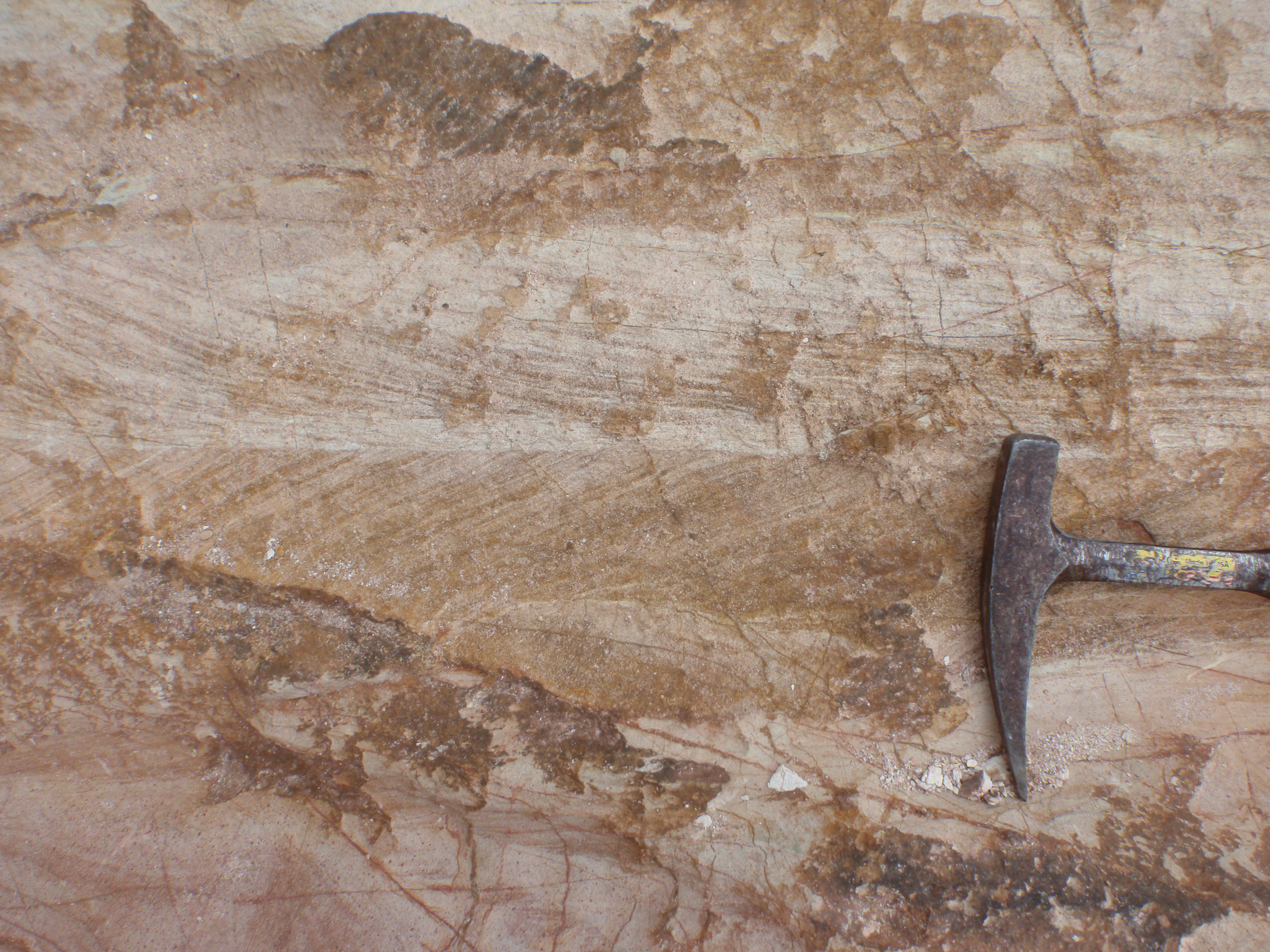
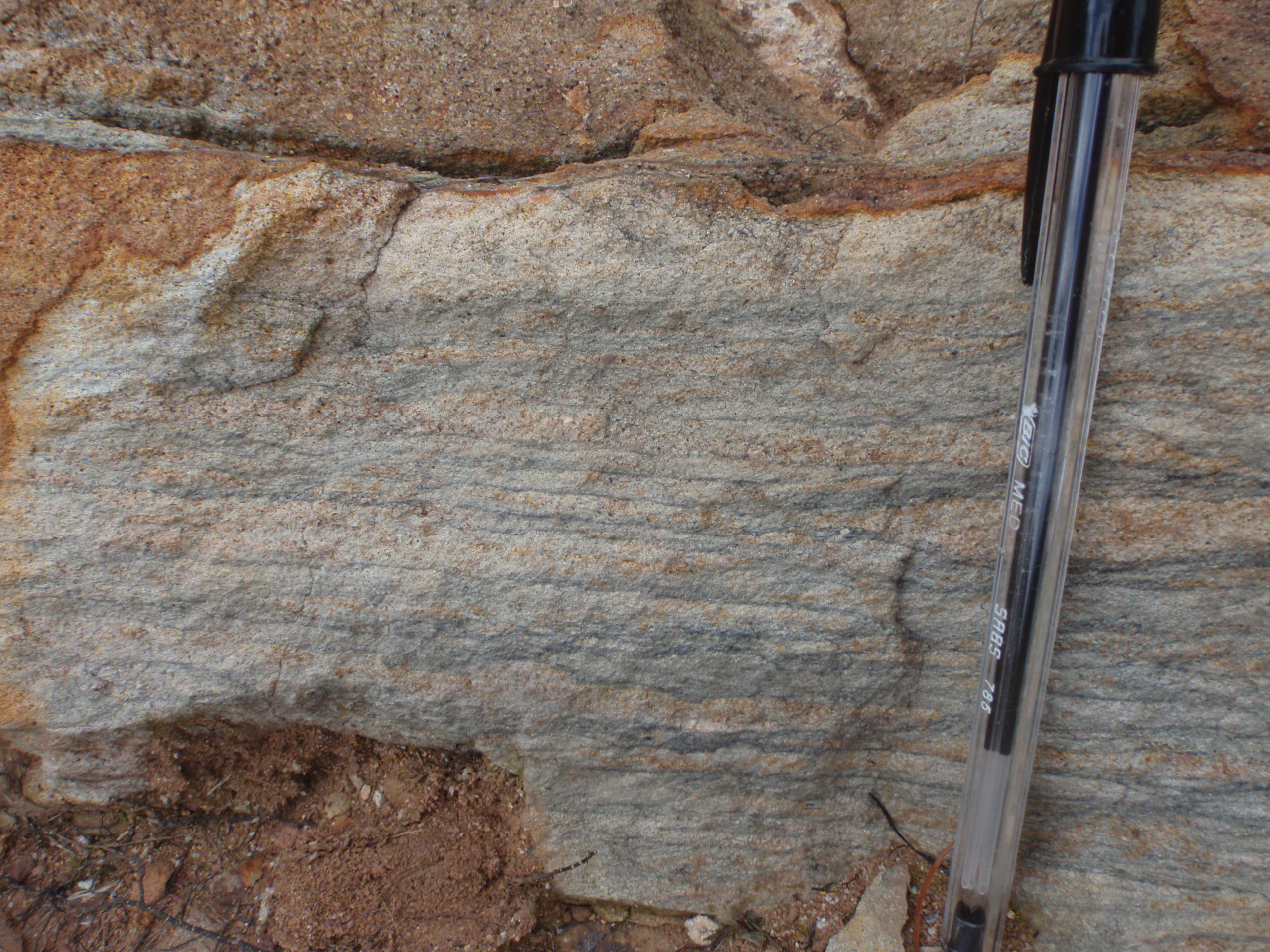
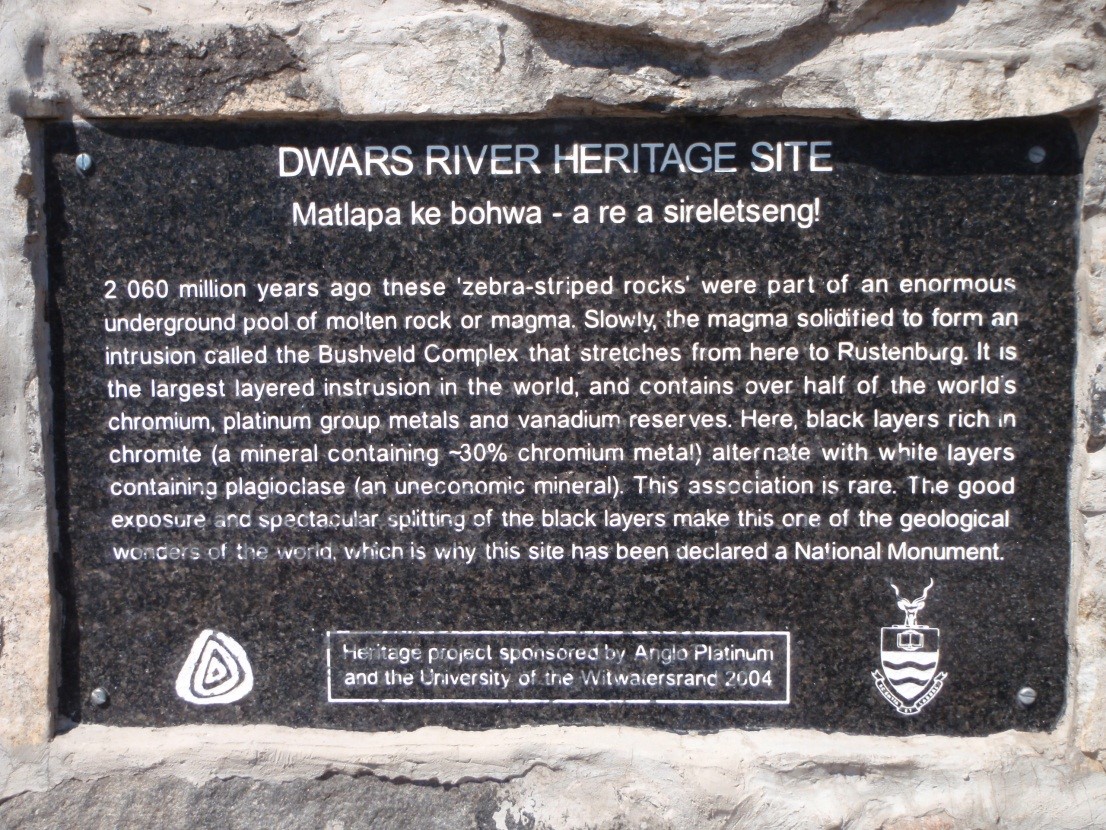
Chromitite seams in the Bushveld Igneous Complex, exposed at Dwars Rivier. Picture taken by Jackie Gauntlett.Informational sign for the Dwars River Heritage Site in the Bushveld Igneous Complex. Picture taken by Jackie Gauntlett.
The Bushveld Igneous Complex in northern South Africa is an amazing, yet somewhat enigmatic, geological phenomenon. At around 8 km thick, this layered igneous intrusion is the largest in the world by an order of magnitude. Its features also allow geologists a look into the inner workings of large magma chambers. In the image above we see layers of chromitite (a rock made up of ~40% chromite) within an anorthosite package. Conventional thinking from other similar igneous bodies would suggest that these layers were laid down inside a magma chamber one on top of the other during fractional crystallisation. However, outcrops like the one at Dwarsrivier show bifurcating seams which often rejoin and anorthosite xenoliths (rip-up clasts maybe?), alluding to a horizontal intrusion mechanism within a hot chamber. Interestingly, even though bifurcating seams are common, the total chromitite thickness remains constant and individual seams can be traced – across 200 km!
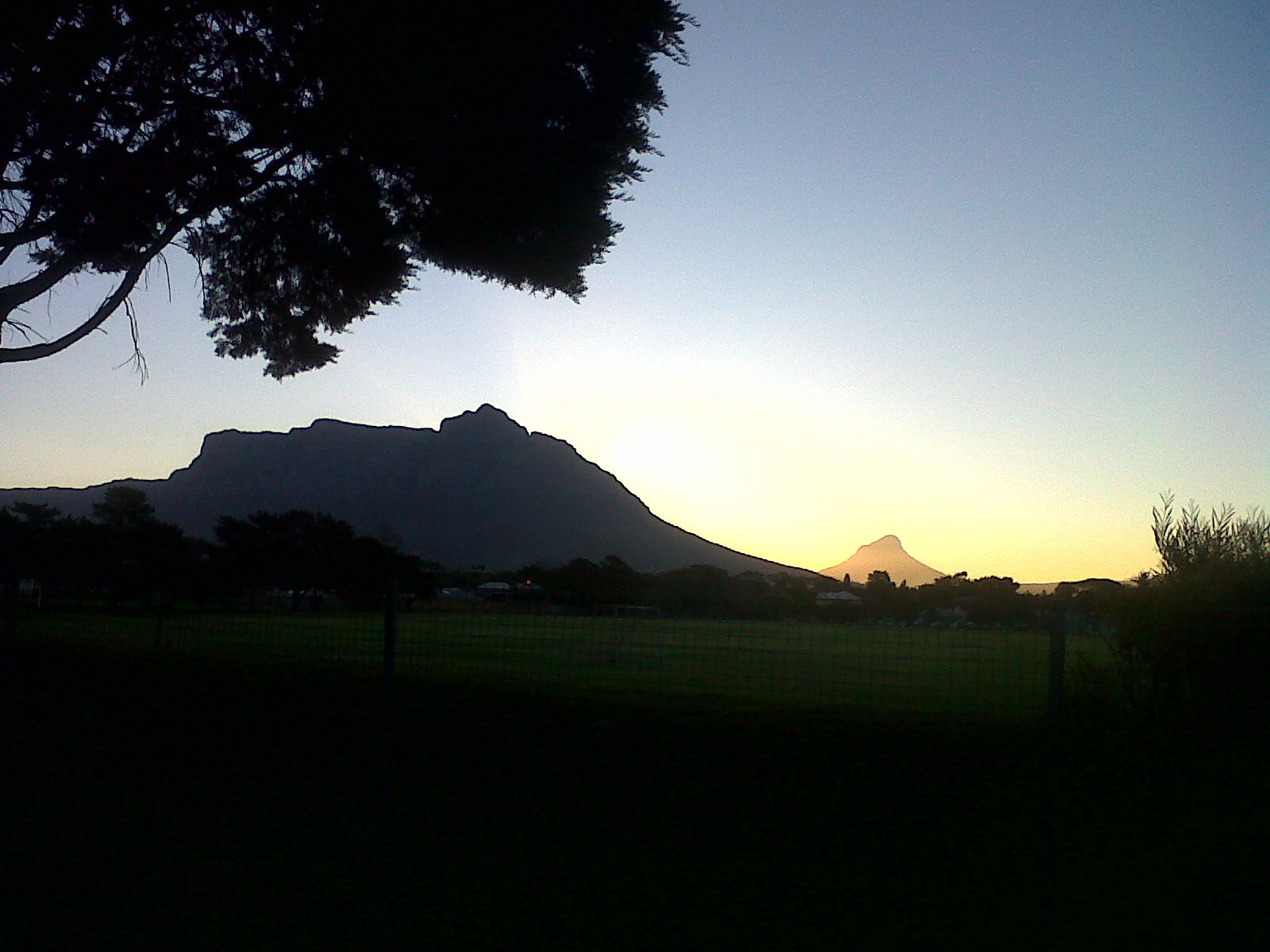
Mountain sunset along one of my walking / running routes.
For this week’s geology picture, I thought I’d share a picture that I took during one of my regular evening walks / runs here in Cape Town, South Africa. This picture shows Table Mountain and Lion’s Head, one of our localinselbergs, at sunset. I feel very fortunate to live in a city with such impressive and beautiful geology.
One of my favorite new songs is “Pompeii” by the UK band Bastille. I’m not sure how popular this song is in the USA, but in the UK and also here in South Africa it’s quite popular at the moment. If you haven’t heard the song yet, please take a listen.
The song has a geological theme and makes reference to the famous eruption of Mt. Vesuvius in AD 79, which destroyed and buried the Roman cities of Pompeii and Herculaneum. Here are the lyrics:
I was left to my own devices
Many days fell away with nothing to show
And the walls kept tumbling down
In the city that we love
Great clouds roll over the hills
Bringing darkness from above
But if you close your eyes,
Does it almost feel like
Nothing changed at all?
And if you close your eyes,
Does it almost feel like
You’ve been here before?
How am I gonna be an optimist about this?
How am I gonna be an optimist about this?
We were caught up and lost in all of our vices
In your pose as the dust settles around us
And the walls kept tumbling down
In the city that we love
Great clouds roll over the hills
Bringing darkness from above
But if you close your eyes,
Does it almost feel like
Nothing changed at all?
And if you close your eyes,
Does it almost feel like
You’ve been here before?
How am I gonna be an optimist about this?
How am I gonna be an optimist about this?
If you close your eyes
Oh where do we begin?
The rubble or our sins?
Oh where do we begin?
The rubble or our sins?
And the walls kept tumbling down
In the city that we love
Great clouds roll over the hills
Bringing darkness from above
But if you close your eyes,
Does it almost feel like
Nothing changed at all?
And if you close your eyes,
Does it almost feel like
You’ve been here before?
How am I gonna be an optimist about this?
How am I gonna be an optimist about this?
I really like this song. The music is nice, and I also appreciate the lyrics. I am sure that there is metaphor and that there are many ways to interpret the lyrics, but for me the lyrics of “Pompeii” express what it must feel like to be suddenly caught up in a devastating volcanic eruption– or any sudden natural disaster. The environment around you changes so quickly and so shockingly that you are left in a state of disbelief. Your mind can’t keep up. You feel, almost, that if you closed your eyes and opened them again everything would return to normal.
What do you think of the song? Does anyone else have geology-themed songs they enjoy? Perhaps we can start a geoblogging meme!
First of all, I want to apologize to my readers that blogging here on Georneys has been somewhat light over the past several weeks. There are a couple of reasons why.
The first reason is that my work as a geologist for a marine gold exploration company has been very busy. Work has been going very well, but as a new industry geologist I’ve been working hard to learn as much as possible and keep up with the work load. However, I’m really enjoying my job and feel extremely grateful to have found a good place for me to do what I love– geology.
The second reason is that a few weeks ago I was home alone in Cape Town, South Africa when robbers brazenly broke into the flat. I was not physically harmed, but I lost my laptop and was quite shaken by the experience. So, I’ve been resting and recovering. I had trouble sleeping for awhile, but I am slowly but surely returning to normal. My husband and I are in the process of installing some additional security– an unfortunate necessity here in South Africa. We’ve also bought extra hard drives and have signed up for on-line back-up (hard drive back-ups don’t help when the thieves steal hard drives, too!). I had a full computer back-up (carefully hidden away!) that was a couple of months old, but I did lose some vacation and geology pictures and a few other things. Everyone, please remember to back up your computers often! It’s heartbreaking to lose things when your laptop is stolen or when it crashes.
Second of all, I want to give you a preview of something to come here on Georneys: pictures and some guest posts by my husband Jackie, who is currently pursuing his masters degree in Exploration Geology at Rhodes University in Grahamstown, South Africa. Jackie is working on his degree part-time over 2-3 years. There are two field trips associated with the degree, and Jackie is currently on the first field trip. He’s been visiting some amazing geological places throughout South Africa and has been taking plenty of pictures.
Below are a few pictures from Jackie’s field trip. Captions are courtesy of Jackie. These pictures are just from a BlackBerry phone– when my husband returns in a week or so, he’ll download the pictures from the proper camera. I can’t wait to see those!
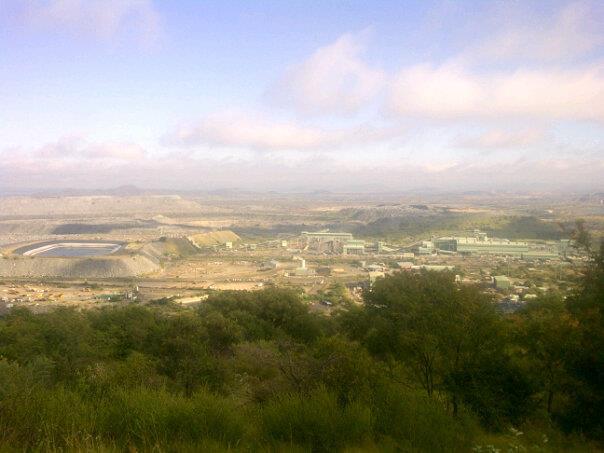
The Bushveld Complex: UG1 chromitite seams in anorthosite. A geological wonder!Mgolokwena open-pit platinum mine.Molokwane North open pit (at Mgolokwena).
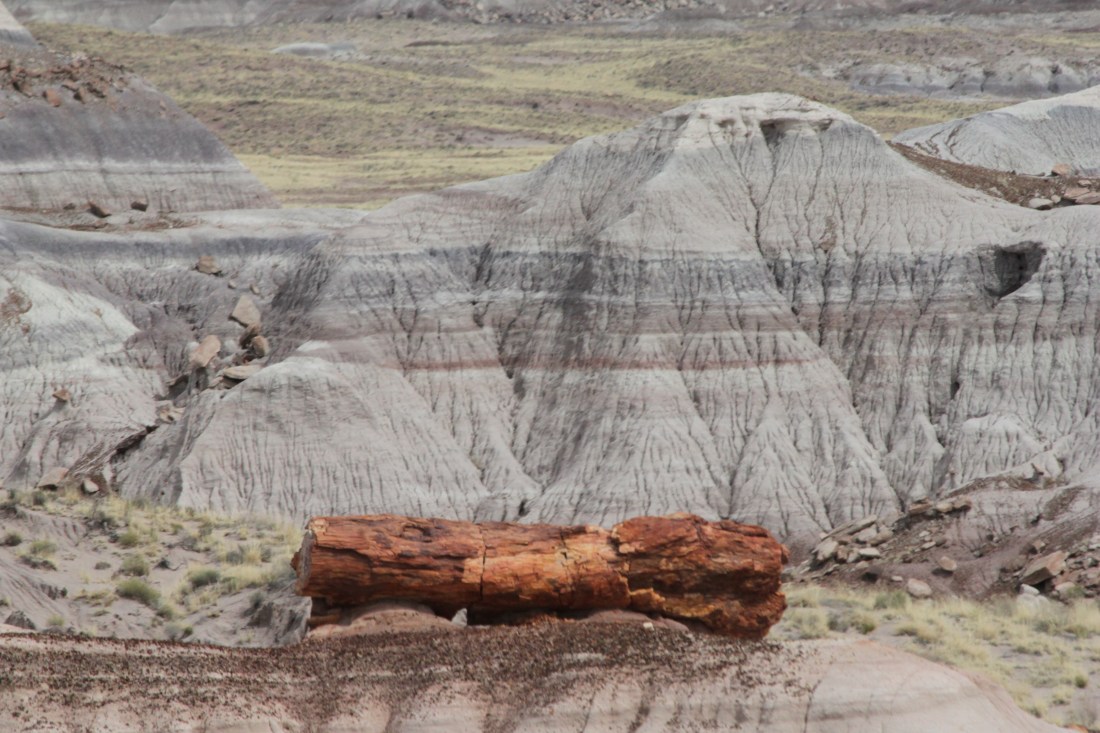
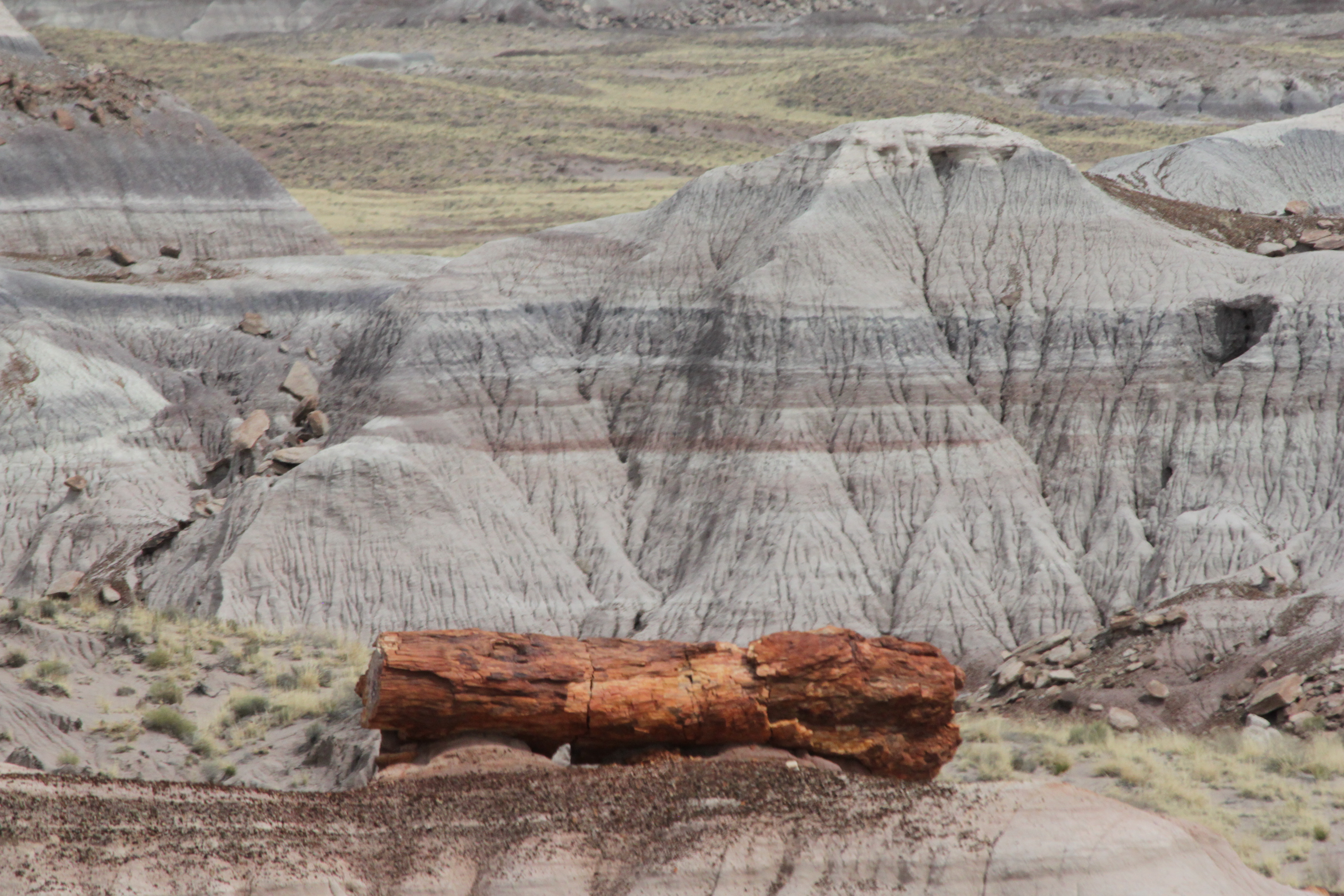
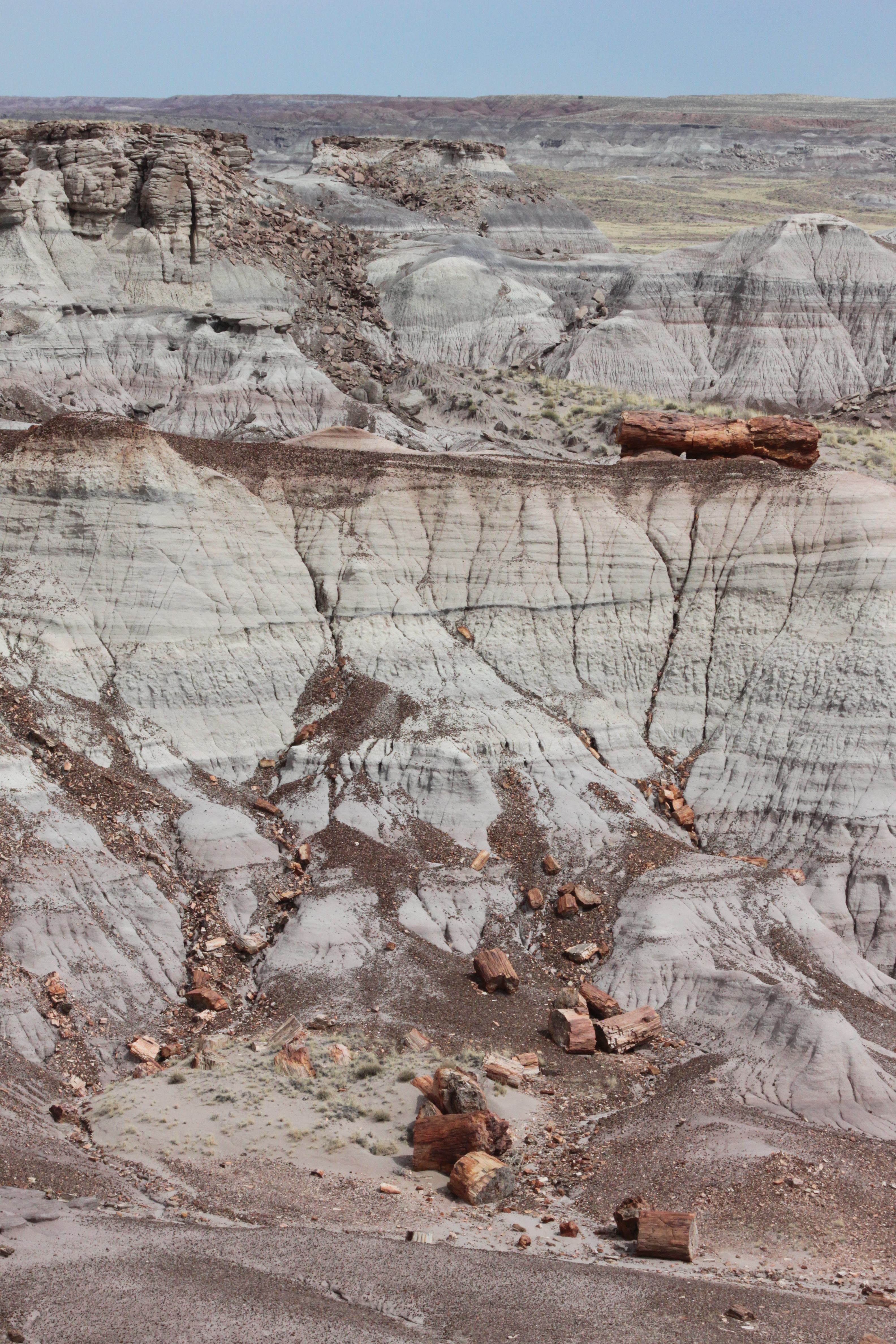
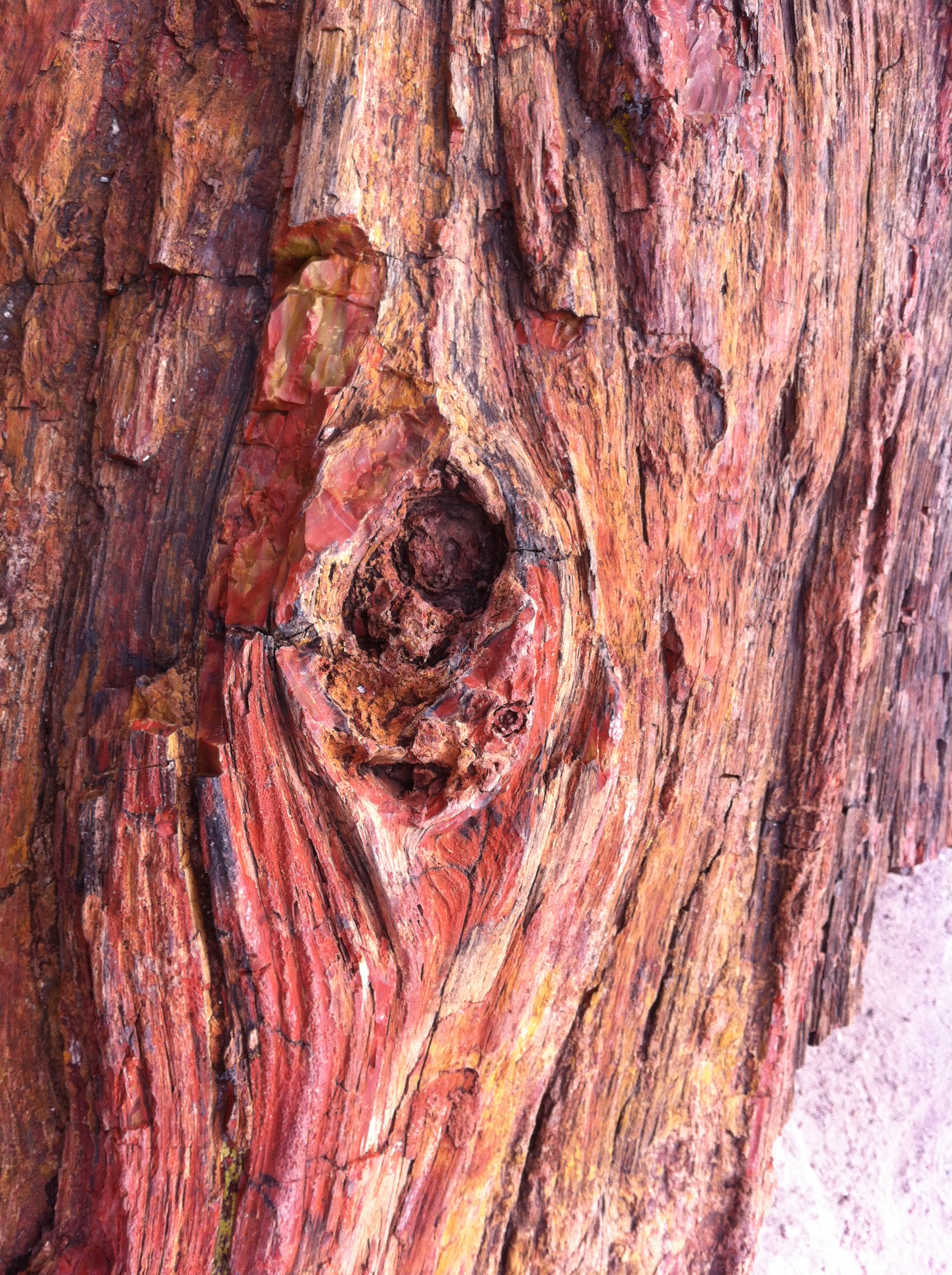
My friend Ray recently visited Petrified Forest National Park in Arizona and was kind enough to send me some of his gorgeous pictures of the landscape, including the petrified trees. Ray says that these pictures were all taken along the Blue Mesa Loop. These fossilized trees are about 225 million years old! They are weathering out of the Chinle Formation, a beautiful Triassic sedimentary unit. I’ve never visited this park, but it’s now very high on my list of geological places I’d like to visit!
Thanks for sharing some pictures here on Georneys, Ray!
Petrified Forest National Park #2.Petrified Forest National Park #3.Petrified Forest National Park #4.
Old mining picture in the Gold Reef City museum. Looks like hard work!
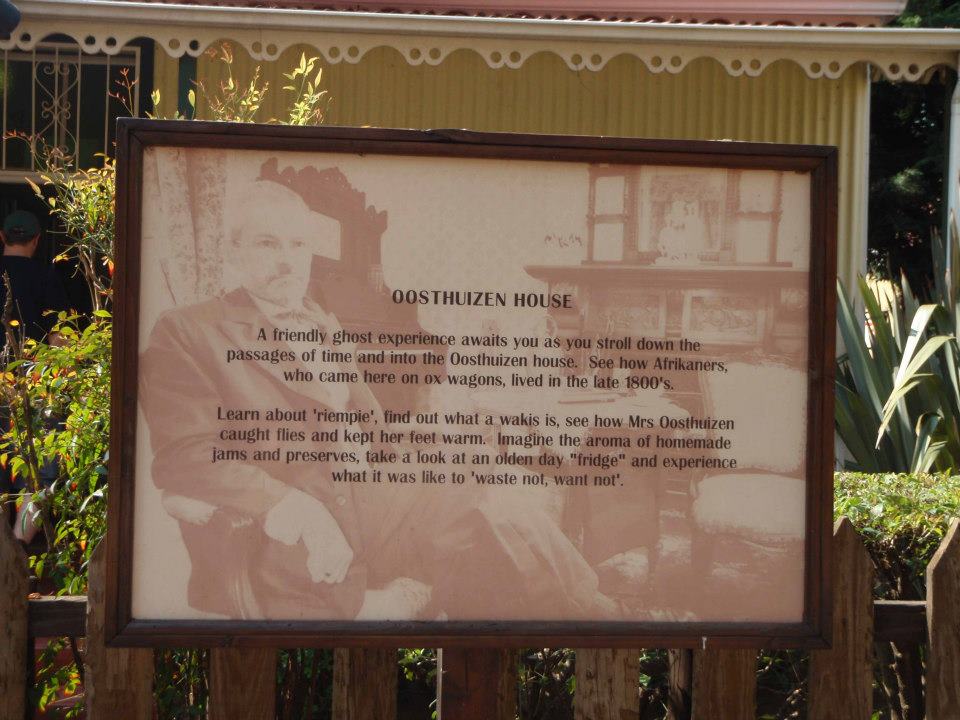
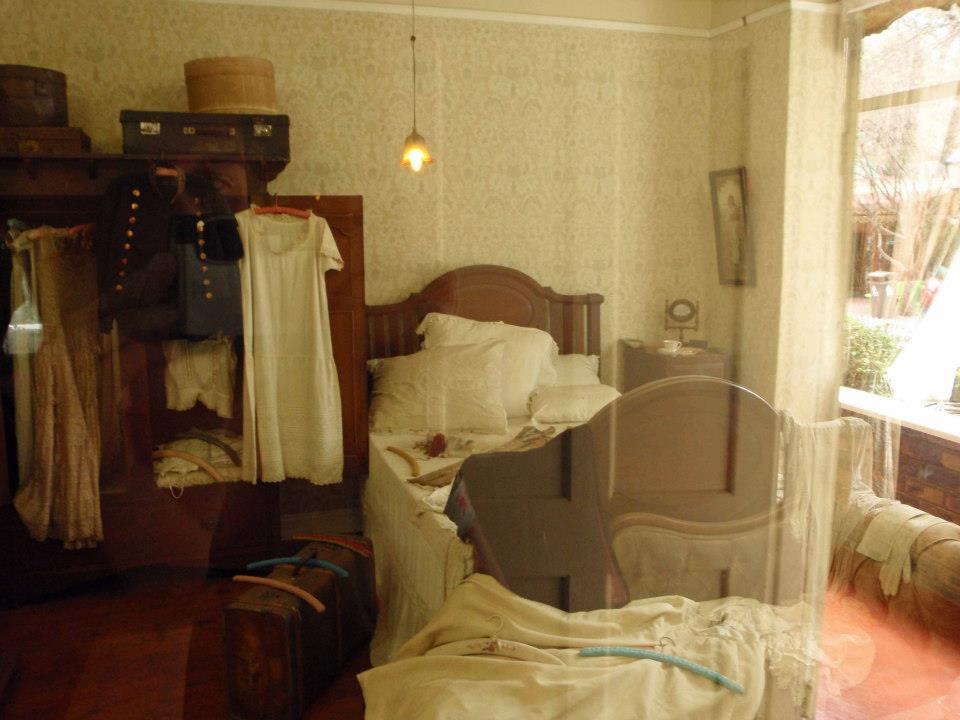
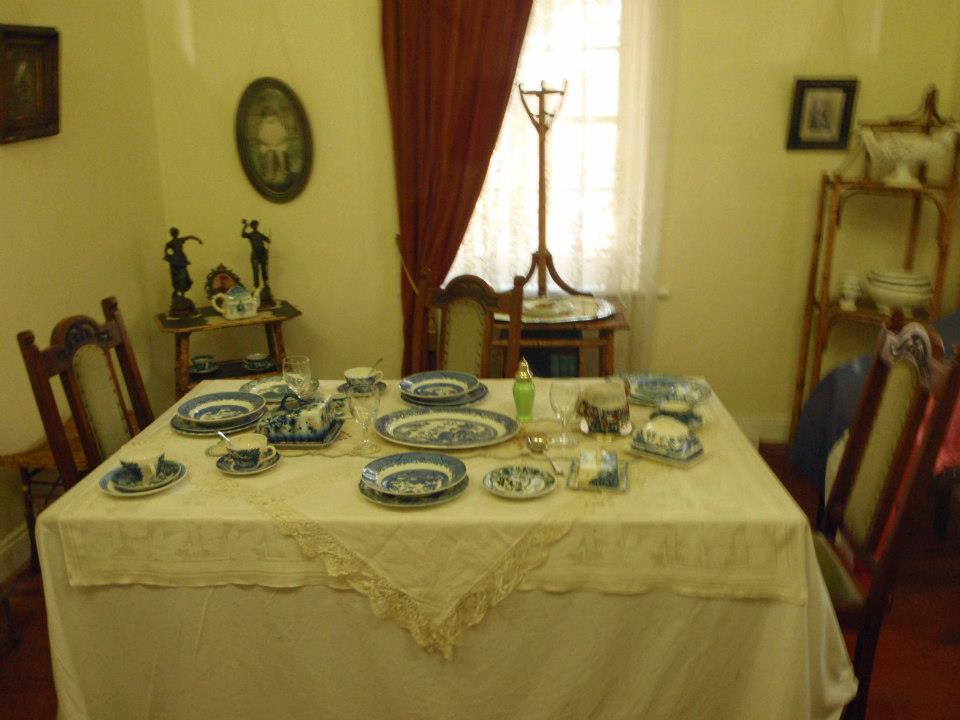
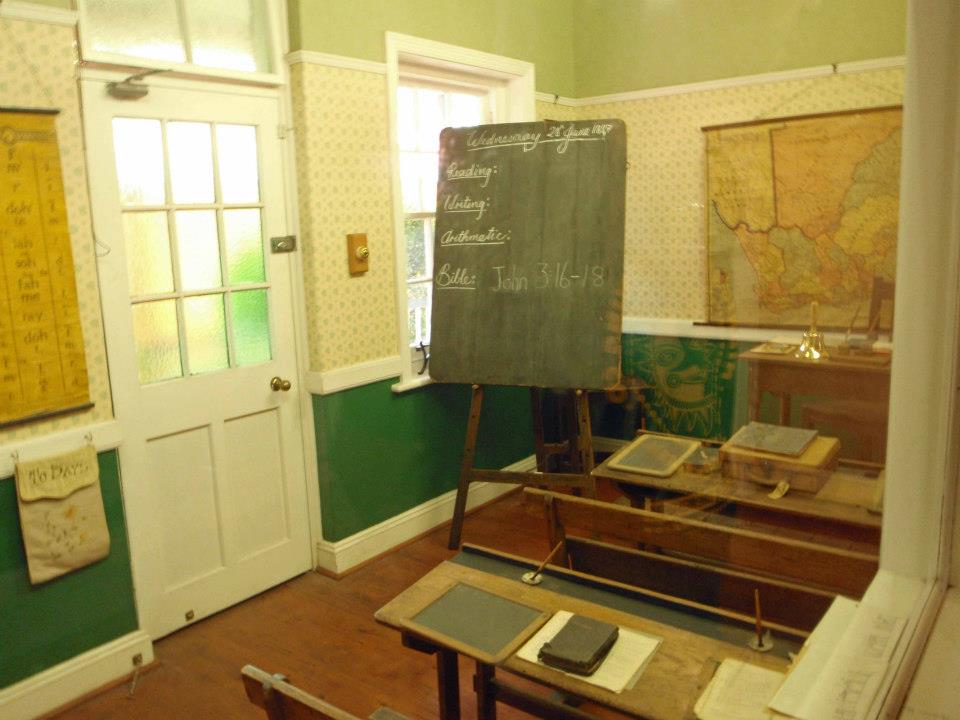
This week I’m sharing the last pictures from my September 2012 visit to Gold Reef City, Gold Reef City, a gold mining themed amusement park in Johannesburg, South Africa. The amusement park is built on the site of an old gold mine, and these pictures provide some insight into what life was like on the mine in days gone by. There is a museum with some pictures and information on what life was like for the miners– it wasn’t always great, by any means. There are also some historical buildings that were used by the mine supervisors and their families. These buildings are filled with historical artifacts. The museum and historical houses weren’t particularly crowded– I guess the rides are much more attractive than the history, which is a shame.
Another picture in the museum.A recreation of some of the mineworkers' quarters. Doesn't look very comfortable!My husband Jackie in front of one of the old houses that belonged to the mine managers / bosses.A sign in front of one of the historical houses.Another sign in front of another historical house.Inside one of the houses.Another view of the room. This bed looks much more comfortable than where the mineworkers slept!A dining room table. I really like Willow Ware plates such as the ones on the table.An old classroom.
I hope you’ve enjoyed all the pictures from Gold Reef City. If you ever find yourself in Johannesburg, I definitely recommend a visit to the park.


















 Georneys