Picture of a cave that formed in a karst landscape. Picture taken at Howe Caverns, New York State, by myself.
Several years ago, I used to write a “Geology Word of the Week” post in which I selected a word used by geologists, wrote a definition of the word, and wrote up a post with some information and pictures related to the word. I went through the alphabet in order twice, writing about words starting with letters from A to Z, and then I started a third run through the alphabet, stopping at my last post J is for Jasper back in 2015. Many people enjoyed my geology word posts, but eventually life became too busy for me to keep up the posts. Since 2015 I’ve obtained an M.Sc. degree in Carbon Management, moved countries, changed jobs twice, and had a child… all while working full-time during a global pandemic! Life is still very busy, but it isn’t quite as busy as it used to be.
For awhile, I’ve been thinking about reviving my weekly geology word posts… and I’ve decided that this year I will do so! I will do my best to post about a geology word every week. I may keep some of the posts a bit shorter than I used to, but I think they will still be informative.
Without further ado, here is the first word for 2023…
def. Karst:
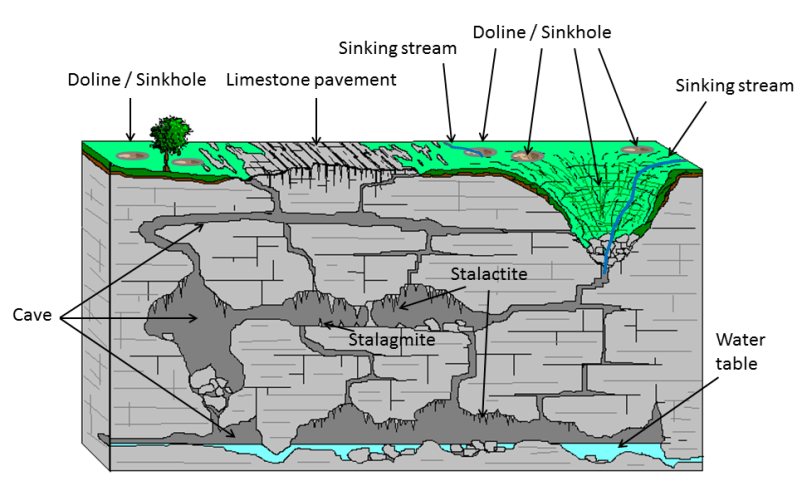
A type of topography or landscape characterized by the dissolution of soluble rocks, such as limestone and dolomite. The dissolution of the rocks leads to the formation of landforms such as sinkholes, caves, and springs. Water is often stored underground in karst landscapes, and thus they can form aquifers that provide sources of water for humans and animals. The sinkholes that form in karst environments are geological hazards that must be monitored and managed.
Here is a great figure showing some typical features of a karst landscape:
Most karst landscapes form in carbonate rocks, such as limestone or dolomite. In these rocks, the dissolution is caused by weak carbonic acid that forms when rainwater picks up carbon dioxide from the atmosphere and soil. In the open spaces of caves that form underground, the carbon dioxide in the water can be released, which causes the formation of speleothems, such as stalactites and stalagmites. If you’ve ever been in a cave with stalactites and stalagmites, then you’ve been in a karst landscape.
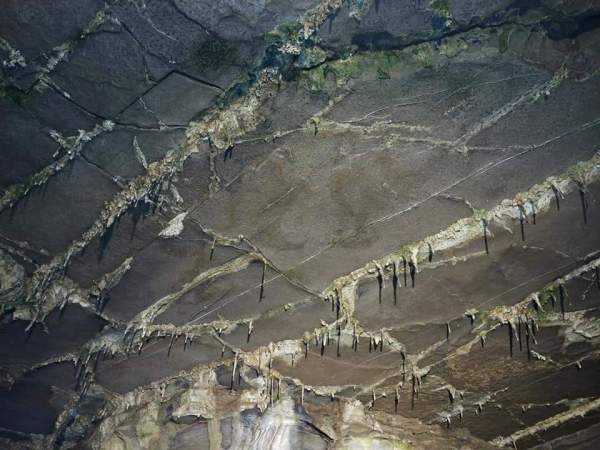
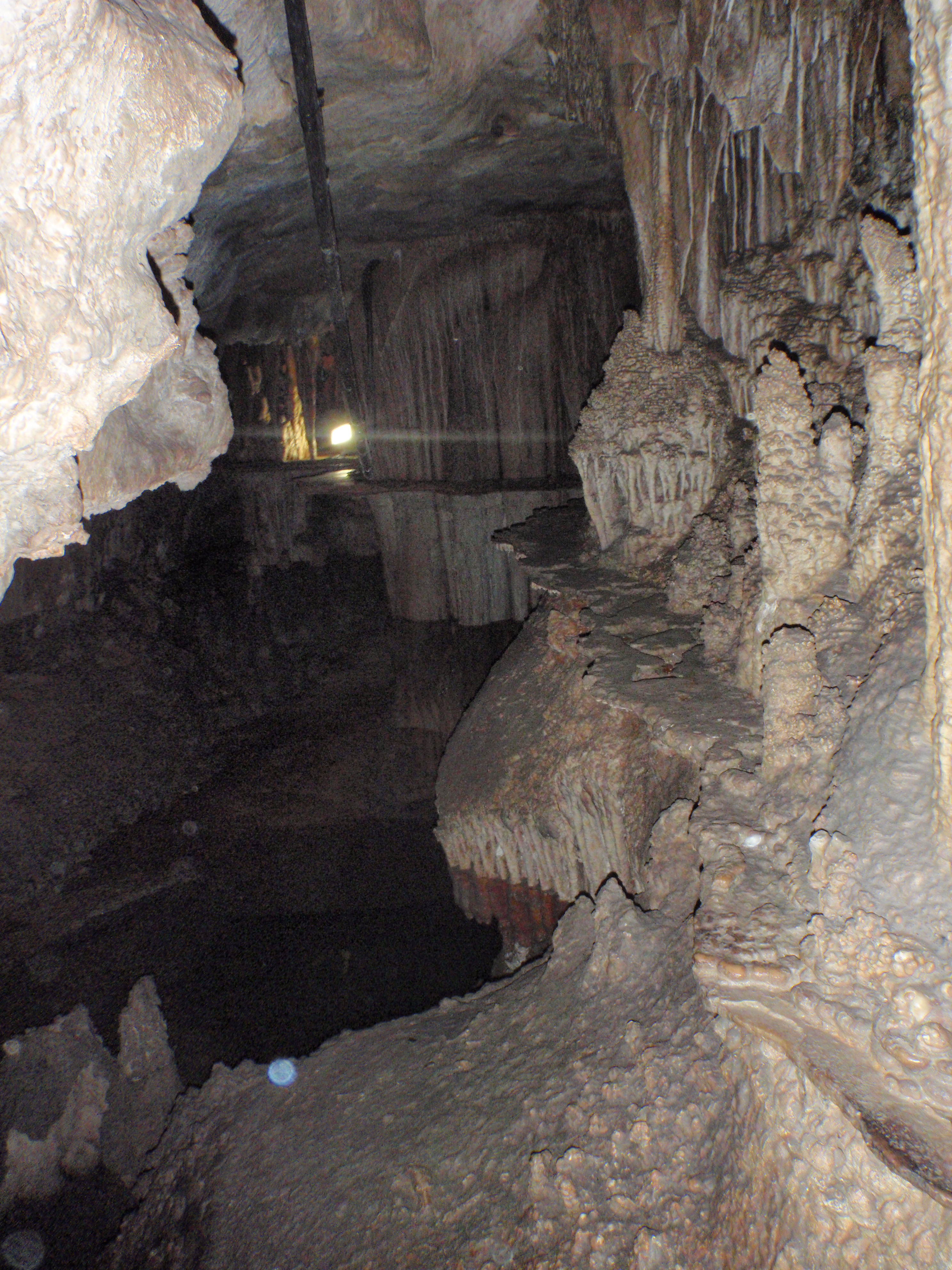
Below are a few pictures from Howe Caverns, a limestone cave in New York State that I recently visited with my family. You can visit an underground lake in this cave – and you can even take a boat ride on the lake! If you want to see a karst landscape up close, then I recommend a visit to Howe Caverns or another cave system.
Stalactites forming at Howe Caverns, New York State. Picture by myself.
Speleothems and other cave rocks reflected in an underground river at Howes Caverns, New York State. Picture by myself.
Gorgeous speleothems at Howe Caverns, New York State. Picture by myself.
Pictures of the boats you can take on the underground lake at Howe Caverns, New York State. Picture by myself.
That’s all for this week’s word. Stay tuned for next week!
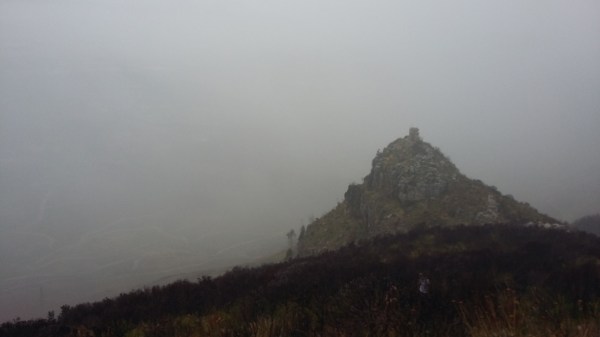
On Monday I shared one picture from a recent hike to Elephant’s Eye cave in Silvermine Nature Reserve here in the Cape Town region of South Africa. Today I’m sharing some more pictures from that hike, which took place last weekend.
I really enjoy hiking to Elephant’s Eye.The hike consists of a fairly easy 3 hour round trip route that takes you through some beautiful fynbos vegetation and past some lovely rock formations in Table Mountain Sandstone. The cave itself is a great destination that provides a nice place for lunch or a snack and, when the weather is clear, a fantastic view of the valley below. Generally, I hike to Elephant’s Eye two or three times a year. However, until last weekend I hadn’t hiked to Elephant’s Eye in well over a year. That’s because much of the Silvermine Nature Reserve was burned during a large forest fire last year. For most of last year, the hike to Elephant’s Eye was closed while the area recovered from the fire. The Elephant’s Eye hiking trial was only opened up again recently.
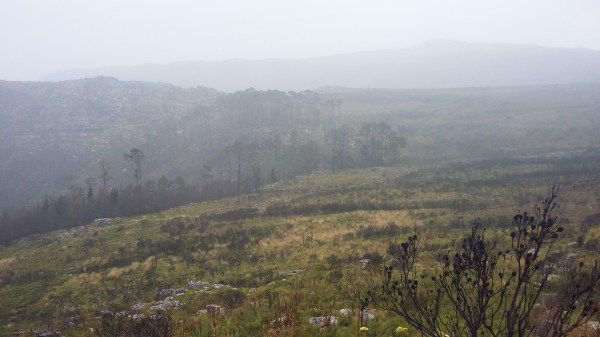
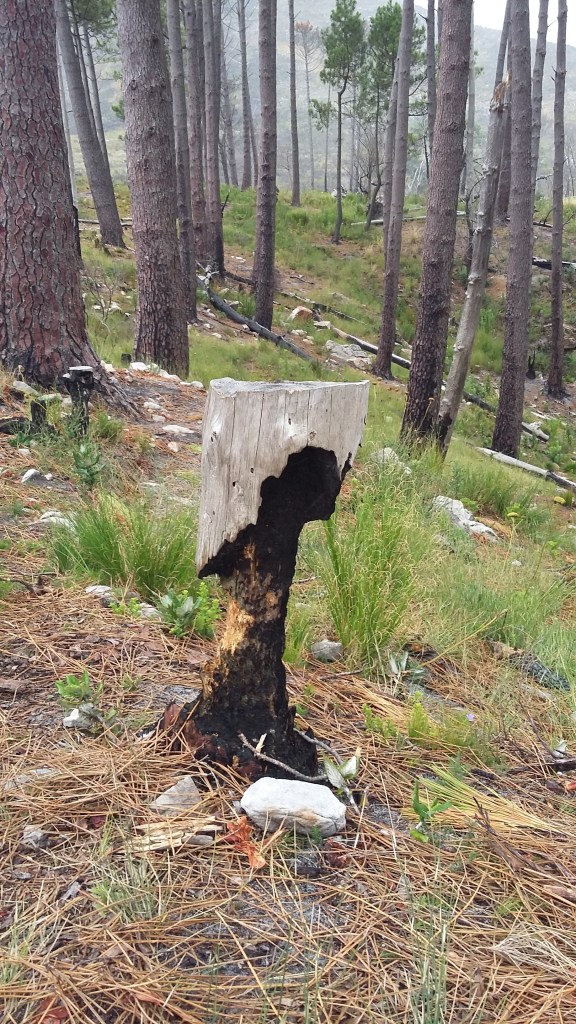
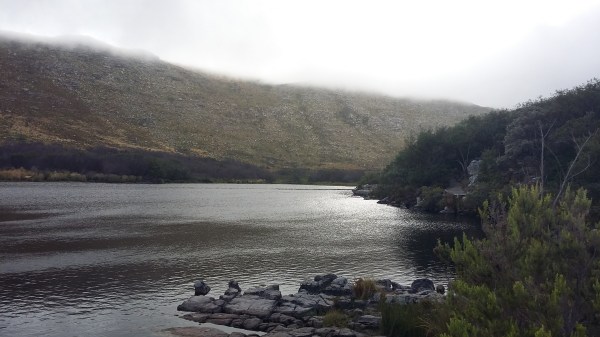
Without further ado, enjoy some pictures from the hike. Note that the weather was rainy and misty for our hike last weekend – however, I enjoyed hiking in the cooler weather. Also note how the vegetation has recovered significantly yet there are still signs of last year’s fire. For example, we saw burned logs and tree stumps amidst fresh green vegetation.
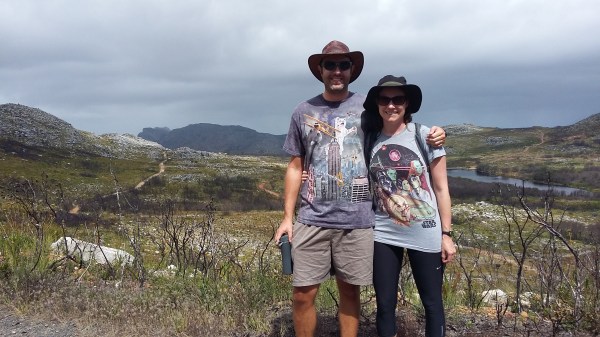
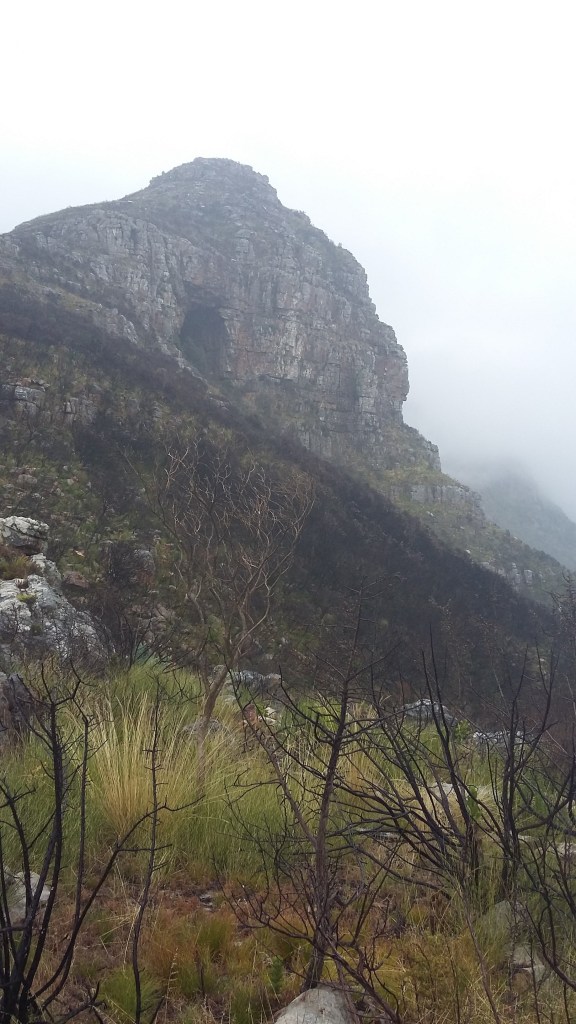
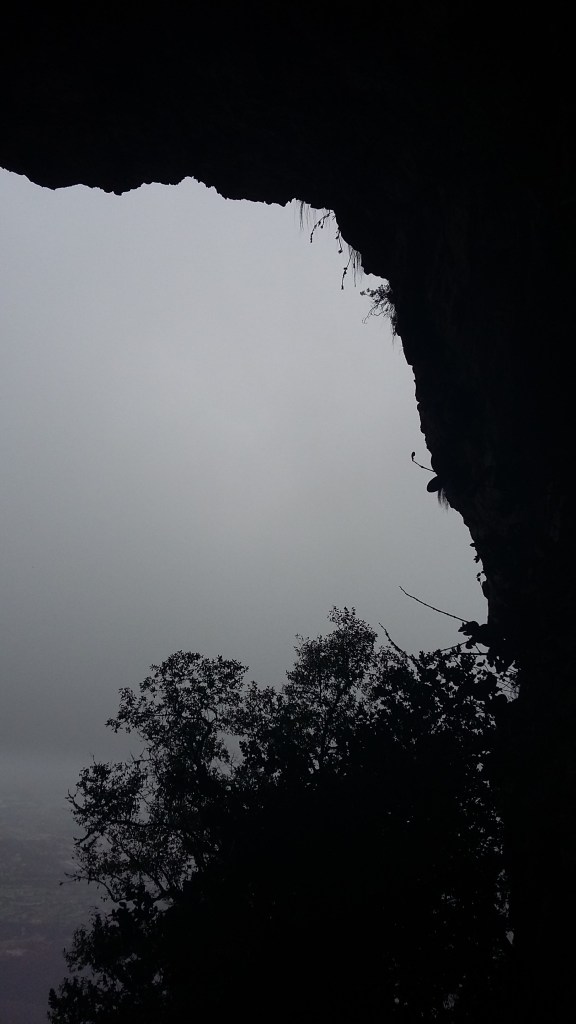
Elephant’s Eye Hike #2.Elephant’s Eye Hike #3. My husband Jackie and I competed for nerdiest t-shirt. My Star Wars t-shirt was pretty amazing, but I think that Jackie won the contest with his “Kitten Kong” t-shirt.Elephant’s Eye Hike #4.Elephant’s Eye Hike #5. A remnant of last year’s forest fire: a burned tree stump.Elephant’s Eye Hike #6. Note a few more charred tree stumps in this picture.Elephant’s Eye Hike #7. Trees and a cliff of Table Mountain Sandstone in the background.Elephant’s Eye Hike #8. Charred logs surrounded by green grass.Elephant’s Eye Hike #9. More charred logs and green grass.Elephant’s Eye Hike #10. The approach to the cave.Elephant’s Eye Hike #11. A misty view of the cave.Elephant’s Eye Hike #12. The cave itself.Elephant’s Eye Hike #13. The view from the cave entrance, shrouded in mist.Elephant’s Eye Hike #14. Another misty view from the cave.Elephant’s Eye Hike #15. We could see a little through the mist.Elephant’s Eye Hike #16. For a few minutes, the mist lifted and we had a lovely view of the valley below.Elephant’s Eye Hike #17. We saw some lovely pink March Lilies – they’re a little early this year!Elephant’s Eye Hike #18. On our way back to the parking lot, we took a small detour and walked past a beautiful lake. Note more charred tree remains here.Elephant’s Eye Hike #19.Elephant’s Eye Hike #20. Water lilies viewed from the bridge.Elephant’s Eye Hike #21. Another view of the water lilies.Elephant’s Eye Hike #22. Yet another view of the water lilies.Elephant’s Eye Hike #23. One last view of the lake as we headed back to the parking lot.
That’s all for now. Stay tuned for more pictures of hikes in the Cape Town area. In August I’ll be backpacking the Fish River Canyon in Namibia with friends, so I’ll be going on a number of training hikes this year. My goal is to hike 2 or 3 times per month. I’m fortunate to live in a part of the world with such lovely hiking trails!
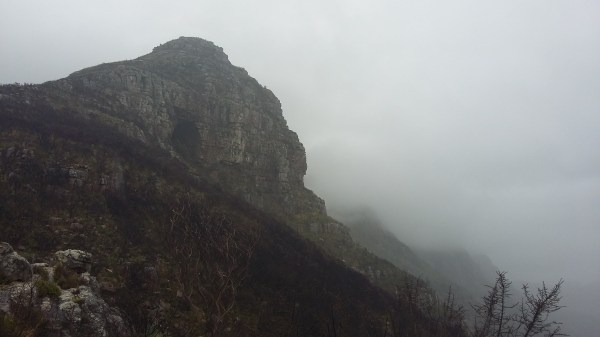
Elephant’s Eye on a rainy Saturday in February 2016.
This week’s “Monday Geology Picture” post features a natural rock formation that resembles an elephant. A small cave named “Elephant’s Eye” is located at the eye of this rock elephant’s head. The elephant consists of Table Mountain Sandstone and is located in the Silvermine Nature Reserve here in the Cape Town region of South Africa. On Saturday I hiked up to Elephant’s Eye with some friends. We hiked on a rare rainy summer day, and we appreciated the cooler weather for our hiking. The scenery on our hike was ethereal and beautiful, although we didn’t have much of a view from the top of the hill! We mostly saw mist. I’ll share some more pictures from our hike later this week.
Like my fellow geoblogger Jessica Ball, I wish that I could be a geologist on Star Trek. I can think of no better, more exciting job than traveling the universe as a geological researcher for the United Federation of Planets. Sign me up, Starfleet!
Maybe one day in my life– or in my children’s or grandchildren’s lives– there will be opportunities for Earth geologists to travel to other planets and planetary bodies. Already, there are hundreds (thousands?) of geologists who work in the exciting field of Planetary Geology. However, today planetary geologists primarily rely upon remote sensing, rovers (on Mars and Earth’s moon), and little bits of space rock that fall to Earth to understand the geology of other planets and planetary bodies. While several humans have walked on the moon, only one geologist (Harrison Schmidt) has walked on the moon.
A few years ago I became interested in Star Trek after watching a few episodes of The Next Generation with some friends in graduate school. Now my husband and I are hooked on Star Trek. We’re currently watching Season 6 of The Next Generation, and I’m also watching Season 2 of Deep Space Nine (so that I have something to watch when my husband is away. He’s forbidden me from watching TNG without him). I’m contemplating buying a Star Trek uniform costume and visiting a Star Trek convention. Any suggestions, for either the uniform or a convention? Are there ever Star Trek conventions in Africa? Also, my husband and I (and also our friend Mo, a fellow Star Trek fan) have already penciled in a visit in 2014/2015 to the Star Trek theme park currently being built in Jordan.
I like Star Trek for many reasons, one of which is the favorable light in which science is portrayed on the show and also the rational way in which science (even if it’s fake “Star Trek science”) is used an explanation for mysterious phenomena which occur on the show. However, the science on Star Trek is often not real science. That is, the scientific explanations on the show are sometimes inaccurate– or at least apply a bit of poetic license to a scientific fact or theory. Also, much of the show’s technology, such as teleportation and warp drive, is not currently scientifically feasible. I recently learned about a book written by Lawrence Krauss called The Physics of Star Trek (next in the queue on my Kindle reading list!) that goes into some of the physics shown on the show.
After I heard about Krauss’s book, I thought to myself: why not write about the geology of Star Trek? This is the first post in what may become a series of posts about the geology of Star Trek. In this post I am going to point out some of the geological inaccuracies of a particular episode, but I hope that these posts will not always be about nit-picking the scientific details. I hope that the geology of Star Trek, even if sometimes scientifically inaccurate, can inspire some young people (myself included, perhaps?) to learn more about planetary geology and geology in general.
I can imagine several topics of interest regarding the geology of Star Trek:
-Types of planets encountered on Star Trek
-Geology of non-Earth-like planets
-Terraforming planets for settlement
-Geoengineering of environment (atmosphere, climate, weather, soil, etc.) and of plate tectonics
-Diversion of meteoroids / comets / asteroids from impact with inhabited planets and planetary bodies
-Volcanic activity of Star Trek planets
-Best geologic lairs for Vulcans, Klingons, Romulans, Cardassians, and other Star Trek species
-Building stones seen/used on Star Trek
-Magnetic fields of Star Trek planets
-Atmospheres of Star Trek planets
-Geochemistry of Star Trek. If it hasn’t been done already, someone should really come up with a Star Trek periodic table. Which element names mentioned on the show are real and which are made up?
-Tools of Star Trek geologists (Do they just need tricorders? What geologic measurements can be made with a tricorder? Why didn’t I have a tricorder for my PhD thesis research?)
-Various mining operations shown in Star Trek
-What are those dilithium crystals made of, anyway?
Perhaps my blog readers can suggest additional topics?
Now that I’ve introduced “The Geology of Star Trek” series, let me move on to my first topic of discussion. In this post, I’d like to talk a little about the geology of a cave shown in the Star Trek: The Next Generation episode “Chain of Command, Part I.” In this episode, Captain Jean-Luc Picard, Chief Medical Officer Beverly Crusher, and Lieutenant Worf are sent on a covert mission to the Cardassian planet Celtris III to destroy a biological weapons facility. The facility is supposedly located in a deep underground cave. Decked out in black with various spy gear, Picard, Crusher, and Worf make their way through the cave to the supposed location of the weapons facility. When they arrive, they discover that there is no biological weapons facility. Rather, the intelligence about the supposed facility was leaked by the Cardassians as a trap to capture Picard. The episode ends with Picard being taken away by the Cardassians as Crusher and Worf escape.
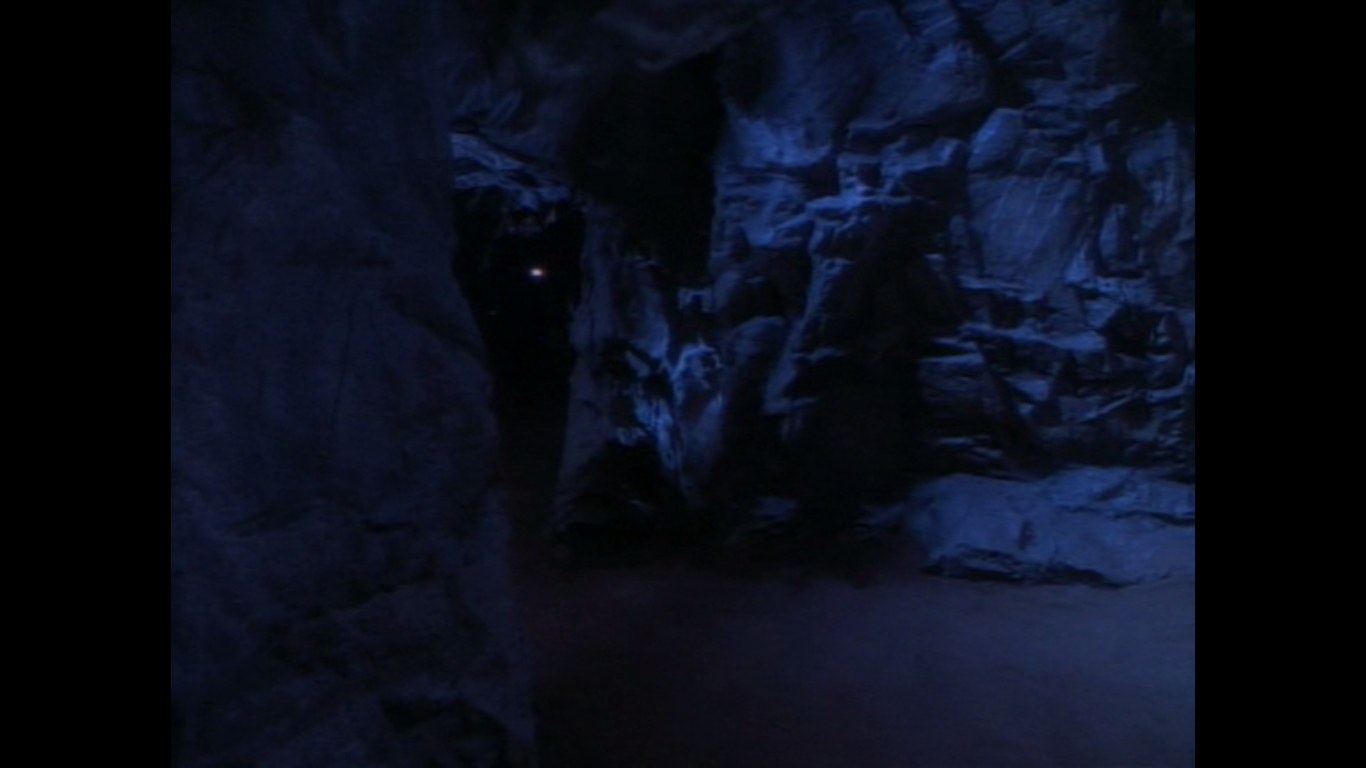
Sneaking through the cave on Celtris III.
The overall plot of this particular Star Trek episode is excellent, but the geology of the cave on Celtris III is somewhat implausible. I suspect that many of the walls of the “cave” are artificial and part of a Hollywood sound stage set-up. Some views of the cave interior also seem to feature painted backgrounds or special effects. Fake and painted rocks aside, however, there are still some fundamental problems and inconsistences with the geology of the cave.
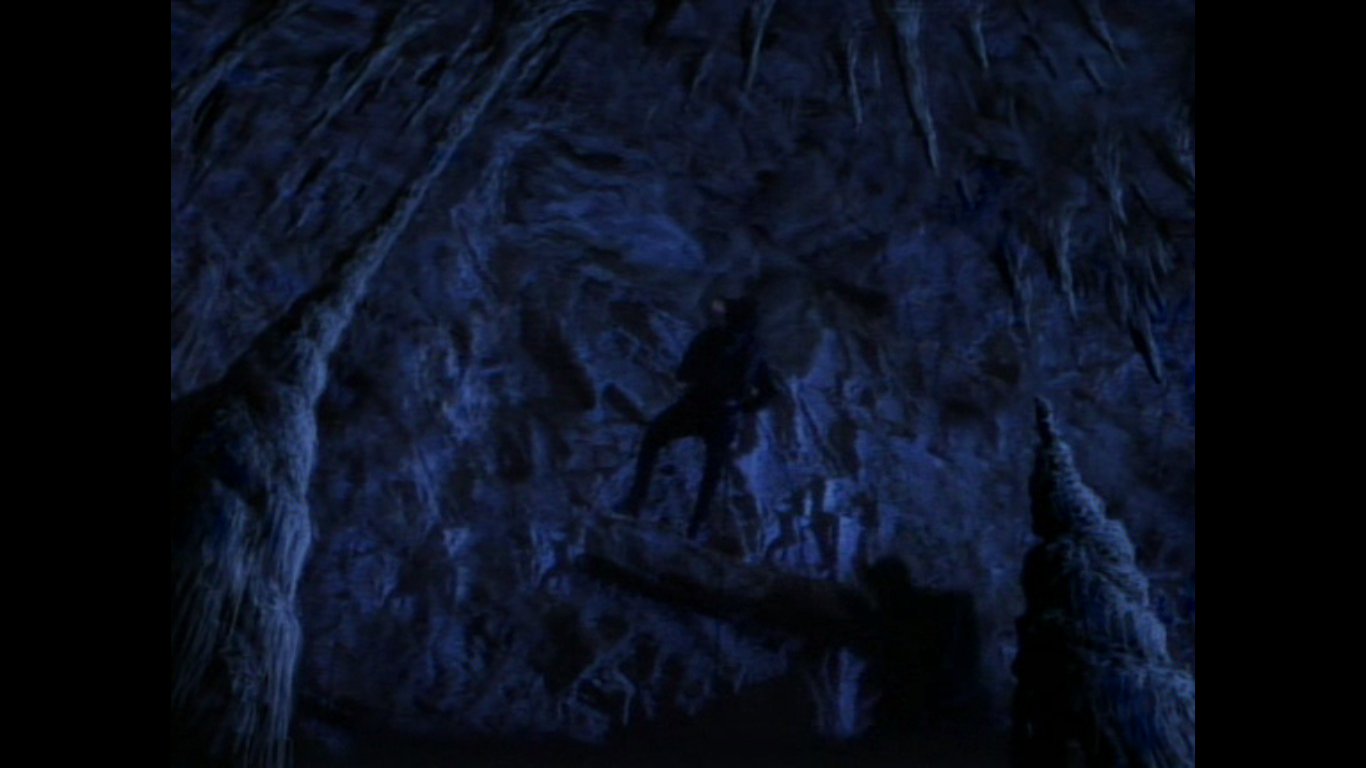
For example, after reaching a steep drop in the cave, Picard says, “We’ll have to rappel from here. This is sheer granite. We’ll have to use fusing pitons.”
"This is sheer granite. We'll have to use fusing pitons."
Granite caves are not unheard of, but they are somewhat unusual. Caves are most commonly formed as solutional caves in soft, easily dissolved and re-precipitated rocks such as limestone, dolomite, and halite. The re-precipitation of minerals such calcite forms speleothems, including stalagtites and stalagmites, that are commonly found in solutional caves. Granite is a very hard rock that is not easily dissolved and re-precipitated. Therefore, solutional caves are not going to form in granite, and granite caves are not going to contain significant speleothem precipitates. The most common type of cave that forms in granite is an erosional cave, a type of cave that forms when flowing water (a stream or possible seawater) erodes rock to form a cave. Some granite caves also may form by seismic activity.
So far, I’m willing to buy that Picard, Crusher, and Worf are in a granite cave. A close-up shot of a fusing piton being inserted even makes the rock (or fake rock) look pretty similar to granite:
The rock looks granite-ish to me. Or maybe rhyolite-ish with phenocrysts.
However, the next few shots show that the “granite” cave has abundant speleothems, which would rarely (never?) occur in a granite cave! The big speleothems look much more similar to what would be seen in a classic limestone solutional cave:
Picard contemplates the cave, which now looks like a limestone cave!Rapelling down a wall in the granite/limestone cave.
After Picard, Crusher, and Worf repel (500 meters, according to the dialogue) down the wall of the “granite” cave and continue walking along, they reach a solid wall and cannot progress any farther. Fortunately, Picard is able to tell with his tricorder that, “There’s a lava tube beyond here [the wall] that runs for 75 meters, and it connects with another chamber. We need to get through here.”
Investigating the rock wall with tricorders.
Hang on a minute! Aren’t Picard, Crusher, and Worf supposed to be in a granite cave (that strangely resembles a limestone cave in some shots)? Lava tubes are a common type of cave, but they aren’t going to be found in a granite cave, and they are very unlikely to be found at 700 meters depth (in one of the early cave scenes Picard notes that the supposed weapons facility is located ~700 meters depth, and the lava tube seems to connect very close to the supposed weapons facility cavern).
For those of you who are not familair, let me explain a little bit about igneous rocks. Igneous rocks are rocks which form from molten material, which is called magma in the subsurface and lava on the Earth’s surface. There are two types of igneous rocks: plutonic rocks (which form in the subsurface from magma) and volcanic rocks (which form on Earth’s surface from lava). Granite is one type of plutonic igneous rock. A common volcanic rock is basalt.
Lava tubes are common primary caves, but they are found close to Earth’s surface, not at 700 meters depth! Furthermore, lava tubes may sometimes be connected to other lava tubes or types of volcanic primary caves, but they are rarely connected to extensive networks of caverns. Since granite is a plutonic rock and not a volcanic rock, it is impossible for a lava tube to form in granite.
To sum up, there are three geological issues with the cave featured in this Star Trek episode:
1. Granite caves are uncommon.
2. Granite caves do not generally contain speleothems such as stalagtites and stalagmites. These are generally a feature of solutional caves in rocks such as limestone.
3. Lave tubes are not found in granite caves and not found in caves at depth. This is because (a.) granite does not form from lava, and (b.) lava flows on Earth’s surface.
Bad geology aside, I do think that it’s pretty cool that Picard, Crusher, and Worf can map out the cave with their tricorders and that Worf can conveniently cut through a rock wall to the hidden lava (err… granite? limestone?) tube by using his phaser. Just check this out:
Phaser versus cave wall #1.Phaser versus rock wall #2.The "lava tube" revealed!Crawling through the "lava tube."
If anyone has an extra tricorder and phaser lying around, could you please send them to me for my upcoming geologic fieldwork in Alaska? Thanks!
I haven’t yet received a reply to my letter to Dr. Sheldon Cooper about why geology is a real and valuable science and why caves are interesting, but that’s okay. For those of you who agree that caves are interesting, I thought I’d share some pictures from my most recent spelunking trip.
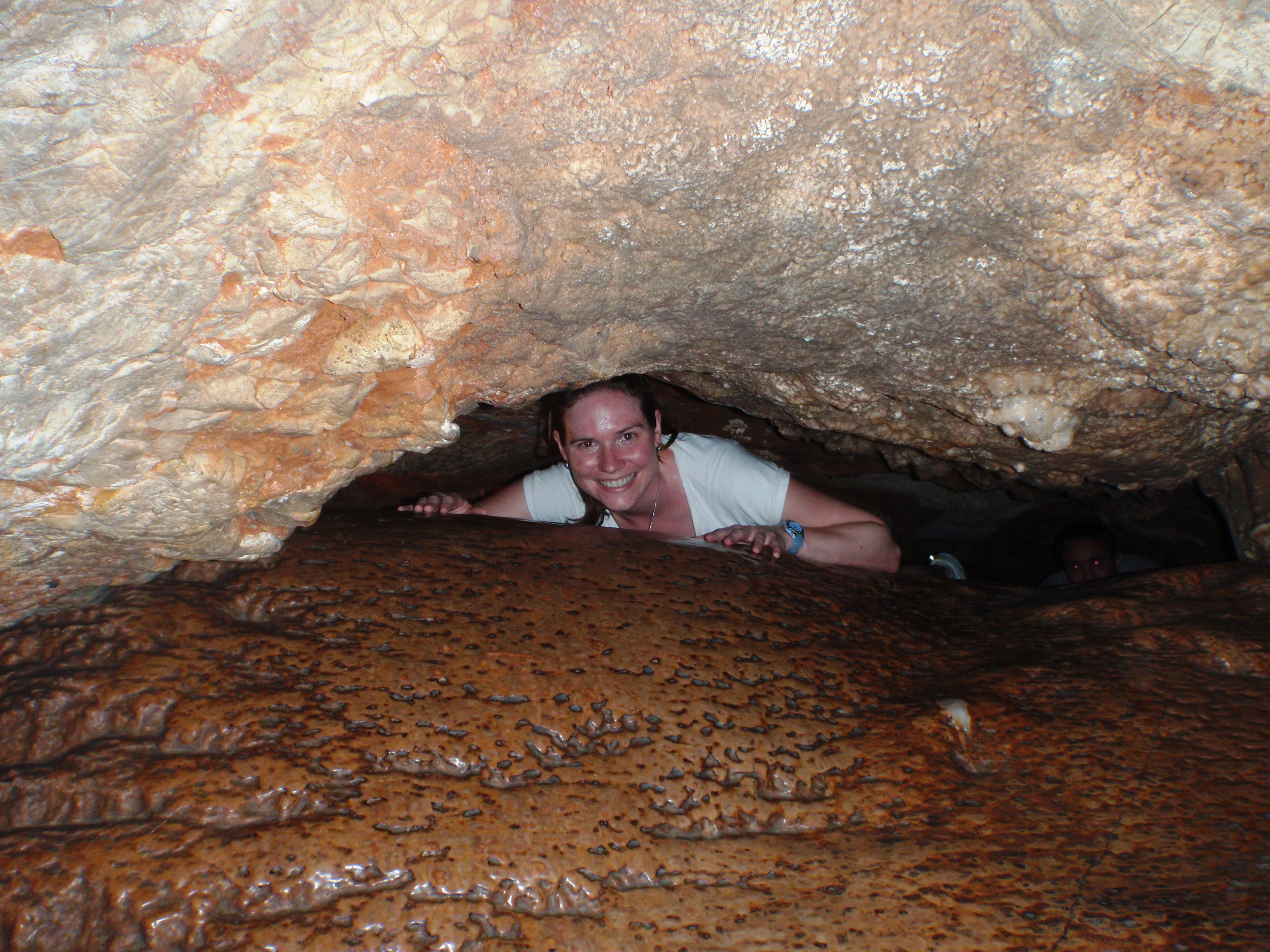
Back in September, my husband and I took a weekend trip to Outdshoorn, South Africa, where I rode an Ostrich and also saw some weatherstones. We also visited the Cango Caves, a large, beautiful, and impressive network of limestone caves. We visited the excellent (though slightly worn-down) geology exhibit at the Interpretive Center (or Centre, to be properly South African) and then went on a guided tour of the caves. We decided to go on the “Adventure Tour.” We were pleasantly surprised to discover that the “Adventure Tour” is actually fairly adventurous, even for two adventurous geologists! My 6’3″ husband actually had some trouble making his way through some of the tight squeezes.
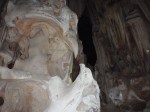
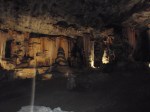
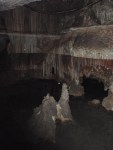
Below are some pictures (albeit not the best since they were taken with a waterproof point-and-shoot camera) from our adventure tour through Cango Caves. Enjoy! Click on any of the pictures in the gallery below for a larger version.
Exploring Cango Cave, South Africa, September 2011.
Dear Dr. Sheldon Cooper,
Let me first say that I greatly admire the documentary “The Big Bang Theory” that follows the daily lives of you and some of your scientific colleagues* at Caltech. “The Big Bang Theory” provides refreshing, mentally stimulating programming in a time when television is, sadly, dominated by fluffy reality TV shows about weddings, cakes, and orange-colored inhabitants of the Jersey Shore who will probably develop melanoma in their early 30s. With rare exceptions, TV has really gone downhill ever since “Firefly” was canceled. Your delightful documentary and “Game of Thrones” are the only shows I regularly watch on television these days. I recently tried adding the promising-sounding “Terra Nova” to my TV-watching schedule, but unfortunately the painfully cliché dialogue and pervasive scientific inaccuracies can only be moderately compensated for by CGI dinosaurs. I’m afraid I may have to abandon my attempts to follow “Terra Nova”, which makes me all the more grateful that I can watch your documentary. Furthermore, I imagine that footage from “The Big Bang Theory” will provide valuable information for the historians who will write your biographies after you win the Nobel Prize in Physics for your innovative and brilliant work in String Theory. I actually wish you would go into more detail about your work in theoretical physics, which sounds fascinating. Much as I enjoy watching you and your friends play games such Klingon boggle, Wii Bowling, and Dungeons & Dragons– past times that I also find entertaining– and watching your amusing interactions with your neighbor Penny and various friends and family members, I do wish that more of your documentary would focus on your scientific achievements.
However, the actual purpose of this letter is not simply to praise your documentary and your work as a scientist. As I’m sure you understand, unfortunately it is sometimes necessary to follow non-optional social conventions. In this case, I am following the social convention of providing compliments prior to providing criticisms. Now that I’ve provided an entire complimentary paragraph, let me move on to my criticism. Actually, I have more of a demand than a criticism. To put it simply: Stop saying that geology isn’t a real science.
Perhaps making up 26 dimensions in order to make your mathematics work out isn’t real science. Ever thought about that, Sheldon?I am a geologist, and I take offense that you consider me a “dirt person” and “not a real scientist.” Firstly, the term is “soil scientist” not “dirt person.” Secondly, geology is a perfectly legitimate, interdisciplinary science that requires advanced knowledge and synthesis of the fields of biology, chemistry, mathematics, and– yes– even physics. Geologists must be polymaths, which makes geologists elite scientists in my completely unbiased opinion. For hundreds of years, geologists have made concrete and important contributions to science. Let me list just a few of these contributions below:
The Age of the Earth:
Without the science of geology, people might still believe that the Earth has a Biblical age of only a few thousand years**. In the 1600s and 1700s geologists such as Nicolas Steno and James Hutton helped scientists understand that Earth must be millions of years old if the weathering and sedimentation processes operating in the Quarternary were responsible for forming the Earth’s landscape. “The Present is the Key to the Past” is a simple but extremely useful concept that was introduced by these early geologists. Admittedly, one of the first scientists to try to calculate (inaccurately, I might mention) the age of the Earth was physicist Lord Kelvin, who came up with an age of 100 million years based on cooling properties. However, Lord Kelvin overlooked radioactive heating***, so his calculated age was far too young. Fortunately, geochemists eventually determined that the Earth has an age of 4.54 billion years based on radiometric dating of chondrite meteorites and also Pb-Pb isotope systematics.
Plate Tectonics:
The theory of plate tectonics was developed by geologists in the 1950s and 1960s. Since you live in southern California dangerously close to the San Andreas fault, perhaps you are not fully familiar with the importance of this theory. After brushing up on the theory, perhaps you will want to consider moving to a more tectonically-stable region of the planet. Personally, I recommend southern Africa.
Science on the Moon:
The only scientist ever to travel to the Moon is geologist Harrison Schmitt, a Caltech alumnus. Clearly, NASA has great respect for the science of geology. Don’t you think that NASA would have sent a physicist to the moon if they considered physics more important?
I could go on, but I think you understand my point. Let me conclude my letter by stating that I think your disrespect for the fine science of geology limits your own scientific endeavors. For example, in one of the early episodes of your documentary you completely overlook the potential for scientific research in caves. As you and your friend Leonard are walking down the stairs to attend a department party, you complain about how at the last department party you were forced to listen to a professor talk about spelunking for 45 minutes. You then rhetorically ask, “Do you know what’s interesting about caves, Leonard?” and then answer your own question with the simple reply, “Nothing.”
Really, I’m shocked at your lack of knowledge regarding caves. A simple Wikipedia search would inform you that there are dozens of reasons why caves are both interesting and scientifically important. To assist you in filling this gaping hole in your scientific knowledge, I’ve listed a few examples below.
A Few Reasons Why Caves are Interesting:
-Many important archaeological artifacts and fossils have been discovered in caves, which tend to preserve items by protecting them from the environment. As an example, important Austrolopithecus africanus fossils have been uncovered in the Sterkfontein Caves in South Africa.
-Study of speleothems (chemical precipitates which form in caves), which form slowly over thousands of years, provides important information about Earth’s paleoclimate, a topic which is very important to understand in light of the rapid anthropogenic climate change which has been occurring since the Industrial Revolution.
-Study of troglobites (cave-dwelling animals) is a rich and very important field of biology that can provide insights into evolutionary adaptation such as the enhancement of non-vision senses such as hearing, taste, and touch.
-Deep, well-shielded caves provide excellent environments in which to observe neutrinos. If I were a physicist, I would want a cave lair where I could set-up and monitor my neutrino experiments.
-Caves contain bats, which are one of nature’s most elegant and interesting creatures. Personally, I find bats’ use of echolocation particularly fascinating. Based on your strong interest in Batman, I imagine you must also find bats very interesting.
Those are just a few of the many, many reasons why caves are interesting.
Now that I have explained why geology is an important and very legitimate science and why caves are fascinating and important scientific research environments, I hope you will reconsider your rash disregard for geology and geologists. Perhaps you will even consider collaborating on some scientific projects with geologists. Caltech has one of the world’s best geology departments, and I would be very interested to see your brilliant mind turned to some of the important outstanding questions in geology. For example, geophysicists do not understand Earth’s magnetic field reversals very well. I imagine that your expertise in theoretical physics could be very useful for providing insight into why and when Earth’s magnetic field reverses. You may wish to pursue this topic for personal reasons since an unexpected geomagnetic field reversal could prove very detrimental to your standard of living.
I look forward to receiving your reply to this letter.
Sincerely,
Evelyn Mervine
PhD Candidate in Marine Geology & Geophysics
MIT / Woods Hole Oceanographic Institution Joint Program
*I realize that you may view “scientific colleagues” as somewhat strong wording. After all, Howard is just an engineer.
**I think that some of your relatives in Texas still believe this. Can you please try to educate them on this matter?
***Probably because radioactivity hadn’t been discovered yet, but surely a smart physicist should have discovered radioactive heat prior to endeavoring to calculate Earth’s age from cooling models.



































 Georneys