

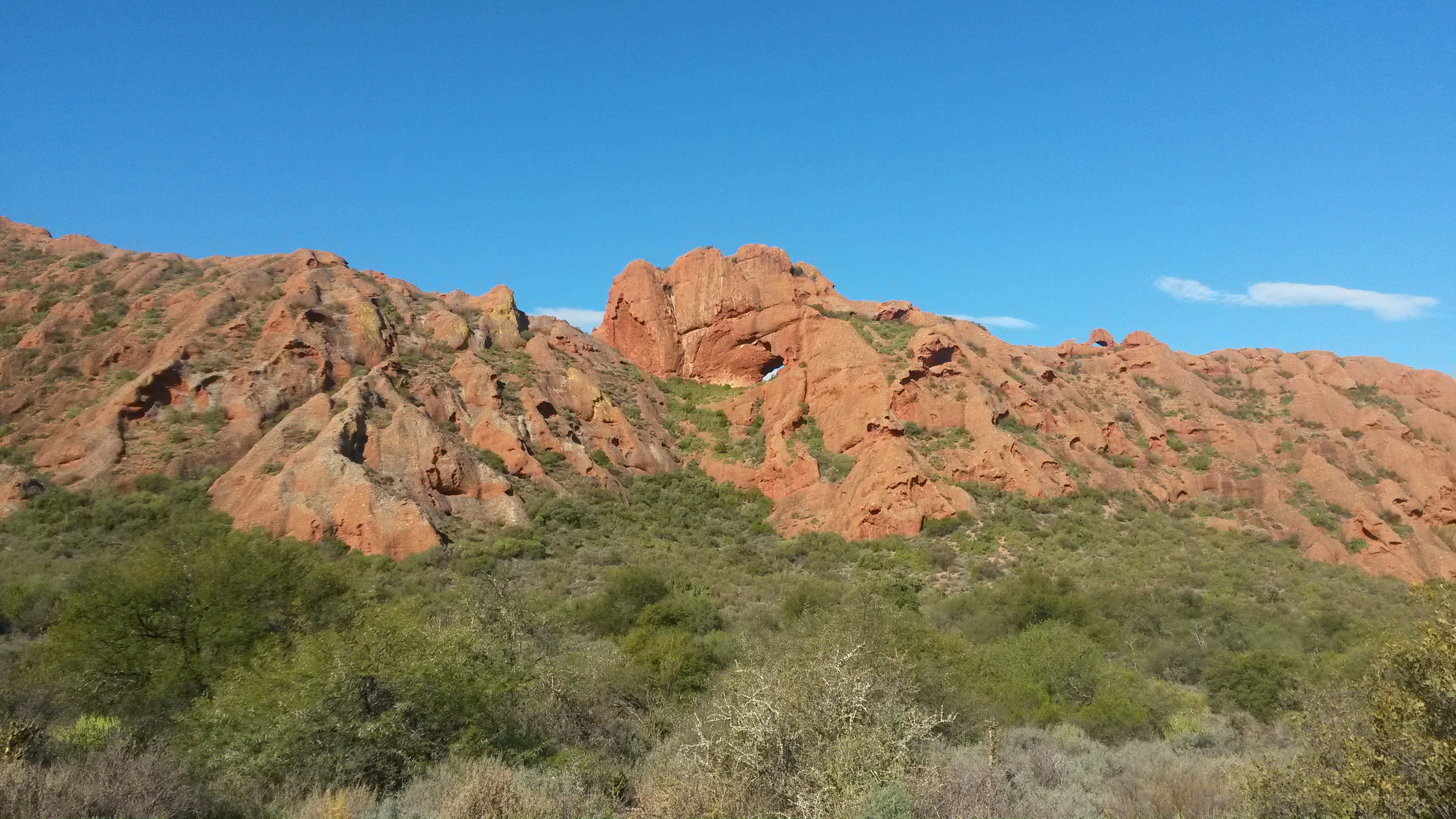
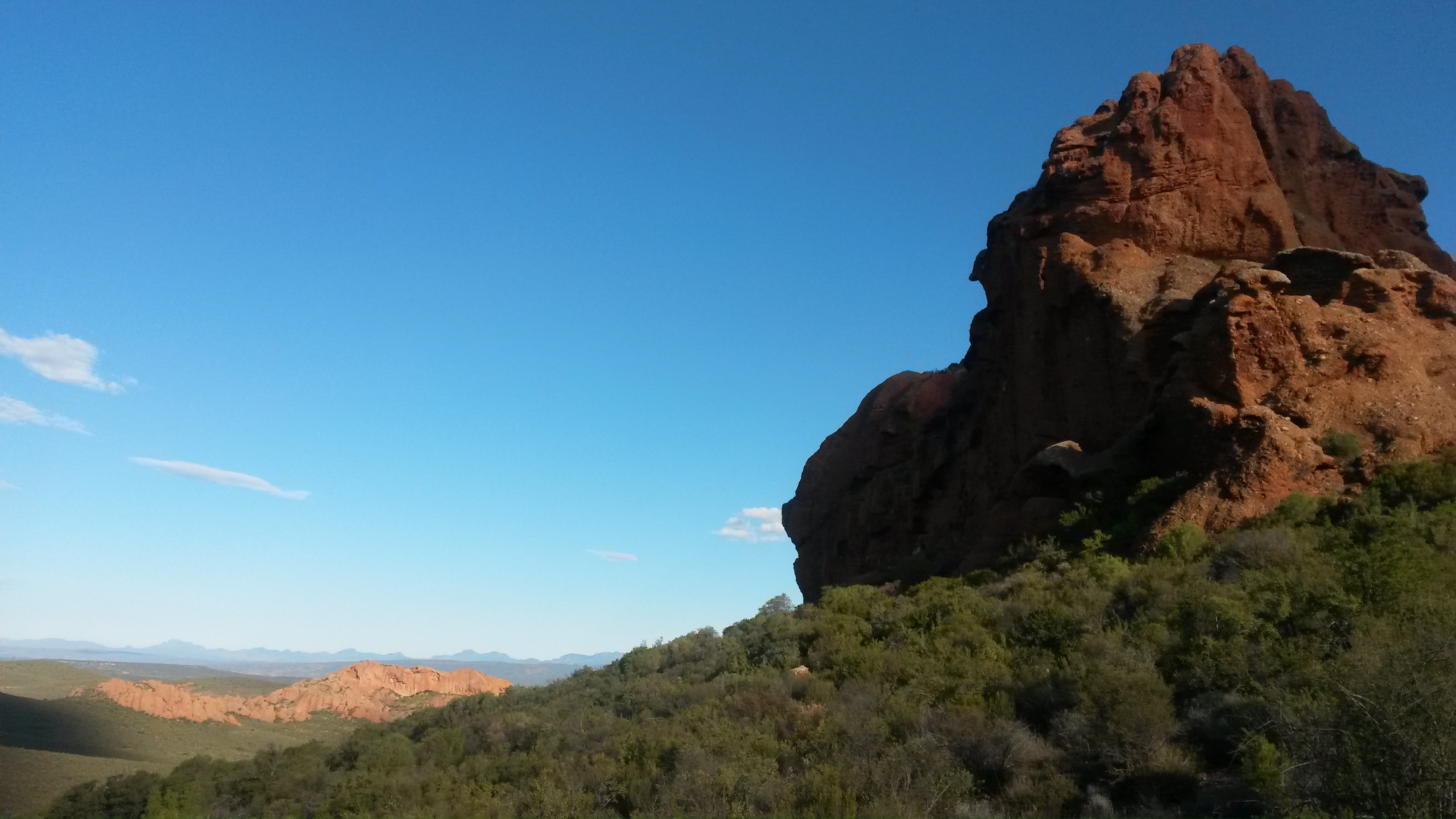
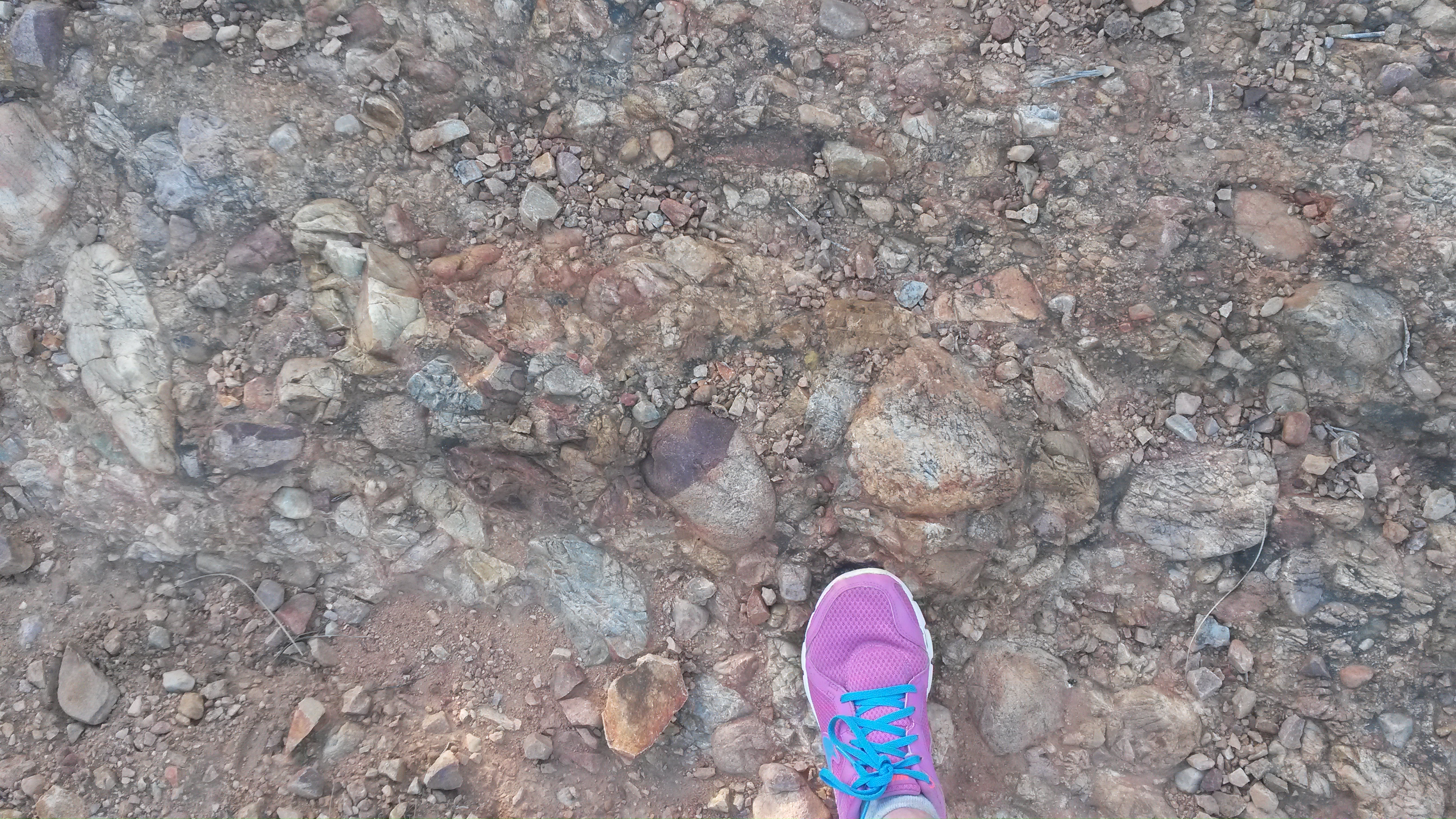
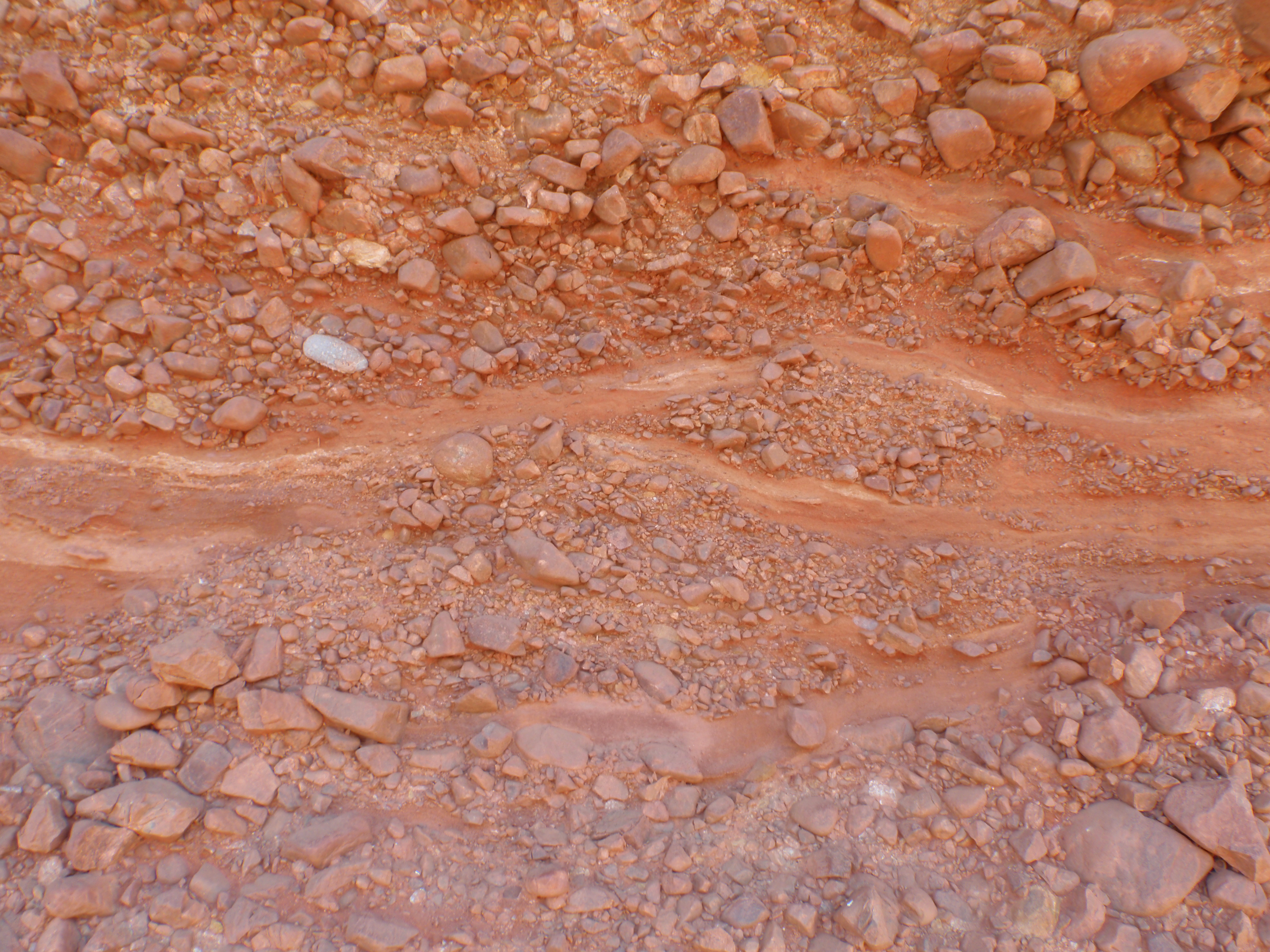
On Monday I shared a picture of a pretty conglomerate that I recently walked across. Today I thought that I would share a few more pictures of this conglomerate formation and also tell you a little more about it. Although in Monday’s picture the conglomerate looks somewhat dull-colored, the conglomerate formation is actually impressively red in color in many places, so much so that hills made of the conglomerate are known as “the red hills” or “the red stone hills”.
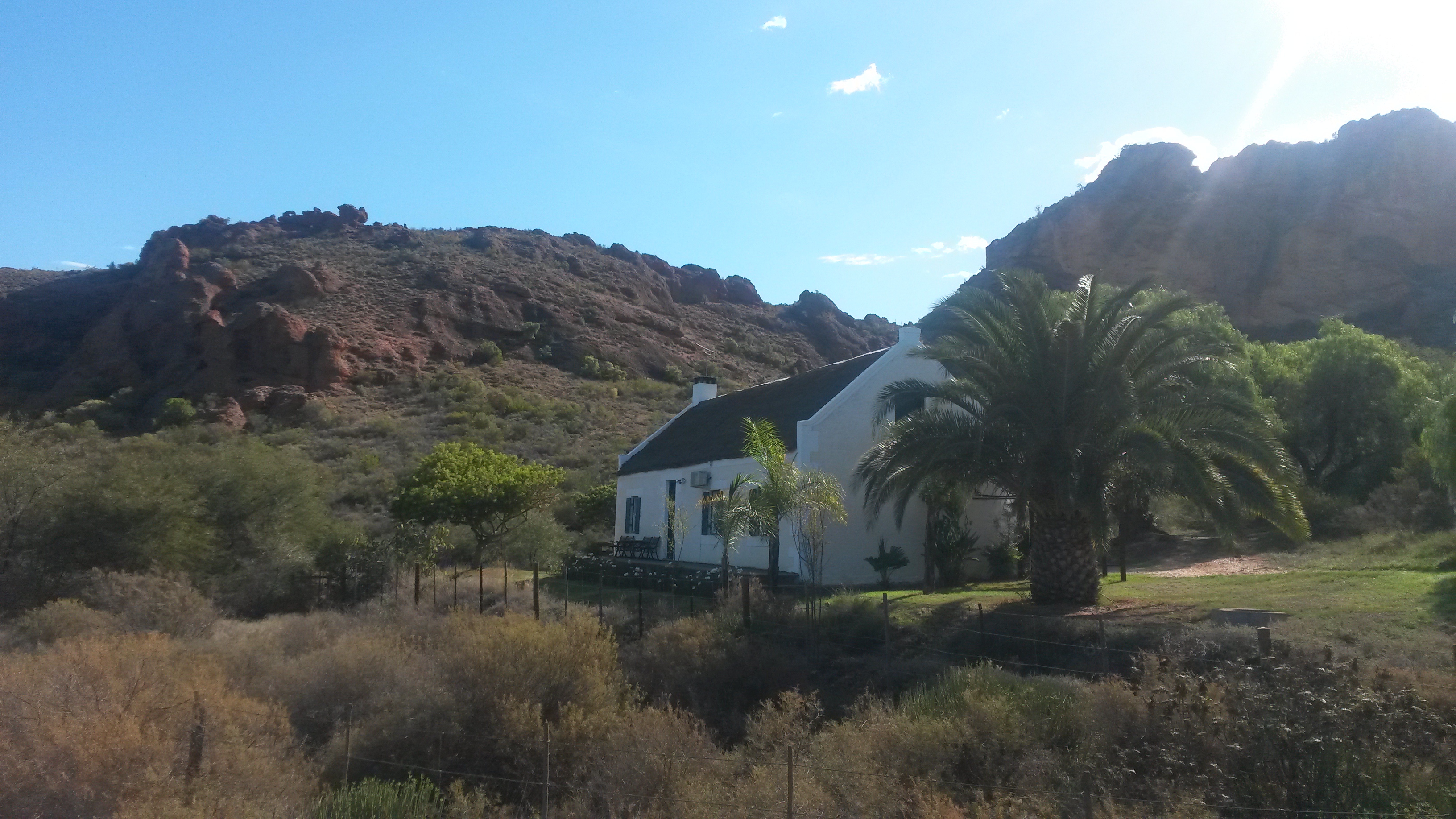
My husband and I hiked amongst the red conglomerate rocks during a recent stay at a wonderful holiday farm known as the Red Stone Hills, named in honor of the local geology, of course! The farm is located a few miles outside of Oudtshoorn, South Africa, a town known for ostrich breeding… so you pass fields of ostriches on your way to the farm! We also stayed at the farm a couple of years ago although I neglected to share pictures of that visit here on Georneys. Around the farm there are several hills of the striking red conglomerate rock. On some of the hills, impressive rock arches have formed. During our previous visit, we hiked up to one of the rock arches and took some pictures. The climb was quite strenuous, however. We only had a few hours for hiking on our recent visit, so we kept mostly to the valleys and observed the rock arches from a distance.
Geologically, the red conglomerates are part of the Buffelskloof Formation. This formation has also been called Enon in the past, so some people still refer to the red rocks as the Enon Conglomerates. The Buffelskloof Formation also contains breccias. The conglomerates and breccias were deposited in a large, land-locked basin in the early Cretaceous. The conglomerates were deposited by rivers and streams while the breccias represent scree deposits. The precise age of the Buffelskloof Formation is not known very well because of poor fossil preservation, most likely due to the sediments being emplaced in an oxidizing environment. Oxidation is also responsible for the reddish color of the rocks. The red color results from oxidation of iron in the matrix of the conglomerate/breccia rocks.
Without further ado, here are some more pictures of the pretty red conglomerates:





I managed to find my pictures from our last visit to the Red Stone Hills farm, so here are some closer images of one of the impressive rock arches:



If you ever find yourself near Oudtshoorn, be sure to visit these impressive red conglomerate rocks!
 Georneys
Do you know if there’s a tectonic event responsible for the uplift that presumably accompanies the deposition of these conglomerates?
LikeLike
I’m not an expert on the geology of the Oudtshoorn region, but I believe that the basin in which these conglomerates/breccias were deposited formed as a result of stretching due to the final separation of Africa from Gondwana… there are also some large faults in the area…
LikeLike
Best Evelyn
Absolutely spot on. As mentioned, when Gondwanaland finally fragmented a number of fault lines, e.g. The Cango fault developed forming a series of step faults into which flysch and molasse type deposition took place along or within a miogeosynclinal environment, hence the absence of volcanoclastics. The Enon (buffelskloof) formation, around Oudshoorn superimpose on the Cape Supergroup forming very sharp discontinuities with older geological formations surrounding. The red color of the rock denotes oxidation of iron, suggesting a period in earths history when oxygen was exceptionally abundant, perhaps accounting in part for the gigantic size of some late Mesozoic, late Jurassic to Cretaceous dinosaurs
LikeLike
Hi
Yes indeed. The Enon formed as a flysch and molasse deposit set along a series of step faults creating fault controlled basins related to the tectonic fragmentation of Gondwanaland
LikeLike
Ron
Absolutely, during the fragmentation of Gondwanaland isostatic equilibrium dynamics caused enhance erosion along the edges of the deeply folded Cape Supergroup. In responds to stretching, a series of step faults forming grabens within a miogeosynclinal environment formed basins into which flysch and molasse deposits formed
LikeLike
Thank you so much for this information! I am from South Africa and I’ve noticed today the conglomerates while we’ve travelled between Oudtshoorn and George. Your blog explained it in simple terms so that I can understand as well, really appreciate! Hope you’ve enjoyed your stay in SA!
LikeLike
Hi
I am a geologist with my field of study relating to karst geology and related aspects. As such i have done my MSc on the structural controls of the caves found along the far west rand, and presently work on my Ph.D elaborating on my MSc, only this tile i include the cradle of humankind
LikeLike