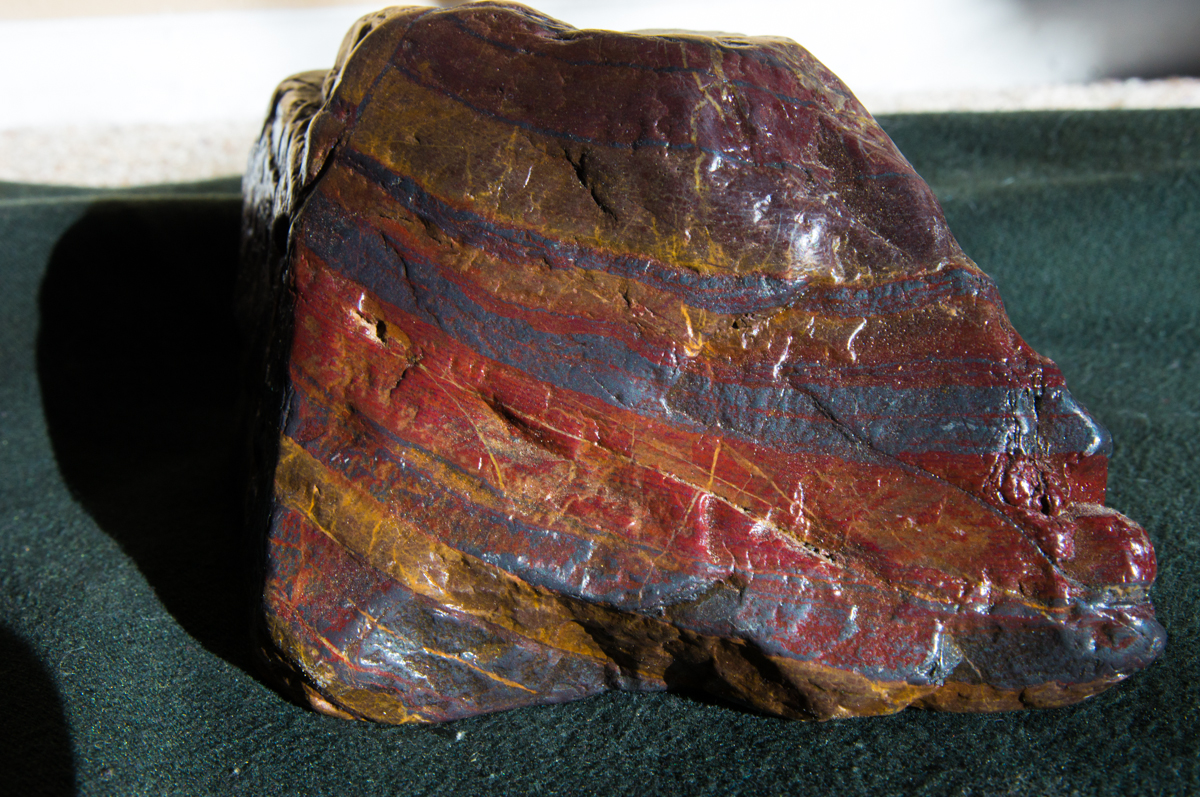
A jasper-rich rock from Minnesota. Picture courtesy of Ben Chorn.
def. Jasper:
A dense, opaque variety of chalcedony. Jasper is most often red in color but can also be yellow, brown, green, or gray.
For this week’s Geology Word of the Week post, we’re going to learn a little about silica, aka silicon dioxide or SiO2. More specifically, we’re going to learn about silica minerals. Silicon and oxygen are the two most common elements in the Earth’s crust and are found in many, many minerals. In fact, silicate minerals comprise ~90% of Earth’s crust. Silica minerals are silicate minerals with the chemical formula SiO2.
The most common silica mineral (and the second most common mineral in Earth’s crust, after feldspar) is quartz. Quartz is most commonly clear or opaque white in color but can also be purple (amethyst), pink (rose quartz), yellow (citrine), and brown or black (smoky quartz). The different colors of quartz are caused by impurities and crystal defects. Quartz is one of a few varities of crystalline SiO2. Under most pressure and temperature conditions present at Earth’s surface and in Earth’s crust, quartz will crystallize as the SiO2 mineral. However, under different temperature and pressure conditions, such as deep in Earth’s mantle or at a meteorite impact site, SiO2 can form as other minerals, such as cristobalite, coesite, tridymite, or stishovite.
When SiO2 does not form with a large crystal structure but rather forms with a microcrystalline or cryptocrystalline structure, a mineral known as chalcedony forms. Like quartz, chalcedony comes in different varieties. Jasper is one common type of chalcedony. Another common type of chalcedony is agate, which has alternating clear and opaque banding. Other types of chalcedony include carnelian, chrysoprase, heliotrope, and onyx.
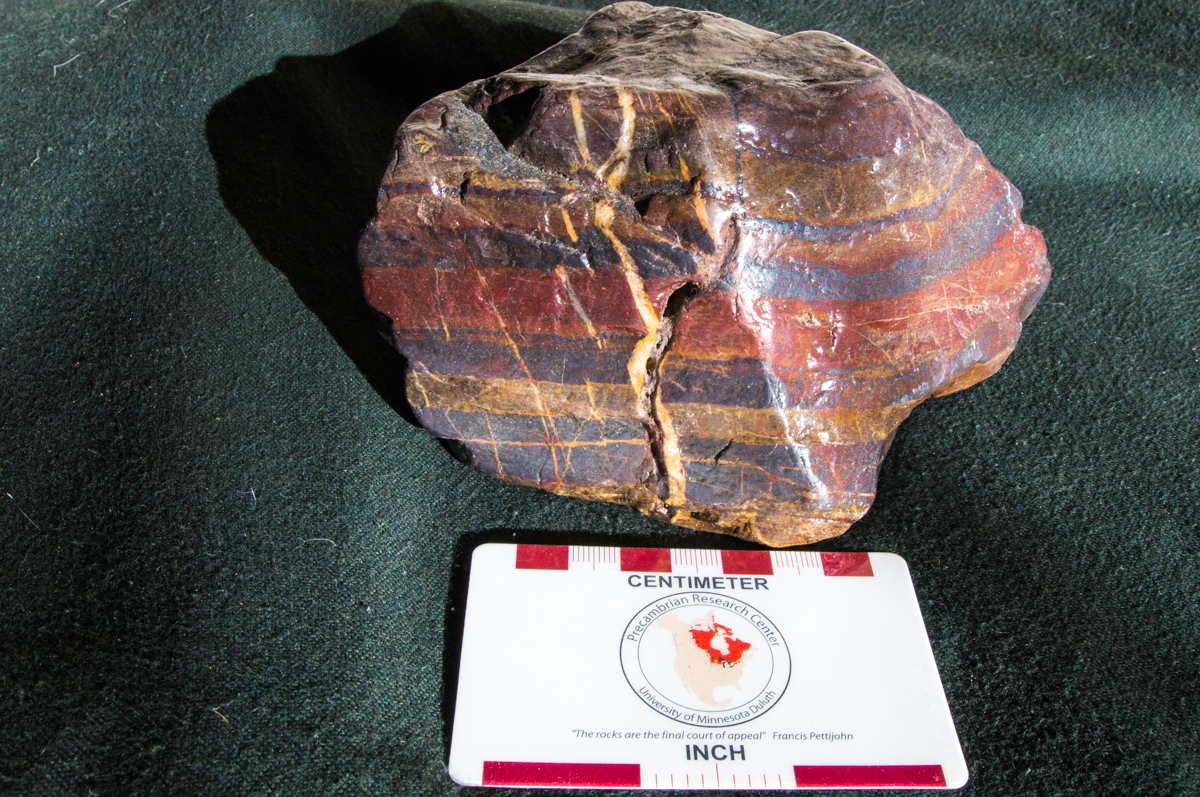
Here are a few more pictures of jasper rocks, courtesy of Ben Chorn:
Another jasper rock from Minnesota. Picture courtesy of Ben Chorn.Yet another Jasper rock from Minnesota. Picture courtesy of Ben Chorn.Jasper cobbles from Minnesota. Picture courtesy of Ben Chorn.Two jasper cobbles from Minnesota. Picture courtesy of Ben Chorn.
And here’s a pretty agate that’s sitting on a shelf in my living room:
Agate rock.
And here’s some quartz crystals on a rock that I picked up during a recent hike in South Africa:
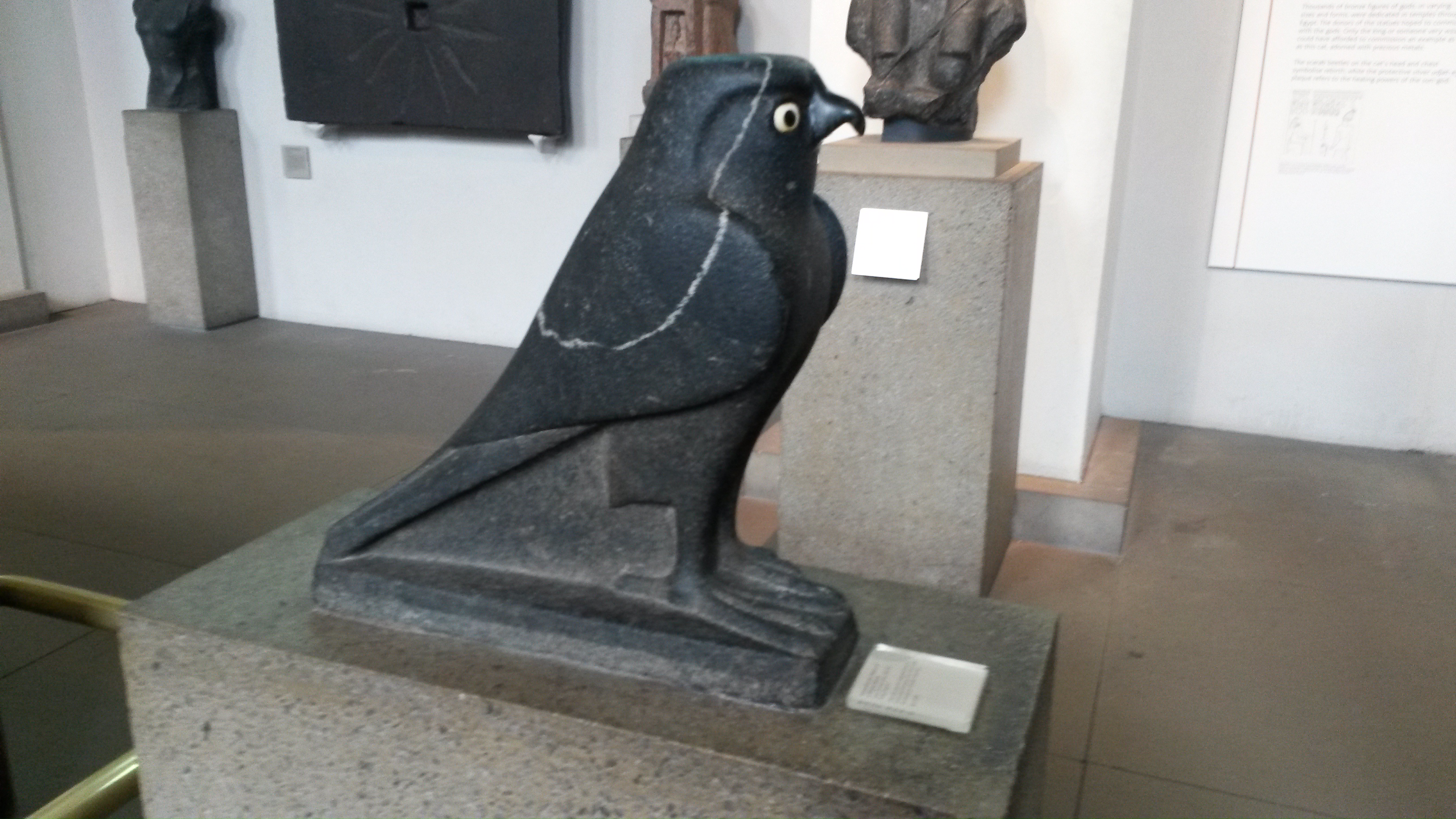
An ancient Egyptian Horus statue, The British Museum, November 2014.
For this week’s “Monday Geology Picture” I thought that I would share a couple more pictures that I took during my recent visit to The British Museum. When I was in one of the exhibits with ancient Egyptian artefacts, I was struck by a beautiful dark-colored Horus statue with a light-colored vein running through it. According to the museum sign, the statue was carved out of granodiorite. The vein is probably quartz.
Here is the museum sign about the statue:
Museum sign. Click to enlarge.
And here is a view of the statue from the front:
The Horus statue viewed from the front. Apologies that the picture is slightly blurry.
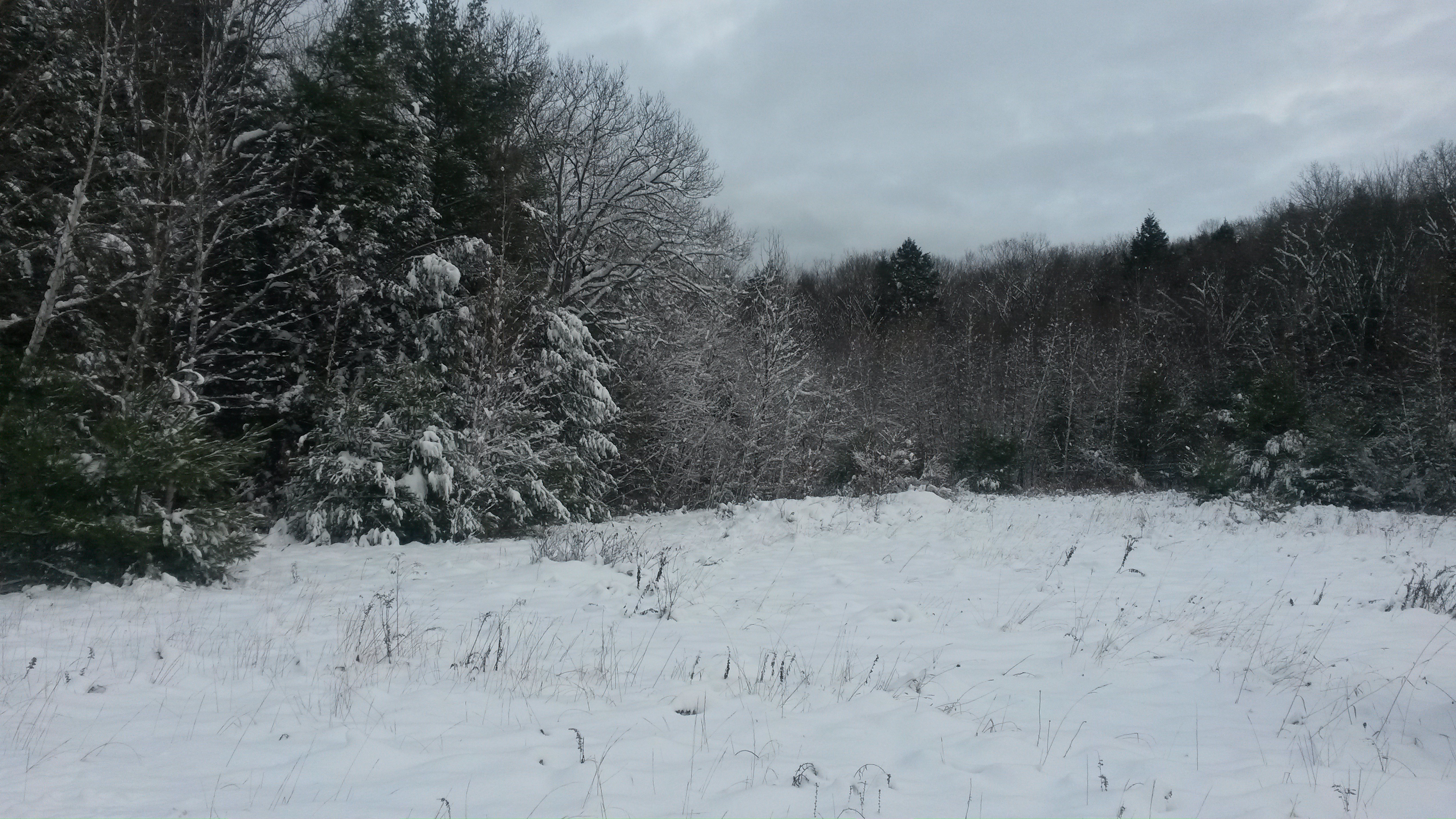
Ice on a partially-frozen wetland pond, New Hampshire, November 2014.
def. Ice:
Water (H2O) in a solid state. When naturally occurring, ice is considered a mineral. There are many forms of ice: lake ice, river ice, sea ice, snow, glaciers, ice caps, ice sheets, and frozen ground (such as permafrost).
If you ask a geologist what he or she considers to be Earth’s most important mineral, you will probably hear many different answers, depending on the person. Some might choose a common mineral, perhaps olivine or quartz or feldspar. Others might choose a rare, economically valuable mineral, perhaps gold or tantalite or monazite. Others might choose a mineral that is important for understanding the geological history of the Earth, perhaps zircon or spinel or serpentine or maybe even jimthompsonite. However, if you ask me what I consider to be Earth’s most important mineral, I think that I would reply that it is ice.
After all, how many minerals have an entire field of geology devoted to them? Glaciology is a very important field of geology that is devoted to the study of glaciers and, more generally, ice in all its forms.
And how many minerals cover vast expanses of the Earth? Sure, much of the mantle consists of olivine and much of the core consists of metal alloys, but no other mineral can compete with ice when it comes to Earth’s surface. Ice covers much of the Earth’s land and ocean surface, and the portions of the Earth that are covered with ice comprise the cryosphere. Some scientists even believe that during particularly cold time periods in the past, the entire Earth, a so-called “Snowball Earth”, was covered with ice, an all-encompassing cryosphere.
And how many minerals play such an important role in Earth’s climate? The formation of ice is a key aspect of Earth’s climate system. Very simply, there is more ice when Earth is colder and there is less ice when Earth is warmer. However, the transition from water to ice and ice to water can be complex. For example, the light color of ice creates an ice-albedo feedback loop. Climatologists are still working to unravel the details of the roles that ice plays in global climate.
And how many minerals are less dense than their liquid counterparts? The lower density of ice relative to water enables it to float on top of water, and this physical arrangement has a profound impact on the nature of the hydrosphere and biosphere. If ice did not float on top of water, then many natural bodies of water might freeze completely, never fully thawing in the heat of summer. The lower density and greater volume of ice (compared to water) also plays a role in geomorphology. The expansion of water when it freezes into ice contributes to the physical weathering of rocks. The freezing and thawing of water breaks up rocks and is also responsible for other geomoprhological processes, such as solifluction.
I’m sure that there are many other reasons why ice is an important mineral. However, I think that the ones I’ve listed above are sufficient to convince me. If anyone asks me what I consider to be Earth’s most important mineral, I will answer ice… although since I currently work as a diamond geologist I might broaden the definition to include both frozen water and the sparkly gemstones I study at work.
But what would you answer? What is Earth’s most important mineral? What about Earth’s second most important mineral?
I have to admit, until I gave some thought to this week’s geology word I don’t think that I would have answered ice. I probably would have answered olivine, since I like mantle geology. However, that’s because I don’t generally think of ice when I think of minerals. I guess that ice is so common, and also so unusual (compared to other minerals), that it doesn’t fit into my standard “this is a mineral” box. There’s no doubt about it, though: ice is a mineral, and it is an important one.
Of course, not all ice is a mineral. The ice that you find in ice cubes in your drink is technically not a mineral since minerals must be naturally occurring by definition. My husband, who grew up in South Africa and only saw snow for the first time in his 20s, has a nice way of categorizing ice: he calls the ice that you find in your refrigerator “domesticated ice” and ice that you find out in nature “wild ice”. Growing up in a landscape without ice, my husband finds the “wild ice” of New Hampshire, where I come from, fascinating. And I suppose he should. For while a frozen puddle on the street, a line of icicles on a rooftop, and a dusting of snow on the driveway may seem quite ordinary to someone who grew up in a cold climate, they are small pieces of a quite extraordinary cryosphere that is an integral part of the planet we call home.
Snowy New Hampshire scenery, November 2014.Snow and glacier covered Denali in Alaska, 2013.
Two ancient Egyptian stone jars on display at the British Museum.
For this week’s “Monday Geology Picture” I thought that I would share another picture that I took during my recent visit to The British Museum. This week’s picture shows two beautiful ancient Egyptian stone jars. The jar on the left is made out of limestonebreccia while the jar on the right is made out of andesiteporphyry.
A simple 10x power folding hand lens, typical of the ones geologists carry into the field.
I’ve decided to bring back the long-lost “Geology Word of the Week” posts in 2015. For those of you who don’t know, for a few years I regularly posted about a geological word every week. These posts included a brief definition (written by me) of the word and then some additional information and pictures. However, starting in 2012 I stopped posting these words regularly. I was quite busy in 2012 because I defended my Ph.D. and then started working as an industry geologist. Then, for the past two years, my industry work has kept me extremely busy, and I’ve spent quite a bit of time in the field, far from home.
However, now that I’ve settled into a new industry job and will be spending a little more time in the office, I’ve decided that it’s time to revive the “Geology Word of the Week”. I will endeavor to post about a geological word every week. However, I may sometimes (perhaps more often than not, depending on how much time I have) keep the posts very short. For some words, I may just provide the definition and a picture or two. Regardless, I think that such posts will be interesting and informative and will help both amateur and professional geologists (including myself!) improve their geological vocabulary. Also, depending on my work schedule, I may occasionally have to skip a week or two. I’ll try not to skip too many, though!
For the “Geology Word of the Week” posts I go through the alphabet from A to Z to select my words. I made my way through two alphabet cycles before I stalled at G is for Glacial Erratic. I’m picking up the alphabet where I left off, so this week’s word starts with H. By the way, you can browse all of the previous geological words here.
Without further ado, here is this week’s geology word:
def. Hand Lens:
A small magnifying glass used by geologists to take a closer look at rocks. Commonly, hand lenses have 10x magnification power and fold into protective metal cases. Geologists use hand lenses to help identify minerals and fossils in rocks and also to take a closer look at rock textures and structures. Hand lenses can also be used to take a closer look at soft rocks such as soils and sand grains. A hand lens is an essential part of a geologist’s field equipment, and many geologists wear a hand lens on a string around their neck when they venture out into the field. Hand lenses are also useful for looking at rocks, sediment cores, and other geological samples in a laboratory.
Here are a few pictures of geologists using hand lenses in the field:
Three geologists taking a close look a boulder with their hand lenses.A geologist taking a good look through a hand lens.A geologist preparing to take a good look at a mineral grain through a hand lens.
That’s it for this week’s geology word… stay tuned for next week!
The end of another year is here, so that means that it’s time for my annual “Year of Travel” post. Below you can find out where I was fortunate enough to travel to in 2014. You can also see where I traveled in 2010, 2011, 2012, and 2013.
This was a very busy year for me. I’m hoping that I’ll have a little more time for blogging in 2015. The Geology Word of the Week is returning soon!
I spent January to March residing at my home base of Cape Town, South Africa:
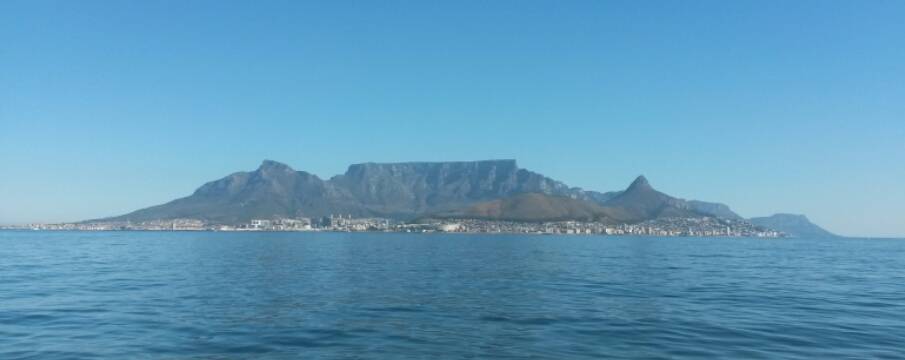
Cape Town’s beautiful Table Mountain, viewed from the sea.Another view of gorgeous Cape Town.
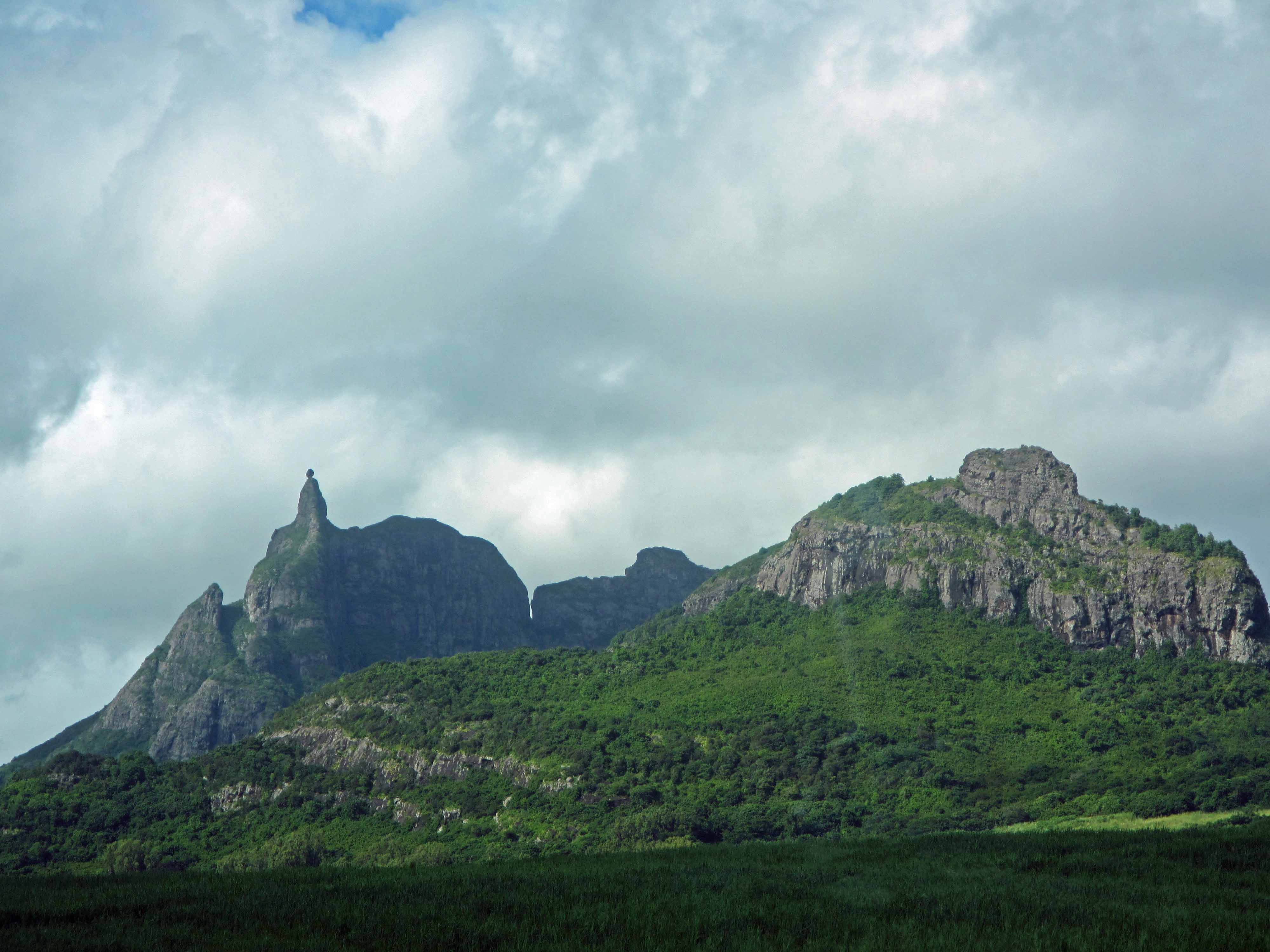
In late March my husband and I went on a week-long holiday to the beautiful, tropical, volcanic island of Mauritius:
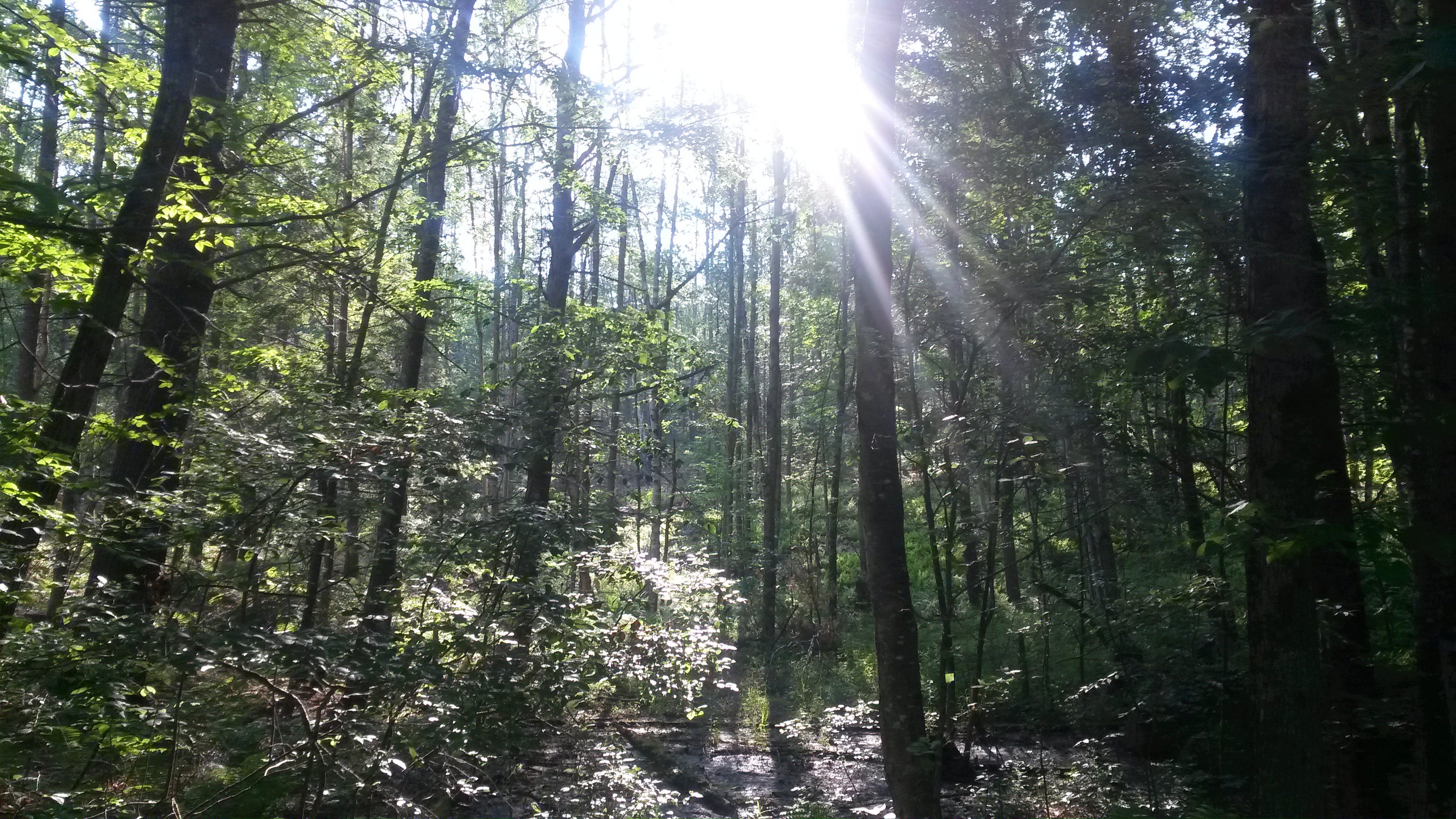
In June and July my husband and I went to the US for three weeks. We visited family and friends in New Hampshire, Massachusetts, Maryland, and Washington, DC:
A forest view, New Hampshire.Lincoln Memorial, Washington, DC.
From July to October I spent much of my time working up in Namibia:
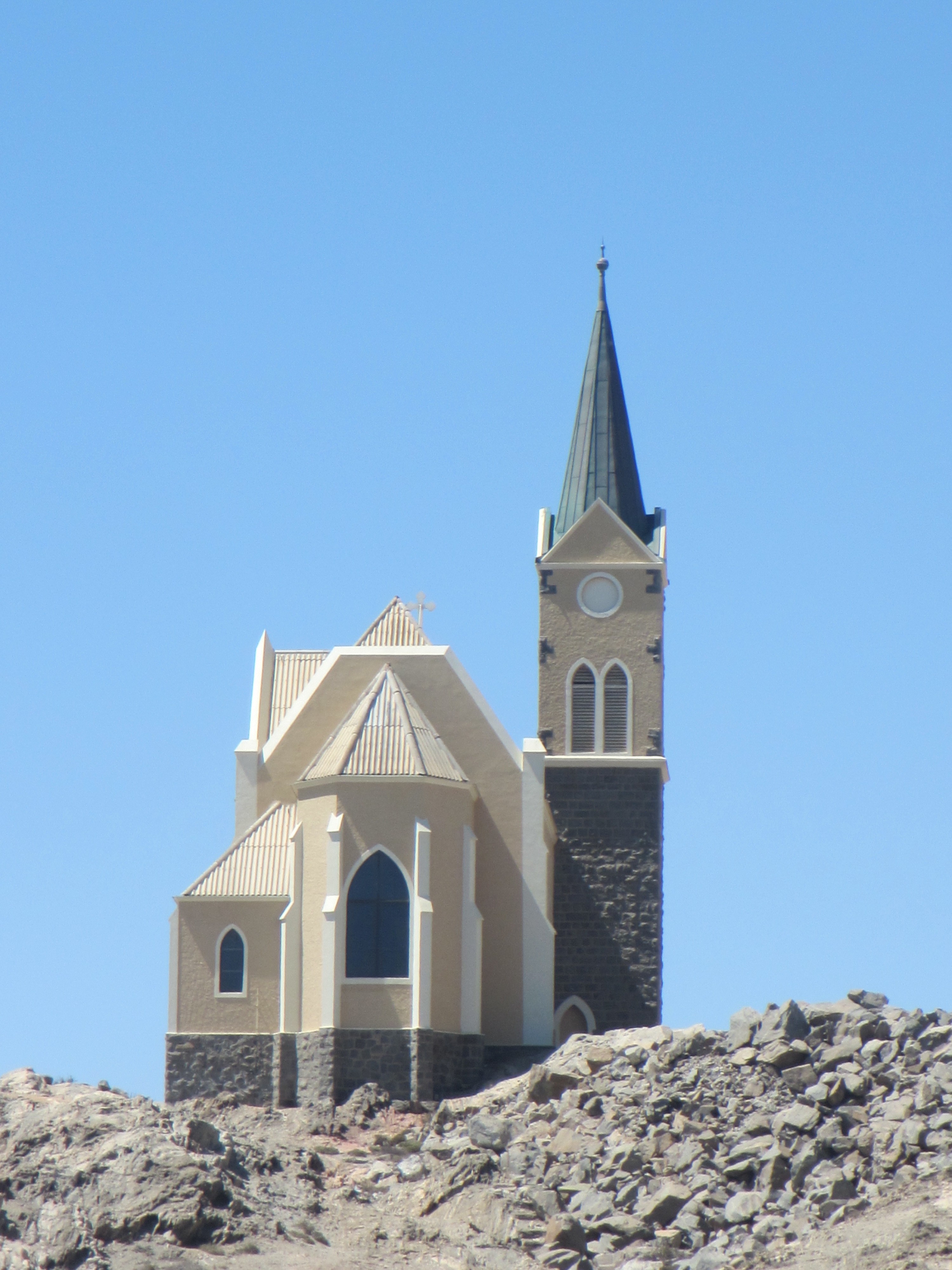
Sunset at sea, offshore Namibia.A church in Lüderitz, Namibia.A sand-filled building in Kolmanskop, Namibia.
In between my Namibia trips I had some time off, which I spent in the greater Cape Town area:
Ziplining in Ceres, South Africa.Sitting in a very old tree in Kirstenbosh Gardens, Cape Town.
In late November I went to visit my parents in New Hampshire again since I had quite a bit of leave from my time spent working in Namibia. I enjoyed seeing some snow and ice while I was there:
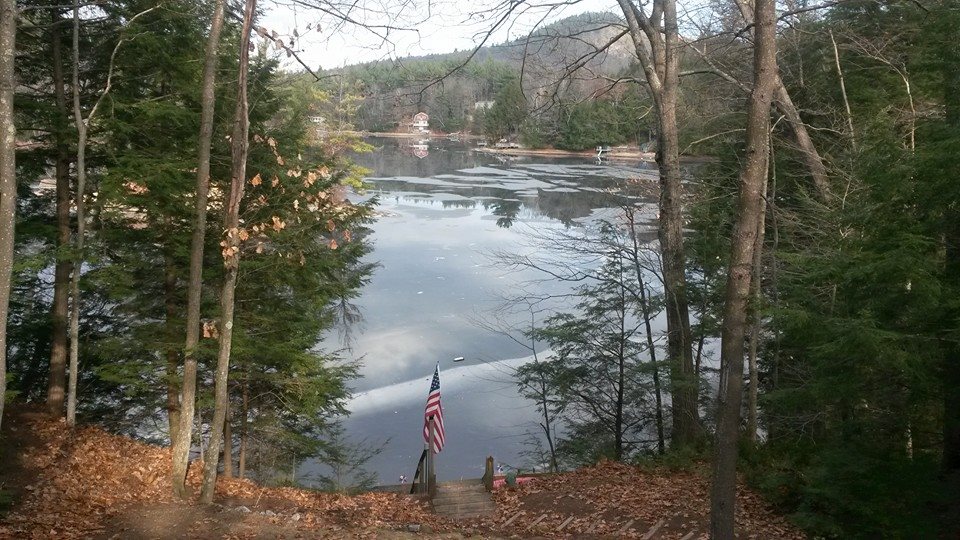
Snowy scenery, New Hampshire.Icy lakeview, New Hampshire.
On my way back to Cape Town from New Hampshire, I had a one day layover in London. I explored a few of the city sights:
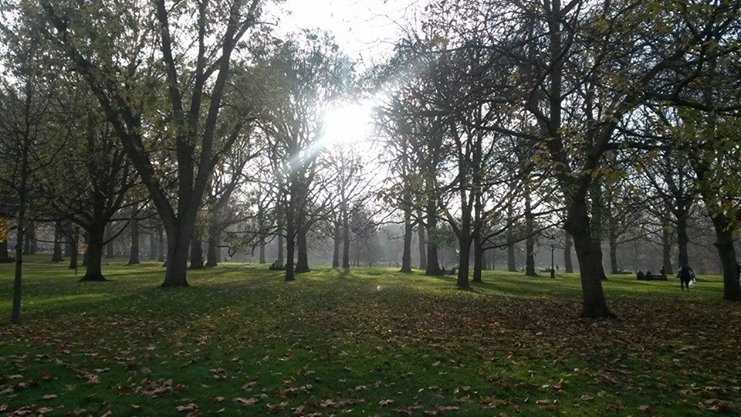
A London Park.Posing with some Egyptian artefacts at The British Museum.
Currently, I’m back in Cape Town awaiting my next trip. Cape Town is not a bad place for a home base:
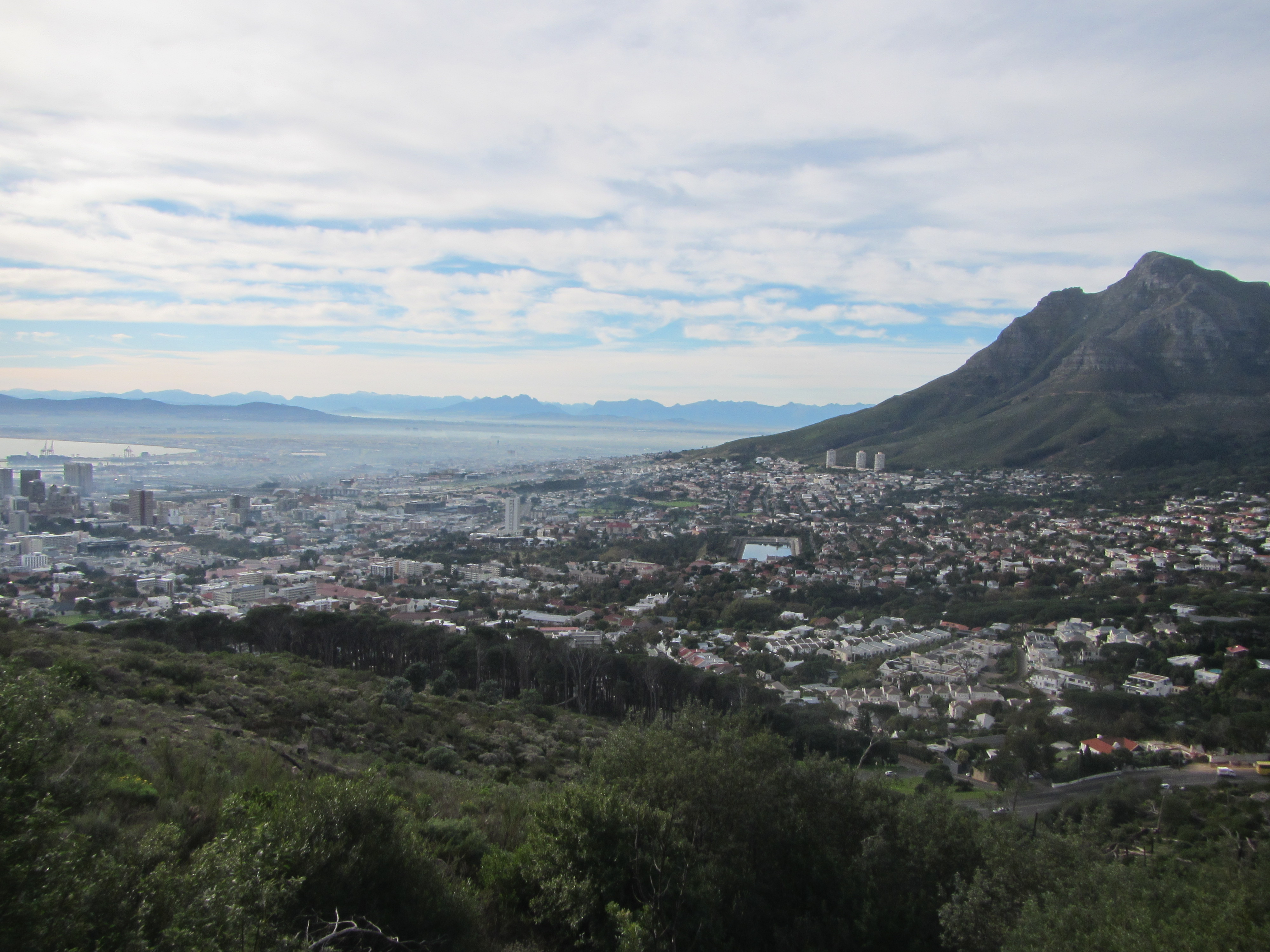
Cape Town city center.Cape Town city center viewed from atop Table Mountain.
I also travelled to Johannesburg a few times for work, but I’m afraid that I didn’t take any pictures. I mostly spent my time in offices and conference rooms, anyway!
I’m looking forward to another wonderful year of travel in 2015. Happy New Year, everyone!
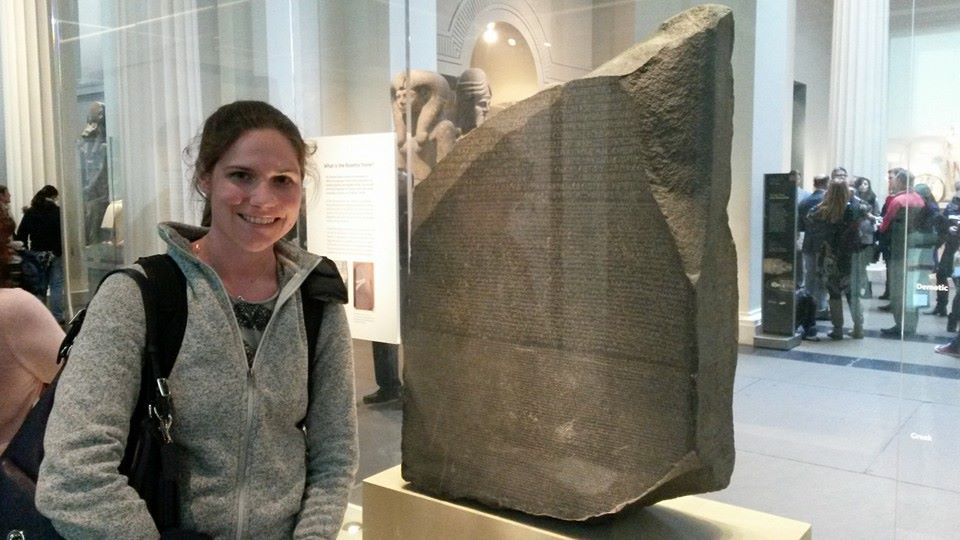
Yours truly posing with the Rosetta Stone at the British Museum. November 2014.
A few weeks ago I flew from the USA back to my home base of Cape Town, South Africa. During the journey, I had a long layover in London, so I left the airport for awhile and did some sightseeing. Among other touring, I spent several hours at The British Museum, where I saw many interesting artefacts. The most fascinating and awe-inspiring artefact that I saw was a slab of granodiorite. Now, a slab of granodiorite may not sound like much. After all, granodiorite is a common rock type. However, this particular slab of granodiorite has some words written on it. Specifically, it has an Ancient Egyptian royal decree written on it in three different scripts: Ancient Egyptian hieroglyphs, Demotic (another type of Ancient Egyptian script), and Ancient Greek. That’s right… this granodiorite slab is the Rosetta Stone, the artefact that allowed modern linguists to decode the meaning of Ancient Egyptian hieroglyphs. After linguists puzzled out the text on the Rosetta Stone, people were, for the first time in centuries, able to read hieroglyphs. This makes the words on the Rosetta granodiorite some of the most important ever to be written in stone. Discovered in 1799, the Rosetta Stone has been on display at The British Museum since 1802. The picture above shows me visiting the Rosetta Stone in November 2014.
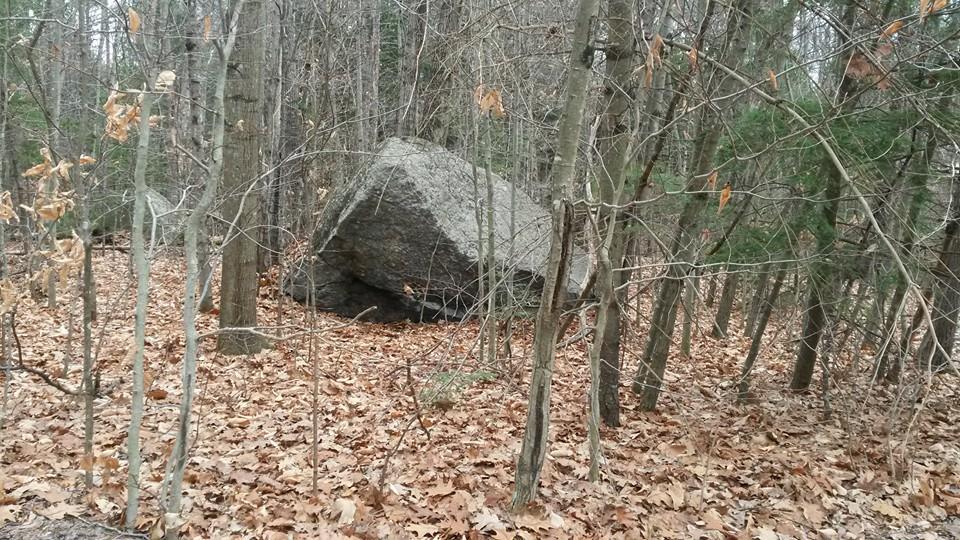
A glacial erratic in the woods near the Mervine Family Cabin in New Hampshire.
I spent the last two weeks of November visiting my family in New Hampshire. While I was in the US, I went on some long jogs and walks and took pictures of some glacial erratics, which can be found all around the Mervine Family Cabin in southern New Hampshire. This week’s “Monday Geology Picture” features a glacial erratic in the woods just down the road from the cabin. This large, angular rock was deposited during the retreat of the last ice age.
The gift guide author (yours truly) getting into the holiday spirit during a recent snowstorm in New Hampshire. I’m back in sunny South Africa now, but I’m still in holiday mode!
Well, it’s that time of year again… it’s time for the annual Georneys “What to Buy a Geologist for Christmas” (or Chanukah or Newtonmas, etc.) list! Do you have a geologist (or several) in your family? Then check out the list below for some holiday gift ideas. Also be sure to also check out the 2010 (Part I and Part II), 2011, 2012, and 2013 lists. I apologize that some of the pictures and links in the previous lists are now broken. The ideas are still good!
Happy holidays!
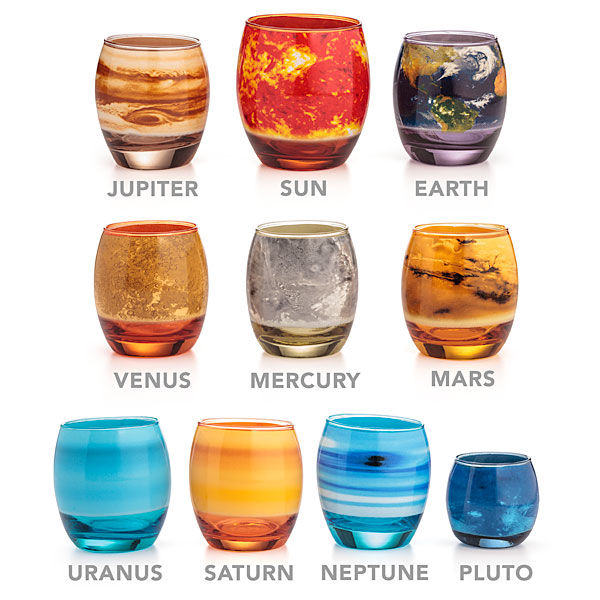
Gift #1: Set of Planetary Glasses
Set of beautiful planetary glasses. Image from ThinkGeek.com.
The planetary scientist in your family definitely needs this set of planetary glasses. Actually, these glasses are so awesome that I think all geologists need a set! The glasses are actually so popular that they are currently sold out, but you could order them for your geologist family member and promise delivery in February.
Cost: $49.99
Gift #2: Cosmos: A Spacetime Odyssey DVD
Cosmos: A Spacetime Odyssey DVD. Image from NationalGeographic.com.
I really enjoyed watching the new Cosmos TV series, which was hosted by Neil deGrasse Tyson and aired earlier this year. Why not buy this TV series for the geologist in your family? The DVD for this TV series is currently on sale at Amazon here. You can also buy the DVD for Carl Sagan’s original Cosmos TV series here.
Cost: $24.99 (on sale) or $49.98 (regular price)
Gift #3: Rosetta Stone Paperweight
Rosetta Stone Paperweight. Image from The British Museum website.
Do you have a geoarchaeologist in the family? Then you should consider buying a Rosetta Stone themed gift from The British Museum. There are many choices in the museum shop here. You can buy a Rosetta Stone themed paperweight (shown above) or an iPad case or a bag or a puzzle or even a replica of the stone.
Cost: £6.99 for the paperweight
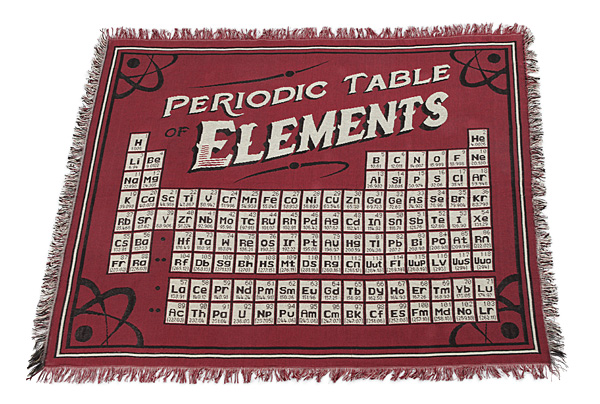
Gift #4: Periodic Table Blanket
Periodic Table of the Elements Blanket. Image from ThinkGeek.com.
The economic geologist in your family will love a gold pan for Christmas. I spent a couple of years working in gold exploration, and one thing I learned is that panning for gold in streams and on beaches is great fun! I also learned that you can never have too many gold pans. You can buy gold pans from many places, such as from the Garrett online shop.
Cost: About $10
Gift #6: A Geological Dictionary
A Dictionary of Geological Terms. Image from Amazon.com.
Like all sciences, geology is full of terminology. Why not buy the geologist in your family a geological dictionary to help them remember all of the jargon? There are a few good geological dictionaries out there, such as this one.
Cost: About $15
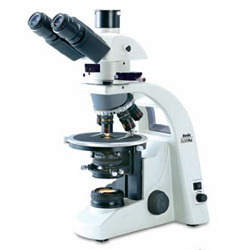
Gift #7: A Microscope
A basic polarizing microscope. Image from MicroscopeWorld.com.
Geologists can tell a great amount about rocks from outcrops and hand samples, but sometimes they need to take a close look at rocks and rock slices using a microscope. You can buy geological microscopes from several websites, such as UKGE, Microscope World, and Zeiss.
Cost: Variable from about $100 to several thousand dollars
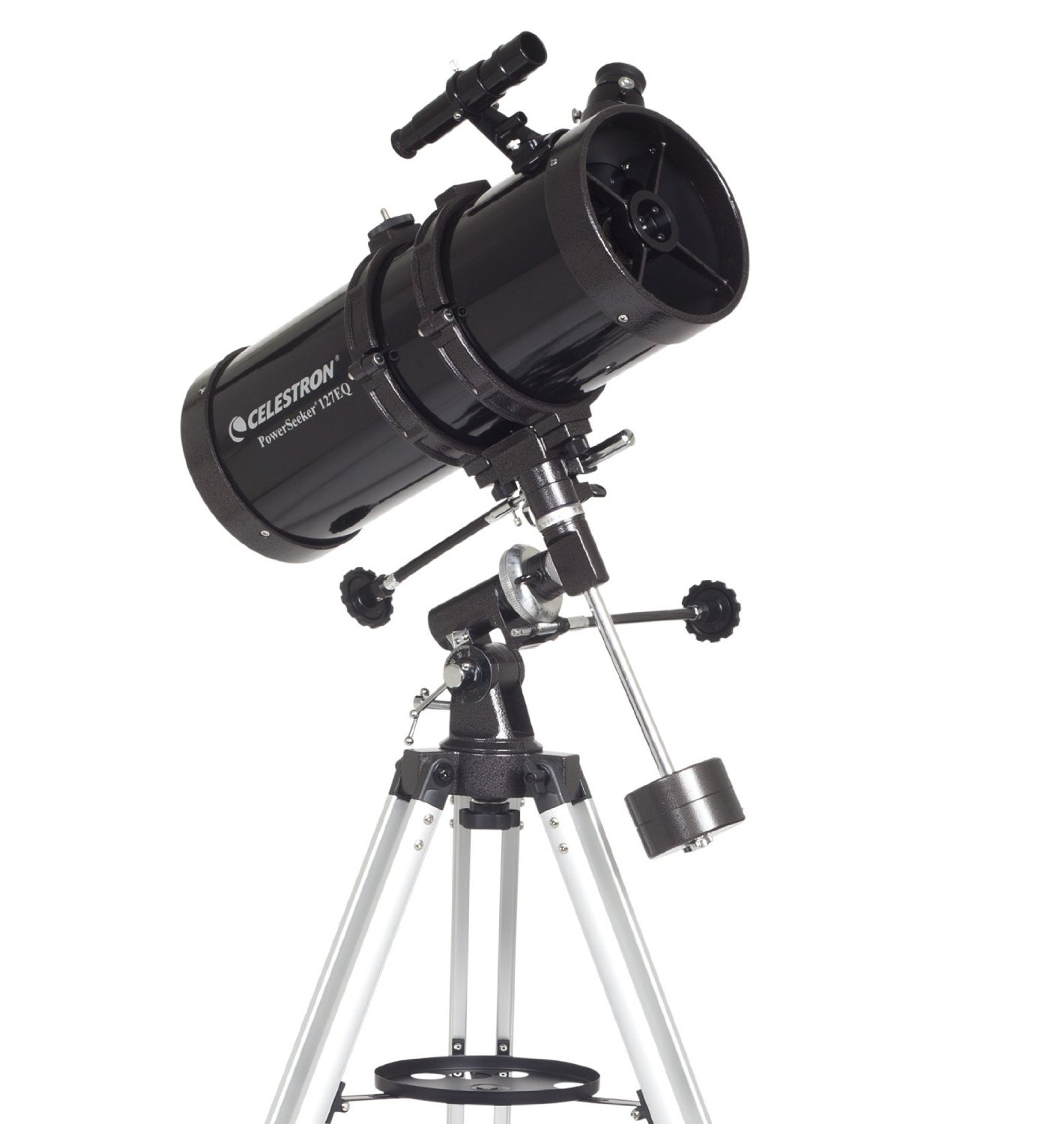
Gift #8: A Telescope
A Celestron telescope. Image from Amazon.com.
Geology is a science that takes place on many scales. Sometimes geologists need to look closely at rocks using a microscope and other times they need to look out at very big space rocks using a telescope. Even if the geologist in your family is not a planetary scientist, they will probably appreciate the gift of a telescope. I know that I certainly enjoy looking at the moon using a telescope. If you can’t afford a telescope, then perhaps buy a pair of binoculars, which can be used for looking at the moon (a poor man’s telescope) and which can also be used during geological field work.
Cost: Variable from about $100 to many, many thousands of dollars
Gift #9: A Jar of Sand
A collection of glass vials of sand given to me as a gift. What a great gift!
Geologists love sand, which is just small bits of rock. So, if you want a gift for the geologist in your family, visit a beautiful beach (one with beautiful white sand or red sand or maybe even black sand) and collect some of the sand. Put the sand in a pretty jar and then write a note explaining where and when the sand was collected. The geologist in your family will enjoy this thoughtful (and affordable!) gift.
Cost: $5 to $15 for the jar. The sand is free!
Gift #10: A Donation to a Geological Charity
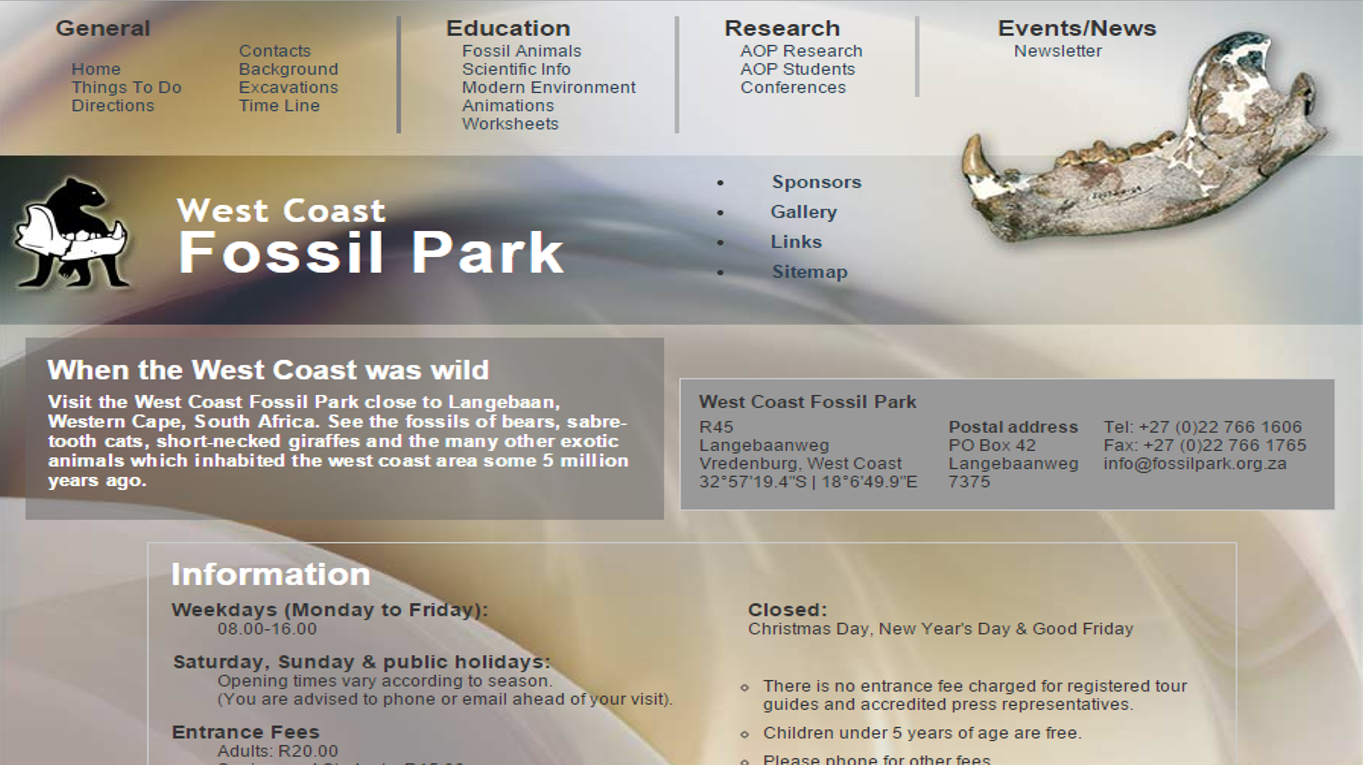
West Coast Fossil Park website front page.
If the geologist in your family already has too many things (as many scientists do…) then why not consider making a donation to a geological charity in their name? You can donate money to a local geology department to support a student fund or you can donate to a geological park. For example, here in South Africa I would recommend donating to the West Coast Fossil Park in Langebaan in the Western Cape. This park, which is funded through donations and ticket sales, preserves a world class fossil site and runs wonderful educational tours and other activities.
Cost: Whatever you want! $25 could be a good donation amount.
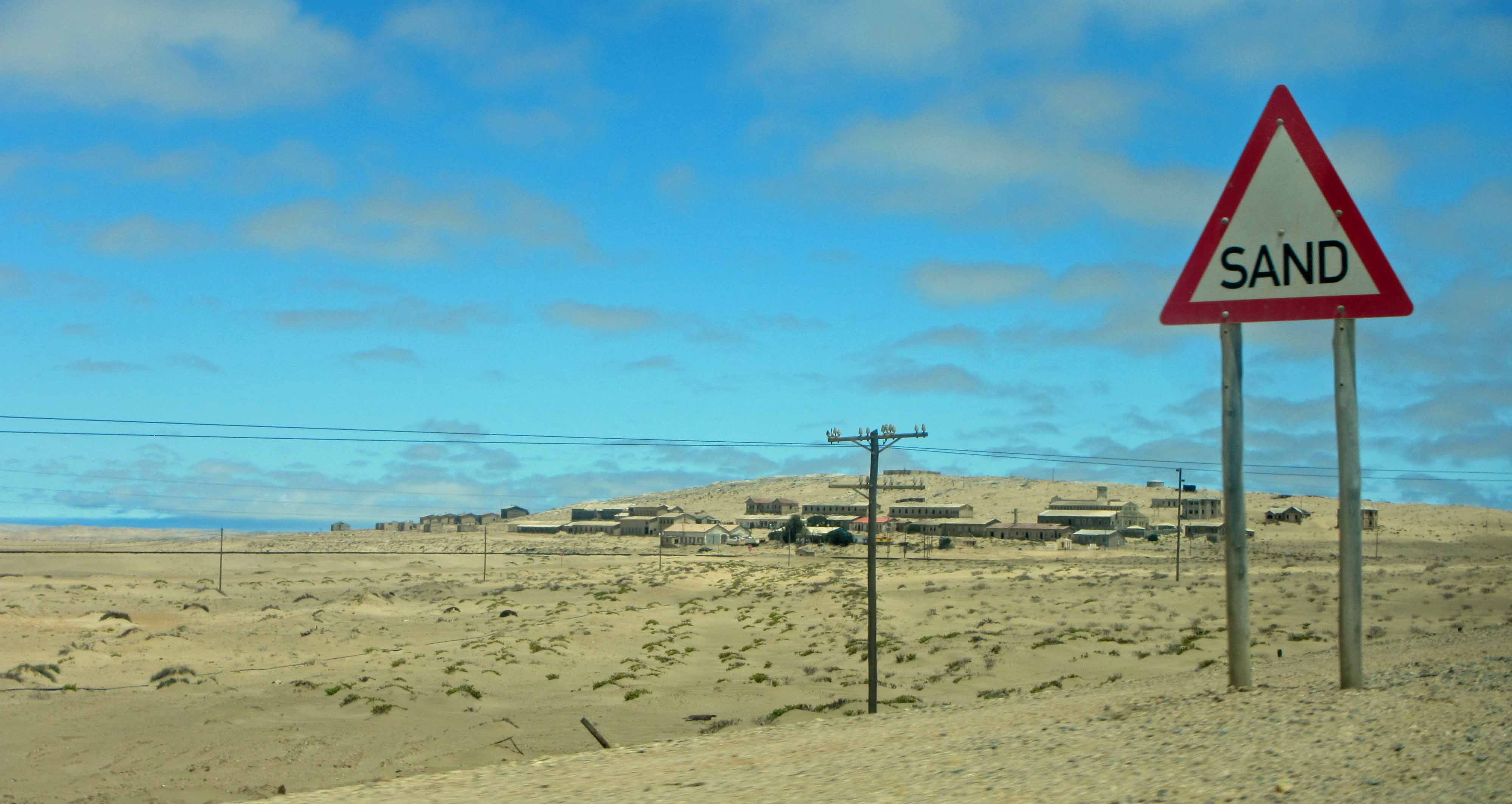
For this week’s “Monday Geology Picture” I’m sharing another picture from Kolmanskop, an abandoned diamond mining town in Namibia. Many of the buildings at Kolmanskop have been partially filled with sand. You can see more of my pictures from Kolmanskop here. When you drive along the paved road near Kolmanskop, you pass a roadside warning sign that says “Sand”. I suppose that the sign is warning drivers about sand covering the road or perhaps sandstorms creating poor visibility for driving, but when I saw the sign I thought that it was quite funny because it really states the obvious. Of course there is sand in the Namib Desert, especially at Kolmanskop!
Does anyone else have pictures of fun geologically themed roadsigns?























 Georneys