I convinced my Geokittehs co-author Dana Hunter to fly from Seattle to New Hampshire to visit me for a few days. I handed in the final version of my PhD thesis on Friday afternoon, and Dana arrived last night to help me celebrate. So far, we’ve been having a ball. You can expect several forthcoming posts about Dana’s visit, both here on Georneys and over at Dana’s blogs Rosetta Stones and En Tequila Es Verdad. For now, I thought I would share just a few pictures from the first full day of our adventures.
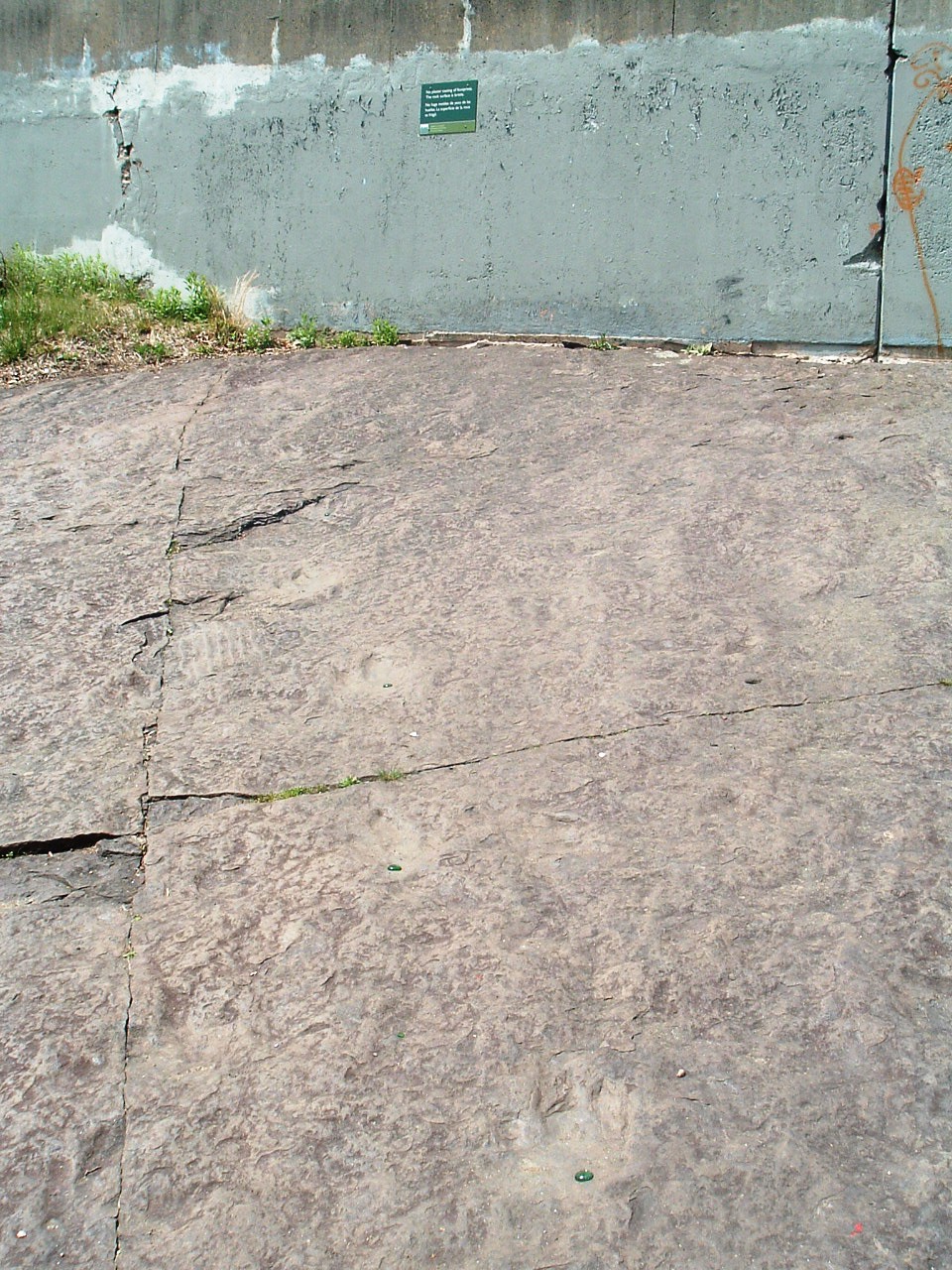
In this post, I’ll share some pictures from our visit to the dinosaur footprints, which were quite impressive. In the photos below, I’ve indicated the locations of the dinosaur footprints with green markers (glass beads from the dollar store) since the footprints are sometimes difficult to see.
Dinosaur footrpint #1Dinosaur footprint, with my foot for scale. A trackway of footprints. If you look closely, you can see the green markers indicating the footprints.Footprints near ripple marks. More ripple marks.
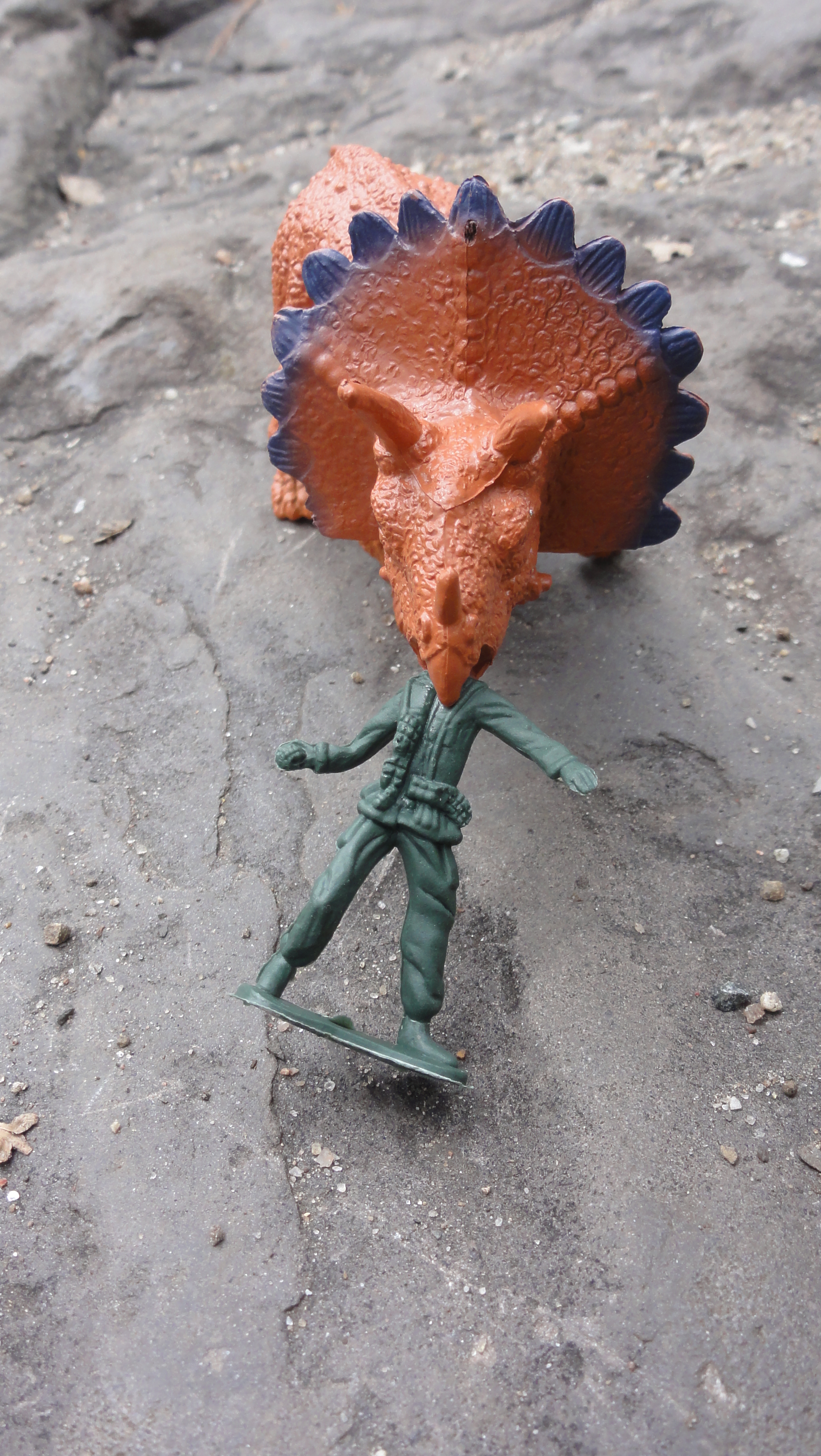
Dana and I aren’t paleontologists, but we think we have some idea how the tracks were made. We think it went something like this:
A scientifically accurate reconstruction of the events leading to track formation (we are joking, obviously 🙂 )Yummy. Epic dinosaur-army battle.
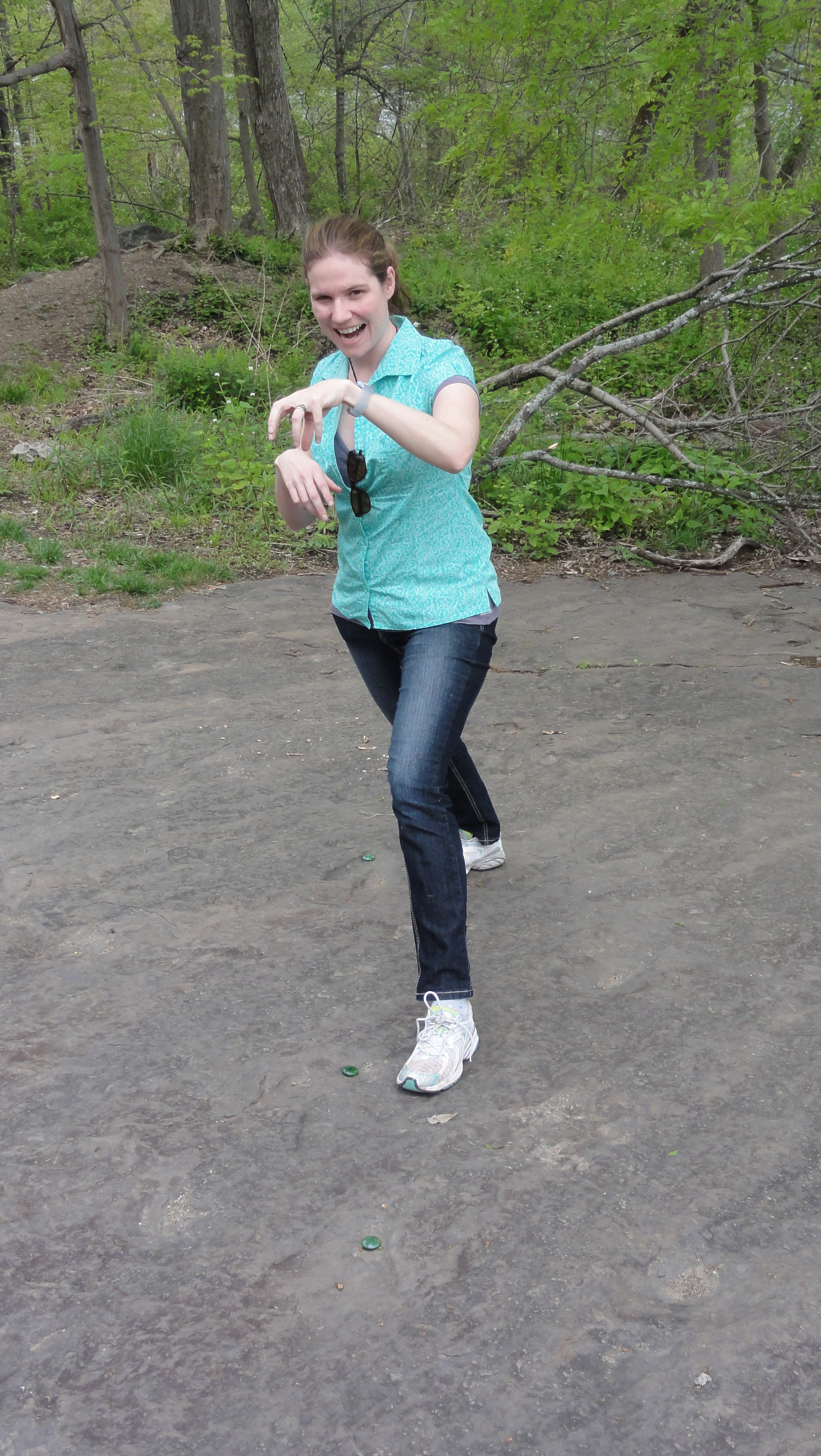
Alternatively, the tracks could have been formed by a Danaraptor:
Researchers believe these prints were left by small groups of two-legged, carnivorous dinosaurs, up to 15’ tall. The entire Connecticut River Valley – which scientists believe was a sub-tropical swamp a “mere” 190 million years ago – has long been recognized for its wealth of prehistoric footprints.
The first dinosaur prints to be scientifically described are still here to be seen, preserved in sandstone* since this valley was a sub-tropical mix of wetlands and shallow lakes, 190 million years ago. The larger Eubrontes prints were likely made by ancestors of the great Tyrannosaurus rex, standing up to 15’ tall and 20’ long. You can see hundreds of fossils not only from the four distinct two-legged dinosaurs, but also stromatolites, fish, plants and other ancient beings. Finally, look for the 20+ dinosaurs trackways, which formed the basis for the novel theory that dinosaurs travelled in packs or groups.
*Note: I’m not convinced the rock is sandstone– it looked more like siltstone or mudstone to me. Can anyone confirm the rock type? When I have the time, I’ll track down some scientific references.
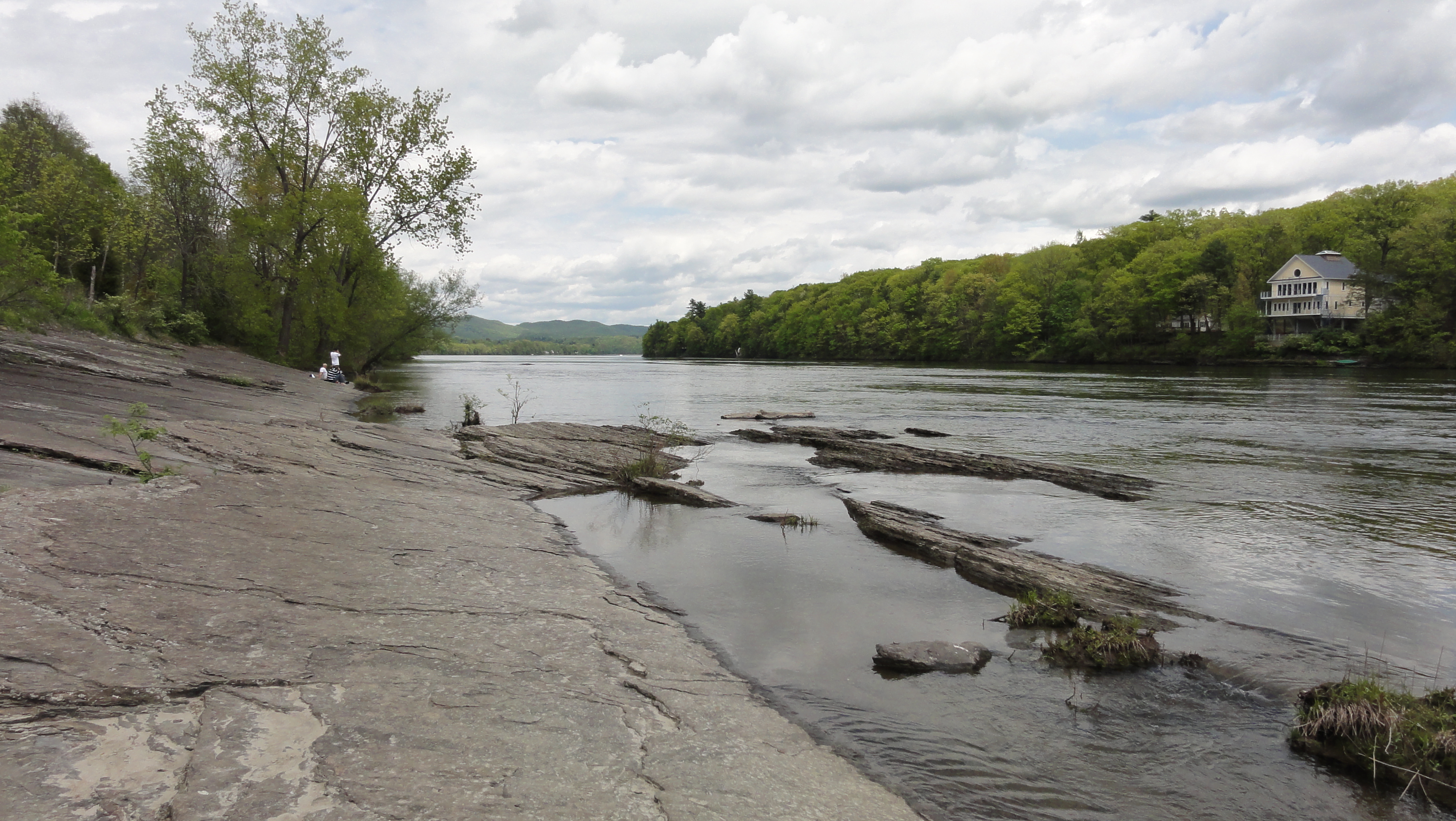
The dinosaur footprints are located along a beautiful section of the Connecticut River. After we had our fun looking at the tracks and doing our “scientific reconstructions,” we went down next to the river edge for awhile.
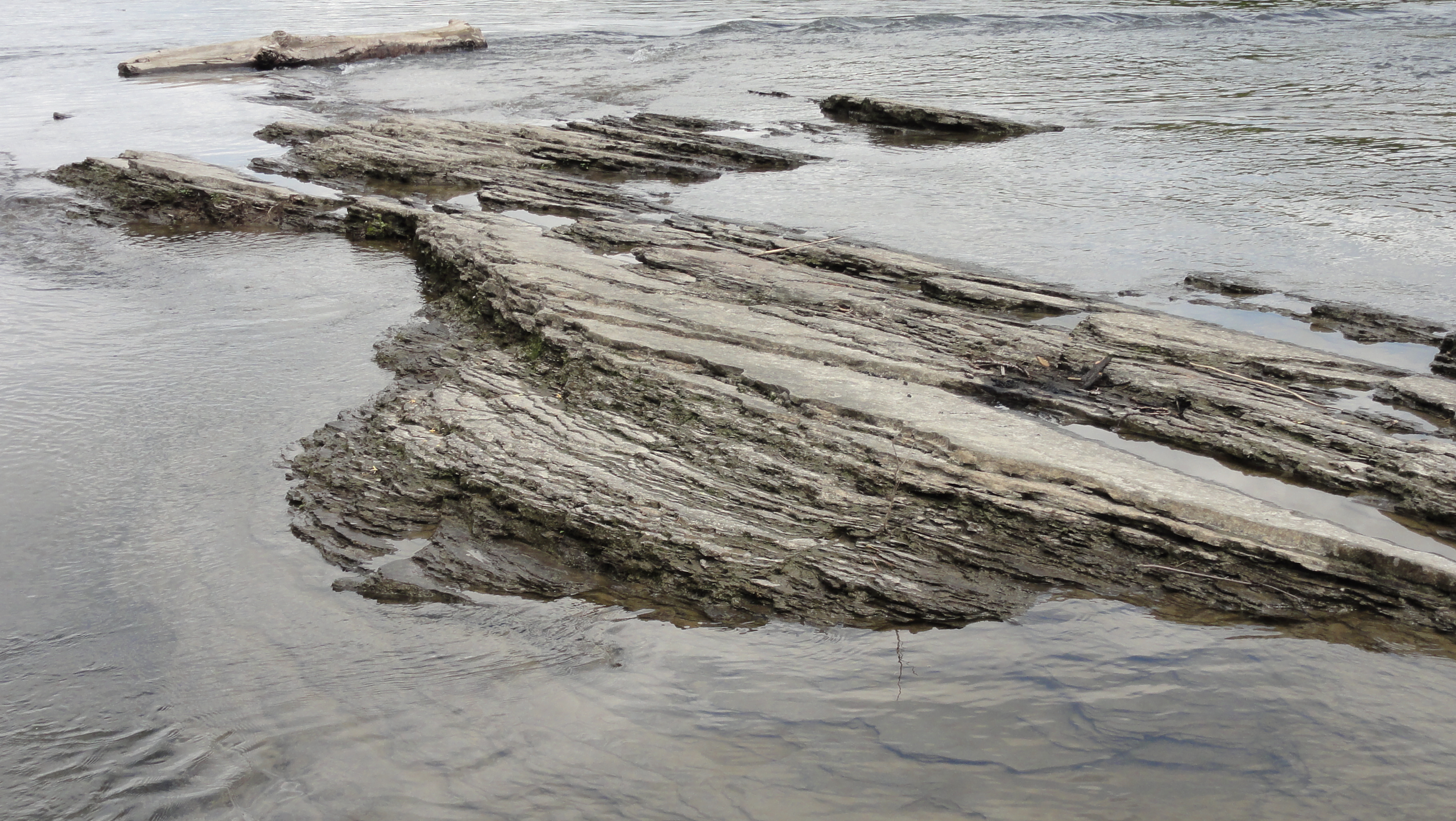
A pretty house along the CT River. On the tilted riverbank. Another view of the tilted rocks along the riverbank. Sedimentary, my dear Watson.
def. Ulexite:
1. Hydrated sodium calcium borate hydroxide (formula: NaCaB5O6(OH)6•5(H2O) ), a silky, brittle, generally white evaporate mineral which often crystallizes in the form of densely-packed fibers that transmit light along the long axis of the mineral.
2. A party trick rock. Have any party guests who think that geology isn’t awesome? Just pull out your fibrous ulexite sample and say, “Hey look, I have a fiber optic rock.” Then watch the fun– the geology fun– begin.
Ulexite really does have remarkable optical properties, as the photos below demonstrate. Personally, I think that the fiber optic images produced by ulexite are even more fun and interesting than the double images caused by refraction in calcite.
Another picture of my ulexite sample, with keys for scale. The word "Hyundai "through ulexite. Dinosaur origami box, viewed through ulexite.A side (short axis) view of ulexite, showing the fibers but no optical transmission.
I bought my ulexite sample at a rock sale. Does anyone know of good places to collect ulexite in the field?
Today is Earth Day. Today is a day when one is supposed to reflect on Earth and the environment, particularly the detrimental impacts that billions of humans have on the environment. So, I thought I would take a little time today to muse about Earth and the environment, post an inspiring video, and make a small pledge.
As a geologist, I think about Earth and the environment all the time, so in a way every day is Earth Day for me. I’ve always been drawn to the outdoors, and my interest in geology began at a young age. I’ve just devoted ten years– four years of college followed by six years of graduate school– to formal study of the Earth, and I’m very satisfied with my career choice. Most recently, I spent several years studying natural carbon sequestration for my PhD research, and I hope that my research will help inform scientists and engineers who work to develop technologies for carbon sequestration that employ storage of carbon in carbonate alteration minerals. One day such technologies may mitigate anthropogenic emissions of carbon dioxide in the atmosphere and, as a result, anthropogenic climate change.
I’ve worked hard to improve my understanding of the planet, and hopefully that will help me to make informed environmental choices to reduce my environmental impact– and maybe inspire others to reduce their impact– where I decide it is worthwhile to do so. As I’ve studied the Earth, one thing I’ve learned is that I don’t blindly support all “environmental” causes. For example, I don’t think that organic farming is practical on a global scale, and I am in favor of many genetically modified foods. With 7 billion humans on the planet, unfortunately we cannot always follow the so-called “best” environmental options; rather, we must make environmental choices.
I think that the best way we can prepare ourselves to make these choices– some of which are going to be very, very tough choices– is through education and research. We need to learn as much as we can about planet Earth, and then we need to apply this knowledge to decide where and how to reduce our impact on the planet. I think that everyone should strive to learn as much as they can about the Earth. I’m not saying that everyone should pursue a PhD in geology, but I think it’s a good idea for people to try to understand some of the basics of how planet Earth operates. Maybe I can help a bit with that through my musings here on Georneys.
I think the worst thing we can do is fight about how to mitigate the impact of 7 billion humans on Earth. Certainly, informed discussion of the options is worthwhile, but I don’t think we should pit various options against each other. We aren’t doing enough to mitigate the impact of humans on the environment, and many of our mitigation ideas may fail, so we need to pursue as many mitigation efforts as possible.
As an example, some environmentalists are critical of geoengineering projects such as carbon sequestration. For these environmentalists, there is concern that carbon sequestration efforts will slow efforts to reduce carbon dioxide emissions. I understand these concerns, and I wholeheartedly support efforts to reduce carbon dioxide emissions. I have no doubt that the future of energy on Earth is renewable energy. However, I am doubtful that renewable energy technologies will be developed quickly enough, affordably enough. I also think it is unfair to force developing countries to not use resources, such as coal, that are at their disposal for development. Therefore, in addition to supporting efforts to reduce carbon dioxide emissions and develop renewable energy, I also heartily support geoengineering projects that aim to sequester carbon dioxide from prior and ongoing emissions. I think that both reduction of emissions and sequestration of carbon are required to mitigate carbon dioxide concentrations in the atmosphere and avert catastrophic anthropogenic climate change. I am hopeful that humans can commit to both reduction and sequestration to make the difference we need.
That said, when considering the large and exponentially growing number of humans on the globe and their large impacts, I find that I can easily become discouraged and depressed. I wonder, sometimes, if I should even bother trying to reduce my own impact on the Earth when I am only one out of seven billion. I also find myself thinking thoughts such as: Does it really matter if I recycle this can when one plane flight between America and South Africa contributes so much more to my carbon footprint? I am also lazy. Very often, I will do things such as drive somewhere when I really could walk, throw something recyclable into the trash if its easier at the time, and neglect to turn off the lights in a room when I’m not there. As Callan points out, if one day my husband and I have children, that will undo (in a way) years of dedicated environmental efforts. A part of me wants to just throw up my hands and give up on all efforts to be environmentally responsible.
Ultimately, though, I have hope for planet Earth and the future of her environment. Humans may be multiplying in large numbers and may be lazy and destructive to the environment, but we are also (I hope, although the recent climate change denialism has me worried) smart. Perhaps I am just naive and young, but I am hopeful that we will be able to use a combination of reduction of impact and geoengineering to keep Earth a reasonably pleasant place to live.
For some inspiration in this regard, below is an incredible video showing how a soon-to-be MIT student sent the tube containing her admission letter to near space. For me, watching this video leaves me hopeful for the future of humans on Earth. If we can inspire the next generation to be curious about our planet and also to have concern for the planet that translates into action through hard work and creativity, then Earth may not be such a bad place to live in the future, after all. Perhaps all we need are a few more smart, curious, hardworking young people like Erin King. I realize that Erin didn’t address the environment in the below video, but I’d sure like to hear her ideas (and the ideas of other smart young people) for how to geoengineer the planet.
Although I am hopeful that humans are smart enough to geoengineer their way out of environmental problems (or at least some of the problems) on Earth today, I also recognize that reduction of impact remains important. I know I can do more to reduce my own environmental impact. As tempted as I may be, sometimes, to give up on my environmental efforts, the hope in me won’t let me. So, I’ll end this post with a pledge:
For the next month (hopefully longer, but I’ll start out with something realistic), I am not going to use a single plastic bag from any store. I’m fairly good about this back home in South Africa, where they actually charge for plastic bags, but I’ve been slacking during my trip back to the United States. I just purchased two cloth bags at the grocery store this evening. I plan to take them everywhere with me during the next month.
Okay, that may be a small pledge, but it’s a start. I’ll report back in a month, hopefully to tell you that I succeeded in this small effort. If you would like to make a similar pledge, please feel free to leave a comment below or to make a pledge on the Earth Day website.
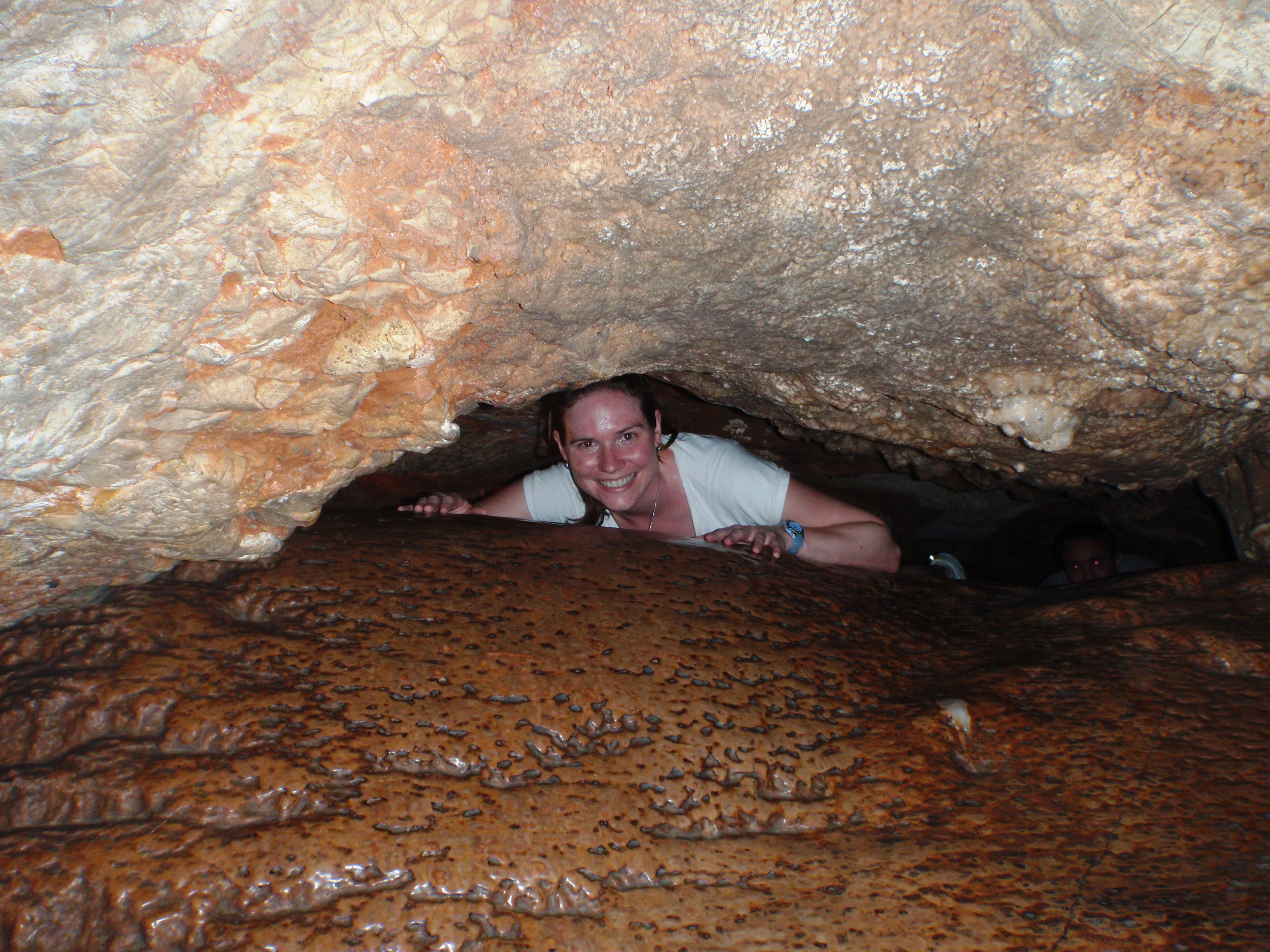
Exploring Cango Cave, South Africa, September 2011.
Dear Dr. Sheldon Cooper,
Let me first say that I greatly admire the documentary “The Big Bang Theory” that follows the daily lives of you and some of your scientific colleagues* at Caltech. “The Big Bang Theory” provides refreshing, mentally stimulating programming in a time when television is, sadly, dominated by fluffy reality TV shows about weddings, cakes, and orange-colored inhabitants of the Jersey Shore who will probably develop melanoma in their early 30s. With rare exceptions, TV has really gone downhill ever since “Firefly” was canceled. Your delightful documentary and “Game of Thrones” are the only shows I regularly watch on television these days. I recently tried adding the promising-sounding “Terra Nova” to my TV-watching schedule, but unfortunately the painfully cliché dialogue and pervasive scientific inaccuracies can only be moderately compensated for by CGI dinosaurs. I’m afraid I may have to abandon my attempts to follow “Terra Nova”, which makes me all the more grateful that I can watch your documentary. Furthermore, I imagine that footage from “The Big Bang Theory” will provide valuable information for the historians who will write your biographies after you win the Nobel Prize in Physics for your innovative and brilliant work in String Theory. I actually wish you would go into more detail about your work in theoretical physics, which sounds fascinating. Much as I enjoy watching you and your friends play games such Klingon boggle, Wii Bowling, and Dungeons & Dragons– past times that I also find entertaining– and watching your amusing interactions with your neighbor Penny and various friends and family members, I do wish that more of your documentary would focus on your scientific achievements.
However, the actual purpose of this letter is not simply to praise your documentary and your work as a scientist. As I’m sure you understand, unfortunately it is sometimes necessary to follow non-optional social conventions. In this case, I am following the social convention of providing compliments prior to providing criticisms. Now that I’ve provided an entire complimentary paragraph, let me move on to my criticism. Actually, I have more of a demand than a criticism. To put it simply: Stop saying that geology isn’t a real science.
Perhaps making up 26 dimensions in order to make your mathematics work out isn’t real science. Ever thought about that, Sheldon?I am a geologist, and I take offense that you consider me a “dirt person” and “not a real scientist.” Firstly, the term is “soil scientist” not “dirt person.” Secondly, geology is a perfectly legitimate, interdisciplinary science that requires advanced knowledge and synthesis of the fields of biology, chemistry, mathematics, and– yes– even physics. Geologists must be polymaths, which makes geologists elite scientists in my completely unbiased opinion. For hundreds of years, geologists have made concrete and important contributions to science. Let me list just a few of these contributions below:
The Age of the Earth:
Without the science of geology, people might still believe that the Earth has a Biblical age of only a few thousand years**. In the 1600s and 1700s geologists such as Nicolas Steno and James Hutton helped scientists understand that Earth must be millions of years old if the weathering and sedimentation processes operating in the Quarternary were responsible for forming the Earth’s landscape. “The Present is the Key to the Past” is a simple but extremely useful concept that was introduced by these early geologists. Admittedly, one of the first scientists to try to calculate (inaccurately, I might mention) the age of the Earth was physicist Lord Kelvin, who came up with an age of 100 million years based on cooling properties. However, Lord Kelvin overlooked radioactive heating***, so his calculated age was far too young. Fortunately, geochemists eventually determined that the Earth has an age of 4.54 billion years based on radiometric dating of chondrite meteorites and also Pb-Pb isotope systematics.
Plate Tectonics:
The theory of plate tectonics was developed by geologists in the 1950s and 1960s. Since you live in southern California dangerously close to the San Andreas fault, perhaps you are not fully familiar with the importance of this theory. After brushing up on the theory, perhaps you will want to consider moving to a more tectonically-stable region of the planet. Personally, I recommend southern Africa.
Science on the Moon:
The only scientist ever to travel to the Moon is geologist Harrison Schmitt, a Caltech alumnus. Clearly, NASA has great respect for the science of geology. Don’t you think that NASA would have sent a physicist to the moon if they considered physics more important?
I could go on, but I think you understand my point. Let me conclude my letter by stating that I think your disrespect for the fine science of geology limits your own scientific endeavors. For example, in one of the early episodes of your documentary you completely overlook the potential for scientific research in caves. As you and your friend Leonard are walking down the stairs to attend a department party, you complain about how at the last department party you were forced to listen to a professor talk about spelunking for 45 minutes. You then rhetorically ask, “Do you know what’s interesting about caves, Leonard?” and then answer your own question with the simple reply, “Nothing.”
Really, I’m shocked at your lack of knowledge regarding caves. A simple Wikipedia search would inform you that there are dozens of reasons why caves are both interesting and scientifically important. To assist you in filling this gaping hole in your scientific knowledge, I’ve listed a few examples below.
A Few Reasons Why Caves are Interesting:
-Many important archaeological artifacts and fossils have been discovered in caves, which tend to preserve items by protecting them from the environment. As an example, important Austrolopithecus africanus fossils have been uncovered in the Sterkfontein Caves in South Africa.
-Study of speleothems (chemical precipitates which form in caves), which form slowly over thousands of years, provides important information about Earth’s paleoclimate, a topic which is very important to understand in light of the rapid anthropogenic climate change which has been occurring since the Industrial Revolution.
-Study of troglobites (cave-dwelling animals) is a rich and very important field of biology that can provide insights into evolutionary adaptation such as the enhancement of non-vision senses such as hearing, taste, and touch.
-Deep, well-shielded caves provide excellent environments in which to observe neutrinos. If I were a physicist, I would want a cave lair where I could set-up and monitor my neutrino experiments.
-Caves contain bats, which are one of nature’s most elegant and interesting creatures. Personally, I find bats’ use of echolocation particularly fascinating. Based on your strong interest in Batman, I imagine you must also find bats very interesting.
Those are just a few of the many, many reasons why caves are interesting.
Now that I have explained why geology is an important and very legitimate science and why caves are fascinating and important scientific research environments, I hope you will reconsider your rash disregard for geology and geologists. Perhaps you will even consider collaborating on some scientific projects with geologists. Caltech has one of the world’s best geology departments, and I would be very interested to see your brilliant mind turned to some of the important outstanding questions in geology. For example, geophysicists do not understand Earth’s magnetic field reversals very well. I imagine that your expertise in theoretical physics could be very useful for providing insight into why and when Earth’s magnetic field reverses. You may wish to pursue this topic for personal reasons since an unexpected geomagnetic field reversal could prove very detrimental to your standard of living.
I look forward to receiving your reply to this letter.
Sincerely,
Evelyn Mervine
PhD Candidate in Marine Geology & Geophysics
MIT / Woods Hole Oceanographic Institution Joint Program
*I realize that you may view “scientific colleagues” as somewhat strong wording. After all, Howard is just an engineer.
**I think that some of your relatives in Texas still believe this. Can you please try to educate them on this matter?
***Probably because radioactivity hadn’t been discovered yet, but surely a smart physicist should have discovered radioactive heat prior to endeavoring to calculate Earth’s age from cooling models.
Typical migmatite rock. Photo courtesy of Etienne Médard.
def. Migmatite:
A heterogeneous silicate rock with properties of both igneous and metamorphic rocks. Typically, the rock contains alternating lighter layers (leucosomes, comprised of light-colored minerals such as quartz, feldspar, and muscovite) and darker layers (melanosomes, comprised of dark-colored minerals such as amphibole and biotite). The heterogeneous nature of the rock results from partial melting (called anatexis) that occurs when a precursor rock is exposed to high pressures and temperatures. The light-colored layers originate from the partial melting and have igneous characteristics– that is, their appearance indicates that they have been crystallized from a melt. The dark-colored layers have experienced metamorphism, but they do not have igneous characteristics. The distinctive light-and-dark banding (similar to that seen in gneiss) as well as the folding commonly found in this rock results from the partial melting as well as from high-grade metamorphism and deformation. The heterogeneous nature of this rock occurs on a wide range of scales, from microscopic (seen on thin sections) to intermediate (within a hand sample) to very large (only observable on a large outcrop). The word “migmatite” was first introduced into the geologic literature in 1907 by Jakob Johannes Sederholm and literally means “mixed rock,” originating from ancient Greek.
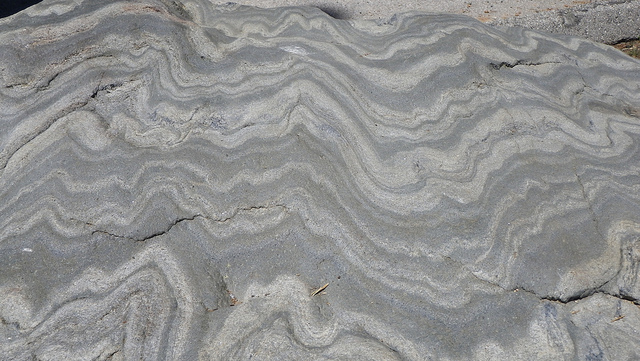
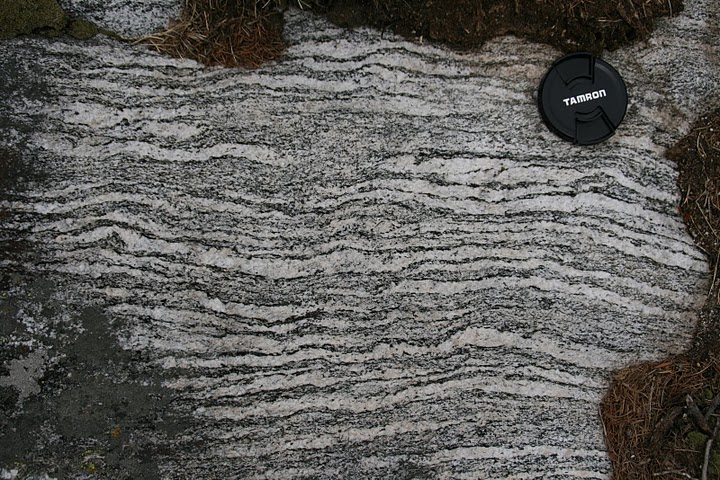
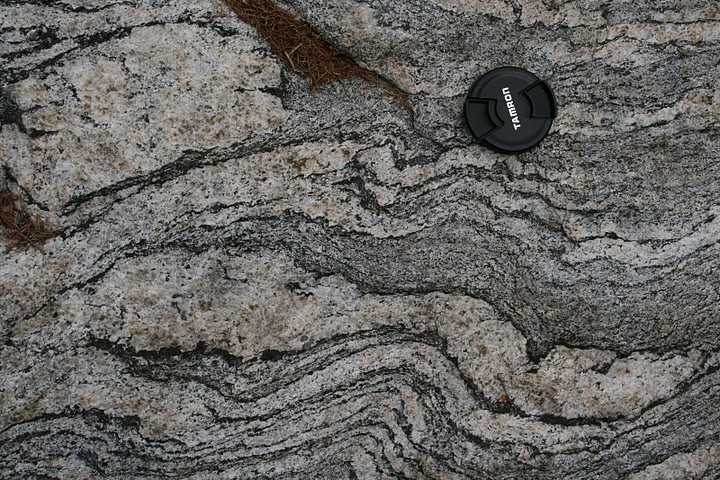
Migmatites are truly extraordinary rocks. They are very beautiful rocks to observe in the field or in hand sample. They usually consist of dramatic alternating black-and-white layers, and I like to call them “Zebra rocks.” These alternating layers usually undulate in a serpentine fashion, often containing beautiful, sinuous, ptygmatic folds.
Tight folds in a migmatite boulder (called "Bob's Rock") on display in the Grassy Hallow Visitor's Center, Angeles National Forest, California. Photo courtesy of Tisha Irwin. Another view of the "Bob's Rock" migmatite boulder. Photo courtesy of Tisha Irwin.
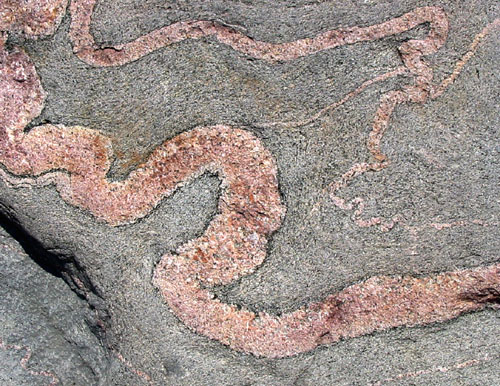
As a quick aside, the word “ptygmatic” was also introduced into the geological literature by Jakob Johannes Sederholm in 1907 and originates from the ancient Greek word for “fold” or “anything folded.” In a way, using the term “ptygmatic fold” is somewhat redundant– like saying “a folded fold.” However, the term “ptygmatic” in the geologic literature generally refers to tight folds that form when the folded material has a greater viscosity (resistance to flow) than the surrounding medium. In migmatites, ptygmatic folds often form in the more-viscous lighter layers.
Pink (K-feldspar-rich) ptygmatic folds. Photo taken from Wikipedia Commons here: http://en.wikipedia.org/wiki/File:Ptigmatite.jpg. Photo credit: Siim Sepp.Ptygamtic folds, a screenshot from part of the migmatite Gigapan by Callan Bentley. See end of post for a link to the Gigapan.
Beauty aside, migmaties are also extraordinary rocks because they form at the boundary between the metamorphic and igneous worlds. As a quick reminder for those of you who are a little rusty on Geology 101, metamorphic rocks are rocks which deform at very high pressures and temperatures and which may recrystallize but which have not formed through melting. Igneous rocks, on the other hand, are rocks which form by cooling from completely molten material. Migmatites are hybrid rocks: the dark layers (most often composed of biotite and amphibole) experienced metamorphic changes, but did not melt. The light layers (most often granitic in composition; as a reminder, granite consists of the minerals quartz, feldspar, and muscovite), on the other hand, crystallized from partial melts of the precursor rock.
A quick look at Bowen’s Reaction Series, which (in a very general way) organizes the order in which minerals melt (coldest to hottest) or crystallize (follow the diagram the opposite way, from hottest to coldest), gives a sense of why dark-colored minerals such as amphibole and biotite are more resistant to melting than light-colored minerals such as quartz, k-feldspar (often light pink in color), and muscovite. Generally, the light-colored minerals melt at lower temperatures than the dark-colored minerals.
Here’s a nice figure, courtesy of fellow AGU blogger Callan Bentley, illustrating partial melting:
Partial melting of a rock to form a felsic (generally, light-colored) melt and a mafic (generally, dark-colored) residue. Image courtesy of Callan Bentley.
The above figure refers to “felsic” melt and “mafic” residue. Felsic melts are silica-rich and form from silica-rich, generally light-colored mineral such as quartz and k-feldspar. Mafic melts are silica-poor (relative to felsic melts) and form from minerals with lower silicon contents such as olivine, pyroxene, and amphibole. Mafic minerals are generally darker in color, often black, brown, or dark green.
Migmatites actually look very similar to a related rock: gneiss. Gneisses also contain alternating light and dark layers which result under high-pressure and high-temperature conditions. However, in a strict definition gneisses are metamorphic rocks, which means that the light bands form through recrystallization alone; the light layers did not form by cooling from a melt. Distinguishing between gneisses and migmatites can be slightly challenging to do in the field. The two rock types are certainly relatives, so to speak. If a gneiss experiences just slightly higher temperatures, it may partially melt and become a migmatite. Most migmatites probably were gneisses on their way to becoming true hybrid metamorphic-igneous (metagneous? ignamorphic?) rocks.
Because migmatites are hybrid metamorphic-igneous rocks , they are important rocks for geologists to study in order to better understand how rocks melt and how these melts migrate and eventually become igneous rocks. Because many migmatites are silica-rich, some geologists have tried studying migmatites as a way to understand another silica-rich rock: igneous granite. For a long time, the origin of granitic rocks was debated by geologists. Between the 1920s and the 1960s, many geologists argued that granites could form from sedimentary or other non-granitic rocks through chemical alteration caused by fluids. This theory has now been largely abandoned, and geologists now believe that granites crystallize from melts of high-grade metamorphic rocks. The precursors of these high-grade metamorphic rocks may be either igneous (I-Type Granite) or sedimentary (S-Type Granite). Geologists now understand that granitic melts can form through a variety of melting processes. The presence of migmatites was one line of evidence that geologists examined to determine that granites probably formed through melting processes, not through chemical alteration processes. The exact relationship– if any– between migmatites and large bodies of melt is ambiguous and still debated amongst geologists, but migmatites do provide clear evidence that granitic melts (and also other types of melts) can be produced through partial melting of metamorphic rocks. Some migmatites are even found in close proximity to granite, such as in the photo below.
Adjacent granite and migmatite. Photo courtesy of Callan Bentley.
Below are a few more pictures of gorgeous migmatite rocks. Enjoy!
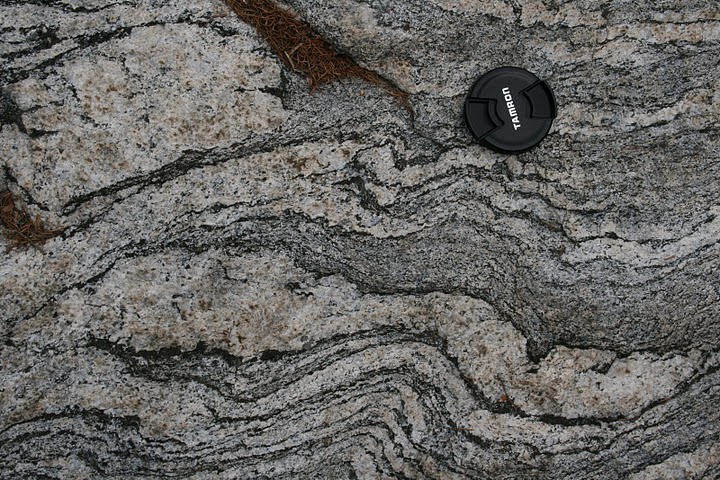
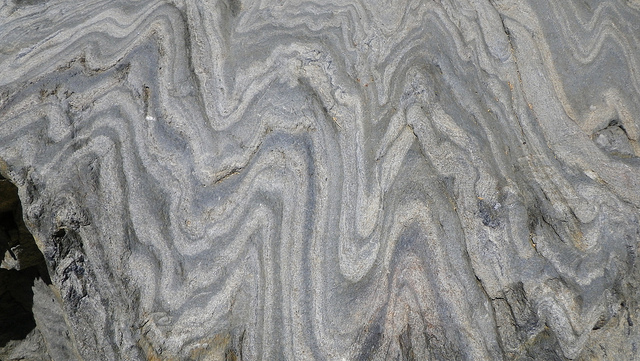
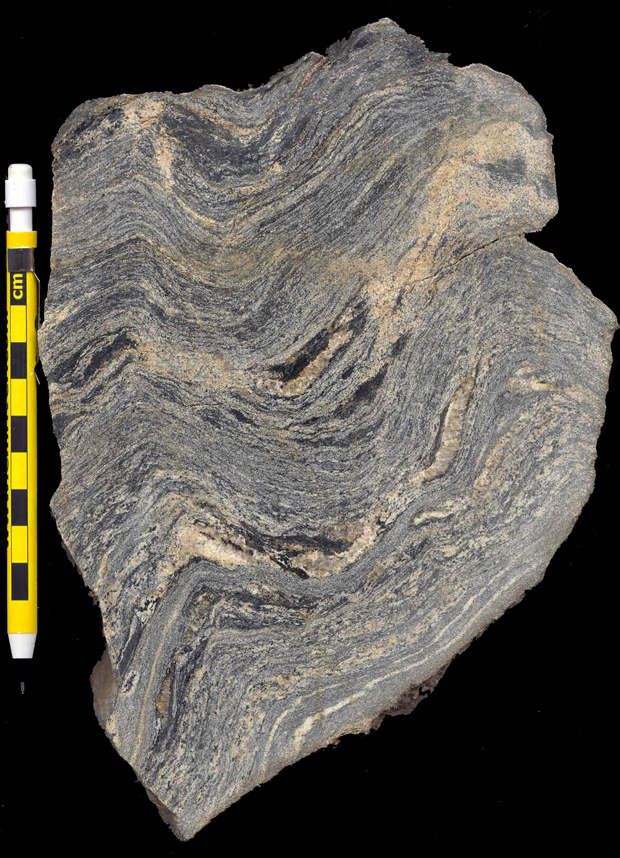
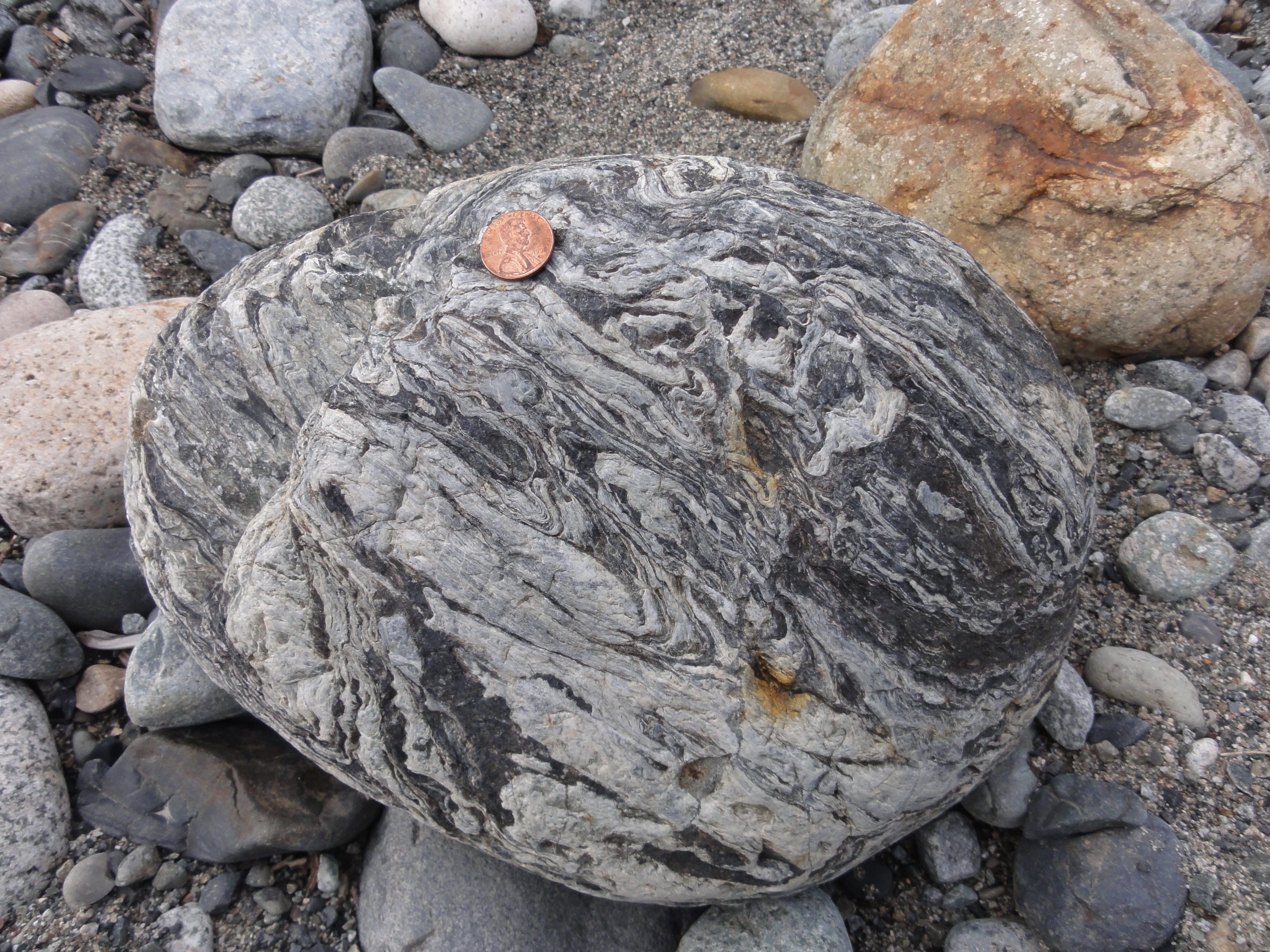
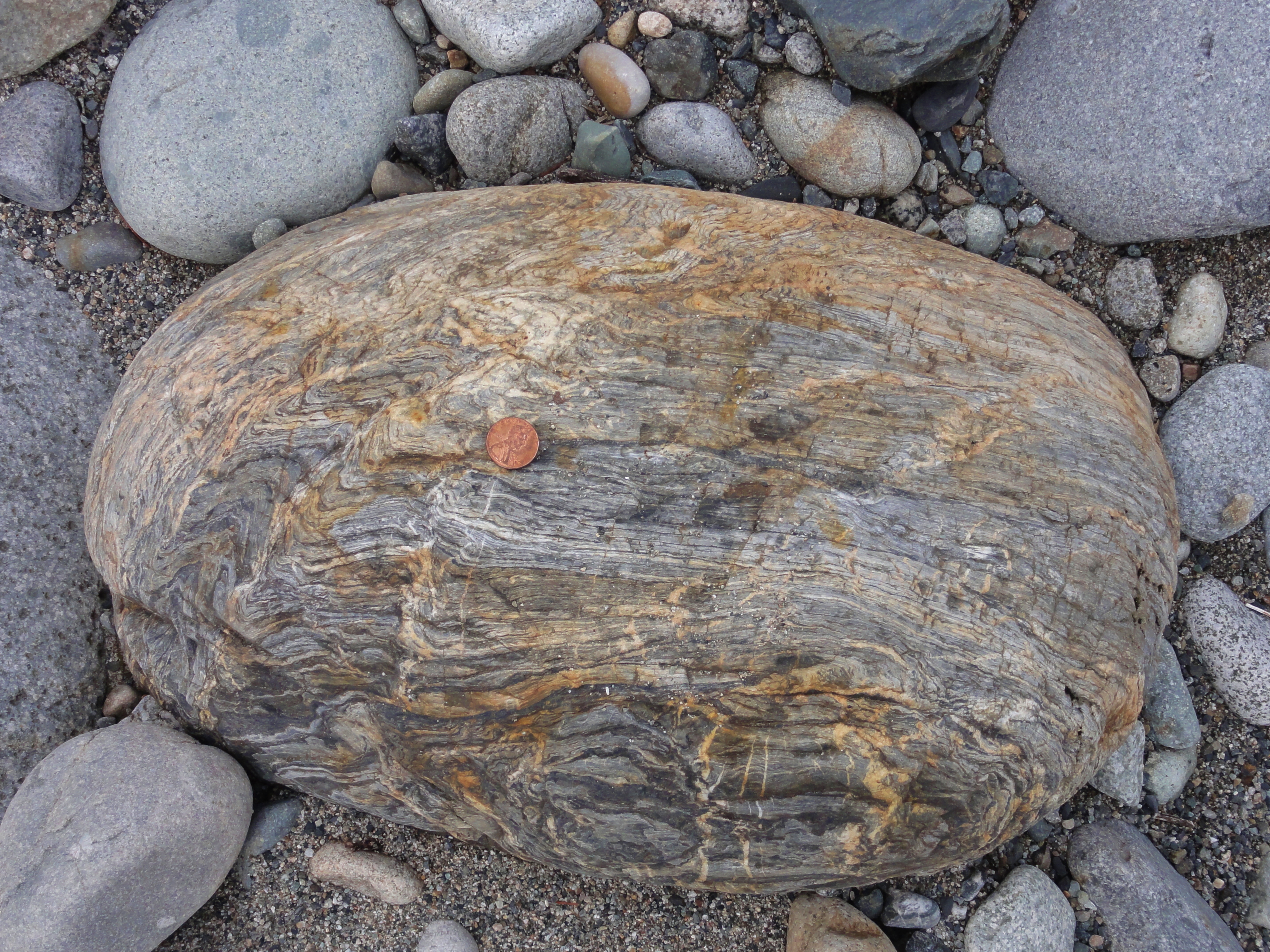
Close view of sinuous migmatite layers. Photo courtesy of Etienne Médard.Light-colored melt layers have aggregated in the center of this migmatite. Photo courtesy of Etienne Médard.Fine bands of light and dark minerals in migmatite. Photo courtesy of Etienne Médard.Sharp folds in migmagtite. Photo courtesy of Etienne Médard.More migmatite layers and folds. Photo courtesy of Etienne Médard.Gorgeous migmatite observed along the Billy Goat Trail, Maryland. Photo courtesy of Callan Bentley.Another migmatite observed along the Billy Goat Trail. Photo courtesy of Callan Bentley.Tight folding in migmatite. Photo courtesy of Callan Bentley. Gorgeous migmatite hand sample photographed in the lab. Photo courtesy of Callan Bentley.Migmatite boulder from the Skykomish River near Gold Bar, Washington State. Photo courtesy of Dana Hunter.A closer view of the above migmatite boulder. Photo courtesy of Dana Hunter.Another migmatite boulder from the Skykomish River. Photo courtesy of Dana Hunter.Closer view of the above migmatite boulder. Photo courtesy of Dana Hunter.
The image I put up on my old blog to announce the move to AGU.
I am very honored and excited to join the AGU Blogosphere! I hope that my old blog readers will continue to follow Georneys here at AGU. Feel free to leave a comment below if you’d like to say hello.
All of my posts from my old blogger site have been migrated over the AGU. I will also leave the blogger site up as an archive.
Are you a science blog reader*? Or writer? Feel free to go over to the comments here and nominate a science blog post that you like for the 3 Quarks Contest. The deadline is May 31st.
[Warning: Shameless self-promotion ahead] I’m a fairly new science blogger and a scientist, not a professional writer. However, if you like any of my writings here on Georneys, please feel free to nominate them. Below I’ve listed a few blog posts of mine which I like. [End: Shameless self-promotion]
At the very least, please do go nominate some geology-themed posts! Geology needs to represent in these science blogging contests.
Every week (except for the month when I interviewed my dad about Fukushima) since I started this blog back in November 2010 I’ve posted a “Geology Word of the Week.” For some reason I decided it would be fun to cycle through the alphabet from A to Z, and I’ve now accomplished that, writing about words from Alluvium to Zanclean.
Perhaps the alphabet theme is cliche, but I’m having fun with it. So, I think I’ll cycle through the alphabet at least one more time. You can expect another A word (Allochthonous? Alvin? Albite? You’ll have to stay tuned!) next week.
For the past little while, I have been keeping track of some interesting search terms that found my blog. These are just a sampling of ones that I happened across. I’ve put some “answers” below the search terms. Hope you enjoy. Happy Friday!
what is at the center of any self respecting volcano (4/5/11) Answer: The lair of a mad scientist.
is jurassic park too scary for 8 yr old (4/6/11) Answer: My grandmother took me to see Jurassic park in theaters when I was 9 years old, and I was very, very scared and had nightmares about velociraptors. However, the movie also helped inspire my interest in geology & dinosaurs.
synonym: hot liquid that come from tsunami in japan (4/6/11) Answer: Oil and gas that caught on fire? The only thing worse than a tsunami is a tsunami ON FIRE.
what is komatiite used for today (4/8/11) Answer: Many komatiites are mined for diamonds. D’oh, that would be kimberlites. Thanks for the correction, Chuck. More here.
is there a volcano in japan (4/9/11) Answer: Yes. Many, actually.
dress code geology convention (4/10/11) Answer: Recommended dress code for a geology convention is a t-shirt with a dinosaur and/or a geology pun on it, hiking pants, and teva sandals with socks. dress code for geologists (4/27/11) Answer: See above.
best reporting on fukushima (4/11/11) Answer: My blog? Maybe? I’m honored that this search reached my blog.
bee bop the bear (4/11/11) Answer: Is the general exam bear! And I’m not the only one who thinks he’s a bear. Yay!
can average students become great scientists (4/12/11) Answer: Yes. Absolutely.
why do geologists hate the core movie (4/17/11) Answer: Well, I’d define it as more of a love-hate relationship.
cimarec hot plate, error message (4/18/11) Answer: I bet you hate Cimarec hotplates, too. I have no idea what the f**k the error messages mean. And I’ve read the manual ten times.
mit lab fire hot plate (4/27/11) Answer: Yes, crappy (probably Cimarec) hot plates can cause fires. And melt valuable samples.
blatt and tracy, petrology: igneous, sedimentary and meta (4/19/11) Answer: Obviously, you want to see cute pictures of my cats.
are the lithosphere and crust the same (4/19/11) Answer: No.
most cluttered offices (5/7/11) Answer: Yes, my office is a bit cluttered… but that’s just related to my brilliance. Maybe.
whoi general exams difficult (5/10/11) Answer: Yes and no. But Bee-Bop helps.
hamsters move the tectonic plates (5/8/11) Answer: Say what???
what composition is the mantle felsic (5/9/11) Answer: No. Ultramafic.
have people died at geo field camp (5/14/11) Answer: Probably. But geo field camp is awesome! Take a wilderness first aid class if you’re worried. Actually, I highly recommend that for all geologists.
small picture of eating raccoon (5/15/11) Answer: Is a jungle raccoon eating pizza okay?
honnybees interact with the lithosphere (5/17/11) Answer: Say what???
alternate careers for geologists (5/17/11) Answer: Why on Earth would you want an alternate career? Being a geologist rocks. Actually, I’ve had days when I’ve considered alternate careers, too.
beep bop break dancing (5/19/11) Answer: I’m sorry that you were looking for information about break dancing and instead found information about PhD qualifying exams.
card games for 2 people (5/19/11) Answer: No idea why this search reached my blog. I don’t have any posts about card games, but here’s one about the most awesome car game ever.
geologists name for the first continent (5/19/11) Answer: Vaalbara, maybe?
iguanodon poem (5/19/11) Answer: Yes! I happen to have one of those.
I want to give you a quick update on the status of the book “Conversations with My Dad, a Nuclear Engineer, about the Fukushima Daiichi Nuclear Power Plant Disaster in Japan” which I plan to self-publish on Lulu. I am still working on putting this book together, albeit in my very limited free time. Now that I’m back from my South Africa trip, I’m working 10-12 hour lab days to finish up the labwork for my PhD thesis. The good news is that the interviews are all transcribed now (thanks to my volunteers; if I haven’t sent you a rock yet I’ll do so in the next few weeks), so I just need to finish editing and compiling them.
My plan is to have the book available on Lulu around the first week of June. I want to include a few pictures of my father and I in the “extra” chapter. I was compiling some photographs, and I realized that my dad and I have not taken a picture together since my college graduation back in 2006! I’d like to include a recent picture of my dad and I. Fortunately (maybe unfortunately for him), my dad is visiting me on June 1st to help me move out of my apartment, so we’ll do our best to take some photos then to include in the book. You should expect the book on Lulu shortly thereafter. The interviews will of course be out-of-date, but there is still plenty of good information and explanation in these interviews, much of which will still be relevant even three months after the nuclear disaster began. Also, our interviews tell a story, in a way, of the first month of the Fukushima nuclear disaster.
As a reminder to everyone, the nuclear disaster at Fukushima is far from over. There has been so much damage to the Fukushima reactors 1-3 and the spent fuel pools at reactors 1-4 that restoration of normal cooling systems will still take months. Meanwhile, the situation at Fukushima remains precarious.



















 Georneys
