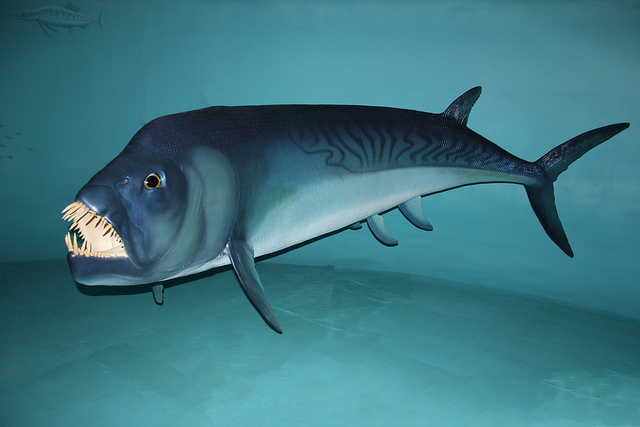
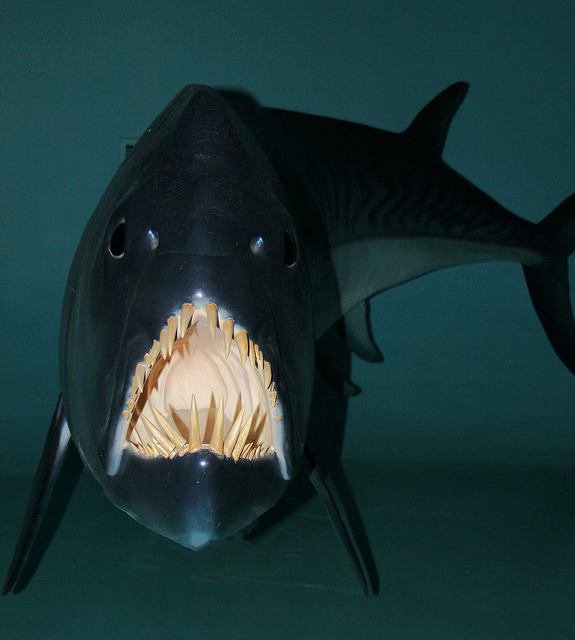
A model of a live Xiphactinus. Photo courtesy of Ron Schott.
def. Xiphactinus:
1. A large (15-20 ft long), predatory fish that lived during the Late Cretaceous.
2. A prehistoric sea monster. Seriously. What an enormous and scary looking fish.
3. A really, really cool fossil. Maybe one day I can display one in the library of my evil geologist lair.
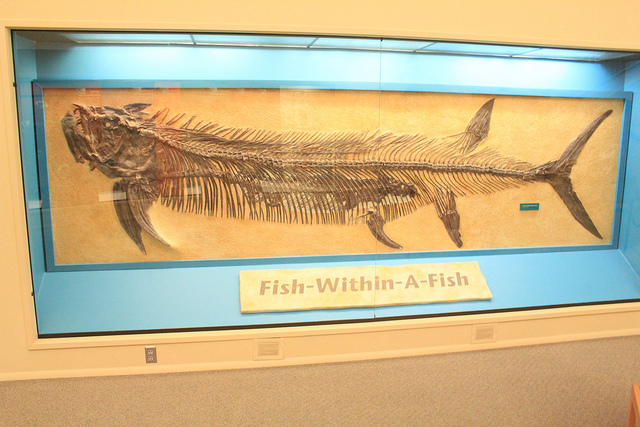
One of the most famous fossils of Xiphactinus is the “fish within a fish” fossil located at the Sternberg Museum of Natural History in Hays, Kansas. Ron Schott visited the museum several months ago and took many pictures as well as an incredible Gigapan of the “fish within a fish” fossil and some of the associated displays. Ron describes:
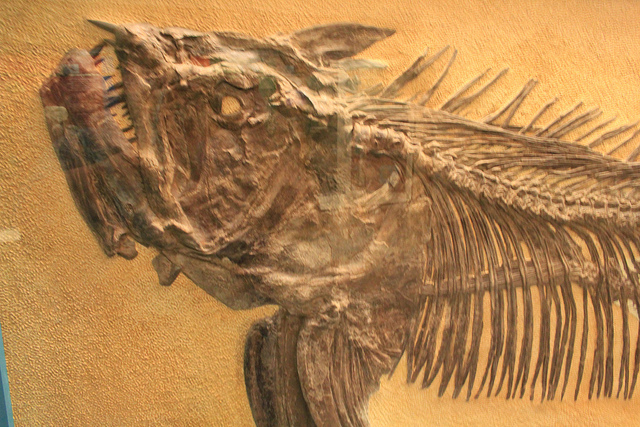
The centerpiece of the Sternberg Museum of Natural History in Hays, Kansas is the world renowned “Fish Within a Fish”. This remarkably complete sample from Gove County, Kansas is of a fourteen foot long Xiphactinus that had ingested an eight foot long Gillicus shortly before its demise in the Western Interior Seaway some 80 million years ago.
Here are some pictures that Ron took of Xiphactinus:
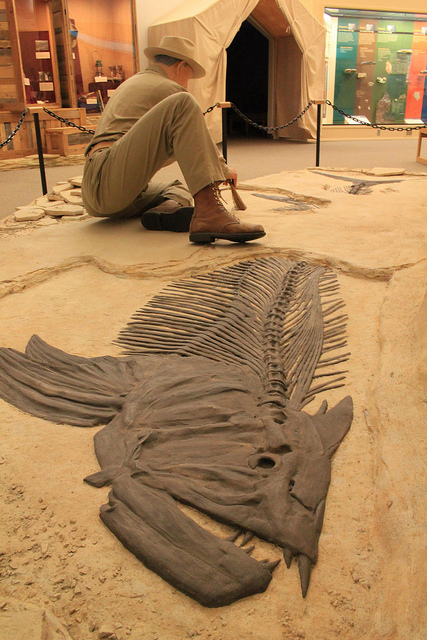
A fossil fish within a fossil fish. Very cool! Photo courtesy of Ron Schott.Another view of the "fish within a fish" fossil. Photo courtesy of Ron Schott.A closer view of the big fish's head. Look at those teeth! Photo courtesy of Ron Schott.Scary fish teeth! Photo courtesy of Ron Schott.A Xiphactinus skull. Photo courtesy of Ron Schott.A reconstruction of the excavation of a Xiphactinus fossil. The model person gives a good sense of scale-- this is an enormous fish! Photo courtesy of Ron Schott.Another view of the model excavation. Photo courtesy of Ron Schott.Scary Xiphactinus mouth. Photo courtesy of Ron Schott.Boo! Photo courtesy of Ron Schott.
***Thanks to Ron Schott for suggesting this week’s word and providing all the wonderful scary pictures.***
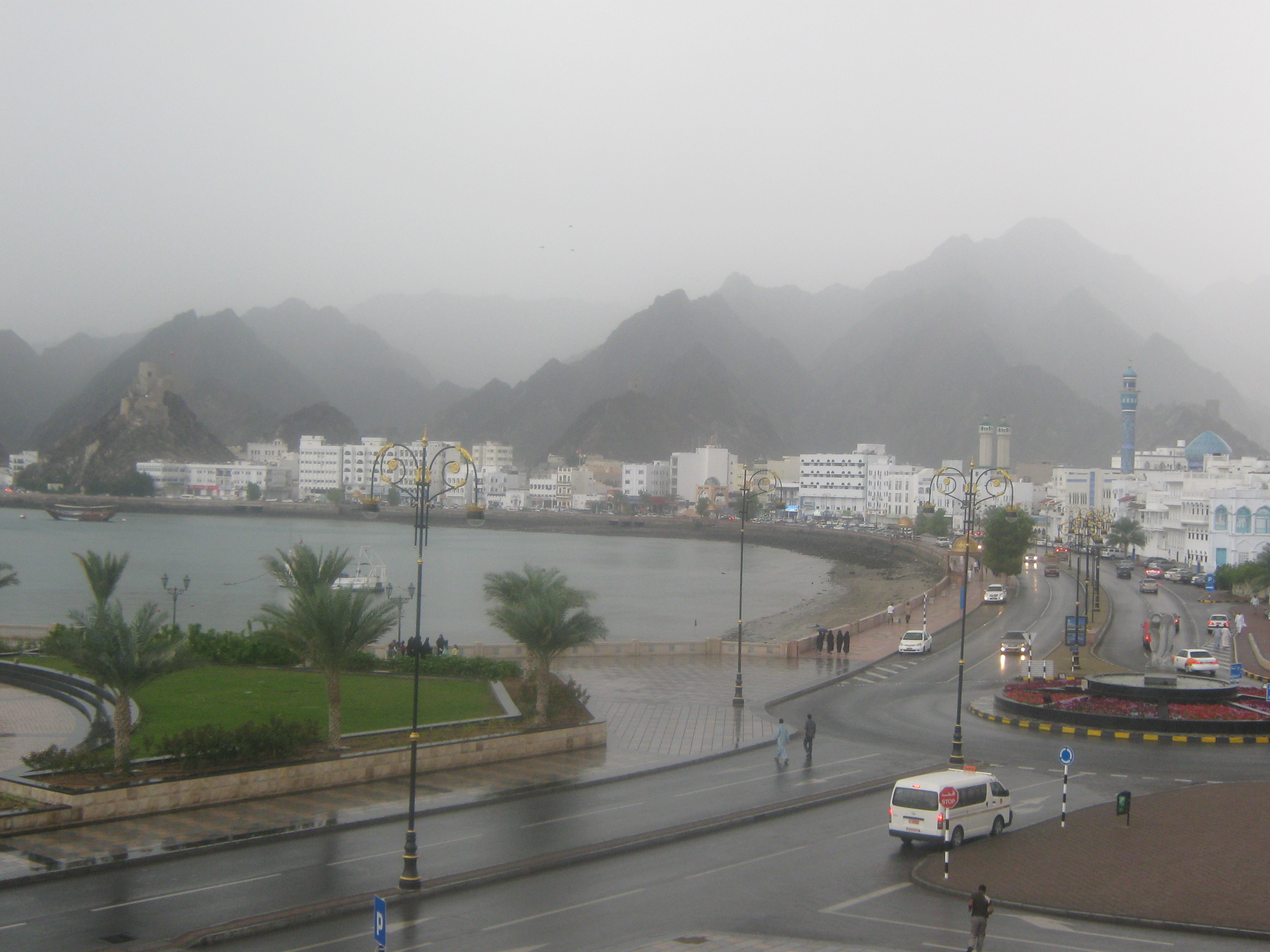
Sunrise over peridotite mountains in downtown Muscat, the capital of Oman.
I have the honor of hosting Accretionary Wedge #50 here at Georneys. The topic I chose for the September (Deadline: October 10th) Wedge is:
Share a fun moment from geology field camp or a geology field trip. You can share a story, a picture, a song, a slogan, a page from your field notebook– anything you like!
I have many fond memories from Dartmouth’s geology field camp (called “The Stretch”) in the Western USA and also from various geologic field trips I’ve taken over the years. However, for Accretionary Wedge #50 I’ve decided to share a moment from some fieldwork I did in the Sultanate of Oman for my PhD thesis research.
I participated in two ~1 month long fieldwork seasons in Oman: January 2009 and January 2010. For the first field season one of my PhD supervisors came along to help me with mapping and collecting samples. For the second field season neither of my two PhD supervisors were available to help me with my fieldwork, so I had to recruit another helper. I ended up bringing along my husband Jackie, who was my fiance at the time. Jackie was already working full-time as an industry geologist, but fortunately he had accumulated significant vacation time from several months that he spent at sea and in the field. So, Jackie cashed in 3 1/2 weeks worth of hard-earned vacation time… and then spent his vacation helping me do more geology work!
Jackie and I worked hard during the field season. We worked long days, eating a quick campfire breakfast of oatmeal with tea or coffee and then heading off to the day’s sampling location. We would map and sample until a couple of hours before dark and then head back to camp. Even though January is the middle of winter for Oman, the days were often sunny and hot. Temperatures in the 90s were not uncommon, and we had to be careful to keep our heads covered and stay hydrated. We usually drink plain water when hiking, but working in Oman is so hot that we frequently mixed Gatorade powder into our water bottles as the electrolytes seemed to help prevent dehydration. We usually arrived back at camp a little before sunset. Some nights we arrived at a new campsite and had to pitch our tent and set-up the rest of the camp. Other nights we returned to a campsite and just had to help make dinner. Most nights we joined up with a group of scientific colleagues who were working in similar field areas. A few nights we camped on our own and made a small makeshift meal, generally out of canned supplies that were perhaps supplemented by a few local ingredients from a nearby town. No fresh food stays fresh for very long in 90+ degree temperatures. We ate plenty of canned hummus and tahini, that’s for sure!
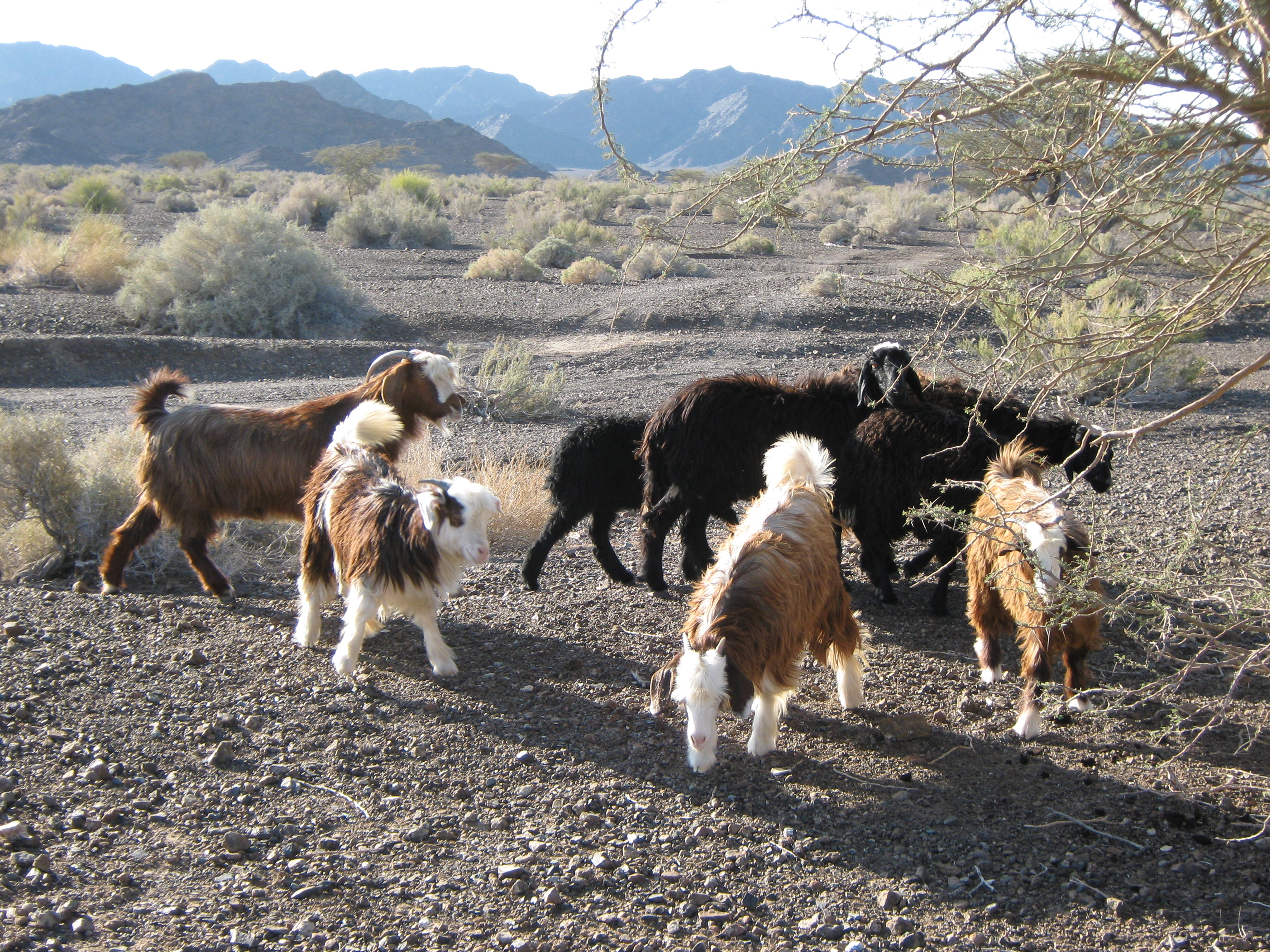
My PhD fieldwork in Oman mostly went smoothly, but there were some challenging days. During my first field season in 2009, we experienced a rare torrential downpour, and our hotel in Oman’s capital city of Muscat flooded. We had to dart around our rooms picking our bags and other gear and putting them on top of beds and sofas as the floors turned into rivers. I remember walking down the hotel stairs to inform the hotel management about the flood and feeling as if I were climbing down a waterfall. There was no need for me to inform the management– they were already rushing around with mops and buckets and trying to placate several disgruntled guests. During the 2009 field season we also had problems with goats invading one of our campsites. One of my scientific colleagues gave a half-rotted apple to one adorable goat that wandered into our camp, and within a few minutes all of the goat’s friends arrived– more than a dozen friends! The goats started eating through the cardboard boxes that contained our vegetables and fruit, eating the cardboard along with the food!
A rare Muscat rainstorm. This storm was in 2010, but we experienced a similar storm during the flooding event of 2009.A small goat invasion.
Jackie and I had a few challenging days during the 2010 field season, too. One morning we were packing up our tent when suddenly Jackie jumped away from the tent and screamed. I asked him what was wrong, and he replied, “There’s a spider under the tent fly.” I rolled my eyes and asked, “Is that all?” Then I looked under the tent fly and started screaming myself. Underneath the tent fly was an enormouscamel spider. Now, I knew that camel spiders are relatively harmless: they aren’t poisonous, and accounts of them attacking people are mostly urban legends. In fact, they aren’t even spiders; they are solifugae. There is actually a variety of poisonous spiders, scorpions, and snakes in Oman, so camel spiders are really the least of your worries when camping in the Oman Mountains. However, camel spiders are very large and can run very fast, and for some reason this makes me– and I guess also Jackie– petrified of them. Eventually, we managed to gently coax the camel spider away from our tent with a stick. After carefully checking the rest of our tent for other critters, we packed up camp and started driving to our next sampling location.
Jackie and I at the start of the 2010 field season. Already, we look sunburned! That's Muscat in the background. Notice the old fort in the far distance.
Towards the end of the 2010 field season, we had a couple of very difficult days. One morning, I woke up and felt horribly ill. I think I must have caught some sort of flu. I don’t think it was food poisoning because I hadn’t had anything to eat or drink that was out of the ordinary, and no one else in our group fell ill from the food that we shared. Whatever I had, I was very, very sick. I immediately vomited up any food or water. All day, I could only keep a few sips of Sprite down. I left a certain public bathroom in a certain little Omani village in a terrible state. One day, I must go back and do something nice for the village– maybe donate a sparkling new public bathroom. By the end of the day of vomiting, I was becoming dangerously dehydrated. Jackie ended up driving me to a rural hospital, where a kind doctor treated me for free. The doctor did ask if perhaps I were pregnant with another child and experiencing morning sickness (note: Jackie and I have no children; I guess he thought Jackie and I were old enough to have a couple of kids), but once we assured him that I was not pregnant, he diagnosed me with flu, rehydrated me, and gave me some medicine to take back to camp. After a day or two I felt much better, just a little bit weak. However, I can’t say that I’d like to repeat the combination of having flu and camping in hot weather anytime in the near future! Poor Jackie ended up catching my “death flu”, as we called it, a few days later. However, I didn’t feel too sorry for him because he had “death flu” in the nice air conditioned hotel room with a proper bathroom in Muscat.
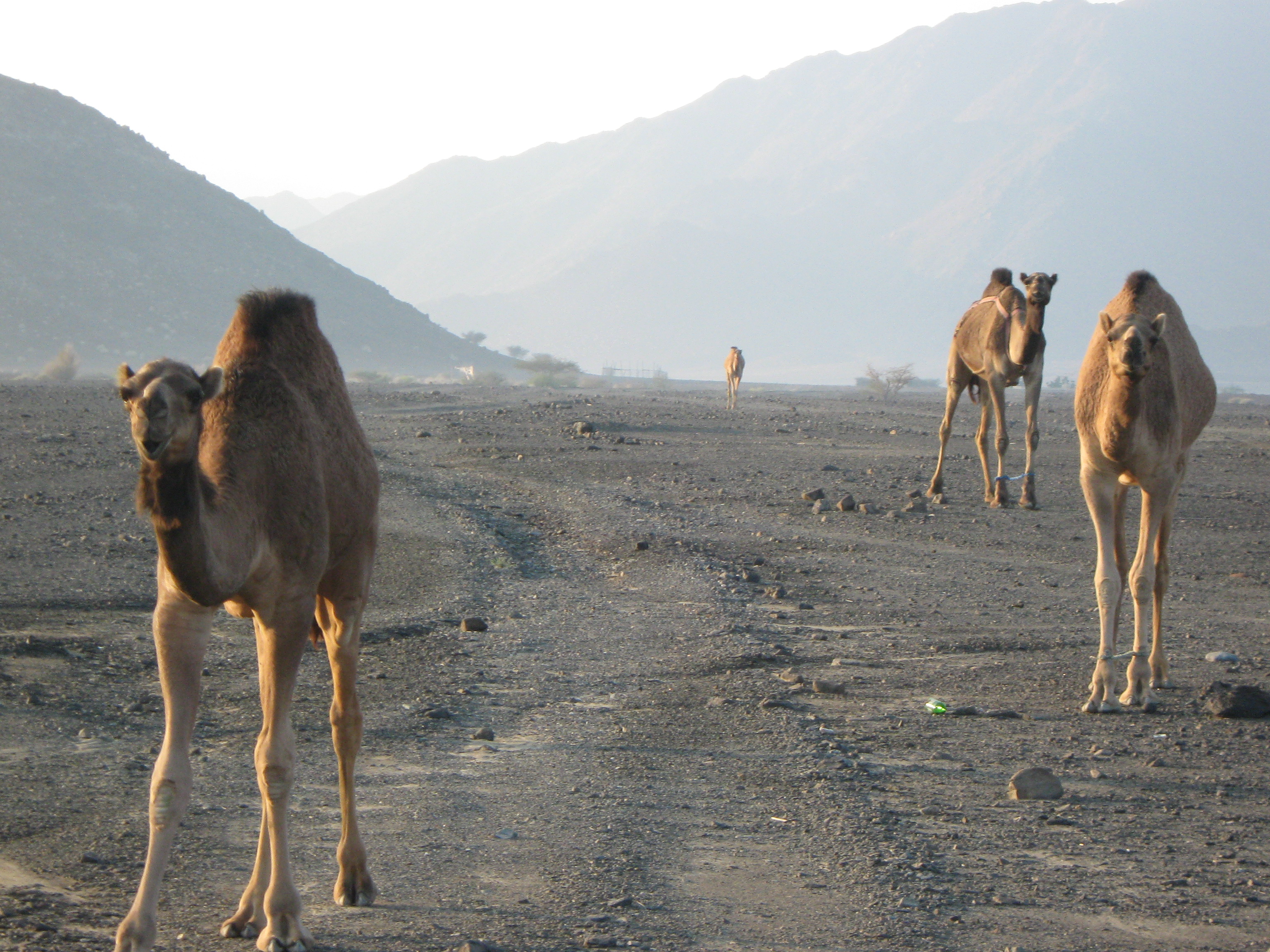
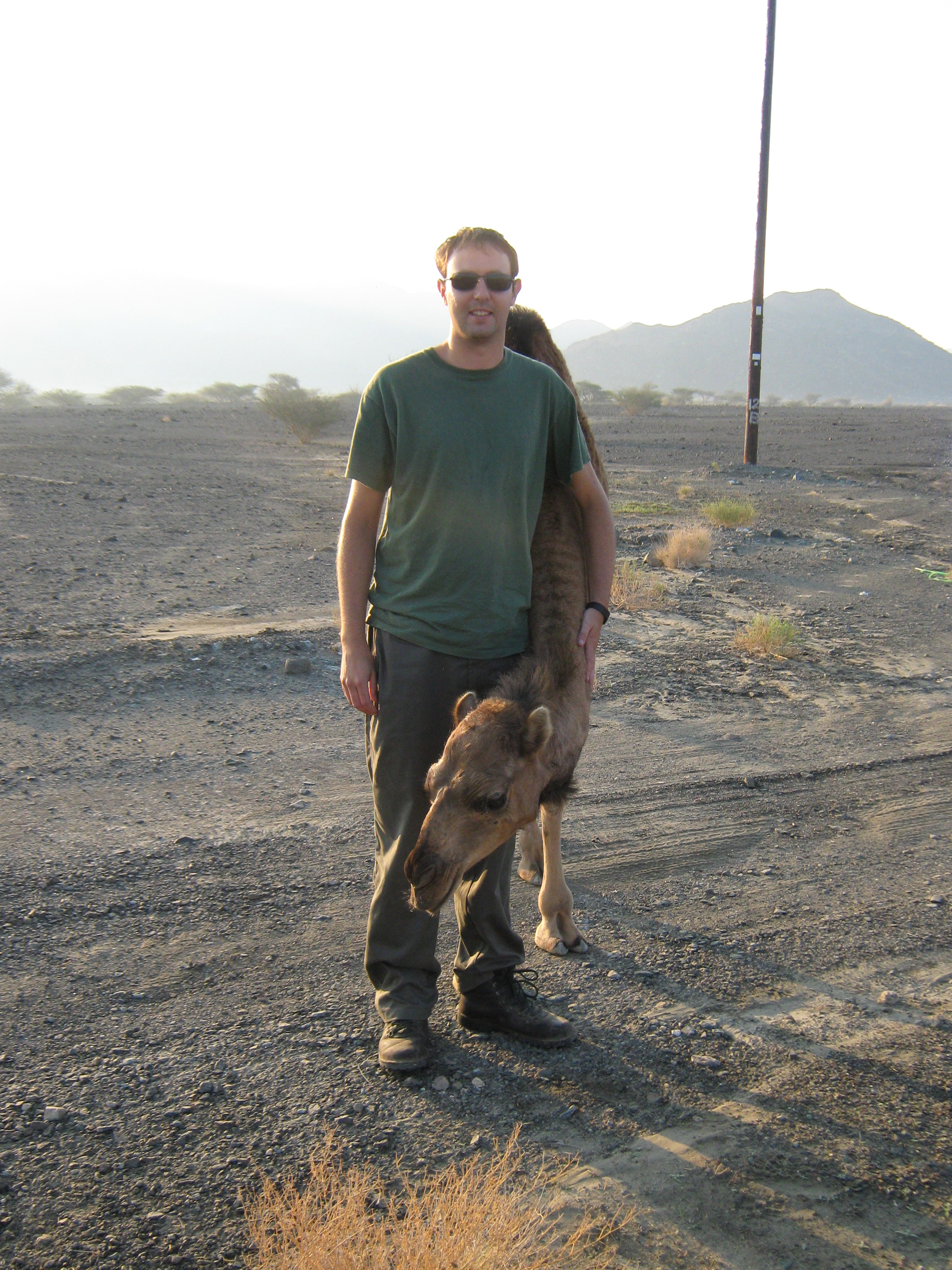
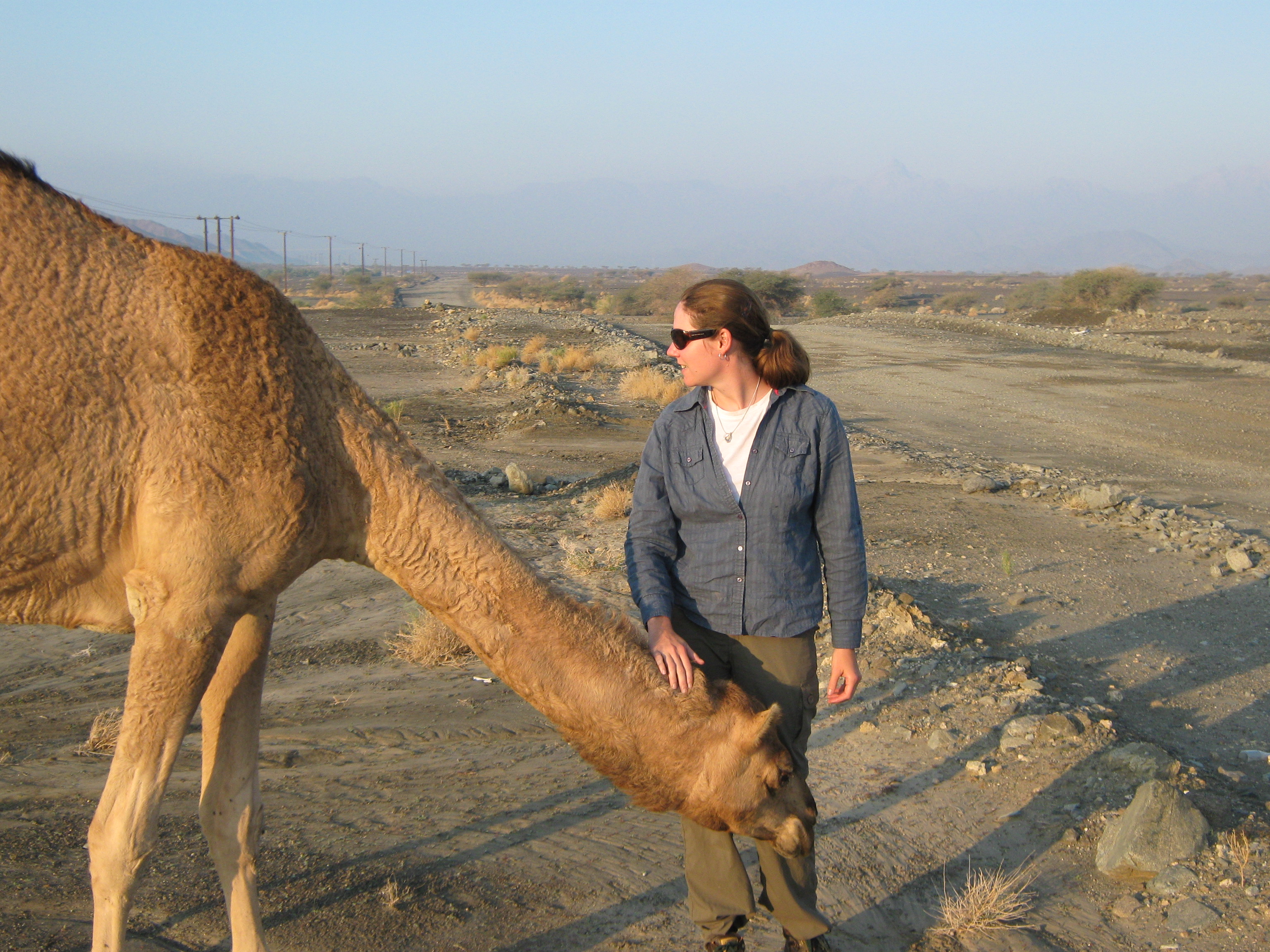
However, there were also plenty of wonderful field moments during the 2010 field season to make up for the challenging times. I wanted to share one moment in particular: a camel sunrise. As Jackie and I were driving out of camp early one morning along a dirt road, we stopped to observe four camels in the distance. As we stood by our Land Cruiser, the four camels slowly walked towards us and came over to say hello. We pet all of the camels, and a juvenile camel was particularly affectionate. After awhile, the camels continued on their way, stopping now and then to nibble on Acacia trees as they shuffled along. I have a vivid memory of the few minutes we spent watching the camels– the early morning light was beautiful, and for that moment all the world seemed to contain were the two of us, our Land Cruiser, the camels, and the mountains. In a busy, often crowded world, I’ve learned to treasure such moments. It was one of those moments that makes you remember why you became a geologist. It was one of those moments that makes you remember why you keep going into the field– floods, goats, camel spiders, “death flu”, and all.
Approaching camels.Closer......And Closer......And Closer!The affectionate juvenile camel.Cuddling with a camel.Petting one of the adult camels.Shuffling away. The adult camels had their legs tied together with ropes to keep them from wandering too far.Every day I'm shuffling.
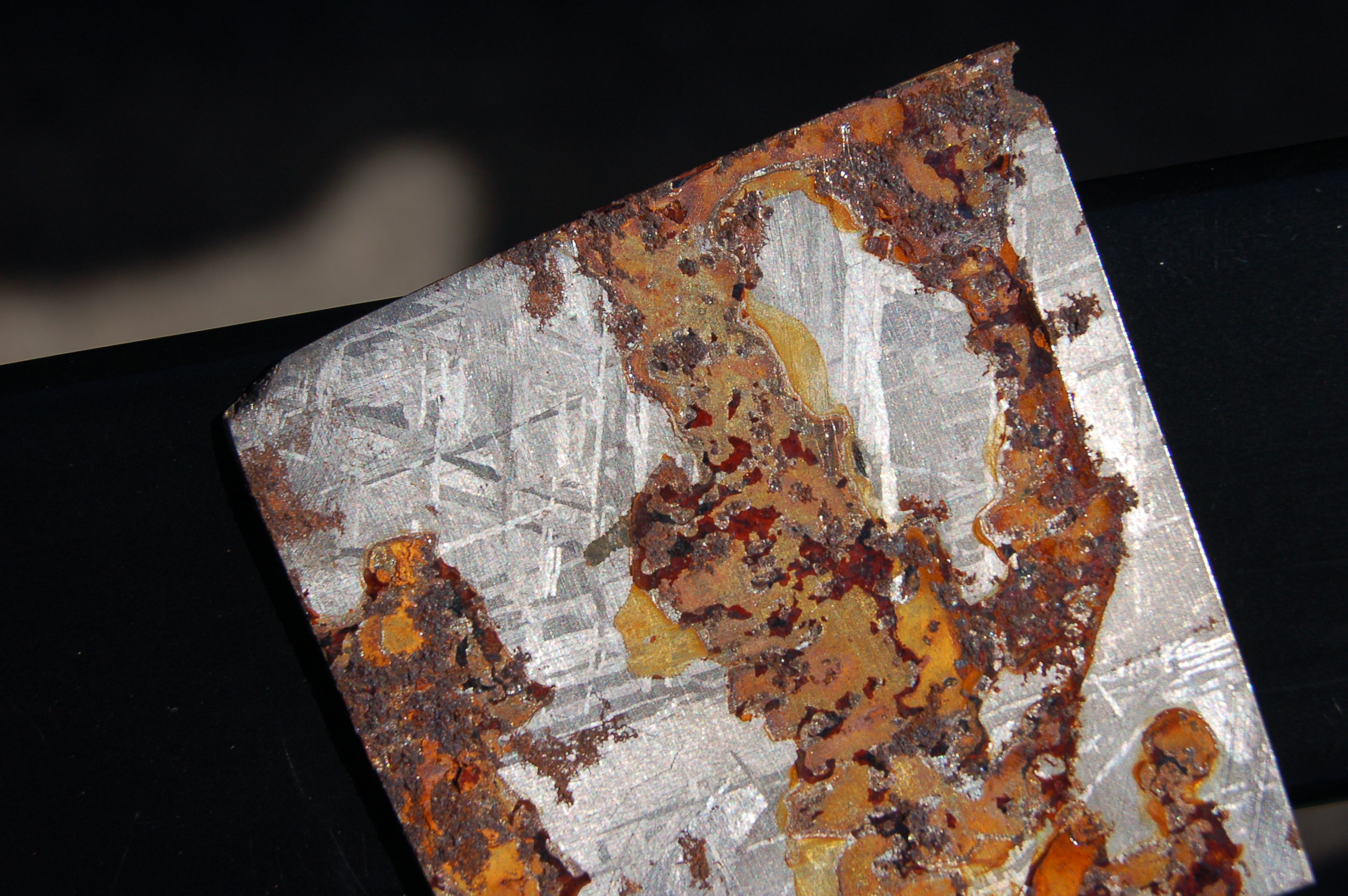
A slice of meteorite displaying a Widmanstätten pattern (silvery patches) in between oxidized or rusted sections (reddish brown patches). Photo courtesy of Lockwood Dewitt.
def. Widmanstätten Pattern:
An interweaving pattern of the extraterrestrial minerals kamacite (a low nickel content iron-nickel alloy, similar to the terrestrial mineral ferrite) and taenite (a high nickel content iron-nickel alloy, similar to the terrestrial mineral austenite) that appears in some iron-nickel meteorites when a cut section of the meteorite is etched with weak acid.
Widmanstätten patterns appear during acid etching because kamacite is more easily dissolved by weak acid than taenite. Widmanstätten patterns are believed to form in a few different ways (depending on the pressure and temperature conditions experienced; I won’t go into too much detail on this) as iron-nickel material separates into the high-nickel and low-nickel minerals as it cools. Whatever the formation pathway, Widmanstätten patterns can only form when there is very slow cooling in an environment such as the core of a planet. Therefore, Widmanstätten patterns are only found in meteorites, not in any naturally forming rocks on Earth’s surface. In fact, Widmanstätten patterns require such slow cooling that they cannot even be reproduced by scientists in a laboratory.
Widmanstätten patterns are named after Count Alois von Beckh Widmanstätten, an Austrian scientist who discovered the patterns in 1808 when he was flame heating a meteorite. Count Widmanstätten never published his discovery, but he orally communicated it to his scientific colleagues, and the pattern was named after him. Some scientists believe that the patterns should also be called Thomson patterns because a scientist named G. Thomson had previously, independently discovered the patterns when he was trying to use acid to clean some rust off of a meteorite. Thomson published his discovery in French in 1804. However, Thomson’s discovery was not widely spread throughout the scientific community because the Napoleonic wars interrupted Thomson’s communication with his scientific colleagues (Thomson was English) as he was living in Naples, Italy at the time. Thomson also died at an early age in 1806 before Widmanstätten made his own discovery of the patterns.
I, for one, always forget how to spell and pronounce “Widmanstätten.” Perhaps I’ll remember better after this post. Regardless, I’m happy to know that, due to some scientists trying to right some misfortunes and twists of history, I can always google “Thomson patterns” to find out the more popular name of “those pretty meteorite pattern thingies.”
Below are a few more pictures of Widmanstätten patterns. If anyone else has additional pictures of Widmanstätten patterns, I’d love to add them to this post. Just email them to georneys blog (AT) gmail.
Another view of the Widmanstätten pattern on Lockwood's meteorite. Picture courtesy of Lockwood DeWitt.Widmanstätten pattern on the Cape York meteorite at the American Museum of Natural History in New York City. Picture courtesy of Patrick Donohue.
***Thanks to several of my twitter followers for suggesting this week’s word. Thanks to Lockwood DeWitt and Patrick Donohue for providing pictures.***
Earlier today I noticed an unusual comment on my blog post Blast from the Past: Carbon Cycle Story. In the blog post I share a story that I wrote about the carbon cycle when I was 10 years old as part of a school unit on atoms at my Montessori school.
Here is the unusual comment, which is from a “Mrs. Kim”:
Please delete this post. I am a biology teacher at Thomas Jefferson High School for Science and Technology. Two students were caught plagiarizing this article for a carbon cycle assignment. The issue has been resolved, but we need to guarantee this does not occur in the future. Thank you.
I replied to “Mrs. Kim”:
Hi Mrs. Kim, Thanks for your concern– I’m sorry to hear that students were plagiarizing this assignment, but I’m not going to delete it. There will always be things out on the internet to plagiarize, and schools need to learn how to resolve these issues. I find it sad that students felt the need to plagiarize this assignment, which was one of my favorite school assignments ever :-).
I then asked my twitter followers, many of whom are geoscientists and/or teachers, what they thought about the comment and my response. Here’s the tweet:
Please excuse the typo. "aksed" should be "asked."
Overwhelmingly, my twitter followers agreed that I should not take down the blog post and that requesting that primary sources be taken down from the internet is an inappropriate way to handle plagiarism. Here is a sample of the many, many replies I received on twitter:
A sample of the replies to my twitter inquiry.
Wanting to make sure that the teacher saw my response to her request, I tried sending a message to the email which “Mrs. Kim” provided. The email was returned because the address didn’t exist. I thought that possibly “Mrs. Kim” had entered her email address incorrectly, so I did some sleuthing and looked up the Thomas Jefferson High School for Science and Technology. Guess what? From 2007 to 2011 this high school was ranked as the best public high school in the United States.
Now, I found it somewhat strange that a teacher at one of the best high schools in the United States would be so naive about how to handle plagiarism. I also found it strange that high school students would be plagiarizing a story I wrote when I was 10. So, I decided to write to Dr. Evan Glazer, who is the principal of the Thomas Jefferson High School for Science and Technology. Boy, that school name is sure a mouthful! From now on, I’ll refer to the school as TJHSST. Dr. Glazer kindly wrote back to me and informed me that there is no biology teacher named Mrs. Kim at TJHSST. Furthermore, the TJHSST email provided by “Mrs. Kim” is fake.
Quite honestly, I now find myself puzzled and somewhat discombobulated by the “Mrs. Kim” comment. I find myself worried over who “Mrs. Kim” could possibly be. Is “she” a teacher at another school? Could “she” be a student trying to convince me to remove my post so that “she” can plagiarize my content for a school assignment? I have no idea. However, I do feel relieved that the comment does not come from a biology teacher at TJHSST.
However, I’m happy to see that my twitter followers and blog readers are so passionate about issues regarding the internet and plagiarism. Please feel free to comment (productively and politely– I reserve the right to remove comments) about plagiarism and the internet below.
“Mrs. Kim”: please don’t post here again under a false name! And “Mrs. Kim”: if you are a student with a carbon cycle assignment, I’d be happy to answer any questions you may have about the carbon cycle… though you’ll have to write the assignment yourself!
Some of the gorgeous decorative stones at O.R. Tambo International Airport.
Today I am going to share some pictures of decorative stones adorning the O.R. Tambo International Airport in Johannesburg, South Africa. I’ve flown through O.R. Tambo a dozen times or more, and I always appreciate the beautiful decorative stones that are found throughout the airport. I took the pictures in this post from the area around the security check-in for the international terminal. I apologize that the quality of these pictures isn’t fantastic. I took these photos somewhat slyly with my Blackberry phone, and I didn’t pause for too long to examine the decorative stones. The security guards look at you suspiciously when you start investigating the walls of the terminal too carefully.
I don’t know much about these decorative stones or where they came from– can anyone provide me with more information on them? All I know is that they are GORGEOUS and make my layovers in the airport much more enjoyable.
More gorgeous decorative stones at O.R. Tambo International Airport.Even more gorgeous decorative stones at O.R. Tambo International Airport.Even MORE gorgeous decorative stones at O.R. Tambo International Airport.A closer view of some of the decorative stones.An even closer view, with my hand for scale.Another close-up view.Even closer!
Several days ago, I shared some pictures of me in my PhD regalia, and I asked people to share with me pictures of academic dress so that I could host an academic dress parade here on Georneys.
For those of you who are not familiar, academic dress consists of fancy robes and hats and such that used to be worn daily or regularly by students and professors but which are now generally only worn for formal ceremonies such as graduations. Academic dress is very diverse. Countries, schools, and even departments have their own individual styles of academic dress, and the dress also varies to indicate the level of degree earned by an individual (PhDs and DScs usually wear doctoral hoods, for instance). Since academic dress is so diverse, I thought it would be fun to share some pictures here. I’m still looking for more pictures of academic dress (particularly some of the more elaborate dress styles with fur and lace and really crazy hats), so please continue to send pictures to georneysblog AT gmail. I can always host a second parade!
I think it’s wonderful to celebrate academic dress. In these days when students and professors are more likely to wear jeans than a tie, I find the academic dress a fascinating throwback to times when dress was much more elaborate. Today, academic dress looks delightfully ridiculous… as if all the students and professors are dressed up for a Harry Potter movie, perhaps.
I recently attended the Massachusetts Institute of Technology graduation ceremony (I received my PhD in Marine Geology), and the graduation speaker this year was an MIT alum named Salman Khan.During his speech, Khan compared MIT to Hogwarts:
As long as I could remember, to anyone who would listen to me, I’ve told people that MIT is the closest thing on this planet Earth to Hogwarts, to Harry Potter’s wizarding school. That the – the ideas and research and the science that percolate behind these walls — that’s the closest thing to magic in the real world, and frankly, to people outside this campus it looks like magic. The faculty we have these are the leading wizards of our time, the Dumbledores and McGonagalls (I guess, President Hockfield, you would be McGonagall). The halls here they have secret passages and tunnels, and around every corner there are strange and bizarre magical objects and creatures, some of whom may finish their thesis this decade. Maybe a few in the audience.
I’d argue that Khan’s remarks apply not only to MIT but also to many other research universities. While a bit ridiculous, perhaps Harry Potter style robes are appropriate attire for the “leading wizards of our time.”
I really like my tassled hat!My doctoral regalia from the back.
I describe the dress as well as my doctoral hooding and graduation ceremonies in detail in this post.
In similar attire, here is my friend Einat Lev, who graduated with a PhD from the Earth and Planetary Sciences Department at MIT:
Einat, showing off her doctoral hood.
You’ll notice that Einat’s hood has red and gray colors (MIT’s school colors) while my hood has red, gray, and blue colors. The extra blue is to represent the joint program with WHOI. Here’s another photo of Einat, eager to remove the very hot robes!
The MIT PhD robes are rather warm for June weather in Cambridge!
Here is Jenny Holden, decked out in her undergraduate and PhD academic dress:
Jenny in her undergraduate robes.Jenny in her stylish PhD regalia.Jenny at her PhD graduation.
Jenny provided some detailed information about her academic dress and graduation ceremonies:
I got my undergrad and PhD from the University of London but different colleges (SOAS and King’s). I chose to have a University of London PhD and academic dress over the King’s robes as although the latter were designed by Vivienne Westwood— they don’t have a detachable hood, which you can wear when singing in certain church choirs and preaching in some places (an option I may want to take up). There are nine pages describing University of London academic dress more interesting pictures.
The gowns are fairly heavy and warm (good in Winter not so much in July), but my supervisor’s (who got his PhD at Cornell) seemed warmer and velvet like!
I hired all mine but can buy the hood at a later date if I wish. We don’t have any robing ceremony, you are dressed by the gown hire people and don’t wear hats [see hat picture above] for ceremonies.
My PhD ceremony in July last year was with undergraduates so we had our degree titles and names read out as we walked across the stage as opposed to just our names (which undergrads get). We had
a couple of honorary doctorates awarded at my ceremony including Terry Pratchett!
My undergrad ceremony is memorable as I graduated from the School of Oriental and African Studies, so the music before, during and after reflected this (Shone funeral music, Sephardic singing, Chinese strings and a Japanese Buddhist nose flute where the player wears a basket over their head!), after 3 years at SOAS the graduands are used to it but our parents not so much.
All undergrads in the UK have black gowns, with the colours on the hood denoting different subjects in groupings such as Science, Arts, LLB (or law) etc. The Masters gowns have different colour ribbons but are still black. In Scotland (where I work now) the PhD students where a different kind of cap called the John Knox cap.
I have to say the most striking PhD gown was worn in the academic procession for my PhD and we think it came from a Scandinavian university and looked like a knight’s outfit.
Note: If you know of anyone who owns Scandanavian knight academic dress, please tell them to email me a picture for our next dress parade!
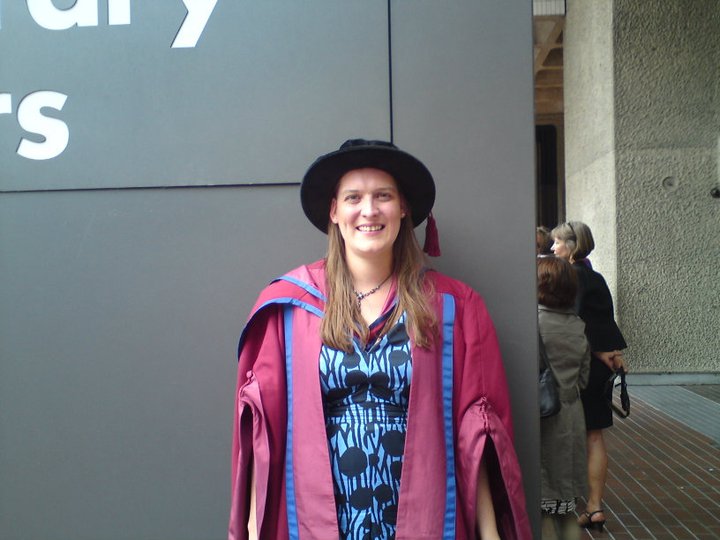
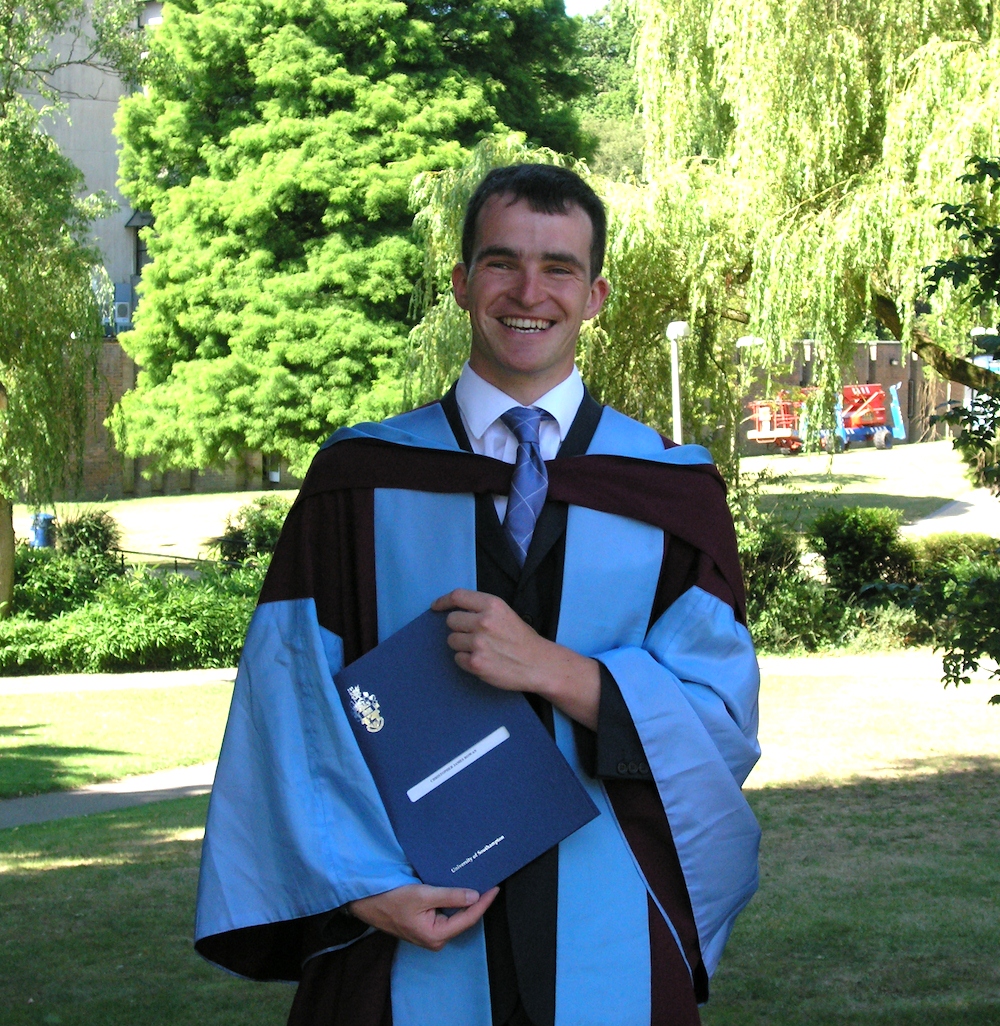
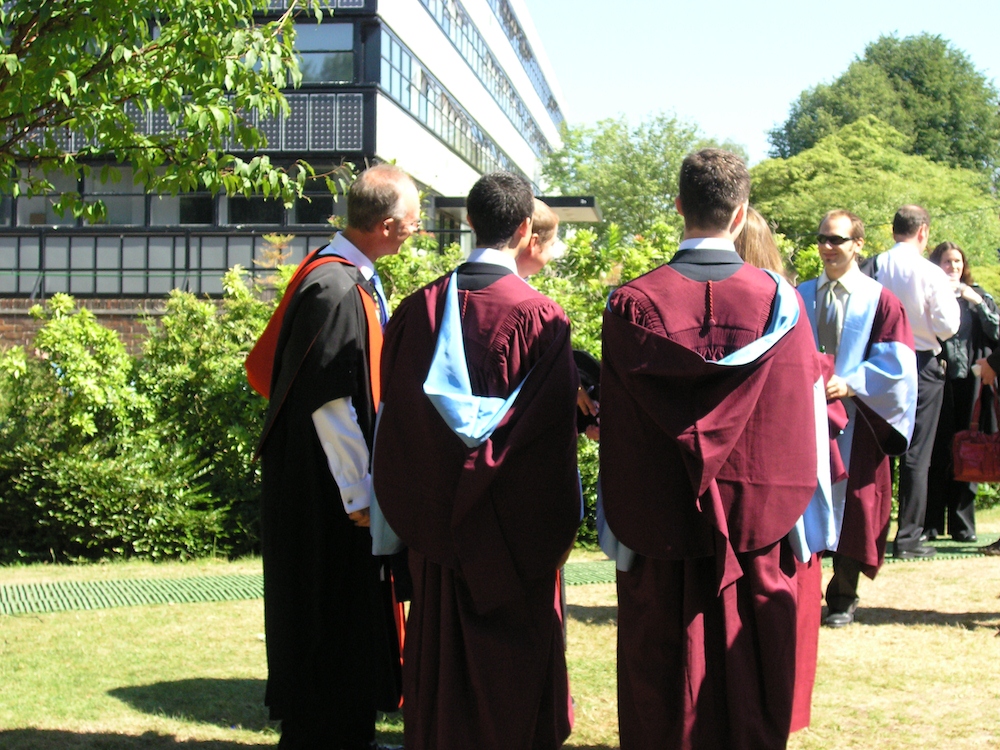
Moving along, here are some pictures of my fellow geoblogger Chris Rowan in his academic dress during his PhD graduation from the University of Southampton in 2007:
Chris in his doctoral robes and with his diploma. He looks very happy in this picture!The back of the Southampton doctoral regalia.Chris with his PhD supervisor Andy Roberts.
Here’s a picture of Tannis McCartney, another fellow geoblogger, in her MSc robes for her recent graduation from the Department of Geoscience at the University of Calgary:
Anna in her undergraduate academic dress... posing with an interesting sculpture!Anna in her MSc academic dress.A sea of students in academic dress.
Anna wrote a little explanation of her academic dress:
I have two photos for you! the first is my undergrad and second is my masters!
WWU: I got a BS in Geology and as part of the College of Sciences and Technologies we had a yellow tassel. Just the tassel and the black rope, that was it.
UAF: I got a MS in Geophysics and for this one the black gown had different sleeves for the masters candidates (I contemplated putting a book in one to read….) and I think everyone had the same tassels in the schools colors. The cape thing was colored for colleges and mine was yellow for College of Natural Science and Mathematics.
You can also see that I got very pale living in Alaska! 🙂 I am exited to see all the photos! Oh and I am sneaking in a photo of me against a see of other grads! It’s just too fun!
Here are some pictures of my high school friend Taylor in academic dress during her graduation from the University of Arizona with an MSc degree in library science:
Receiving her diploma! This picture shows a nice view of the hood.A view of Taylor's academic dress from the front.
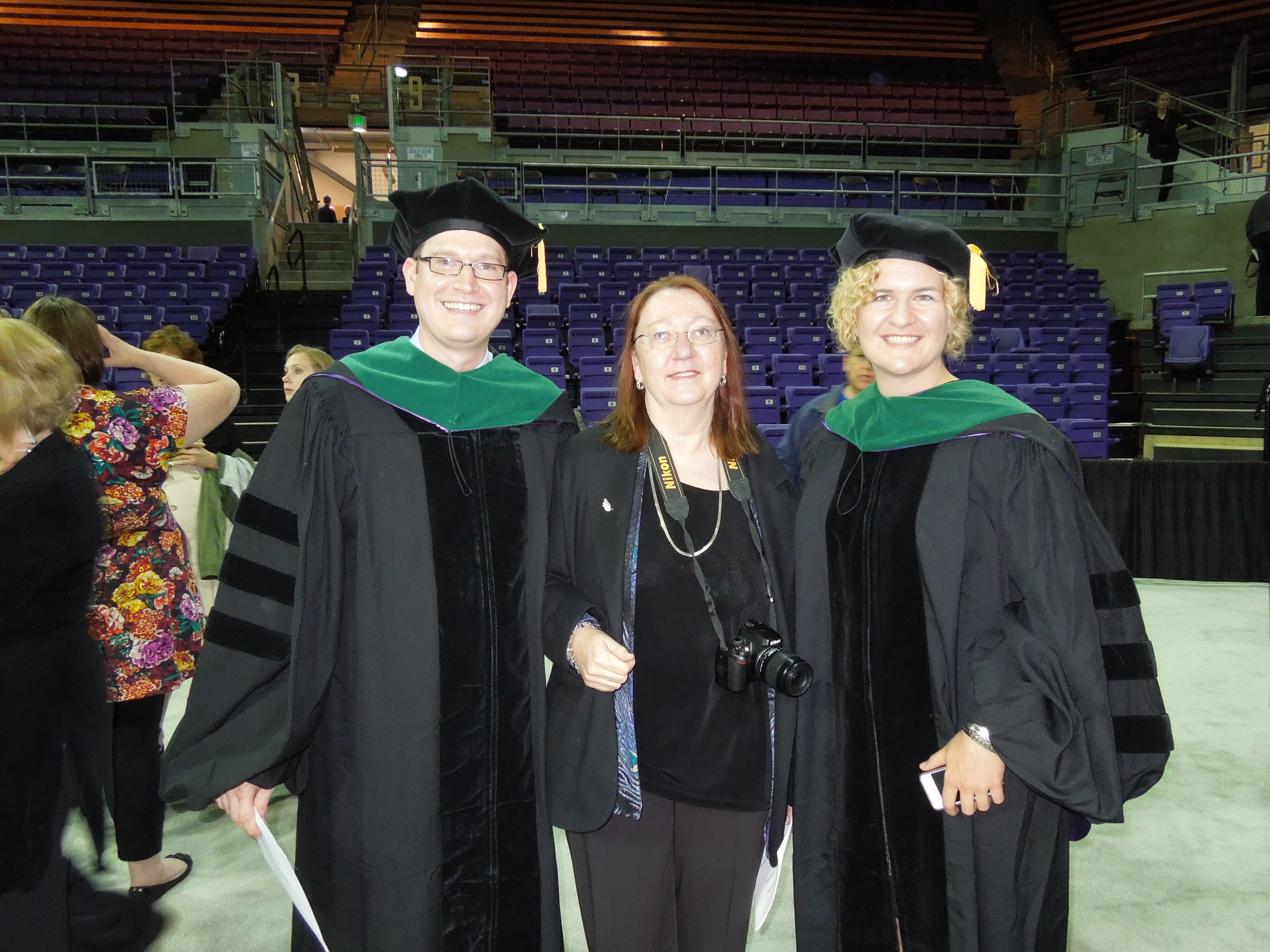
Here’s a picture of Aimee, another high school friend of mine, in her doctoral regalia. Aimee is a real medical doctor! She recently obtained her degree in medicine from the University of Washington:
My friend Aimee is on the right in this picture. Looking good, Aimee!
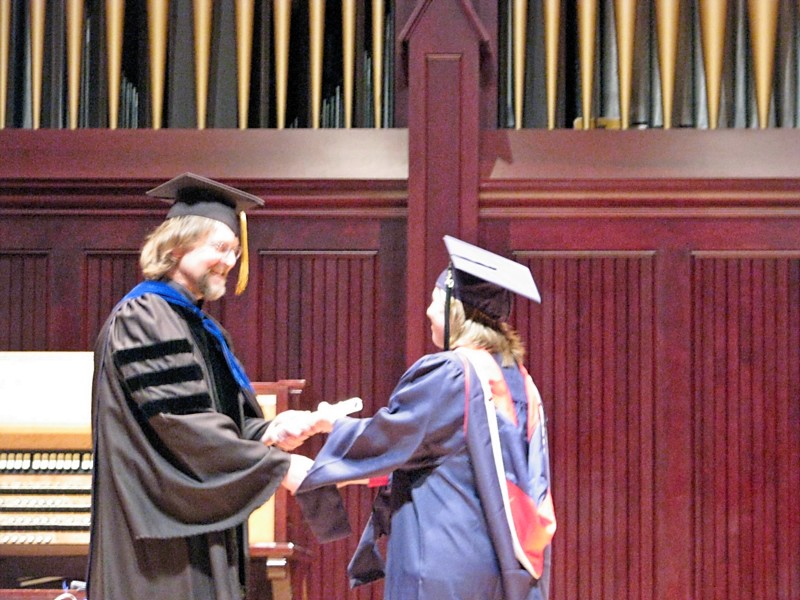
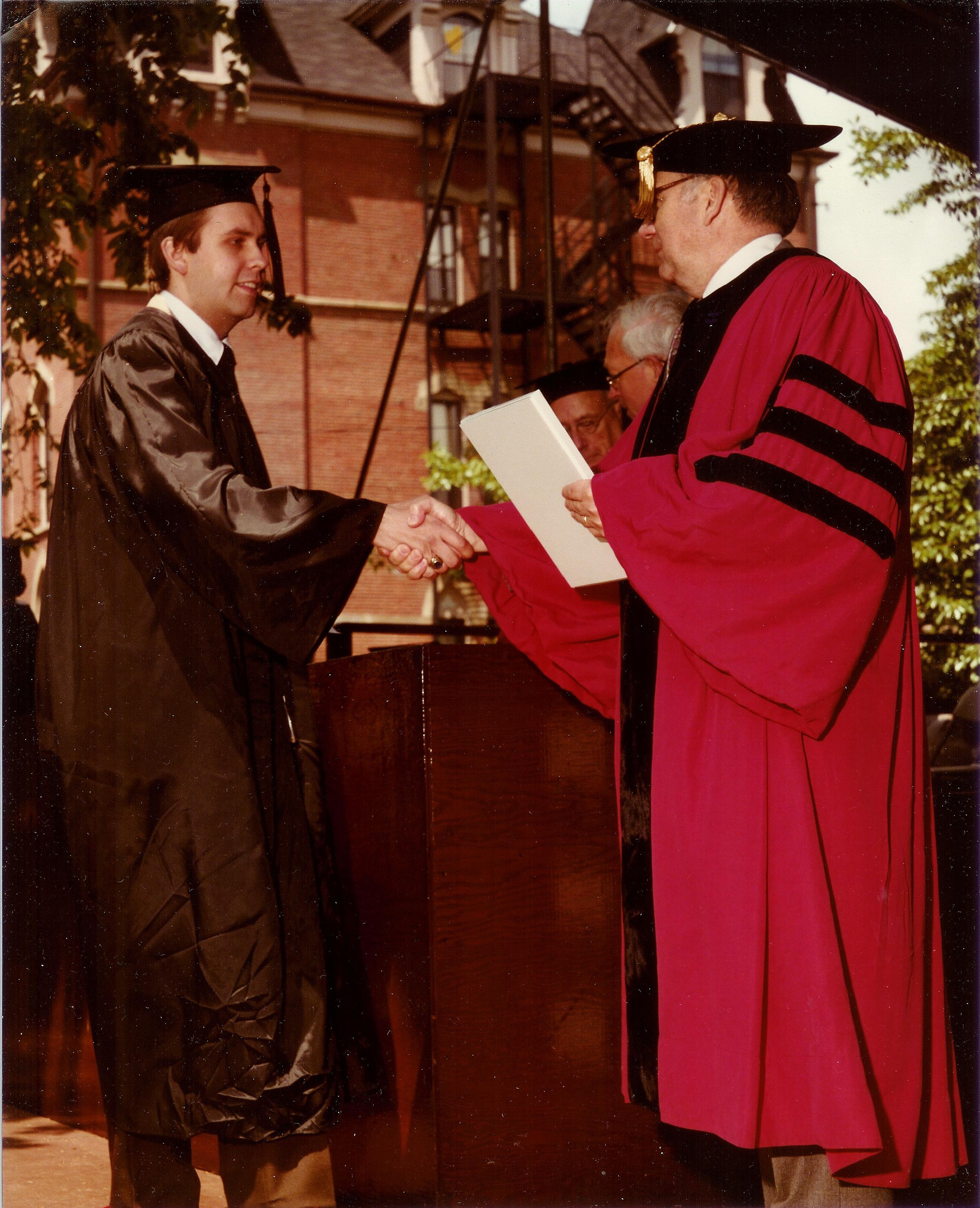
Moving along with the dress parade, here are pictures of Scott, another friend of mine. These pictures show Scott graduating with his degrees in BSEE (Bachelor of Science in Electrical Engineering) and MSEE (Master of Science in Electrical Engineering) from Tufts University. These pictures were taken back in the 1980s.
Scott at his BSEE graduation.Scott at his MSEE graduation.
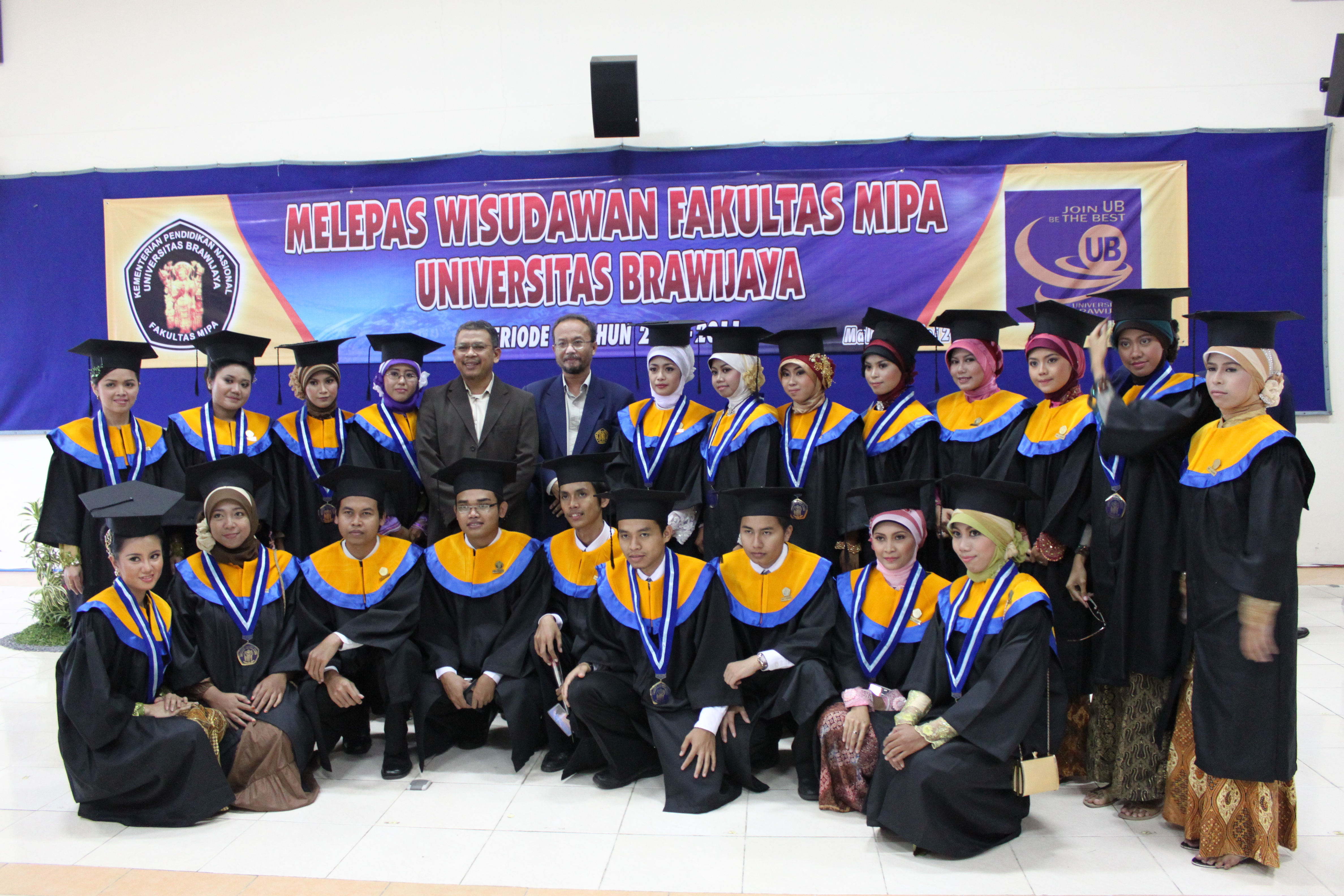
Last, but definitely not least, here are some pictures of Cholisina in her academic dress for her graduation from Brawijaya University in East Java, Indonesia:
Cholisina in her academic dress with her diploma. That's a great hat, Cholisina!A view of the Brawijaya University academic dress, with some helpful annotations by Cholisina.Cholisina with other graduating students in her department.
Cholisina wrote some explanation of the academic dress at Brawijaya (note: I’ve corrected the English very slightly):
I’ve attached some phothos of my graduation day.
Actually, we have little bit different in toga’s [robe’s] collar to determine whre he/she graduate from. If me, because I gradute from Faculty of Mathematics and Natural Sciences, it will be blue colour in my toga’s collar (the other that I remember is Green for graduate from Medical Faculty and red for gradute from Law Faculty).
If he/she graduate in Undergraduate level, it will be square shape in the back, but for master and PhD have triangle shape one.
That’s all the pictures I have for this academic dress parade! Thanks to everyone who sent me pictures. Please let me know if I’ve forgotten to include any pictures or if you have additional pictures you’d like to share. Again, I’d be happy to host a second academic dress parade in the future!
Almost three weeks ago I participated in the doctoral hooding and commencement ceremonies at the Massachusetts Institute of Technology (MIT). During these ceremonies, I received my doctoral hood and my diploma, which I earned for my PhD in Marine Geology, a degree which was jointly awarded by MIT and the Woods Hole Oceanographic Institution (WHOI). During the course of planning for and participating in these ceremonies, I found myself fascinated by the traditions associated with these ceremonies. I found myself particularly fascinated by the doctoral regalia and other forms of academic dress, which are the fancy robes worn by the faculty members and graduates in the ceremonies.
I think I found myself fascinated by the academic dress because the standard dress for students and professors– at least in the geology departments at MIT and WHOI– is fairly casual. Personally, I generally wore shorts, t-shirts, and sandals in the summertime and jeans, t-shirts, sweaters, and sneakers in the wintertime during my time at MIT and WHOI. This sort of clothing is more-or-less what most people in the departments wear. At both institutions, it was not uncommon for me to encounter people in exercise clothes or field clothes or old painting clothes, recently covered in dirt and mud from some rock or core sampling project. Occasionally, I wore fancier clothes. I wore slightly nicer attire (perhaps a skirt or just nicer shoes and a nicer shirt with jeans) for classroom presentations, and I wore full-out “dress attire” (a simple suit or a dress with a nice sweater or jacket) for my qualifying exams, committee meetings, presentations to the trustees, and for my PhD defense. Given the fairly casual attire worn around the geology (and many other) departments, I found it delightful and somewhat humorous to see my classmates and faculty members decked out in elaborate doctoral regalia, complete with fancy velvet and tassles and bright colors.
A few weeks ago, I thought I might do a little research on academic dress and then write up a post on such dress, perhaps with a focus on doctoral regalia. However, after a few minutes of google searching, I found myself overwhelmed with information about academic dress. Academic dress comes in all shapes and sizes and colors, and each country– even each institution– seems to have its own particular set of rules for academic dress. Thus, I think I’ll abandon my pursuit to write a detailed post about academic dress. Instead, I’ll just provide a little bit of basic information about the dress and then will focus this post on the doctoral regalia which I recently wore.
I’d also like to present a call for pictures. I think it would be great to compile a bunch of pictures of people in their academic dress, so if you have a photo of you in your dress, please email it to georneysblog AT gmail with a little bit of information about the dress (perhaps provide the name of the school and the degree and any information about what various parts of the attire might represent). I’ll compile the pictures, and we’ll have an academic dress parade here on Georneys. If you prefer, you’re welcome to post pictures of your academic dress on your own website or blog, and I can just link to your post.
I’ll start the academic dress parade with some pictures of my MIT /WHOI doctoral regalia and a description of the ceremonies in which I participated. MIT has a great webpage here which gives a little bit of history about academic dress in America and then describes the MIT academic dress. My academic dress journey started when I had to make a decision about whether I wanted to buy or rent the doctoral robes. Purchasing the doctoral robes from the official MIT store costs over $700. Renting the doctoral robes from the MIT store is still fairly expensive– about $170– although you are allowed to keep the fancy gray hat with the tassle. You also are allowed to keep your doctoral hood, which is presented to you at the hooding ceremony. Various knock-off MIT doctoral regalia can be purchased or rented for less money. A word of advice about that: DO NOT purchase or rent the knock-offs… or at least make sure you inspect the quality of the knock-offs prior to the ceremony. I saw some terrible looking knock-off robes during the hooding and commencement ceremonies. Some of the cheap knock-off robes started to fall apart during the ceremony– the stripes on the sleeves were actually peeling off in some cases. Although expensive, the official MIT gowns definitely look MUCH better than the knock-offs. Of course, for awhile I contemplated purchasing this $20 Harry Potter costume, which could probably pass as doctoral regalia… and could also be worn with a stylish wand, I suppose.
I contemplating renting verses buying for a few days and then decided to rent my doctoral regalia. While academic dress used to be worn daily (back in the 1700s and 1800s, anyway), these days academic dress is pretty much only worn at fancy ceremonies such as commencement. So, the only time that I might wear my fancy academic regalia in the future would be as a university faculty member participating in graduation and other ceremonies. Several months ago, I decided to leave academia and spend some time working in industry. One day, I may return to academia. However, I don’t see any need for my doctoral regalia in the near future, so I decided to rent the regalia.
I first donned my rented regalia on the morning of Thursday, June 7th. My husband Jackie and I woke up very early– about 5:30 am– so that we could drive from my parents’ house in New Hampshire to the Alewife T-station (subway station) in Boston. We parked the car at Alewife then took the T to the Alewife/Kendall stop, where we visited the MIT COOP to pick up my doctoral regalia. I was worried it might take a long time to pick up the regalia, but the process actually went fairly quickly. We soon headed across campus to the gym, where the doctoral hooding ceremony was going to be held.
As we were walking around outside the gym, a Chinese couple came up to us, and the man said to me, “You are very beautiful. I take a picture?” I was a bit flabbergasted, but I agreed. I ended up taking several pictures with the Chinese man and his wife, who told me (in very broken English) that they were tourists from China and were very excited to be visiting MIT. I’ve encountered many Chinese and other Asian tourists during my years at MIT. Often, the tour groups at MIT are full of Asian tourists. I guess my doctoral robes and I will be shown in some vacation picture slideshows over in China! Being asked to take pictures with the two Chinese tourists reminded me just how special– how beautiful, really– it was to be graduating from MIT. I am very lucky to have had the opportunity to study– and graduate from!– such a world-renowned institution.
Eventually, the Chinese tourists left us alone, and I went inside the gym to line-up. Jackie waited outside to meet my parents, who drove down from New Hampshire a little bit later. After some waiting and some processing, the soon-to-be-doctors made their way into the gym and sat down on the plastic chairs that were lined up. At least, most people sat down on plastic chairs. There were supposed to be 13 chairs in each row, so the ceremony staff members counted out 13 people before starting a new row. However, in the row where I sat there were only 12 chairs because one chair had been taken away to make room for a person in a wheelchair. As we were counted out, my classmates and I tried to protest when 13 people were directed to sit in 12 chairs, but our protests were swiftly dismissed by the stern staff member.
Before we knew it, the procession music had ended, and we were trying to figure out how to sit 13 people in 12 chairs. Fortunately, we were seated by degree, so most of the people sitting in my row were my fellow classmates in the MIT/WHOI Joint Program. Therefore, at least we knew the people to whom we were suddenly a bit too close for comfort. The plastic chairs placed out for the ceremony are not very comfortable to begin with, and they are definitely not comfortable when you are sitting on half of one chair and a quarter of another chair. We giggled and elbowed each other a bit, but otherwise we managed to make ourselves look reasonably presentable for the ceremony despite our 13-people-in-12-chairs situation. At one point, we attempted to steal a chair from a partly-empty row behind us. However, we noticed– just in time– that the chairs were tied together. I imagine we would have caused quite a ruckus had we pulled on the one chair and moved the entire row of chairs. In any case, we survived our seating arrangement, and I managed to enjoy the ceremony despite the uncomfortable seating.
The ceremony was fairly simple. There were a few speeches, and then the names of the 400+ doctoral graduates were read. After a person’s name was read, the person went onto the stage, where he or she received a doctoral hood. Each hood was placed over a student’s head by the chancellor, who was assisted by a representative from the student’s department. My hood was thus placed over my head by the chancellor and by Jim Yoder, who is the Dean of the MIT/WHOI Joint Program. I’ve known Jim for several years, and it was nice to have someone I know investing me with my doctoral hood. If you have any interest, you can watch a video of the hooding ceremony here. I receive my doctoral hood towards the end of the video. On that same website, there are also videos of the next day’s commencement ceremony.
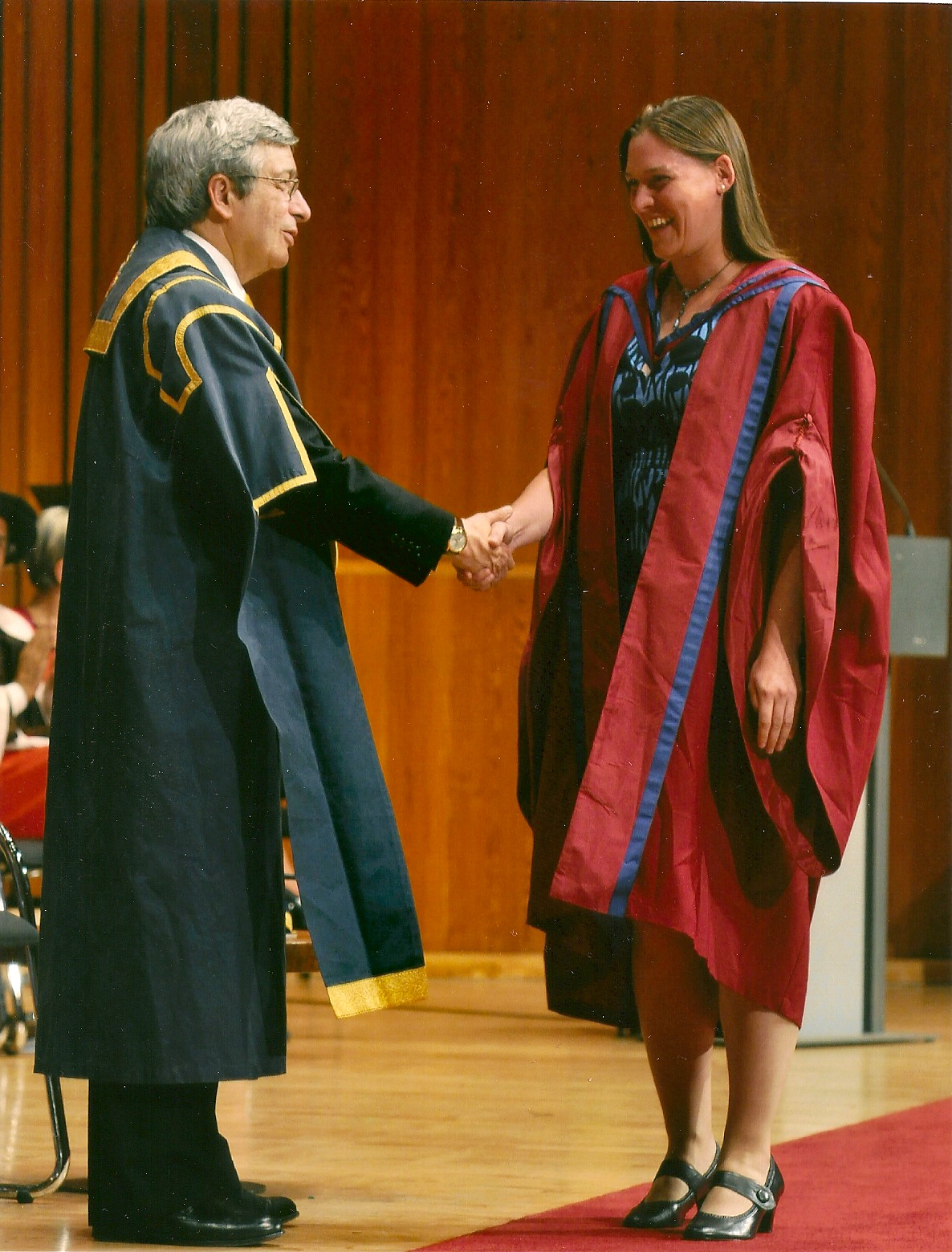
Here’s a picture of me receiving my hood:
Receiving my doctoral hood. Yay!
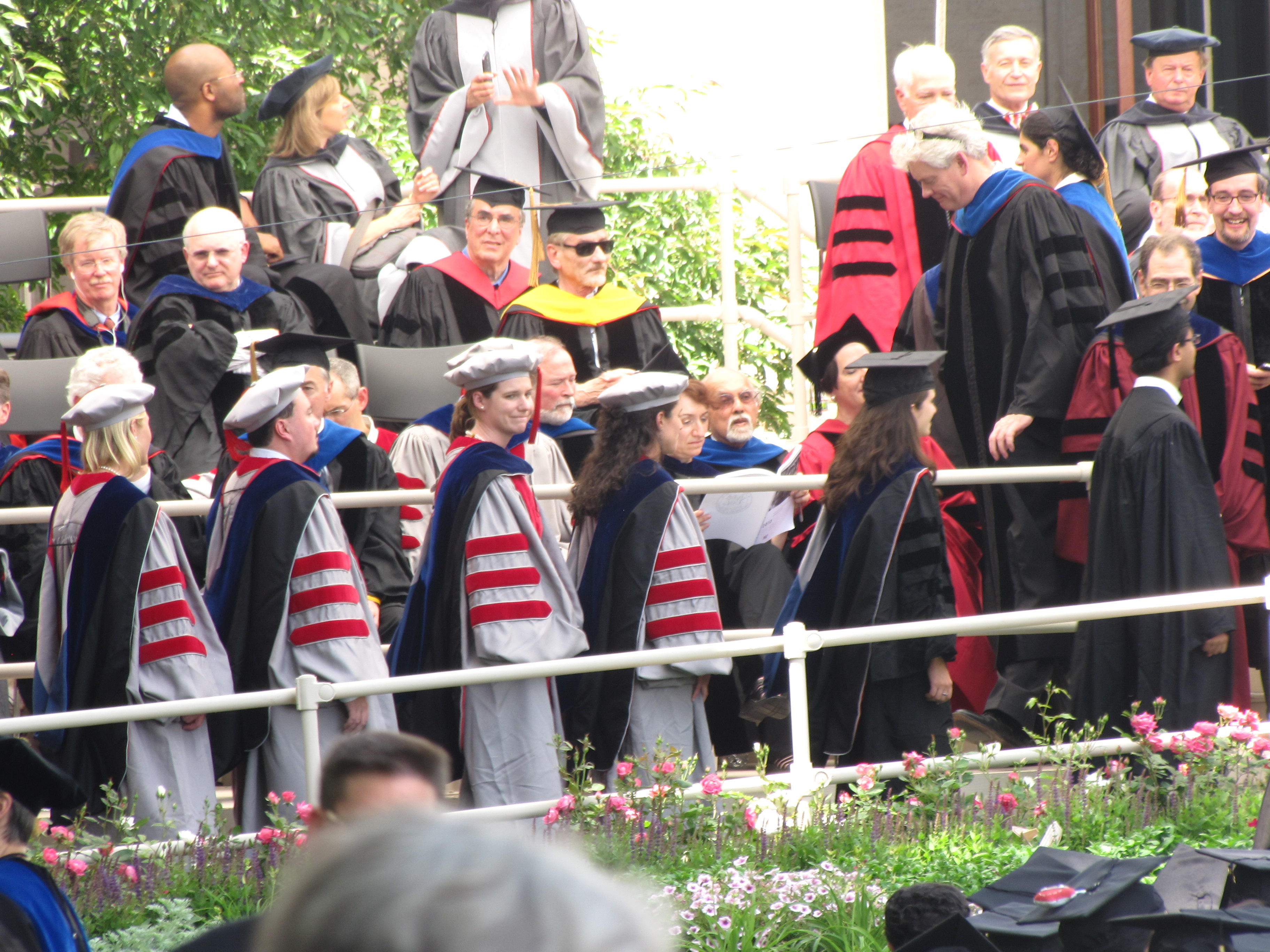
And here’s a view of the MIT/WHOI doctoral hoods from the back:
Soon-to-be MIT/WHOI graduates lined up, wearing their doctoral hoods. This picture was taken by my husband at commencement.
Doctoral hoods are somewhat funny garments. From what I can tell, doctoral hoods are not really designed to be worn at hoods. At least, I couldn’t figure out how to cover my head with my hood. Rather, doctoral hoods are worn on the back as a sort of decorative embellishment. The MIT doctoral hoods are black on the outside with a blue velvet strip for PhDs and a yellow velvet stripe for DScs. The inside of the hood is lined with the MIT school colors– red and gray. In addition, the hoods of MIT/WHOI doctors are lined with a stripe of “Old Glory” blue, which can be seen at the bottoms of the hoods in the above picture. The hoods contain a pocket which, as the chancellor explained during the hooding ceremony, “Is big enough for a book or perhaps a sandwich but is too small for an iPad.” Graduates were not permitted to carry purses and other bags for either the hooding or commencement ceremonies. The men generally wore pants with pockets and were able to store their wallets, keys, cell phones, etc. in their pants’ pockets. Most of the women, on the other hand, wore dresses or skirts underneath their robes and had difficulty finding places to store their things. Keys and wallets and such were stored in sleeves and blouses and even, in one case, underneath a hat. I know many women were grateful for their hood pocket for the commencement ceremony. Personally, I stored my Kindle, keys, wallet, and cell phone in my hood pocket for the commencement ceremony.
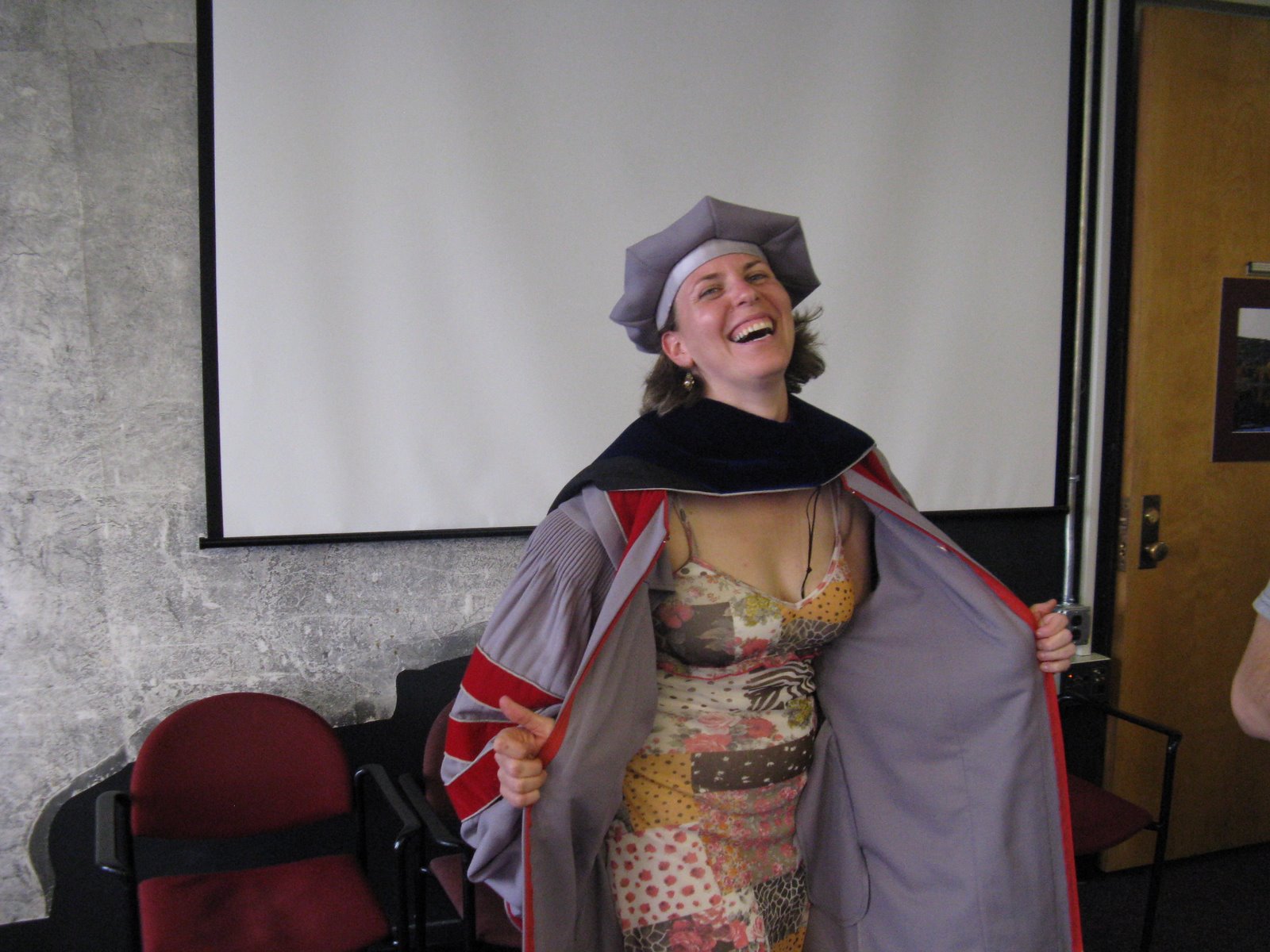
The commencement ceremony on Friday June 8th was held in Killian Court, which is a beautiful courtyard located across the street from the Charles River and adjacent to one of MIT’s classic domed buildings. Like the doctoral hooding ceremony, the commencement ceremony was fairly simple– a long, hot procession (they actually made us walk a lap around the MIT track!) followed by sitting in the courtyard and listening to a few speeches and then about two hours of name reading and diploma receiving. The day was fairly sunny and warm, and the graduates were sitting in the sun. Like many other graduates, I unbuttoned and loosened my doctoral robe, grateful that I was wearing a fairly cool sundress underneath. While name after name was called, I chatted with my classmates and read a book on my Kindle. Eventually, the time came for the MIT/WHOI graduates, and we lined up to approach the stage. My name was finally called, and I received my diploma from MIT president Susan Hockfield and WHOI president Susan Avery.
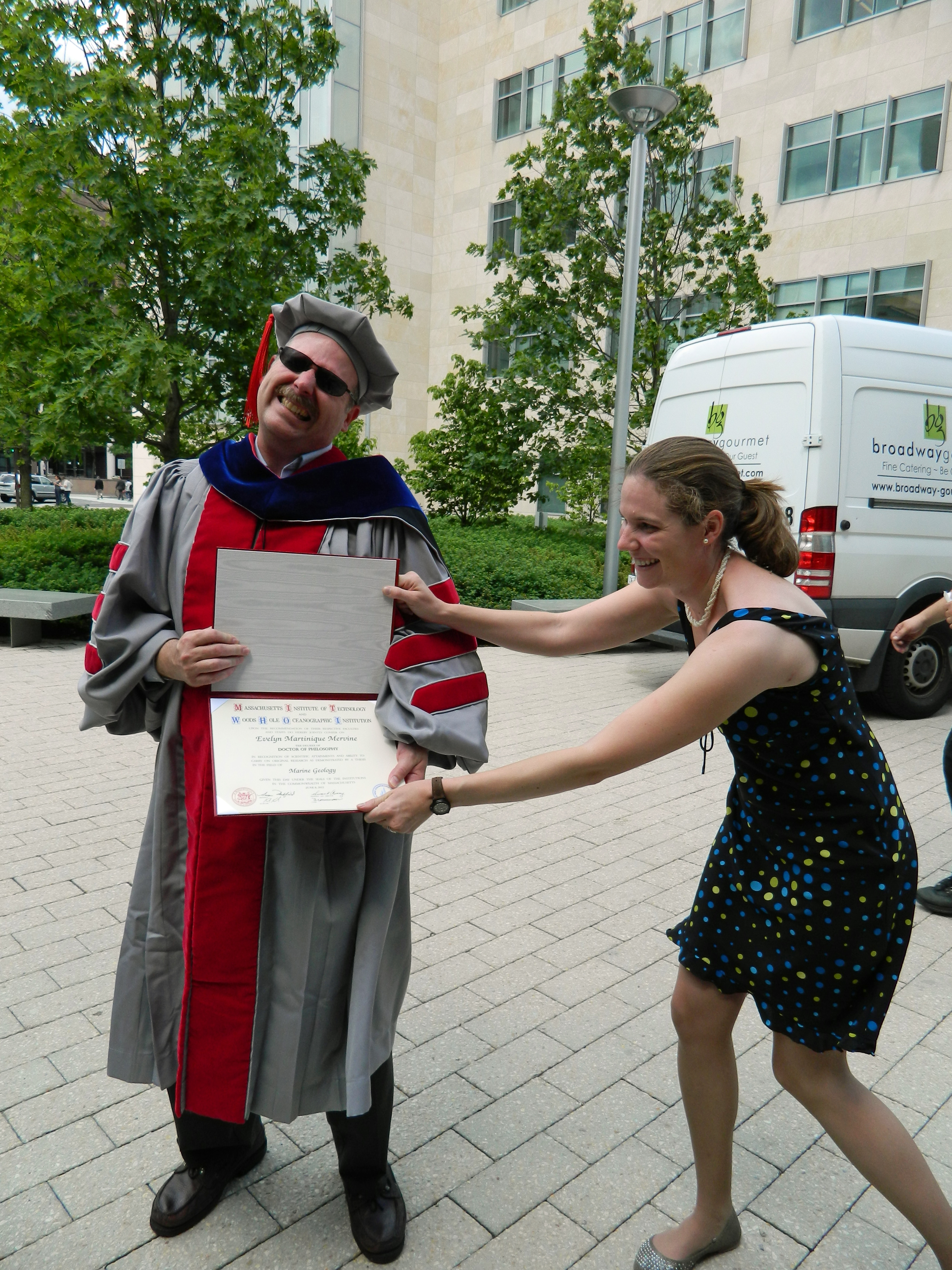
Here’s a picture of me receiving my diploma:
Receiving my diploma. Yay!
Here are a few more pictures from the doctoral hooding and commencement ceremonies:
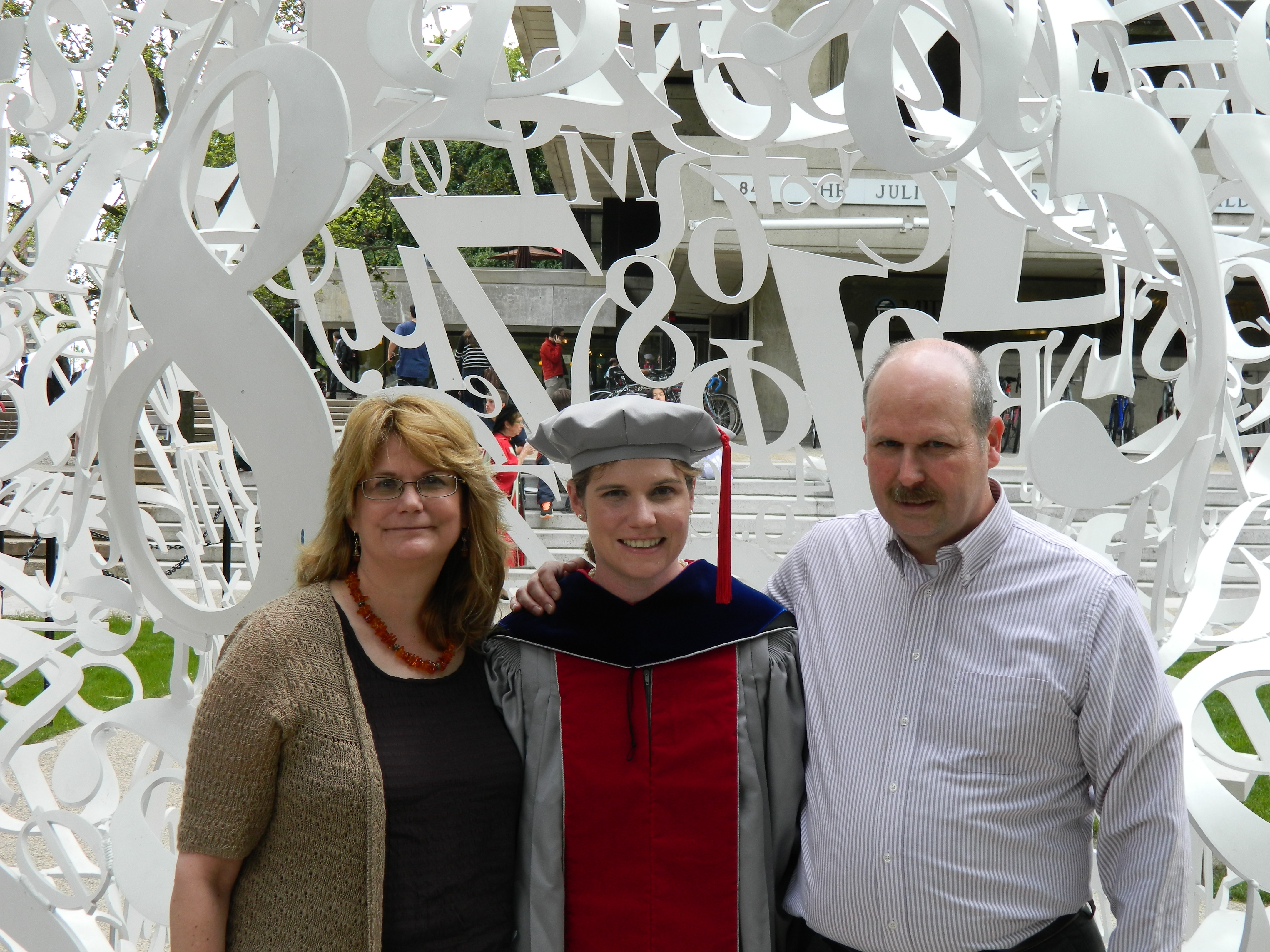
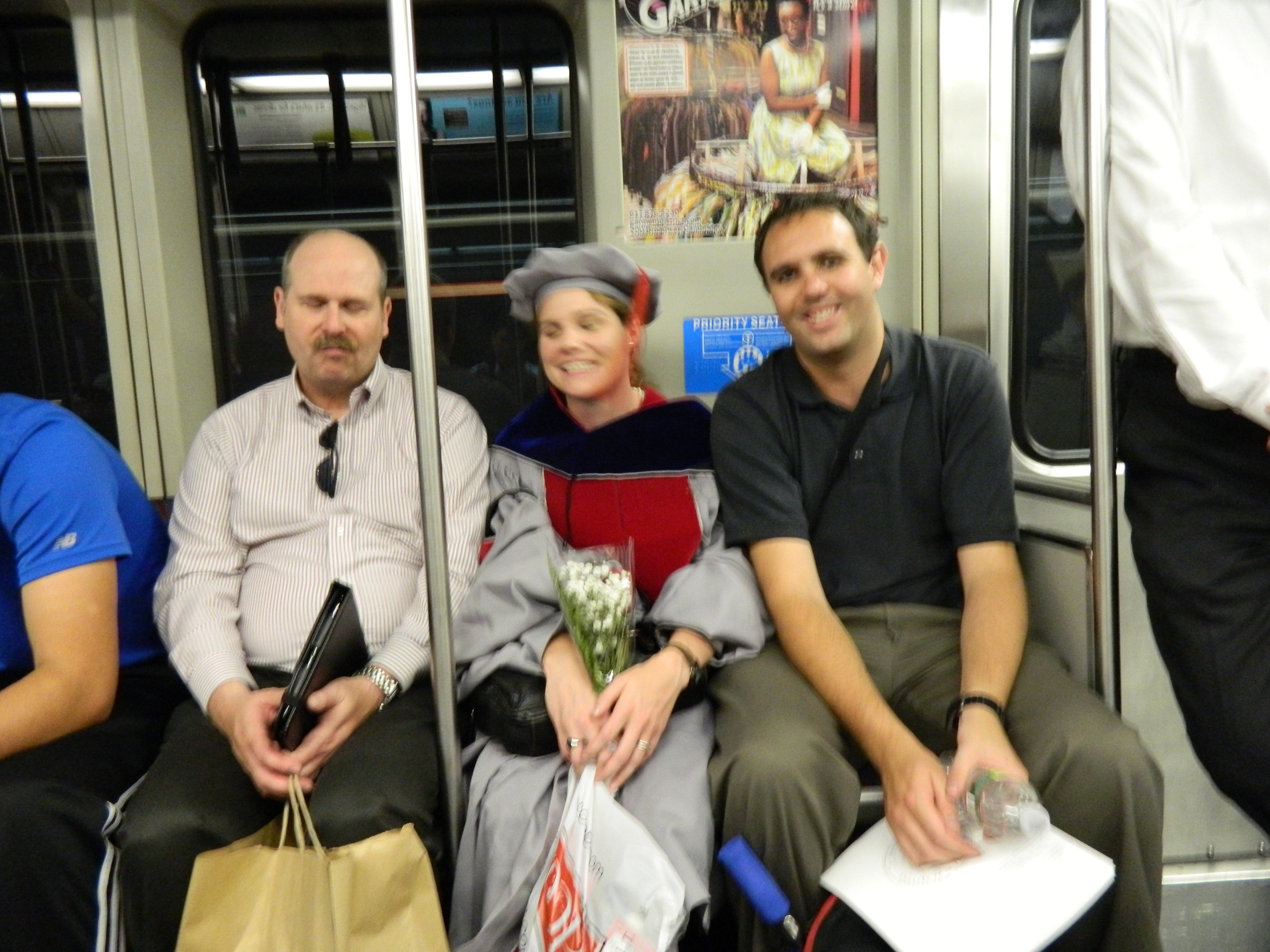
All decked out in my doctoral regalia, before the hooding ceremony.After the hooding ceremony, with my hood.With mom and dad in front of a number sculpture.With Jackie in front of the MIT seal.Wearing the doctoral regalia on the T.Another view of the doctoral regalia on the T.With my diploma!I went to use the restroom, and my dad tried to steal my diploma.
Those are the pictures I have to share. Please share some pictures of you in your own academic dress!
Tilted rocks along the River Dee, Aberdeenshire, Scotland, June 2012.
For this week’s geology picture, I thought I would share a photograph from my recent trip to Scotland. I recently spent four days staying in the village of Ballater, Scotland with Dr. Ken Glennie, a well-known petroleum geologist (he worked 33 years for Shell and is now an Honorary Professor at the Univeristy of Aberdeen) who is now retired but still spends several hours every day thinking and writing about geology. I greatly enjoyed the four days I spent with Ken, and I learned a great amount about the geology of Oman, Scotland, and elsewhere. I plan to write up several articles about my visit, so stay tuned for more! The picture above was taken when Ken and I took an afternoon trip to Balmoral Castle and some other sites of interest in Royal Deeside.
At the moment, I am enjoying being home in Cape Town, South Africa after 3 1/2 months away. Yesterday evening I arrived at the Cape Town airport after flying from Aberdeen to London to Johannesburg to Cape Town. I’m exhausted from the flight and also from the past 3 1/2 months. There have been many events and changes in my life over the past 3 1/2 months. I successfully defended my PhD, for one. I also visited Florida and Scotland, spent some time with my family in New Hampshire, took my husband to my 10-year high school reunion, had a wedding/graduation celebration with friends and family in New Hampshire, and attended my MIT PhD hooding and graduation.
I’m pretty tired, and chances are I may be starting a job in the near future, so posting may be a bit quiet on here for awhile longer as I rest and recover. Never fear, though! The Monday Geology Picture shall appear like clockwork, and I will be catching up on a few outstanding posts. Eventually, perhaps, the Geology Word of the Week may also make a reappearance, but probably only after I’ve had a bit of rest and relaxation.
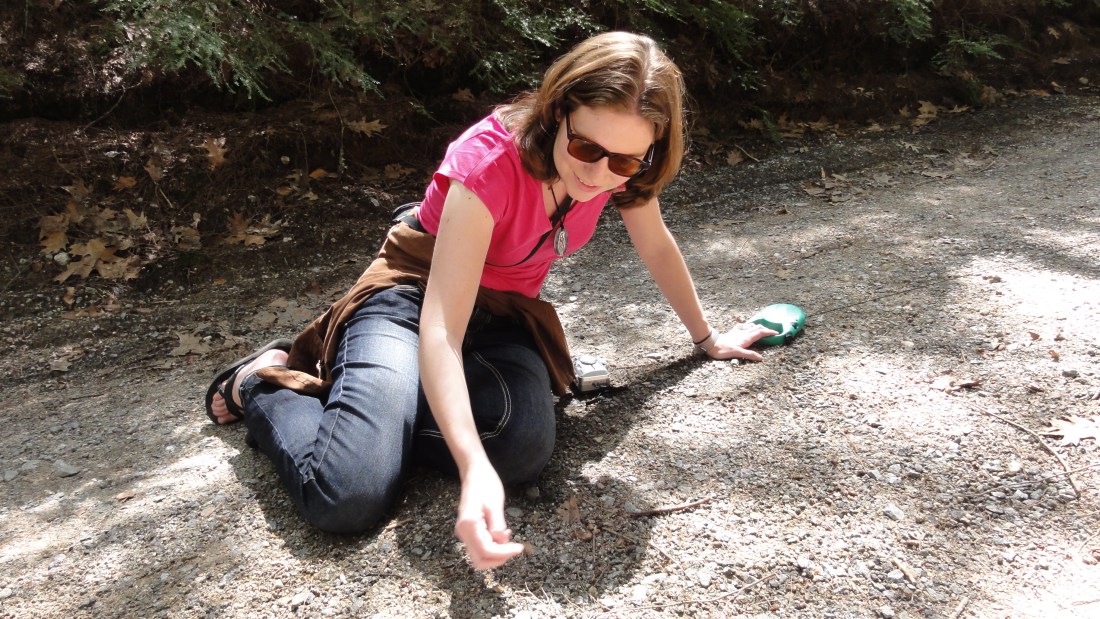
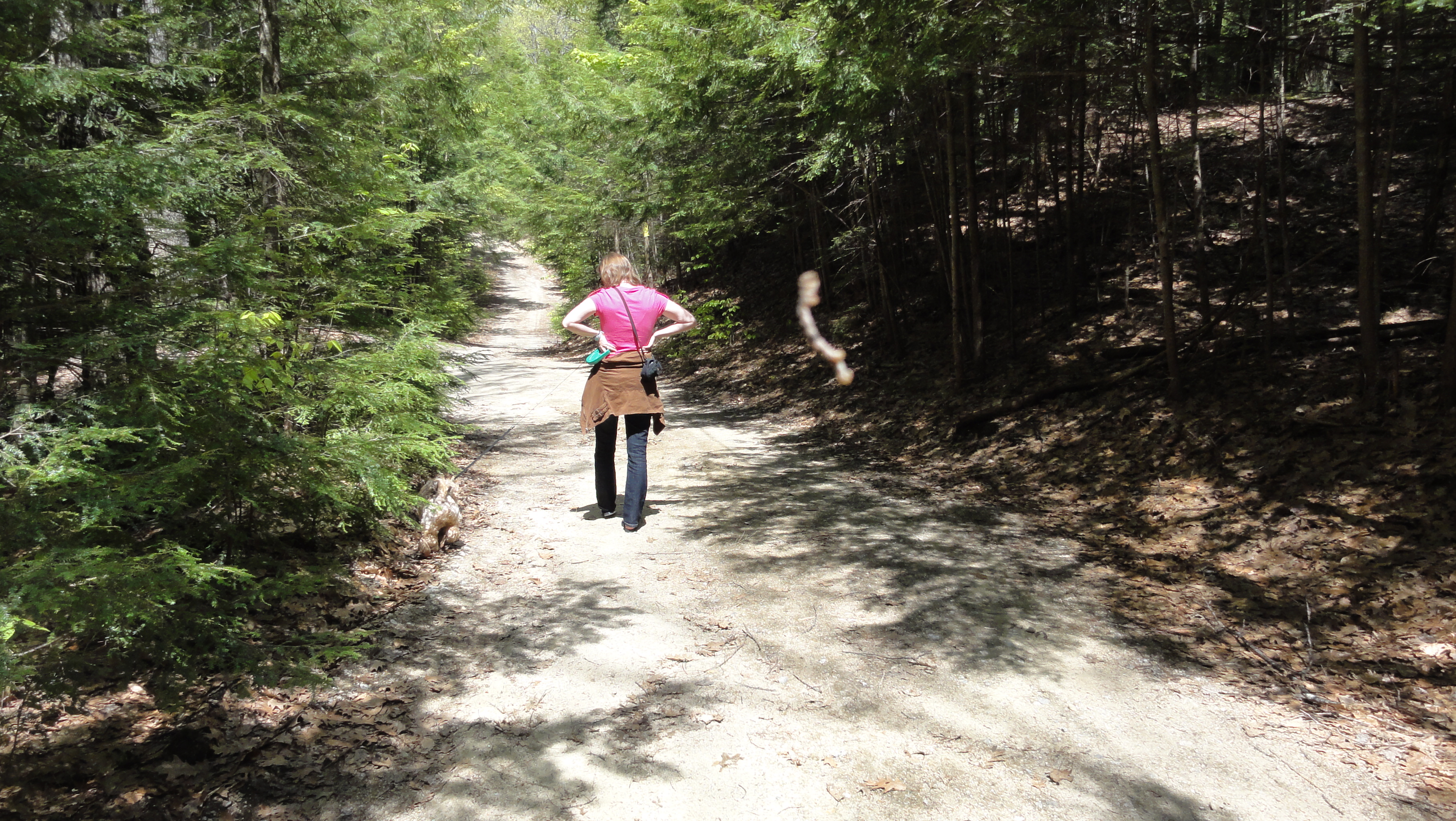
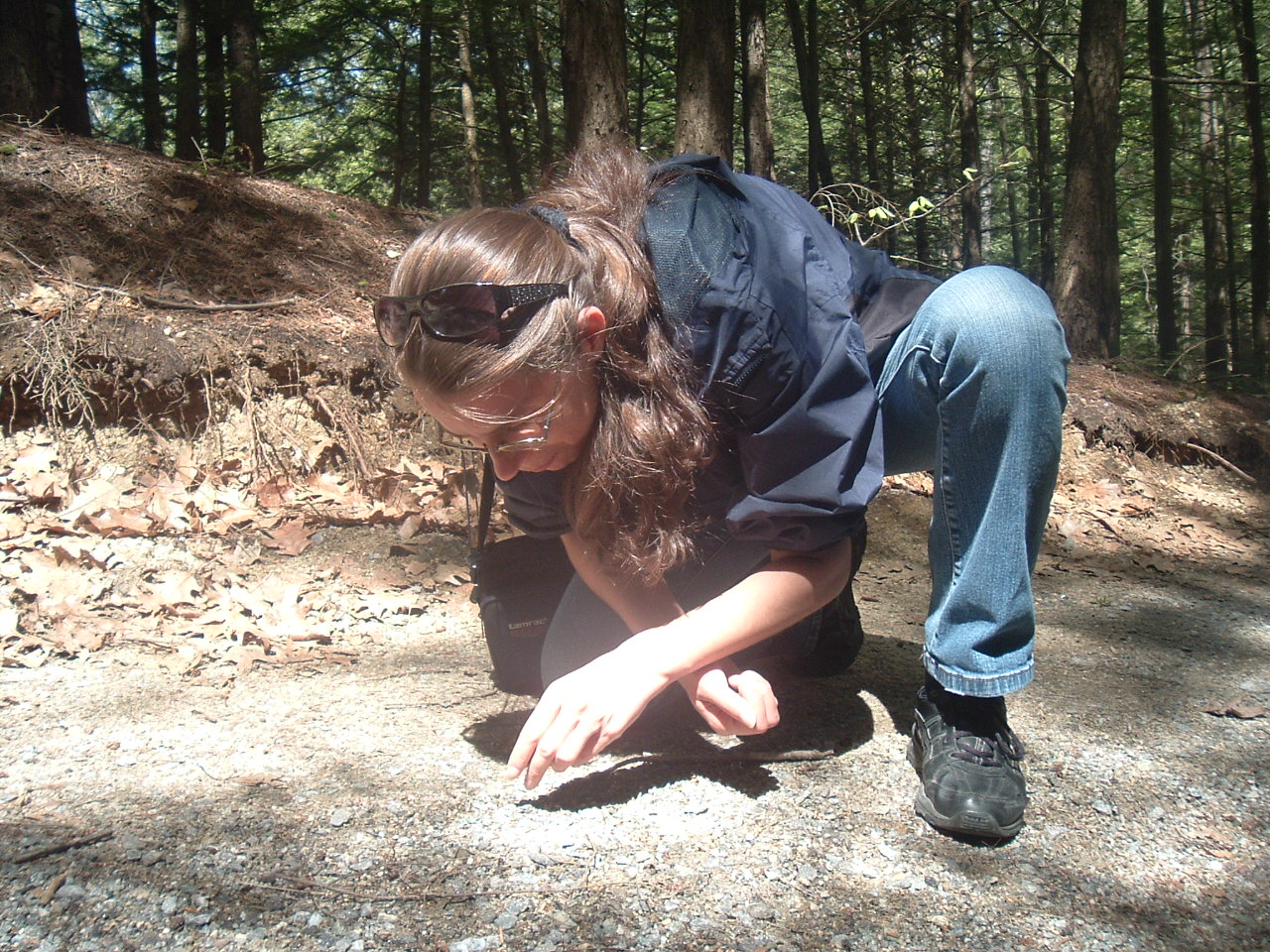
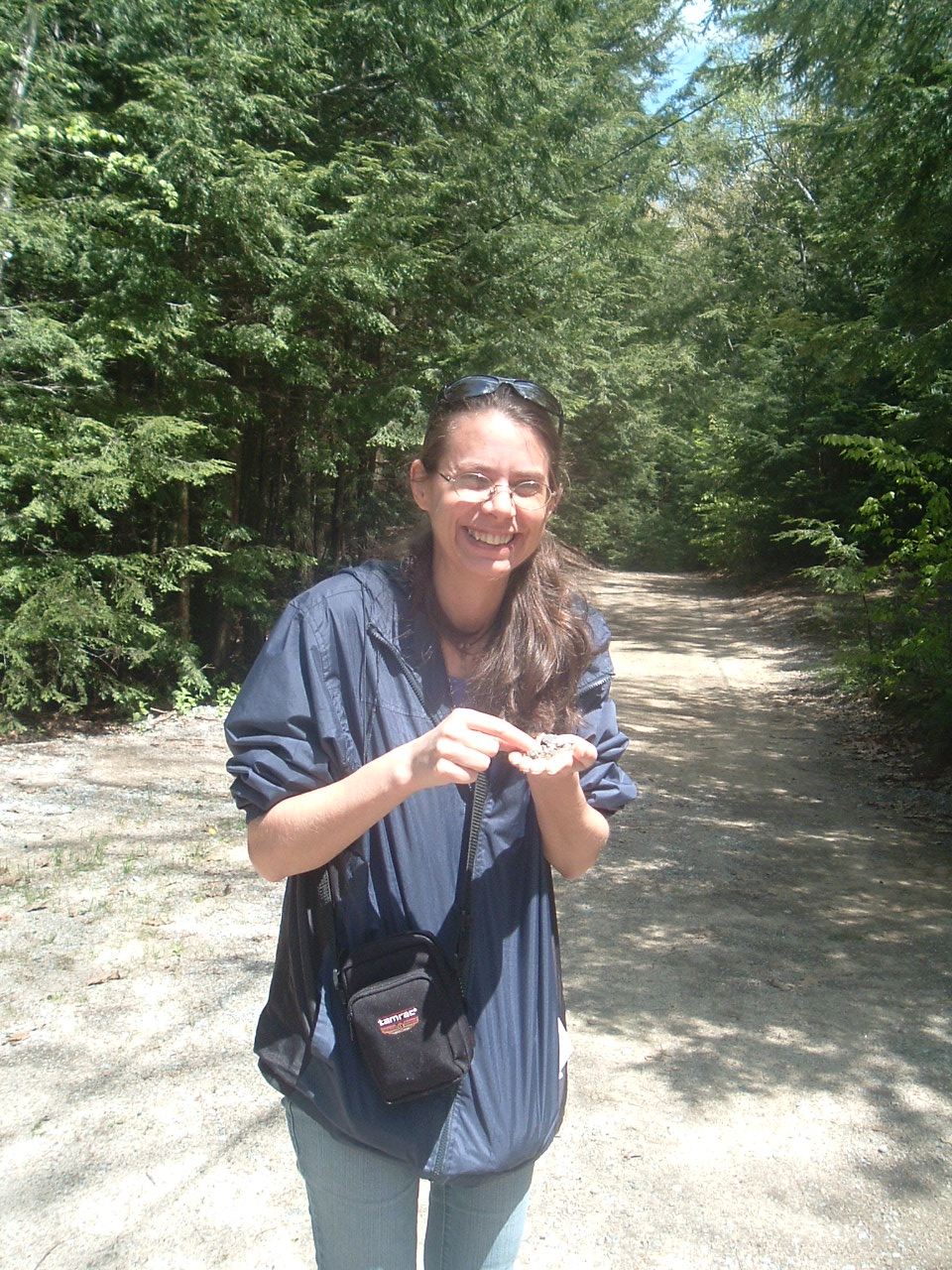
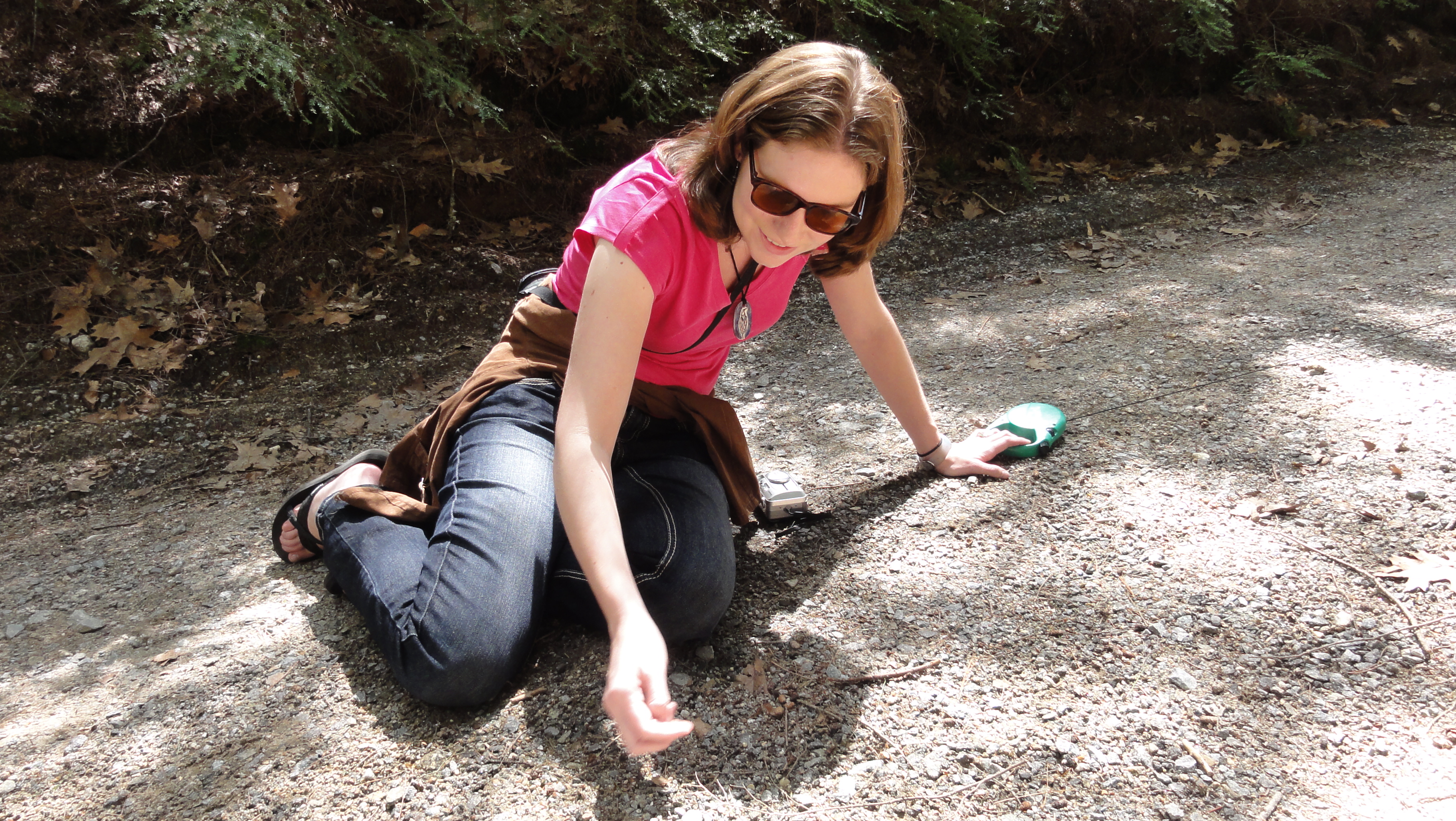
A casual stroll along the garnet road. Geologists often walk with their heads to the ground,watching for interesting rocks.
I apologize for a bit of a hiatus in posting. There were some technical troubles with the AGU blogs, and then my husband and I were down in Florida for five days. Blogging may continue to be somewhat light for the next few weeks, but I’ll post when I’m able. First, I’ll finish up my “Georneys with Dana” series. Then, I’ll post a bit about the trip to Florida.
Note: I convinced my Geokittehs co-author Dana Hunter to fly from Seattle to New Hampshire to visit me for a few days. I handed in the final version of my PhD thesis on Friday May 4th, and Dana arrived the next day to help me celebrate. This is Part V of my description of the fun georneys we had together during Dana’s visit.
Geologists, you may notice, often walk with their heads pointed downward. That’s because down is where the rocks generally are. Geologists also keep their heads pointed toward cliffs or boulders. When driving, geologists slow down and turn their heads when they pass roadcuts. At times, geologists become so absorbed in watching for rocks– and then looking closely at the interesting rocks they find– that they forget about the rest of the world: the scenery, other people, that squishy biology stuff, lunch, water, continuing the walk or hike that was started, driving at a normal highway speed, and so on.
Long before I began studying geology in a formal manner, I walked with my head pointed downward, looking out for interesting rocks. I guess that’s how I knew I should study geology. For example, my second week of high school I was going on a training run in the woods as part of my school’s Outdoor Program*. As I ran, I kept my eyes on the ground, keeping a casual eye out for interesting rocks. I ended up running straight into a tree. I went to the hospital for a few stitches, but I was generally okay. For the rest of the year, I was called “George” by my fellow students.
Before I learned much about rocks, I used to watch out for “pretty” rocks such as large pieces of rose quartz, silvery garnet schists, and rocks with bright red iron oxide weathering rims. Now that I know more about geology, I still enjoy finding “pretty” rocks, but I also find myself very interested in a wide variety of “ugly” rocks, such as highly-weathered peridotites, dull-colored sandstones, and gray basalts. That’s because even the dullest of rocks can tell fascinating stories.
To non-geologists, rocks are just something to walk upon or drive above or build a house upon; rocks are brown or gray or white hard things that are not worth paying much attention to unless they sink or shake or erupt… or perhaps if they are particularly sparkly. To geologists, rocks– even the dullest gray or brown rocks– are interesting, even when they are not particularly mobile or sparkly. That’s because geologists learn to read rocks the way people learn to read books. To a geologist, a rock’s features are like hieroglyphics. There are stories enfolded in the juxtaposition of two minerals, in the order of a set of veins, in the thickness of a lamination, in the offset of a fault, in the shape of a crystal, in the softness of a sediment, in the curve of a fossil,in the color of a weathering rind, in the roundness of a cobble, and in many other rock features.
Rock stories are almost always mysteries. The rocks provide clues, but it takes often quite a bit of work to figure out who murdered whom in what room with what weapon, so to speak. When reading rocks, geologists use various clues to try to figure out what crystallized from what and then squished into what under what conditions… or, perhaps, who died and was preserved into what that was then altered into what… or, perhaps, what settled onto what and then was filled with what… or, perhaps, what slid past what when and caused what size earthquake and tsunami. There are countless rock mystery stories.
Often, geologists barely begin to unravel rock mysteries in the field. Rocks must also be sampled and brought into the laboratory. Rocks must be cut up into thin slices and examined under microscopes; they must be scanned and crushed and dissolved and, sometimes, turned into plasma. Sometimes, rocks must be analyzed from space, using fancy satellites that provide much information about large and small-scale field features. Field observations of rocks must be carefully examined in the office: thousands of strikes and dips and other field information must be compiled and formed into geologic maps and models. Even then, geologists often only unravel part of a rock mystery. There is always more to learn about rocks. Like a good mystery novel, a rock story is rarely fully resolved; there are always loose ends left at the end; there are always sequel stories to unravel.
Because they can read rocks, geologists are easy to entertain. You don’t need a computer or a kindle or a television to entertain a geologist. All you need are some rocks– and there are rocks almost everywhere.
Here’s one recipe for entertaining two geologists for a morning:
1. Take two geologists.
2. Add one dog, two cameras, one hand lens, and one dirt road in New Hampshire.
3. Sprinkle the dirt road generously with freshly-broken, garnet-filled metamorphic rocks that are useful for stabilizing the road during spring “mud season.”
4. Tell the geologists to take the dog for a walk along the dirt road.
5. Busy yourself with something else while you wait for the two geologists to return. Note that geologists may take much longer to complete walks than non-geologists. A good rule of thumb, when the rocks are particularly interesting, is that geologists will take about two hours to complete a walk that takes non-geologists twenty minutes. If the geologists are too long in returning home, you may be able to lure them back by cracking open a few ice cold drinks.
Recipe warnings: The dog may periodically sit down in the middle of the road, looking forlornly at the geologists while they hunt for pretty garnet rocks in yet another section of the road. The geologists are likely to fill their pockets and camera bags full of rocks. Even for a “short” walk, it is advisable to send the geologists out fully equipped with water, sunscreen, and sun hats. Don’t bother sending snacks as the geologists will likely forget to eat the snacks.
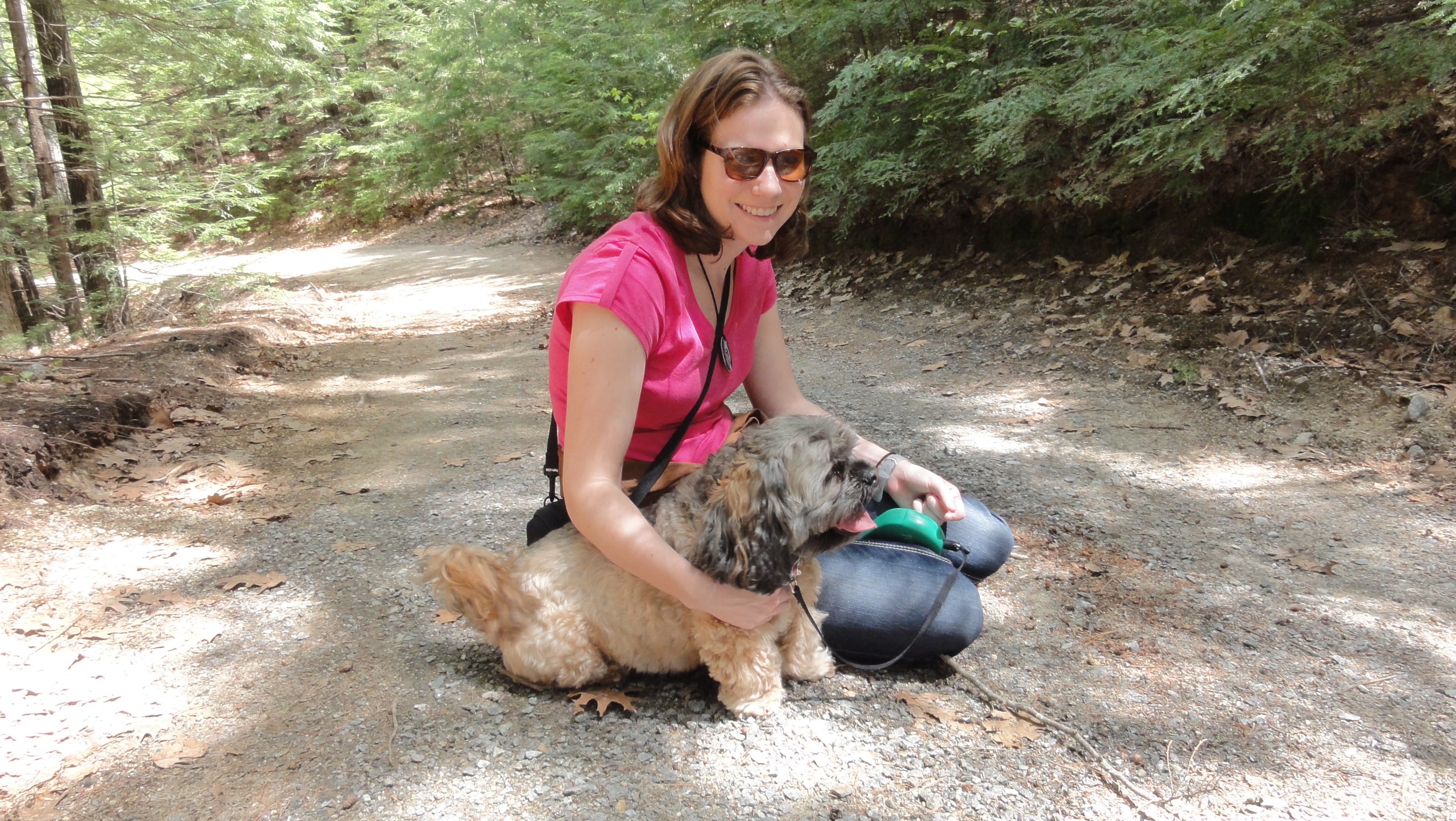
I followed the above recipe when entertaining Dana last week. Dana served the role of “first geologist, I served the role of “second geologist” and Dingo (my parents’ pet) served the role of “the dog.”
Here are some pictures of our walk along the road which we nicknamed “The Garnet Road” because of all the crushed-up, garnet-bearing metamorphic rocks which were recently dumped on the road:
Oooh interesting road rocks.Found something.Interesting rocks = happy geologist.Sitting down to search for garnets. Fortunately, there is not too much traffic along the dirt road.Taking a closer look at a road rock.Dingo was confused about why we were doing so little walking on our "walk."Can we walk please?Dana finds a great pile of garnet-rich rocks.
Here are some pictures of a few garnet-rich, metamorphic rocks which we collected along the road:
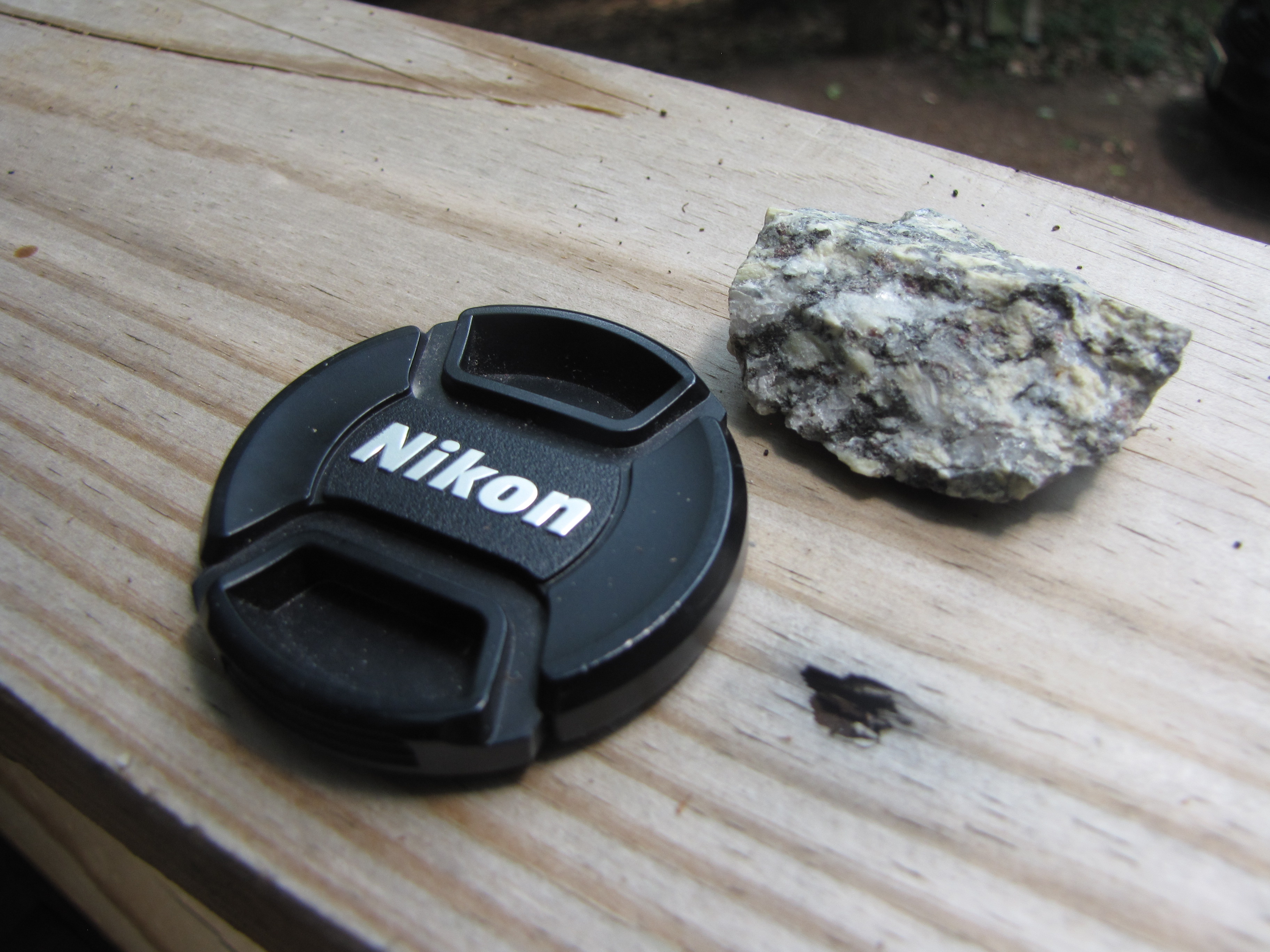
Garnet Rock, Picture #1. Just look at those large, gorgeous garnets!Garnet Rock, Picture #2.Garnet Rock, Picture #3.
*My high school has a wonderful program called Outdoor in which students spent the semester learning about hiking, rock climbing, kayaking, and camping. Twice a week the students go on a longer trip, such as a kayaking trip. The rest of the week the students participate in short exercise and skill programs, such as going for a run and then learning how to set up a tent. I participated in Outdoor all four years of high school, and I greatly enjoyed the program.
Note: I convinced my Geokittehs co-author Dana Hunter to fly from Seattle to New Hampshire to visit me for a few days. I handed in the final version of my PhD thesis on Friday May 4th, and Dana arrived the next day to help me celebrate. This is Part IV of my description of the fun georneys we had together during Dana’s visit.
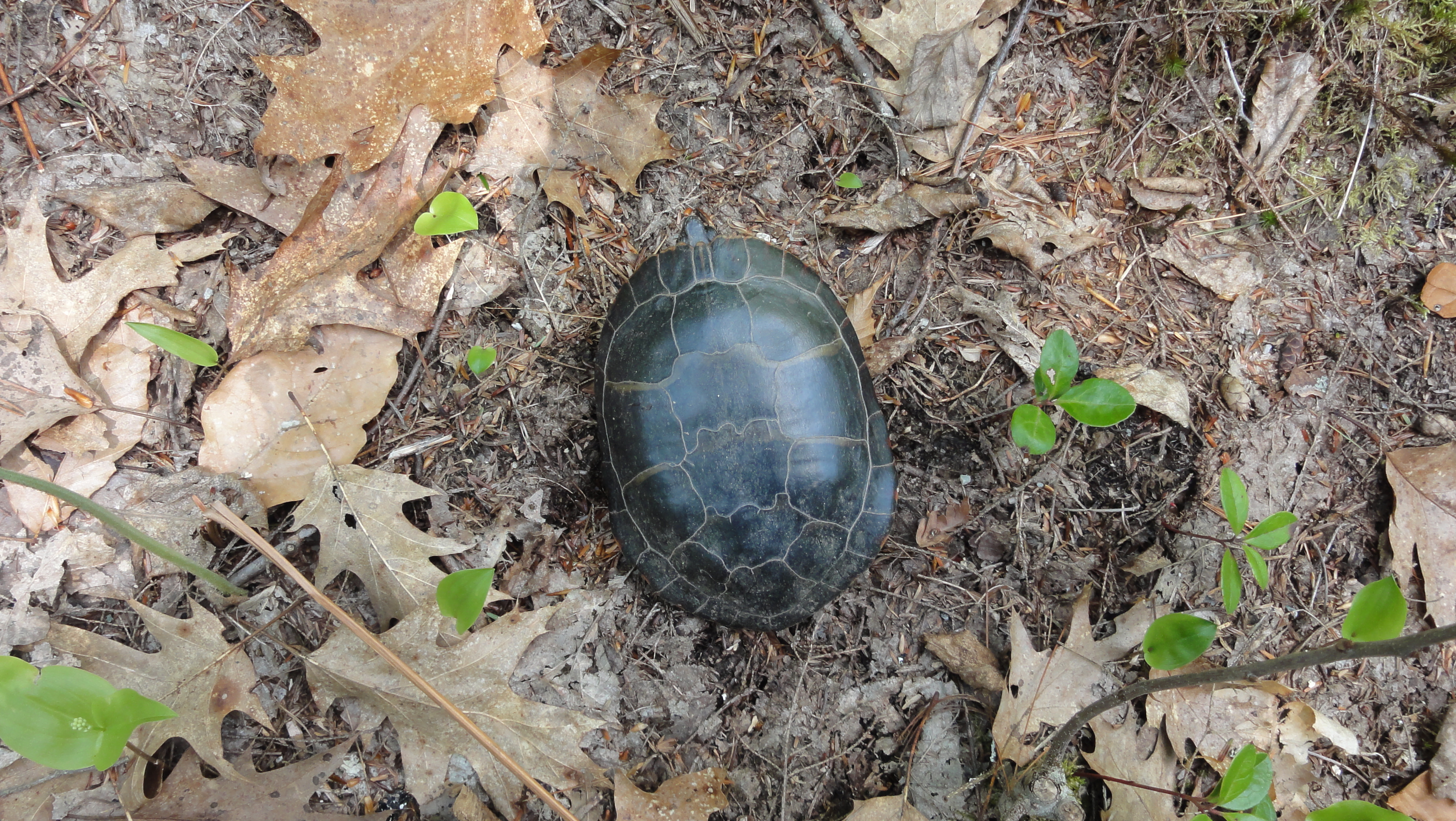
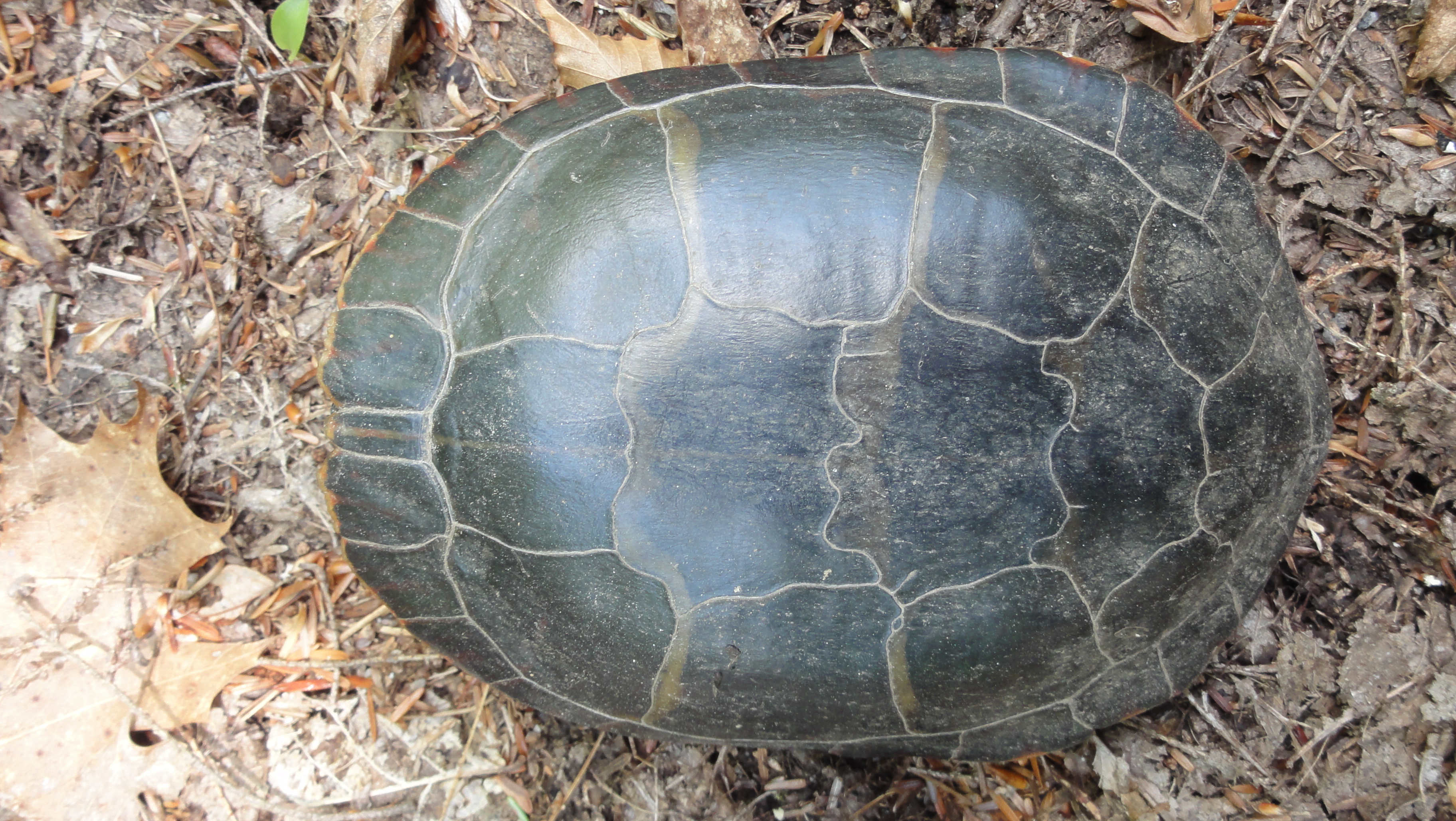
Before continuing with my description of the fun georneys that Dana and I had during Dana’s recent visit, here’s a biological interlude. During a walk along a dirt road in New Hampshire, we found a turtle making his (or her?) way across the road. We stopped to take a few pictures and also to gently move the turtle off the road and out of harm’s way.
I think this is an Eastern Painted Turtle. Can anyone confirm? Does anyone know more about this turtle?
Another view of Mr. (or Ms.?) Turtle.Frontside view.The turtle retreated into his (or her?) shell when we went to remove him from the road.A closer view of the turtle's shell.















































 Georneys