Geology Word of the Week: X is for Xenolith

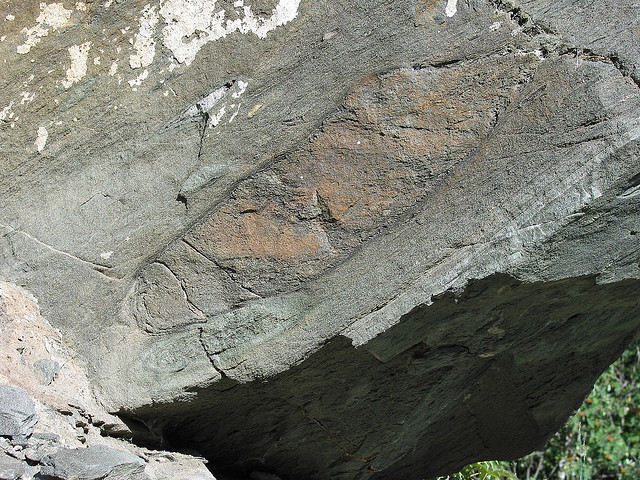
Mafic xenolith, Ontario, Canada, 2002. Photo Credit: Ron Schott.

Note: Sorry for the re-post. This post was lost and then mangled somewhat in the blogger mishap last week. I managed to correct the post, but I had to re-post it under a new day and time.   

def. Xenolith:
A foreign rock inclusion, usually in an igeneous rock.

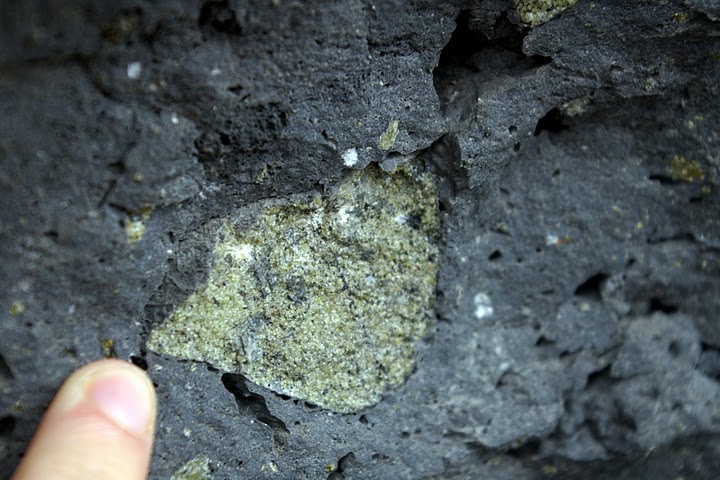
Xenolith literally means “foreign rock” coming from “xenos” (foreign) and “lithos” (stone) in Ancient Greek. A xenolith is a fragment of foreign rock within a host rock. To be considered a xenolith, the inclusion must be different in composition from the enveloping rock. Inclusions of similar rocks are called “autoliths” or “cognate inclusions.”  Xenoliths are generally easy to recognize because they are very different in composition (and often in color) from the encompassing rock. For example, in the picture below the bright green olivine crystals and shiny black pyroxene crystals of a mantle peridotite xenolith stand out in contrast to the fine-grained, gray basalt in which they have been encompassed.

Peridotite xenolith in basalt, Hawaii, 2009. Photo Credit: Einat Lev.

Xenoliths most often occur in igneous rocks. For those of you who are a little rusty on Geology 101, igneous rocks are rocks which form by the cooling and solidification of molten material– either magma or lava. As magma or lava migrates and cools to form igneous rock, it may pick up inclusions of foreign rock. Where do these foreign rock inclusions come from? There are several possible sources. Often, molten magma intrudes into preexisting rocks (known as “country rocks”) and may pick up fragments of this country rock. Commonly, xenoliths are fragments of the walls of a magma chamber or conduit. Xenoliths may also be picked up by lava during explosive volcanic eruptions or may be picked up by lava as it flows along Earth’s surface (if a different type of rock is at the surface).

The term xenolith is most commonly applied to foreign rock fragments in igneous rocks. However, a broad definition of the word xenolith might include foreign rock fragments in sedimentary rocks and inclusions found in meteorites.

Xenoliths are generally small in size relative to the overall body of rock. However, xenoliths can range in size from single crystals (called “xenocrysts”) to rock fragments of several meters.

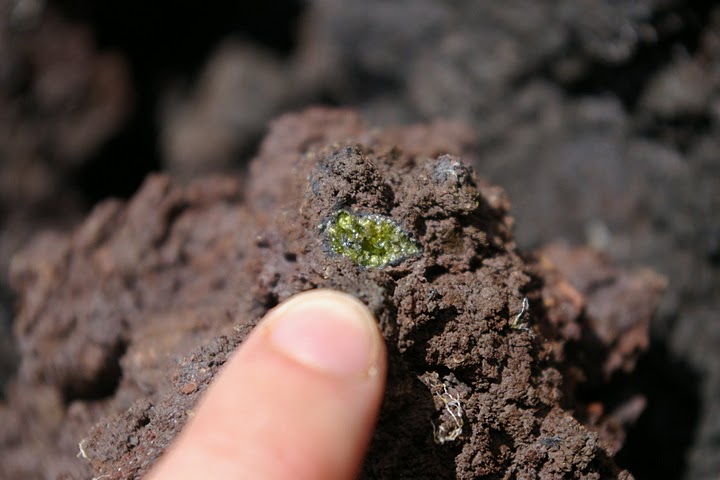
A small peridotite xenolith in basalt, Hawaii, 2009. Photo credit: Einat Lev.
“Teboho-size xenolith.” Cape Columbine, South Africa, 2009.
Photo credit: Christie Rowe.

Xenoliths are important because by studying xenoliths geologists can learn about the origin and evolution of the host rock. For example, when an igneous rock contains a xenolith, geologists know that at some point the magma or lava that cooled to form the igneous rock was in contact with that foreign rock. Xenoliths are also important because they often allow geologists to sample and study rocks which are difficult to access. For example, mantle rocks are not generally exposed at Earth’s surface (except at ophiolites), so xenoliths of mantle rocks are important for learning about the composition of Earth’s mantle. Some xenoliths come from very deep within the Earth. For example, diamonds are famous and economically valuable xenocrysts that formed at high pressures and temperatures very deep within the Earth, ~140 km deep or deeper. Diamond are brought to Earth’s surface as xenocrysts in kimberlite rock.

Here are a few more pictures of xenoliths:

Peridotite xenolith in basalt, Hawaii, 2009. Photo credit: Einat Lev.

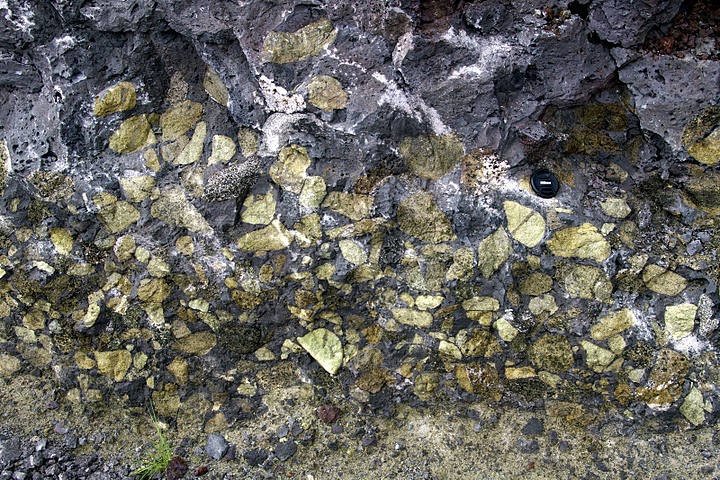
Many peridotite xenoliths in basalt, Hawaii, 2009. Photo credit: Einat Lev.

Xenolith in lamprophyre, Ontario, Canada, 2002. Photo credit: Ron Schott.

Peridotite xenolith collected at Dish Hill Cinder Cone, Mojave Desert. Photo credit: Ron Schott.

Oxidized mantle xenolith collected at Dish Hill Cinder Cone, Mojave Desert. Photo credit: Ron Schott.

Finally, Callan Bentley of the Mountain Beltway blog has a zillion majillion photos of xenoliths on his blogs (Mountain Beltway used to be the NOVA Geoblog):

Xenolith Label on Mountain Beltway

Xenolith Label on NOVA Geoblog

Here is one of Callan’s xenolith pictures that I found particularly striking:

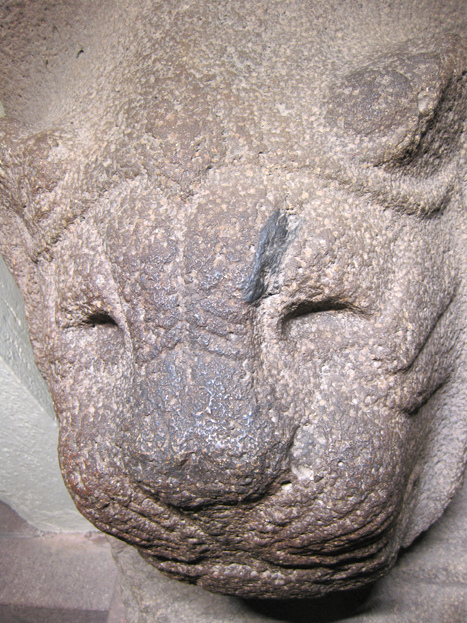
Mafic xenolith in a statue carved from porphyritic andesite, Ankara, Turkey, 2010.
Photo Credit: Callan Bentley. Read more about Callan’s trip to Turkey here.

Thanks to all of my geologist friends and fellow geobloggers who sent me pictures of xenoliths. If you have any good xenolith pictures, post a link below in the comments.

Geology Word of the Week: W is for Wadi (وادي‎ )

A Wadi, Oman, January 2009.

def. Wadi ( وادي):
1. An Arabic word meaning “valley.”
2. A valley or canyon– usually in an arid part of the world such as the Middle East– that contains an ephemeral streambed, which generally fills with water only after heavy rainfall.

In Arabic the word “wadi” means “valley.” However, in the Middle East and North Africa– where Arabic is spoken– the climate is arid, and rainfall is rare in most places. For example, where I do my thesis work in Oman, there are very arid places that receive rainfall only every few years. There are a few places in the Arab-speaking world that receive regular rainfall and where permanent rivers flow. However, many streams are ephemeral and only carve their valley channels after a rare rainstorm. Valleys which contain these ephemeral streams are called “wadis,” both in Arabic and in English. Many Arabic place names contain the word “wadi,” and the word “wadi” is often carried over into the English place name as well. For instance, “Wadi Al-Abyad (وادي الأبيض)” could be translated as “The White Wadi” on an English map.

Here are a few pictures of wadis in Oman:

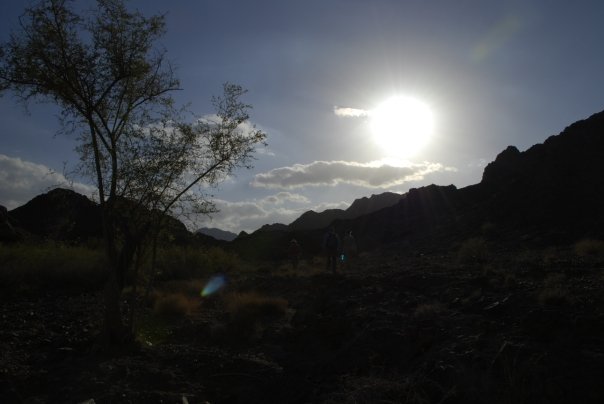
Wadi Sunset, Oman, January 2009.
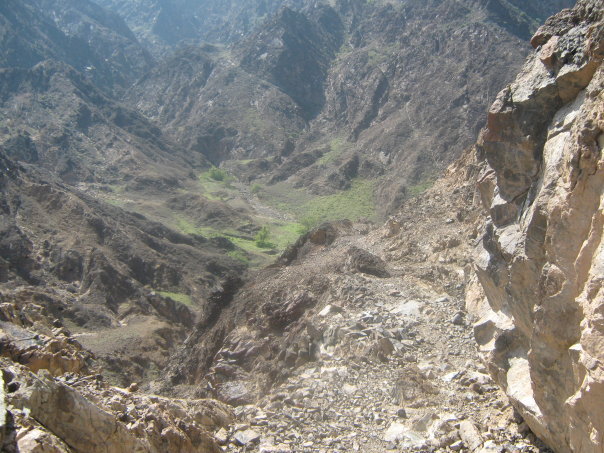
Ephemeral streambed, Oman, January 2009.
Herding goats up a wadi, Oman, January 2009.
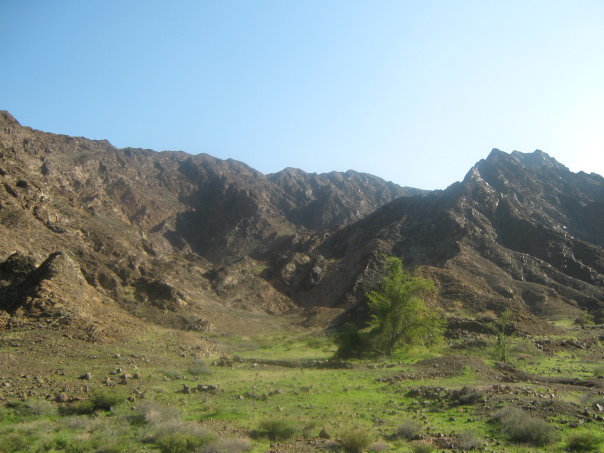
Green wadi from a distance, Oman, January 2010.

A wadi transformed by recent rainfall, Oman, January 2010.
After a rainfall, a wadi can be transformed overnight from dull brown to lush green, as in the two final pictures above. During a rainfall, wadis may also flood dangerously. I’ve never seen a wadi in flood, but here is a scary YouTube video of a wadi flooding in Oman:

Geology Word of the Week: V is for Vesicle (and Vug)

Vesicles in basalt, image courtesy of Ron Schott of the Geology Home Companion Blog.

def. Vesicle:
A small cavity in a volcanic rock that was formed by the expansion of a bubble of gas that was trapped inside the lava.

Vesicles are commonly found in volcanic rocks– that is, in rocks that solidified from lava. As you might remember from M is for Magma, lava is what you call molten rock when it is extruded onto Earth’s surface. Molten rock– magma and lava– often contains dissolved gases such as water and carbon dioxide. When lava erupts, these gases expand and often are able to escape to the atmosphere as the lava cools and solidifies to form a volcanic rock. Sometimes, particularly in very small, interior vesicles, the gases do not escape and geologists are able to study these gas (or sometimes fluid) inclusions to learn more about the gases and fluids that were in the lava when it erupted. When there are many vesicles in a volcanic rock, this indicates that the lava from which the rock formed was very rich in gases.

Since vesicles are open cavities, they sometimes become filled in with secondary alteration minerals such as calcite, quartz, or zeolite. When vesicles are filled with a secondary alteration mineral, they are called amygdules (or amygdales, if you’re British). Since calcite, quartz, and other secondary minerals are generally light in color compared to the brown or black volcanic rock, amygdules can make a volcanic rock look spotted– like a reverse Dalmatian rock.

Spotted rock (brown basalt with white amygdules), collected from the Ninetyeast Ridge, Indian Ocean, Summer 2007.

Spotted dog, Johannesburg, South Africa, December 2009.

When you describe a volcanic rock, you can say that it is “vesciular” if it contains vesicles and that is it “amygdaloidal” if it contains amygdules.

The word vesicle generally applies only to cavities formed in volcanic rocks by gases expanding in lava. The word “vug”– another v word– is another term used to describe cavities in rocks. Vugs can be formed in a variety of ways– such as through faulting, folding, or collapse of a rock– and are often partially filled with secondary minerals.

Since I’m currently traveling and don’t have all my geo-pictures at hand, I’ve asked some of my geologist friends and geobloggers to send me some pictures of vesicles, amygdules, and vugs. Ron Schott already kindly gave me the vesicle picture at the top of this post. I am going out now for a few hours, but this evening I’ll hopefully be able to add some more pictures to this post. Feel free to send your own vesicle, amygdule, and vug pictures to georneysblog (at) gmail (dot) com, and I’ll post them here. Please include what– if anything– you’d like me to use as credit for the picture. Thanks!

Update:

From Callan Bentley over at Mountain Beltway, here are some posts with vesicle pictures:
Rock varieties of Hawai’i
Hol(e)y basalt, Batman!

Geology Word of the Week: U is for Uraninite

Botryoidal uraninite. Image taken from wikipedia commons here.

def. Uraninite:
A uranium-rich mineral with the formula UO2 (uranium oxide). Often, part of the uraninite is oxidized with the formula UO3. Uraninite is the primary ore for uranium and can also be mined for other elements such as radium, thorium, and lead, which are decay products of radioactive uranium. Uraninite deposits are generally a dark steel black with a slight metallic luster. The shape of uraninite is typically botryoidal (looks like a bunch of grapes) or amorphous, but rare cubic and octahedral crystals can form in certain environments. Uraninite often forms when hydrothermal circulation picks up uranium from a uranium-rich rock (such as granite or syenite) and concentrates this uranium in a hydrothermal ore deposit. The primary reason that uraninite is mined is to provide fuel for nuclear power plants.

Uranium can be found in almost all rocks. Uranium is found in at least trace quantities in rocks ranging from sedimentary limestones to granites to volcanic tephras. However, in most rocks the concentration of uranium is very, very low– parts per million or even parts per billion. That is, for every million atoms in the rock only one atom is uranium. Most rocks on Earth have ~1-2 parts per million uranium. Some uranium “enriched” rocks such as granite can contain as much as 50 parts per million uranium. Even though most rocks contain some uranium, it simply isn’t economical to mine uranium in most rocks since most rocks have very low concentrations of uranium. Instead, geologists must look for ore deposits in which uranium has been concentrated through a geological process, such as hydrothermal circulation. The uranium ore must then be processed and enriched before it can be used as nuclear fuel.

Uranium-rich ores are found and mined in many countries throughout the world Here is a nice pie chart from wikipedia (data taken from here):

Uranium mining by country. Taken from wikipedia commons here.

Here are some links if you want to learn more about uraninite and uranium mining:

Wikipedia:
Uraninite
Uranium Ore
Uranium Mining

Mineralogy of Uraninite:
Uraninite Mineral Data
The Mineral Uraninite

IAEA Website:
The Formation of Uranium Ore Deposits

Geology Word of the Week: T is for Travertine

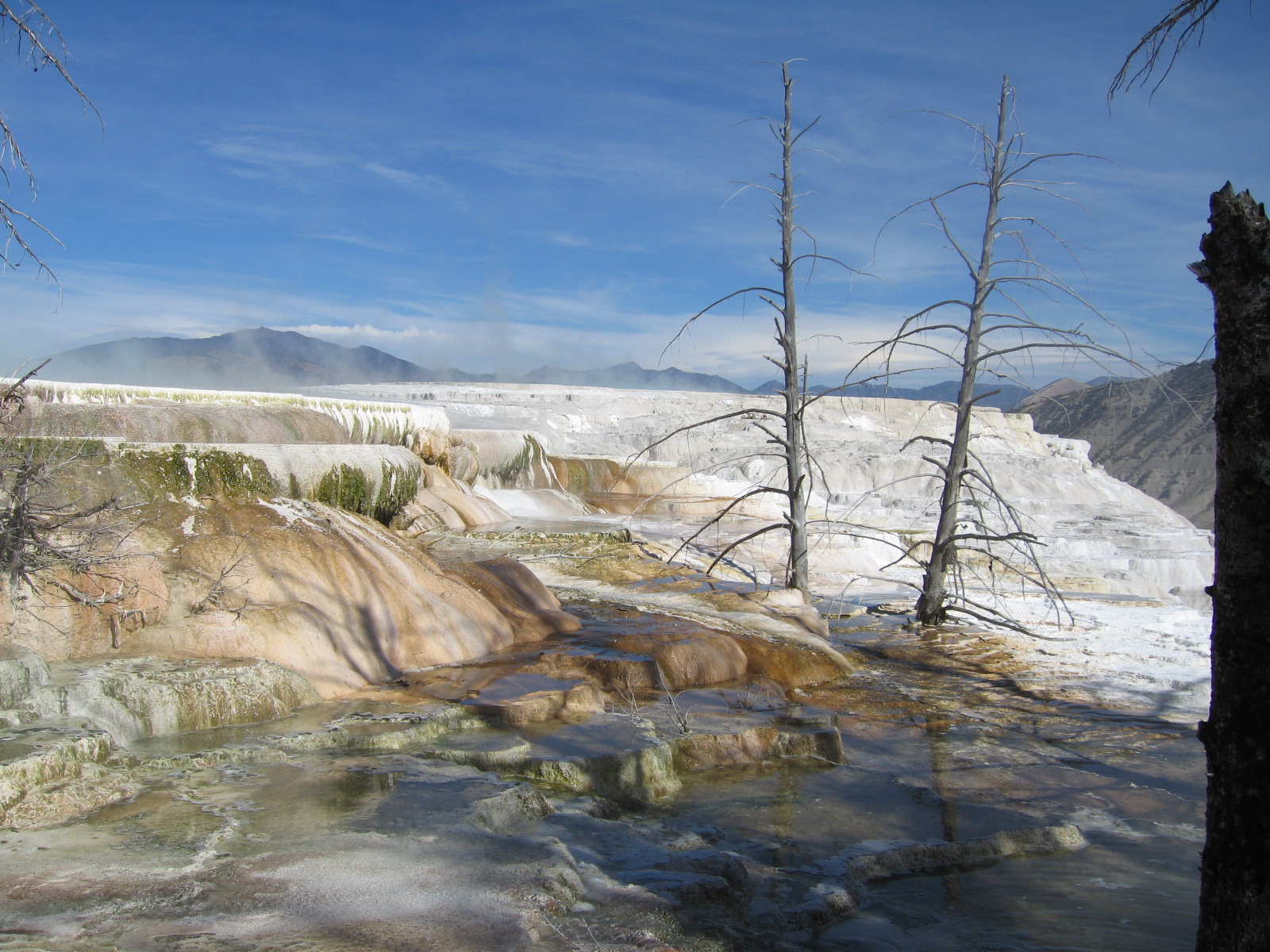
Travertine terraces, Yellowstone, Western USA, Fall 2005.

After a month’s absence because of the Fukushima interviews, I am resuming the geology word of the week. For my new readers, every week I blog about a geology word. Over the past several months, I have been working my way through the alphabet, from A is for Alluvium to S is for Speleothem. I hope you enjoy this weekly feature!

def. Travertine:
1. Formal and specific: “A chemically-precipitated continental limestone formed around seepages, springs, and along streams and rivers, occasionally in lakes and consisting of calcite or aragonite, of low to moderate intercrystalline porosity and often high mouldic or framework porosity within a vadose or occasionally shallow phreatic environment. Precipitation results primarily through the transfer (evasion or invasion) of carbon dioxide from or to a groundwater source leading to calcium carbonate supersaturation, with nucleation/growth occurring upon a submerged surface (Pentecost, 2005).”

2. Translation of the above + a little more: A type of limestone (a calcium-rich rock composed primarily of the CaCO3 minerals calcite and aragonite) which forms by chemical precipitation (the stuff that makes the rock falls out of solution) from certain types of shallow or surface waters, such as springs and rivers. The trigger for the precipitation is usually gain or loss of carbon dioxide (CO2), which causes a pH change and changes the solution chemistry so that CaCO3 precipitates. This gain or loss of CO2 usually happens very close to the Earth’s surface as the CO2 is lost to or gained from the atmosphere. The waters that produce travertines are usually very acidic (low pH) or very alkaline (high pH). Often, travertines precipitate from acidic hotsprings, such as those at Yellowstone in the Western USA. However, contrary to many web sources (this wikipedia article, for instance), travertines do not always form at hotsprings; they can also form from cooler waters. Closely related to the word travertine is another T word: tufa. The difference between travertine and tufa is porosity– tufa is a type of highly porous travertine that generally forms from cooler waters (not hotsprings).

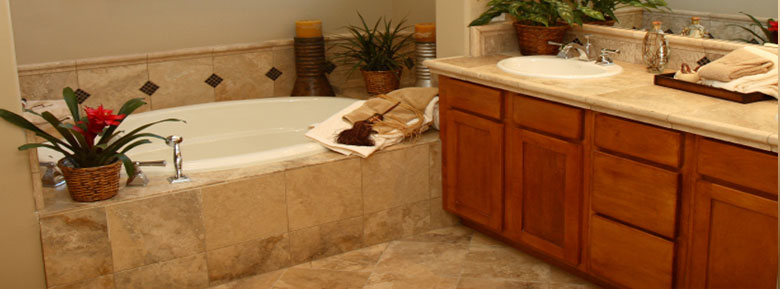
If you’re not a geologist– and even if you are– you might associate the word “travertine” more with fancy tiles and kitchen countertops than with geology. That’s okay– travertine tiles and countertops can be very beautiful. Personally, I’d love to have some gorgeous travertine in my kitchen or bathroom. Since I work on travertines as part of my PhD, such tiles and countertops would be part of my geology dreamhouse. However, perhaps it’s best that I don’t have any travertine in my kitchen. If I did, every time some poor houseguest complimented me on my beautiful kitchen I’d probably subject this poor person to a long lecture on just how amazing travertine is scientifically and what I’ve learned from studying travertines in Oman. I’d probably go on to excitedly point to a small layer or feature in a tile and bemoan how some of the textural characteristics were lost when the piece of travertine was polished to make it into a tile. Since my soon-to-be husband is also a geologist, he’d probably join in on the discussion and we’d scare away our poor houseguest.

Travertine bathroom. Image taken from here.

However, the value of travertine goes beyond the economic value of certain types of travertine as ornamental stones. There is also much scientific value that can be gleaned from studying travertine. Also, I’d argue that the beauty of seeing many travertines in their natural environment– no polishing– goes far beyond the beauty of any travertine tile or countertop. At least for me, anyway.

There are many good scientific reasons to study travertine. For example, study of carbon and oxygen isotopes in travertines (especially speleothem-type travertines that form in caves) can provide a chemical record about how the climate of a region has varied in the past. Study of travertines and the fluids from which they precipitate can also provide information about shallow groundwater. Since many travertines form from high-temperature springs (often heated by magma, such as at Yellowstone), study of these types of travertines can provide information on a volcanic system, such as water-magma interaction. As I mentioned in the definition above, travertines usually precipitate from either very high pH or very low pH waters. Study of the critters (bugs and fishy things and microbes) that hang out in these extreme pH environments provides interesting information about life in extreme environments, which might provide helpful information relevant to looking for life on other planets and figuring out the origin of life on our own planet. These are just a few of the ways that studying travertine is scientifically valuable.

Why do I study travertine, you might be wondering? Well, I study travertine because I am interested in learning more about how travertine interacts with atmospheric CO2. As many of you know, CO2 is a greenhouse gas that contributes to global warming. Humans release CO2 to the atmosphere through burning of fossil fuels. There is currently much effort being put forth around the world to investigate how we can reduce anthropogenic CO2 emissions and– maybe– even geoengineer our environment so that we can remove CO2 from the atmosphere and store it in another reservoir, such as underground in an abandoned oil well or a porous sedimentary layer.

Most travertines precipitate when water degasses CO2 to the atmosphere. This happens through the reverse of the following reaction:

(Opposite of) travertine formation through degassing of CO2. Reaction taken from Pentecost (2005).

However, a few travertines– such as the ones I study in Oman– actually precipitate when CO2 is “sucked up” into the water from the atmosphere. This happens through the following reaction:

Travertine formation through uptake of CO2. Reaction taken from Pentecost (2005).

If you think about it, this is really, really cool! Travertines that form in this manner are naturally sucking up CO2 from the atmosphere and storing this CO2 in solid rock– travertine. For my thesis research, I am studying the formation of such travertines from very high pH (highly alkaline) natural groundwaters (most are pH = 11-12) that occur in peridotite rocks in Oman. Very high pH groundwaters are rare, but they are found at several places around the world.

Below are some pictures of travertines I’ve encountered in my geology travels and research. The Omani travertines are my favorite. I think the newly-formed travertine looks like snow in the Omani desert. Click on any of the pictures below to view larger.

A final note: I really like the first definition above, which I took from a book called “Travertine” by Allan Pentecost. I like this definition because it is very specific, descriptive, and inclusive. However, this type of definition is probably daunting for the non-geologist. A common problem with definitions of scientific words is that they contain more scientific words. As a geologist who works on travertine, I am familair with the other sciencey words such as “aragonite”, “mouldic”, and “vadose.” However, I can see how a non-geologist might struggle with the first definition of the word travertine. In the second definition, I have tried to define travertine in plainer language.

Pictures of hot, low-pH (acidic), CO2-degassing travertines in Yellowstone:

Travertine terraces engulfing trees, Yellowstone, Western USA, Fall 2005.
Travertine precipitating around a tree, Yellowstone, Western USA, Fall 2005.

Travertine engulfing civilization, Yellowstone, Western USA, Fall 2005.

More travertine! Yellowstone, Western USA, Fall 2005.

Closer view of travertine terraces, Yellowstone, Western USA, Fall 2005.

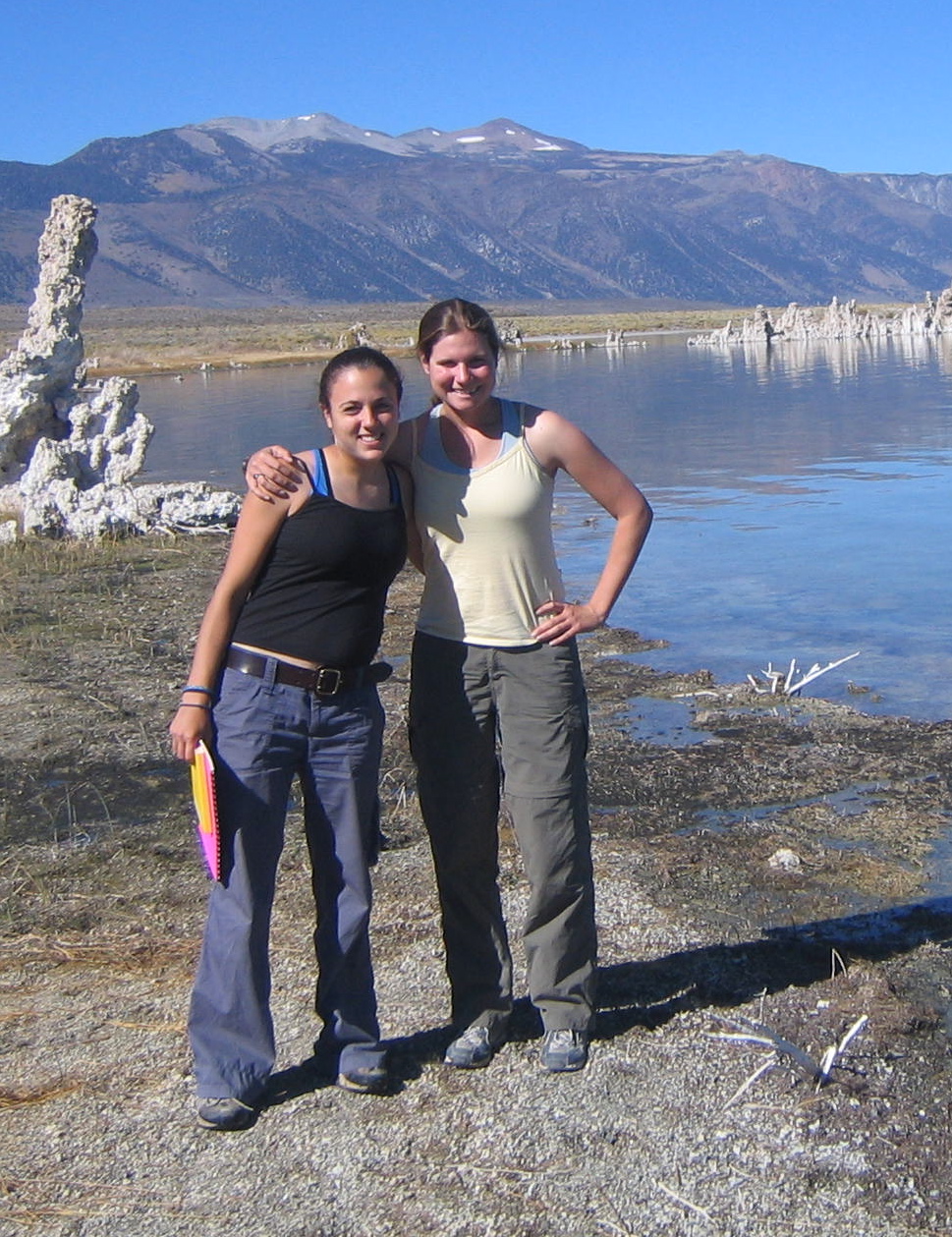
Here’s a picture of me and a friend posing with some tufa (very porous travertine):

Geology students with tufa towers in the background, Mono Lake, California, Fall 2005.

Pictures of cold, high-pH, CO2-absorbing travertines in Oman:

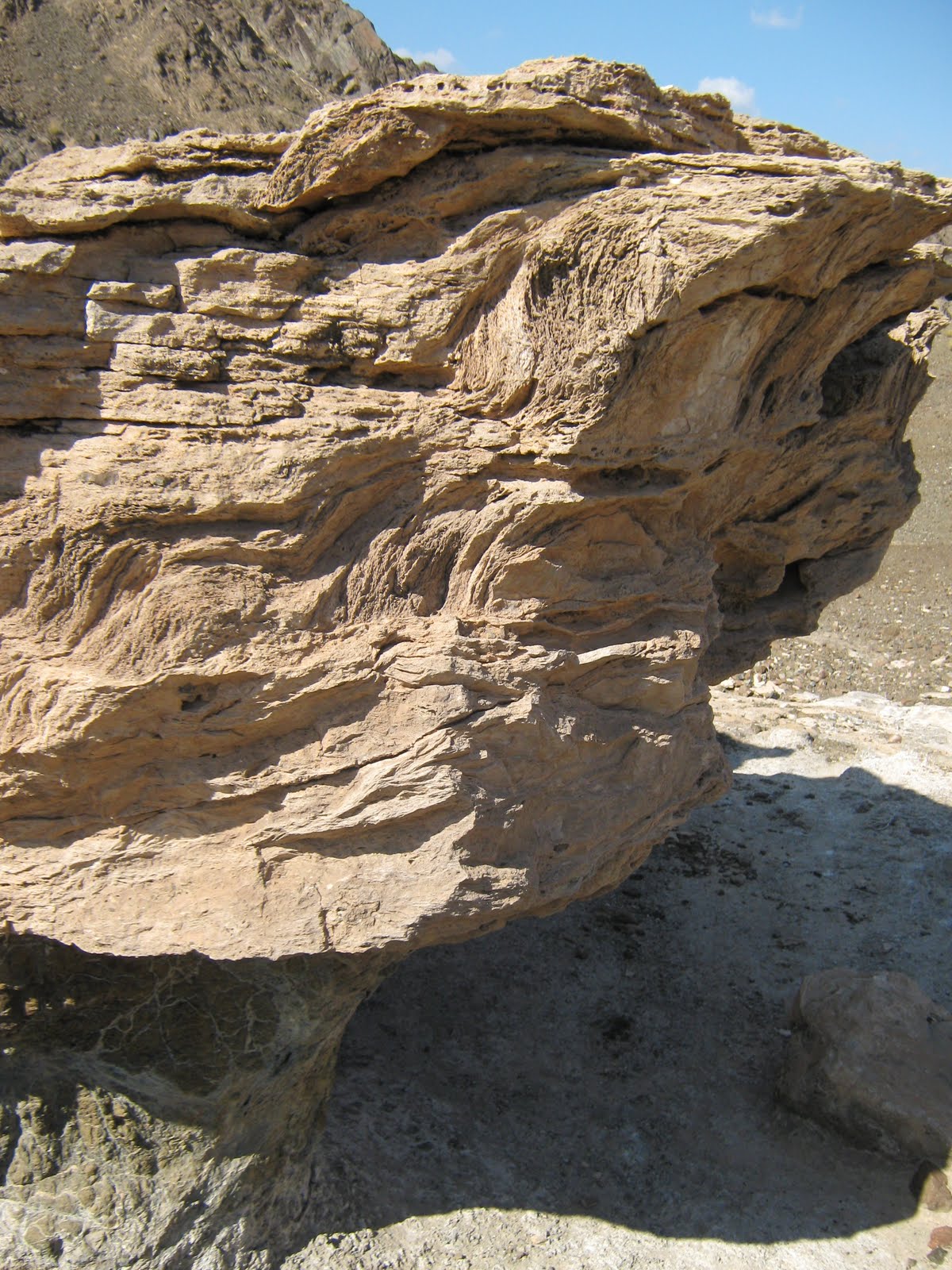
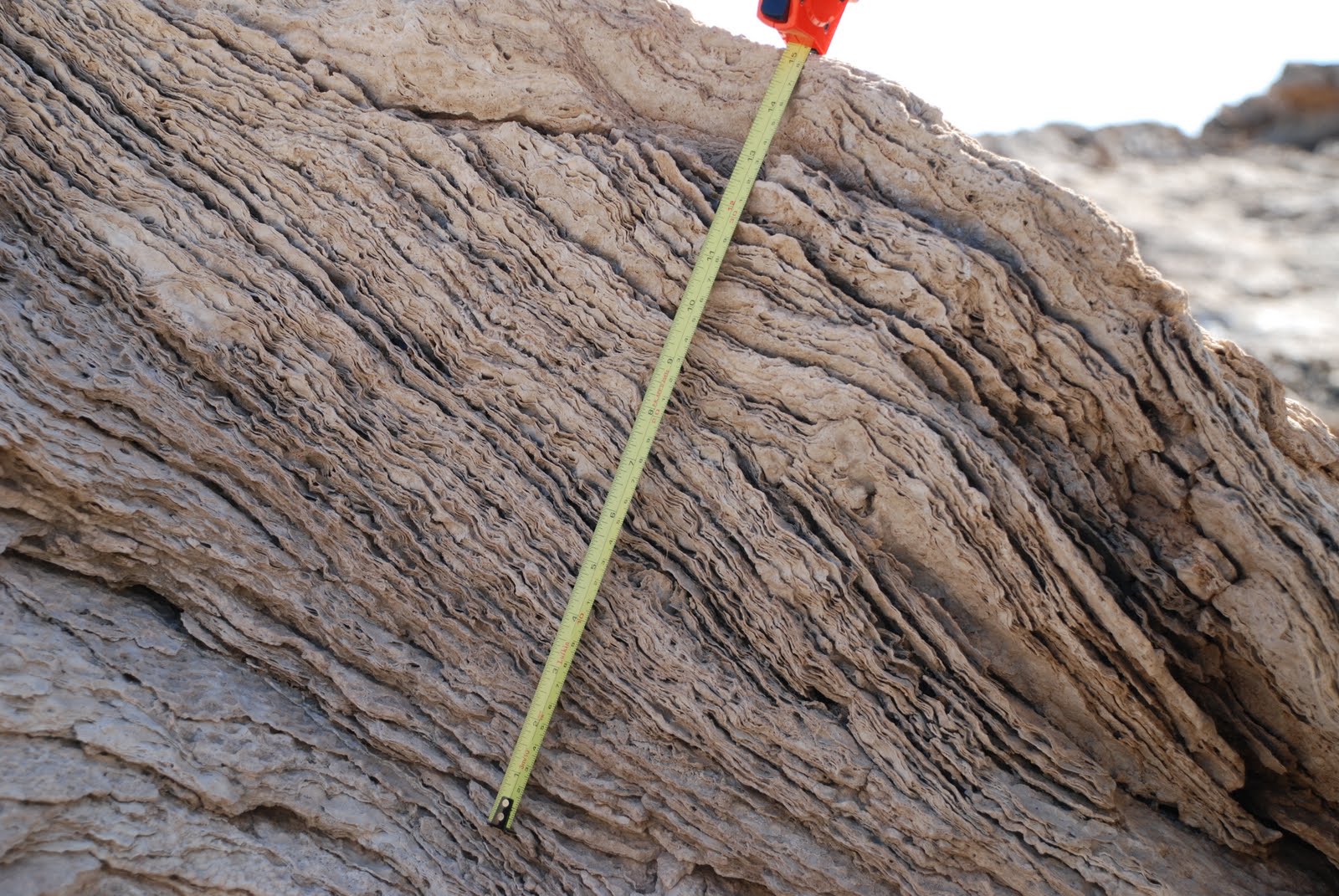
Layers of travertine time, Oman, January 2009.

Sitting atop some travertine, Oman, January 2009.

Investigating some more travertine, Oman, January 2009.

Travertine coating an alkaline streambed, Oman, January 2009.

Travertine coating a soda bottle, Oman, January 2009.

Travertine precipitating from an alkaline pool (geologist for scale), Oman, January 2009.

Travertine tower, likely formed from an alkaline waterfall (geologist for scale), Oman, January 2009.

Very large travrtine deposit, note the tower (see above picture) to give you a sense of scale, Oman, January 2009.

Alkaline streambed, Oman, January 2009.

Older (brown) and newer (white and black) travertine, Oman, January 2009.
Standing around an alkaline pool, Oman, January 2010.

Little travertine terraces, Oman, January 2010.
Older, brown travertine deposit, Oman, January 2010.

Older travertine (brown) and newer travertine (white and black), Oman, January 2010.

Unusual travertine morphology, Oman, January 2010.

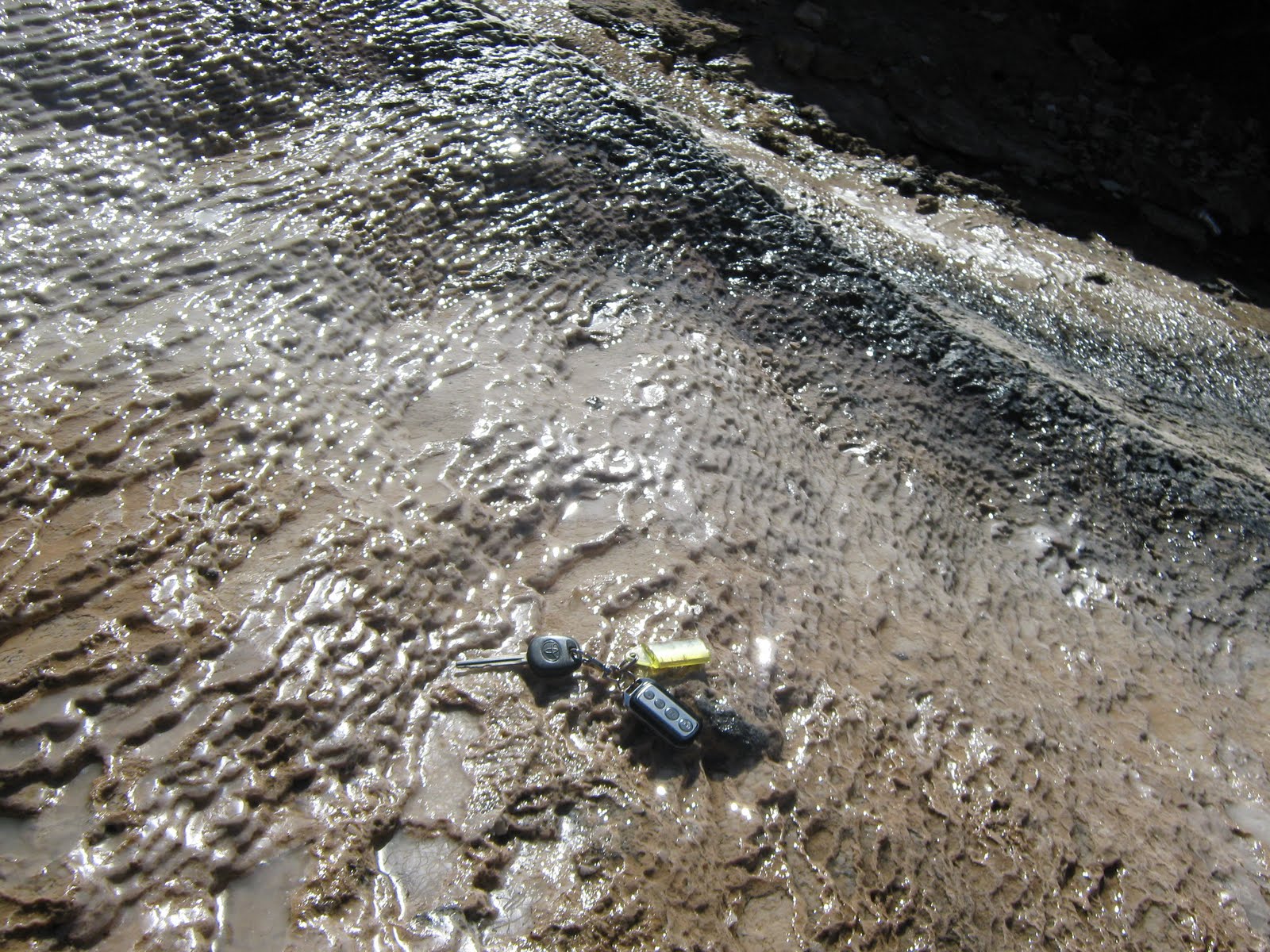
Mini travertine terraces (car keys for scale), Oman, January 2010.

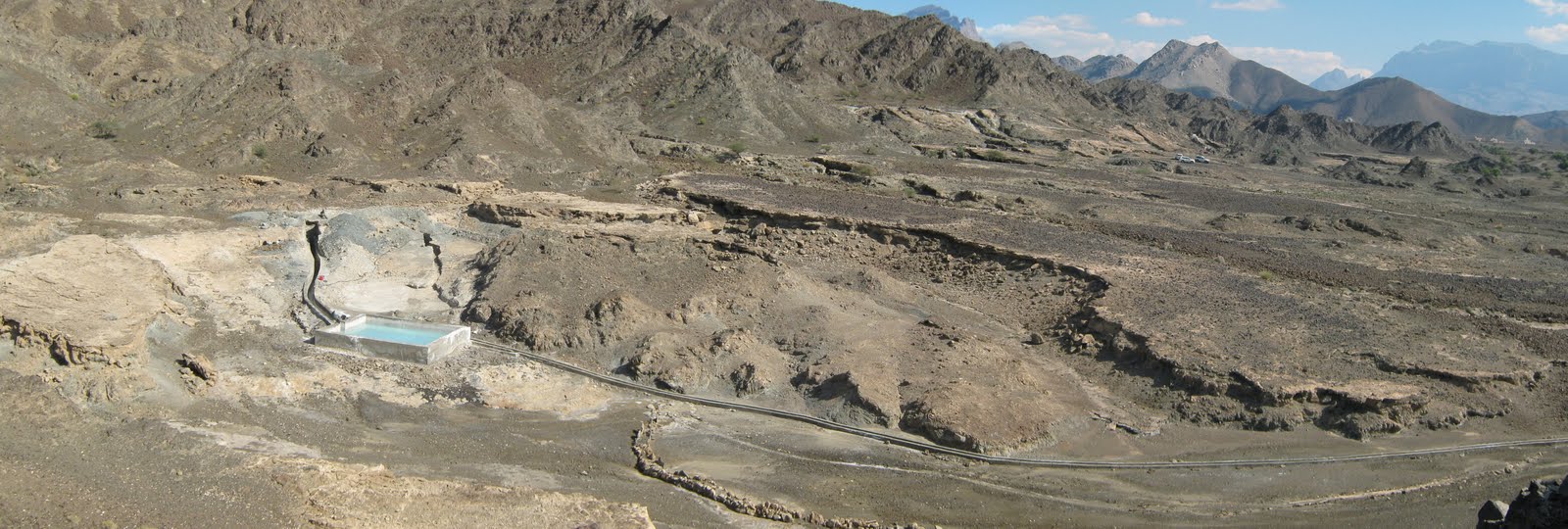
Large travertine deposit (locals have controlled the alkaline stream in a cement pool), Oman, January 2010.

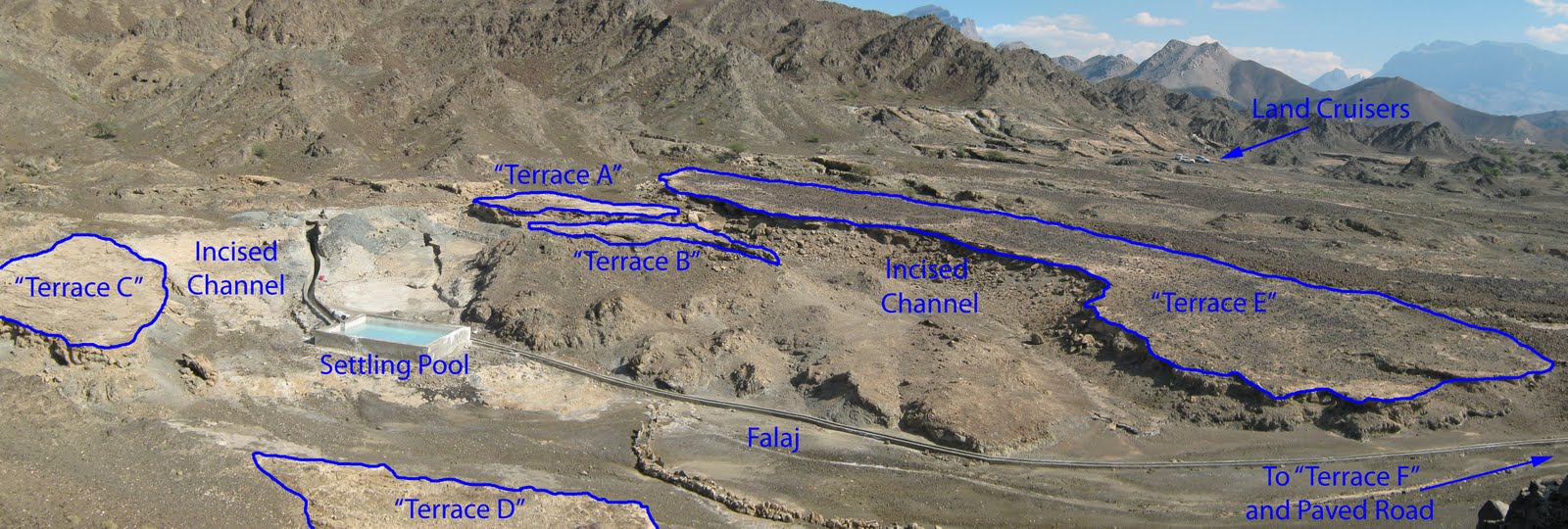
Travertine terraces outlined, Oman, January 2010.

A tower amidst the travertine, Oman, January 2010.

A tower amidst the travertine (with labels), Oman, January 2010.

For more pictures of Omani travertine, see here and here.

Useful Link:
More on how CO2 affects water pH

Reference:
-Pentecost, Allan. Travertine. Berlin: Springer-Verlag, 2005.

Geology Word of the Week: S is for Speleothem

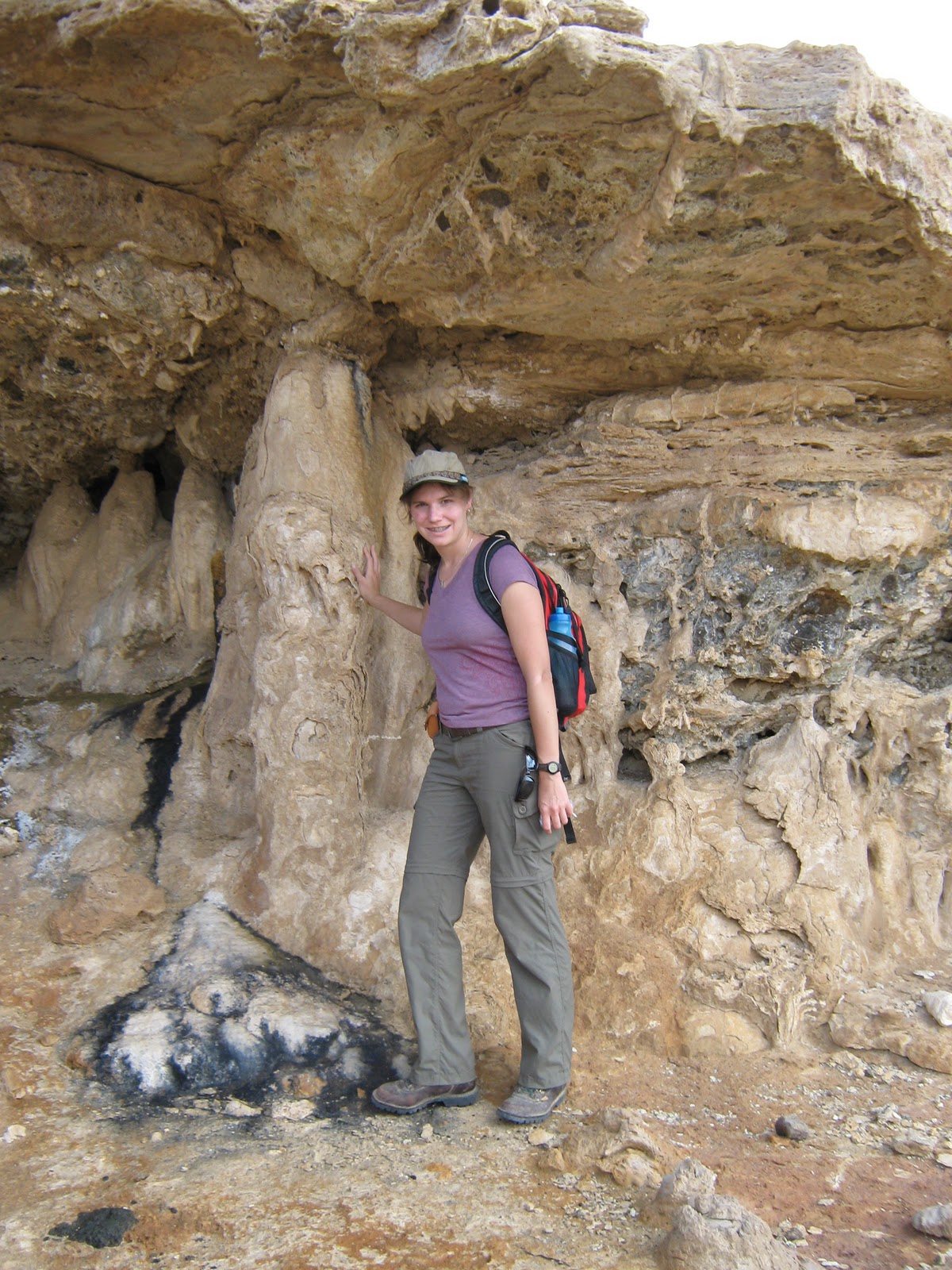
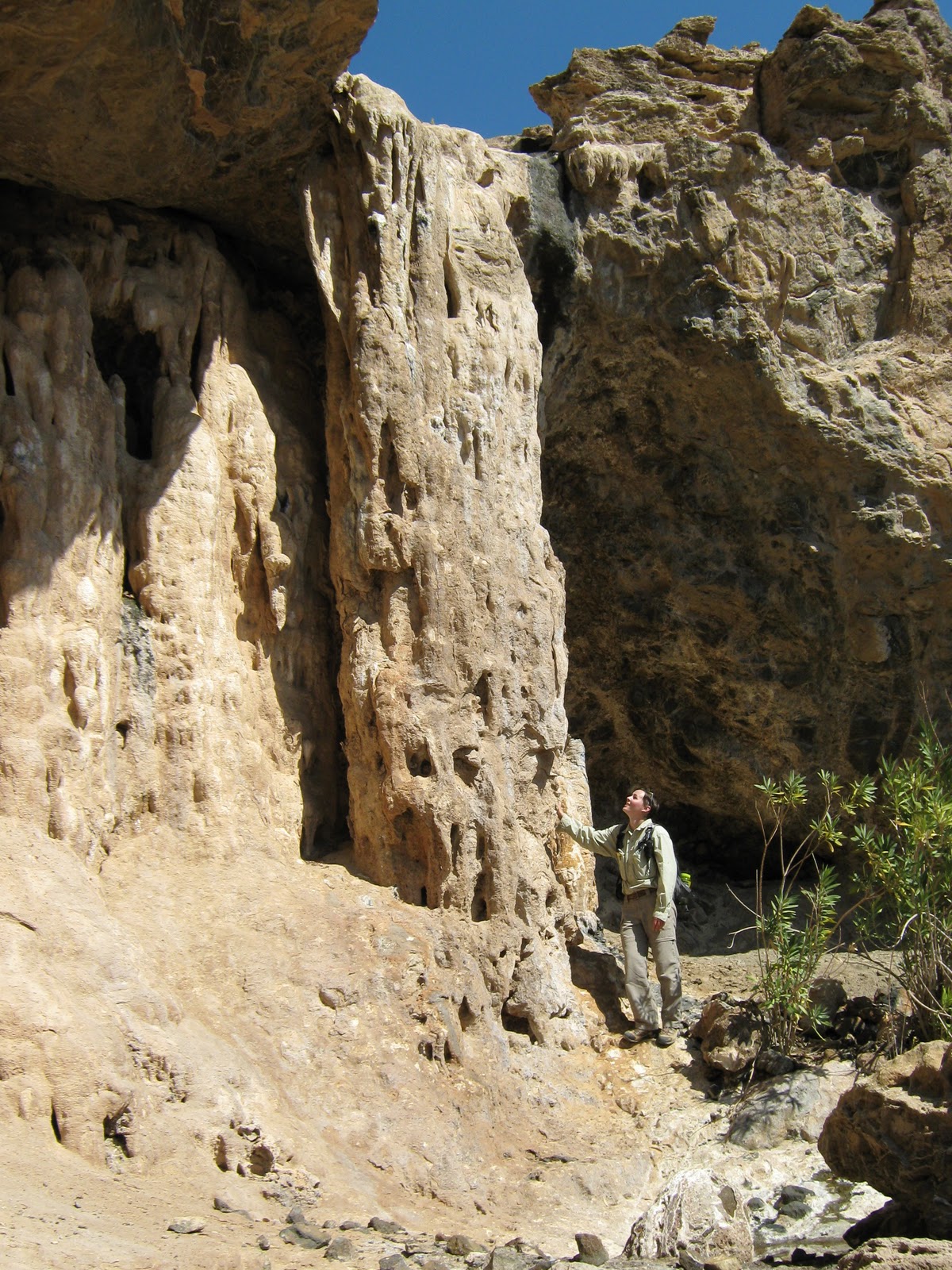
Posing with a pseudostalagmite, Oman, January 2009.

def. Speleothem:
An encompassing term used to describe all types of chemical precipitates that form in caves.

If you’ve ever been in a cave, you’ve probably seen speleothems. Speleothems generally precipitate from groundwater which has percolated through the bedrock surrounding the cave and leached various elements and compounds. When the enriched water reaches the cave, changing conditions (a large open space has very different pressure and temperature than pore spaces in bedrock) allow gases, such as carbon dioxide, to escape from the water. Evaporation can also occur. The changing composition of the water encourages the (usually very, very slow) precipitation of speleothem minerals from cave waters.

Chemically, the speleothems which form in a particular cave are similar in composition. Most caves are formed in limestone, and so the speleothems will generally be formed of calcite, the dominant mineral in limestone. However, depending on how and where the speleothem is precipitated, it can take on a variety of shapes. Scientists and other cave explorers have given different names to these various morphologies. Examples of speleothems are stalactites, stalagmites, flowstones, cave coral, cave drapery, cave curtains, and cave crystals. There are dozens of names for various cave mineral formations, so speleothem is a nice catch-all phrase for geologists to use.

Here is a great picture (from Wikipedia) of some of the most common types of speleothems:

Photo by Dave Bunnell of some common speleothems. Taken from Wikipedia here. Click photo to enlarge.

Most speleothems form over thousands upon thousands of years. Thus, you shouldn’t touch or remove speleothems unless you’re doing so for legitimate science. Even when collecting speleothems for science, one should be conservative. Geologists should take small samples and obtain the necessary permissions. Fortunately, for my own research in Oman I am often able to collect speleothems which have fallen on the ground and are no longer growing.

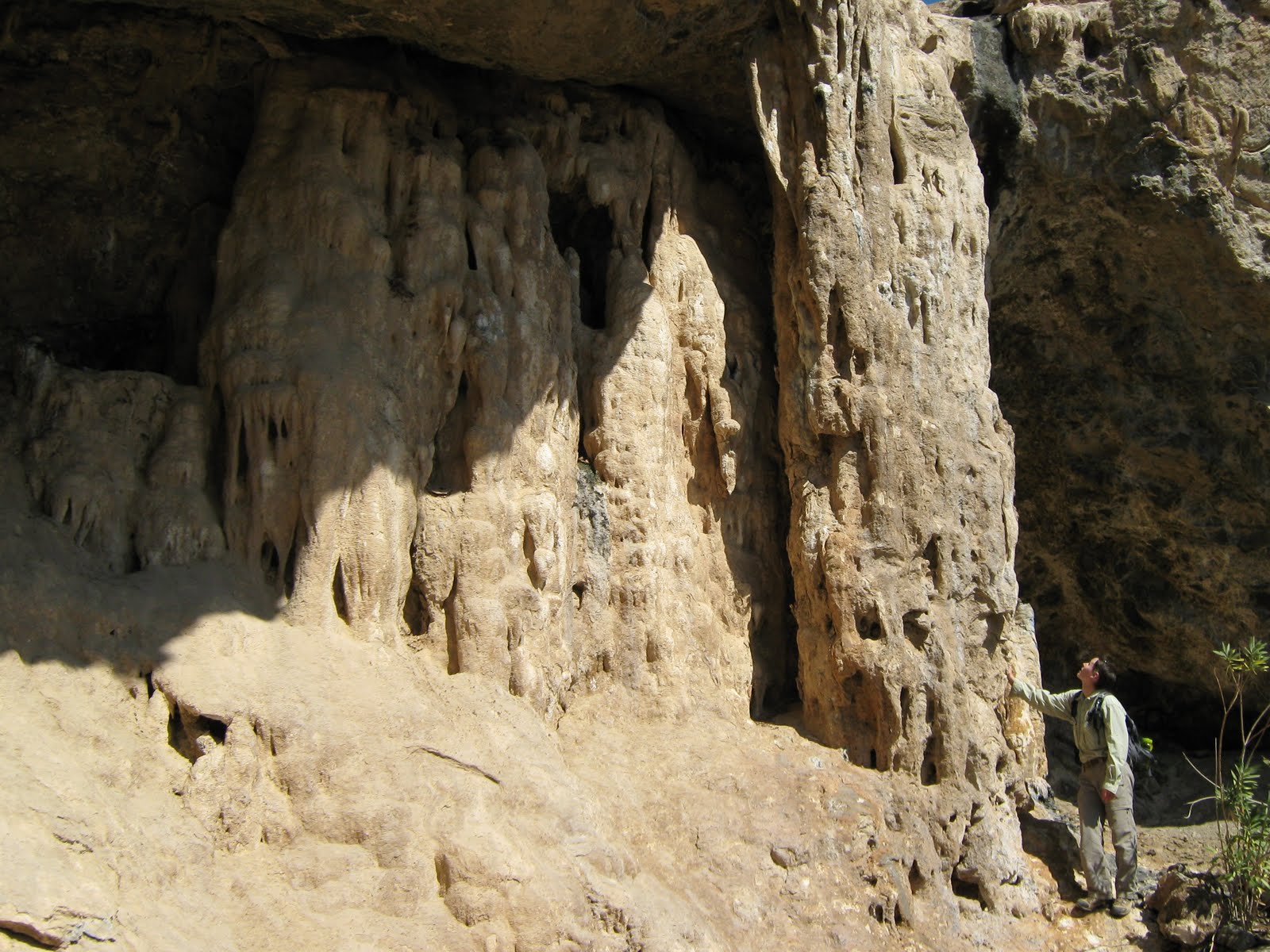
At the top of this post is a picture of me with a stalagmite in Oman. I didn’t sample this one, but I did sample some of its neighbors. This particular stalagmite isn’t forming in a true cave but rather in an open hallow underneath a layer of rock. Water percolated through the layer of rock and formed speleothems in the hallow underneath. The speleothems I study in Oman are thus really pseudospeleothems– they are not in true caves but rather in little overhangs and hallows.

Now, for those of you who still confuse stalactite and stalagmite, here’s a reminder of something you probably learned in grammar school but may have forgotten by now:
StalaCtites hang tight (or tite) to the Ceiling while stalaGmites grow up from the Ground.

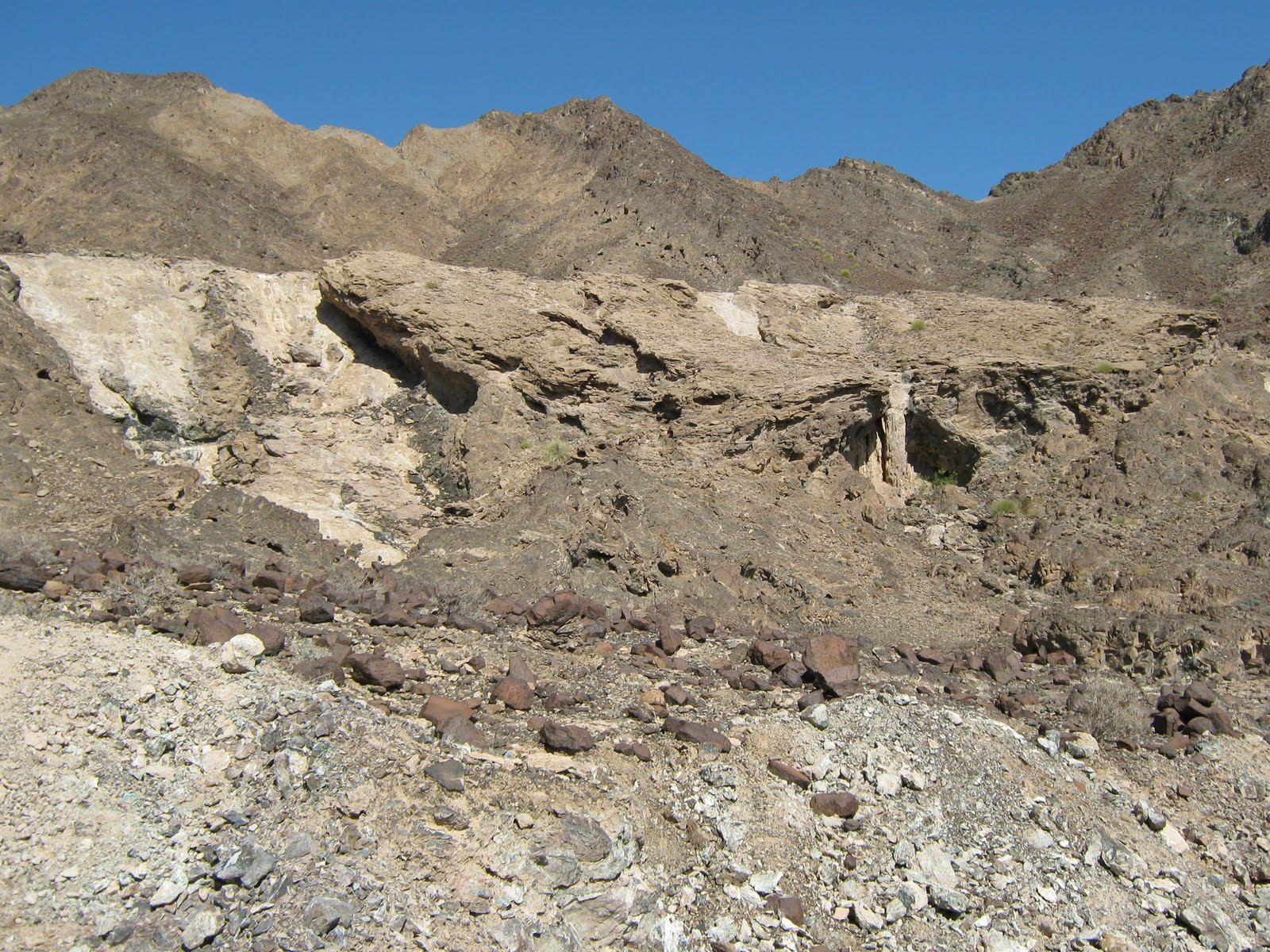
Finally, below are few more pictures of some Omani pseudospeleothems. These pseduospeleothems are forming in overhangs in travertines (carbonate precipitates) which are forming at the surface of the peridotite layer of the ophiolite. Be sure to click on the two panoramas to enlarge them. Note the location of the pseudospeleothem column in the two panoramas. Many pseudospeleothems are located in the overhang around this column. The last picture has my colleague Lisa standing next to this column for scale; this shows the enormous size of the travertine deposit.

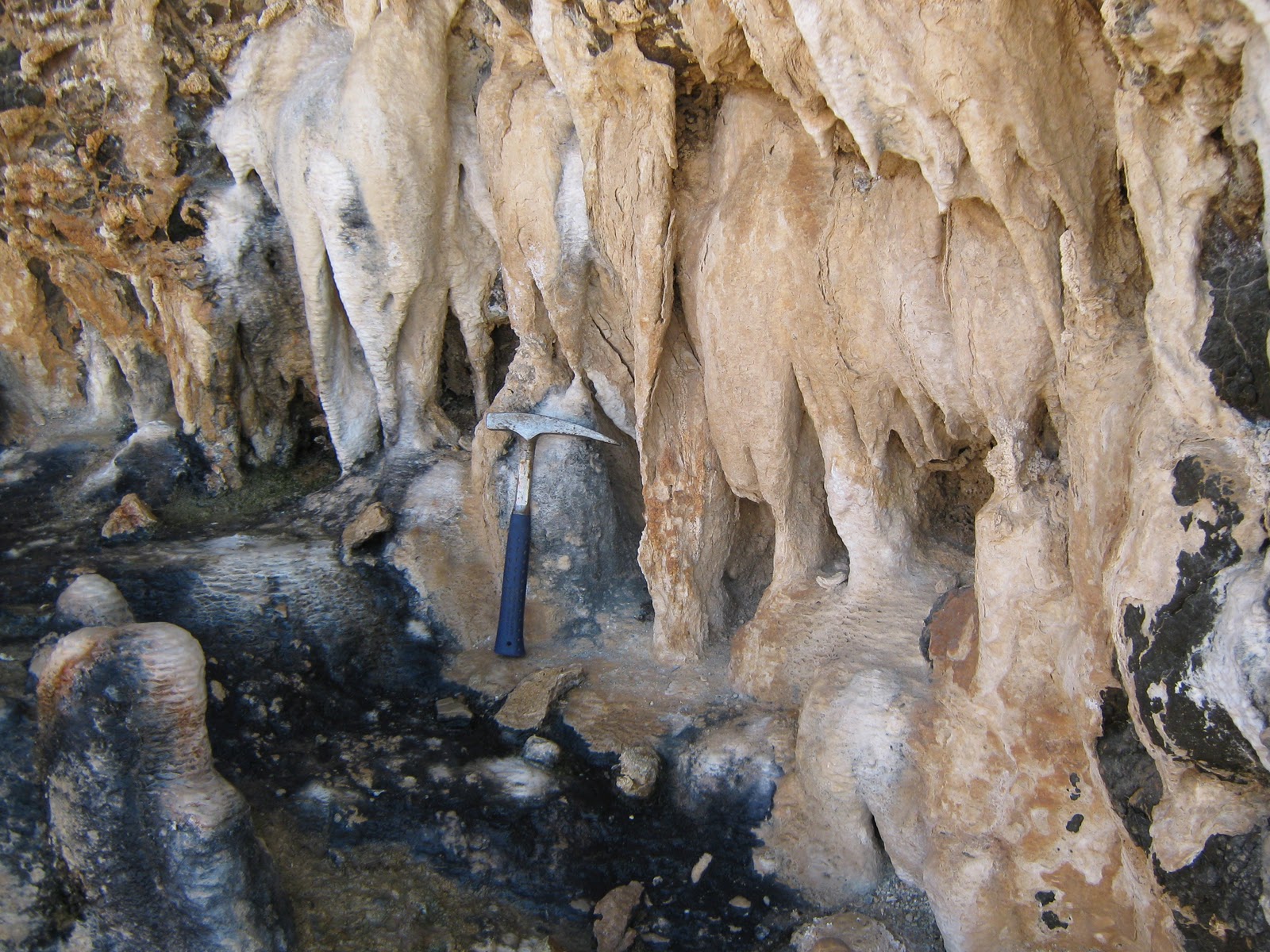
Travertine pseudospeleothems, Oman, January 2009.
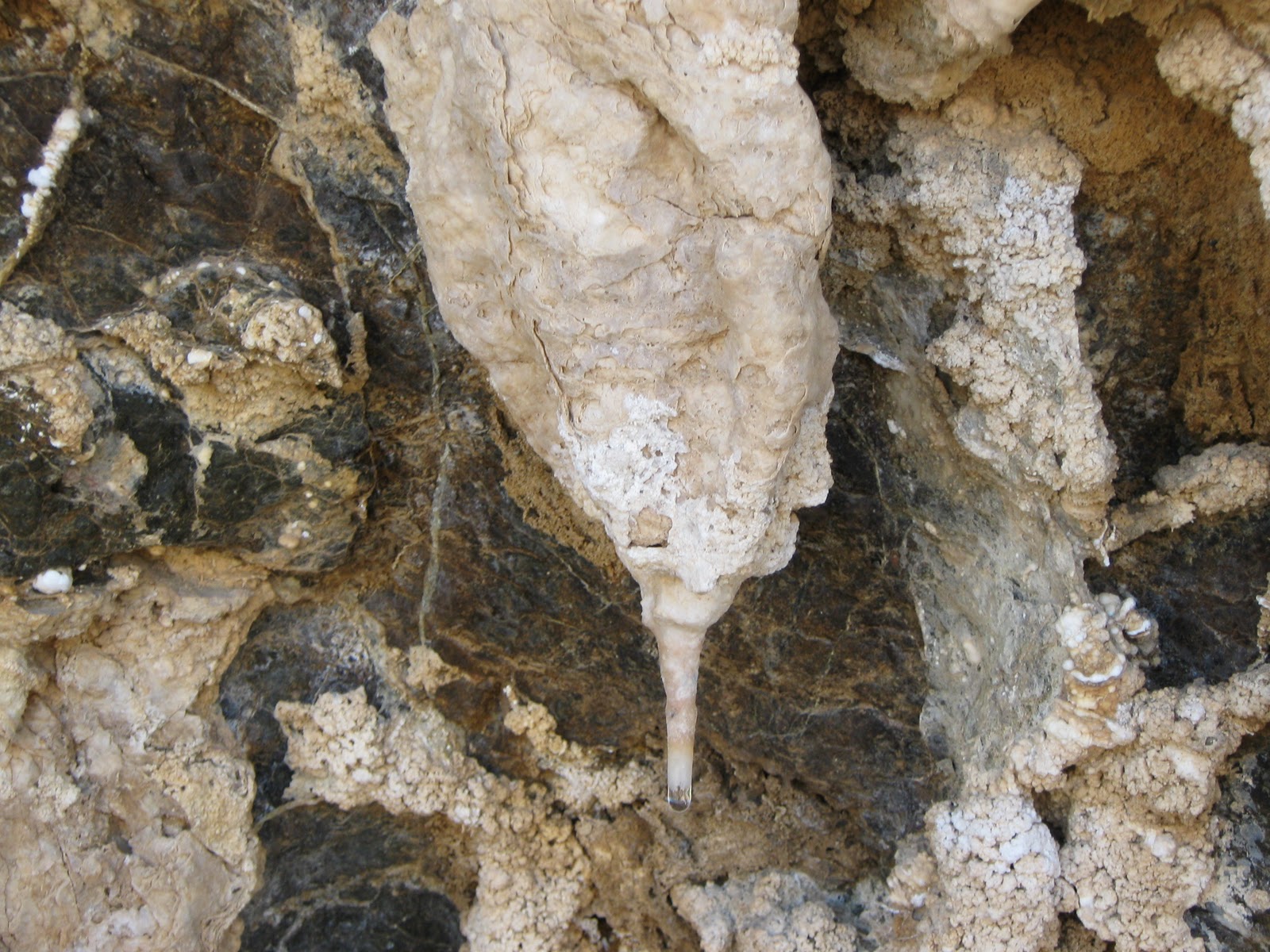
Water dripping from a pseduospeleothem straw, Oman, January 2009.
Panorama of Wadi Sudari Travertine I, Oman, January 2010.
Panorama of Wadi Sudari Travertine II, Oman, January 2010.
Lisa standing next to an enormous column of travertine, Oman, January 2009.

Geology Word of the Week: R is for Rock

“In spite of the difficulty in defining rocks, most rocks are easily recognized when you see them, and most are made of minerals or mineral-like substances. They are usually solid, hard, and heavy, compared to the other materials you see and use daily.”
-From Rocks and How They Were Formed by, Herbert Zim, Golden Library of Science, 1961.
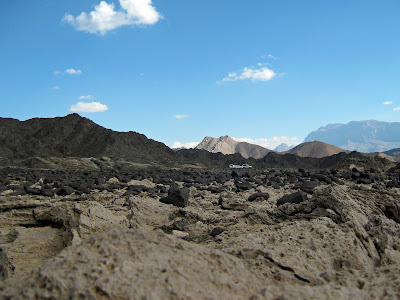
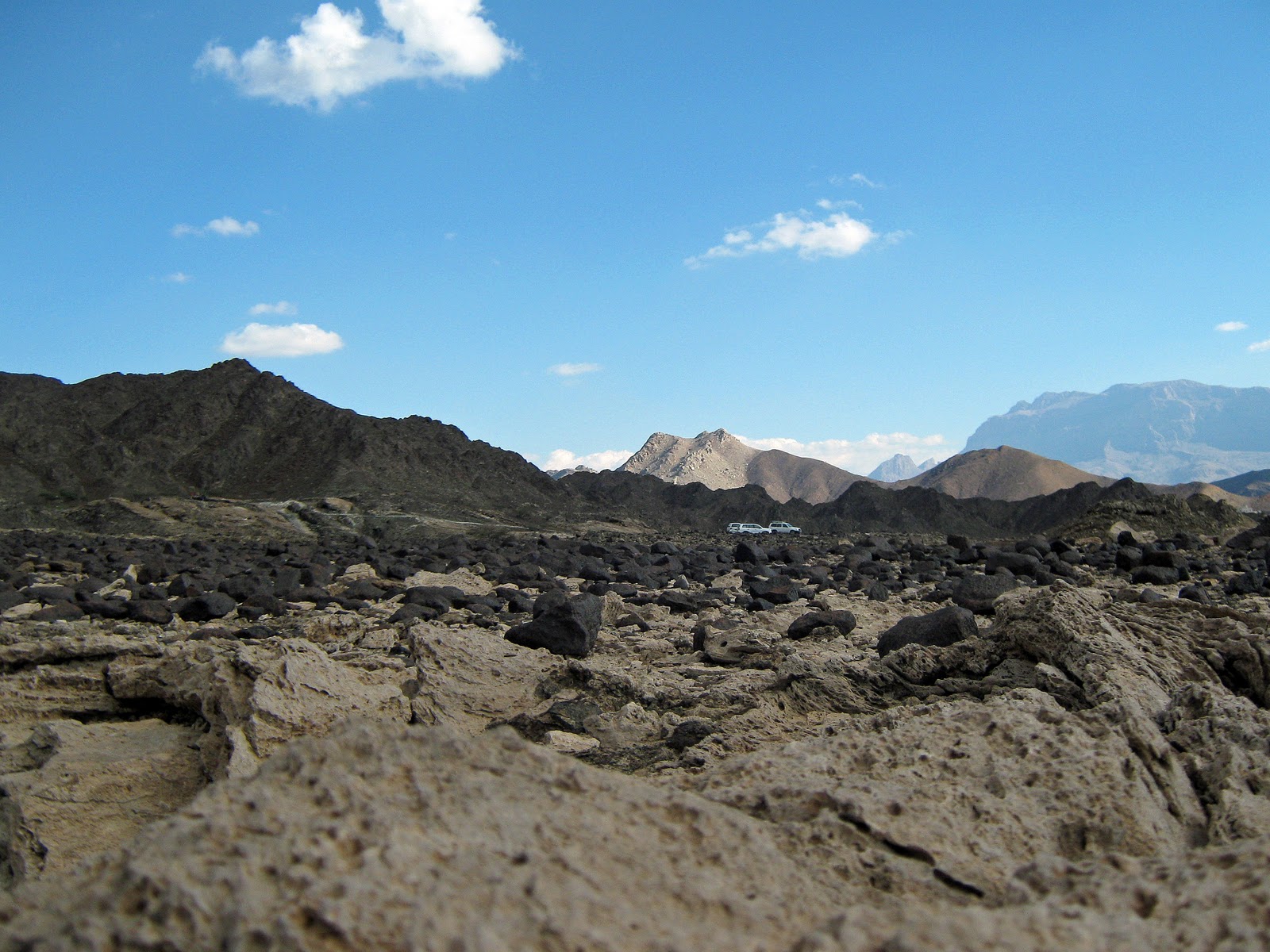
Carbonate rocks, peridotite rocks, mountains, and field vehicles, Oman, January 2010.

def. Rock:
1. A solid mass of matter– usually composed of one or more minerals or mineraloids– that occurs naturally on the Earth or another planet or extraterrestrial body.
2. What geologists study.

Sometimes, the simplest words are the most difficult to define. This is particularly true when it comes to basic words that have broad definitions. The basic stuff of our universe is innately understood by us but often difficult for us to describe. Words such as water, fire, air, plant, animal, person, rock– and many others– have encompassing, basic meanings that are understood by everyone. These words also have precise– yet still broad– scientific definitions. Yet, if you ask a person to define a simple word such as air or water, this person is likely to struggle somewhat. How do you define a basic, essential word whose meaning you understand instinctively more than intellectually?

When we define complex words, we usually describe them with more simple words.  For example, “petrology” is “the study of all aspects of rocks” according to my trusty Dictionary of Geology (Keary, 1996).  Other complex words can be defined with one-word synonyms. For example, the word “innate” (used earlier in this post) can be defined by synonyms such as instinctive, intrinsic, inherited, native, natural, and intuitive. However, simple words such as water and air and rock cannot be easily defined by one-word synonyms.

Yesterday evening I asked my geologist fiance Jackie for a geology word starting with the letter R. As some of you may have noticed, I am going through the alphabet for my geology words of the week. So far, I have made it from A is for Alluvium to Q is for Quaternary. My conversation with my fiance went something like this:

********
Me: “I need a geology word that starts with R.”

Jackie: “Huh? Oh- I don’t know. I’m sleepy.”

My fiance and I are temporarily living on different continents, so there’s a six or seven hour time difference. I usually call him late at night and wake him up for work, so he’s often sleepy when I call him.

Me: “I was thinking of regolith, but that’s sort of boring. And I already used the word alluvium, which is similar. I also thought about radioactive decay, but that’s too complicated. I think I want to write about that in some posts about how to date rocks.”

Jackie: “Huh. Well, what about rock?

Me, laughing: “Well, it is an important word for geology! How do you define a rock anyway?”

Jackie: “A silicate network… wait… uh… yeah, a silicate material…”

Me, interrupting: “But what about carbonates?”

Jackie: “Carbonates aren’t rocks.”

Me: “Not even limestone?”

Jackie: “Well, I guess limestone is a rock. Those carbonate alteration products you study aren’t rocks, though. They’re just gardening.”

Earlier in the phone call, Jackie and I had a conversation about how certain high-temperature metamorphic petrologists we’ve met refer to low-temperature surface metamorphism (the stuff I work on) as “gardening.” Not sure why exactly, but it’s become our new term for my thesis research.

Me: “I work on real rocks. And even if my carbonates aren’t real rocks, I also work on peridotites.”

Jackie: “Yeah, okay. Well, I guess a rock is a solid material… that… uh…”

Me: “Do anthropogenic materials count as rocks? Like man-made conglomerate?”

Man-made conglomerate is what we call cement that has little rocks in it.

Jackie: “No, I think rocks have to be naturally-occurring. Like minerals.”

Me: “Okay, so we have to say a naturally-occurring solid material… hmm. I’ll look up rock in my geology dictionary.”

While Jackie muttered some more about how he was sleepy, I consulted my trusty geology dictionary. I was surprised to discover that the word rock is not in my geology dictionary! There are words that contain rock– such as rockburst and rocksalt– but the word rock isn’t in the dictionary.

Me: “The word rock isn’t in my geology dictionary!”

Jackie: “I guess that’s not a very good geology dictionary. Now you definitely have to blog about this word.”
********

And so this week’s geology word was chosen. I did eventually find various definitions of the word rock in other geology books. From these definitions, I came up with the simple, broad definition above. Geologists, how do you define the word rock?

Below are a few definitions of the word rock from various geology books:

“Look for rocks. They are the materials of which the crust of the earth is made. They form the mountains and underlie the valleys. You see them when they have have been pushed or folded upward or when they jut through soil to form an outcrop. All minerals occur within rocks, and often are components of rocks.”
-From Rocks and Minerals: A Guide to Minerals, Gems, and Rocks (A Golden Nature Guide), 1957.

“Rocks are large masses of material making up the Earth’s crust; many are not solid, like soil and gravel. A rock may consist of just one mineral, like quartz, dolomite, or calcite. Some rocks do not have discreet minerals but are made of glasses. However, most rocks contain several minerals, or were formed from older rocks where these minerals were present.”
-From Collins Wild Guide: Rocks & Minerals, 2000.

“The difference between a rock and a mineral should be clearly understood. Rocks are the essential building materials of which the earth is constructed, whereas minerals are the individual substances that go to make up the rocks. Most rocks, therefore, are aggregates of two or more minerals. Thus, granite (a rock) is composed of at least two minerals (quartz and feldspar), though others are almost certain to be present.

If a single mineral exists on a large scale, it may also be considered a rock, because it may then be regarded as an integral part of the structure of the earth. Thus, a pure sandstone or quartzite rock contains only one mineral, quartz, distributed over a wide area. Other single minerals which are described in this book and are regarded also as rocks by this definition include anhydrite, dolomite, gypsum, magnesite, serpentine, and sulfur– all of which occur in huge beds or masses. Some rocks of this type have a different name from that of the mineral composing them. Thus, the mineral halite makes rock salt; calcite or dolomite can make up the rock called marble. Kaolinite composes many of the rocks we know as clay. Bauxite has been proven to be really a rocky mixture of several minerals, but many geologists still prefer to call it a mineral because of its uniformity.

In addition to these two classifications, rocks include natural glass, though it may be devoid of any actual mineral components. Obsidian, an abundant rock in Mexico and Iceland, is natural volcanic glass. Organic products of the earth, which cannot be called minerals because they are formed from plants and animals, are properly known as rocks. Coal, derived from partly decomposed vegetation, is a rock of this kind.”
-From How to Know the Minerals and Rocks by Richard Pearl, 1955.

“Minerals are the fundamental units of which rocks are composed, homogeneous solids of definite chemical composition, formed by natural inorganic processes. Such a definition includes ice as a mineral but excludes coal, natural gas, and oil… The term ‘mineral’ often has a more extended usage, and may be used to describe anything of economic value which can be extracted from the earth, even clay or coal. A rock, on the other hand, has no fixed chemical composition, is not homogeneous, and has no definite shape of its own. In most cases it will consist of mixtures of several minerals. Granite, for example, is composed of the minerals feldspar, quartz, and mica, but some rocks may be formed mainly from one mineral.”
-From Rocks and Man by Myra Shackley, 1977.

“Rocks make up most of the Earth on which we live. The mountains are built of rocks. The plains and oceans rest on deep layers of rocks. Even in outer space, there are rocks circling the sun like tiny planets.”
-From Rocks and What They Tell Us by, Lester del Ray, 1961.

“What are rocks?

Simply put, rocks are naturally occurring aggregates (collections) of minerals. What makes rocks so different is their diversity– they can range from masses of minerals formed by volcanic action, from eroded sediment,or from great pressures and high temperatures. Rocks are usually composed of more than one mineral, although in rare cases they can be entirely composed of a single mineral, in which case they are called monomineralic rocks.”
-From The Handy Geology Answer Book by, Patricia Barnes-Svarney and Thomas Svarney, 2004.

Finally, below is my favorite definition of rock that I have found in my geology books. Sorry for such a long quotation, but I just love the completeness of this definition of a rock.

“To the geologist, rock is the natural, solid material that makes up the earth. The first word ‘natural’ immediately eliminates man-made materials like cement, glass, brick, and steel, even though these all come from the crust of the earth.

The second word, ‘solid,’ rules out the air and other gases, the oceans, rivers, lakes, and other liquids. However, solids can be changed to liquids and gases by being heated; liquids and gases can be changed into solids by being cooled. The definition of a rock means solids at temperatures which normally occur in the earth’s crust.

Even this does not cover everything, because one of the most common chemical compounds on the surface of the earth may or may not be a rock, depending on its temperature. This chemical compound is water- H2O. Water makes up nearly three fourths of the earth. Most of it is in the form of a liquid, and while liquid water affects the rocks of the earth in many ways, water is not a rock. However, in the arctic and antarctic regions, and in the temperate regions during winter, millions upon millions of tons of water are a hard, frozen solid. In the antarctic, ice occurs in layers nearly two miles thick. Ice is, therefore, a rock, and geologists study the great ice fields just as they study other rock formations.

In speaking of rocks, geologists use the word ‘solid’ in its technical sense. A solid is matter that is not a liquid or gas. What the geologists would call ‘solid rock’ might seem strange to you. The wet sands on the beach and the sifting sands in the desert are a solid– and a rock. This is also true of the layers of mud and muck in the swamps, or the ash and cinders from volcanoes. They are rock also.

The third word, ‘material,’ brings no additional problems to the definition of a rock. But it may be well to point out that materials in the crust of the earth have two distinct origins. Most of the material in the crust of the earth is inorganic. This means that it is no way related to life or living things. Lava pouring from a volcano makes an excellent example of an inorganic material. So do the great masses of granite pushed miles into the air as part of the Rocky Mountains.

While most rocks are made of materials which are not or never have been alive, some rocks are organic– made by living things. Coal and oil deposits, for example, are the remains of ancient plants. Oil, you might say, is a liquid and therefore is not a rock. However, there are no great underground lakes of oil as some people imagine. The oil is usually soaked up in the pores of sand and other rocks. Under special conditions it will drain into wells where it is pumped to the surface. Millions of gallons of oil are locked up in rocks, especially in the oil shales of Alberta, Canada, and other places. Asphalt is another organic rock. Great deposits of it are found on the island of Trinidad.

Less well-known are the rocks which are formed from the remains of sea animals. Shells cemented together form several kinds of limestone. Sometimes these are shells of microscopic animals; sometimes they are larger shells.

Coral is another kind of rock made from living things. Coral animals take lime from sea water and build it into reefs in which millions upon millions of animals live. Islands of coral dot the South Pacific. A few microscopic plants and sponges have silica skeletons. Under certain conditions these, too, form organic rocks.

One final explanation, and the definition of rocks is about as complete as it can be. The definition implies that rocks are large masses of natural, solid material, big enough to form a distinct part of the earth’s crust.

Diamonds are not rocks, even though they are found in the crust of the earth. But if a whole mountain of diamonds was discovered, then it would be correct to call diamonds a rock. There are places where one can see mountains of marble, quartz, granite or limestone. You can find large beds of coal, shale or lava. These are rocks. There are many miles of rich soil, more miles of sand in the deserts and on the shores. They all make up major parts of the earth’s crust, so they are called rocks.

You may have noticed that the definition of a rock does not say anything about minerals. This is odd, for we commonly think of rocks and minerals as going hand in hand. Most often they do. However, all minerals are inorganic. They are all chemical compounds and therefore have definite chemical composition. Mixtures of minerals often do form enough of earth’s crust to be considered rocks. Granite, made mainly of three minerals– mica, feldspar, and quartz– is undoubtedly a rock.

There are also times when a single mineral may form a rock. Quartz is a common mineral. Some forms of sandstone are made up of 99 per cent pure quartz. In this and other cases the rock and mineral are made of the same chemical. This may also happen in the case of the mineral, calcite, which forms a kind of pure marble. Here again the rock and mineral are the same. Gypsum is another rock made of a single mineral. The mineral kaolin makes fine clay and forms still another kind of rock.

However, rocks may be made of materials which are not minerals at all. Volcanic glass or obsidian is not a mineral but frequently forms rocks. Coal, peat, and asphalt are not minerals but they are rocks.

In spite of the difficulty in defining rocks, most rocks are easily recognized when you see them, and most are made of minerals or mineral-like substances. They are usually solid, hard, and heavy, compared to the other materials you see and use daily.”
-From Rocks and How They Were Formed by, Herbert Zim, Golden Library of Science, 1961.

Geology Word of the Week: Q is for Quaternary

Quaternary Girl. Base image taken from here.

def. Quaternary:
The most recent Period of geologic time. We have been in the Quaternary Period for the past ~2.6 million years. The Quaternary Period is located within the Cenozoic Era and is further sub-divided into the Pleistocene and Holocene Epochs.

For this week’s Geology Word of the Week I decided to write a song. I am not singing it for you because I cannot sing. Although I sometimes “sing” in the shower or in my car (when alone), I do not have a single grain of musical ability. Seriously. When I first participated in Chapel services at my high school, the minister and choir director actually suggested I mouth the words rather than sing. I had an even more humiliating musical experience earlier in life. After a few months of failed attempts to teach me to play simple tunes such as “Mary Had a Little Lamb” and “Twinkle Twinkle Little Star,” my second grade music teacher suggested to my parents that I not pursue playing the recorder any further.

Come to think of it, perhaps my musical lack-of-ability means that I am not a very good songwriter. Oh, well. The song is already written, so I may as well share it with you here. If anyone with musical talent and a nice singing voice would like to record this song, I would love to hear it sung properly.

Quaternary Girl
Lyrics by, Evelyn the Geologist
To the tune of Madonna’s “Material Girl”

Cambrian Devonian
They’re too old for me
Triassic and Jurassic
The dinosaurs not me

Permian Silurian
The timing’s just not right
That’s right
For the past two million years
These Periods aren’t right, ’cause we are

(Chorus)
Living in a Quaternary world
And I am a Quaternary girl
You know that we are living in a Quaternary world
And I am a Quaternary girl

Carboniferous and Cretaceous
Tertiary makes three
Ordovician’s the last one left
Unless you count Miss and Penn

Eons, Eras, and Epochs
And sometimes a short Age
But when it comes to Periods
There’s only one today, ’cause we are

(chorus)

Living in a Quaternary world [Quaternary]
Living in a Quaternary world
(repeat)

Ages come and Ages go
That’s just geology 
Anthropocene is coming next
Unless that’s now maybe, but everybody’s

(chorus)

A Quaternary, a Quaternary, a Quaternary, a Quaternary world

Living in a Quaternary world [Quaternary]
Living in a Quaternary world
(repeat and fade)

Here’s the lyrics of the original song:

Material Girl
Madonna

Some boys kiss me, some boys hug me
I think they’re O.K.
If they don’t give me proper credit
I just walk away

They can beg and they can plead
But they can’t see the light
That’s right
‘Cause the boy with cold hard cash
Is always Mister Right, ’cause we are

(Chorus)
Living in a material world
And I am a material girl
You know that we are living in a material world
And I am a material girl

Some boys romance, some boys slow dance
That’s all right with me
If they can’t raise my interest then I
Have to let them be

Some boys try and some boys lie but
I don’t let them play
Only boys who save their pennies
Make my rainy day, ’cause they are

(chorus)

Living in a material world [material]
Living in a material world
(repeat)

Boys may come and boys may go
And that’s all right you see
Experience has made me rich
And now they’re after me, ’cause everybody’s

(chorus)

A material, a material, a material, a material world

Living in a material world [material]
Living in a material world
(repeat and fade)

Geology Word of the Week: P is for Peridot

Peridot gemstone. Image taken from here.

def. Peridot:
Peridot is a gem-quality olivine [(Mg,Fe)2SiO4], a beautiful green mineral found in mafic to ultramafic rocks.

My engagement stone is a peridot– my fiance was pleasantly surprised that my favorite gemstone is among the cheaper gemstones. Though far less durable than diamond, peridot has a beautiful green color which I love.

Most gemstones have alter ego mineral names. Below are some examples:

Peridot- Olivine: (Mg,Fe)2SiO4
Ruby- Corundum (Red): Al2O3
Sapphire- Corundum (All other colors except red): Al2O3
Moonstone- usually Potassium Feldspar: KAl2Si3O8
Tanzanite- Zoisite (Blue): Ca2Al3(SiO4)(Si2O7)O(OH)
Amethyst- Quartz (Violet): SiO2
Aquamarine- Beryl (Blue/Turquoise): Be3Al2(SiO3)6
Emerald- Beryl (Green): Be3Al2(SiO3)6

These are just a few of the many examples of gems with both gem names and mineral names. Note how some minerals have multiple gem names depending on their color. Makes learning geo lingo a little more difficult, doesn’t it?

To be fair, some of the gem names undoubtedly originated before the mineral types were discovered/invented. Also, while color is usually a poor way to identify a mineral, color is very important for gemstones. Thus, it makes sense that some minerals such as corundum and beryl (which come in many colors) have multiple gem names. Interestingly, diamonds are always diamonds– no matter the color.

Geology Word of the Week: O is for Ophiolite

Shadows over Oman mantle peridotite, January 2009.

def. Ophiolite:
An ophiolite is a segment of ocean crust and mantle tectonically exposed on land by obduction (overthrust), usually when an ocean basin closes. An ophiolite sequence consists of variably altered oceanic rocks, including marine sediments, ocean crust, and part of the mantle. The name ophiolite means “snakestone” from “ophio” (snake) and “lithos” (stone) in Greek. The rock sequence is named for the brilliant green, snake-like serpentine minerals which form in altered ocean crust and mantle. Ophiolites are rare but nonetheless found throughout the world. Notable ophiolites are found in Cyprus, the northwestern US, the Alps, Papua New Guinea, and Oman.

I am a marine geologist, but I often cheat and work on land. For one of my PhD general exam projects, I worked on rocks from Iceland, which is a part of the Mid-Atlantic Ridge that has built up above sea level because of a hotspot. For my thesis research, I am working in the Samail Ophiolite, which is located in Oman and the United Arab Emirates and is one of the largest, best-preserved, and best-exposed ophiolites in the world. For both projects, I am studying marine rocks which have been exposed on land because of unusual circumstances. Although such rocks are anomalous and thus are not perfect analogies for your average seafloor rocks, there are great advantages to being able to actually see, touch, and– if needed for identification– taste marine rocks in the context of an outcrop.

Traditional marine geology is expensive and difficult. Since the ocean floor is generally covered by several kilometers of water, marine geologists cannot study the ocean floor using traditional geological methods. That is, marine geologists cannot walk around with their maps, hammers, and Brunton compasses and observe the geology first-hand. Instead, marine geologists must go out on ships and use remote methods to make observations and sample the ocean floor. Going out on ships is very expensive, costing tens of thousands of dollars per day. For example, one of the best ways to observe the ocean floor is to go down in a manned deep-sea submersible such as Alvin. However, operating costs for Alvin, including the ship costs, are about $40,000 per day. This is incredibly expensive, and even Alvin doesn’t allow you to walk on the rocks with your Brunton. As a comparison, a month of field work in Oman costs about $10,000 for myself and an assistant– about $3,000 for two round-trip plane tickets, about $4,000 for a rental 4 x 4, $500 for gas, $500 for food and water, maybe $500 for a few nights in a hotel (we camp the rest of the time), and $1,500 for supplies and shipping rocks. So, for 1/4 of the cost of operating Alvin for a single day, I can carry out a month of fieldwork on marine rocks exposed in the Samail Ophiolite. Oman is an expensive country, so many of these costs (such as the rental vehicle) are reduced when working on other ophiolites.

There are various remote methods of observing the geology of the ocean floor. The topography of the ocean floor can be mapped from a ship using multibeam bathymetry (bouncing sound waves off the bottom of the ocean to calculate topography) or by satellite altimetry (using the height of ocean waves to look for gravity anomalies and infer the topography below). Additional remote (shipboard or satellite) instruments allow marine geologists to measure properties, such as magnetism and gravitational pull (which can provide information on topography and density), of marine rocks. Seismic waves– passive source (generated naturally by the Earth, such as during an earthquake) and active source (generated by man, often by an explosion)– can be monitored to learn about the structure of the marine rocks. For example, the speed of seismic waves through various parts of the crust and mantle can be used to infer density. Seismic waves travel faster through more dense layers (such as hard rock like basalt or gabbro) and travel more slowly through less dense layers (such as soft marine sediment).

There are also various methods of sampling the ocean floor. One of the best ways to sample the ocean floor is to use a deep-sea submersible such as Alvin as this allows you to see exactly where the rocks you are sampling are coming from. However, since Alvin and other submersibles are so expensive, a very common method of sampling the seafloor is dredging— basically, throwing a metal basket over the side of the ship and dragging it along the seafloor. This simple technique can be very effective. As an example, when I participated in a two-month cruise along the Ninetyeast Ridge, we obtained about 3,000 kilograms of rocks by dredging. However, dredging provides only limited geological context for the samples and also tends to pick up loose surface rocks that may or may not be representative of the outcrop. For instance, these rocks may have rolled downhill from other locations. Another method of sampling is drilling cores from the ocean floor. Since the late 1960s, there has been a global effort to obtain cores from the ocean floor, in the form of first the Deep Sea Drilling Project, then the Ocean Drilling Program, and finally the Integrated Ocean Drilling Program. Cores are great because they sample the actual seafloor (not just loose rocks) and can also sample deep into the crust. However, as I discussed in my post on the lithosphere, no ocean drilling effort has managed to reach the crust-mantle boundary. Cores also have their limitations. They are only a few inches in diameter, and so they provide only narrow cylinder snapshots of the overall geology. Some cores are fairly deep, but others may only sample the upper few meters of the ocean floor. Drilling is also much more time-consuming and expensive than dredging.

Because studying the geology of the actual ocean floor is so challenging and expensive, many marine geologists also work in Iceland– the only place you can walk along an active Mid-Ocean Ridge– and at ophiolites, which are fragments of ocean crust and mantle that have been exposed on land because of unusual tectonic circumstances. Dense oceanic crust almost always subducts underneath lighter and more buoyant continental crust. This is the traditional plate tectonic situation that you learn about in introductory Earth Science classes. However, in certain circumstances ocean crust– at least small slivers– can be thrust up onto land. For example, this often happens when ocean basins close, particularly if the ocean crust is young and relatively hot and buoyant. Slivers of ocean crust may also be thrust onto land in a forearc environment. The forearc is the area located between a subduction zone and its associated volcanic arc. New continental crust is often accreted in forearc environments, and this accretion often includes small bits of ocean crust.

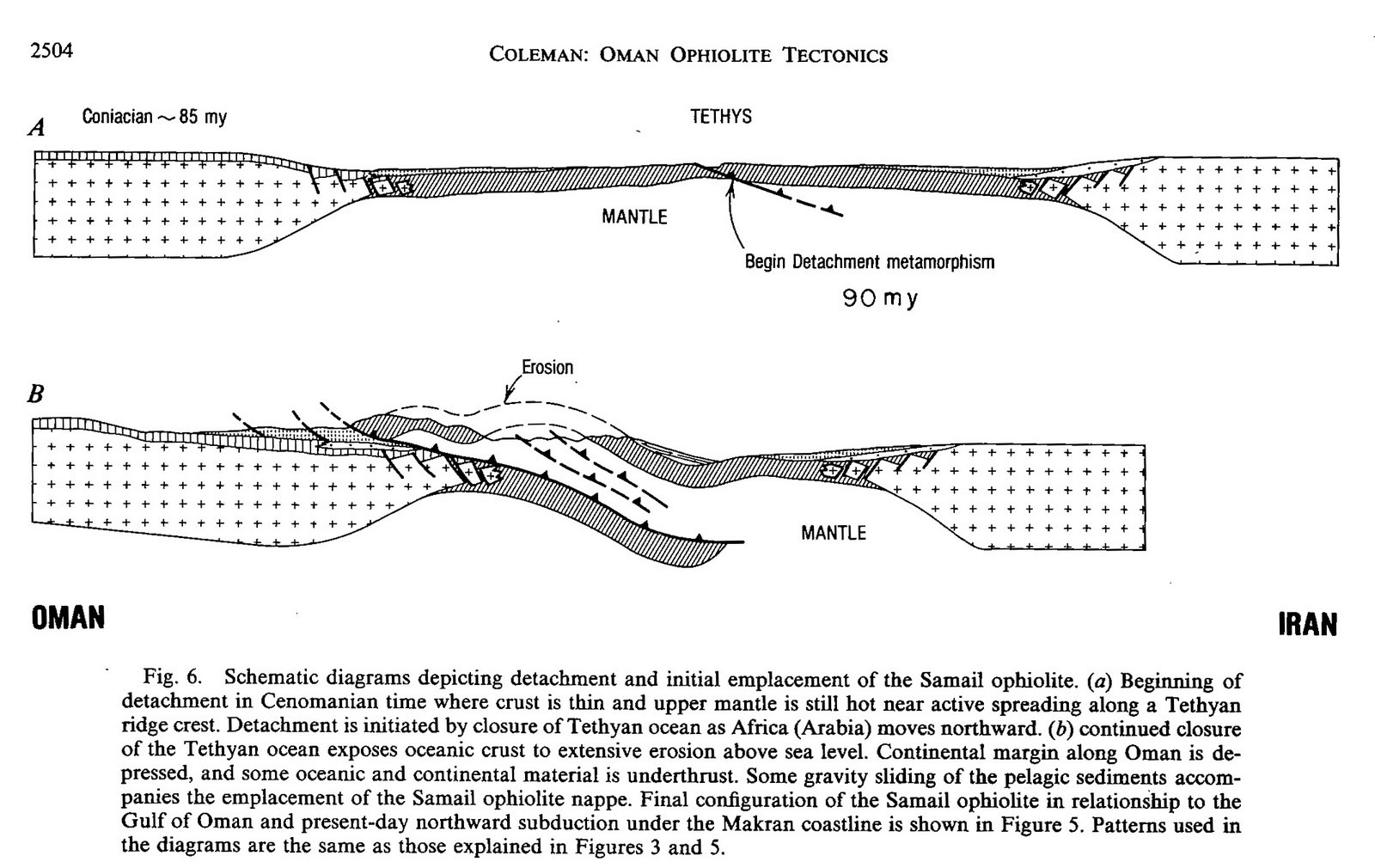
As an example, here is a simplified version of the obduction (overthrust) of the Samail Ophiolite in Oman:

Samail Ophiolite obduction. Continental crust indicated by crosses, oceanic crust
by darker shading. Figure taken from Coleman (1981). Click on the figure to view larger.

There is another important reason why marine geologists often study ophiolites: in addition to exposing ocean crust, ophiolites also often expose a section of the underlying mantle. Since scientists have never drilled deep enough into the Earth to observe the mantle, ophiolites are important because they are places where geologists can observe large sections of mantle rocks directly. Geologists can also study mantle rocks that have been uplifted to the seafloor through tectonic processes, but again all that water makes observation difficult.

Below is a map that shows global exposures of mantle (aka “ultramafic”) rocks. This map is a little dated as it was published in 1982. Since then, many more mantle exposures have been discovered, particularly on the ocean floor. However, the map gives you a good general idea of where on the Earth ophiolites (lines on continents) can be found and where mantle rocks (dots and boxes on oceans) have been brought to the surface of the ocean floor.

World map showing locations of ophiolites (lines on continents) and exposures of mantle
rocks on the ocean floor (dots and boxes on oceans). Figure taken from Hekinian (1982).
Click on the figure to view larger.

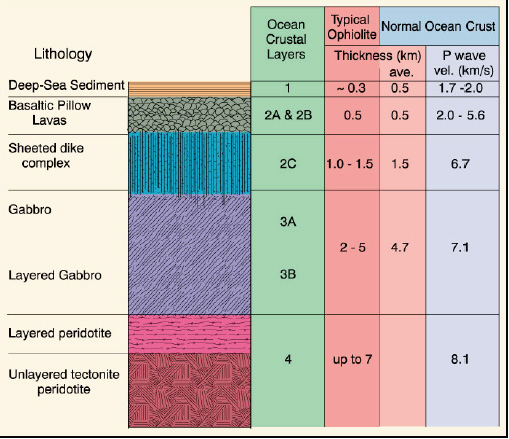
In the definition above, I mention an ophiolite sequence. The classic ophiolite sequence, such as that found in Oman, is marine sediment then volcanic basalt then plutonic gabbro (the same chemical composition as basalt, but crystallized deep rather than at the ocean floor surface) then mantle (mostly peridotite). These classic ophiolite layers have been given numbers which marine geologists use as short-hand. The numbers are:

1- Deep-sea sediment
2- Basalt
3- Gabbro
4- Peridotite

Some of these layers have been further distinguished into sub-layers based on density and textural features:

1- Deep-sea sediment- no subdivision.
2-Basalt- often further divided into A, B, and C. Layer 2A represents surface pillow lava basalt while 2C represents a zone with sheeted dikes, which cooled more slowly and are gabbroic in composition. 2B is a sort of transitional zone. Some geologists just break down Layer 2 into 2A (surface volcanics) and 2B (sheeted dikes).
3-Gabbro- often divided into 3A (regular gabbro) and 3B (layered gabbro).
4- Peridotite- not usually subdivided, though there is also regular and layered peridotite.

Ocean crust (and mantle) layers. Figure modified from Brown and Mussett (1993) and
taken from my Marine Geology & Geophysics I course notes. Click on the figure to view larger.

For many years, marine geologists based their understanding of the structure and composition of the ocean crust and mantle on the structure and composition of ophiolites. Now, marine geologists understand that the structure of the actual ocean crust and mantle often differs slightly from that of ophiolites. For instance, the ocean crust and mantle layers are often thicker in the actual ocean than in ophiolites (see above figure). Nonetheless, ophiolites provide excellent, easily-accessible analogues for the ocean crust and mantle.

Below are a few photographs from my own fieldwork in the peridotite layer of the Samail Ophiolite in Oman. For my thesis, I am studying the unique ways in which peridotite– which is a mantle rock and does not belong at Earth’s surface– alters when uplifted onto land. In particular, I am studying the formation of carbonate minerals. When peridotite alters, many carbonate minerals (e.g. calcite, dolomite, magnesite) are formed. The carbon dioxide (CO2) in these carbonates comes from the atmosphere. Thus, formation of carbonate minerals in peridotite is a natural process that removes CO2 from the atmosphere and stores this CO2 in solid mineral form. 

Samail Ophiolite 1, Oman, January 2009.
Samail Ophiolite 2, Oman, January 2009.
Samail Ophiolite 3, Oman, January 2009.
Samail Ophiolite 4, Oman, January 2009.
Samail Ophiolite 5, Oman, January 2009.
Samail Ophiolite 6, Oman, January 2009.
Friendly ophiolite residents, Oman, January 2009.
A vein of carbonate (white) and serpentine (green) alteration, Samail Ophiolite,
Oman, January 2009.
Sampling carbonate precipitating from a peridotite spring, Oman, January 2009.
Standing next to a carbonate-filled peridotite spring pool, Oman, January 2009.
Herding goats across peridotite, Oman, January 2009.
Goats and field vehicles, Oman, January 2009.

References: 

Brown and Mussett. 1993. The Inaccessible Earth: An Integrated View of its Structure and Composition. London: Chapman and Hall.

Coleman, R. G. 1981. Tectonic setting for Ophiolite Obduction in Oman. Journal of Geophysical Research, vol. 86, no. B4: 2497-2508.
Hekinian, R. 1982. Petrology of the Ocean Floor. New York: Elsevier Publishing Company.