Geology Word of the Week: B is for (Volcanic) Bomb

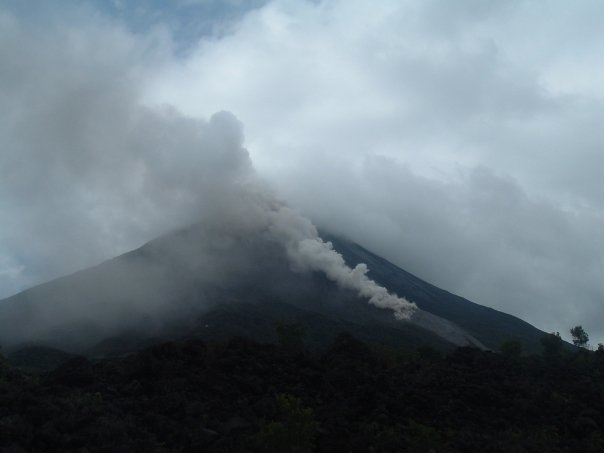
Fiesty Arenal Volcano, Costa Rica, June 2008.

This week’s geology word of the week is actually a phrase: volcanic bomb.

def. Volcanic Bomb:
A rock that forms when lava is thrown up into the air and cools very quickly. Volcanic bombs have characteristic shapes that they take on when they turn and twist in the air as they cool. They are often tear-drop shaped with a long tail. To be called a bomb, the tephra (another potential word of the week… this basically refers to material ejected by a volcano) must be greater than 64 mm in diameter. Tephra 2-64 mm in diameter is called volcanic lapilli while tephra smaller than 2mm is called volcanic ash.

Here are some links to some beautiful pictures of volcanic bombs:
Bomb #1

Bomb #2

Many more bombs!

I am posting links above because in this blog I want to make an effort not to steal photos off the internet. I want to give credit where credit is due. Unfortunately, I don’t have a good picture of a volcanic bomb in my personal collection of geology photographs. I think it’s time to visit some volcanoes…

I am, however, the proud owner of a volcanic bomb which I picked up from a volcano in California near Mono Lake. I acquired this rock during a geology field trip I went on as an undergraduate. After the field trip, I brought this rock to my parents’ house. My mom wouldn’t let me bring such a large rock inside the house, so I put it in my mother’s flower garden, where it still sits (next to some delightful pegmatite samples), certain to confuse future generations of geologists who will wonder where there are volcanoes in New Hampshire.

I was not the only one to pick up a volcanic bomb during this trip to California. We actually collected several, and we wrapped them in sleeping bags and put them in plastic coolers so that we could transport them back to New Hampshire safely. Just to make the coolers look as sketchy as possible for the TSA folks, we wrapped duct tape randomly around the coolers to keep them closed.

Here’s some advice (for a certain geology professor and everyone else): when transporting volcanic bombs via air travel DO NOT refer to the rocks as volcanic bombs. In fact, I’d go so far as to say that the words “volcanic” and “bomb” should never be uttered within an airport and certainly not in combination.

Here’s a (somewhat stylized through tricks of memory and artistic license) conversation that almost landed the entire geology field trip in a questioning room at the Las Vegas Airport:
**********
TSA official: What’s in the coolers?

Naive geology professor: Oh, those are our volcanic bombs!

TSA official: Your WHAT?

Naive geology professor: Volcanic bombs. They’re great examples, very large bombs… that’s why the coolers are so heavy.

TSA official: Sir, I need to see your passport please.

Quick-thinking geology student: What Prof. Naive meant to say is that these are scientific rock samples from X volcano in California. We’re going to take them back to our college so that we can use these specimens as classroom examples. Would you like me to show you the samples? They are really beautiful rocks.

TSA official: Beautiful rocks? You mean these coolers are full of rocks?

Naive geology professor: Yes! Beautiful examples of volcanic bom–

Quick-thinking geology student: Yes, rocks. We’re geologists. We’ve wrapped the rocks in sleeping bags so that they don’t break. If they break it would ruin some really great scientific samples for very important scientific research.

TSA official: You’re worried about the rocks breaking? So you wrapped them in sleeping bags?

Naive geology professor: And duct tape! So many uses for duct tape. I hope you don’t want to see the bombs because the duct tape is hard to–

Second quick-thinking geology student: I’d be happy to open the cooler, sir. Let me just get the tape off…

TSA official: Okay, I’d like your group to step aside. We’re going to have to hand search all your luggage.

First quick-thinking geology student (Muttered under breath to second quick-thinking geology student): Don’t let Prof. Naive say anything else… ask him a question about crystallization phases or something…
**********
Well, we did make it through security eventually and didn’t miss our flight. Again, let me repeat: do not use the phrase “volcanic bomb” in the airport. Fortunately, this incident happened several years ago before security became so crazy. I think today we would end up in the questioning room for sure.

That’s the word for this week… stay tuned for more geological tidbits! I’ll be back in a few days!

Ternary Personalities

Ternary personality diagram of Dartmouth 2005 field camp (“The Stretch”) members.

Ternary diagrams are frequently used by geologists to classify rocks. A ternary diagram is a triangle that has three end-member compositions A, B, and C at the points. Rocks identified using such a diagram are plotted in terms of their proportions of A, B, and C. Depending on where the rock falls on the diagram, it will have a certain name. Ternary diagrams are a little confusing, at first, if you’ve never seen one before. The best way to learn is through examples. After awhile, you’ll develop an eye for reading ternary diagrams and will be able to easily estimate where a particular rock should plot.

An excellent description of how to read a ternary diagram is located here:
http://csmres.jmu.edu/geollab/fichter/SedRx/readternary.html

Andrew Alden discusses ternary diagrams for sedimentary rocks here:
http://geology.about.com/b/2009/02/19/ternary-diagrams-for-sedimentary-rocks.htm

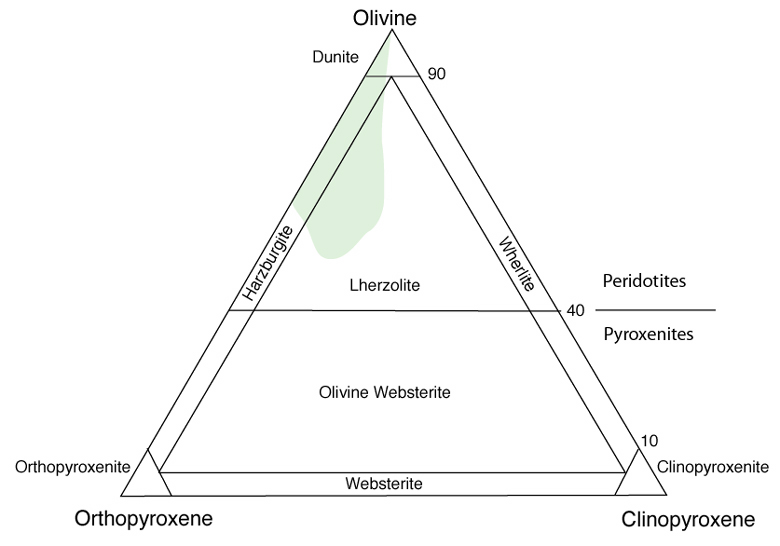
For my thesis research I am studying alteration of the Samail Ophiolite, a fragment of uplifted ocean crust and mantle located in Oman. I work primarily in the mantle section, so I mostly use this particular ternary diagram for classifying mantle (or ultramafic) rocks:

IUGS classification diagram for ultramafic (mantle) rocks. From Wikipedia Commons.

To use this diagram, I estimate the percentages of the minerals orthopyroxene, clinopyroxene, and olivine in my peridotite rocks and then figure out where my rocks plot on the diagram. Most of my samples are lherzolites or harzburgites, though I have the rare dunite. Since I work on altered peridotites, the hard part is actually estimating what percentage of minerals there used to be in my rocks when they originally formed. Most of the olivine is long gone and has been replaced by red clays. Note that the green field in the above diagram represents the range of values typically seen in mantle peridotite rocks. Wherlites are relatively rare. I remember this by thinking, “Where (or wher) is the wherlite?”

Of course, you not only have to develop an eye for how to read ternary diagrams, you also have to develop an eye for estimating percentages of minerals or grain types that are present in the outcrop or rock that you are trying to identify. Again, after awhile you become fairly good at this. I actually find that if I work on sample descriptions in lab for a long time, my eye becomes well-calibrated. I also start trying to estimate the percentage compositions of EVERYTHING. For instance, a few years ago I was on a research cruise and spent much of my time estimating the percentages of plagioclase and olivine in basalts during routine sample descriptions. After one really long day describing rocks I, finally, went back to my cabin. As I was brushing my teeth before bed, I found myself absently estimating the percentage of blue flecks in the white bathroom tiles.

However, if I haven’t had to estimate mineral percentages for awhile I find it’s best to use a cheat sheet. My go-to cheat sheet is found in the back of the trusty “Rite-in-the-Rain” All-Weather (well, perhaps not wintry mix) Geological Field Notebook. This field notebook has a great plastic scale and pages of useful information for the field geologist. Included are sedimentary ternary diagrams and- gasp- a quaternary diagram for classifying igneous rocks. There is also a size chart for identifying sedimentary grain sizes. Importantly, there are two pages (below) that can be used for estimating percentage composition of grains and/or minerals. Very useful!

Rite-in-the-Rain All-Weather Geological Field Notebook, turned to the percentage composition diagram, with its own plastic ruler for scale. The perfect gift for any geologist! Photo taken November 2010.

So, now that I’ve talked a little about the conventional way that geologists use ternary diagrams, let me discuss a less-common way that geologists use ternary diagrams: to classify personalities! Next time you in the field with a group of geologists (or anyone, I suppose, but if they’re not geologists they might think you’re weird/nerdy) or taking/teaching a geology class, you can make your very own ternary personality diagram!

Making such a diagram is fairly simple, but generally goes more smoothly if delegated to two or three enthusiastic and perceptive members of your group. I suppose that you should also make sure that your everyone in your group is okay with having their personality classified. The first picture in this blog post is a ternary personality diagram made by Dartmouth geology students during the Fall 2005 field program. You may notice that I am roughly 55% Iona, 40% Lisa/Jon, and 5% Hannes. Dartmouth students, especially geology students, are pretty chill, so no one in our group seemed to mind their personalities being classified.

Here’s how to make your very own ternary personality diagram:
1. Find a group of geologists who are related in some way. They could be on a field trip together, taking the same geology class, or perhaps students/professors in the same department. Generally, it’s best to make the diagram after the group members have spent some time together and have become familiar with each other’s personalities. Field camp is the perfect environment for this!
2. Figure out the three members of the group with the most extreme/different personalities. Draw a ternary diagram triangle with these three people as end-members.
3. Plot everyone else on the diagram, based on what percentage of each end-member personality each person has.
4. Drink beers/soda and eat pizza and laugh about how similar/different in personality you are to the other members of your group.

I hope you have enjoyed my geological musings so far! Late Wednesday night I leave for a geology-themed wedding in Costa Rica. Two dear friends of mine are going to be married near Arenal volcano, so I’ll be out of town for a few days. However, I promise to post volcano pictures upon my return!

Geology in the Wintry Mix

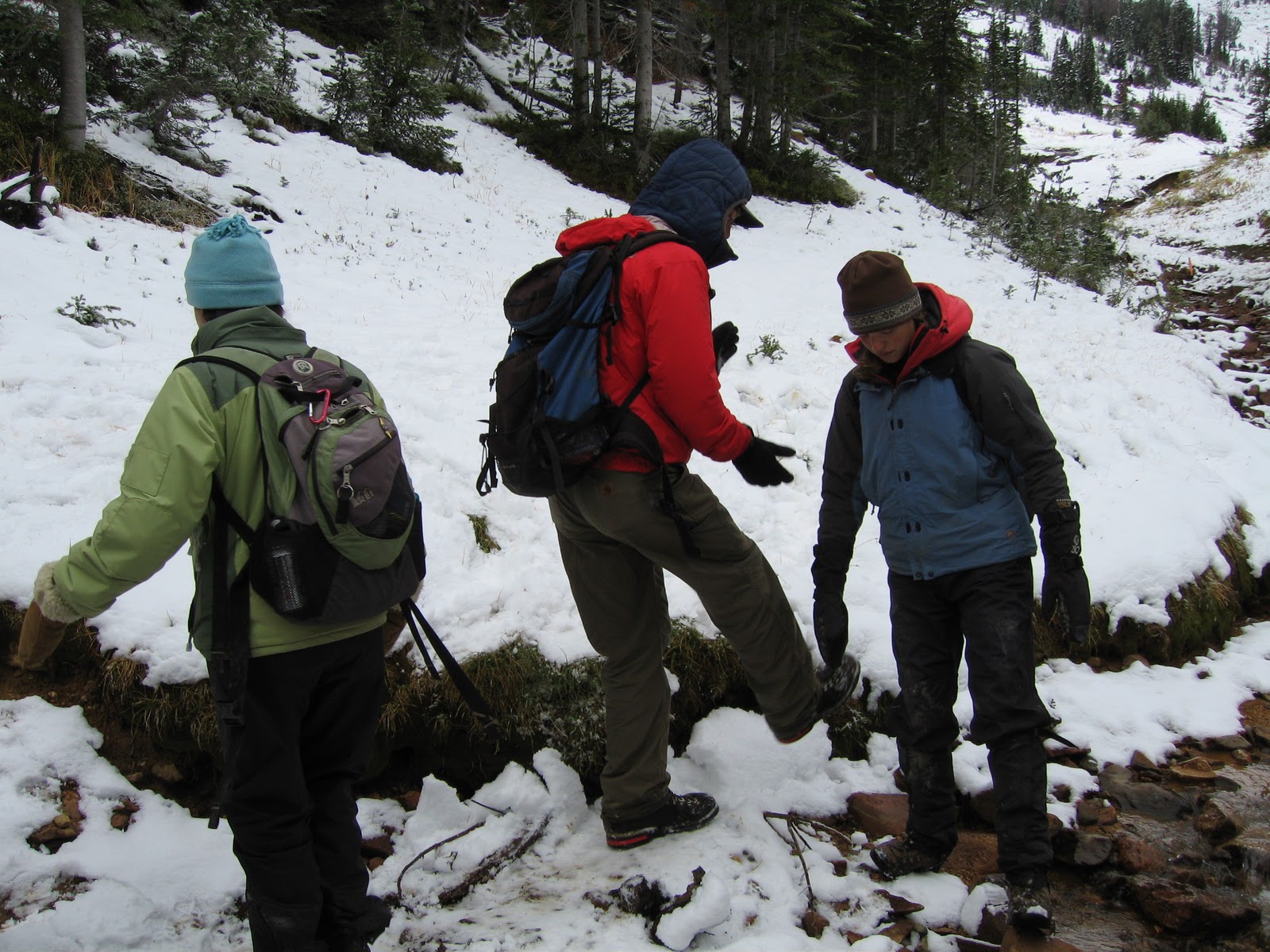
Where is that contact again?, Montana, Fall 2005.

Many people in New England had their first taste of winter today with a wet, slushy snowfall. Here on Cape Cod we haven’t had any snow yet, but we’ve had nasty, cold rain all day. Today’s cold rain is my least-favorite sort of weather for geology fieldwork. I don’t mind snow- except when it accumulates so much that you cannot see the rocks. My second least-favorite weather for geology fieldwork is a hot summer day in the Middle East. But at least the heat is a dry heat and you can guzzle liters of gatorade. I definitely prefer the dry desert heat of Jordan (which is more moderate than Saudi or Oman, but still intense) in August to the just-above-freezing weather that produces cold rain and sometimes slush. Weather forecasters call this sort of precipitation “wintry mix.”

Wintry mix sounds festive, but New Englanders groan at such a forecast. I’ll take real snow over wintry mix any day. Wintry mix just means that the slushy rain is going to freeze into ice once the temperature drops at night. Wintry mix just means that in addition to being cold you are going to be soaking wet. Wintry mix just means that you can’t wear your snug, down-stuffed winter gear, which flattens and thus becomes less-warm in the rain. Instead, you have layer sweaters and fleeces under your rain jacket and wear two pairs of wool socks in your rain boots or hiking boots. Wintry mix means that your “Rite-in-the-Rain” field notebook is going to malfunction… this is the only sort of weather in which I’ve found it difficult to write in those robust, amazing field notebooks. Personally, I advocate changing the name of wintry mix to “wintry sh*t.”

I prefer fieldwork in snowy weather over wintry mix weather because even though the temperature is lower, you feel warmer because you’re not wet. Of course, geology fieldwork in the snow is somewhat problematic, even if you can keep yourself warm. Geologists dislike anything (vegetation, houses, water, alluvium, etc.) covering up the rocks they are trying to examine. Snowfall therefore presents a problem.

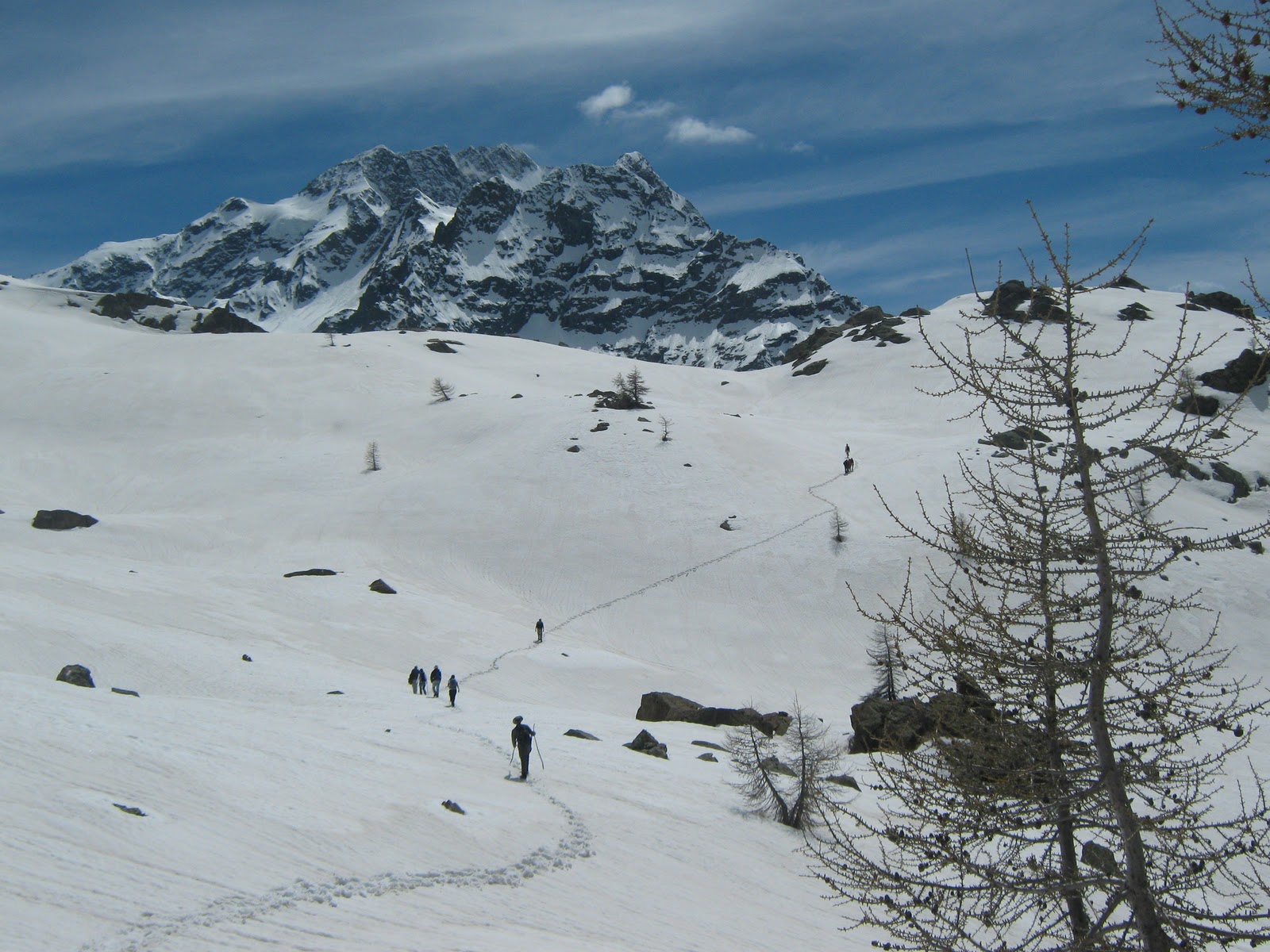
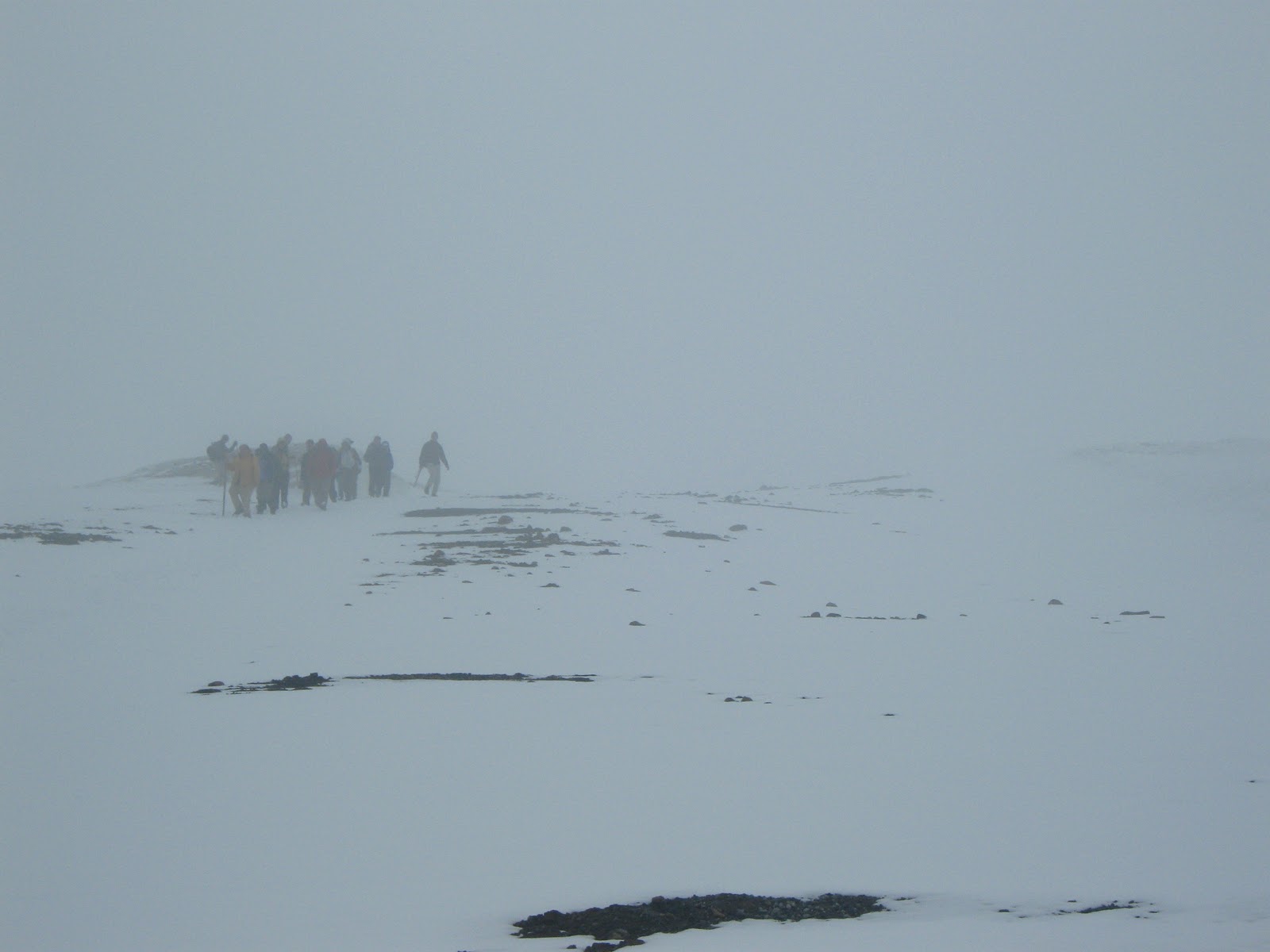
Although less-than-ideal, I have done some geology fieldwork in the snow. During my undergraduate field program, we did some mapping in Montana in early September. We had to shovel the snow off the outcrops in order to identify them. The teaching assistants took pity on us and helped us find key contacts, at least.  Most recently, I was on a geology trip in Switzerland & Italy and had to hike through significant snowfall… in early June! We didn’t expect or even particularly dress for heavy snow, but we didn’t let that stop the field trip. Geologists are tough… though a few of us did purchase some expensive (Switzerland is expensive!) hats and gloves.

A long climb, The Alps, Italy, June 2010.

White-out!, The Alps, Switzerland, June 2010.

There is one good thing about doing geology in the snow, though… at least you know when bears (and other snowprint-leaving animals) are around!

Rite-in-the-Rain field notebook (for scale) and bear track, Montana, Fall 2005.

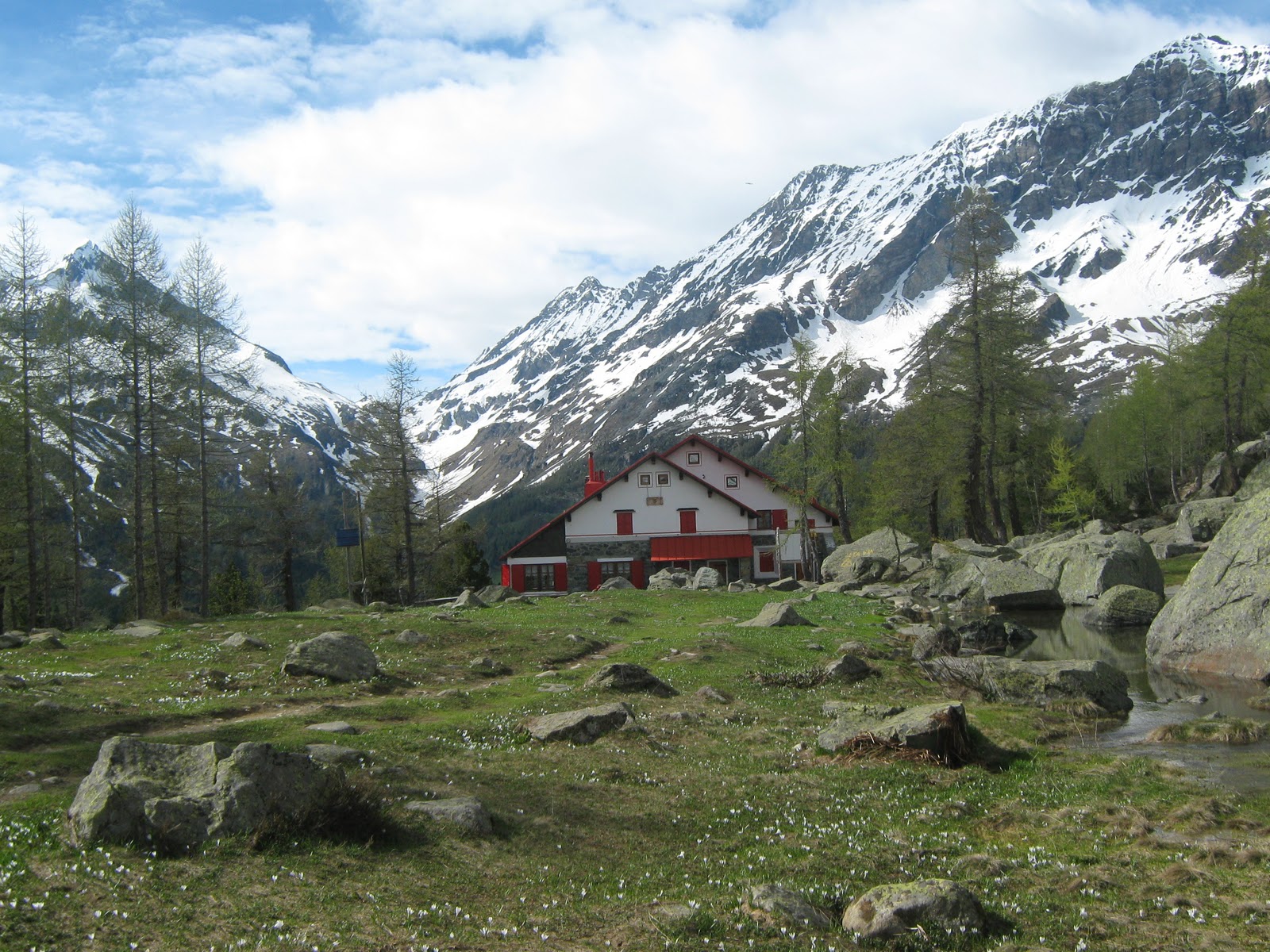
Another good thing about doing geology in the snow/wintry mix is that it feels wonderful to go back to a hot meal and a warm cabin/tent at the end of the day… particularly when your cabin looks like this: 

Beautiful cabin, The Alps, Italy, June 2010.

We didn’t actually stay in this cabin (I think Heidi lives there), but we stayed in a quaint little hotel just down the hill a bit. Beautiful, especially because there was no snow at lower elevations.

Okay, it’s time for me to drive home through the wintry mix. I hope the roads aren’t frozen yet!

The Cow Game

Geology trips often involve very long drives. Rocks are sometimes conveniently exposed in the vicinity of civilization, such as at roadcuts, but often reaching rocks of interest requires a long, exciting drive. Or not so exciting, depending on the location. For instance, for my very first geology field trip I went on a two-week Western USA tour with a group of geology students and professors from Florida State University. Florida is pretty much just limestone, so to see other types of rocks the geology department goes on long drives and also cultivates a rock garden full of basalts and granites and such. The first day of this field trip, we drove twelve hours from Tallahassee to Texas. Not the most exciting day, but necessary to reach the rocks. 

When doing fieldwork for research, I generally ride to the rocks in a stylish Land Cruiser such as these:

Land Cruisers in Oman, January 2009.

 Land Cruisers are great when you have a few scientists and some gear. They can cross some impressive terrain and carry many hundreds of pounds of rocks. I actually prefer the older models (right) to the newer models (left). The newer models are shiny, but I think they’re less-powerful.

However, Land Cruisers are generally not sufficient for transporting large groups of geology students. For my undergraduate field program, we rolled in three Dodge Sprinter vans: 

A trio of Sprinter vans, Western USA, Fall 2005.

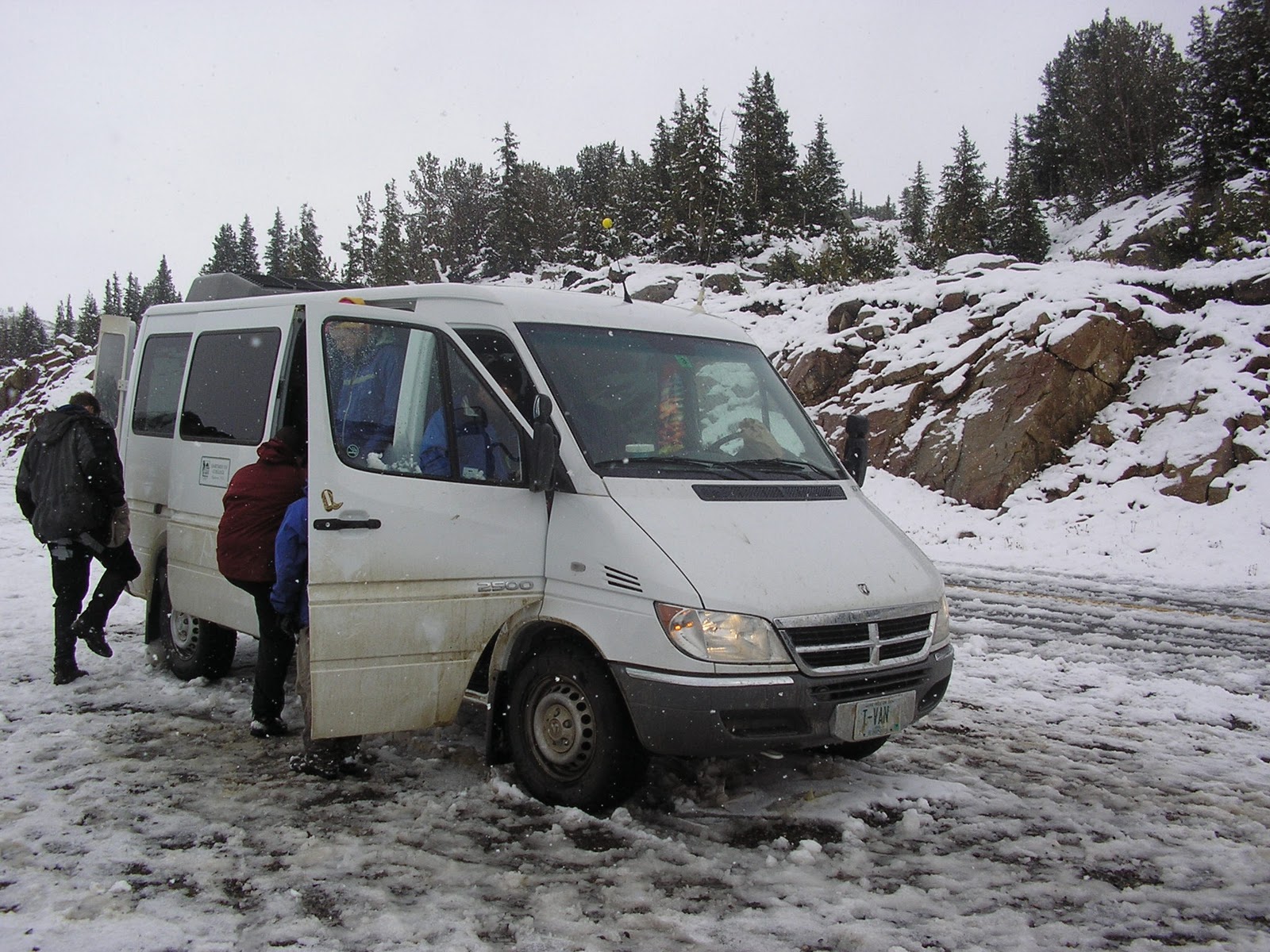
The Dodge Sprinter van is spacious, but that’s about all that can be said for it. Sprinter vans are ugly and are definitely not 4x4s. Sprinter vans are designed to deliver packages or flowers in town, not traverse rocky slopes. I have great respect for my geology professors and TAs… they bravely drove the Sprinter vans on coarse gravel roads, across bentonite mudflats (geologists will know just how dangerously sticky this mud is when it rains), and even through thick, slushy snowfalls.

Sprinter van in the slush, Western USA, Fall 2005.

Whatever vehicle you drive to the field, the long drives can be boring… especially in places where annoying vegetation covers up the interesting rocks.  Geologists have different ways of entertaining themselves on the long drives: iPod music mixes, books, long talks about rocks, and- last but not least- car games.

Today I am going to teach you an awesome car game to play next time you have a geologic (or any) roadtrip. Before I explain the game, however, I must warn you. After first hearing the rules, almost everyone thinks this is the stupidest game they have ever heard about. However, in my personal experience, almost everyone also ultimately ends up playing this “stupid” game. One or two steadfast skeptics usually whine about how annoying it is that everyone is playing this game. However, even these whiners usually participate randomly- generally to sabotage the person who is winning and hope that the game dies.

But the game does not die. It endures. It is often played for days at a time. Sometimes, the game is forgotten but then returns a few days later. The game is AWESOME.

Without further ado, let me introduce you to… THE COW GAME!

The cow game rules are as follows:
1. When you see cows, yell out “My cows!” Whoever yells that phrase first owns all the cows. If you call the phrase out first and can obviously count the number of cows, follow by saying, “I now have 5 cows.” If you already have 100 cows, say, “I now have 105 cows.” If you cannot count the cows, estimate how many you think there are in a particular field or barn or wherever. Participants are encouraged to argue about the number of cows a person has just claimed. Disagreements are settled by majority rule. In the case of just two people playing the game, disagreements are settled by whoever gives up first. Whoever has the most cows wins. There is no set timeframe for the end of the game, which can go on for days or even months.

2. If you see a white horse and are the first to yell “My white horse!”, your number of cows is tripled. If you call out “My white horse!” and it is really a goat or a black-and-white horse or something else upon closer inspection, all your cows die.

3. If you see a cemetary and yell “My cemetary!” (yelling “My graveyard!” is acceptable), everyone else’s cows die.

4. Cows are the most commonly owned thing. However, depending on where you are in the world you can play variations of this game. In Oman, I have played with goats (for cows) and camels (for white horses). In South Africa, I have played with ostriches (for cows) and springbok/rhinos/any other kind of cool animal (for white horses). When driving in North Carolina whitewater country, I have played with river rafts (for cows) and open canoes (for white horses… kayaks were too common). You can also decide to collect multiple types of livestock/animals/rafts.

5. Plastic/artificial giant animals, such as plastic cow signs at dairy farms, count. These add to your cow count and cannot die when someone yells “My cemetary!” Also, giant plastic animals are worth a gazillion coolness points each.

I learned the cow game on a kayaking trip in college, and I thought it was really stupid at first. Despite my initial reaction, I have now played the cow game on many long drives. I have taught the game to a few of my friends and colleagues, and now I am teaching the whole internet… though I imagine many of you have played various permutations of the game in the past.

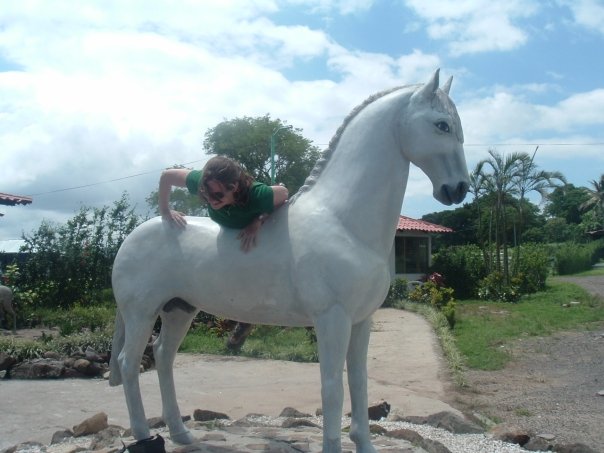
Speaking of fake animals, during a trip to Costa Rica a couple of years ago I was lucky enough to encounter this wonderful white horse at a roadstop. I had a little trouble climbing on top… 

White horse 1, Costa Rica, June 2008.

… but I managed eventually… 

White horse 2, Costa Rica, June 2008.

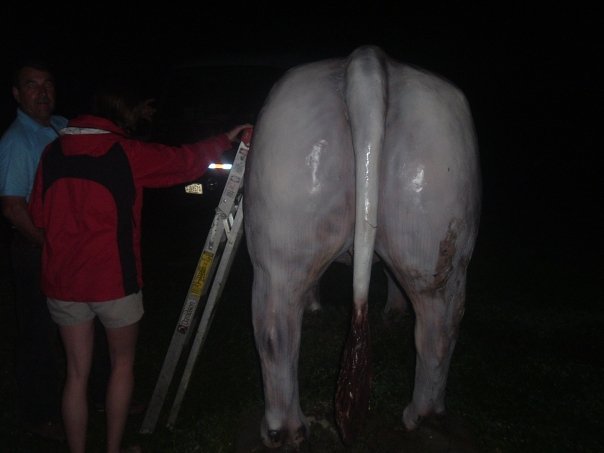
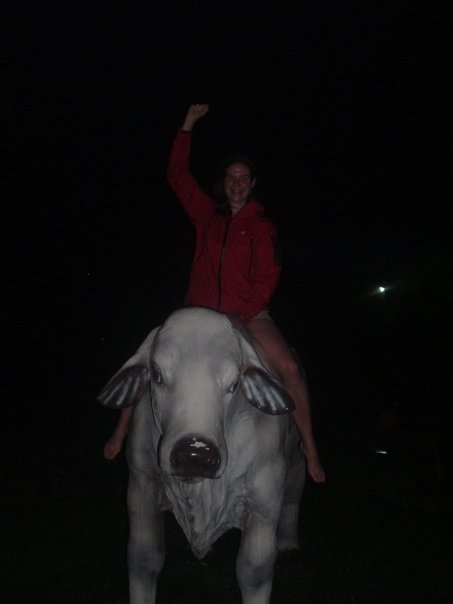
A few days later on the Costa Rica trip, we had dinner at a restaurant with a giant fake cow in front. I went to climb the cow, but one of the restaurant employees followed me. I was worried and thought he was going to yell at me to stop climbing the cow. Instead, he brought me a ladder. Costa Ricans- or at least this particular man- are AWESOME… just like the cow game.

The nice Costa Rican man brings me a ladder, Costa Rica, June 2008.

Yee-haw!, Costa Rica, June 2008. 

Come to think of it, I’m not sure exactly why I needed to climb the fake animals in Costa Rica… perhaps it was worth an extra gazillion coolness points.

Rocks for Jocks

A group of geology students learning how to “use” Brunton compasses, Western USA, Fall 2005.

Introductory geology courses have the unfortunate (or fortunate, perhaps?) reputation for being “easy” or “fun” relative to other introductory science courses such as chemistry, physics, and biology. At most colleges, the introductory geology course (Geology 101 or Introduction to Earth Science) is known as “Rocks for Jocks.” The stereotype is that jocks (e.g. guys on the football team) take introductory geology as an easy way to obtain a necessary science credit. At colleges here in the United States, even if you are not a science major you generally have to take at least one science class. At least, this is the case at liberal arts schools where students mostly take courses in their major, but also are required to fulfill broad educational requirements and take a course in subjects such as English, History, Art, Language, and-of course- Math and Science.

I have mixed feelings about the “Rocks for Jocks” stereotype. I love the name, actually. As I mentioned in my welcome post, geologists have a penchant for puns and jokes and fun names. I’ve even heard other geology courses described in similar manners. For instance, I have heard Introduction to Geophysics called “Quakes for Flakes.” However, I do feel a little sad that geology is considered an “easy” science. There is no doubt that “Rocks for Jocks” is an easier class to take for your science credit than Chemistry 101, Physics 101, or Biology 101. I can verify this firsthand as someone who took Chemistry 101, Physics 101, Rocks for Jocks, and an introductory biology course.

As a quick aside, I actually didn’t take Biology 101- I took a different introductory biology course about dinosaurs because who wouldn’t want to take a class about dinosaurs??? It turned out the class was mostly about cladograms and evolution. On the first day of class, the professor said something along the lines of, “Welcome to the dinosaur class. This class is really about ancestral relations and evolution. I could just as easily teach what I need to teach you using clams or cows or squids. However, none of you would probably take a class about clams, so I’m going to use dinosaurs in all my examples.” The class turned out to be a little more difficult than I expected, but I enjoyed it anyway.

Here at MIT where I am a graduate student, geology is almost considered a humanities department (not really, but some engineers view it that way). The geology major is often considered “an easy major choice” for students who can’t quite cut it (at MIT, anyway) in physics or engineering. Sometimes, I even catch myself saying, “Oh, I’m at MIT… but I’m only in the EAPS (Earth and Planetary Science) department.”

However, I don’t really think that geology is an “easy” science. At least, not when you continue beyond “Rocks for Jocks” and pursue the full undergraduate major. My second, third, and fourth year geology classes were challenging. The geology department was small (relative to chemistry, physics, and biology), so perhaps my courses were slightly easier because the professors were able to give their students more attention. However, I remember some very tough mineralogy, petrology, and geochemistry exams. Also, because geology is a highly interdisciplinary field, in order to be prepared for graduate school I actually took several chemistry, physics, biology, and math courses as an undergrad. So I had to study those “tough” sciences in order to be prepared for my “easy” science of geology. 

Come to think of it, the “Rocks for Jocks” course actually does teach quite a bit of chemistry, physics, biology, and even a little math. At many colleges, the class doesn’t turn out to be quite as easy as the jocks were hoping.  And you know what? Many people who take the course, even some of the jocks, end up majoring in geology. Probably because it’s fun to go hiking and look at rocks and play with minerals. Really, really fun, even if there’s a little chemistry and math and such thrown in. So perhaps “Rocks for Jocks” serves as good recruitment for the sciences, or at least for geology.

Geology Word of the Week: A is for Alluvium

 A geology student on some alluvium, Western USA, Fall 2005.

def. Alluvium:
1. Loosely-consolidated sediment transported or re-worked by freshwater.
2. What you put down on a geologic map when loose crap is covering up interesting rocks.
3. Very interesting sediment with key climate information that will save the world from global warming and/or help the world grow more food. (In Quaternary science only).
I think that I learned the word “alluvium” during my first mapping exercise as part of my undergraduate geology field camp. I learned that “alluvium” or more specifically “Quaternary Alluvium” is what you sketch on your geologic map when recently-deposited, poorly-consilated, partly re-worked by water soil and sediment (*cough* crap *ahem*) is covering up the consolidated geological layers of rock (limestone, sandstone, granite, whatever it may be) that you are trying to map.This recent alluvium (deposited in the last ~2.5 million years or in the Quaternary) hasn’t had enough time to consolidate into a sedimentary rock.

It can be frustrating to encounter alluvium at a key contact. Geological mapping is, when you think about it, a little bit crazy. I still remember the teaching assistant telling me to “guess” where I thought a particular contact lay underneath a wide expanse of alluvium. Guessing is, to an extent, acceptable in geology. As a novice geologist, I found the tolerance for guesswork remarkable– when you make a geologic map, you take measurements wherever you can see a particular rock layer and wherever you can’t see it– where it’s obscured by other layers or alluvium– it’s okay to guess where you think it may be. You can even make reconstructive geologic maps where you draw where layers used to be before they were eroded!

As a geologist, I suppose that I have become good at “thinking below the alluvium” or guessing. I am not afraid to make an educated guess. You have to in geology. You take what evidence you have– a small outcrop sticking out of the alluvium or that annoying biological cover; a sliver of a deep layer exposed in a fault; a diamond from the deep; a single, enduring zircon grain that’s survived 4 billion years; whatever you have– and you do your best at interpreting the geology. In academia, you guess the best you can and the different flavors of guess can lead to decades of back-and-forth discussion. In industry, you guess and the difference between a good guess and a bad guess can be millions of dollars. You guess where to drill for oil, where to mine for diamonds, where to prospect for gold. You are often wrong. If you are wrong too often, you are fired. To survive, you have to become good at guessing. You have to accept that guesswork has a place in science. You have to learn to guess as scientifically and accurately as possible.

I suppose that “thinking below the alluvium” is an example of where intuition and art, even, enters science. Experienced geologists and those with a natural intuition are better at guessing, better at figuring out where a layer runs underground or where to drill for oil. Certainly, geologists have many tools and data available to them to help them guess. As we develop our geological toolbox– both geophysical and geochemical tools– we have to guess less. Or we have more ways in which to narrow down our guesses to the most likely guess.

When I was in fieldcamp working on that first mapping exercise, I remember something that our instructor said to a few students (myself included). A few years before, this instructor had been a lecturer at well-respected University X. His first year of teaching at the university he noticed that a large number of financial recruiters made rounds of the geology department, sweeping up recent geology grads for positions in banking and investment. He found this befuddling– many of the geology students who were recruited had never even taken an economics course. When the recruiters returned the next year, he cornered one of them in the hallway and asked why they were recruiting in the geology department. Did they simply recruit from all departments because students at University X were known for being smart?

The recruiter replied that, yes, students from University X were known for being smart but that the geology department was targeted in particular. The instructor asked why this was and the recruiter replied something like this:

“Because geologists are not afraid to make confident decisions based on extremely limited data. This is a very useful skill for finance. We can train new recruits in finance, but it’s difficult to train new recruits to make decisions.”

I have never thought about going into finance (even typing this makes me shudder… I plan to leave day-to-day finances and taxes and investments and such to my soon-to-be husband), but I suppose it is true that some skills translate. There is merit to studying geology– and science in general– because of the ways in which you learn to think. The ways you learn to analyze data and test hypotheses and make decisions. I’d argue that a scientific background of any sort has important skills that translate into other fields. There are many reasons to study science, even if you never intend to become a scientist. Personally, though, I hope that I’m always able to make my way as a geologist. If only because I much prefer jeans and t-shirts to skirts and suits.

Welcome!

Hi!

My name is Evelyn, and I like rocks.

The above sentence pretty much sums up who I am and what I will be writing about in this blog.

First and foremost, let me apologize for the horrible pun / purposeful misspelling in the name of this blog. I contemplated various names for this blog, and- despite many pun-free alternatives- I decided to name my blog “Georneys.” I like the title because my study of geology takes me many places- physically, mentally, and philosophically. Also, geologists seem to have a penchant for puns and jokes. This is not surprising considering that words such as orogeny, eruption, schist, and cummingtonite are common geology lingo. 

In this blog I will write about my fieldwork- past and present- to study geology, both formally and informally. I will also write about my geochemical adventures in lab, taking you to the lands filled with mass spectrometers, microscopes, lasers, acids, magnets, and other fun toys utilitarian laboratory equipment. Since I am currently a 5th year graduate student, I am sure that I will also write in abundance about my adventures in Thesisland.

Since I am a busy graduate student with other obligations, my goal is to blog 1-3 times per week. I hope I am able to stick with it! Nag me if I don’t write for a while!

To help me write on a consistent basis, I am introducing two recurring features:

1. Geology Word of the Week
Every week, I will take you on a geology-themed etymological journey. That is, I will teach you a new geology word and use this weekly word to teach a little geology. Since I am not an expert in all sub-fields of geology, I will also strive to teach myself some new geology vocab. After all, much of being a scientist is sounding like a scientist. You have to know the lingo.

2. Bad Geology Movie of the Month Whenever*
Every month, I will watch a so-called “Bad Geology Movie” and write a movie review. I will also comment on the accuracy / inaccuracy of the science in this movie. Why? Becuase I love “Bad Geology Movies” and have quite an extensive personal collection. I welcome suggestions of movies from my readers!

That’s it for my welcome… I hope you enjoy my blog!

*Revised 4/14/11: Turns out that reviewing a “Bad Geology Movie” every month takes more time than I expected. I will occasionally post about “Bad Geology Movies,” but I have been unable to commit to doing so on a monthly basis. I’ll just blog about bad geo movies now and then as I’m inspired.

Revised 5/19/11: I also have three other semi-regular features:

1. Holiday Rocks
On certain holidays I post about a rock that has some sort of relation to the holiday. For instance, on Thanksgiving I posted about Plymouth Rock.

2. Blast from the Past
I’ve actually had an interest in science and travel from an early age. When I come across interesting tidbits from my past (pictures, childhood drawings, old school essays, etc.), I will sometimes share them with you here, for better or for worse.

3. …in Pictures
Although I have yet to invest in a fancy camera (I plan to do so after I graduate and have a real job), I really enjoy taking pictures on my travels. Sometimes, I will simply share pictures from my travels with minimal text and (usually) interesting picture captions.

Also, for one month (mid-March to mid-April 2011) this was not a geology blog but rather a blog in which I regularly interviewed my father, a nuclear engineer, about the ongoing crisis at the Fukushima Daiichi nuclear power plant in Japan. These conversations have been compiled along with some additional information in the book “Conversations with My Dad, a Nuclear Engineer, about the Fukushima Daiichi Nuclear Power Plant Disaster in Japan.” This book will be available from Lulu the first week of June, so stay tuned! Occasionally, my father and I may continue to comment on Fukushima and nuclear power issues on this blog.