Jim Thompson, circa 1979. Image taken from American Mineralogist, 1979, vol. 64: 664.
def. Jimthompsonite:
1. A magnesium and iron-rich silicate mineral found between the chlorite and actinolite zones of a metamorphosed ultramafic body. Jimthompsonite has the formula (Mg,Fe)5Si6O16(OH)2 and an orthorhombic structure. The mineral was named after James Burleigh Thompson, Jr., an eminent mineralogist and petrologist.
2. A wonderful example of scientists having fun with naming– and, in the process, classifying and better understanding– the world around them.
Jimthompsonite is a delightfully ridiculous mineral name. Minerals are often named after people, usually for the people who first discovered them. For example, searching randomly through my mineralogy book, I come across mineral names such as Pentlandite (named for Joseph Barclay Pentland), Vivianite (named for John Henry Vivian), and Covellite (named for Nicola Covellite).
Minerals are also commonly named after places, often their “type locality,” a notable place where the mineral occurs or was first discovered. For example, Andalusite is named for Andalusia, Spain. Mineral names are also sometimes taken from colloquial, historical names– sometimes modified– which existed prior to the mineral being classified scientifically. For example, Beryl comes from Ancient Greek.
Sometimes, minerals that are named in honor of people end up with ridiculous names such as “jimthompsonite.” Why jimthompsoite? Well, thomsonite was already taken, and I suppose thompsonite and thomsonite would have been somewhat confusing. Jamesonite was also already taken. I suppose jamesthompsonite was a slightly more formal option, but for whatever reason the mineral namers went with jimthompsonite, which is simply delightful and probably more reflective of Prof. Thompson, who apparently went by Jim rather than James.
Jimthompsonite? Sounds like something Tintin detectives Thompson and Thomson should investigate!
What’s an even more ridiculous mineral name than jimthompsonite? Clinojimthompsonite, also named after Jim Thompson.
Ridiculous scientific names are not just limited to minerals. Just look at some of the ridiculous Element names (for example, Californium) and asteroid names (for example, #12426 is named “Raquetball”). Isn’t discovering and naming things fun? One of the funnest parts of science, I think.
Here are a few more ridiculous and fun mineral names:
Armalcolite: A mineral discovered on the moon and named for astronauts Armstrong, Aldrin, and Collins.
Znucalite: A mineral rich in the elements Zn, U, and Ca. Sounds like a Dr. Suess mineral, doesn’t it?
Cummingtonite: Supposedly named for the town of Cummington, Massachusetts. Uh-huh.. sure… 🙂
Coffinite: A halloween mineral? It’s uranium-rich and radioactive, so be careful…
Over the past day or so, I have been receiving some requests to interview my dad, a nuclear engineer, about the Fukushima Daiichi Nuclear Power Plant Disaster, which has been in the news again recently because of high radiation readings.
I’ve been trying to coax my dad into doing an update interview about Fukushima for the past month or so, but his work and travel schedule (as well as my own work and travel schedule) have made it difficult for us to carry out an update interview. We’ve both been extremely busy.
However, we are finally planning an update interview. We plan to carry out the interview in the next week or so. My dad is going to do some research over the next few days. In the interview he will give a general update on what progress has been made– and hasn’t been made– at Fukushima over the past five months. He will also answer 10-12 questions. I have a couple of questions of my own, and I have also received some questions by email. If you have a question about Fukushima that you would like to ask my dad, a nuclear engineer, please post a comment below or send me an email (georneys blog at gmail).
For those of you who are not familiar, for the first month of the Fukushima disaster I interviewed my father 20 times about the ongoing crisis. You can find the interviews here on my vimeo channel. You can find all of the posts under the category “Interviews with my Dad a Nuclear Engineer.” For some reason, all of the embedded vimeo videos disappeared during the move to AGU, but I’m hoping this will be fixed in the near future. If you want to listen to the interviews, please visit the vimeo page.
If you’d like to ask my dad a question about Fuksuhima, please send in your question as soon as possible so that I can compile the questions.
As for the book of all the interviews… it is still in progress. My PhD work takes priority, but I continue to work on it as time permits. Sorry for the delay!
The next few weeks are going to be crazy busy for me since I’m moving to Cape Town, South Africa. I’ve arranged with my thesis supervisors to finish up some of my thesis writing from over there, where my fiance lives full-time and where we share a flat. Over the next year, I’ll periodically be back on Cape Cod (and perhaps Wyoming, where one of my supervisors is based) for meetings and ultimately for my PhD defense. However, I’m very happy that I will soon be able to live (mostly) full-time with my soon-to-be husband and to do some of my thesis work remotely. Thank goodness for Skype!
Anyway, I have a zillion things to do related to work, packing, and immigration before I fly to South Africa in two weeks… with my two cats! So, the next few weeks may be somewhat light for blog posts. Never fear, though. I will at least keep you entertained with the Geology Word of the Week and the occasional quick post such as the below.
Remember those high school “most likely” awards?
What was my high school “most likely” award?
Most Likely To Be Crushed By Falling Rocks While Examining Them.
My high school "most likely" award. Click to enlarge.
Someone even made up this little drawing for me. I think this “most likely” award may have actually been a sports award from when I did “Outdoor,” a semester of outdoor activities such as kayaking, rock climbing, and hiking. However, I believe my yearbook “most likely” award was very similar. My yearbooks are all packed away, but when I unearth them eventually I’ll scan the yearbook page.
As for avoiding the rock crushing? So far, so good. But I suppose geology is a somewhat dangerous profession what with hammering on rock outcrops and all.
A sedimentary inselberg (in the distance) in Cape Town, South Africa, September 2010.
def. Inselberg:
A small, rounded hill, knob, ridge, or mini mountain that rises abruptly from relatively flat surroundings. “Inselberg” is a loan word from German and literally means “island mountain.”
Originally, the term inselberg was used to apply to landforms in hot, arid regions; early German explorers were particularly impressed with the “island mountain” landforms which they observed in southern Africa. However, the term can also be applied to similar landforms in more humid regions.
Inselbergs are generally erosional remnants. Often, inselbergs are composed of harder igneous rock (such as granite) that is more resistant to erosion. However, inselbergs may also form in sedimentary rocks.
Uluru or Ayer's Rock inselberg in Australia. Photo courtesy of Gillian. Kata Tjuta inselberg in Australia. Photo courtesy of Gillian.
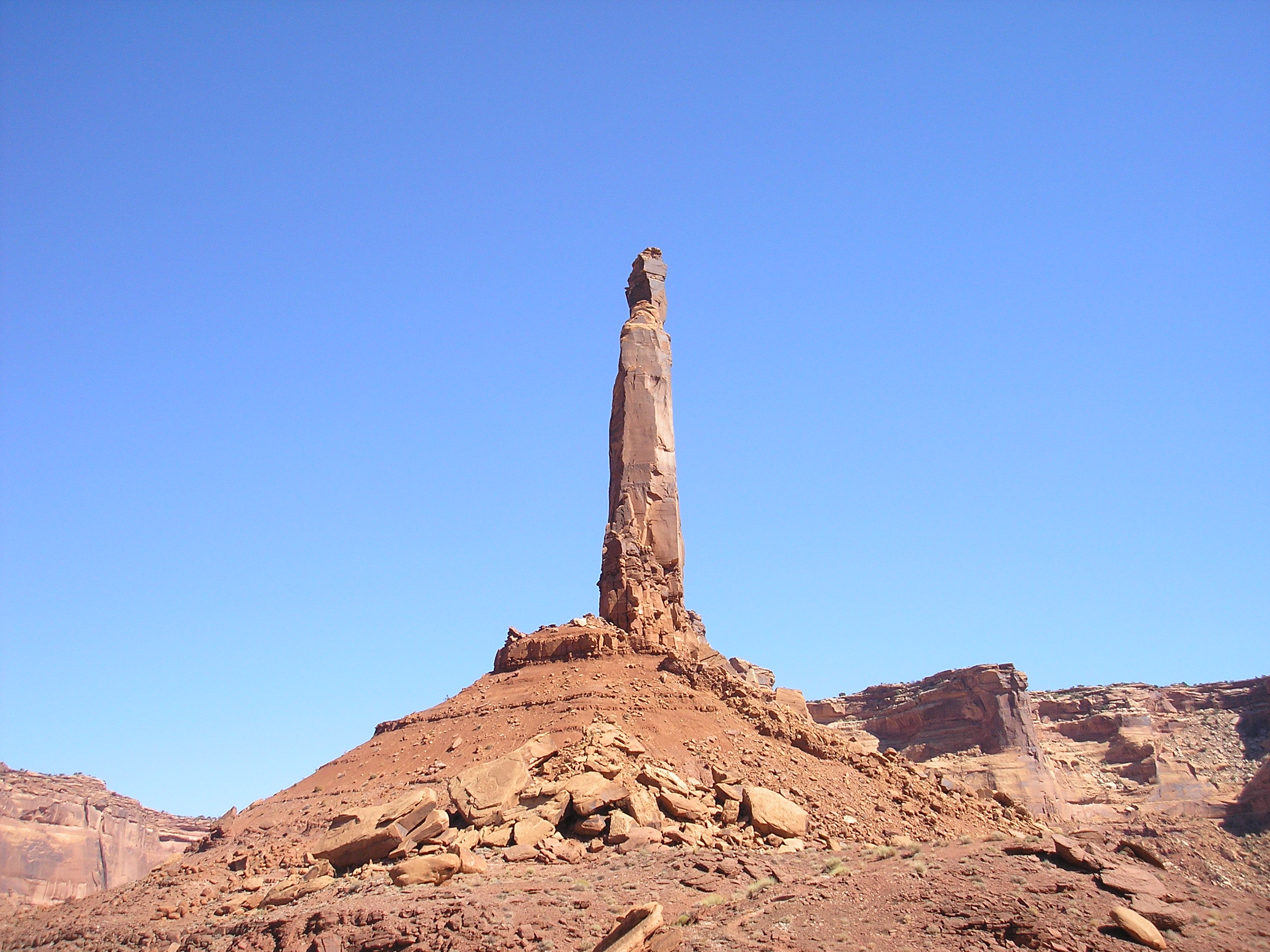
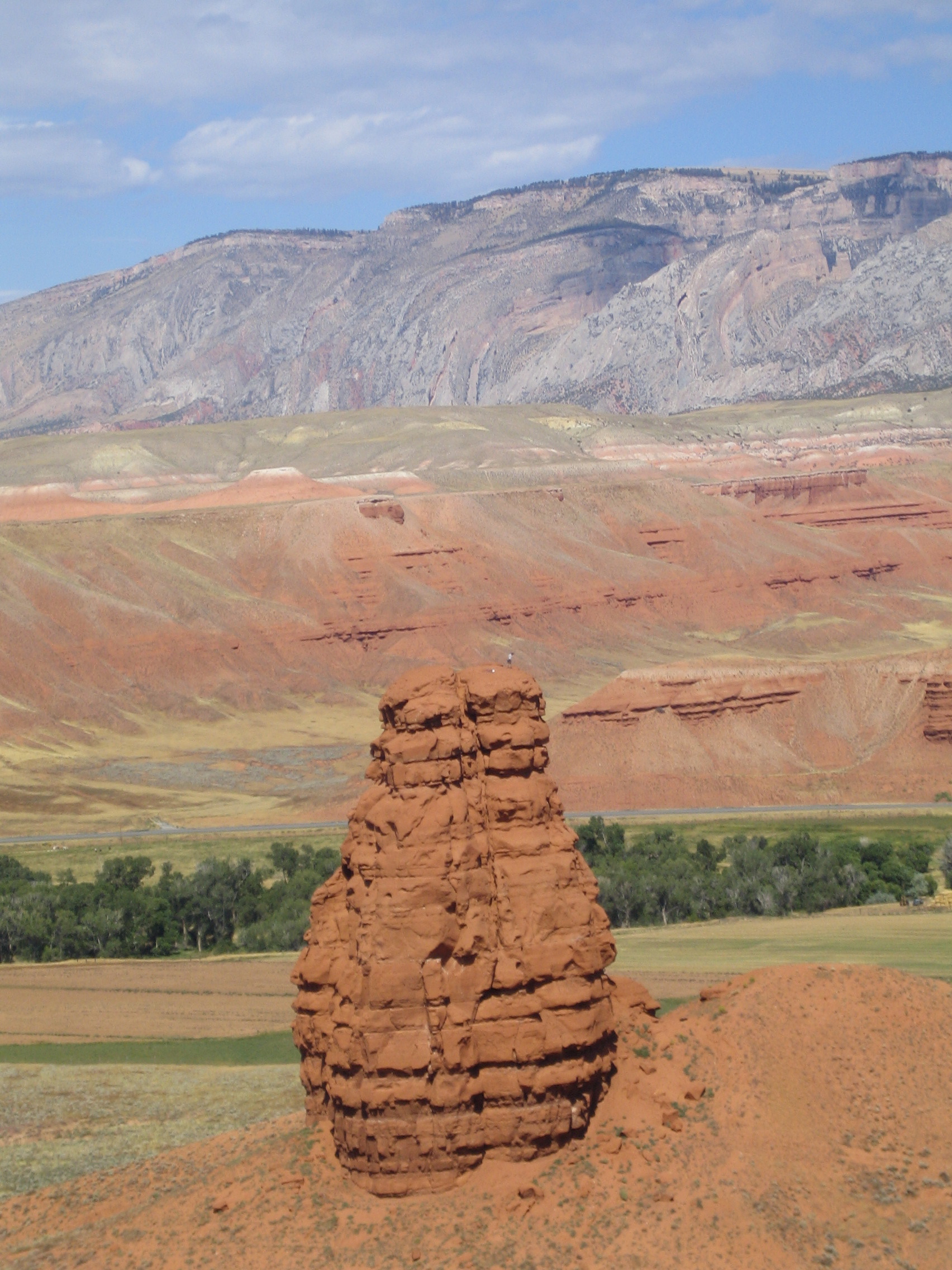
A variety of other terms, both scientific and colloquial, are also used to describe “island mountains.” Among these are monadnock (after Mt. Monadnock in my home state of New Hampshire), bornhardt (after the German geologist and explorer who coined the term “inselberg”), tor, butte, and monument. The distinctions between these various terms are somewhat confusing and not consistent in the scientific literature. Generally, more rounded landforms are described as inselbergs or monadnocks while flat-sided, towering landforms are described as monuments.
Whatever term or terms you use to describe geological island mountains or towers, these distinctive landforms are beautiful, intriguing, and can often provide information about current and past erosional environments. Island mountains and towers are also often very fun to climb or hike.
Steep-sided monument. Western USA, Fall 2005.Skinny monument. Western USA, Fall 2005. Small, slightly rounded monument. Western USA, Fall 2005. A closer view of the small monument. Check out the folding in the background! Western USA, Fall 2005.
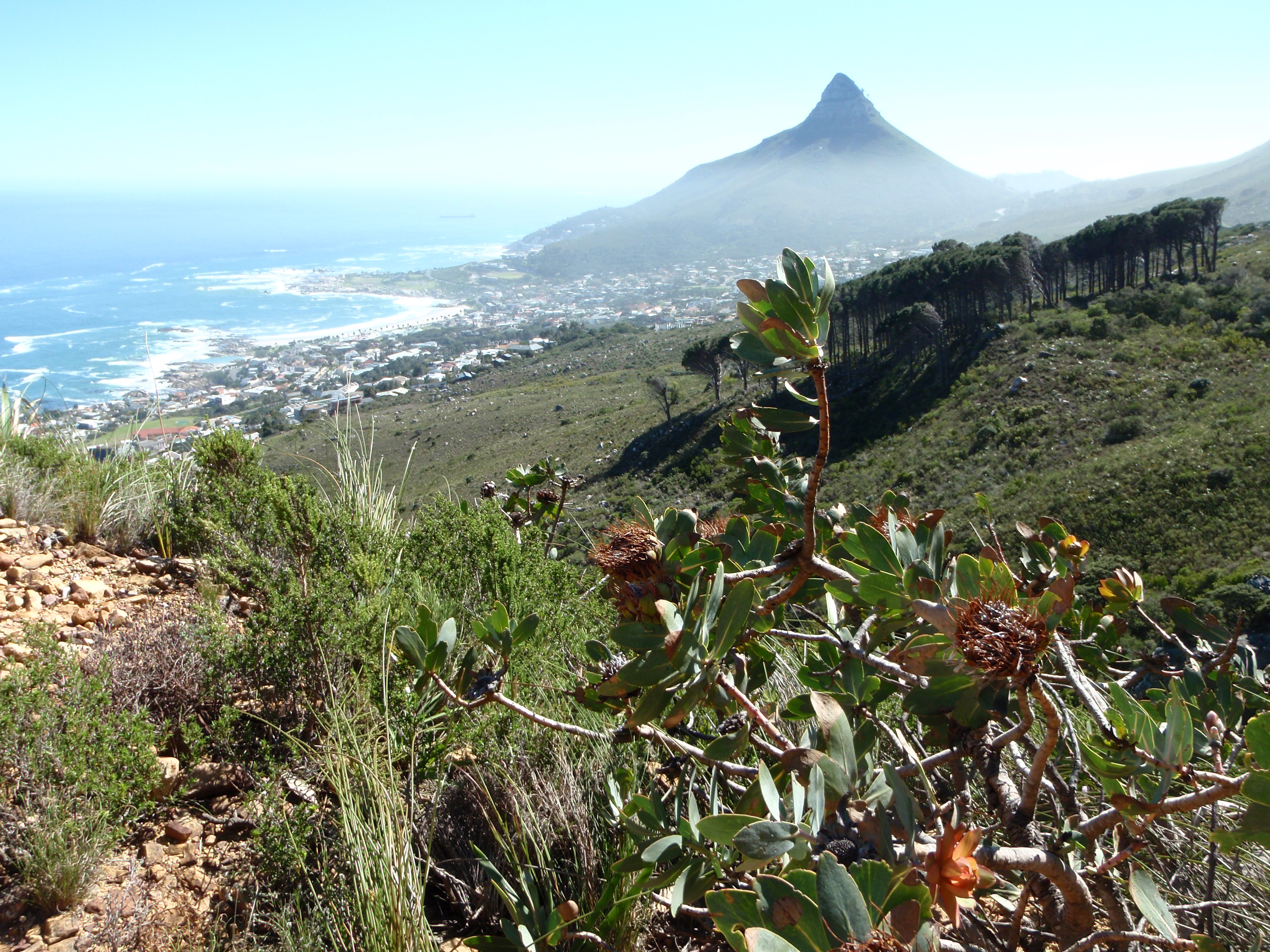
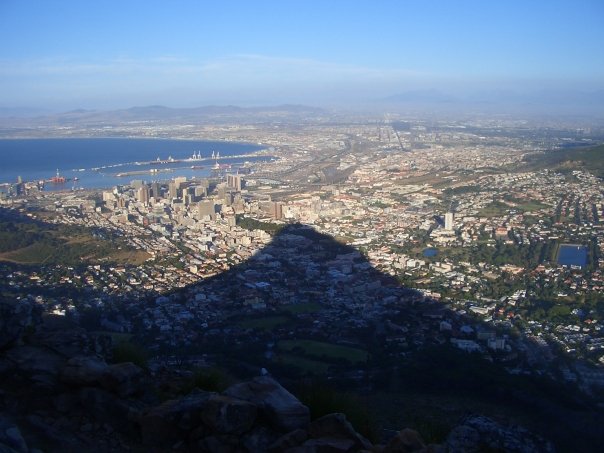
My favorite island mountain is called “Leeu Se Kop” or “Lion’s Head” and is located in my adopted home city of Cape Town, South Africa. Lion’s Head is a sedimentary erosional remnant that is composed of the same sandstone as nearby Table Mountain. Hiking to the top of Lion’s Head takes about an hour. At the top of Lion’s Head there are is a gorgeous 360-degree view: ocean on three sides and towering Table Mountain on the fourth side. A popular activity among Capetonians and visiting tourists is to hike up Lion’s Head just before sunset on a night with a full or almost full moon. On full moon nights, dozens of people hike up Lion’s Head to watch the sunset. While the sun sets, people relax at the top with picnic baskets and bottles of wine or beer. After the sun has set and the full moon has risen, everyone hikes back down the island mountain.
Lion's Head. Cape Town, South Africa, April 2011. Shadow of Lion's Head over Cape Town, South Africa, January 2007. Sunset view from Lion's Head. Cape Town, South Africa, January 2007. Another sunset view from Lion's Head. Cape Town, South Africa, January 2007.
***Thanks to Shaun for recommending this week’s word and to Gillian for providing two beautiful pictures.***
References:
“inselberg, n.” The Oxford English Dictionary. 2nd ed. 1989. OED Online. Oxford University Press. 30 July 2011.
“monadnock, n.” The Oxford English Dictionary. 2nd ed. 1989. OED Online. Oxford University Press. 30 July 2011.
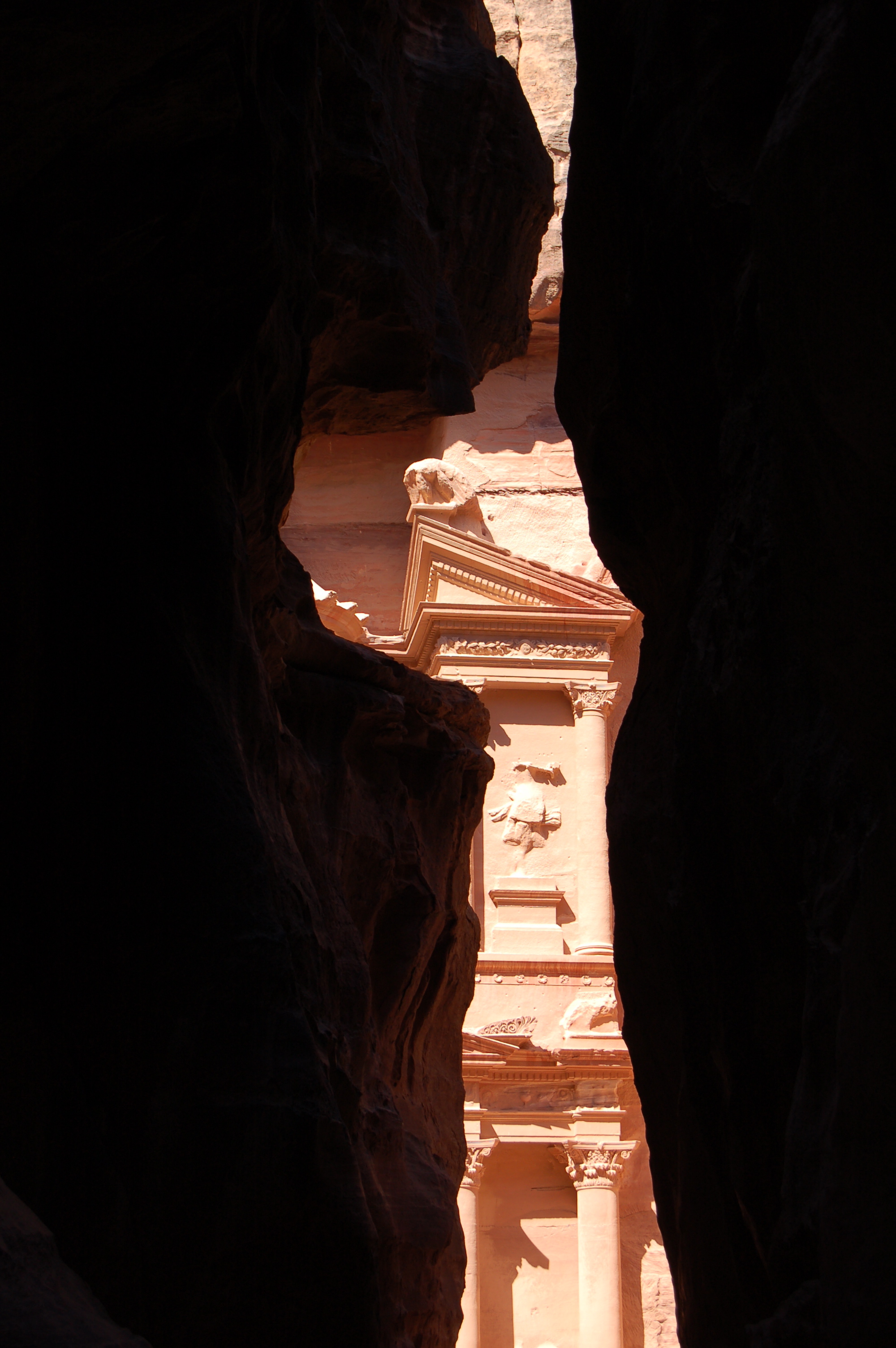
Al-Khasnah viewed through The Siq. Petra, Jordan, August 2007.
For those of you who are not familiar, in my “Blast from the Past” posts I share– for better or for worse– interesting tidbits from my past (pictures, childhood drawings, old school essays, etc.). Below is a Chapel Speech that I gave at Westover School (the wonderful all-girls’ boarding school I attended… yes, I went to fancy shmancy boarding school) back in April 2000 when I was sixteen years old. I ran across a paper version of the speech a couple of months ago when I was packing, and I’ve typed it up for you here. The speech is about the Fall 1999 semester I spent living in Amman, Jordan and attending the Ahliyyah School for Girls. The writing is a bit silly, immature, and ethnocentric at times, but keep in mind that I was very young and just starting to explore the world. I thought this would be interesting to share since my time in Jordan, particularly my visits to Petra, inspired me to study both geology and Arabic. In the text below I’ve interspersed a few pictures taken during my time in Jordan. There are also some 2011 footnotes. Enjoy!
If you want to see more pictures of Jordan, I have two “…in Pictures” albums of Jordan so far:
I had only slept three hours before I was awoken by a loud, howling chant. I sat bolt upright on my cot, scared to death, not realizing entirely where I was, and looking everywhere for something familiar. My sleep-deprived eyes finally rested on my large, khaki-colored duffel bag, and instantly I felt a sort of calm relief. My senses clearing, I realized I was hearing for the very first time in my life a Muslim call to prayer with its origin at a nearby mosque. The sound, enchanting and mystical, vibrated through the dusty streets of a Middle Eastern metropolis.
Disentangling myself from the thin sheets that were plastered to my legs with sweat, I stumbled to the window. My watch revealed that the hour was only five am, but already a pink light was piercing the sky, and I soaked in deeply the first sight of Amman, Jordan, the city that would be my home for the next four months. The street below revealed nothing in particular: only a few sand-colored houses with white or green painted bars on the windows. Here and there a vine or a pitiful little shrub made a brave stand against the desert heat. However, as I looked between the roofs of the nearby buildings and into the distance, I had my breath taken away. Row upon row of buildings, all beige or sand-colored and seeming almost mirages out of the desert, tiled the softly-rolling hillsides. Three or four mosque towers (1) rose high into the sky. I soon realized why the chanting had startled me so: black speakers dotted the very tops of the mosque towers and blared forth the call to prayer. If three or four mosques were visible out of this one small window alone, who knew how many mosques were blaring the exact same chant all over the city! No wonder the noise had awoken me.
As the chanting slowly died down, I became aware of other noises. In the room next to mine I could hear the sound of prayer rugs being tucked back into closets or under beds. Down below in the street, two men were walking slowly and speaking in guttural-yet-melodic Arabic, a language I had heard for the first time only the evening before. In the far distance I heard small horns, which I assumed to be those of taxi drivers already embarking on another day of business. Having stood there gazing out the window for quite some time, I suddenly realized my legs were wobbling, my head spinning, and my back aching. And so, with a new, exciting world awaiting me, I crawled back on the cot, pushed the sticky sheets aside onto the floor, and immediately fell back asleep.
With my first host family in downtown Amman, Jordan. Fall 1999.
A week later as I sat sipping a soda at the top of an ancient Roman amphitheater in downtown Amman, I reflected on how quickly I was adjusting to life in Jordan. The last seven days had been a whirlwind of new experiences. That first morning when the mosque towers awoke me, I fell back asleep and slept until eleven. I probably would have slept longer had not Mrs. Awqati entered bearing a breakfast tray heaped high with fried eggs, soft cheeses, leban (a sort of sour yogurt), tomatoes, pickles, olives, toasted pita bread, and the first of many cups of sweet, soothing tea.
The next day I began my role as a student. All of the girls at the Ahliyyah School were very welcoming but bombarded me with a thousand questions about my life, home, family, and country. The girls wanted to know everything about my life in America. Girls who did not know me yet would often approach by asking questions such as, “Have you ever been to Disney World?” or “Have you ever seen Leonardo DiCaprio?” or “Do you like Nike?” Yes, I have. No, I have not. And, no, I do not.
The schoolwork not being very difficult, I had plenty of time to explore and reflect while I was in Jordan. I jumped at every opportunity to go anywhere, meet anyone, try any new food, and try any new experience. To tell of every excitement and wonder I encountered while in Jordan would probably take me the entire weekend. Thus, for the sake of time, I shall recount only a few of my many spectacular experiences.
A posed photo at a shop in Amman, Jordan. I’m wearing traditional bedouin clothing. Fall 1999.A second posed photo in Bedouin clothing. Amman, Jordan, Fall 1999.
One of my first outings led to my gazing upon the holy city of Jerusalem. About an hour’s drive from Amman is the slightly more rural city of Madaba. At times I was not quite sure what made Madaba any more rural than places in Amman. In both cities herds of sheep can be seen grazing next to shopping centers, and Bedouin tents are often pitched next to five-star hotels (2). However, I was quickly told that in Amman the slaughter of chickens is prohibited. In Madaba, however, the front of every grocery shop is piled high with wooden cages containing live chickens. Customers simply indicate which bird they like, and the shopkeeper takes the bird to the back of the store to meet its death. A customer receives first the noise of frantic squawking in her ears, then a freshly decapitated bird in her hands. The banishment of “street chicken slaughter” seemed to be a primary distinguishing characteristic of Amman’s worldly sophistication (3).
Anyway, I had been staying at my friend Rawan’s house for the weekend and, to speak truthfully, not particularly enjoying the experience. Rawan’s five younger sisters were constantly running through the four rooms of the small apartment whining and screaming, and Rawan’s mother kept trying to prepare Western dishes for me, all of which turned out terribly. I would have much preferred a traditional rice dish or even a pita and cheese sandwich, but not wanting to seem rude, I gulped down the charred hamburgers and burnt onion rings and forced myself to smile. I was greatly relieved when Rawan’s parents offered to take me on a trip to Madaba. I had heard of the many beautiful mosaics there and also would have gone anywhere to get away from the screams of Rawan’s youngest sister. As I skipped down the stairwell and into the car, I realized that the entire family was trooping out the door behind me. Apparently, all nine of us– Rawan’s parents, Rawan and her five sisters, and I– were all going to pile into the family’s ancient two-door Toyota.
Despite having a nine-year-old piled on top of me and Rawan’s elbow in my stomach, the drive passed quickly. Because all of the museums in Madaba had closed earlier in the day, Rawan’s parents instead drove us past the town of Madaba to Mt. Nebo. Mt. Nebo is of great Christian importance as religious scholars believe that this is the final resting place of Moses, who gazed upon the Holy Land of Israel from the mountaintop just before he died.
One of the most mystical, beautiful churches I have ever entered is built upon Mt. Nebo. The church, called Siyaga, was was built in the IV century and then enlarged in Byzantium times. Inside are crumbling, yet somehow holy (4), columns; intricate, colorful mosaics depicting everything from saints to camels; and a few simple wooden benches. There is also an ancient cross-shaped basin once used for baptism, a small sandpit near the altar where candles lit for loved ones may be stuck into the holy soil, and a small tourist shop in the back where one might buy a Mt. Nebo postcard or an “I’ve been to Mt. Nebo 2000” t-shirt.
However, the view of the valley below is what really makes one feel holy. Except for the modern-looking iron cross which has been erected at the top of the mountain, I found myself looking at the very same view Moses himself must have seen so many centuries before. I stood on the rocky mountaintop and gazed below at the small Israeli towns– so close, and yet politically so far away– and at the distant, glorious city I knew to be Jerusalem. Never had I gazed upon hills such as those that then surrounded me. The sand-covered hills, covering the land like a wrinkled skin, were almost devoid of vegetation. On and on stretched the sand, here diving into valleys, here darkened by shadow, here lit brilliantly by the setting sun. As vivid pinks and purples began to fill the sky, I turned to leave and, this time, smiled as Rawan’s sister again crawled into my lap in the overstuffed Toyota.
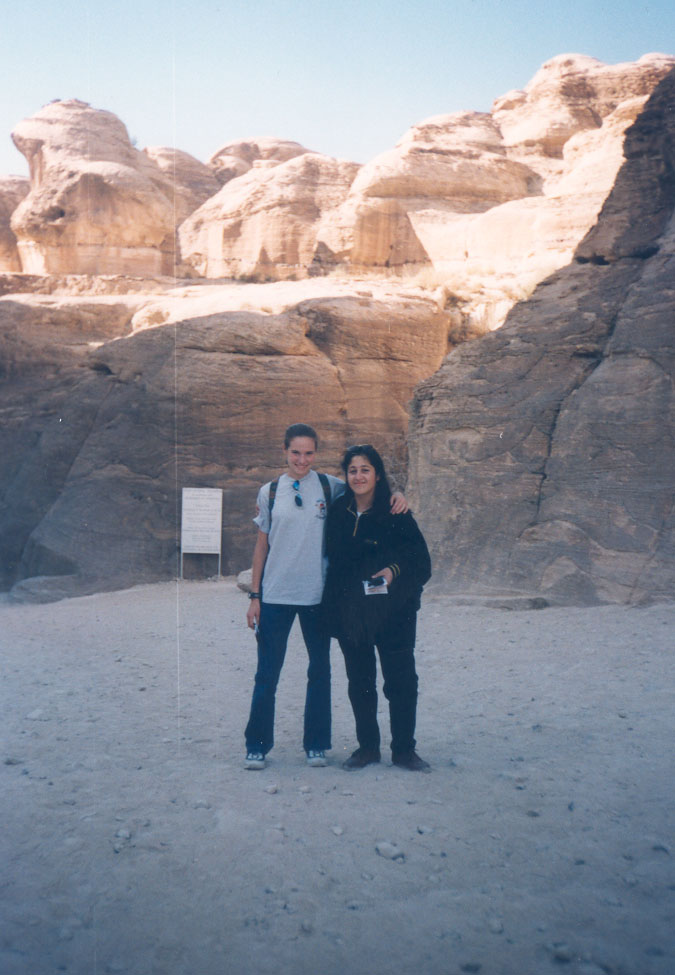
With a classmate in Petra, Jordan. Fall 1999.Hanging out with some sandstone in Petra, Jordan. Fall 1999.
The second place worth describing is the ancient Nabatean city of Petra, a sandy, monotonous, three-hour drive from Amman. The ancient city is at first hidden by gigantic rock mountains, and only the modern city of Wadi Musa can be seen. However, a short horseback ride to The Siq, or the tiny crack in the mountainside which is the only entrance to Petra, and immediately one is transported into another world. Petra is entirely encased in tall rock mountains, which form a sort of valley through which a river once flowed. The Siq alone would be enough to draw me as a tourist. The towering cliff faces are lined with strips of color that look very similar to the rock patterns found in America’s Grand Canyon (5). The countless murals and decorations, painstakingly carved out of the rock so many centuries ago, enhance the natural beauty of The Siq walls. Just before reaching the city of Petra, The Siq narrows, turns sharply, and suddenly a thin strip of what must be one of the most awe-inspiring temples in the world becomes visible. When I saw the pink facade of Al-Khasneh before me, I did not know whether to run forward or stand still forever in the hope that I might one day die with such an extraordinary view before me (6). For those of you who have seen “Indiana Jones and the Last Crusade,” you probably remember the temple where the Holy Grail was finally found. That temple was no movie set; it was Al-Khasneh.
Although I found no Holy Grail in Petra, I certainly found something else. Something more abstract, something more personal, something more valuable. In a way I found myself. Being surrounded by not only Al-Khasneh but also by hundreds of similar facades and carvings seemed to breathe life and hope and spirit into every moving, working cell in my body. I could almost feel my mitochondria doubling their efforts (7). I was once told while in Jordan that to see Petra thoroughly takes sixteen days. I was blessed to spend three days in Petra and could spent three years describing my short experience. However, I will stop at Al-Khasneh. Transform this robe (8) I am wearing into jeans, a T-shirt, and hiking boots (10), put me on the top of camel surrounded by men wearing their hattah (9) headdresses, put the Al-Khasneh facade at my back, The Siq before me, and you have what, to this date, is one of the most satisfactory moments of my life (11).
Jordan brought me not only this thrilling moment, but also many others. Jordan also brought me new ways in which to observe and judge the world around me. Although I still believe that I harbor a great amount of American ethnocentrism, I believe that my trip to Jordan helped me shed at least a few of my cultural biases and, perhaps, helped me realize that American is often not as bad or as wonderful as I think it is. For four months I was immersed in an environment with a culture and society so different from my own. Under such circumstances, how could I not adapt, change, and acquire new knowledge? Impossible. Thus, I tried to accept the task wholeheartedly. Many days were far from easy. However, what I learned from these more difficult days is just as important as what I learned from my more pleasant experiences. When I recount some of my more trying experiences, some people ask why I bothered to go to Jordan at all if I knew this sort of thing might happen to me. Usually I smile and say something difficult to argue such as, “I didn’t go to Jordan to be in America. I went to Jordan to be in Jordan.” This is not really a complete explanation. I think I would be more truthful if I said I was driven by adventure and wanderlust. However, reflecting back on my experience I realize that satiating these two desires was only a minute piece of my unusual trip. What I learned about life and the world is much more permanent and satisfying. I imagine that my wanderlust and sense of adventure will lead to many more travels. I can only hope that I am able to glean as much knowledge and insight from my future travels as I have from this one short stay in Jordan.
2011 Footnotes:
(1) Mosque towers are known as “minarets.”
(2) I wonder if this is still true in 2011.
(3) This passage sounds horribly condescending, now that I am reading it years later.
(4) When I was sixteen, I considered myself a Christian. I now consider myself an atheist of Episcopalian heritage. I no longer believe in holy things, but I still enjoy visiting historical churches.
(5) I must be speculating here since I did not visit the Grand Canyon until 2005.
(6) Don’t worry- I’m just being a melodramatic 16-year-old here.
(7) Science metaphor for the win.
(8) Robe? Maybe they made me wear something special for Chapel. Normally, we went in our dress class clothes, which were formal Laura Ashley-style sailor uniforms (I kid you not. If you ask nicely, maybe I will post a picture).
(9) Definitely my preferred outfit, especially compared with Chapel robes and sailor uniforms!
(10) A hattah is also known as a kuffiyah.
(11) Definitely still up there on the list, though I’ve seen many more amazing places.
Back in undergrad I double majored in Earth Science and Arabic Language & Literature. I am far from fluent in Arabic, especially since I haven’t formally studied the language for the past 5 years. However, I crack open my old Arabic vocabulary and grammar textbooks when time permits, and I try to learn more Arabic during my field seasons in Oman.
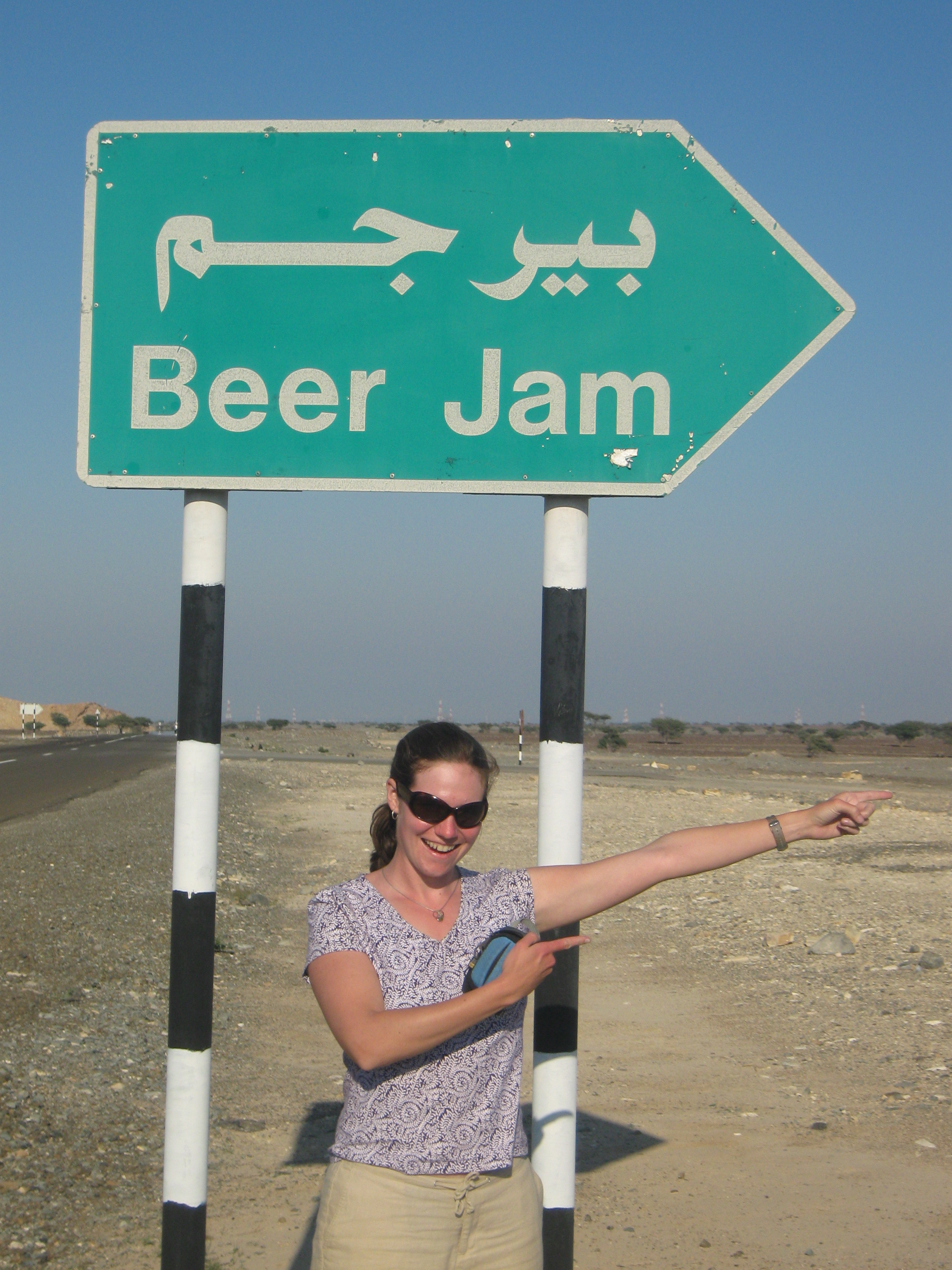
During my last Oman field season in January 2010, my fiance (who came along as my field assistant) and I encountered a strange roadsign along the road from Al-Wuqbah to Sohar:
Sign for the village of Beer Jam. Oman, January 2010.
We laughed when we saw the sign, and we pulled over the Land Cruiser so that we could take pictures of the sign. We wondered what a “Beer Jam” could possibly be. “Beer Jam” sounds like a good name for a beer and music festival, but we knew this could not be the case. Muslims in Oman are not permitted to drink alcohol. While non-Muslim foreigners can purchase limited quantities of alcohol in large cities such as Muscat, beer is not exactly a common beverage in Oman. We contemplated making a detour to Beer Jam to investigate, but we had limited time since we had to travel on to Sohar and Muscat in order to meet up with colleagues.
My fiance asked me what “Beer Jam” meant, so I looked up the Arabic “بير جم” in my Arabic-English dictionary. Despite much searching (Arabic dictionaries are not alphabetical, so you have to look up words by their roots, which are sometimes difficult to determine), I was unable to figure out the meaning. So, “Beer Jam” remained a mystery.
Posing with the "Beer Jam" sign. Oman, January 2010.
As I was reading a paper last night on lacustrine carbonate deposits in the Sahara Desert, I was reminded of the “Beer Jam” sign. The paper mentioned that carbonates were sampled at “Bir Tarfawi” and “Bir Sahara,” and I wondered if “Bir” could possibly be the same as “Beer.”
Excerpt from the paper I was reading last night. Click to enlarge.
I was curious, so I asked native Arabic speaker and fellow geoblogger Selim of the GeoSelim blog if he knew what “Bir” or “Beer” meant in Arabic. Selim quickly replied that he thought the word was “بئر”, which means “well” as in a well which provides water. The Arabic word for well contains a glottal stop (called a hamza), which is something we don’t have in English. Properly transliterated, the Arabic word should be written something like “Bi’ir” or “B’ir.” The word “بئر” is the more formal Arabic word for well. Like many languages, Arabic has both formal and colloquial forms. Modern Standard Arabic is the formal written language and serves as a lingua franca among educated Arabs. However, no one really speaks in Modern Standard Arabic– except, perhaps, for Arab news reporters and foreigners trying to learn Arabic. Rather, Arabs speak in their local dialects, which vary greatly from country to country and even within a single country.
Selim informed me that “Bir” and “Beer” are simply colloquial ways of saying “Bi’ir.” Since the glottal stop is a bit difficult and slows the word down, it makes sense that the colloquial forms of the word are simpler and avoid the hamza. Arabic is usually written in its Modern Standard form, but sometimes colloquial Arabic is written down as well. The reason I could not find “بير ” in my Arabic-English dictionary is because this is a colloquial spelling of the more formal word “بئر .” Thanks to Selim, I now know that “بير ” simply means “well.” So, “بير جم” means “Well of Jam.” I’m not sure if the “Jam” means anything in Arabic; likely it is just a place name.
Apparently, using “Bir” or “Beer” or “Bi’ir” in place names is fairly common. I guess in the deserts of the Middle East, villages tend to be found in the vicinity of water sources such as wells.
I realize that this post seems more linguistic than geological, but in my own research I’ve found language to be a helpful tool in the field. As I mentioned above, I am far from fluent in Arabic. However, even simple Arabic can be useful in the field. For example, basic Arabic is very useful when asking directions to a particular town or field location as many locals in Oman do not speak English. Knowledge of Arabic is also useful when looking at place names on a map. I now know that every time I see “Bir” or some variation on a map, there will be a well and water there. Perhaps that information will be useful in some future geologic fieldwork and research.
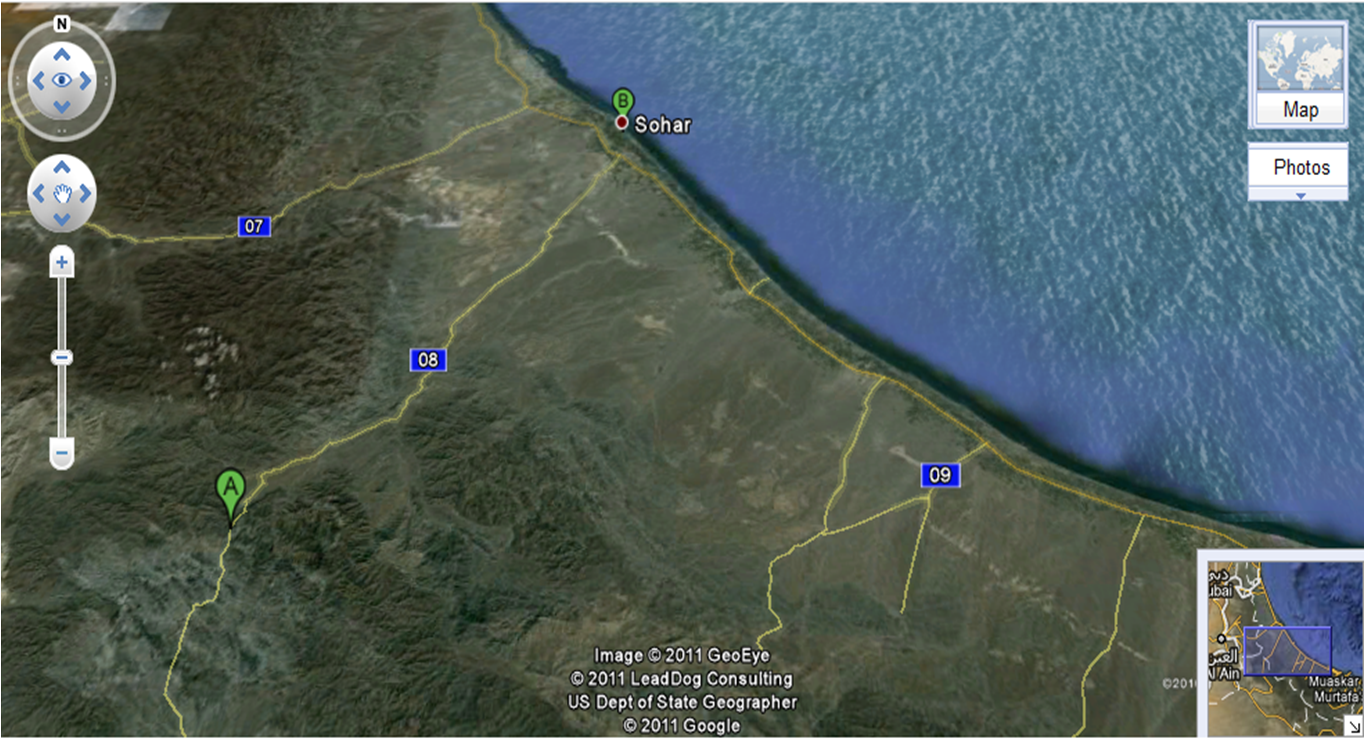
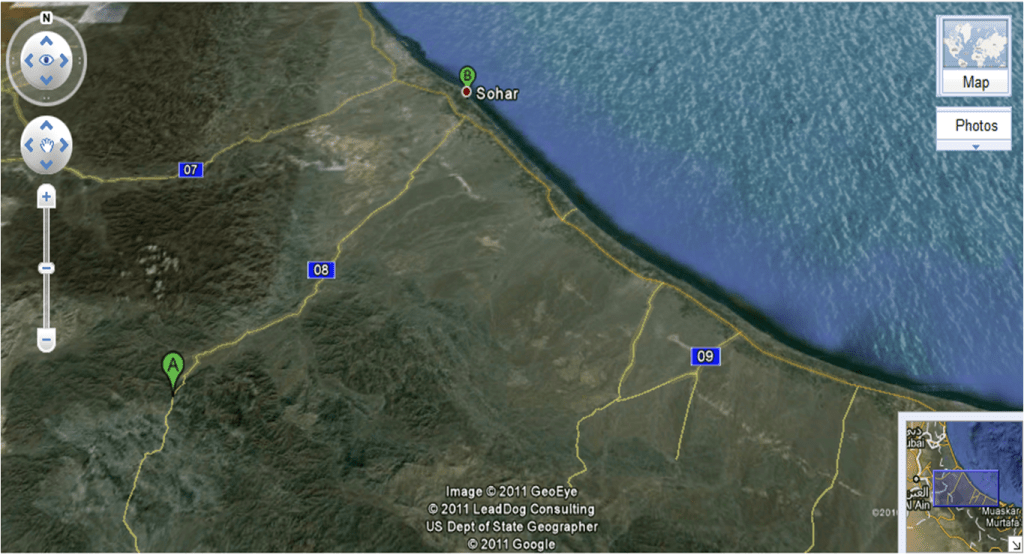
If you’re ever in Oman and want to visit the Beer Jam sign, here are some Google Maps showing the road from Al-Wuqbah (A) to Sohar (B):
The road from Al-Wuqbah to Sohar. Click to enlarge. Google Map showing the road relative to Muscat. Click to enlarge.
Reference: Sczabo et al., 1995. Age of Quaternary pluvial episodes determined by uranium-series and radiocarbon dating of lacustrine deposits of Eastern Sahara. Palaeogeography, Palaeoclimatology, and Palaeoecology, vol. 113: 227-242.
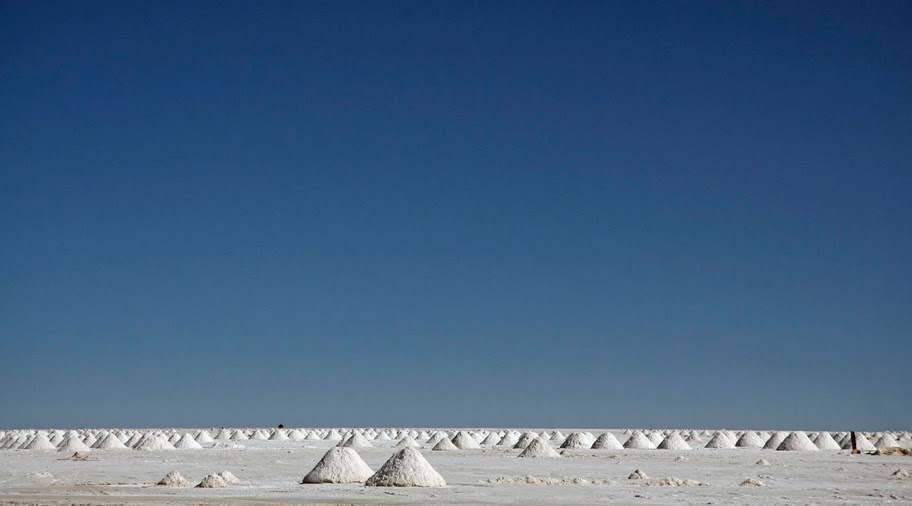
Piles of salt ready to be collected at Salar de Uyuni, Bolivia. Photo courtesy of Tannis McCartney. Click photo to enlarge.
def. Halokinesis:
1. The movement of salt and salt bodies. The study of halokinesis includes subsurface flow of salt as well as the emplacement, structure, and tectonic influence of salt bodies. Another term used to refer to the study of salt bodies and their structures is “salt tectonics.”
2. The magical (and non-existent) ability to move salt with your mind.
This week, as usual, I have been asking for suggestions for the Geology Word of the Week on Twitter and Facebook. I find Twitter and Facebook to be great resources– I receive so many great word suggestions. After I select a geology word for the week, I also use Twitter and Facebook to find out more information about the geology word and to find some pictures related to the word. For those of you wondering how useful social networking sites such as Twitter might be for geologists, MJ Vinas of AGU wrote a great post on The Plainspoken Scientist blog titled Why should scientists use Twitter? Of course, Twitter is no substitute for mainstream scientific publications or scientific conferences, but personally I find Twitter a great place to go for geology news and for asking geology-related questions.
If you haven’t noticed already, I work my way through the alphabet for the Geology Word of the Week. For example, for my first geologist’s alphabet, I made my way from A is for Alluvium to Z is for Zanclean. This week I am at the letter H, so I asked for suggestions of geology words beginning with the letter H. As usual, I had many wonderful suggestions of geology words. However, I was particularly struck by Brian Roman‘s suggestion on Twitter of the word “halokinesis” as I had never heard of this word before, and it sounded– to me– like some psychic pseudoscience nonsense. Here is the twitter exchange I had with Brian this morning:
Well, I was intrigued. So, I did a little bit of research on the word “halokinesis,” both the scientific definition and the pseudoscientific definition.
Scientifically, halokinesis is the movement (-kinesis) of salt and salt bodies. Salt often forms on Earth’s surface as a result of evaporation. Salt is highly soluble, so surface salt deposits are generally ephemeral and short-lived, disappearing with the rain. Significant salt deposits only develop in very dry places. For example, salt deposits form in the hot, dry– and aptly named– Death Valley, California. The world’s largest salt flat is located at Salar de Uyuni, Bolivia.
Salt flat from a distance. Death Valley, California, Fall 2005.Venturing out onto the salt flat. Death Valley, California, Fall 2005.
While salt deposits are somewhat ephemeral and ever-changing on Earth’s surface, salt deposits become somewhat more stable when they are buried. Salt is often found in subsurface sedimentary sequences. However, even when buried salt deposits can move. Furthermore, subsurface salt deposits can move in quite strange ways. Normal sediments contain a large amount of pore space, so as they are buried and transformed into sedimentary rocks, they tend to compress and increase in density. Salt deposits, on the other hand, do not contain much pore space, so their density does not increase significantly as they are buried. Because salt deposits tend to be less-dense than the surrounding sedimentary rocks, these salt deposits tend to deform and migrate, moving in a fluid-like manner– almost like magma or the plastic aesthenosphere– and forming structures such as diapirs and domes. Because oil is often found above subsurface salt deposits, there is much interest in better understanding how salt deposits form and migrate in the subsurface.
Seismic image showing salt diapirs on the Brazil margin. Image courtesy of Peter Clift.Seismic image showing salt bodies in the Gulf of Lions, France. Image courtesy of Peter Clift.
Both surface and subsurface salt deposits are often mined for salt and other evaporite minerals. However, the mining of salt deposits must be done carefully as salt dissolves easily in water, and therefore the presence of water can destabilize salt deposits. Most salt mining is relatively straightforward, but the potential danger was highlighted in a disaster at the Jefferson Salt Mine, which operated underneath Lake Peigneur in Louisiana. As I mentioned above, oil is often found above subsurface salt deposits. On November 20th, 1980, Texaco was drilling into Lake Peigneur to search for oil above the salt deposit. Due to an error, the 14″ drill bit accidentally breached the subsurface salt mine, and water began leaking down into the mine. As the salt deposit and surrounding sediment dissolved and were washed away, the original drill hole was enlarged. An enormous whirlpool developed in the lake as water poured down into the salt mine. When most of the lake water had drained into the hole, a canal that normally drained to the Gulf of Mexico actually reversed direction and continued providing water to the whirlpool for several days.
Here’s a video with images and more information about the Jefferson Salt Mine disaster:
Pseudoscientifically,”halokinesis” is the ability to move salt with your mind— with magical psychic abilities, I guess. First and foremost, let me say that all telekinesis (also called “psychokinesis”)– the ability of a person to move or manipulate objects with their mind– is complete nonsense. There is no scientific evidence at all that people can manipulate objects with their mind. But don’t take my word for it. Listen to my friend James Randi explain how simple magic tricks can look like telekinesis:
I don’t know about you, but I think that a simple magic trick to explain the motion of a salt shaker on a table makes much more sense that calling upon some strange supernatural magic or exception to fundamental physics.
Halokinesis is the psi ability to manipulate salt. One with this power could dehydrate another person (or occasionally rocks). Theoretically one with this power could control water of the ocean (salt water) as well. With the salt thoroughly dissolved, it could be extracted or used to help control the water.
Wow- that’s quite the telekinetic power! Can you imagine becoming angry with someone and then dehydrating them? Ouch. And how wonderful would it be to use such powers to desalinate ocean water? That would certainly help with freshwater shortages all over the world. I’m a little confused, though, about the movement of salt to “dehydrate” rocks– aren’t salty rocks, which are generally evaporites, generally already dehydrated? Come to think of it, how can you dehydrate a person by moving salt? Do you add salt to the person?
I must say that I am extremely skeptical of halokinesis. As Randi is fond of saying, “Everyone who believes in telekinesis, raise my hand.” Or, in this case, “Everyone who believes in halokinesis, dehydrate me.” Go on. I dare you.
I think that’s enough pseudoscience. Back to some real science.
Here are a few more salty pictures from Death Valley and Salar de Uyuni:
Salt flat reflection. Death Valley, California, Fall 2005.Striking a post on the salt flat. Death Valley, California, Fall 2005.Shoes become cumbersome on a salt flat. Death Valley, California, Fall 2005.Salar de Uyuni Salt Flat, Bolivia. Photo courtesy of Tannis McCartney. Click photo to enlarge.Another view of Salar de Uyuni, Bolivia. Photo courtesy of Tannis McCartney. Click photo to enlarge.A block of salt at Salar de Uyuni, Bolivia. Photo courtesy of Tannis McCartney. Click photo to enlarge.
When I asked for pictures of salty things, my friend Peter Clift sent me on a Google Earth quest to investigate the Great Kavir salt diapir, which is located at 34° 40.007’N 52° 13.732’E in Iran. You should go check out that location on Google Earth– the diapir as well as nearby the nearby Namak Lake salt flat are quite impressive.
Google Earth image showing the Great Kavir salt diapir and the Namak Lake salt flat in Iran. Click image to enlarge.An aerial photo of the Great Kavir salt diapir, an eroded salt diapir that has reached the surface. The sediment is all twisted and deformed around the salt column, which breaches the surface in the middle of the photo. The central part is around 5 km across. Image courtesy of Peter Clift.
***Thanks to Brian Romans for recommending this week’s word. Thanks to Peter Clift for the seismic images and for introducing me to the Great Kavir salt diapir in Iran. Thanks to Abdelrhman Selim and Brian Romans for recommending the Hindered Settling post. Thanks to Anne Jefferson for information and a video about the Lake Peigneur salt mining disaster. Finally, thanks to Tannis McCartney for pictures of the Salar de Uyuni salt flat.***
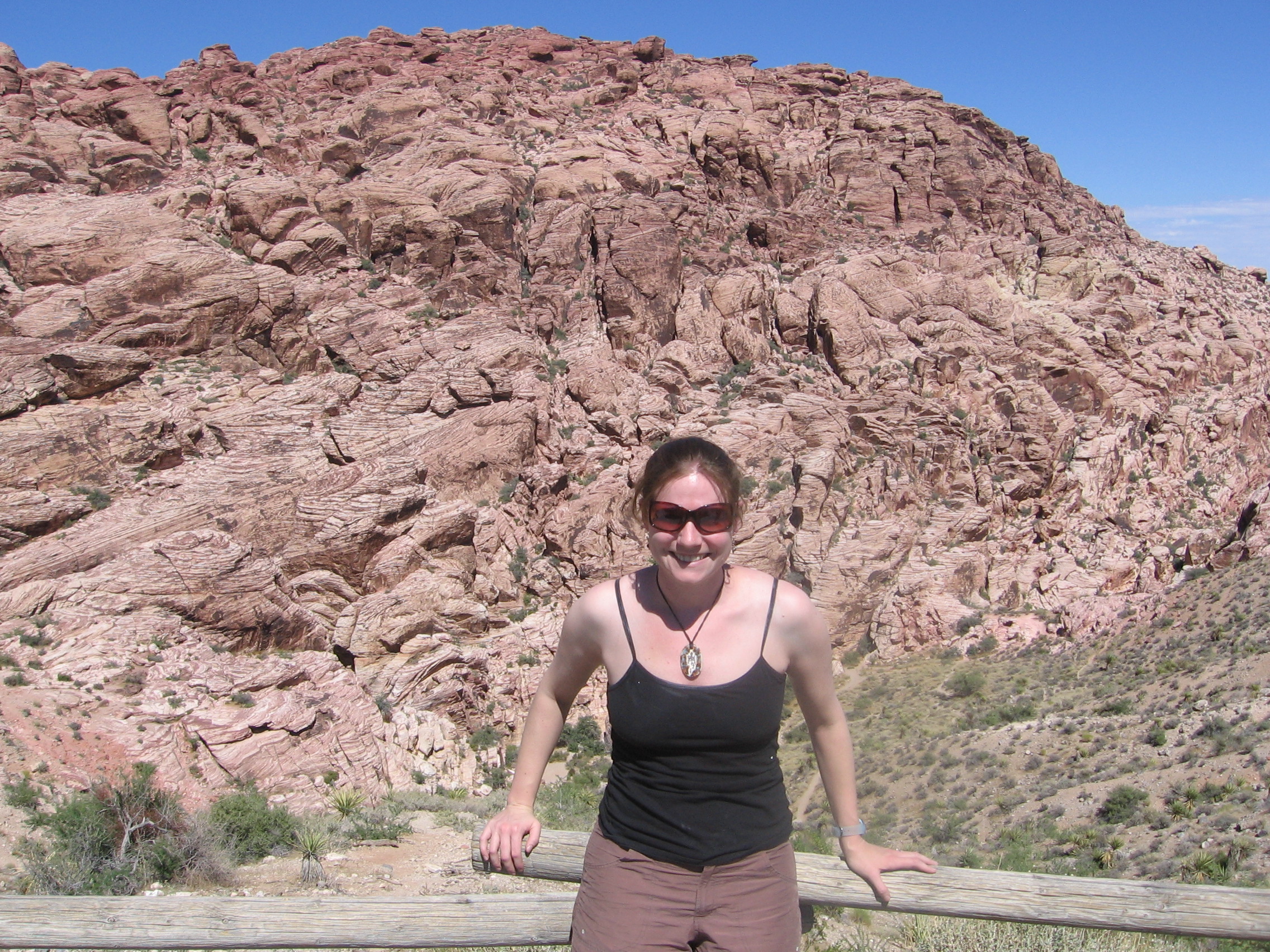
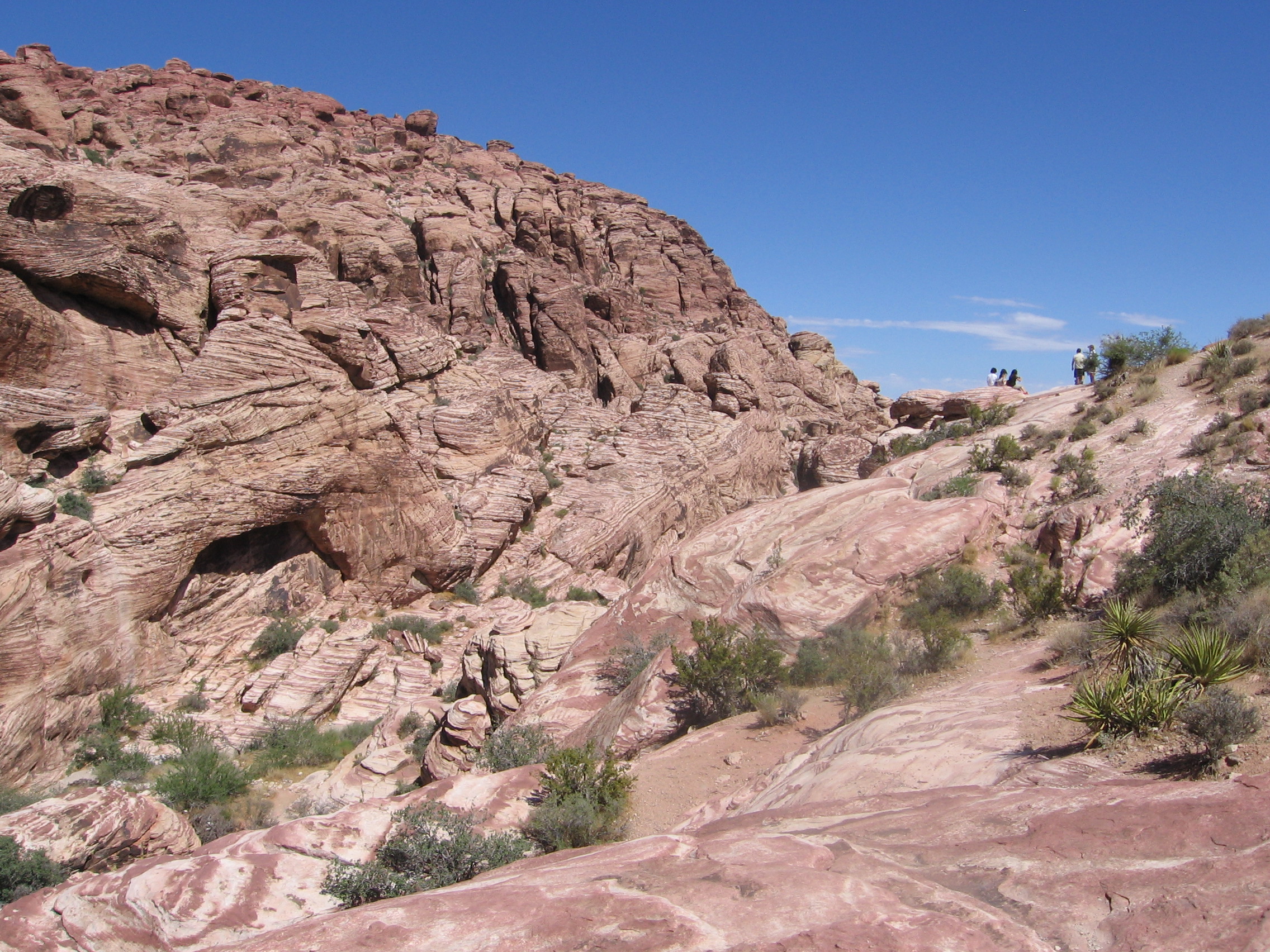
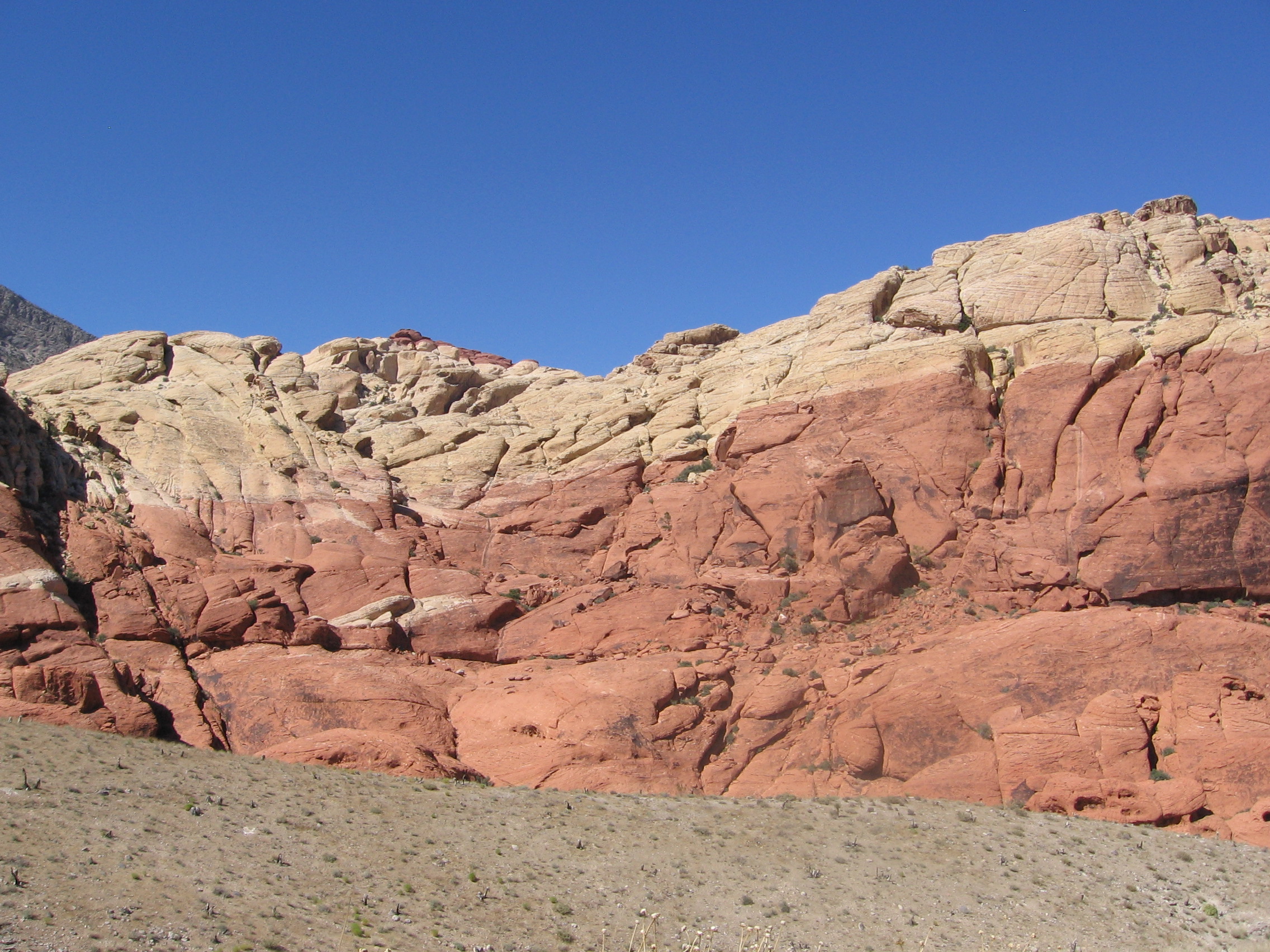
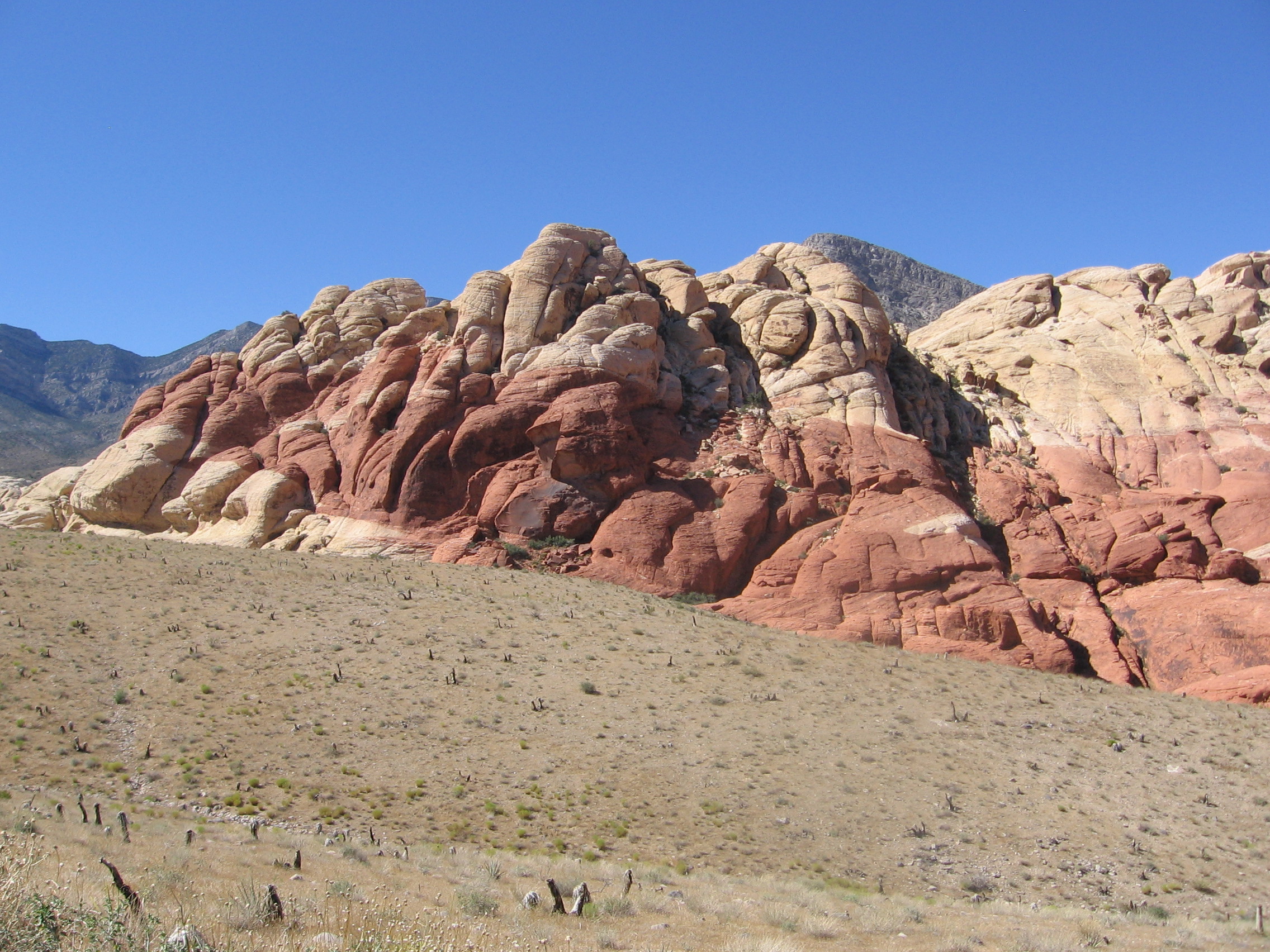
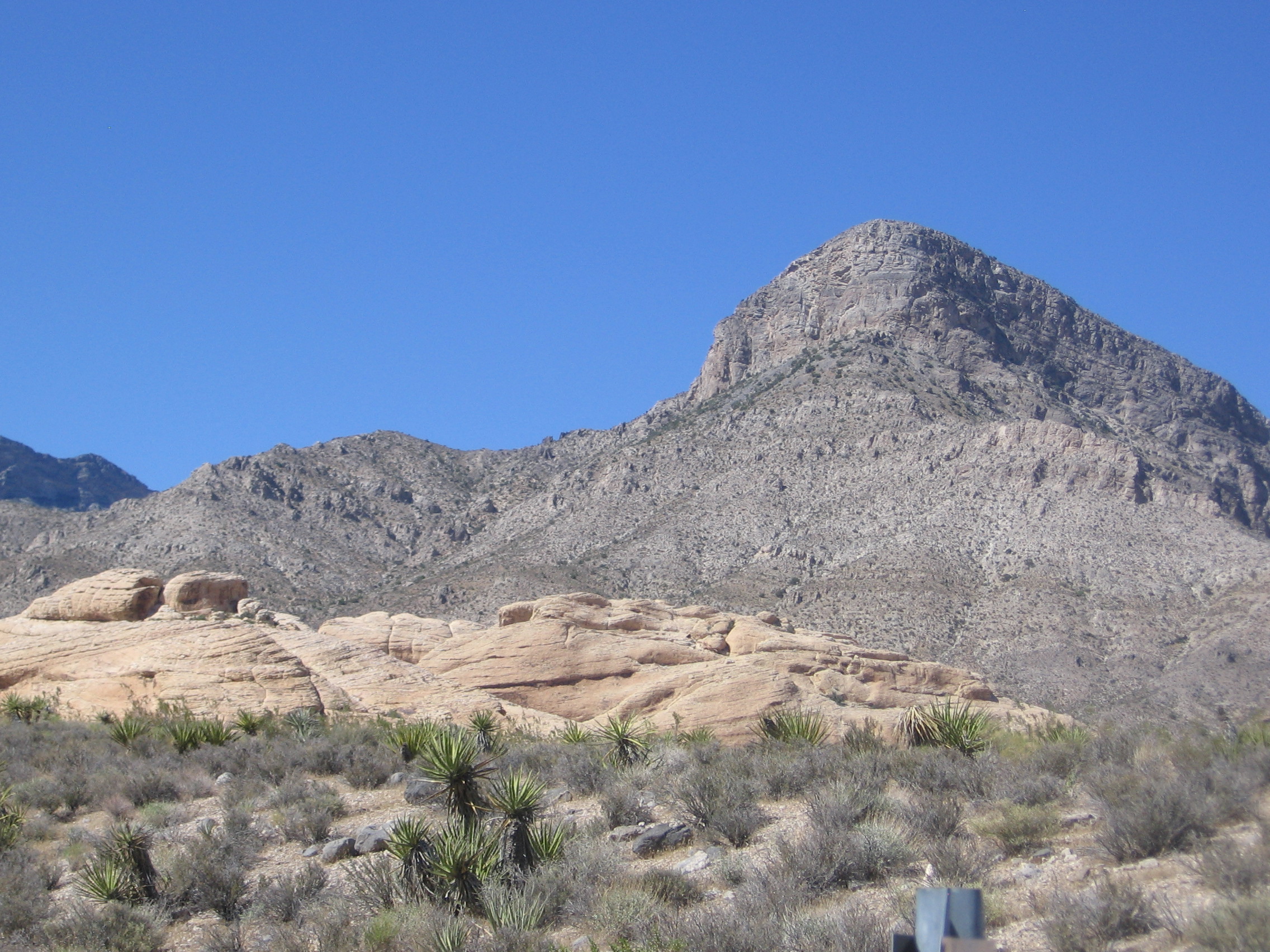
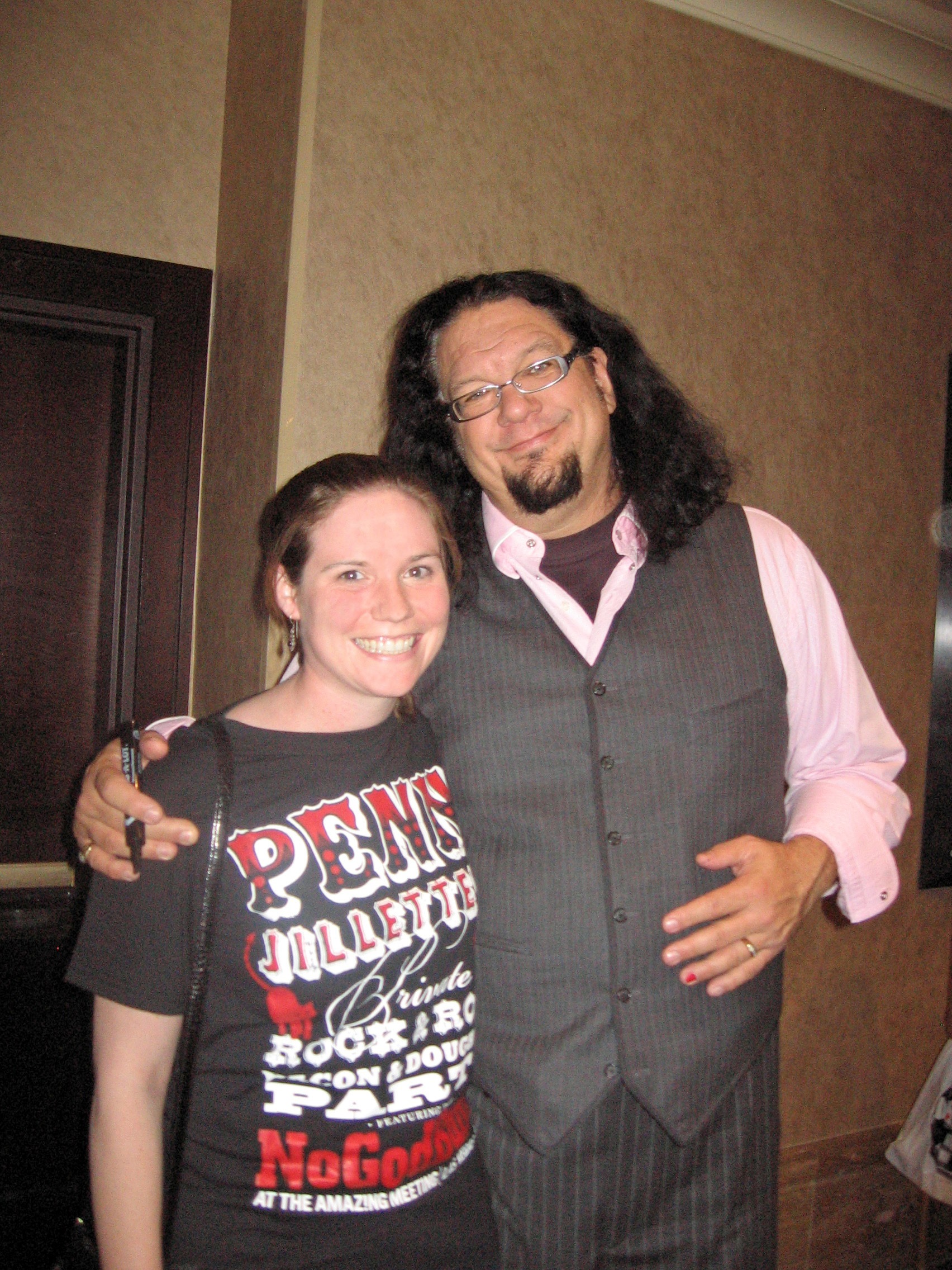
This past weekend I attended The Amaz!ng Meeting 9 in Las Vegas, Nevada. On Sunday some friends and I drove out to Red Rock Canyon just outside Las Vegas. Red Rock Canyon has some amazing geology– I’ll write up a post about the geology in the next week or two. For now, here are some pretty pictures of rocks… plus a bonus picture of magician Penn Jillette and I.
View from the Visitor's Center. Looking back towards Las Vegas.Enormous cross-bedding in the Aztec Sandstone.Standing in front of some sandstone cross-bedding.Iron oxide concreations in sandstone, with foot for scale. Another view looking back towards Las Vegas.Another picture of me with beautiful sandstone cross-bedding in the background.More sandstone cross-bedding!Gorgeous red and white sandstone. More red and white sandstone. A closer look at the red/white boundary. Enormous fossilized sand dunes, with person for scale (lower right corner).500 million year old limestone on top of 200 million year old sandstone-- what a fault!Another stunning view of the Aztec Sandstone. Another look back towards Las Vegas.Looking closely, you can see the casino where I stayed (South Point). I took a closer look through the binoculars... Sure enough! That's the South Point Casino-- the big yellow building.Bonus picture! Penn Jillette and I.
Glomeroporphyritic basalt from Ontario, Canada. Image courtesy of Ron Schott.
def. Glomeroporphyritic:
A textural term used to describe igneous rocks that contain clusters of phenocrysts, which are large crystals in a finer-grained matrix or groundmass.
Glomeroporphyritic is one of my favorite geology words. I love this word because it’s such a funny, complicated-looking word, and it’s so much fun to say. Sometimes, I manage to say “glomeroporphyritic” perfectly. Other times, I stumble over the tongue-twister of the word, saying something like “glomeroporphaglomeroporphyryyitic” before taking a breath and slowly, deliberately saying, “glomeroporphyritic.”
The word “glomeroporphyritic” is a modification of the word “porphyritic,” which is a textural term used to describe igneous rocks that have large crystals in a finer-grained groundmass. How do porphyritic igneous rocks form?
How to porphyritic igneous rocks form? They generally form when magma that has been slowly cooling for a long time, possibly in a magma chamber, is suddenly erupted to Earth’s surface. Deeper in the Earth where magmas can cool more slowly, large crystals have time to form and grow. Magma takes awhile to crystallize completely, so sometimes partially-crystallized magmas are brought to Earth’s surface and erupted as lavas. When these partially-crystallized lavas are erupted, the rest of the molten rock cools quickly, and there is no time for large crystals to form.
Here are a couple of pictures of regular porphyritic rocks:
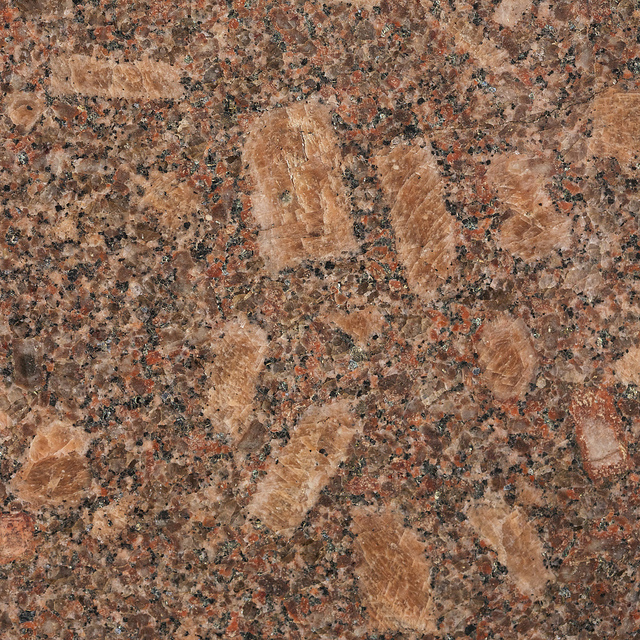
Porphyritic granite. Photo courtesy of Ian Stimpson. A rhomb porphyry (porphyritic trachyte) from the 'Sande cauldron', in the Oslo Graben, Norway. Image courtesy of Ian Stimpson.
Unfortunately, “glomeroporphyritic” is not in the Oxford English Dictionary, so I’m not sure when the word was first adopted into the English language (anyone know?). The word “porphyritic” was first used in English in the late 1700s and comes from the Latin word “porphyrites,” which comes from the Greek word for purple and was used by ancient Romans to describe a purple-colored (and apparently porphyritic!) stone found in Egypt and used as a building stone.
The prefix “glomero-” is also of Latin origin, coming from the Latin “glomerat-“, which is the participial stem of the verb “glomerare,” which means“to form into a ball or mass” or “to collect.” So, a glomeroporphyritic rock is a rock which contains balls or collections of phenocrysts. As an aside, I have just discovered that “glomerate” is a real word in English, and I think it’s my new favorite verb. I’m actually headed off to a meeting tomorrow, and I think I’m going to say to people, “Hey, shall we glomerate over there?” just for fun. It’s a nerdy meeting, so I think people will like the word “glomerate.”
There are two other geology words which are related to the word “glomeroporphyritic.” The first word is “glomeroporphyroclast,” which describes a cluster or collection of phenocrysts. Although the word contains the singular “clast,” the term really describes a collection of crystals. Actually, the “-clast” suffix is a misnomer. Technically, a “clast” is a rock fragment found in a sedimentary rocks. Glomeroporphyroclasts don’t really contain clasts at all– they contain phenocrysts. So, I think the term should really be “glomeroporphyrocryst,” but as far as I can tell no one uses that. The second word is “glomeroporphyroblast,” which describes a collection of “blasts,” which are large crystals found in a finer-grained matrix in a metamorphic rock. For more on crysts, clasts, and blasts, see this “About Geology” article.
You might be wondering– do geologists actually use these fun but complicated words? Absolutely. A quick search of the GeoRef database returns 52 papers when I search with the term “glomeroporphyritic.” If you google the term “glomeroporphyritic,” you will find numerous scientific papers and reports which include the word as a textural description for rocks. I suppose geologists could just say something like “clumps of crystals” or “globs of phenocrysts,” but “glomeroporphyritic” is such a fun word! I’ve even used the word in my own research to describe globs of plagioclase phenocrysts in basalts.
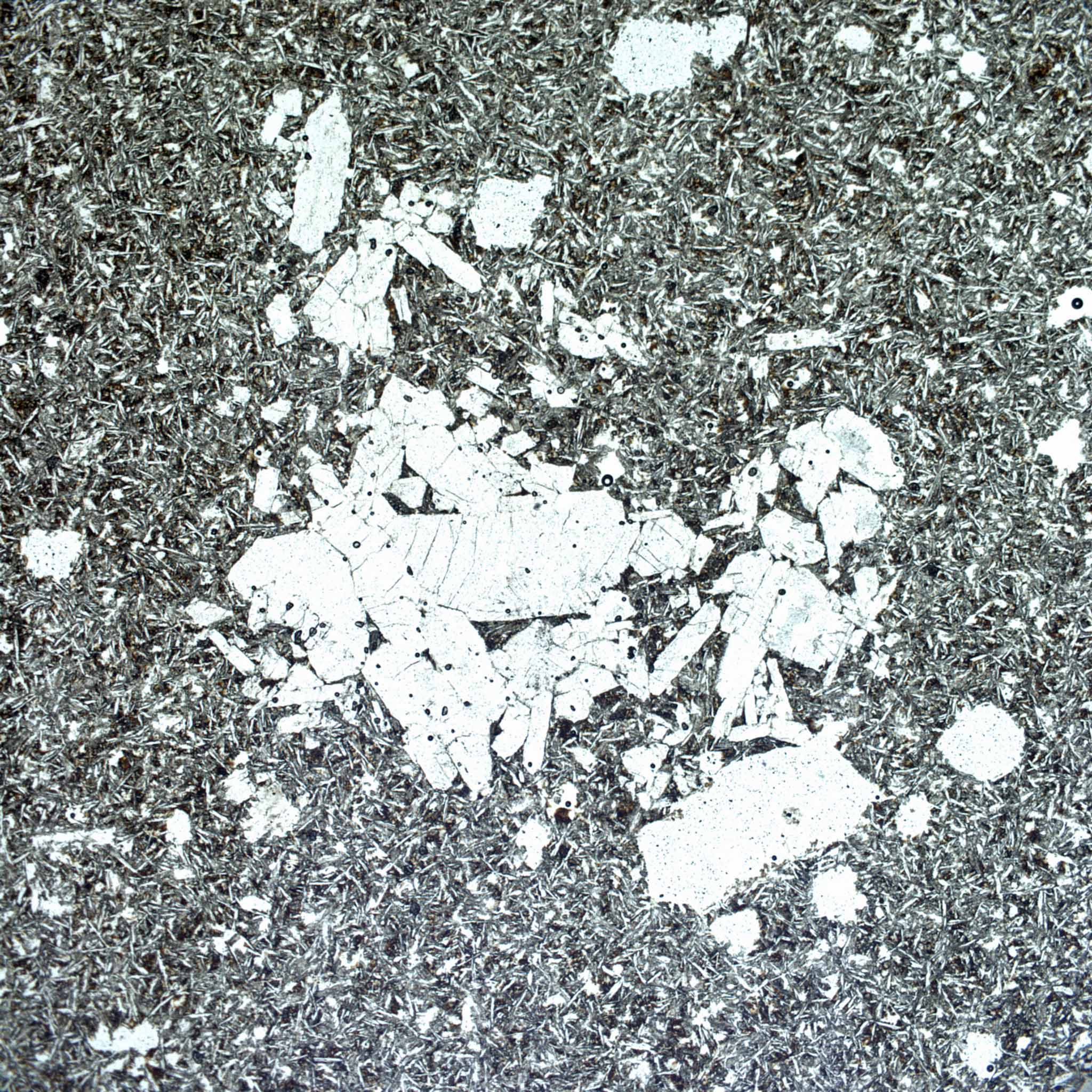
For example, below are some pictures of a geologic thin section which I described as having glomeroporphyroclasts of plagioclase phenocrysts:
Plagioclase glomeroporphyroclast (-cryst) in basalt. Thin section viewed through a microscope under plane light. Sorry there's no scalebar!Plagioclase glomeroporphyroclast (-cryst) in basalt. Thin section viewed through a microscope under cross-polarized light. Sorry there's no scalebar!
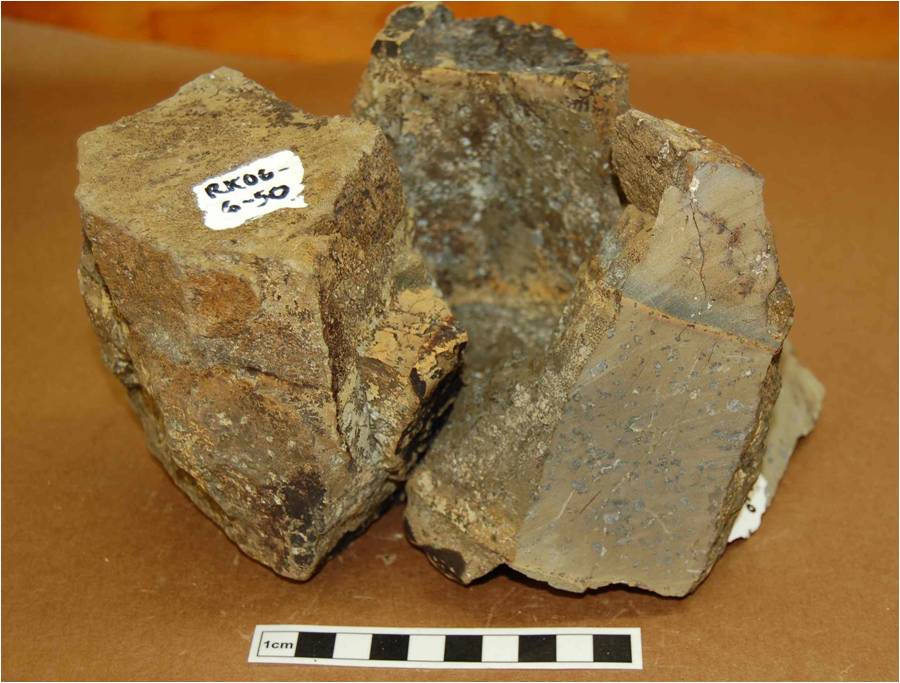
The thin section pictured above came from a porphyritic basalt collected along the Ninetyeast Ridge in the Indian Ocean. In hand sample, the basalt looked something like this (not the same rock, but similar):
Porphyritic basalt with phenocrysts of plagioclase. Collected along the Ninetyeast Ridge, Indian Ocean in 2007.
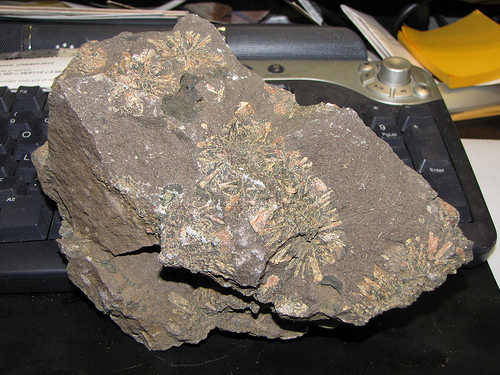
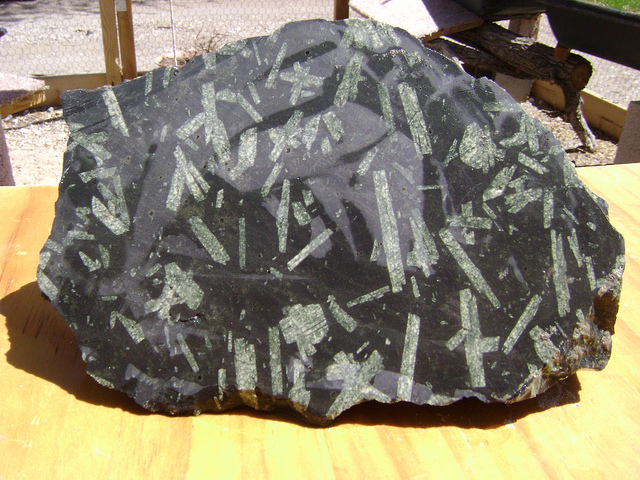
Finally, back in May I identified (with the help of some fellow geologists!) a “Mystery Rock” with gorgeous plagioclase phenocrysts. This mystery rock has slight glomeroporphyritic texture– some of the phenocrysts look as if they are clumping together. The owner of this mystery rock actually decided to name her rock “Glomer.” You can see some more photographs of Glomer the rock here.
Plagioclase phenocrysts in the "Mystery Rock."
***Note: Thanks to Ron Schott and Ian Stimpson for pictures for this week’s geology word of the week.***
References:
“glomerate, n.” The Oxford English Dictionary. 2nd ed. 1989. OED Online. Oxford University Press. 13 July 2011.
“porphyritic, n.” The Oxford English Dictionary. 2nd ed. 1989. OED Online. Oxford University Press. 13 July 2011.
“porphyrite, n.” The Oxford English Dictionary. 2nd ed. 1989. OED Online. Oxford University Press. 13 July 2011.
This is just a quick post to let you know that I have a guest blog article on Scientific American today. A few months ago, just after the Fukushima interviews with my dad, I thought it would be interesting to do a little research and write up an article on the 2-billion-year-old nuclear reactors in Gabon, Western Africa. I took a few months to get around to writing up the article (busy with graduate school!), but it is finally available today. I hope you head over to the Scientific American guest blog to check it out.






























 Georneys