LASI V: Xeno-Pumice– Mysterious Floating Rocks of the Canary Islands

Note: Dr. Steffi Burchardt, a senior lecturer in Structural Geology at Uppsala University in Sweden, presented a talk, “Xeno-pumice erupted offshore El Hierro, Canary Islands: A tale of stoped blocks in magma chambers?” at the LASI V workshop in Port Elizabeth, South Africa in October 2012. The article below is based on this talk and also an interview with Dr. Burchardt. Over a few weeks, I am highlighting some of the research that was presented at the LASI V workshop. This is the second post in that series.

Following a period of intense seismic activity, on October 10th, 2011 a submarine eruption began approximately 1 kilometer off the coast of El Hierro, the youngest and westernmost island in the Canary Islands, which is a group of volcanic islands believed to have been formed through hotspot volcanism. The eruption was evident from the unusual conditions on the sea surface: the sea bubbled, like a Jacuzzi, and was stained green. The large green stain was easily observable from space. In the midst of these strange conditions, some highly unusual rocks were erupted. For several days after the sea started bubbling, strange floating rocks were observed and collected off the coast of La Restinga, the closest town to the undersea eruption. These floating stones were generally tens of centimeters in size and resembled lava bombs in shape. The outsides of these floating rocks consisted of basanite , a rock type commonly observed in the Canary Islands and other volcanic ocean islands. Basanites don’t generally float. However, these basanite shells floated because their insides were filled with a white to light grey, pumice-like material. Pumice is a highly vesicular rock, which means that it is a rock full of voids or bubbles, which make the rock light enough to float on water.

Figure showing the green stain on the sea during the early days of the 2011 El Hierro eruption. Figure from Troll et al., 2012.
A restingolite bomb with a basanite crust and a white, pumice-like interior. Photo courtesy of Dr. Steffi Burchardt.

While the pumice-like centers explained why the rocks floated, they also raised a multitude of questions and triggered some heated debates amongst geologists. This is because pumice is not commonly produced in the Canary Islands* or in other oceanic island hotspot environments, such as Hawaii and Iceland. The lavas erupted at oceanic island hotspots are generally mafic, low viscosity lavas such as basalts (and basanites). Viscosity is, in essence, a measure of how resistant lava is to flowing. The less viscous a lava, the more likely that lava is to flow. Therefore, low viscosity lavas such as basalts tend to flow easily and also tend to regularly release volatiles such as water and carbon dioxide. Therefore, the pressures in these lavas remain relatively low, and violent eruptions are uncommon. Pumice is most commonly produced during eruptions of felsic, highly viscous, volatile-rich lavas, which are found in environments such as island arcs, not oceanic island hotspots. The voids or bubbles in pumice represent places where volatiles have been rapidly released due to a pressure change, often during a violent eruption.

So, what was pumice-like material doing in an oceanic island eruption? A number of theories were put forward to try to explain the floating rocks that were erupted off of La Restinga. Some scientists thought the pumice-like material represented juvenile, highly silicic, highly viscous magma (such as rhyolite), which is very explosive. Other scientists proposed that the pumice-like material represented re-melted magmatic material, altered volcanic rock, or reheated hyaloclastite or zeolite from the slopes of El Hierro. Mysterious in origin, the floating stones were called “restingolites” after the nearby town of La Restinga.

After extensive analysis, a group of scientists (Troll et al., 2012) proposed an alternative hypothesis to explain the pumice-like material found in the restingolites. Based on the material’s high silica content, lack of igneous trace element signatures, and high oxygen isotope values as well as the presence of remnant quartz, jasper, carbonate, and wollastonite, Troll et al. concluded that the pumice-like material in the restingolites in fact represented xenolithic material from pre-island sedimentary layers that were picked up and heated by ascending magma, which caused the layers to partially melt and bubble. Looking like pumice and originating as xenoliths, Troll et al. dubbed the restingolites “xeno-pumice”.

Dr. Burchardt elaborates, “Xeno-pumice is definitely not an established term. We have coined it for the first time in the case of El Hierro eruption. The name comes from adding the preface ‘xeno-‘, which means foreign, to ‘pumice’. We used this term because the floating rocks of El Hierro present the characteristics of pumice, but they are actually not pumice in origin; they are actually xenoliths. We found out, based on mineralogy and also the fact that they contain detrital sand grains and fossils, that they are actually not magmatic in origin but rather that they are xenoliths from the sedimentary layers that underlay the Canary Islands. So, they are older than the volcanism. When the magma was rising, it stagnated at this level and interacted with the sedimentary rocks, sandstone and minor carbonate, and the magmas transported the xenoliths up with them to the ocean floor, where they were erupted. But in the process of the ascent of these xenoliths, they were subject to heat from the magma, so they started to melt. Since they contain a lot of water, this water started to boil and formed bubbles. The end product was something that looked like a pumice: lots of bubbles surrounded by a glassy matrix.”
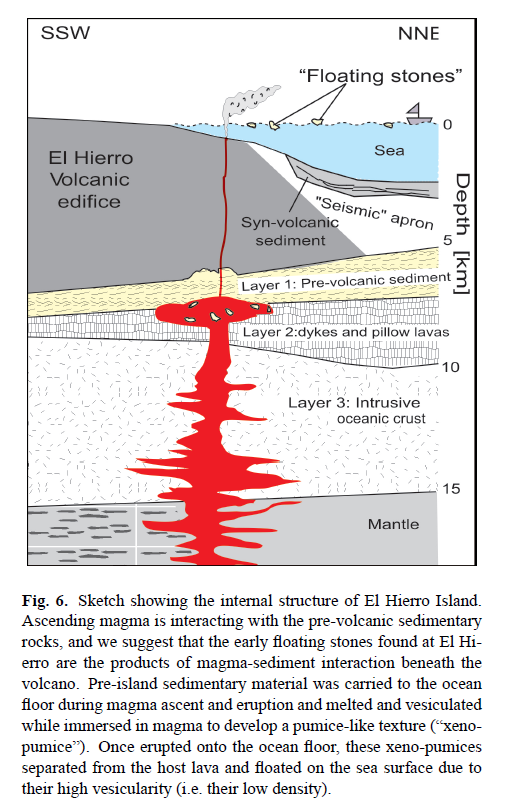
Schematic from Troll et al. 2012 illustrating how the El Hierro restingolites may have formed.

Even though xeno-pumice was not a known rock type before the 2011 El Hierro eruption, Dr. Burchardt and her colleagues think that xeno-pumice may actually be a common—if not commonly recognized—rock type in other parts of the world.

Dr. Burchardt explains, “The El Hierro eruption was a very fortuitous circumstance for our work because my colleagues and I had been working on similar rocks from volcanoes worldwide, but that they were not previously recognized as xeno-pumice. The El Hierro eruption was therefore some kind of a breakthrough for our research in this field, and there will be a whole series of papers dealing with xeno-pumice from different parts of the world.”

By November, the xeno-pumice rocks were no longer being erupted, and worries that a dangerous, explosive eruption could occur at El Hierro abated. The identification of the restingolites as xeno-pumice was also good news for the hazard risk at El Hierro.

Dr. Burchardt explains, “It was good news that these xenoliths are sedimentary in origin because it means that there is no rhyolitic magma beneath the island, which means that a big explosive eruption isn’t likely.”

While the xeno-pumice rocks do not carry the message that an explosive eruption is likely to occur at El Hierro, they do carry other important messages from the deep. The unusual xeno-pumice rocks observed erupting at El Hierro in 2011 can provide much direct information about the interaction of magma and oceanic sediments and also may indicate that recycling of oceanic sediments into magma is an important process at ocean islands. Further study of xeno-pumice from the Canary Islands—and also from other parts of the world—will go a long way towards helping geologists better understand how volcanic eruptions at ocean islands interact with oceanic crust and sediments as they make their way to the surface.


*Update: Commentor Siim Sepp points out that intermediate composition pumice is found on the Canary Islands, most notably on the island of Tenerife. This is a very good point. I have perhaps oversimplified the explanation– pumice can be found at volcanic ocean islands under certain conditions. Thanks for pointing this out, Siim!

Reference:

Troll, V.R., Klügel, A., Longpré, M.-A., Burchardt, S., Deegan, F. M., Carracedo, J. C., Wiesmaier, S., Kuepper, U., Dahren, B., Blythe, L. S., Hansteen, T., Freda, C., Budd, D., Jolis, E. M., Jonsson, E., Meade, F. C., Harris, C., Berg, S. E., Macini, L.,  Polacci, M., and Pedroza, K. 2012. Floating stones off El Hierro, Canary Islands: xenoliths of pre-island sedimentary origin in the early products of the October 2011 eruption. Solid Earth, Vol. 3: 97-110.

Accretionary Wedge #42: Countertop Geology

My friend's front entryway in Abu Dhabi. Can you spot the xenolith?

Ian Saginor of the blog Volcanoclast is hosting this month’s accretionary wedge, and this month’s theme is countertop geology!

Here’s the call for posts:

Have you seen a great countertop out there? Sure, everyone says it’s “granite”, but you know better. Take a picture, post it on your own blog or send it to me and I’ll post it for you. Do you think you know what it is or how it was formed? Feel free to include your own interpretation and I’m sure others will enjoy joining in the discussion. Ron Schott suggested that we expand the entries by including any decorative stone material that has been separated by humans from its source. This includes buildings, statues, etc. There’s a lot of really unusual stuff out there, so make sure to find a good one.

I think this is a great topic for an accretionary wedge! Anyone who has spent any amount of time with me knows that I am constantly looking at stone countertops, floors, walls, statues, and pretty much anything else made out of rock.  Actually, I just visited by good friend Karima in Abu Dhabi, and she and her husband laughed at how I inspected the walls of all of the buildings we visited. I couldn’t help myself– there is some spectacular building stone to be found in Abu Dhabi. I was particularly impressed with all of the amazing building stones used in the Sheikh Zayed Mosque and the Emirates Place Hotel. My friend Karima actually joked that when we visited the Emirates Palace hotel and ate our gold-flaked dessert, I kept looking at the floors and walls rather than enjoying the spectacular ocean and city views. However, I’m actually planning to share pictures of those two buildings in other posts. For this accretionary wedge post, I’m actually going to share some pictures of my friend Karima’s front entryway to her house in Abu Dhabi.

Karima and her family live in a lovely two-story house (with a rooftop balcony) in Abu Dhabi. In front of their house, they have lovely slabs of granite decorating their front steps and entryway. They also happen to have a dark-colored xenolith just in front of their front door! The xenolith caught my eye as soon as I arrived at their house, and it actually reminded me very much of the dark-colored xenoliths I often observe in the Cape Granite here in Cape Town.

Here are some pictures of my friend’s front entryway xenolith:

Dark-colored xenolith in granite.
And here's one with my hand for scale.

And here’s a picture of a similar looking dark-colored xenolith in the Cape Granite here in South Africa:

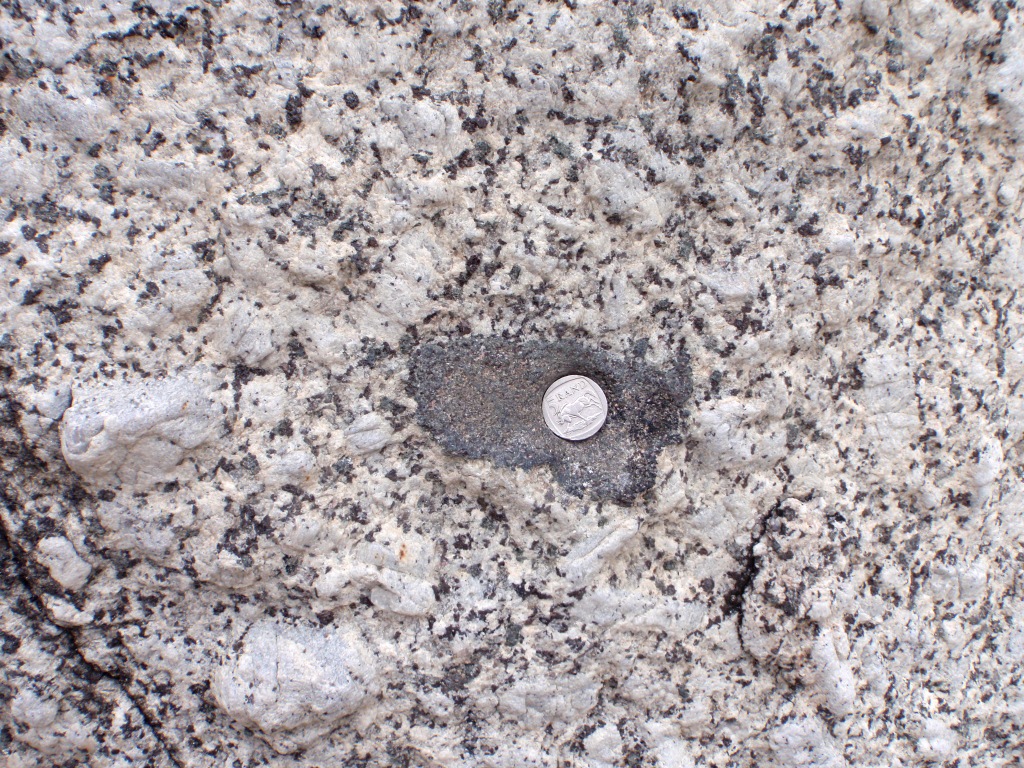
A similar looking dark-colored xenolith in the Cape Granite here in South Africa.

You may recognize the above picture as it was this week’s Monday Geology Picture.

Monday Geology Picture: A Dark-Colored Xenolith in the Cape Granite

A little dark-colored xenolith (isn’t it adorable?) in Cape Granite, Clifton Beach, Cape Town, South Africa, October 2011.

I’m back home in Cape Town, so I thought I’d post a local picture for this week’s Monday Geology Picture. The above picture shows a small, dark-colored xenolith in the Cape Granite, a 550 million year old granite that has megacrysts (very big crystals) of feldspar. This xenolith is most likely a small piece of the Malmesbury Group, an older group of rocks that consists of alternating grackwacke sandstone and slate that have experienced significant uplift and metamorphism. The above xenolith was observed at Clifton Beach, a fancy beach area known for its bright white beaches which result from the weathering of the Cape Granite. Abundant xenoliths, such as the one above, can be observed in the granite boulders at Clifton Beach. I took the above picture when we took my husband’s cousin around to look at a few geological sites in the Cape Town area .There is a 5-Rand South African coin for scale in the picture; this coin is slightly smaller than an American quarter.

I have a few thesis deadlines looming, so for the next 2-3 months as I prepare for my thesis defense this blog may consist mostly of short picture posts. If time permits, I’ll try to slip in a few geology words and longer posts, but my thesis comes first at the moment. Hopefully the pictures will be enough to tide over my readers as I wrap up this PhD of mine.

Geology Word of the Week: X is for Xenolith

Mafic xenolith, Ontario, Canada, 2002. Photo Credit: Ron Schott.

Note: Sorry for the re-post. This post was lost and then mangled somewhat in the blogger mishap last week. I managed to correct the post, but I had to re-post it under a new day and time.   

def. Xenolith:
A foreign rock inclusion, usually in an igeneous rock.

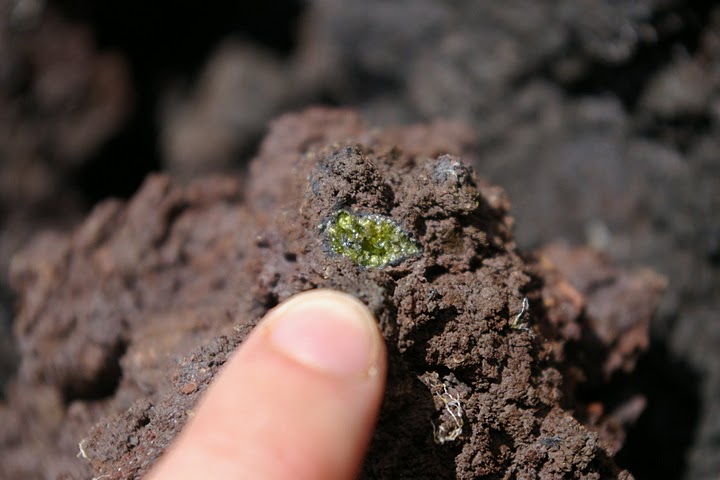
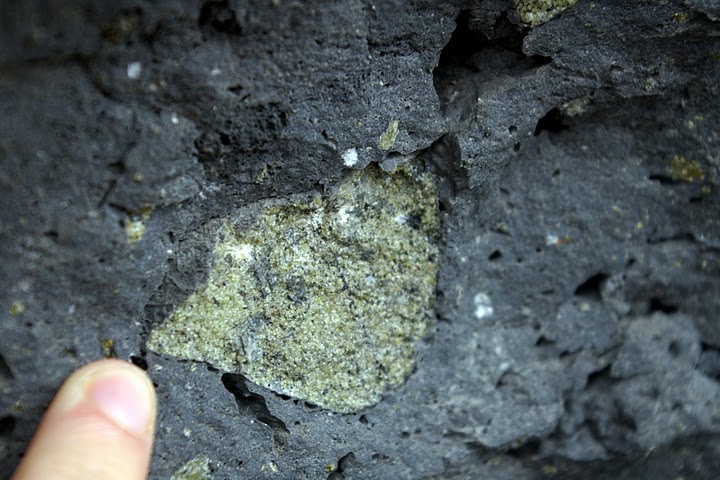
Xenolith literally means “foreign rock” coming from “xenos” (foreign) and “lithos” (stone) in Ancient Greek. A xenolith is a fragment of foreign rock within a host rock. To be considered a xenolith, the inclusion must be different in composition from the enveloping rock. Inclusions of similar rocks are called “autoliths” or “cognate inclusions.”  Xenoliths are generally easy to recognize because they are very different in composition (and often in color) from the encompassing rock. For example, in the picture below the bright green olivine crystals and shiny black pyroxene crystals of a mantle peridotite xenolith stand out in contrast to the fine-grained, gray basalt in which they have been encompassed.

Peridotite xenolith in basalt, Hawaii, 2009. Photo Credit: Einat Lev.

Xenoliths most often occur in igneous rocks. For those of you who are a little rusty on Geology 101, igneous rocks are rocks which form by the cooling and solidification of molten material– either magma or lava. As magma or lava migrates and cools to form igneous rock, it may pick up inclusions of foreign rock. Where do these foreign rock inclusions come from? There are several possible sources. Often, molten magma intrudes into preexisting rocks (known as “country rocks”) and may pick up fragments of this country rock. Commonly, xenoliths are fragments of the walls of a magma chamber or conduit. Xenoliths may also be picked up by lava during explosive volcanic eruptions or may be picked up by lava as it flows along Earth’s surface (if a different type of rock is at the surface).

The term xenolith is most commonly applied to foreign rock fragments in igneous rocks. However, a broad definition of the word xenolith might include foreign rock fragments in sedimentary rocks and inclusions found in meteorites.

Xenoliths are generally small in size relative to the overall body of rock. However, xenoliths can range in size from single crystals (called “xenocrysts”) to rock fragments of several meters.

A small peridotite xenolith in basalt, Hawaii, 2009. Photo credit: Einat Lev.
“Teboho-size xenolith.” Cape Columbine, South Africa, 2009.
Photo credit: Christie Rowe.

Xenoliths are important because by studying xenoliths geologists can learn about the origin and evolution of the host rock. For example, when an igneous rock contains a xenolith, geologists know that at some point the magma or lava that cooled to form the igneous rock was in contact with that foreign rock. Xenoliths are also important because they often allow geologists to sample and study rocks which are difficult to access. For example, mantle rocks are not generally exposed at Earth’s surface (except at ophiolites), so xenoliths of mantle rocks are important for learning about the composition of Earth’s mantle. Some xenoliths come from very deep within the Earth. For example, diamonds are famous and economically valuable xenocrysts that formed at high pressures and temperatures very deep within the Earth, ~140 km deep or deeper. Diamond are brought to Earth’s surface as xenocrysts in kimberlite rock.

Here are a few more pictures of xenoliths:

Peridotite xenolith in basalt, Hawaii, 2009. Photo credit: Einat Lev.

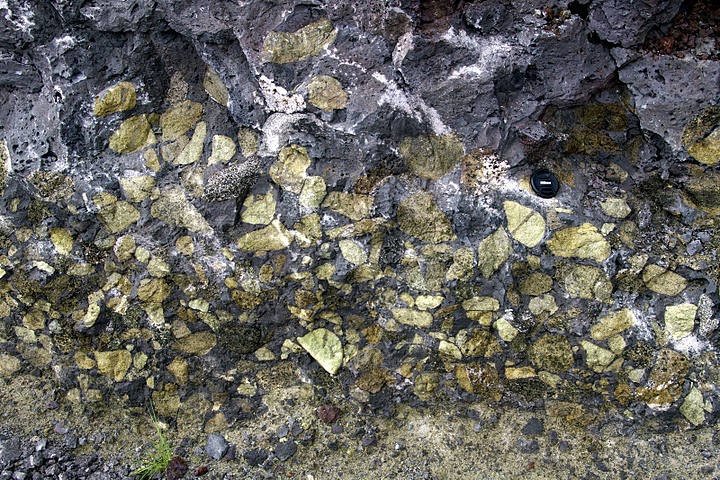
Many peridotite xenoliths in basalt, Hawaii, 2009. Photo credit: Einat Lev.

Xenolith in lamprophyre, Ontario, Canada, 2002. Photo credit: Ron Schott.

Peridotite xenolith collected at Dish Hill Cinder Cone, Mojave Desert. Photo credit: Ron Schott.

Oxidized mantle xenolith collected at Dish Hill Cinder Cone, Mojave Desert. Photo credit: Ron Schott.

Finally, Callan Bentley of the Mountain Beltway blog has a zillion majillion photos of xenoliths on his blogs (Mountain Beltway used to be the NOVA Geoblog):

Xenolith Label on Mountain Beltway

Xenolith Label on NOVA Geoblog

Here is one of Callan’s xenolith pictures that I found particularly striking:

Mafic xenolith in a statue carved from porphyritic andesite, Ankara, Turkey, 2010.
Photo Credit: Callan Bentley. Read more about Callan’s trip to Turkey here.

Thanks to all of my geologist friends and fellow geobloggers who sent me pictures of xenoliths. If you have any good xenolith pictures, post a link below in the comments.