20th Interview with My Dad, a Nuclear Engineer, about the Fukushima Daiichi Nuclear Power Plant Disaster in Japan

You can listen to all the interviews on the new vimeo channel Brandon and I created. You can also listen to most of the interviews on Brad Go’s YouTube channel.

Here’s the vimeo channel:

Brad Go’s YouTube channel: 

This evening my dad and I recorded our 20th interview on the Fukushima nuclear power plant disaster. Please see the rest of the blog (sidebar) for previous interviews. If you would like to send a message to me or my father about this or any of the previous interviews, you can do so in a comment below or by sending an email to georneysblog (at) gmail (dot) com. You can also follow me on twitter @GeoEvelyn.

We thought that we were done with the Fukushima interviews, but because of a number of requests by email and in comments, we decided to conduct an interview tonight to comment on the upgrade of Fukushima from a 5 to a 7 on the International Nuclear and Radiological Event Scale (INES).  My dad highly recommends checking out this IAEA slideshow presentation to better understand this scale and the reason for the upgrade:

My dad also recommends checking out this Associated Press article comparing and contrasting the Fukushima and Chernobyl nuclear disasters:

As a geologist, I also wanted to comment on the recent magnitude 6.6 earthquake that prompted an evacuation and cut off power at Fukushima for the better part of an hour. Any event– such as an earthquake– that could lead to an extended loss of power is potentially quite serious for the Fukushima Daiichi reactors and spent fuel pools at Units 1-4, which remain “static but not stable.”  Fortunately, the recent earthquake only caused a temporary evacuation and loss of power. There is the potential for more aftershocks in coming days, and an unfortunately located aftershock could potentially lead to another power loss.

However, I am a geochemist, not a geophysicist or an earthquake expert, so I am not qualified to speak in too much detail about earthquakes and aftershocks. Fortunately, two of my geophysicist friends came through with some more detailed information and analysis than I can provide. First, I want to direct you to a blog post about the recent Fukushima area earthquakes by geoblogger Chris Rowan.  Second, I want to direct you to a guest post (following this one) on my blog that has some figures and text written by Jean-Arthur Olive, a good friend of mine and a fellow PhD student in the MIT/Woods Hole Oceanographic Institution Joint Program. Thanks so much, Chris and Arthur! If any other geophysicists would like to add anything else, just let me know. I can post more information on my blog and/or post a link to another website. Here are links to the two posts I mentioned above:

In today’s interview:
1. My dad gives an update about Fukushima

2. My dad discusses the upgrade on the INES scale and comments again on the evacuation zone.

Hope to have an audio link soon. Here is the interview on vimeo:

Please see the announcement page for more information about these interviews:

If you have time and interest, please transcribe this interview or volunteer to transcribe Interviews 17, 18, and 19. At this time, we have no plans for future interviews.

A Quick Note: And We Thought We Were Done with the Interviews…

My dad and I wrapped up our regular Fukushima interviews last Saturday, but we did say that if something important happened we would consider commenting on it.

Well, the Fukushima nuclear disaster was just provisionally upgraded from a 5 (Three Mile Island level) to a 7 (Chernobyl level) by Japanese authorities. My dad is not surprised by this upgrade since he has long felt Fukushima to be higher than a level 5. Several people have asked us (begged, even) if we would consider commenting on the upgrade, so we’ve agreed to do another interview tonight. If you have any questions related to recent developments at Fukushima that you would like me to ask my father, we may have time to answer one or two questions. Post them in a comment below or send them to georneysblog (at) gmail (dot) com no later that 5 pm EDT.

19th (and Final) Interview with My Dad, a Nuclear Engineer, about the Fukushima Daiichi Nuclear Power Plant Disaster in Japan

You can listen to all the interviews on the new vimeo channel Brandon and I created. You can also listen to most of the interviews on Brad Go’s YouTube channel.

Here’s the vimeo channel:

Brad Go’s YouTube channel: 

This evening my dad and I recorded our 19th interview on the Fukushima nuclear power plant disaster. Please see the rest of the blog (sidebar) for previous interviews. This is the final interview in our series. If you would like to send a message to me or my father about this or any of the previous interviews, you can do so in a comment below or by sending an email to georneysblog@gmail.com. You can also follow me on twitter @GeoEvelyn. My dad in particular has put an enormous amount of work into research for these interviews. If you would like to send him a thank-you message, I promise to pass it along to him.

In today’s interview:
1. My dad gives a quick update about Fukushima

2. My dad discusses 5 types of Generation III and Generation III+ nuclear power plants (click on links below for more information on each plant):

(a.) EPR AREVA

(b.) APR1400

(c.) AP1000

(d.) ESBWR

(e.) Thorium Reactors

Several links, thanks to a listener also named Mark:

Summary of multiple videos on Thorium reactor, (16 minutes):
One of the better long videos on Thorium reactor, (55 minutes):
A written article on the Thorium fuel cycle:
A written article on the molten salt reactor that the Thorium fuel uses:

(3.) My dad talks about the importance of evaluating spent fuel pool safety & long-term storage of spent fuel rods

Hope to have an audio link soon. Here is the interview on vimeo:

Please see the announcement page for more information about these interviews:

If you have time and interest, please transcribe this interview or volunteer to transcribe Interviews 17 & 18 (16 is in progress). This is our last interview.

Some Final Notes:
As I announced before, I will be compiling all of the interview transcripts into a book that I will be self-publishing on Lulu. My goal is to have this book available by the end of April. I will try to keep the cost of the book fairly low, and I will donate 25% of the book profits to charities (such as the Red Cross, see the sidebar for a list of charities) benefiting Japan earthquake and tsunami disaster relief. The remaining profits I will use to recover some the expenses I had to put forth (paying for several different recording softwares before Skype came forward and helped, a new headset, and video hosting costs on vimeo) over the past month. Anything leftover I will share with my dad, who has put forth a tremendous amount of effort for these interviews. If you would like to support us (and Japan disaster relief), you can buy the book from Lulu when it comes out and/or you can use the paypal button (see blog sidebar) to make a small donation.  If you prefer that 100% of your money goes to Japan earthquake and tsunami disaster relief, please consider a donation to one of the charities listed on my blog sidebar or any of a number of other relief organizations.

The interview audios and transcripts will remain freely available here always. I also hope to put together the audios in podcast format in the near future– if you have tips on how to make this happen, please post a comment or send an email.

Finally, I would like to say a big THANK YOU you to all of the people who volunteered their time and expertise to help me with audio quality, hosting, and transcriptions. My helpers are too numerous for me to list here, but I will compile a long thank you list (first names) to put in the Lulu book. I have already mailed many of you pretty rocks as thank-you presents. There are still a few of you I need to mail rocks to– I will try to do so in the next couple of weeks. Note that I am a geologist and so I consider *most* rocks pretty, but hopefully some of you appreciate the rocks I have sent you.

I would also like to say a big THANK YOU to all of the thousands upon thousands of people who listened to these interviews, read these interviews, and sent my father and I comments and emails. We hope that these interviews have been helpful for you, and we are happy that we were able to continue them as long as we did– a full month.

In the near future this blog will return to being a geology blog. I hope that a few of you will stay to learn about geology and read about some of my geological travels and adventures. However, I will not be offended at all if many of you decide to no longer follow this blog, which will no longer focus on nuclear power.

As a transition back to geology, in a few days I will blog a little about the Oklo Natural Nuclear Reactor— a nuclear reactor that occurred naturally due to some unusual conditions a long, long time ago in what is today Gabon, Africa. There is no danger of natural nuclear reactors developing on Earth today, but this is an interesting ancient geological phenomenon that can teach a little about nuclear reactors, including possible lessons for long-term storage and migration of nuclear fission products.

18th Interview with My Dad, a Nuclear Engineer, about the Fukushima Daiichi Nuclear Power Plant Disaster in Japan

You can listen to all the interviews on the new vimeo channel Brandon and I created. You can also listen to most of the interviews on Brad Go’s YouTube channel.

Here’s the vimeo channel:

Brad Go’s YouTube channel: 

This afternoon my dad and I recorded our 18th interview on the Fukushima nuclear power plant disaster. Please see the rest of the blog (sidebar) for previous interviews. We are no longer answering listener questions, but please do continue to send emails to georneysblog@gmail.com. We really do appreciate all the comments and nice emails we receive! You can also follow me on twitter @GeoEvelyn.

Here are some websites we refer to in today’s interview:

In today’s interview:
1. My dad gives his usual update

2.We address a final batch of questions from listeners:

(a.) Is there a possibility that radioactive water is seeping into the ground? What potential harm could this cause?

(b.) How could it happen that, after much less than a century of nuclear power, we’ve got an accident that is completely beyond the design basis of a nuclear plant? Aren’t the designs of these plants supposed to take into account events far rarer than that? Was this so out of the blue that we can be reasonably sure something like this won’t happen again in the next, say, 200 years, or does this mean that in the next couple of decades, we might well have another disaster, perhaps of some completely different nature, that is so beyond the design basis of a plant that its safety mechanisms are as compromised as we’ve seen at Fukushima?

(c.) Why do they build several nuclear reactors close together, such as the 6 reactors and 7 spent fuel pools at Fukushima? What are the advantages of building several reactors close together? What are the disadvantages of building several reactors close together?

(d.) What missing information do you wish you had to help you better understand what is happening at Fukushima?

Hope to have an audio link soon. Here is the interview on vimeo:

Please see the announcement page for more information about these interviews:

If you have time and interest, please transcribe this interview. Our final wrap-up interview will take place on Saturday, April 9th.

Announcement: The End of the Interviews with my Dad, a Nuclear Engineer

As my dad and I just announced in Interview 17, we have decided to do just two more interviews about the Fukushima Daiichi nuclear power plant disaster in Japan.

We will conduct a last interview update on Thursday, April 7th. This will be the last interview in which we address questions from listeners, so please email any remaining questions you may have to georneysblog@gmail.com as soon as possible.

On Saturday, April 9th we will conduct a final interview in which we summarize the previous interviews. In this final interview my dad will also discuss newer generations of nuclear power plants and talk a little about a proposed idea to use thorium, rather than uranium, as a fuel source in nuclear power plants.

After Saturday, we will not conduct any more interviews unless there is a major development at Fukushima. We may also conduct the occasional interview from time to time to remind people that the nuclear disaster at Fukushima will take months to years to fully resolve and overcome.

We hope that these interviews have been helpful for people. As I mentioned in a previous note, I will be compiling all of the interview transcripts in an easy-to-read book form. My father and I will be self-publishing this book on Lulu (unless a publisher wants to come forth and help us?), and we will donate 25% of the book profits to earthquake and tsunami disaster relief in Japan. The book will include all of the interviews through the interview we will be doing on Saturday, and there will also be some extra information on my father and I (including a collection of family photos) and a chapter compiling some of the many, many emails and comments we have received over the course of doing these interviews. The interviews will remain freely available here always; I just thought that some people might like the interview transcripts available in an easier-to-read book form.

There are still a few interviews that need transcriptions. If anyone would like to transcribe some or all of Interviews 14, 15, 16, and 17, my father and I would be most grateful. I can send payment in the form of pretty rocks or gear from Woods Hole Oceanographic Institution, where I am a graduate student.

17th Interview with My Dad, a Nuclear Engineer, about the Fukushima Daiichi Nuclear Power Plant Disaster in Japan

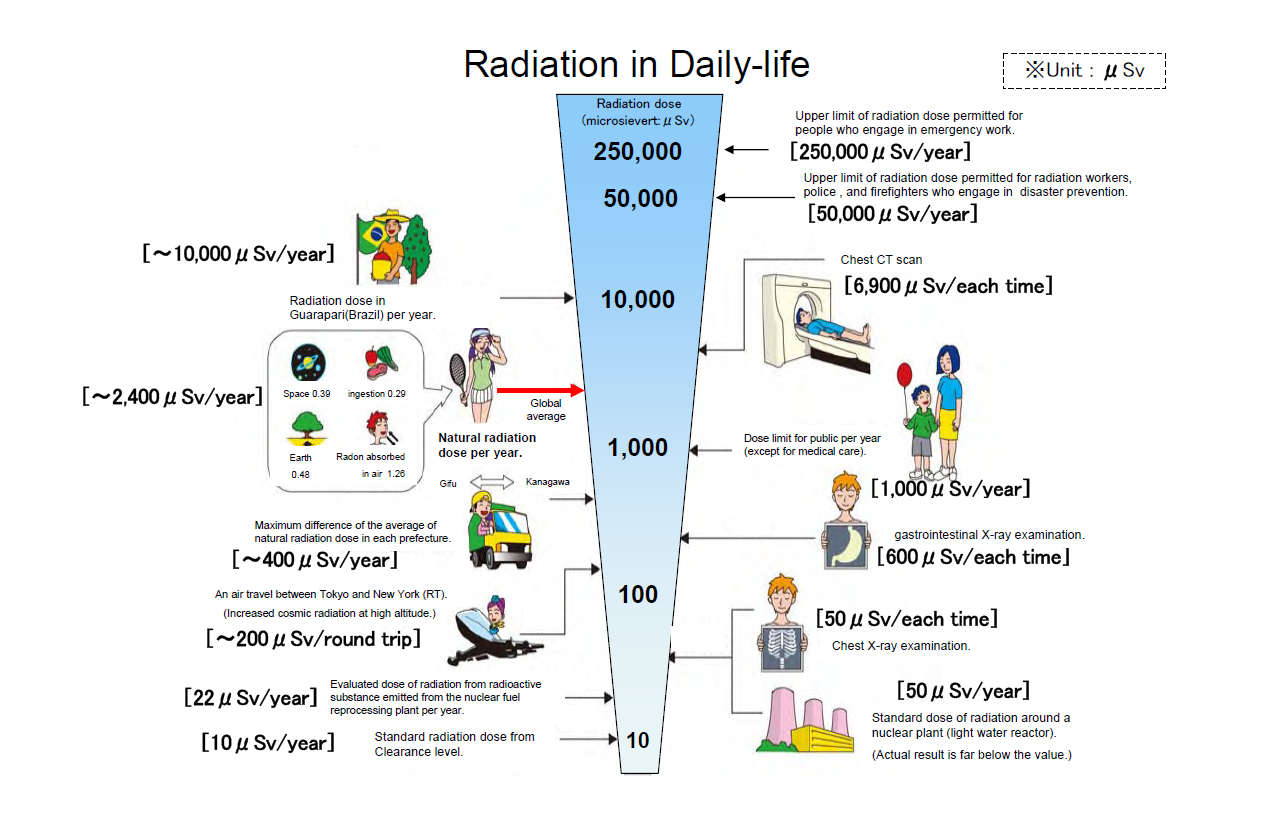
Radiation in Daily Life. Figure taken from MEXT website here (click on any of the PDFs and scroll to last page).Click figure to view larger. My dad refers to this figure in the interview today.

You can listen to all the interviews on the new vimeo channel Brandon and I created. You can also listen to most of the interviews on Brad Go’s YouTube channel.

Here’s the vimeo channel:

Brad Go’s YouTube channel: 

This afternoon my dad and I recorded our 17th interview on the Fukushima nuclear power plant disaster. Please see the rest of the blog (sidebar) for previous interviews. Please keep sending questions and comments to georneysblog@gmail.com. You can also follow me on twitter @GeoEvelyn but please do not send questions via twitter. Please note that our next interview will be the LAST interview in which we will address listener questions, so send in your questions if you have them.

Here are some websites we refer to in today’s interview:

In today’s interview:
1. My dad gives his usual update

2.We address questions from listeners:

(a.) Can you explain some of the different units that are used to measure radiation and radioactivity?

(b.) Can you comment on the radiation reports on the MEXT website? 

(c.) Is it possible the Fukushima plants did have hardened vents but they were inoperable due to air-operated valves which were dependent on air compressors which were without power?

(d.) In the US plants are required to show they can survive an extended station blackout (this sort of accident) and make design and procedure changes if they couldn’t under their original design. Did the Japanese regulator follow the US lead in this area?

Hope to have an audio link soon. Here is the interview on vimeo:

Please see the announcement page for more information about these interviews:

If you have time and interest, please transcribe this interview. Our next interview will be on Thursday, April 7th. This will be the LAST update interview before our final wrap-up interview.

A Quick Note: A Message from My Dad, a Nuclear Engineer, for TEPCO and the Japanese Government

A message from my dad for the Tokyo Electric Power Company (TEPCO) and the Japanese government, from Interview 16:

“We’ve tried to remain calm and rational and not get too excited. So, just because we haven’t raised our voice and started yelling and screaming doesn’t indicate at all that we don’t have concerns. I think from early on, if you go back and listen to some of the early interviews, the lack of transparency from TEPCO– I’ve been saying all along I think before, definitely before, the mainstream press, and I remember in one of the interviews early on I was really happy when finally Anderson Cooper was starting to take them to task for their lack of transparency– we’ve been saying since day one that TEPCO has not been forthcoming. And, in the last interview, and I realize it’s probably been three days, we talked about: hey [TEPCO], two-and-a-half weeks into this, now three weeks into this, how come you can’t get two or three reactor operators or engineers together from some of your other plants [and] interpret for the public what’s going on and produce a comprehensive briefing every day? And their [TEPCO’s] press releases are still not very informative.

The other thing that we’ve commented on is the lack of a website that an average person can go to and have the radiation and contamination readings in plain English so that they can understand where it’s above the limit and where it’s below the limit and where they should and should not be concerned. And the IAEA had at least put some information out there, and we had referenced people to it a few days ago, but still as far as I know, today– now there may be a site in Japanese that I can’t find or read– but to my knowledge there’s still not a website that people can go to that shows them: here’s the radiation and contamination readings for the past twenty-four to forty-eight hours– and here’s where we are above the limit, here’s where we are below the limit. It just doesn’t seem to exist. The information is scattered. Clearly, I think the Japanese government could be doing a better job there. I’m surprised that they’re not.

And the other thing  that we pointed out– we had a very long discussion about venting and the fact that the NRC in the US had required plants with the Mark I containment to go back in and put in hardened vent systems and that TEPCO obviously didn’t do that– now they’re not in the United States so they’re not compelled to follow orders from the NRC, but certainly they were aware that this design change had been required in the US, and I think TEPCO as a nuclear operator has a responsibility to do the right thing whether they are required by the government or not. But also– where was the Japanese government in requiring this for the plants in Japan? So, as far as I’m concerned they’re both at fault. And that has to be looked at. The Japanese government has to look at their regulatory agency and say: okay, what else should have been done to our nuclear power plants in Japan that we haven’t required?…

…given the lack of transparency, given the lack of implementation of the design changes, given some of the other shortcomings that we’ve heard of in terms of radiation suits and radiation badges, I don’t think it’s unreasonable to question if TEPCO should be allowed to continue to operate nuclear power plants. Now, I’m not yelling, I’m not screaming, but I don’t think I can be any clearer in saying that I don’t trust TEPCO, and I’m not sure anybody else should either based on what’s happened during this accident. ”

-Cdr. Mark L. Mervine, Nuclear Engineer (USNR, Ret.) 

16th Interview with My Dad, a Nuclear Engineer, about the Fukushima Daiichi Nuclear Power Plant Disaster in Japan

You can listen to all the interviews on the new vimeo channel Brandon and I created. You can also listen to most of the interviews on Brad Go’s YouTube channel.

Here’s the vimeo channel:


Brad Go’s YouTube channel: 


This afternoon my dad and I recorded our 16th interview on the Fukushima nuclear power plant disaster. Please see the rest of the blog (sidebar) for previous interviews. Please keep sending questions and comments to georneysblog@gmail.com. You can also follow me on twitter @GeoEvelyn but please do not send questions via twitter.

Here is a website we refer to in today’s interview:


In today’s interview:
1. My dad gives his usual update

2.We address numerous questions from listeners:

(a.) What is going on with the resin they are spraying at Fukushima to lower radioactive particulate dispersal?

(b.) The rescue effort is now bringing some large barges with fresh water, and there is talk about re-purposing a gigantic floating platform as a radioactive water holding tank.  Clearly, this has never been done before.  How long would the highly radioactive water have to be stored in the floating platform before it could be dispersed into the ocean more safely?

(c.) What potential problems will there be because there is so much radioactive water being generated at Fukushima? What will happen with these large volumes of highly radioactive water?

(d.) Are they now planning concrete entombing of the reactors at Fukushima? What would this lead to? How wide would the exclusion zone be?

(e.) What is happening to the enormous volumes of water that are being pumped into the reactors and spent fuel pools? Where does all this water go?  
   
The above are all of the questions we had time to answer today, but we will answer some more questions tomorrow. Please continue to send questions if you have them.

3. We address a concern from a listener: “Why do we sound so ‘trusting’ of TEPCO and the Japanese government regarding the nuclear disaster?”

To paraphrase our answer in the interview, just because we do not raise our voices and scream in anger does not mean that we are not deeply concerned and critical. We try to be calm and rational in these interviews as we believe this is the best way to provide clear information. We also want to avoid– to the best of our ability– conspiracy theories, misinformation, and unnecessary panic, which will only make the disaster worse. If you feel that we are too trusting, please listen again. From early on in the interviews we have actually been critical of TEPCO and the Japanese government in how they have handled (and not handled) the nuclear disaster.

In recent interviews, we have becoming increasingly critical of TEPCO and the Japanese government. For instance, we have been critical about the lack of clear, cohesive information from both TEPCO and the Japanese government, the unwillingness of TEPCO to communicate with and ask for help from the Japanese government and international community when they need it (for instance, asking for more radiation badges and suits), possible mistakes made by TEPCO (not checking the spent fuel pool water levels), and many other items. In the past two interviews, my dad has condemned both TEPCO and the Japanese government for not following the advice of the US Nuclear Regulatory Committee (NRC) to retrofit the Mark I reactors with important safety modifications that likely would have prevented the steam explosions that severely damaged reactor buildings 1, 2, and 3.

In the interview today, my dad said that in his opinion we should seriously question if TEPCO should be allowed to run nuclear power plants. I’m not sure how much more critical he can be than that. I hope this clears up any confusion over how “trusting” we are of TEPCO and the Japanese government.

Hope to have an audio link soon. Here is the interview on vimeo:

Please see the announcement page for more information about these interviews:


If you have time and interest, please transcribe this interview. Our next interview will be on Monday, April 4th. Thanks to Dave, a transcript is now available after the jump.

                                                                                                                                                   
Transcript for Interview 16:
A:      Hello!
Q:      Hi, Dad!
A:      Hello!
Q:      Sorry about that.  They put me on hold!  Are you ready for the interview today?
A:      I’m ready!
Q:      Ok, let’s go ahead and get started.  I’ll edit out that first part.  So,  my name is Evelyn Mervine, and, this is an interview with my Dad, Mark Mervine, who is a nuclear engineer.   This is,actually,  I believe, the 16th interview that I have done with my Dad about the Fukushima nuclear power plant disaster in Japan.  And, it is currently 1:50 P. M. Eastern Daylight time. And, it is the 3d of April.  And, I just want to quickly say,  sorry there was such a gap between the  interview we did on Tuesday and today.  We had travel schedules and there was some weather, so it was difficult for us to do an interview.  And, if you want to listen to any of the previous interviews, you can do so on my geology blog, georneys, which is G E O R N E Y S – georneys.blogspot.com.   So, today, the interview is gonna be the usual format.  My Dad is going to give an update, and, actually, I’ve received quite a number of questions from listeners, so we’re gonna try and answer as many of those as we can today.    So…Why don’t you give us an update on what’s been happening at Fukushima over the past few days.  I know there’s been quite a bit of news.
A:      Well, there has quite  a bit of news, but not much of a change in the actual status of the plants.  So, as a recap, there are six nuclear power plants at the Fukushima site.  Units 5 and 6 were least impacted, and, both of those units are in cold shut-down and would be considered safe, as long as they can maintain power and cooling to them.   There are seven spent fuel pools. One at each reactor, and a common one  and, the common one also has  electrical power for cooling, and, that one is considered  to be in a safe condition.  And, units 1 through 4 have been the reactors we’ve been concerned about during this accident.  Units 1 through 3 were operating at the time of the earthquake, and shut down automatically.  And, unit 4 was completely defueled for maintenance and its entire core load along with a lot of other spent fuel was in the spent fuel pool.  And…we’ve had explosions at each of these reactors that we think came from hydrogen that was generated from fuel damage.  So we know that we have fuel damage in each of the three reactors that were operating, and, the spent fuel pool from Number 4, and, that’s at a minimum.  We may also have fuel damage from some of the other spent fuel pools, but, until we’re able to actually get some close-up visuals, we won’t be able to tell for sure. In terms of changes in the past few days, the conditions of the plant haven’t really changed.  The big thing that happened in the last week was getting fresh water to the site, and, pumping fresh water into the reactors instead of sea water.  And, also fresh water is being used for most of the spent fuel pools, although I saw something today that surprised me, that  said that they were still using sea water for the spent fuel pool at Number 4, and, so, I’m not sure if that report is correct or not, because previously .   We had seem reports that they were using fresh water for all.   But…from a public concern standpoint, as long as they’re getting water in there, that’s the most important thing.   Fresh water, obviously,  is preferable, and, I would be surprised since they have now the large amount of fresh water from the Navy barges, that they would still be using sea water.  But,  it may be a kind of equipment situation.
Q:      So, basically, what you’re saying is that there is no change in that, at those four reactors, I guess one is shut down, so is not as big a concern, but, the three that we’re  concerned about,  they’re still using this temporary cooling system and, they’re not using their  normal cooling, and, we have no idea when the normal cooling is going to be restored.  This is sort of the same situation we were at Tuesday?
A:      Correct.
Q:      Ok.   And, there’s been no report…I mean, I just said this…but there’s been no report as to how long it’s going to take to restore normal cooling?
A:      There’s no indication, which we commented on last time as to what is the timeline.  Now the news that I do want to talk about, that has been – I don’t know if you would call it front page news, but, it has been on some front pages, is the leak of radioactive water into the ocean.  They believe they’ve found the cause of that, which is a pipe trench from unit 2, that  has got a big crack in it.  And they’ve made a couple of different attempts to patch that crack, once with concrete, and, another time with resin mixture.   And, so far, they haven’t been able to stop the leak.  So, we have this leak of highly radioactive water from the lower levels of unit 2, which is getting into the ocean, and, they believe that is what’s causing a majority of the radioactivity in the ocean water.
Q:      That’s sort of good news and bad news.  It’s good news that they have figured out where the leak is coming from, but it’s bad news that they can’t seem to stop it.
A:      Correct.  Again, they’re trying some different techniques, with resin with some fillers – Sawdust, newspaper – The reason for that is that  it will expand and hopefully will expand enough to seal up this crack.  Which, it’s not a little crack, it’s a big crack, which is why it’s leaking so much.   The other thing, in terms of updates, is, in looking at the IAEA website, they’ve got a little bit more information on the restoration of power.    And, for units 1, 2 and 4, they’ve indicated they now have power to the instrumentation.
Q:      Excellent.
A:      But, not for unit 3.  They just indicate lighting for the control room only.  So, they have made some progress then in electrical power restoration and getting  instrumentation back to three of the four units.
Q:      And, the instrumentation,that’s useful because that can be used to  monitor the condition of the reactors.   Is that extremely helpful in this situation?   Is that what they mean by instrumentation?
A:      It is extremely helpful, also, it would be needed in order to restore any of the cooling systems. 
Q:      Ok, so, that’s really a first task before they can even think about restoring cooling.
A:      It’s a very important step; and, up until now we were not really sure how much progress they had made, but, they have made a little bit of progress.   But, again, to your question,  and to the comment we made last time,   Can somebody give us an estimate when we can expect to see some type of normal cooling system restored at any of these plants? 
Q:      I have a simple question – I realize you may not be able to answer this.  The crack in the piping…is that a result of the earthquake, the tsunami, the explosions?  Do they have any idea how that crack occurred?
A:      You broke up a little bit, but, I believe you asked about what caused  the crack in the piping?
Q:      Yea, was it the earthquake, was it the tsunami, was it the explosions?  Do they have any idea?
A:      So, I can’t say for sure.  I did see a news report that said they believe  this may have occurred during the earthquake.  It’s possible that this trench may have had a flaw in it from…for some period of time, and, the movement  of the earth may have caused the crack to expand.  There normally isn’t any water in there, so it would not have been a problem in normal operations,. 
Q:      What is…what is this pipe used for normally? 
A:      They said it was a trench that carried electrical cables.
Q:      And, it’s just filled up with water because they’ve been pouring so much water onto the reactors?
A:      It’s filled up with water that has come from the basement of the turbine halls.  And, I actually sent you a link that you can post on your website, of a very good article on Wikipedia.  And, they have a drawing – a very simple drawing – that shows the elevations of the plant, and an explanation of how the water would get into this trench. 
Q:      Excellent.  I’ll post that.
A:      So, that does a better job of explaining it than we can do over the phone.
Q:      Ok.   Sorry to interrupt you,  I just wanted clarification…
A:      No, it’s ok..
Q:      Do you want to go on with your update?
A:      I can give a little more of an update, again, from the IAEA website, in terms of how they’re getting water into these plants, the… for units 1, 2 and 3.  They’re all being done by electric pumps now, and, they have diesel backup power in the event that they were to lose electric power.  And for the spent fuel pools, they’ve been using a concrete pump for unit 1.  For unit 2, they’ve actually got it going through one of the normal cooling lines.  That doesn’t mean they’re getting cooling, but, they are able to hook up the pipes and get the water in through one of the normal lines.   The same thing for unit 3 and 4.   But, they continue. Also, to spray water from the top for some of these pools as well.  And, the United States is actually sending over a much larger and…much larger concrete pump, that has the capability of being remotely controlled,  so they’ll have that available to them, as well…
Q:      But, they’ll be using that to provide water, not concrete.  I think there’s been some misunderstanding about that, right?
A:      Right.  That’s not for concrete.  They’re using that to pump water into the spent fuel pools.  Correct.
Q:      Right.  But, they can be further from their radiation. 
A:      Right.  And, in particular, this one is capable of being remotely controlled, so, they are able to  get closer and be more precise, because you don’t need a human to be there. 
Q:      Excellent.
A:      Alright, so, that’s the update for today.
Q:      Ok.  I have one quick question of my own, then, I will ask you the listener questions.    I just want you to comment on…I know you mentioned to me a couple of days ago that there a situation about     the  the radiation badges, and TEPCO not dealing properly with that?  Can you comment briefly on that, and, then, I will ask you some listener questions.
A:      So, what they were doing was that they would send a group of, say, three people to work in an area, and, since they didn’t have enough radiation badges, they would just give one to the group.  And, my point was, again, in all these nuclear power plants you have all these resources – you have resources available to you from the international community.  If you were short on radiation badges, either get some there from the other plants, or, ask the international community for them.  I’m quite confident that the United States would have flown some in if they were asked, and, I’m sure the same is true for France or other countries that have a lot of nuclear power plants.  And, certainly would be willing to help.  So, again, you know, it goes back to this whole thread, that, not just us, but other people have talked about which is the lack of communication and lack of transparency from TEPCO.
Q:      And…it’s important for every person to have their own radiation badge, because, you can have different levels of exposure, even in the same area, correct?
A       Yes, you could and, there’s…and there’s…correct, and people aren’t going actually to be standing in exactly the same spot.  The other thing that has been reported is that they have run out of radiation suits and other types of equipment.  And, again, it’s just hard for me to believe that with as many nuclear power plants as they have in Japan that they can’t borrow some equipment from other places.  And, if indeed there’s a shortage in Japan, then ask the international community! 
Q:      I’m sure that there would be support for that.
A:      I don’t think there’s any question.
Q:      Ok.  Well, we’ll maybe talk more about TEPCO in a minute.  But, let me go ahead and go through some of these emails.  I’ve actually gotten several emails that have many, many questions,  I guess there’s been a a bit of a gap between interviews, so, let me go ahead and start with the first email.  This actually comes from someone who’s in Japan, and, has sent me a couple of nice emails and is actually at ????  Ogama Dartmouth, which is the university where I went to for undergrad .  So, it’s nice to hear from a Dartmouth alum…So, I’ll read through these questions and we’ll try to answer as many as we can.  The first one, I think you talked about a little bit.  He was asking about the rescue effort, now spraying a resin to lowerradioactive particle disbursal.  I think this may be specifically for the pipe we just talked about.  And, he was wondering if you had talked about this before, and, if this method has ever been used before? 
A:      No, it’s a different thing, actually, that he is talking about. 
Q:      Oh, is that different?  Ok!
A:      They were actually talking about spraying a resin over some surfaces and the ground, to lock any radioactive particles in place, and, keep them from spreading.  And, that’s really all I can say.  I really can’t comment on it, because I really don’t know what they’re using, how their applying it, but, the concept was, that in some areas where they may have significant amounts of particulate contamination, either on the ground or on a building or whatever, they could spray this resin over it and that would lock it in place, and, it’s not gonna be picked up by the wind, or washed away with rain or something like that. 
Q:      but this is, sort of, not a technique that is put into practice often, because we don’t often have a nuclear disaster, so, this is sort of…They’re trying to see how this works, but, they don’t know much about it.
A:      Right, I mean,  I’ve just told you what I know….
Q:      OK…Let’s move on.
A:      I don’t know what kind of resin it is, where they’re applying it, how they’re applying it, but, apparently in some cases, they’re trying to take some steps to minimize the spread. 
Q:      Ok.  So, the second question from the same person, is about the large barges with fresh water.  And…I’ll just ask the question.   The rescue effort is now bringing in some large barges with fresh water, and, there is talk about re-purposing a giant, floating platform as a radioactive water holding tank.   Clearly, this has never been done  before, and, he wanted to know how long the highly radioactive water be stored in the floating platform before it could be disbursed into the ocean or somewhere  where it can be stored more safely?
A:      Ok.  So, I saw something in the news about that.  What’s going on  at the plant, I mean, we didn’t include this in our update,  is that they’ve been trying to take water that’s in the condensers and pump them into other storage tanks…pump them…pump the water from the condensers into other storage tanks so, they can then pump the highly radioactive water from the basement of the turbine halls into the condenser.  Eventually they’re going need to do something with that water, and, they may, depending on how long this continues…they may need some additional storage space.  They are apparently bringing in a barge where they can pump the radioactive water into this barge as a holding tank.  To my knowledge, they were gonna just hold it in this tank until they were able to transfer and have it processed.  I don’t think the intent was to tow it out in the ocean and just dump it.
Q:      Ok.  So this relates to his next question, which is…I guess he’s very concerned about there being a great amount of highly radioactive water produced   Now, normally, the cooling system is sort of a closed loop, and, you’re recycling, and, you’re not producing large amounts of highly radioactive water so his question and concern is  what do they do with that?  You’re sort of producing large quantities of radioactive waste that you’re going to have to store and do something with.  And, he wants to know how long do you store it?  And, what do you do with it?   You talked just now about reprocessing Is there something you can do that, at least, minimize the volume of radioactive material you’re storing?  Can you talk a little bit about that?
A:      Yea.  What you would do  is that you would take that water, and process it through a series of filters, to  remove particles and radioactive particles, and,  hopefully, produce water that was not radioactive at the output.  Obviously, there would still be some water and some sludge that would be highly radioactive, but, the goal would be to significantly reduce the amount of radioactive water.  And, then that concentrated water, or… They could be running that through charcoal filters  So, the filters themselves that would have to be disposed of as radioactive waste,  but, the goal would be to filter this water and try to remove as much radioactivity as possible so that then, it would be less radioactive, to the point where it would be local levels, where it could be disposed of as just water.
Q:      But, it’s still a problem that they are producing so much radioactive water, because at some time, they are going to have to process that, and, it’s going to be extra work down the line.  It’s obviously not ideal to produce this water, correct?
A:      Correct.  And, right now, we’re pumping water in, and the question is “where’s the water going?” 
Q:      Yea.
A:      Well, if the primary containment is intact, and, we don’t know for sure if the primary containment is intact for all three of these units,  or whether there are some leaks, because we don’t know exactly how all this radioactive water got into the basement of the turbine halls.   We’ve speculated in a couple of our interviews.   We’ve said MAYBE there could be a leak in containment.  Maybe it’s coming from the spent fuel;  Maybe it’s condensation from the steam we’ve vented, but we don’t know for sure.  
Q:      And it could be all three!
A:      It could be all three…Correct.  So..normally, if the containment was intact this water would be going into the reactor vessel.  It would be flashing to steam, and, the steam would be vented to the bottom of the containment, into the torus, as we discussed.  Eventually that torus would fill up with water.  The water would come up those down comer tubes and the water would start to fill up the containment itself.  Obviously, eventually, the containment would completely fill up with water, if it’s not leaking.  What you want to do is get some normal cooling systems restored, so that we’re not just pumping water in, and, once we get normal cooling we would flood the reactor full of water  and, now you’re in a cooling loop and you’re not adding any more water. 
Q:      but, as we just talked about in our interview, we’re not there yet for reactors 1 and 2…
A:      We’re not there yet, and, we’ve got no time line from TEPCO or the Japanese government as to when they could possibly expect to be there.
Q:      In the mean while, it’s still a very precarious situation, so it’s frustrating.
A:      So, yea,  Let me…Let me…be clear.  And, we can repeat it again in a minute.  We are still in a extremely serious situation at all four of these nuclear power plants.  Not just for reactors 1, 2 and 3 for the core damage, but, also we know, at a minimum, we have fuel damage from the spent fuel pool at unit 4 and probably from some of the other units as well.  So,  this situation is not under control, we are not out of the woods,  it’s a very serious situation and, you know, we’ve indicated at least it hasn’t gotten any worse, as opposed to how it was going in the first week, but, there hasn’t been as much progress as we would hope, in…in…the past couple of weeks.  It’s an extremely serious situation we are in.
Q:      Ok.  Let me move on.  The last question that came from this Dartmouth alum  is about concrete entombing.  I think we may have touched on this a little bit before, when talking about Chernoybl.  But…the question was, basically, it seems that discussions about concrete entombing are now on the table, whereas they weren’t during the first few weeks of the nuclear disaster, and, he wanted to know if these four reactors are entombed or abandoned, what does that mean, long-term?   How wide does the exclusion zone need to be?  How long do they have to be entombed?   That sort of thing.
A:      I don’t think we’re there yet.  I haven’t seen any discussion about that.  I don’t know if that was confusion caused by sending this concrete pump over…
Q:      Ok.
A:      Which is actually going to be used to pump water.  So, I haven’t seen anything about that.  Now, to answer the question;  if that was something that was decided to be done,  I wouldn’t see the exclusion area probably being much more than the site boundary, given that they would entomb these, and, concrete is a vary good shield of radiation.  And, I think it would drive the radiation levels down to the  point that the exclusion area wouldn’t  be much more than the site boundary.   Now,with  that being said,  what we don’t know is what the long term situation is for the current exclusion zone, which is 20 kilometers, In terms of how contaminated the soil is, and, when, either through natural decay or remediation efforts people would be able to that zone. 
Q:      Ok…Just to clarify something else.  He talked about these reactors being entombed or abandoned.  And, I don’t know if abandoned is the right word, but, we’ve talked about this many times, but, there is absolutely no way that reactors 1 through 4 can be re-opened.  There has been just too much damage. There is a chance that reactors 5 and 6 might be reopened, but, you talked about other issues with that.  But, these plants are going to have to be decomissioned, and, the effort is not going to be to get them to restore nuclear power, but, to basically try and keep them from being a danger to people by getting them into cold shut-down.
A:      Correct.  And it would be desirable to get these under control;  to get these reactors cooled down; and not have to entomb them, because what the people of Japan should want should be for that to happen, and for these plants to be decomissioned properly, and the area there to be returned to its natural environment.   And, if you entomb them, you’re basically saying “I’m going to have this big, concrete tomb around these four reactors forever”  So, that should definitely be the last resort, and, as long as we continue to make progress and the situation doesn’t get  any worse, I don’t think that option’s really on the table.  But, again, we’re trying to make this judgment from a long way away, with very little information.
Q:      Ok.  Well, thank you for commenting on that.  Let me move on to a second email.  This email has only one question, and, maybe we have touched on this a little before.  But, this person basically did not understand where all the water was going, and, sort of wondered what is happening to the water now?  We talked about this a little bit before   A lot of the water is just evaporating, right?   A lot of the water is going in, but it is very hot, so it is just disappearing, but,   he wants to know where it is going; what various parts is it going to; is it vaporizing to the atmosphere;  is it flowing back to the sea?   So if you could comment a little more on that;  I know we have touched on that already. 
A:      Ok;  Well;  we actually just talked about it a minute ago.  So..we pump the water in, it is flashing to steam, it is being condensed, or vented and being condensed.  It is filling up that torus, eventually, it will come up those down comers, and start to fill up the containment, assuming that the containment isn’t leaking.  The water that is being poured on the spent fuel pools is apparently ending up in the basement of these buildings and, in the case of unit 2, we’ve got this crack in this trench and some of that water is leaking out into the ocean.  But, for the rest of them, they are gonna try to pump the water into the condensers and, then eventually, into this barge, and, then hopefully, they’ll be able to take that barge and hook it up to the reprocessing plant, and, clean up as much of the radioactivity as possible.
Q:      Ok, thanks Dad.   Let me move on to another Email.  This email is actually a pretty long email.  There are a lot of concerns and questions,  so, I’m just going to summarize the main point in the email. So this person has ????    and seems frustrated that we seem to be having total faith in the government and industry officials, thinking that they can be trusted and expected to be forthcoming with information, and, this person’s sort of angry about that.  Actually, I’m not sure…I’m not sure where exactly that was coming from because, particularly in our more recent interviews, but  also from our earlier interviews, I think that we have actually been very frustrated both with TEPCO and the Japanese government.  I don’t know if “trust” is the right word, but they are certainly not performing in a way that we find to be acceptable, and, I think we’ve commented again, and again, probably almost every interview, for the past few interviews that there is information that TEPCO is not communicating with the people.  So…I’m not sure where this is coming from, but, if you could just comment on this.  And, one thing that we have done is we have told people to listen to the government and trust them about environmental readings of radiation, and, listen to them to try and not create panic.  Can you comment on this email we got, a little more, Dad?
A:      Alright.  Well. I try to remain calm and rational and not get too excited, so, just because we haven’t raised our voice and started yelling and screaming, doesn’t indicate at all that we don’t have concerns.  I think from early on, if you go back and listen to some of the early interviews, the lack of transparency from TEPCO, I have been saying all along, I think before…definitely before the main stream press, and I remember in one of the interviews early on,  I was really happy when finally Anderson Cooper was beginning to take them to task for their lack of transparency.  We’ve been saying  since day 1 that TEPCO has not been forthcoming, and, in the last interview, and it’s really only been three days, we talked about – Hey, 2.5 weeks into this; now, 3 weeks into this, How come you can’t get two or three reactor operators or  engineers together  from some of your other plants, determine, for the public, what is going on, and produce a  comprehensive briefing every day?  And, their press releases are, still, not very informative.  The other thing that we have commented on is the lack of a website that  an average person can got to and have radiation and contamination readings, in plain English, so that they can understand where it’s above the limit, and where it’s below the limit, and, where they should or should not be concerned.   And, the IAEA had put some information out there, and we had referenced people to it, but, still, as far as  I know, today – and there may be a site in Japanese that I can’t find or read- but,  to my knowledge there’s still not a website that people can go to that shows them “here’s the radiation and contamination readings for the past 24 or 48 hours, and, here’s where we’re above the limit and where we’re below the limit”  It just doesn’t seem to exist.  The information is scattered.   And, so, clearly, I think that the Japanese government could be doing a better job there.   And, I’m surprised that they’re not.
        And the other thing that we pointed out – we had a very long discussion about venting, and the fact that the NRC in the US had required plants with the Mark 1 containments to go back in and put in hardened vent systems, and, TEPCO obviously didn’t do that.   Now, they’re not in the United States, so they are not compelled to follow orders from the NRC, but certainly they were aware that this design  change had been required in the US, and I think that TEPCO, as a nuclear operator, has the responsibility to do the right thing, whether they’re required by the government or not   But, also, where was the Japanese government  in requiring this for the plants in Japan?  So, as far as I’m concerned, they’re both at fault, and, that has to be looked at.  The Japanese government has to look at their regulatory stance, and say “OK, what else should have been done to our nuclear plants in Japan that we haven’t required?”
Q:      Do other countries – and you may not be able to comment on the details of this – do other countries generally follow the advice of a bigger organization, like the NRC?
A:      Generally, speaking, they do…Obviously, every country has its own laws and regulatory bodies, but, in general, especially for something as significant as this,  they would follow the guidance and direction from both the manufacturer and the NRC.  And, had we had these hardened vents, we would have avoided the explosions of the reactor buildings for units 1, 2 and 3.   Unit 4 was caused by the spent fuel rod pool.  We’ve already talked about how, had they gotten…inspected and gotten water up there sooner,  they could have avoided all that.  I think, given the lack of transparency, given the lack of implementation of design changes;  given some of the other short-comings, that we’ve heard of , in terms of  radiation suits, and radiation badges  I don’t think it’s unreasonable to question if TEPCO should be allowed to continue to operate nuclear power plants.  Now, I’m not yelling, I’m not  screaming but, I don’t think I can be any clearer in saying that I don’t trust TEPCO, and, I’m not sure anybody else should, either, based on what happened during this accident.
Q:      And if the Japanese government can’t get good information from TEPCO, how can they…How can you trust them either?  I guess they’re doing independent radiation readings but it is frustrating that there isn’t clear information on that.
A:      It’s the government’s responsibility so, if they’re not getting the information, then, they need to do more.  it’s their responsibility.  They’re the ones that authorized this company to build these plants; that issued the licenses.  It’s the government’s responsibility.
Q:      And, as good a job as the IAEA and NEA and other websites have done, with our limited time and resources, it’s really not our job to do this.  It’s the job of TEPCO,  it’s the job of the Japanese government and, they’re not doing it.
A:      So, I think, 3 weeks into this, a lot better job could be done.  I’m not questioning the challenges they have in the plant.  I’m not questioning how hard  most people are working and risking their lives, but,  providing better information about what’s going on in the plant, and providing better information to the public on contamination and radiation levels wouldn’t seem that hard  of a job, three weeks into this.   And, so, I think you have to question both TEPCO and the Japanese Government in the way this is being handled. 
Q:      Ok.  Do you have anything else you would like to say before we wrap up the interview today, Dad?
A:      I do.  I didn’t include this in the update, and, kind of wanted to save it for the end  From the time of the earthquake and tsunami, TEPCO had reported that two of their plant workers had been unaccounted for.  And, unfortunately, and, I guess  not that it wasn’t unexpected, but, in the past 24 hours they found the bodies of these two workers in the -1 level of the unit 4 building.  So, kind of sad.
Q:      Did they die during the earthquake and tsunami?
A:      Apparently they died during the earthquake and tsunami, yes.
Q:      that is sad.  I hope that…I don’t know how many more casualties there will be as a result of this, but with the exposure, it’s probably too soon to say.  But it’s very sad. 
A:      But, again, obviously, thousands and thousands of people in Japan died in this event.  But, these people had been unaccounted for, obviously,  for almost three weeks, so, at least they found their bodies which will give their families some peace. 
Q:      Yes…  Ok, well, We actually did receive some more emails with questions, and, I’m going to try and address those questions.  We couldn’t do every one of those questions today.   There was an email from another person who is in Japan, and someone who wants to know a little bit about different units that measure radiation.   So, we will try to address those questions tomorrow, and any other questions that get sent today, or that I go through and decide would be a good question to answer.   We’re still receiving many questions that are duplicate questions,   When I can very clearly find an interview, I write back and tell you where it is.  But, if I don’t answer your question, it is probably because we have already answered it and, we’ve done enough interviews at this point that it’s difficult for me to go back and find out where we answered a specific question.  But, we are trying.  In some cases, we reiterate things that aren’t clear, but, we’re trying not to completely answer questions that we have answered in detail in some of the previous  interviews.  So, with that, Dad, should we  do an update tomorrow? Are you able to do that?
A:      I should, if it’s about the same time.
Q:      Ok, sound good.  I will talk to you tomorrow.
A:      Ok!
Q:      Alright.  Have a good night, Dad.

A Quick Note: Interview Postponed by Nor’easter

Here in New England, the weather is often unpredictable. Seasoned New Englanders often say to each other and to befuddled visitors or newcomers, “If you don’t like the weather, wait five minutes.” Today, there is a late season nor’easter sweeping through New England like an April Fool’s prank. There is rain and snow and slush everywhere.

Unfortunately, the weather has upset our work and travel schedules, so my father and I are unable to carry out our scheduled interview update about Fukushima today. Thus, we are postponing to Sunday, April 3rd. We plan to record the interview in the early afternoon.

We apologize for such a big gap in interviews. To tide you over until Sunday, we recommend taking a look at the information on the IAEA and NEI websites:

I’ve already received a few questions for Sunday, but please continue to send questions and comments to georneysblog@gmail.com. You can also follow me on twitter @GeoEvelyn.

15th Interview with My Dad, a Nuclear Engineer, about the Fukushima Daiichi Nuclear Power Plant Disaster in Japan

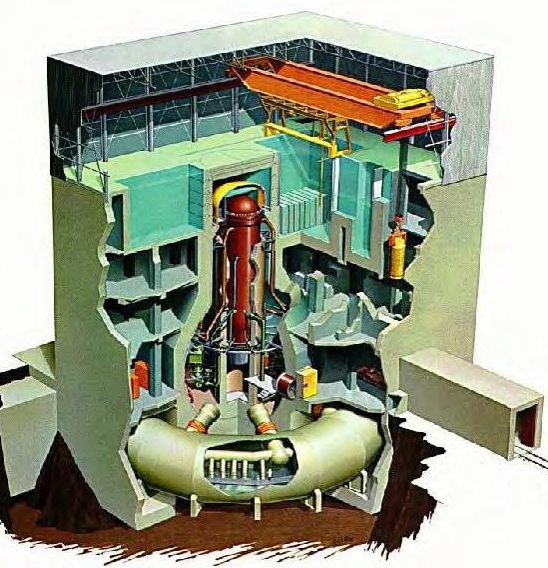
Picture of a Boiling Water Reactor Nuclear Power Plant like the Fukushima Plants. My dad refers to this image in his interview.

You can listen to all the interviews on the new vimeo channel Brandon and I created. You can also listen to most of the interviews on Brad Go’s YouTube channel.

Here’s the vimeo channel:


Brad Go’s YouTube channel: 


This evening my dad and I recorded our 15th interview on the Fukushima nuclear power plant disaster. Please see the rest of the blog (sidebar) for previous interviews. Please keep sending questions and comments to georneysblog@gmail.com. You can also follow me on twitter @GeoEvelyn but please do not send questions via twitter.

In today’s interview:
1. My dad gives his usual update

2. My dad talks some about high radiation levels at reactor #2 and potential sources of this radiation

3. My dad elaborates on the venting of steam from reactors and explains why venting of steam at the Fukushima Mark 1 nuclear power plants is different from venting of steam at American Mark 1 nuclear power plants, which have been retrofitted with design modifications

Hope to have an audio link soon. Here is the interview on vimeo:

Please see the announcement page for more information about these interviews:


If you have time and interest, please transcribe this interview. Our next interview will be on Friday, April 1st. Thanks to Kenyon, a transcript is now available after the jump. 


Transcript for Interview 15:
MARK: Hello

EVELYN: Good evening dad

MARK: Good evening.

EVELYN: Are you ready for our interview?

MARK: I am

EVELYN: Alright, let’s get started. My name is Evelyn Mervine, and this is going to be an interview with my dad, Mark Mervine, who is a nuclear engineer. This is the 15th in a series of interviews that we have been doing about the Fukushima Nuclear power plant disaster in Japan. Today is the 29th of March, and it is currently 9pm EDT. In today’s interview it is going to be the usual format: my dad is going to give an update—and there has been some more news about Fukushima in the last 24 hours since our last update; and then I’m going to ask him a couple of questions. With that, dad, why don’t you go ahead and get started.

MARK: Ok, actually I spent a fair amount of time today taking a look at the news from various different websites and there actually isn’t a great deal of news. I’ll editorialize in a minute. What we do know from today—and I’ll just briefly kind of give an update for those that haven’t been able to listen to the last couple of interviews. There are six reactors at this site, of which numbers one through four have been the ones of the most concern. Five and six were the least impacted, and they were able to get electricity restored to five and six sooner than the others. Both of those plants are in a cooled down, safe shut down condition. As a reminder there are seven spent fuel pools—on at each reactor and then a common one. As we’ve reported they’ve also been able to restore electricity and cooling to the common spent fuel pool. 

That brings us to reactors one through four. The progress has been slow at these reactors. To our knowledge they have electricity back to the control room for lighting, and they’ve been working on trying to restore instrumentation to some of these units, but it’s not been reported that they’ve had any success restoring any of the cooling systems to any of these reactors. The biggest news we’ve had in the past few days is that they’ve shifted from pumping seawater into reactors one, two, and three to pumping freshwater into those reactors. The other news in the past 24 hours is they’ve also shifting to using fresh water for the spent fuel pools. For reactors two and three they are now pumping fresh water into those spent fuel pools. For reactor two they are using a temporary motor driven pump, and reactor three they are using a truck with a pump to pump that water in; and they are making plans to be able to pump fresh water into the spent fuel pool at reactor four in the next few hours. So that’s the update, technically, from the plant. 

Now a little bit of editorilization here. We’re two–and-a-half weeks into this, and although it’s very much a very serious situation and we don’t want to take anything away from the efforts that a lot of people are making: risking their lives, making these efforts, working under extreme conditions to try to minimize the situation and prevent it from getting any worse. What I think is surprising now at the two-and-a-half week point is ‘where is the information on exactly what is going on?’ TEPCO has a lot of nuclear engineers, they run many, many nuclear power plants. They can certainly free some people up to do a better job of providing information and briefing the public. It really is almost impossible to get any kind of detail. In the first week when events were happening every day, and the situation was getting worse, I think you could understand that. But at this point, two-and-a-half weeks in, there should be complete and comprehensive briefings given every day as to the status of these plants. If you look at their press releases from today they’re incomprehensible…garbage, essentially.

EVELYN: Well, and we’ve talked about in the last couple days that organizations like the IAEA and the NEI have tried to step up their reporting efforts, but if they’re…

MARK: And they have, but…

EVELYN: …not able to get information from TEPCO, how can they step up their reporting efforts?

MARK: And they have, but at this point in the game, with as many resources as they have, it shouldn’t be that hard to put together a team of two or three engineers that can take the information from the plant and put together a comprehensive briefing on exactly what’s happening. I’m just really kind of surprised at this point. I…when we started doing these I had no idea there would be any value in us continuing as far as we have, because you would have figured by now—first off that they would have made a little more progress than they have, but second off that they should be able to provide fairly transparent information themselves at this point. It just doesn’t seem like it would be that hard to
me. With that being said I’ll step back now. It is very frustrating, and I know that people are kind of
counting on us to get information—and it’s very hard. I spent a lot of time today trying to get more
comprehensive information, and it just isn’t out there.

EVELYN: We both have full time jobs as we’ve said before, and my dad does a lot of time researching this. We do the best we can, but our reports are not going to be perfect. Part of that is because it is just so difficult to get information in one place that is easy to understand. If my dad, who is a nuclear engineer, has so much trouble, it must be extremely frustrating for the general public, as we’ve said before. It hasn’t, I guess, improved to the point where we feel we can stop doing these interviews.

MARK: For instance—how about a statement on just how much progress they are making on restoring electrical power. I mean, if the news isn’t good—give us the bad news. Give us some expectation as to when they’re going to be able to get cooling systems restored in some of these units. There is just no news…umm, it’s surprising—and shocking—to be honest with you.

EVELYN: Ok, do you have anything else with the update before I ask a couple of questions?

MARK: No, and I wish I could give a more comprehensive update. But…again, what we know is they are injecting fresh water into units one, two, and three, and they are now getting some fresh water to some of the spent fuel cooling pools. Other than that the status doesn’t appear to have changed a lot in the last 48 hours.

EVELYN: All right, well I’m going to ask you a couple of questions, then. A few listeners sent in today an article—I believe it was in The Guardian—and it was talking about there being some trouble with reactor number two. I don’t know if you can confirm this in any way, but the article said that there was a possibility that the fuel had actually…I guess…melted through part of the containment? It was actually sort of resting on the concrete base of the containment. I’m not sure what the evidence was for this, but can you comment on this at all? Have you seen more about that?

MARK: Ok, so what they’re talking about is that the fuel would have melted through the reactor
vessel. So there are supposed to be three barriers to the environment: the first is the fuel
cladding itself. The second is the reactor pressure vessel—which is a huge thick steel
pressure vessel that normally contains the reactor, and the water, and the steam, control rods—all
those things. And then the containment building, which is a steel and concrete structure around the
reactor that will contain anything that does leak out of the reactor if there was a leak.

I think…given the information that we have, that would be speculation on somebody’s part. I’m not saying that that isn’t the case, but I don’t know of any way to confirm it. What we do know is there’s very high radiation and contamination levels in the unit two turbine hall. How that got there is not clear. I think there are three possibilities:

–One: it is possible that the fuel in the number two spent fuel pool is damaged, and the flooding
of water from all the spray and the helicopters and those type of thing has carried a lot of that damaged fuel down in the building, to the basement…

EVELYN: We talked about that being a possibility at…number three…

MARK: Well, it’s a possibility at any of these plants, right…I mean, you don’t…

EVELYN: Yeah, I think maybe we were not perfectly clear on that yesterday. All the water, if it goes over those fuel rods and splashes out or something when they’re throwing it from helicopters, that can carry radiation with it if there is spent fuel damage, correct?

MARK: Correct.

[Two]: We also know that we vented a lot of steam, especially early on in this accident. That
was vented into the reactor building. We know that that caused the explosion. Unit two has the least
damage to its reactor building, but it does have some damage. Again, if that fuel was seriously damaged, then that radioactivity is in that steam. Some of it escaped, but some of it’s going to condense—and again, be washed down to the bottom.

The third possibility is that:

[Three]: That there could be some sort of leak in the containment building that with all this
water that they keep adding that some of that is leaking out into the basement of the building.

EVELYN: None of those are good things, none of those three options, right?

MARK: No. But what we do know is that for there to be this much radiation and radioactivity in
the basement of that building that it is coming from damaged fuel. There is a good probability that
both…that there is a significant amount of damage to the fuel in the reactor and, potentially, damage to the fuel in the spent fuel pool. So it could be from either of those sources, or a combination of both. But from other indications in terms of reports from the IAEA that reactor vessel water level in all these units is about half core-height, it seems kind of implausible that the core would have melted to the bottom of the reactor vessel and still have water in it, but again, without having more information as to exactly what’s going on it’s hard to actually give an answer.

It would be…as much as that person is speculating that the core may have partially melted through the reactor vessel, it’s speculation on my part saying that the radiation and radioactivity in the terminal is coming from spent fuel damage from either the reactor, or the spent fuel pool, or both. We obviously don’t have access to the precise radiation and contamination levels, we don’t know what else is going on in the plant, again—where is the transparency from TEPCO as to exactly what’s happening?

EVELYN: I feel like that should be an easy question for them to answer.

MARK: At this—again, early on we did question their transparency, but at the height of the accident
where there were explosions and things were getting worse every day…you might cut them some slack. But like I said, these people have lots of resources, they run lots of reactor plants. It can’t be that hard to get two or three reactor operators or engineers with knowledge of the plant to be able to translate the information that they’re getting, correlate that, and give some kind of comprehensive briefing.

EVELYN: Especially since there are so many international people involved with nuclear power who are offering them help. I mean, if they can’t do it, they could get help from somebody to do that.

MARK: Alright. Again, I can’t say…I can’t confirm it, I can’t totally rule it out.

EVELYN: Ok, well, let’s go on to the second question. I’ve received a few emails about this over the past few days. I think people are a little bit confused about what is going on with the venting of the steam–which I think is primarily hydrogen gas. I realize that one limitation is that you don’t know the exact design specifics of the Fukushima plants, but you’ve worked on similar plants. Can you talk a little bit more about what happens when they vent steam, where it goes, what that means?

MARK: Yes. I have to reference people back to that drawing that you posted several days ago…

EVELYN: I’ll post it again with this interview.

MARK: …as to the design of the containment of the Mark I containment. Let me just pull up the
picture myself so I can give people a good reference.

Ok, so in looking at that picture, down at the bottom is this round donut looking thing that is cut away.
That is the torus, and that torus is partially filled with water during normal operation. You
can see in the drawing some big pipes that come down at an angle, that are connected to a ring, and
spider/finger like pipes that go down underneath the water. What the concept of the torus and the water suppression are is that if you were to have a break in a pipe and be losing coolant—which would flash the steam obviously, then the water in the the torus serves as a suppression pool to cool that steam; the concept here was they could make the design of the containment a little bit more compact by having this water suppression pool to condense some of the steam and reduce the pressure within the containment structure. What they would have been doing to reduce pressure in the reactor vessel itself to allow first seawater, and now freshwater to be pumped in is they would be opening a valve at the top of one of the steam lines, and that would have a piece of pipe attached to it. That would be routed down and go into this suppression pool. So they were venting the steam out of the reactor and condensing it down in the bottom of this torus, or suppression pool. During operation, the Mark I containments are required to be oxygen free—they actually purge them with nitrogen so that there is no oxygen in there. The reason for that is to prevent an explosion inside the primary containment. So even if you get the fuel damage and the hydrogen, because there is no oxygen in the dry well portion of the containment, then you don’t have the oxygen to interact [with] and cause an explosion. Umm, let’s see…what else

EVELYN: So when they vent that, I guess there is some confusion about where that goes.

MARK: Ok, so there’s two different venting that would have went on. First, we vent steam into the
bottom of this torus, and it condenses. But eventually what happens if you vent enough steam,
then you start building up pressure in that containment building. In order to prevent exceeding the
pressure rating of that containment building, then you would do a second venting where you would
actually vent the containment. So initially we vented the reactor vessels, and we quenched that, but after a lot of doing that we build up a lot of pressure and steam inside the containment and
now we gotta to vent that.

EVELYN: And you vent that to the reactor building, or to the atmosphere, or both, or…?

MARK: Ok, and I think this is where a lot of confusion is coming from for people, because the original
design of these plants had that containment venting through a series of duct works and filters right in
the reactor building. There was a retro-fit required by the NRC back in the late 80s for all of the Mark
I containment structures—I think there are 23 of these in the US—to put in a hardened vent for the
containment. The hardened vents actually go into a fairly strong piping system that is outside of the
reactor building. If this particular scenario occurred at a US plant when they vented the containment, it would have been vented outside of the reactor building, and you wouldn’t have had the explosion of  the reactor building. Generally speaking, most regulatory agencies around the world follow the directions and guidance of the NRC. In this particular case, apparently, the Japanese government did not require those modifications to the Mark I plants.

EVELYN: Well, and we know there had to be steam building up in there because we had the
explosions—I mean, there is nothing else that can explain those explosions, correct? I mean…and we’ve confirmed that that’s why.

MARK: Correct. Again, this was a change in the design of the plants that was required for plants in the US, but it doesn’t mean that it was done to all the plants worldwide; and apparently it was not done to these plants in Japan. The other thing I guess I could comment on with respect to the containment is there was a lot of talk early on about—potentially—damage to the core in Reactor Two, that there was some type of explosion. There were also modifications ordered by the NRC to the torus areas of these containment designs to strengthen them. There were I think…three or four separate modifications that were done because after these plants were built there were studies that realized there was going to be a lot more stress and loading on some of this piping than was originally considered when the plant was built. Each of the utilities have had to go back and implement three or four different design changes and strengthen or modify how, exactly, some of those pipes are connected down in the torus. It’s again speculation, but my guess is that when this is all said and done and done, there may be something to be learned where whatever was going on in Reactor Two, the stresses exceeded the capability of some of that piping that you can see in the cutaway picture—and that may have been the source of the explosion that they heard. It might have just been simple failure of some supports or some piping. You would not expect a hydrogen explosion within the containment because it is inerted with nitrogen.

EVELYN: Ok.

MARK: Ok, so again as a recap—the first venting we would do would be from the reactor vessel down a pipe, into the bottom of this dry…excuse me, torus, where the water would quench it. But if you keep injecting water, and keep venting, you’re going to build up enough steam and enough pressure with-in that dry well portion that you’re going to have to relieve the pressure of the containment—not the reactor vessel, but the containment. And the way it was obviously done at this plant was through this old method, because apparently they didn’t have the design change for the hardened venting, and that was within the reactor building. Again, speculation, but I assume since they’ve reported on Units Five and Six that since they’ve removed some roof panels or drilled some holes, that they didn’t do the modifications on those units, either. As much as we might criticize TEPCO—and we should—because they certainly were aware, made aware, by GE that the US was requiring this and they could have undertaken it themselves—but also, where was the Japanese government oversight to require these changes?

EVELYN: Well, I think there will be many hard lessons learned from Fukushima. I know the NRC is taking an active role in looking at all the US plants, but I hope Japan is does that as well. If that problem is at these plants, at Fukushima, who knows how many other plants this might be a problem at—not just in Japan, I guess, but worldwide.

MARK: So I know that our own regulatory body, the NRC, is not perfect, but this is one case where they did require these changes, and these changes were made at all of the plants that have this containment design in the US. I hope that clears it up for people, because I think people were confused because they see online what the NRC is requiring, and they’re wondering ‘well, if they have these vents outside the building, how are we getting explosions inside the building?’. The way that we did that is apparently these plants did not get those design changes.

EVELYN: Ok, well thanks for commenting on that, dad. Do you have anything else before we end the interview for tonight?

MARK: I don’t. Again, I really think that after this much time they just really have to step it up and
provide more information. It’s kind of sad that different people around the world have to speculate
on what’s happening when—again—they have a lot of resources at their disposal, and they should be
providing a comprehensive overview that just isn’t happening. Again, what happens is…they’re…if they have any credibility left, they’re destroying it by not being transparent.

EVELYN: As happy as we are that these interviews can help people, we’re not working on this full time; we don’t have the resources that they have, we don’t have the information that they have, I mean…this isn’t really our job to be doing this. But because there is so little cohesive information, we feel that we have to do these updates to the best of our ability. We try, but it’s not perfect and, really, it would be great if TEPCO and the Japanese government, and different organizations could step up so that we wouldn’t have to do these updates so we wouldn’t have to do them—and they could do them much better than we could, that’s for sure.

MARK: Do you have any other questions?

EVELYN: That’s it for tonight.

MARK: Ok, I’m not going to be able to do another interview for a couple days, because I’m going to be on an airplane, and be on another continent, but hopefully we can get together on Friday.

EVELYN: We’ll plan on doing that Friday. My dad will be in Europe, but we’re going to try and arrange a time so we can talk on Friday. That will be our next update. If you have any questions, send them in, and if there is developments over the next couple days we’re sorry, but we won’t be able to comment on that until Friday. So that’s it!

MARK: Alright, thank you Evelyn, goodnight.

EVELYN: Ok, goodnight dad!

26:36. End Interview.