Georneys with Dana- Part V: The Garnet Road

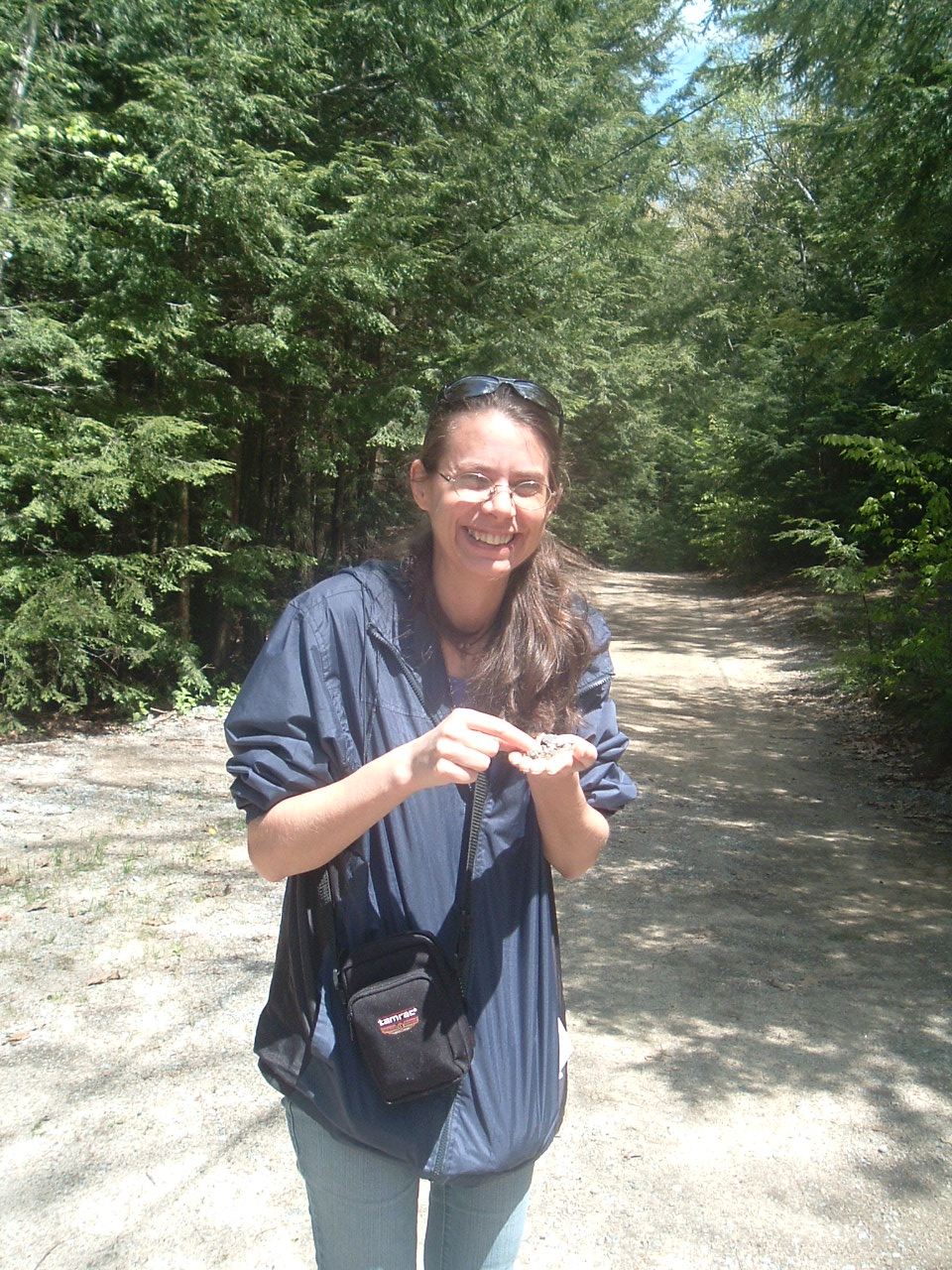
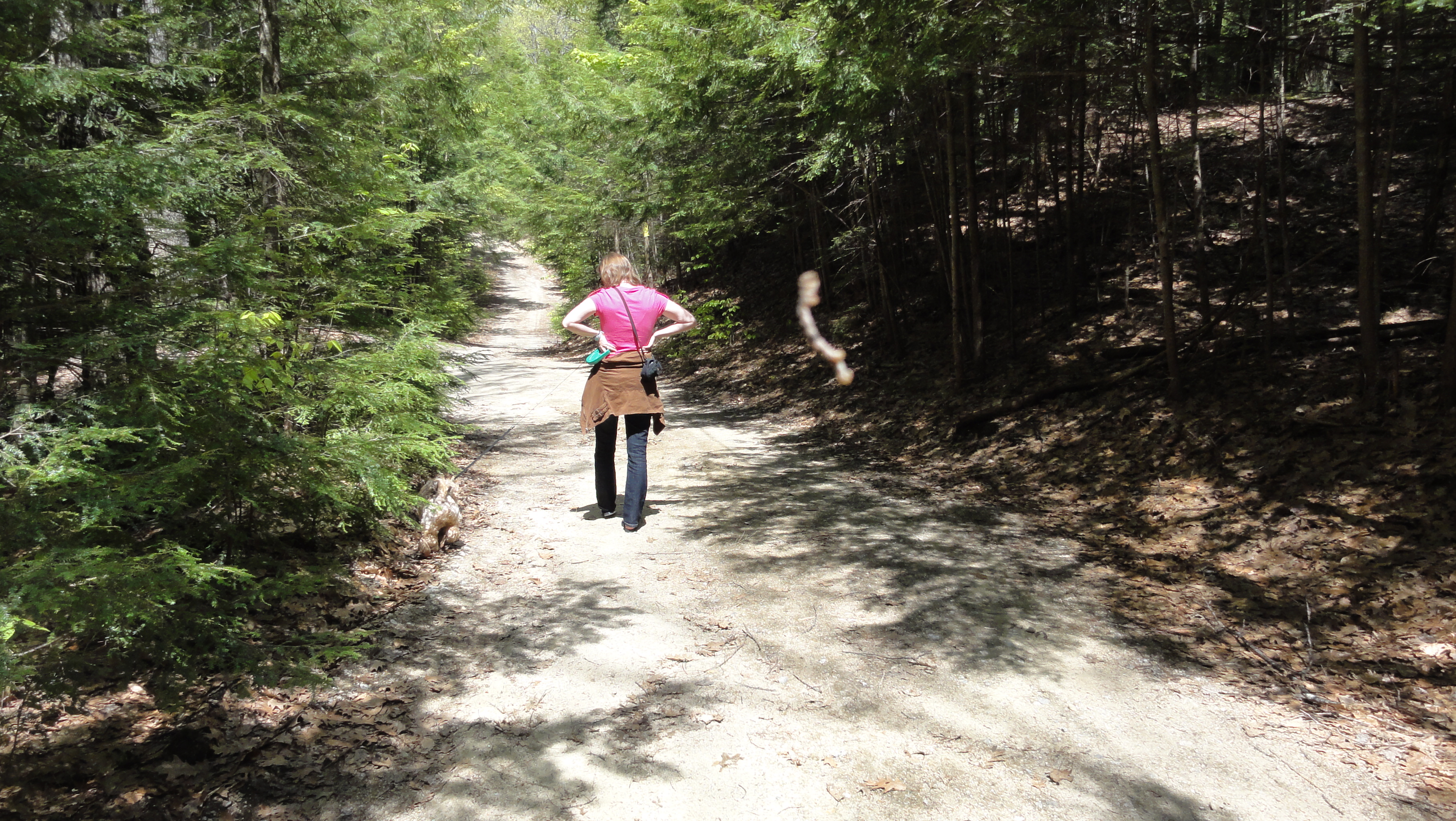
A casual stroll along the garnet road. Geologists often walk with their heads to the ground,watching for interesting rocks.

I apologize for a bit of a hiatus in posting. There were some technical troubles with the AGU blogs, and then my husband and I were down in Florida for five days. Blogging may continue to be somewhat light for the next few weeks, but I’ll post when I’m able. First, I’ll finish up my “Georneys with Dana” series. Then, I’ll post a bit about the trip to Florida.

Note: I convinced my Geokittehs co-author Dana Hunter to fly from Seattle to New Hampshire to visit me for a few days. I handed in the final version of my PhD thesis on Friday May 4th, and Dana arrived the next day to help me celebrate. This is Part V of my description of the fun georneys we had together during Dana’s visit.

Geologists, you may notice, often walk with their heads pointed downward. That’s because down is where the rocks generally are. Geologists also keep their heads pointed toward cliffs or boulders. When driving, geologists slow down and turn their heads when they pass roadcuts. At times, geologists become so absorbed in watching for rocks– and then looking closely at the interesting rocks they find– that they forget about the rest of the world: the scenery, other people, that squishy biology stuff, lunch, water, continuing the walk or hike that was started, driving at a normal highway speed, and so on.

Long before I began studying geology in a formal manner, I walked with my head pointed downward,  looking out for interesting rocks. I guess that’s how I knew I should study geology. For example, my second week of high school I was going on a training run in the woods as part of my school’s Outdoor Program*.  As I ran, I kept my eyes on the ground, keeping a casual eye out for interesting rocks. I ended up running straight into a tree. I went to the hospital for a few stitches, but I was generally okay. For the rest of the year, I was called “George” by my fellow students.

Before I learned much about rocks, I used to watch out for “pretty” rocks such as large pieces of rose quartz, silvery garnet schists, and rocks with bright red iron oxide weathering rims. Now that I know more about geology, I still enjoy finding “pretty” rocks, but I also find myself very interested in a wide variety of “ugly” rocks, such as highly-weathered peridotites, dull-colored sandstones, and gray basalts. That’s because even the dullest of rocks can tell fascinating stories.

To non-geologists, rocks are just something to walk upon or drive above or build a house upon; rocks are brown or gray or white hard things that are not worth paying much attention to unless they sink or shake or erupt… or perhaps if they are particularly sparkly. To geologists, rocks– even the dullest gray or brown rocks– are interesting, even when they are not particularly mobile or sparkly. That’s because geologists learn to read rocks the way people learn to read books. To a geologist,  a rock’s features are like hieroglyphics. There are stories enfolded in the juxtaposition of two minerals, in the order of a set of veins, in the thickness of a lamination, in the offset of a fault, in the shape of a crystal, in the softness of a sediment, in the curve of a fossil,in the color of a weathering rind, in the roundness of a cobble, and in many other rock features.

Rock stories are almost always mysteries. The rocks provide clues, but it takes often quite a bit of work to figure out who murdered whom in what room with what weapon, so to speak. When reading rocks, geologists use various clues to try to figure out what crystallized from what and then squished into what under what conditions… or, perhaps, who died and was preserved into what that was then altered into what… or, perhaps, what settled onto what and then was filled with what… or, perhaps, what slid past what when and caused what size earthquake and tsunami. There are countless rock mystery stories.

Often, geologists barely begin to unravel rock mysteries in the field. Rocks must also be sampled and brought into the laboratory. Rocks must be cut up into thin slices and examined under microscopes; they must be scanned and crushed and dissolved and, sometimes, turned into plasma. Sometimes, rocks must be analyzed from space, using fancy satellites that provide much information about large and small-scale field features. Field observations of rocks must be carefully examined in the office: thousands of strikes and dips and other field information must be compiled and formed into geologic maps and models. Even then, geologists often only unravel part of a rock mystery. There is always more to learn about rocks. Like a good mystery novel, a rock story is rarely fully resolved; there are always loose ends left at the end; there are always sequel stories to unravel.

Because they can read rocks, geologists are easy to entertain. You don’t need a computer or a kindle or a television to entertain a geologist. All you need are some rocks– and there are rocks almost everywhere.

Here’s one recipe for entertaining two geologists for a morning:

1. Take two geologists.

2. Add one dog, two cameras, one hand lens, and one dirt road in New Hampshire.

3. Sprinkle the dirt road generously with freshly-broken, garnet-filled metamorphic rocks that are useful for stabilizing the road during spring “mud season.”

4. Tell the geologists to take the dog for a walk along the dirt road.

5. Busy yourself with something else while you wait for the two geologists to return. Note that geologists may take much longer to complete walks than non-geologists. A good rule of thumb, when the rocks are particularly interesting, is that geologists will take about two hours to complete a walk that takes non-geologists twenty minutes. If the geologists are too long in returning home, you may be able to lure them back by cracking open a few ice cold drinks.

Recipe warnings: The dog may periodically sit down in the middle of the road, looking forlornly at the geologists while they hunt for pretty garnet rocks in yet another section of the road. The geologists are likely to fill their pockets and camera bags full of rocks. Even for a “short” walk, it is advisable to send the geologists out fully equipped with water, sunscreen, and sun hats. Don’t bother sending snacks as the geologists will likely forget to eat the snacks.

I followed the above recipe when entertaining Dana last week. Dana served the role of “first geologist, I served the role of “second geologist” and Dingo (my parents’ pet) served the role of “the dog.”

Here are some pictures of our walk along the road which we nicknamed “The Garnet Road” because of all the crushed-up, garnet-bearing metamorphic rocks which were recently dumped on the road:
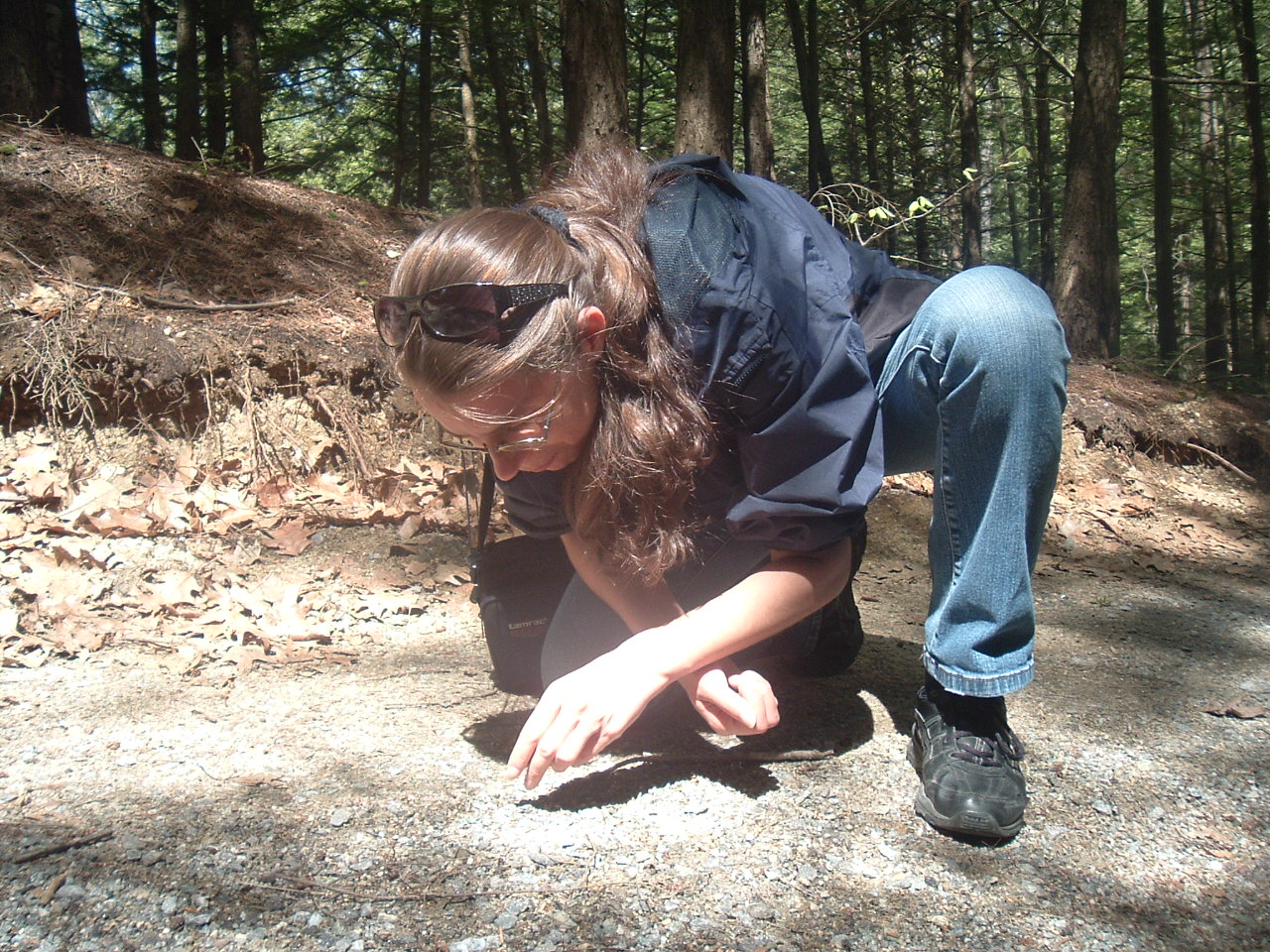
Oooh interesting road rocks.
Found something.
Interesting rocks = happy geologist.
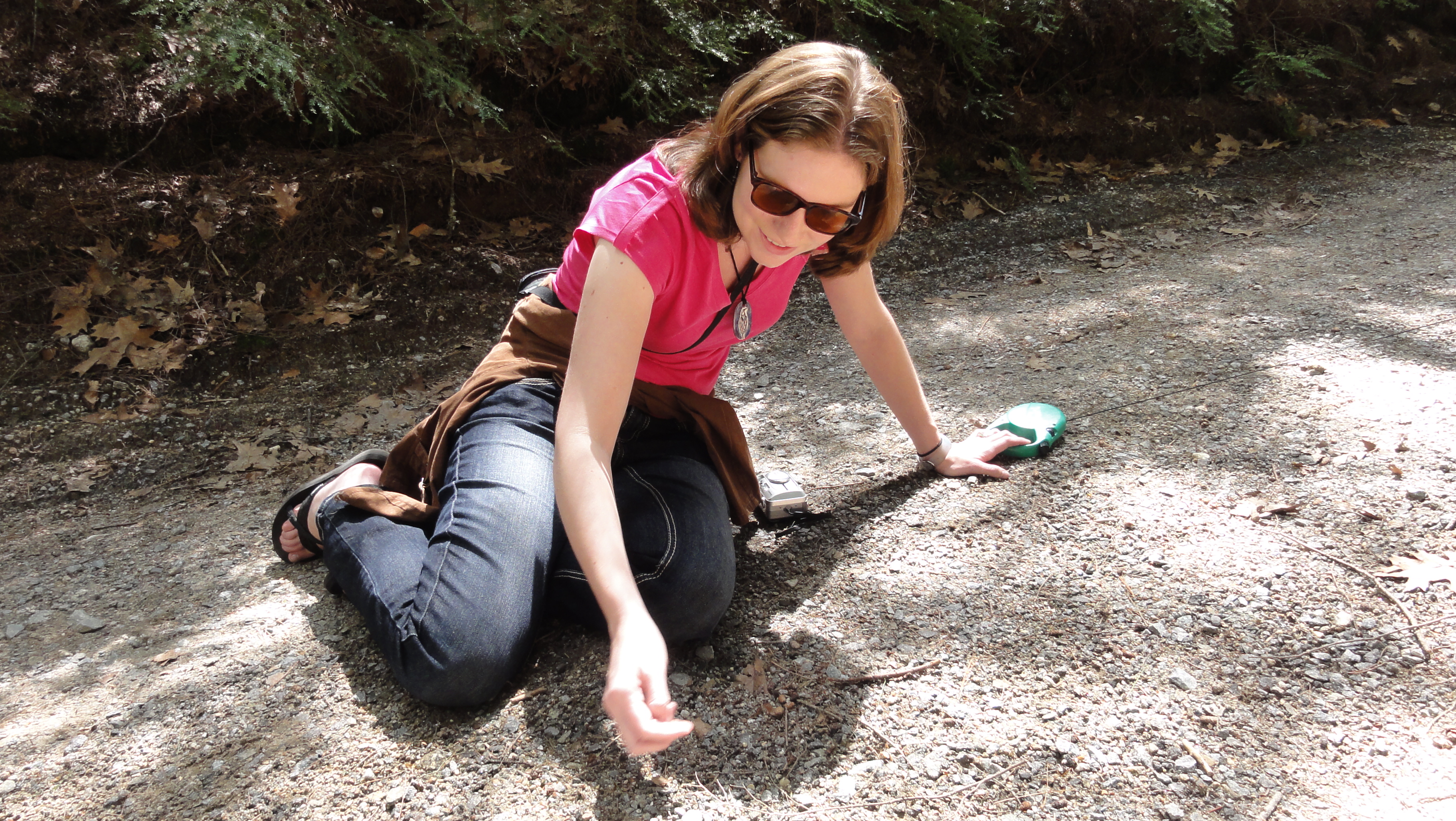
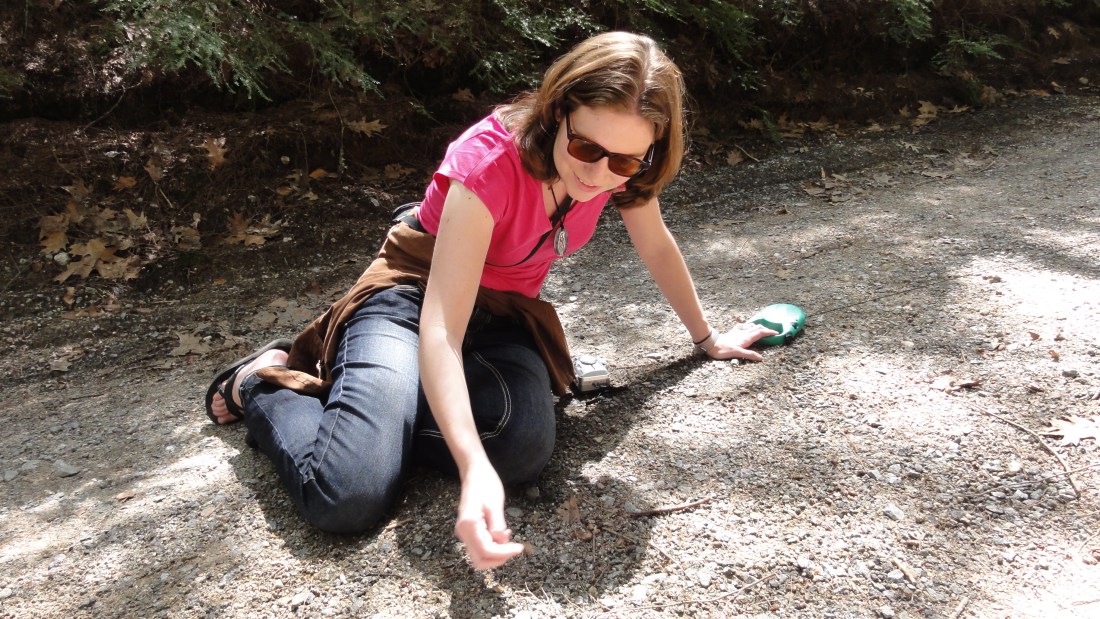
Sitting down to search for garnets. Fortunately, there is not too much traffic along the dirt road.
Taking a closer look at a road rock.
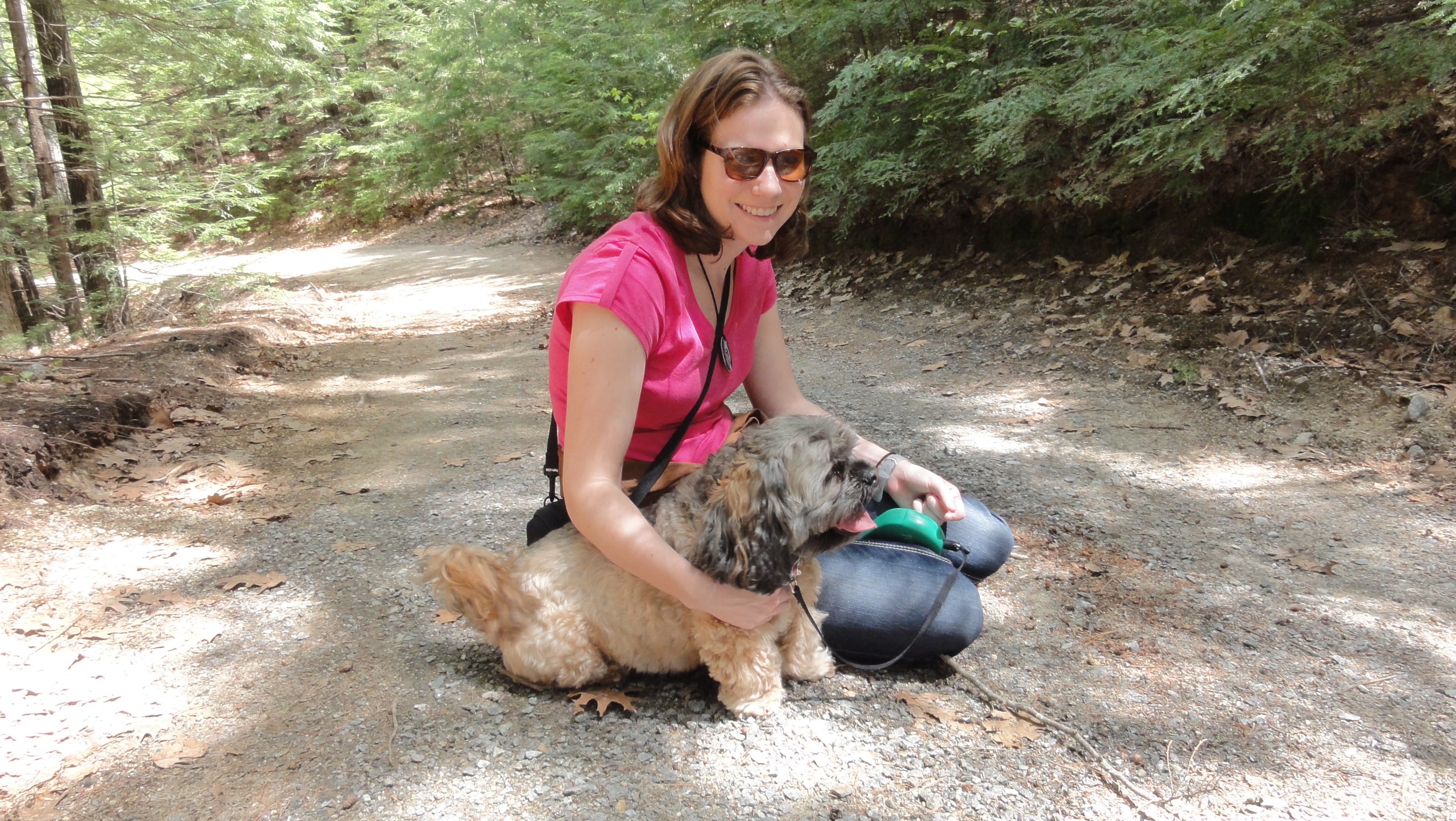
Dingo was confused about why we were doing so little walking on our "walk."
Can we walk please?
Dana finds a great pile of garnet-rich rocks.

Here are some pictures of a few garnet-rich, metamorphic rocks which we collected along the road:

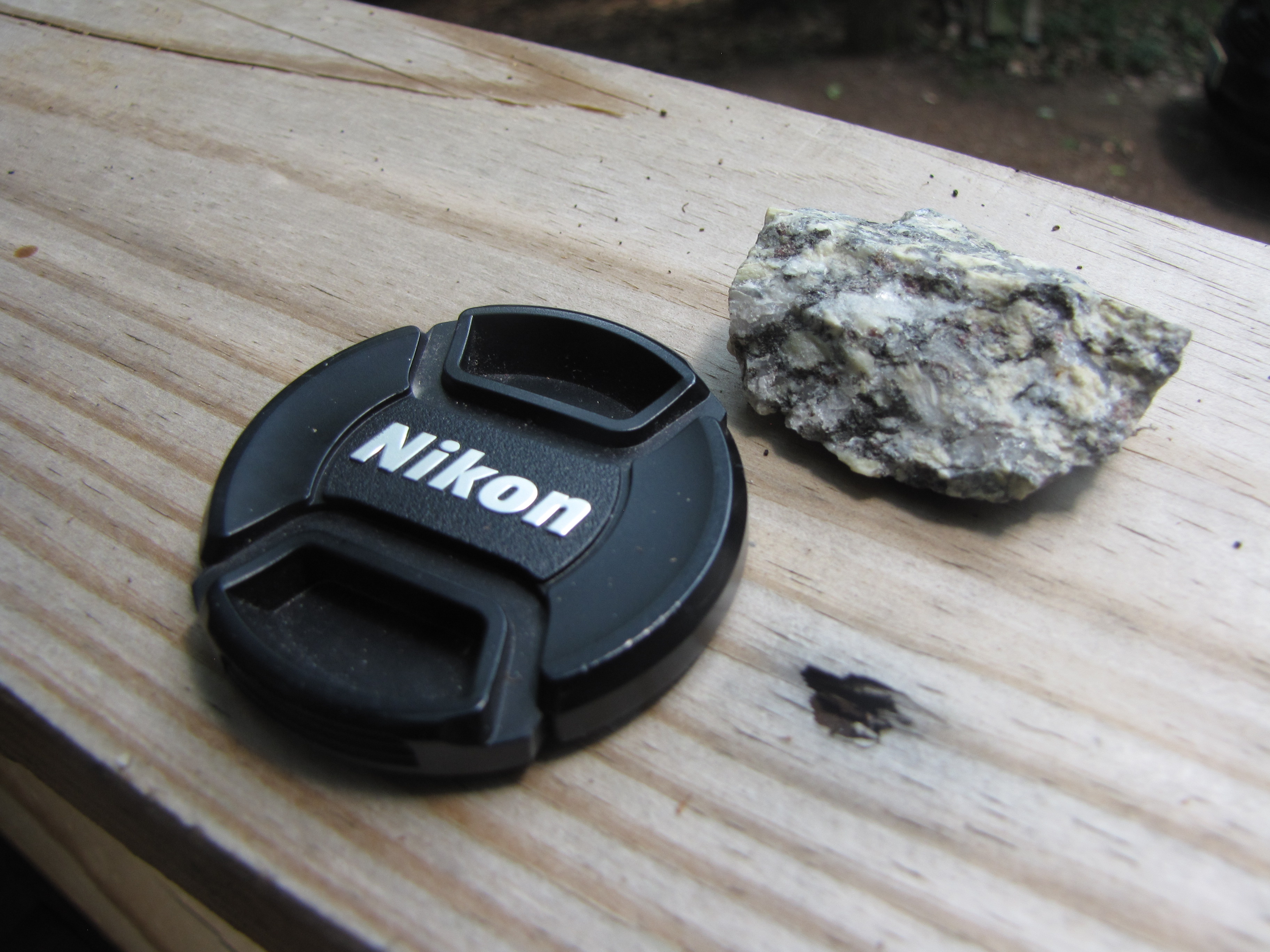
Garnet Rock, Picture #1. Just look at those large, gorgeous garnets!
Garnet Rock, Picture #2.
Garnet Rock, Picture #3.

*My high school has a wonderful program called Outdoor in which students spent the semester learning about hiking, rock climbing, kayaking, and camping. Twice a week the students go on a longer trip, such as a kayaking trip. The rest of the week the students participate in short exercise and skill programs, such as going for a run and then learning how to set up a tent. I participated in Outdoor all four years of high school, and I greatly enjoyed the program.

Monday Geology Picture: Lakeside Geologist Lair

The view from the lair.

All good evil geologists need a  family cabin super sekrit lair. Most geologists prefer volcano lairs, but since there aren’t any volcanoes in New Hampshire, I’m making do (for now) with a lakeside lair. Once I return to my South African lair in a month or so, my geologist husband and I are going to start saving up for our volcanic island lair. Currently, I’m peacefully enjoying working very hard on some Star Trek watching, kayaking, knitting, and sunbathing world domination plotting at my lakeside geologist lair… somewhere in New Hampshire. I can’t tell you exactly where because if I do then my lair won’t be super sekrit anymore. Last weekend, my friend future empire co-leader Dana Hunter visited, and we enjoyed some geological excursions field campaigns and also spent some time watching Dr. Who planning our Geokittehs empire at the lakeside geologist lair. The view from the lair is very pretty, isn’t it?

If you haven’t already, you can read all about Dana’s holiday trip strategic planning mission:

Here on Georneys:
Georneys with Dana- Part I: Dinosaur Footprints Near Holyoke, MA
Georneys with Dana- Part II: The Rock, Fossil, & Dinosaur Shop
Georneys with Dana- Part III: The Chesterfield Gorge

Over at En Tequila Es Verdad (Dana’s blog):
“Groundbreaking result! Carnivorous Triceratops discovered…”
Geology by the Lake
Mystery Flora: Dinosaur Delights
Wuv, Twu Wuv
Saturday Song: Utah Carol
Two Women in a Boat (To Say Nothing of the Dog)

Georneys with Dana- Part III: The Chesterfield Gorge

The gorgeous gorge.
A gorgeous gorge.

Note: I convinced my Geokittehs co-author Dana Hunter to fly from Seattle to New Hampshire to visit me for a few days. I handed in the final version of my PhD thesis last Friday afternoon, and Dana arrived last Saturday to help me celebrate. This is Part III of my description of the fun georneys we had together during Dana’s visit.

After our visits to the dinosaur footprints and The Rock, Fossil, & Dinosaur Shop, Dana and I headed back to New Hampshire to our secret lakeside geologist lair. On the drive back, we stopped at the Chesterfield Gorge. Although there has recently been some illegal activitiy at the gorge, during our visit Dana and I didn’t encounter anything more dangerous than an overly friendly golden retriever who wanted head scratches. I was happy to see that the gorge is back to being a peaceful natural retreat. I think my mother’s claims of the “danger” of the gorge were perhaps somewhat exaggerated.

Gorge Trail Map. Image taken from here: http://www.tmclark.com/ChestGorgeimg-Images/CGMap.jpg

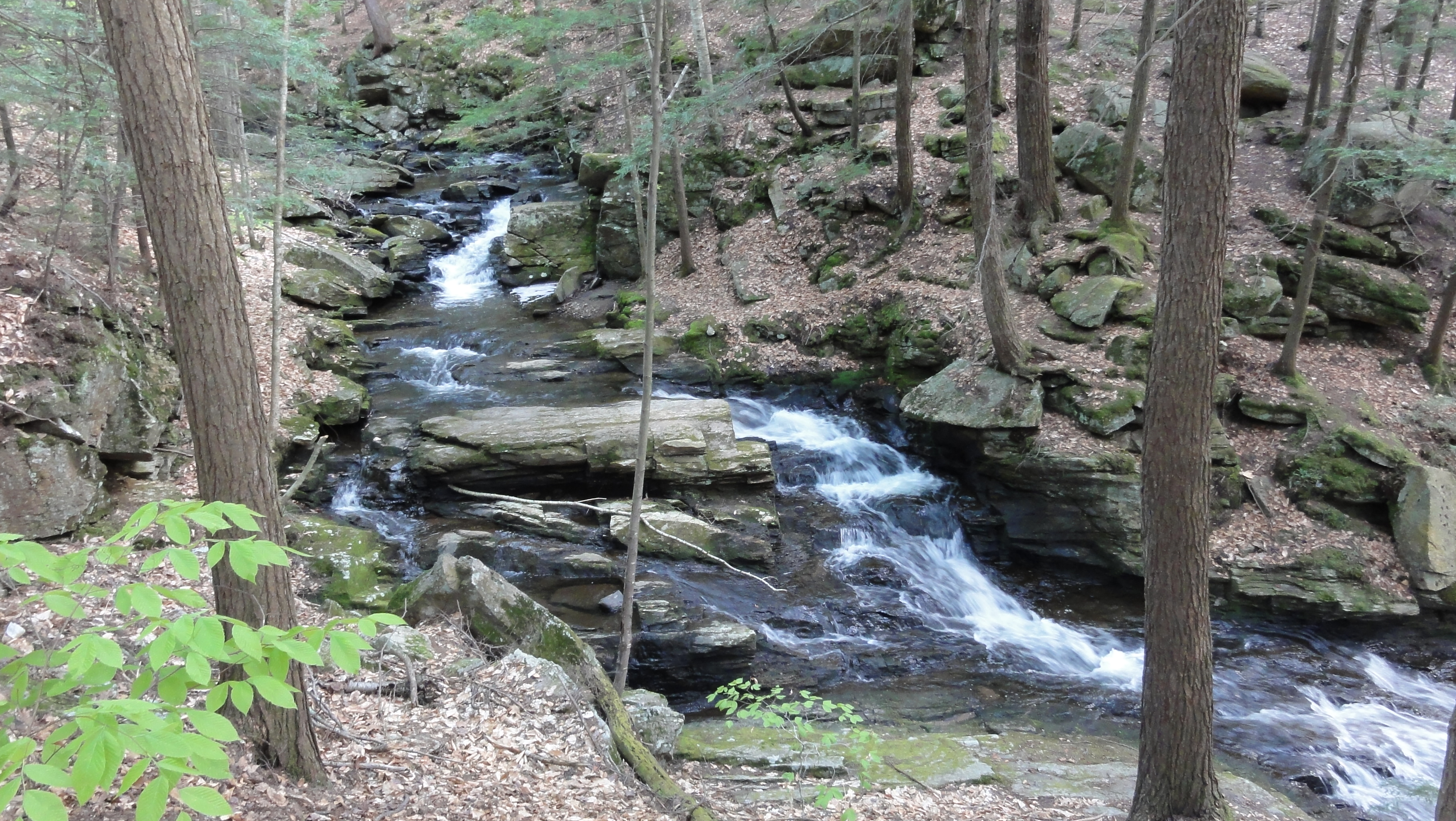
Dana and I hiked the 0.7 mile loop trail along the gorge, stopping frequently to investigate the gorge’s intriguing geology. The gorge contains a most unusual looking stream. Most of the time, the bedrock found in streams and rivers is smooth (and often covered in sediment), and the rocks found within streams and rivers are rounded. River and stream rocks are generally worn down and rounded by physical erosion caused by the passage of water over them. However, the rocks at the gorge are not very round. They generally have sharp, square edges that indicate that the stream is fairly young (or just hasn’t been in contact with this bedrock very long) since there has not been enough time for physical smoothing of the rocks.

Sharp, square edges on those gorge rocks.
More sharp, square rock edges.
More square rocks.

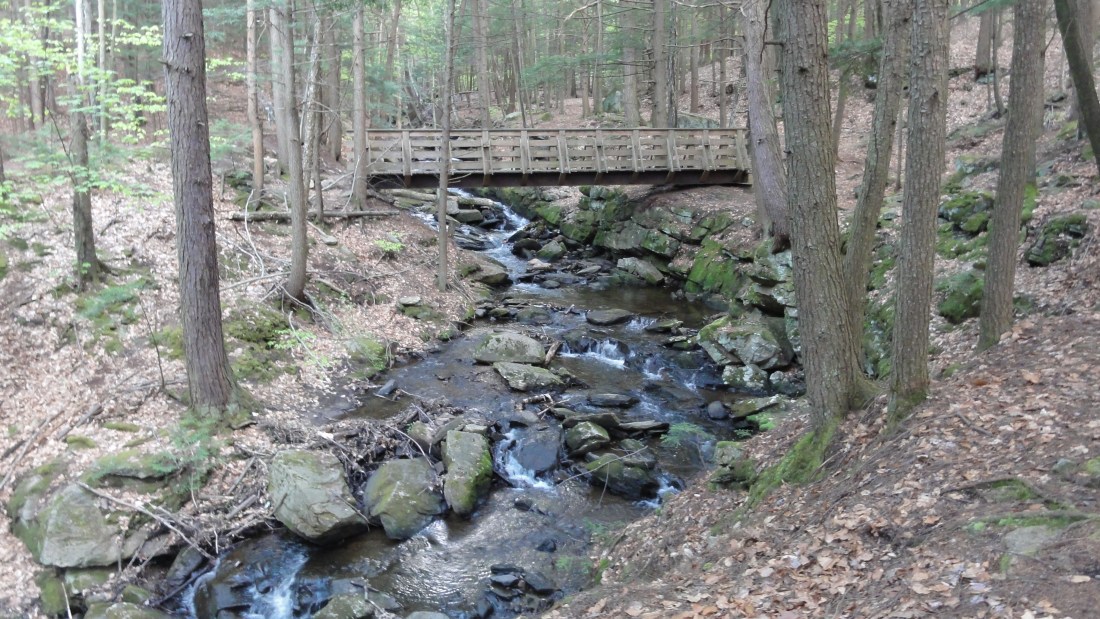
Dana and I made our way along the trail to the first bridge across the stream:

The first bridge. Thou shall pass.

Before crossing the first bridge, we decided to take a closer look at the gorge’s rocks. The rocks are highly-weathered, and many are covered in moss. So, we had to exercise the good science of rock-breaking:


A weathered, moss-covered rock with a freshly-broken rock on top. Penny for scale.

Unfortunately, my rock hammers and other rock-breaking supplies are all in South Africa, and Dana packed carry-on for her trip and couldn’t bring her rock hammer. So, we had to improvise a bit with the rock breaking:

Throwing one rock against another.

Rock breaking by throwing is not as effective as rock breaking by hammer, so we also gathered up some rock samples to break later. The next afternoon, we borrowed a hammer from my dad’s stash of tools and did a little more advanced rock breaking. A word of advice: in the below photos, I set a bad example. Rock breaking should ideally be done with closed-toed shoes and long pants (to prevent injury from stray rock shards), but I did remember the essential eye protection (wrap-around sunglasses, in this case).

Breaking rocks in sandals. Don't try this at home, kids!
A little more aggressive rock breaking.
Dana, breaking rocks in more sensible rock-breaking attire.
Excited about the rock-breaking results.

Here’s what we saw when we broke the gorge rocks:

Gorge rock #1.
Gorge rock #2.
Gorge rock #3.

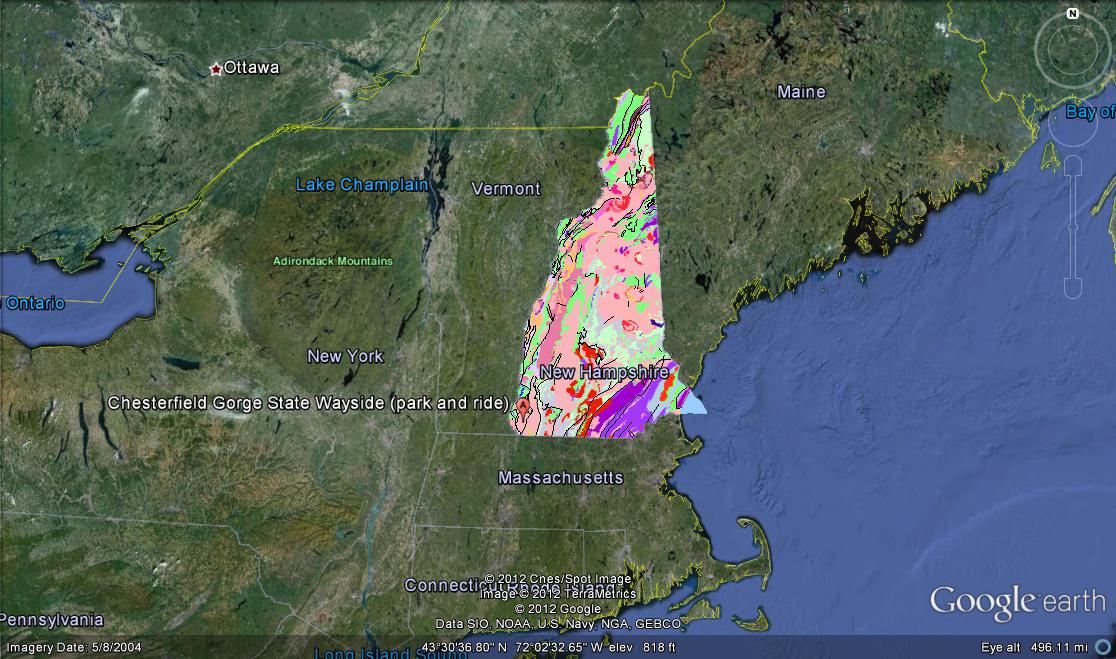
So, what type of rock is found in the gorge? Looks like a metamorphic rock (fairly low grade) that perhaps used to be a granite or granodiorite. I managed to find a little more information about the gorge rock type by plotting the location of the Chesterfield Gorge on top of a geologic map of New Hampshire. I found the New Hampshire geologic map on the USGS website here, and I imported the map data into Google Earth. Pretty neat, huh? It’s actually quite easy to do– just download the .kml file, put it into Google Earth, and then you can look at the geologic map as Google Earth layer. Then, you can just click on a geologic formation, and an internet browser window will open with the information for that particular formation.

Below are some maps that I made in Google Earth showing the gorge location. First, here are some regular Google Earth images:

Google Earth image, showing the location of the Chesterfield Gorge in the state of New Hampshire.
A zoom-in of the previous Google Earth image.

Now, let’s take a look with the New Hampshire geologic map added as a Google Earth layer:

The geologic map for New Hampshire as a Google Earth layer. Pretty neat, huh?
A zoom-in on the geologic map, showing the location of the Chesterfield Gorge.
An even closer zoom in. The gorge parking lot area is indicated by the marker.

The marker in the above maps indicates the location of the parking area for the gorge, which is located in the orange formation. If I click on the orange layer in Google Earth, I find that the parking lot is located on the Ammonoosuc Volcanics, which is a Middle Upper Ordovician unit described as,

Part of the Central Maine Composite Terrane (Central Maine Trough) – Variably metamorphosed sedimentary and volcanic rocks of greenschist to granulite facies, locally migmatized. Area includes structural belts between the Monroe fault on the west and the Campbell Hill fault on the east; that is, the Bronson Hill anticlinorium, Piedmont allochthon, Kearsarge-central Maine synclinorium, central New Hampshire anticlinorium, and Rochester-Lebanon (Maine) antiformal synclinorium. Ammonoosuc Volcanics = 461+/-8 U/Pb per J.N. Aleinikoff, oral commun., Feb. 1994.

Since the trail to the gorge leads away from the parking area, I believe that at least part (all?) of the actual gorge is actually located in the pink layer. When I click on the pink layer in Google Earth, I find that the pink layer is Granite/Granodiorite/Tonalite of Late Ordovician Age. The unit is described as,

Part of the Oliverian Plutonic Suite (Late Ordovician) – Pink, weakly to moderately foliated, locally porphyritic biotite granitoids found in mantled gneiss domes. Mafic varieties contain hornblends. Variably metamorphosed up to amphibolite facies. Oliverian Plutonic Suite: Keene and Surry dome intrusive rocks = 444+/-8 U/Pb per NH020. Warwick dome intrusive rocks = 444+/-8 U/Pb per NH020.

So, I believe the rocks that Dana and I saw at the gorge are from the pink formation. The rocks aren’t particularly pink-colored at the gorge, but they do seem to be granites/granodiorites/tonalites (the rocks seem to contain a fair amount of plagioclase and biotite, so my guess is granodiorite although I’d really need to take a closer look, perhaps employing a thin section– any opinions based on the rock pictures?) that have been metamorphosed somewhat. I’m assuming that the ages above (based on U-Pb dating) are in millions of years, so the gorge rocks are nearly half a billion years in age. Such an old age isn’t unusual for bedrock. Nevertheless, I still find myself somewhat in awe that these rocks originally formed nearly half a billion years ago. What history is exposed in the gorge!  As a quick aside, when people ask me why I became a geologist, I sometimes say, “Well, I always liked history. And geology is really ultimate history, if you think about it. Geology is the study of the history of our planet– and other planets and planetary bodies.”

So, why do such old rocks host such a young stream? Clearly, the stream hasn’t been in contact with the bedrock very long or else the metamorphic gorge rocks would be worn smooth. I searched and searched for some academic papers on the formation of the Chesterfield Gorge. However, despite spending quite a bit of time using search tools such as GeoRef and Google Scholar, I didn’t find any scientific papers on the gorge. If anyone knows of any publications on the gorge’s geology, I would be most grateful if you would direct me to them. I couldn’t even find the gorge in my Roadside Geology of Vermont and New Hampshire book.

The best information I could find on the gorge’s origin is a PDF of an information pamphlet published by New Hampshire State Parks. The brochure indicates that the gorge is located along a fault (I’d love to bring Callan to the gorge to take a look at the structural geology) and that Wilde Brook (never knew the stream was called that until I read this brochure) is a superimposed stream that originated from glacial meltwater ~12,000 years ago. The sediment and gravel that once covered the metamorphic bedrock have been eroded by the young stream (I presume 12,000 years is fairly young for a stream? Perhaps not?), and now the metamorphic bedrock is slowly being eroded.

There is certainly some evidence that there was once a retreating glacier in the Chesterfield Gorge area. For example, just look at this enormous glacial erratic:

A glacial erratic boulder, just a few feet from Wilde Brook.

After Dana and I spent some time breaking rocks at the first bridge, we made our way down to the second bridge. Along the way, we saw some beautiful scenery:

Gorgeous gorge scenery.
More gorgeous gorge scenery.

After a short hike, we found ourselves at the second bridge. When we arrived, we found that we had a slight problem:

The second bridge. Thou shall not pass.

Since we are intrepid geologists, we decided to ford the stream rather than backtrack:

Venturing off the beaten path.
Caulking the wagon and floating didn't seem necessary.
Dana looked a little nervous before the stream crossing, but she made it just fine.

After fording the stream, we headed back up towards the parking area. On our way out, we had another look at the first bridge:

Peaceful and pretty.

And we also found some interesting biologically-assisted rock erosion:

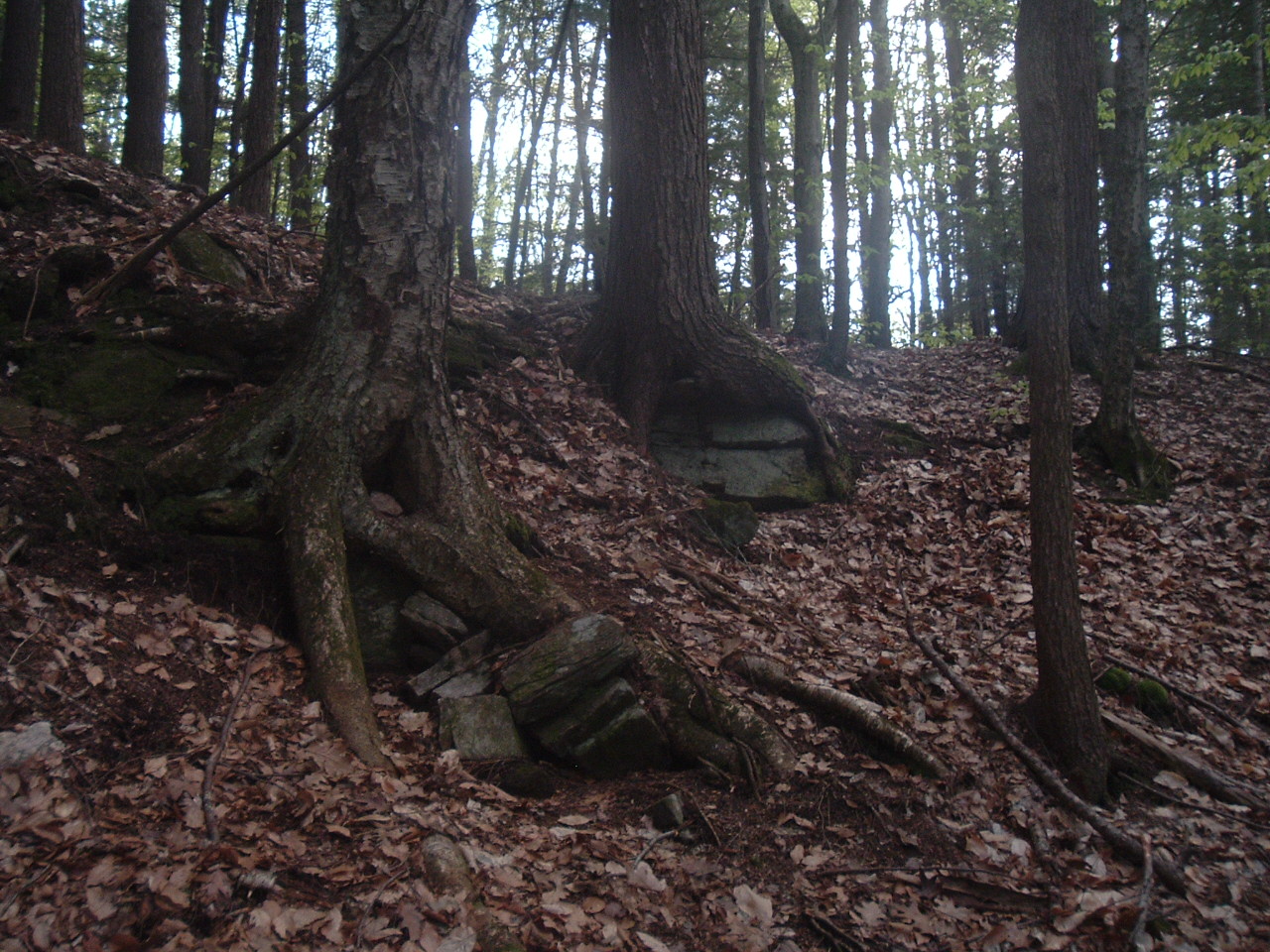
Tree root style rock erosion.
More tree root style rock erosion.

And we saw some interesting mushrooms:

Pretty fungi.

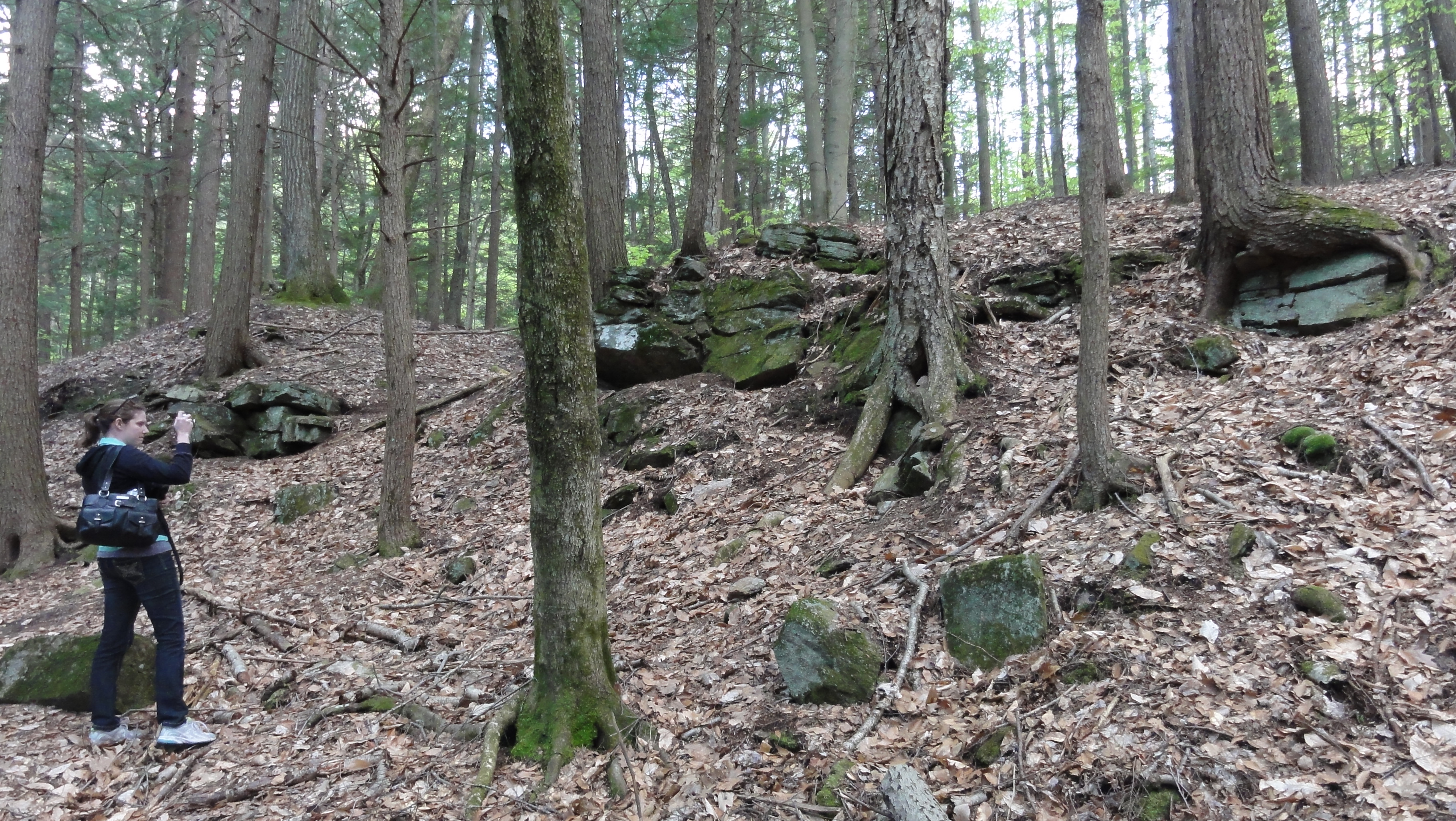
And we found a tree growing in a neat shape:

Strangely shaped tree, with geologist for scale.

All in all, Dana and I had a good day of geologizing. We saw dinosaur footprints, visited a kitschy rock shop, and explored the geology of a gorge. After this full day, we picked up a pizza and headed back to our lakeside geology lair to watch Dr. Who. Next up: Day 2 of our georneys!

Monday Geology Picture: Chesterfield Gorge, New Hampshire

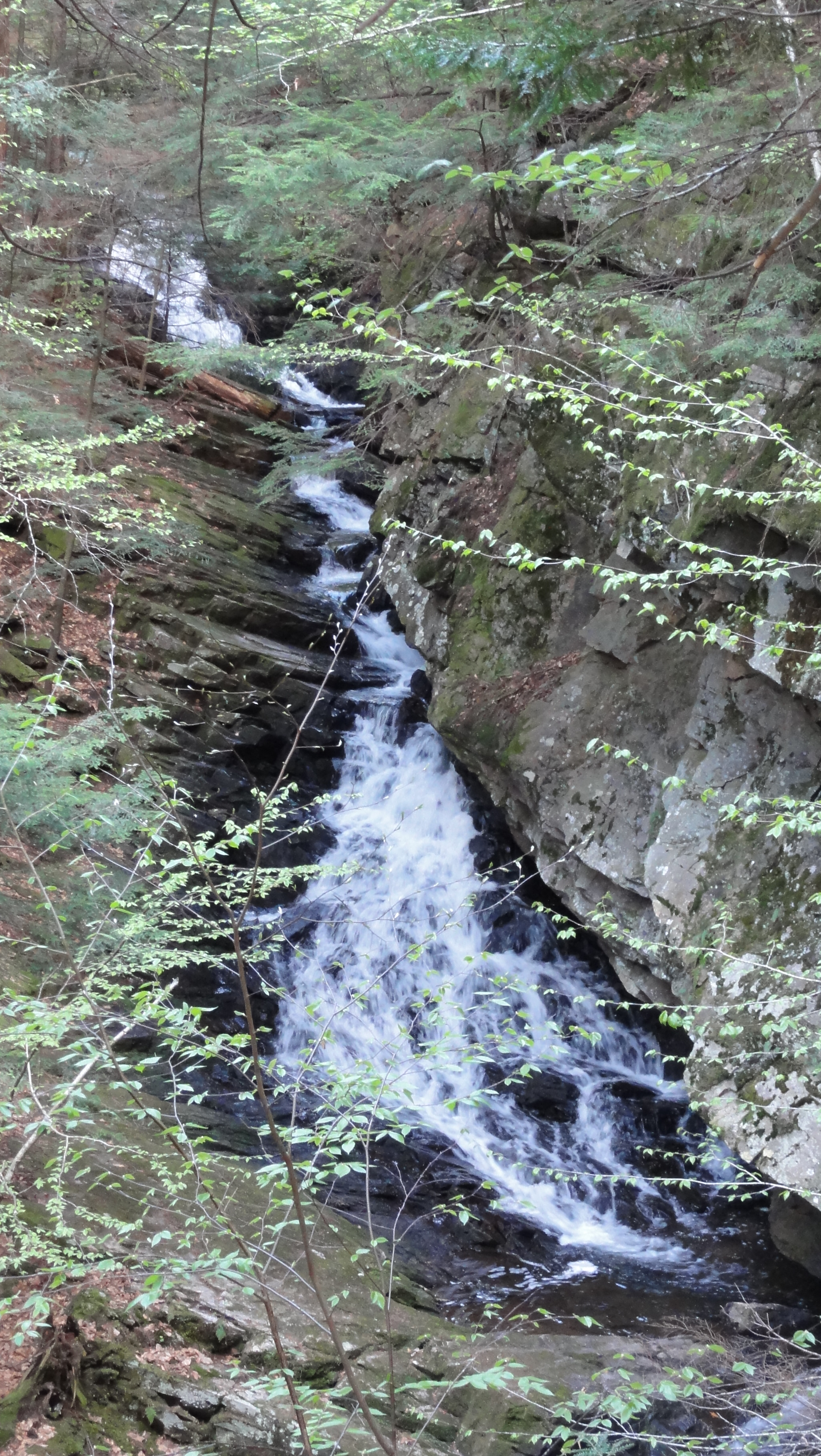
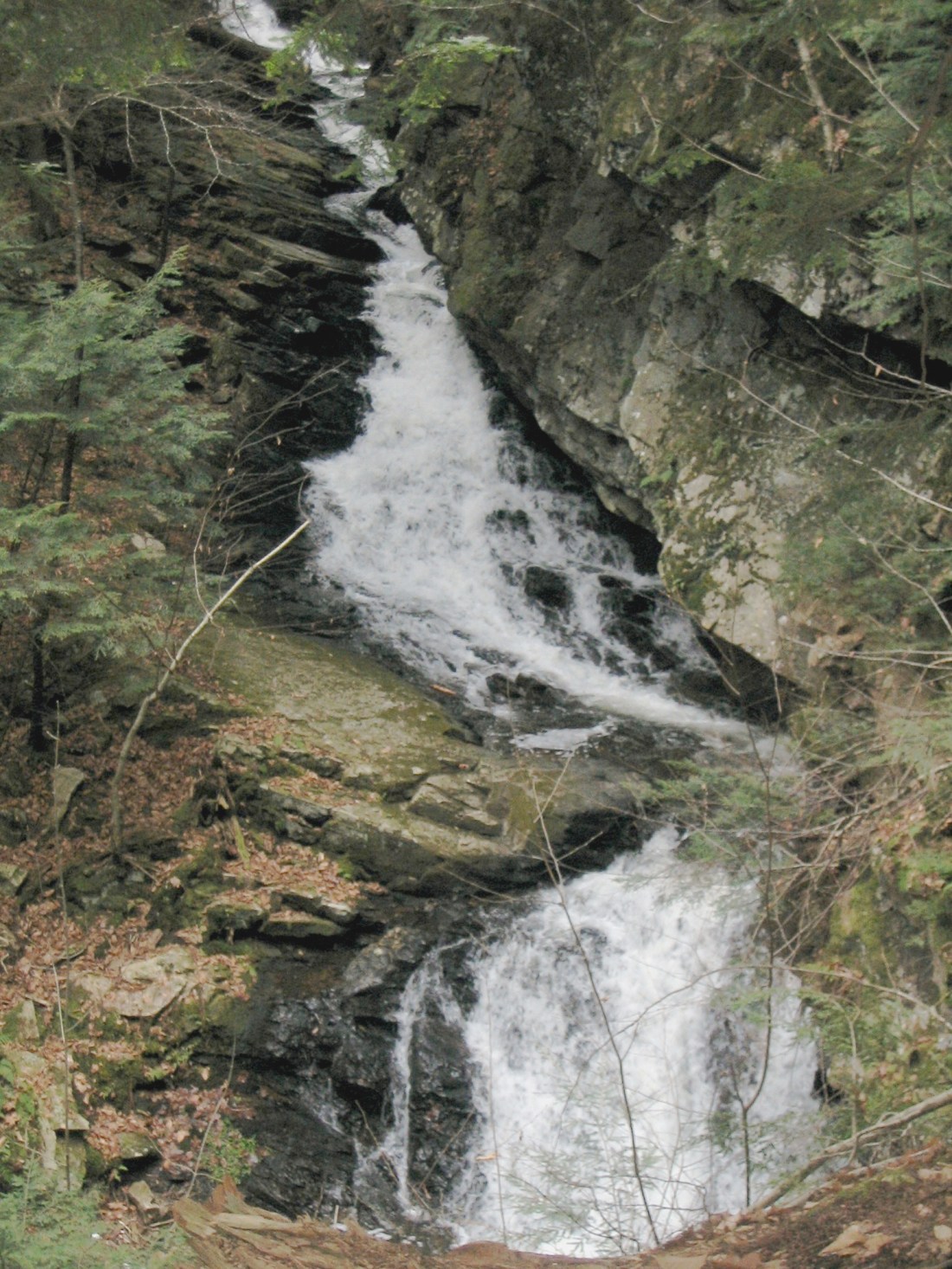
A waterfall along the fault, Chesterfield Gorge, New Hampshire.

This week’s geology picture was taken in the Chesterfield Gorge, which is located just a few minutes from my parents’ house in southern New Hampshire. I would often explore and play at the gorge as a child. I used to like to throw things into the gorge and watch them go over the waterfalls. I once duct-taped a Princess Leia figurine into a plastic toy kayak and watched her go over the falls. Miraculously, Leia made it over the falls, and I retrieved her. She did lose her stick paddle, though.  Also, her arm was also falling off a little bit, but I managed to repair her with quick field surgery.

The gorge is an interesting place, geologically. I remember being fascinated when I first read, as a child, that the gorge was created quickly by movement along a fault, not by the slow carving of a stream. You can see the evidence of the fault very clearly in the photograph above. You can see that the tilted, offset layers still have sharp edges; they have not yet been worn away by many years of erosion by water.

I’m headed up to New Hampshire next week after I hand in my thesis revisions. Perhaps I’ll visit the gorge again and share more pictures and geological explanation. Sadly, my mother tells me that these days one must be careful when visiting the gorge. In my childhood, I could play there with my friends and be perfectly safe. Recently, however, the gorge has been the site of some illegal activities and dealings, so one has to be a little bit more careful when visiting, and children definitely shouldn’t play there alone. Nevertheless, the geology is so spectacular that I may bring Dana Hunter there when she visits me next week. I can’t wait for Dana to visit. You can expect some fun posts about her trip in the next few weeks!