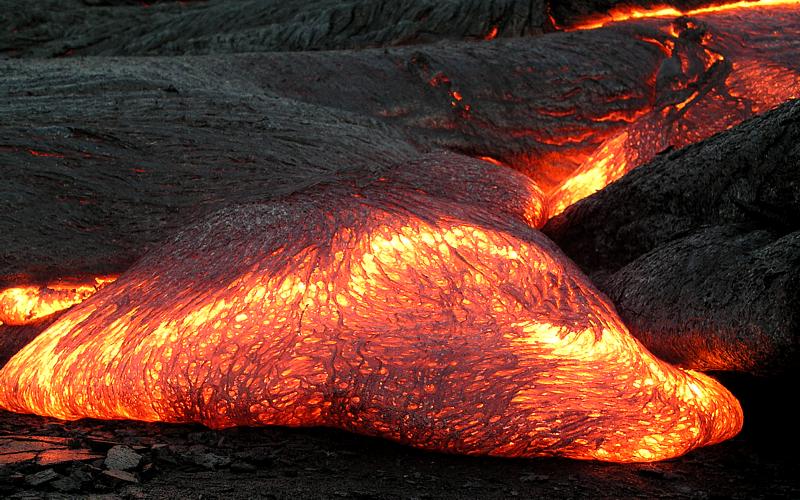
Geology Word of the Week: P is for Pahoehoe

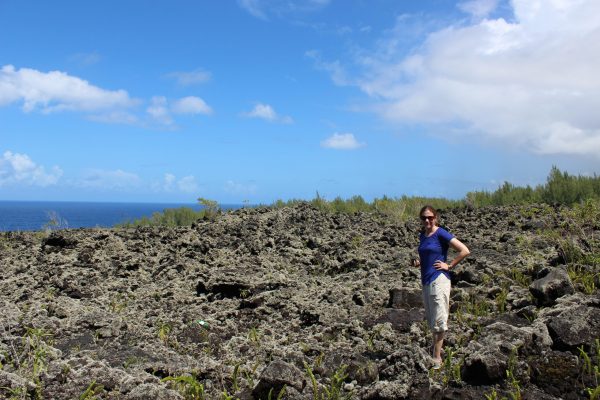
A pahoehoe lava flow on Reunion Island in the Indian Ocean, March 2016.

def. Pahoehoe:

A type of lava with a smooth or undulating surface. Pahoehoe lava flows often resemble coils of rope and are most commonly found in basalt. Pahoehoe is Hawaiian word that is pronounced “pah-hoy-hoy”.


Pahoehoe is a term used to describe a lava flow that has a smooth or undulating surface. Many pahoehoe flows resemble coils of rope or, in some cases, messy piles of rope. Pahoehoe is mostly commonly found in basalt.

Pahoehoe forms when lava flows slowly and a thin crust of cooled material can form on top of the hot lava, preventing heat from escaping and allowing the lava to retain its fluidity (or to retain its low viscosity, to use a more formal geologic term). Lava that flows slowly and cools slowly will form volcanic rocks with smooth or undulating morphologies and, often, will form volcanic rocks that resemble coils or piles of rope.

When lava flows more quickly, the surface crust tends to break and the lava loses heat more quickly. The lava becomes less fluid (or more viscous, since cooler lava is more viscous), which makes the volcanic rock have a blocky, rough morphology. A lava flow with a blocky, rough morphology is known as a’a (pronounced “ah-ah”), another Hawaiian word.

Both pahoehoe and a’a lava flows can be produced at the same volcano. For example, pahoehoe lava flows may form when the lava flows slowly across a gentle slope. However, if the slope becomes steeper and lava starts to flow more quickly the morphology of the lava flow can change from pahoehoe to a’a.

There are many great places to see pahoehoe and a’a lava flows. For example, you can see these types of lava flows in basaltic rocks on the volcanic islands of Hawaii and Iceland. A few years ago, my husband and I went on vacation to the volcanic island of Reunion in the Indian Ocean. We had and incredible trip and saw many amazing lava flows. The pictures of pahoehoe and a’a lava flows in this post were taken during that vacation.

Here are some more pictures of pahoehoe lava flows:

Posing with a pahoehoe lava flow, Reunion Island, March 2016.


Another view of a pahoehoe lava flow, Reunion Island, March 2016.


A close-up view of a pahoehoe lava flow, Reunion Island, March 2016.


Relaxing on a pahoehoe lava flow, Reunion Island, March 2016.


And here are some pictures of a’a lava flows:

An a’a lava flow, Reunion Island, March 2016.


Another a’a lava flow, Reunion Island, March 2016.


An a’a lava flow, with a beautiful view of the sea. A geologist’s dream landscape! Picture taken on Reunion Island, March 2016.


That’s all for this week’s word – stay tuned for next week!

Monday Geology Picture: Pillow Basalt Decor

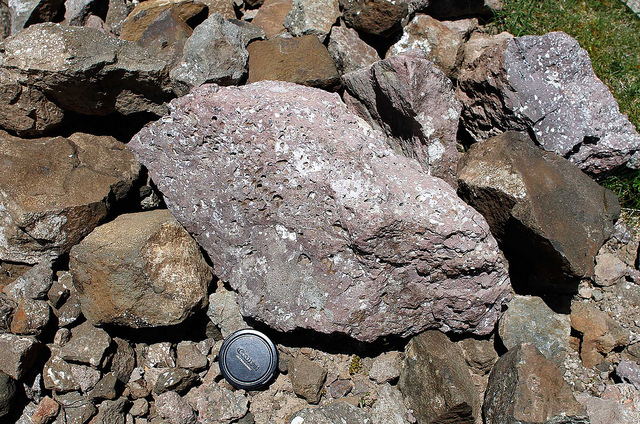
Lovely pillow basalt, with my hand for scale. The shiny polished surface of the decorative slab made photography a little difficult. Photo taken April 2019.

This week I’m sharing a picture of a lovely pillow basalt decorative slab that is part of the decor in the Department of Earth, Ocean, and Atmospheric Sciences at the University of British Columbia.  In this slab, you can see pillow shapes outlined by lovely glass rinds, which formed when the basaltic lava rapidly cooled because it was erupted underwater.

I just love this decorative slab — who wouldn’t want to decorate with beautiful pillow basalt?!

Monday Geology Picture: Another View of Formica Leo Volcanic Crater

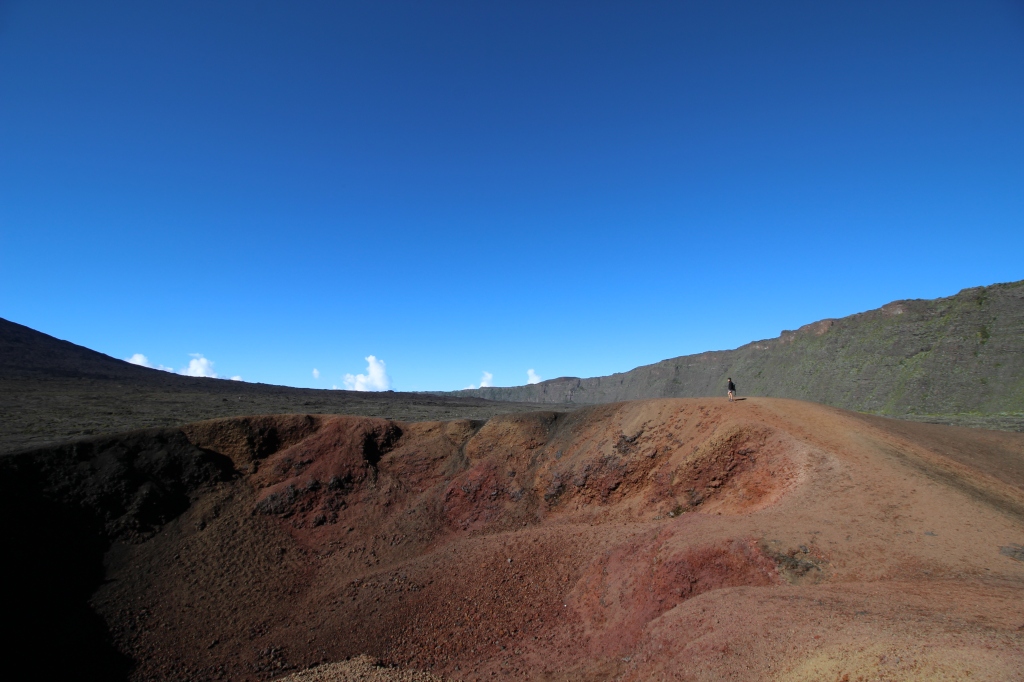
A closer view of the volcanic crater. Note the person for scale.

Last week I shared a picture of the beautiful and impressive Formica Leo, a volcanic crater located at the Piton de la Fournaise volcano on Réunion Island in the Indian Ocean. Last week’s picture showed the crater from a distance. You can just barely make out some small people in last week’s picture, to give you some sense of scale. However, I thought I would share a closer view of the crater this week. This picture, which was taken as we hiked around the rim of the crater, shows a person and gives you a sense that this crater is actually pretty large, if small compared to the overall volcano. The background also gives you a glimpse of the edge of the larger volcanic feature in which this small crater sits. You can see some lava flows on the cliffs in the background.

Stay tuned for more pictures and information from Réunion — there’s much interesting geology to share!

Monday Geology Picture: Formica Leo Volcanic Crater

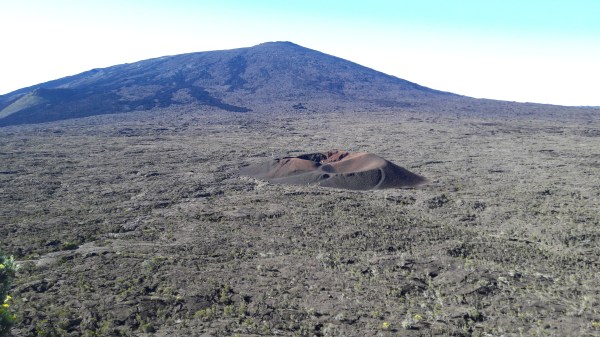
A gorgeous volcanic crater known as “Formica Leo”. Note the people for scale – click to enlarge image.

Today I’m sharing a picture of the stunning Formica Leo (foreground), a volcanic crater located at the Piton de la Fournaise volcano on Réunion Island in the Indian Ocean. My husband and I hiked up this crater when we visited the island for a holiday last year. We also hiked up to the top of the volcanic hill in the distance — crossing over a number of lava flows of various ages. If you ever have the chance, I highly recommend a visit to Piton de la Fournaise — and to Réunion in general. We certainly plan to go back within the next couple of years.

Monday Geology Picture: Pele’s Hair

Pele’s Hair – or “Cheveux de Pele” in French.

For this week’s post, here’s a picture showing a lovely example of Pele’s Hair, which is a type of volcanic glass that consists of fibers or thin strands.

Although I’ve visited many volcanoes (including a few active ones) over the years, I’ve never seen Pele’s Hair in the field. So, I was quite happy to see this excellent example in the volcano museum on Réunion Island. I visited the museum during my vacation to the island last year. If you ever find yourself on the island, visiting the museum is a must. There are all sorts of wonderful displays and examples of different lava types, including this fantastic Pele’s Hair sample.

Monday Geology Picture: Posing with Pahoehoe

Taking a break from hiking on a pahoehoe lava flow. I’m about 9 weeks pregnant in this picture and was already struggling with severe morning sickness. However, that didn’t stop me from (slowly) hiking along some fantastic lava flows during my vacation.

First of all, for this week’s “Monday Geology Picture” enjoy this fantastic picture of me sitting on some pahoehoe lava earlier this year, when I visited Réunion Island back in March.

Second of all, let me provide a little explanation about why I have been terribly negligent of this blog over the past few months, despite my best intentions at the beginning of the year. In January I fully intended to read one science book every month (and write a review), post weekly geology pictures, and blog about some geologically-themed aspects of some recent vacations… and maybe even revive the Geology Word of the Week. Instead, I’ve barely posted at all this year!

My excuse is, however, a happy one: I am expecting a baby boy any day now. Why did my pregnancy lead to such a terrible lapse in my blogging? Well, I have had over 8 months of terrible morning sickness so far. I am unfortunately one of those rare women who have morning sickness for the whole pregnancy, and it’s been really debilitating. Even on strong medication, I feel seasick for many hours every day — often all day and all night. I haven’t read a science book in months because reading generally makes me feel more seasick and gives me a headache. Writing is similarly challenging. With an abundance of medication, careful eating, and days off to rest I’ve managed to (mostly) keep up with my day job and home life, but I just haven’t had anything extra in me for blogging. Fortunately, other than the morning sickness my pregnancy has gone well and baby is healthy. He’s full term now, so he could come at any time!

Now that I’m about to start my maternity leave I thought that I should revive this blog. I’ll start with setting up some weekly geology pictures to auto-post over the next few weeks. Then, once I’m settled somewhat with baby, I hope to add some other blogging. I know that I’ll be very busy and sleep deprived, but I think I should be able to carve out a little time for blogging. Also, I think that I’ll feel more like blogging again, since my doctor assures me that as soon as baby is born the seasickness should quickly go away. Maybe, if baby lets me, I’ll even read a science book now and then!

Anyway, thanks for your patience with my absence… and stay tuned for some good content coming soon!


Geology Word of the Week: A is for Amygdale

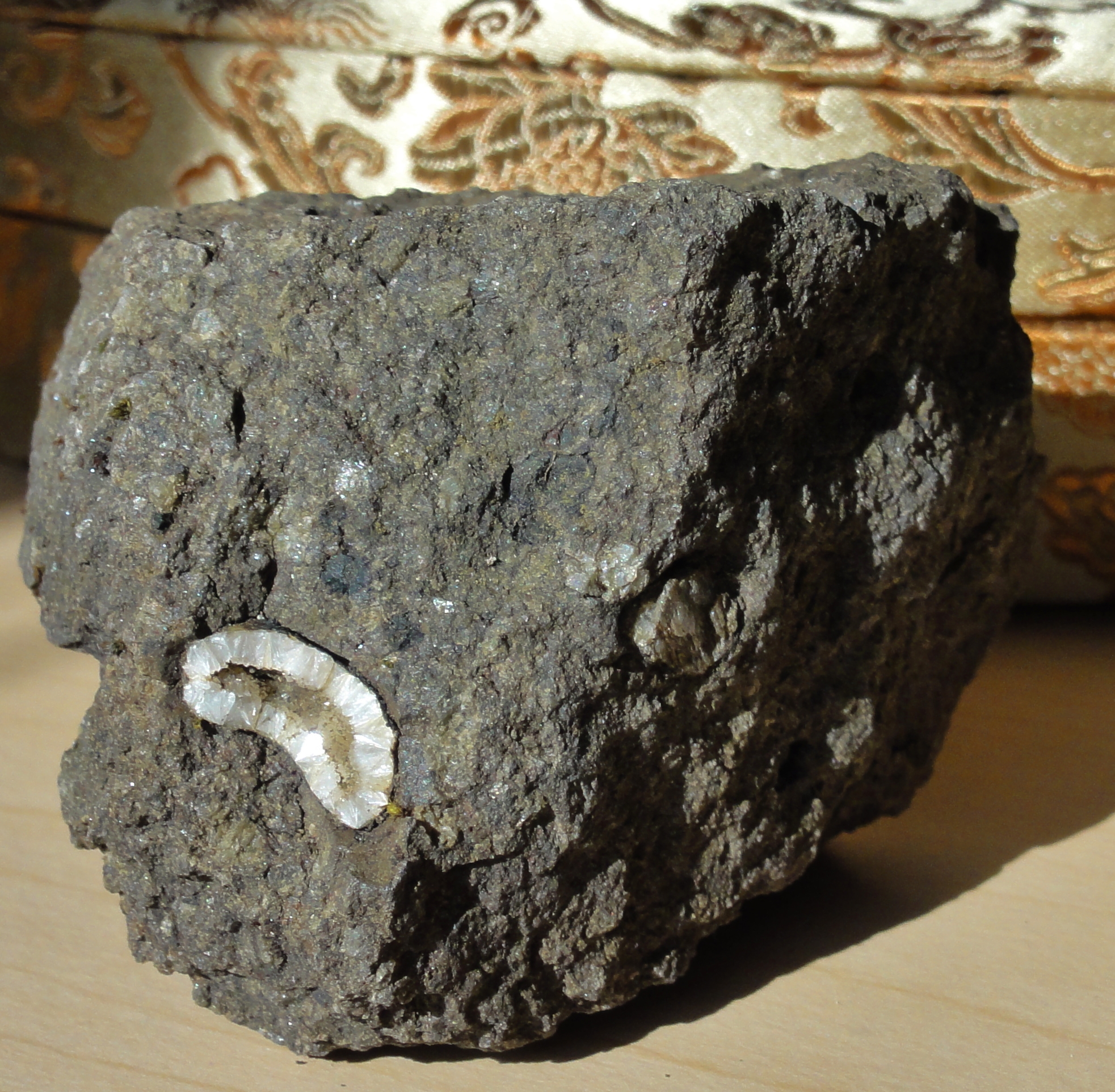
Amygdaloidal basalt collected during dredging along the Ninetyeast Ridge in the Indian Ocean in summer 2007.

def. Amygdale (also spelled Amygule):
Vesicles, generally in extrusive igneous rocks, that are filled with secondary minerals, most commonly quartz, calcite, chlorite, and zeolite.

When a rock contains amygdales, geologists often describe it as an amygdaloidal rock. For example, basalt is often described as amygdaloidal basalt.

Here are a few previous, related geology words of the week that may be of interest:

V is for Vesicle (and Vug)

Z is for Zeolite

M is for Magma

And here are a couple more pictures of amygdaloidal rocks:

Amygdaloidal basalt from the Isle of Skye, Scotland. Picture courtesy of Matt Kuchtam.
A zeolite amygdale in a rock collected from Quartzville, Oregon. Picture courtesy of Dana Hunter.


***Thanks to my twitter follower Laura Hamilton for suggesting this week’s word. Thanks to Matt Kuchtam, Dana Hunter, and Lockwood De Witt for providing pictures.***

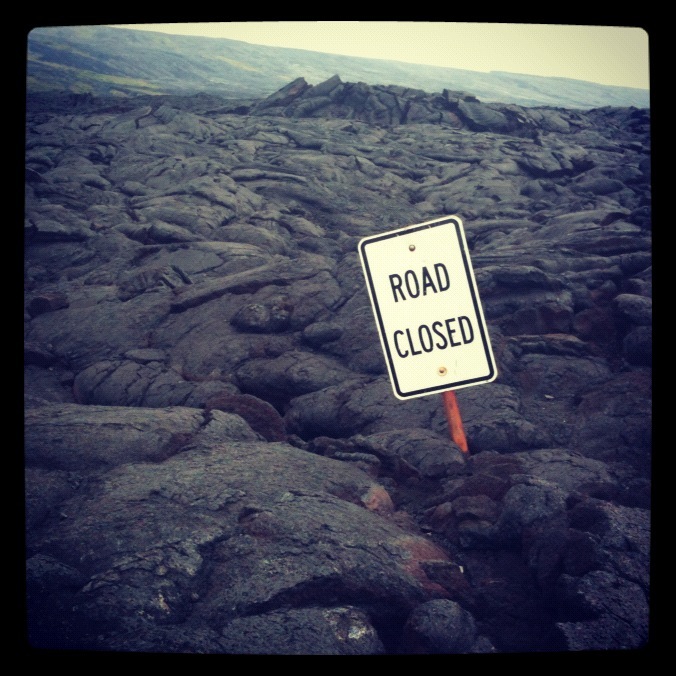
Monday Geology Picture(s): A Lava Road Closure on Hawai’i

Road closed? No kidding!

My friend Arthur recently visited Hawai’i and sent me some wonderful pictures of lava and basalt! My favorite picture is the one above of a former road now almost completely covered by basalt. Arthur informs me that the sign was for Chain of Craters Road, which is now buried under several meters of basalt in places. Here’s the approximate location of the roadsign.

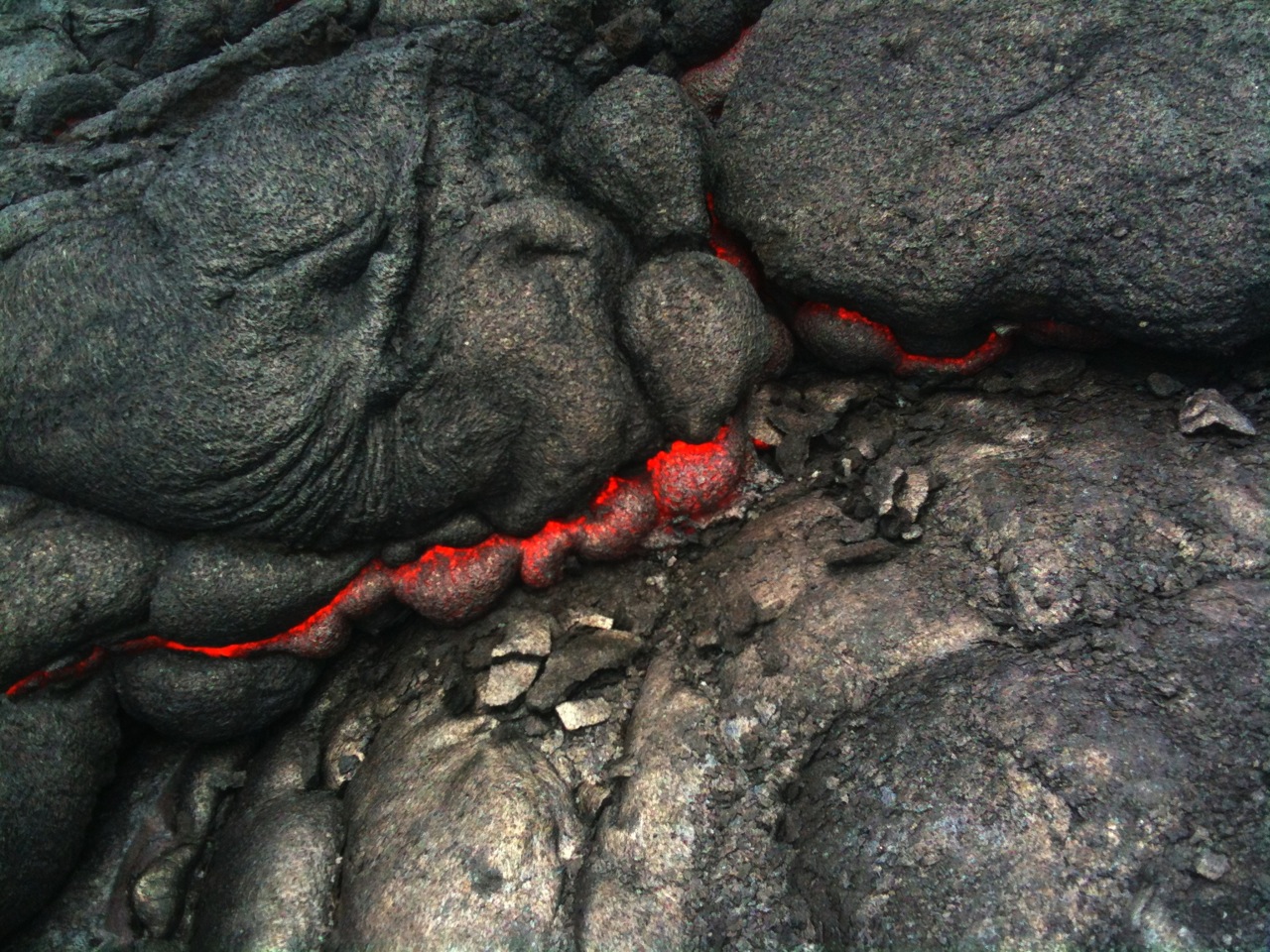
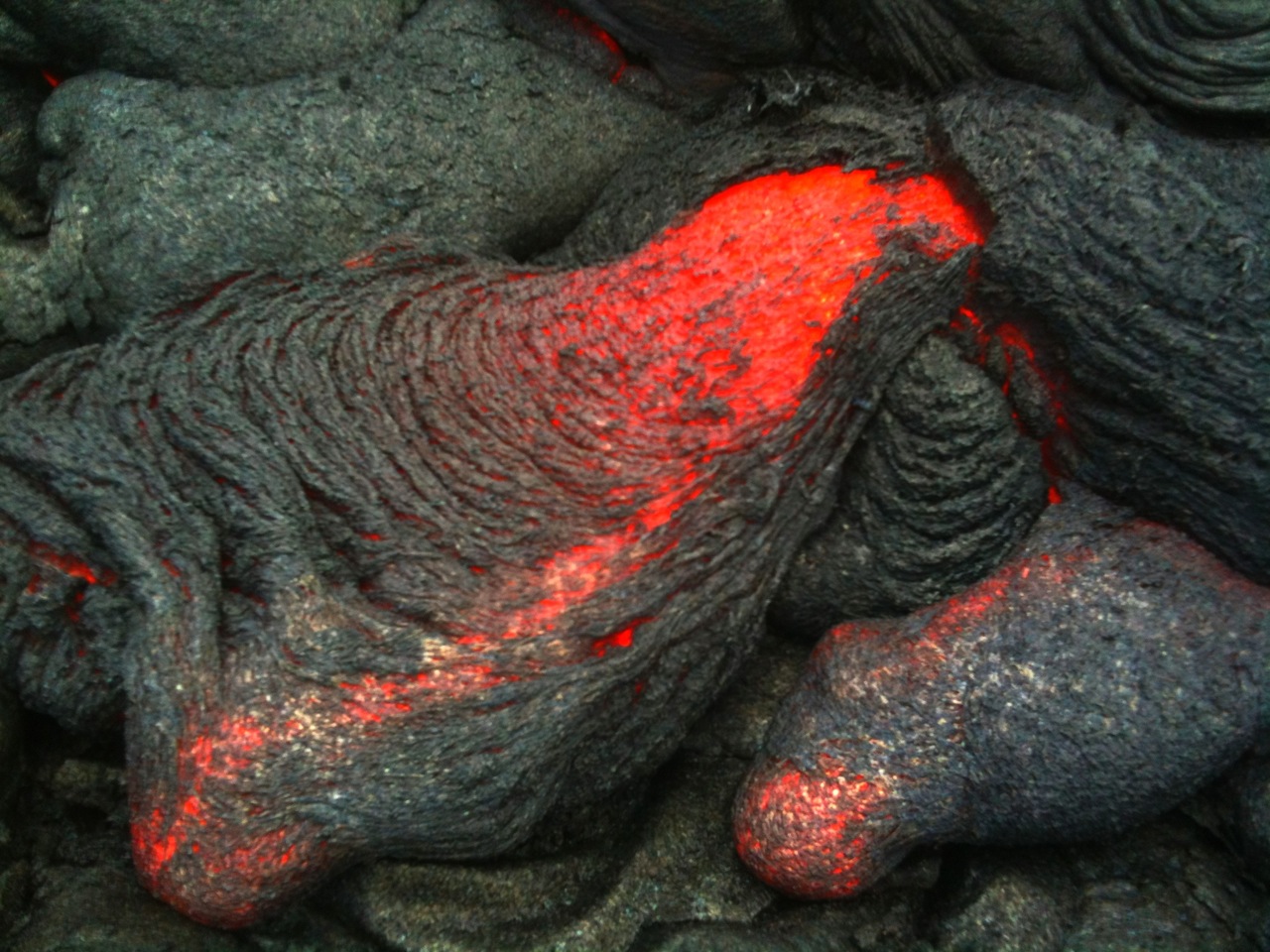
Arthur also sent me a few pictures of some active lava flows. Wonderful! There’s nothing like fresh lava to get a geologist’s blood boiling with excitement!

Lovely lava #1.
Lovely lava #2.
Lovely lava #3.

Geology Word of the Week: M is for Magma

Glowing lava in Hawaii. Image taken from Wikipedia Commons here.

def. Magma
1. Molten (liquid) rock below the Earth’s surface. Often contains volatiles, crystals, and small fragments of solid rock.
2. Not a synonym for lava, which is what you call magma after it has been erupted or extruded onto the Earth’s surface.
3. A favorite word of evil scientists, at least in Hollywood movies.

When non-geologists (and perhaps some beginner geologists) think about magma, there are two common mistakes that I have observed.

The first mistake is confusing magma with lava or treating the two words as synonyms. This is understandable as magma and lava are similar. Both are hot, molten rock. Both can contain volatiles (dissolved gases), crystals (that form as the molten rock cools), and fragments of solid rock (often picked up from the surrounding solid rock). However, magma specifically refers to molten rock located beneath the Earth’s surface while lava specifically refers to molten rock at the Earth’s surface.

Non-geologists might think it silly to have two words to describe molten rock. Perhaps this is true. Perhaps we should call all molten rock magma or lava or even coin a new word– I propose “molta”– that encompasses all types of molten rock. However, I’d argue that having two words to distinguish between molten rock below and above Earth’s surface makes sense. Having two words allows geologists to be specific. For example, in my previous post on komatiite rocks, I was able to say that komatiite rocks formed from lava that cooled. When I said that there is clear evidence that komatiites cooled from lava, geologists immediately understood that this meant these rocks formed at Earth’s surface. This is significant because komatiite rocks have a composition that is normally found deep within the Earth, not at Earth’s surface.There are also some differences between magma and lava. For instance, lava usually contains fewer volatiles (gases) than magma because these escape to the atmosphere.

Science is often intimidating and inaccessible to non-scientists because of all the vocabulary. When you become a scientist, you almost have to learn to speak a new language. While all of the vocabulary can be overwhelming until you learn it, science vocabulary exists for good reason. Science is all about being specific, about describing, quantifying, and– ultimately– understanding a part of the universe. Having a specialized, organized vocabulary allows precise classification. This vocabulary allows scientists to talk to each other and to compare finds and observations from different parts of the planet and universe.

One reason I write the geology word of the week is to explain and celebrate some of the remarkable vocabulary that geologists have developed to describe and classify their rocks. I love geology words. I love talking geology. But I realize that when I talk geology many of  my non-geologist friends are left in the dark. My best friend is an ocean engineer, so I have had to teach her some geology vocabulary over the years. She’s taught me some engineering vocabulary, and now we can talk– with relative ease– with each other about our research. Maybe on this blog I can teach some other people some geology words– and also teach myself some new geology words!

Of course, sometimes scientific vocabulary is a little too complex, even for scientists. For instance, there are thousands upon thousands of different names for rocks. The exact same type of rock might have a dozen different names. This is partly because rocks were independently “discovered” in different places and given different names. A rock might be called by one name in one country and by another name in another country. Rock and mineral names have been standardized internationally in relatively recent times, and continued standardization is an ongoing process. Unfortunately, the standard system of rock names isn’t perfect. Some of the complex names that remain are relics of the time before standardization and really should be replaced by simpler, more logical names. Furthermore, not all geologists stick to the standard names, at least not all the time. Some geologists prefer old names that have been “thrown out” and still use them, at least informally amongst each other. To really speak geology, you have to know  not only the standard names but also many of the non-standard names that are favored by some geologists.

Complex scientific vocabulary also causes problems when scientists want to talk to non-scientists or even to scientists in other scientific disciplines. I speak geology (or at least geochemistry, a dialect of geology), but I don’t speak biology. I also don’t speak physics or astronomy or proper chemistry, though I do know many words in these languages. If I need to collaborate with a physicist or a biologist, I first need to find a common scientific language. Scientists, myself included, often struggle to translate their science into plain English. I believe that it is very important for the general public to understand science and for scientists from different disciplines to be able to talk to each other. I’m not sure the best way to overcome the vocabulary problem, but I don’t think that throwing out all of the vocabulary is the answer. Personally, I don’t see a problem with using some jargon (maybe more when talking to other scientists and less in popular science writing) as long as you explain the terms you are using.

Anyway, I am rambling (which is okay since this is a blog), so let me now continue on to the second common mistake about magma. I think that many people (or at least the people who write bad geology movies) imagine the Earth as being full of magma. They imagine that the interior of the Earth is mostly molten rock or, as Dr. Evil of the “Austin Powers” movies would say, “liquid hot MAGMA.” This is far from the truth. Most of the Earth is actually solid, not liquid. Only one Earth layer (the outer core) is liquid. The Earth’s crust, mantle, and inner core are primarily solid. There is actually only a very small amount of molten rock compared to the amount of solid rock. Even the Earth’s asthenosphere (see last week’s word of the week if you don’t know what this is) is a solid, albeit it tar-like solid that moves very slowly over time. Molten rock only exists in small amounts in Earth’s crust and mantle. Furthermore, while there are some large bodies of magma in magma chambers and channels, much magma actually exists as tiny amounts in tiny pore spaces, not in well-defined magma chambers.

I think that understanding the words magma and lava is important because these words are so commonly used in popular science articles and even in every day life. Jessica Ball over at Magma Cum Laude wrote a great post awhile back about common mistakes made when reporting on volcanic eruptions. One of the mistakes she mentioned is that reporters often confuse magma and lava when writing about volcanoes. However, Jessica thinks it is important for reporters to use these (and other) terms accurately. I agree. Throw out jargon if you must, but don’t misuse scientific terms.

As a lighthearted example of the misuse of the word magma, I would argue that one of my favorite toys is misnamed. “Magmar” is a Rock Lords toy. The Rock Lords are similar to the more-popular Transformers toys except rather than being robots they are “powerful living rocks.” The Rock Lords toys were made in the 1980s, and I had a few of them as a child. Magmar is the leader of the evil Rock Lords. However, since Magmar exists on the surface of the Earth he should really be called “Lavar” or perhaps– since he is a rock– “Basaltar.” I didn’t appreciate Magmar’s misnomer when I was a child, but I do now as an adult geologist.

Magmar. Image taken from here.