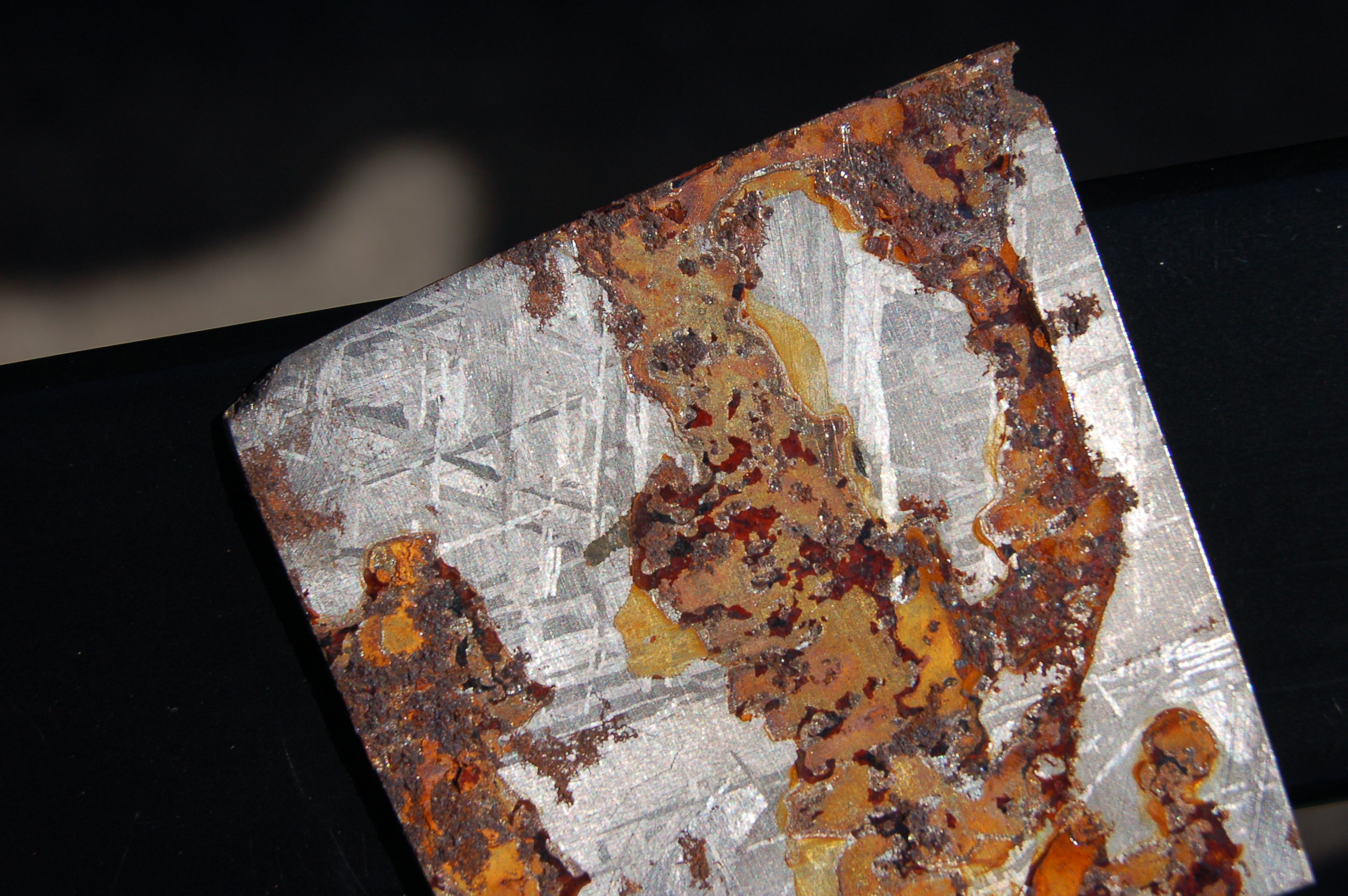
A slice of meteorite displaying a Widmanstätten pattern (silvery patches) in between oxidized or rusted sections (reddish brown patches). Photo courtesy of Lockwood Dewitt.
def. Widmanstätten Pattern:
An interweaving pattern of the extraterrestrial minerals kamacite (a low nickel content iron-nickel alloy, similar to the terrestrial mineral ferrite) and taenite (a high nickel content iron-nickel alloy, similar to the terrestrial mineral austenite) that appears in some iron-nickel meteorites when a cut section of the meteorite is etched with weak acid.
Widmanstätten patterns appear during acid etching because kamacite is more easily dissolved by weak acid than taenite. Widmanstätten patterns are believed to form in a few different ways (depending on the pressure and temperature conditions experienced; I won’t go into too much detail on this) as iron-nickel material separates into the high-nickel and low-nickel minerals as it cools. Whatever the formation pathway, Widmanstätten patterns can only form when there is very slow cooling in an environment such as the core of a planet. Therefore, Widmanstätten patterns are only found in meteorites, not in any naturally forming rocks on Earth’s surface. In fact, Widmanstätten patterns require such slow cooling that they cannot even be reproduced by scientists in a laboratory.
Widmanstätten patterns are named after Count Alois von Beckh Widmanstätten, an Austrian scientist who discovered the patterns in 1808 when he was flame heating a meteorite. Count Widmanstätten never published his discovery, but he orally communicated it to his scientific colleagues, and the pattern was named after him. Some scientists believe that the patterns should also be called Thomson patterns because a scientist named G. Thomson had previously, independently discovered the patterns when he was trying to use acid to clean some rust off of a meteorite. Thomson published his discovery in French in 1804. However, Thomson’s discovery was not widely spread throughout the scientific community because the Napoleonic wars interrupted Thomson’s communication with his scientific colleagues (Thomson was English) as he was living in Naples, Italy at the time. Thomson also died at an early age in 1806 before Widmanstätten made his own discovery of the patterns.
I, for one, always forget how to spell and pronounce “Widmanstätten.” Perhaps I’ll remember better after this post. Regardless, I’m happy to know that, due to some scientists trying to right some misfortunes and twists of history, I can always google “Thomson patterns” to find out the more popular name of “those pretty meteorite pattern thingies.”
Below are a few more pictures of Widmanstätten patterns. If anyone else has additional pictures of Widmanstätten patterns, I’d love to add them to this post. Just email them to georneys blog (AT) gmail.
Another view of the Widmanstätten pattern on Lockwood's meteorite. Picture courtesy of Lockwood DeWitt.Widmanstätten pattern on the Cape York meteorite at the American Museum of Natural History in New York City. Picture courtesy of Patrick Donohue.
***Thanks to several of my twitter followers for suggesting this week’s word. Thanks to Lockwood DeWitt and Patrick Donohue for providing pictures.***
Obsidian with vitreous luster. Photo courtesy of Maitri Erwin.
Introductory Note: At long last, the Geology Word of the Week has returned! For almost a year, the Geology Word of the Week post has been on hold. I briefly resurrected the weekly word back in April with the posts T is for Time and U is for Ulexite, but the revival was short-lived. I neglected the weekly word because this past year has been busy and full of important life events and changes: getting married, finishing up my PhD, moving overseas, and starting my first job, among other things! To keep Georneys interesting, I started the Monday Geology Picture weekly feature. I’ll still keep posting the Monday Geology Picture, but I also hope to resume my weekly words. As always, feel free to suggest words and provide information and pictures related to the weekly word. Note that I go through the alphabet in order for my words, so for next week you should suggest words that start with “W”. From now on, I’ll do my best to keep up with the weekly word, but I may skip a week or several weeks here and there depending on what else is going on in my life.
def. Vitreous:
Resembling glass. Most often used in geology to refer to a glassy (highly reflective and often transparent to translucent) luster.
Luster (or Lustre) is a term that is used to describe the way that light interacts with the surface of a mineral, rock, or other solid (such as glass or a manmade crystal). Luster is one of many physical properties (others are hardness, streak, cleavage, crystal shape, color, etc.) that geologists use to help them identify rocks and minerals. There are several terms used to describe luster, such as dull, metallic, waxy, pearly, and so on. Andrew Alden, the geology writer for About.com, has a great webpage (including an example gallery) all about luster here. Vitreous (also called glassy) luster is which resembles the luster of glass. Vitreous rocks and minerals are thus highly reflective and often translucent to transparent, like glass. Some vitreous rocks, such as obsidian, even are glass… natural glass!
Here’s a few more pictures of rocks and minerals with vitreous luster:
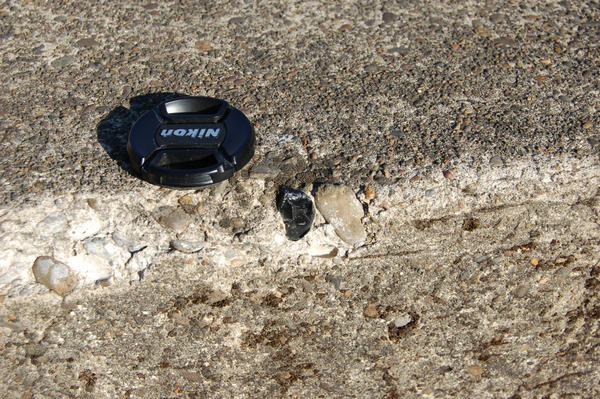
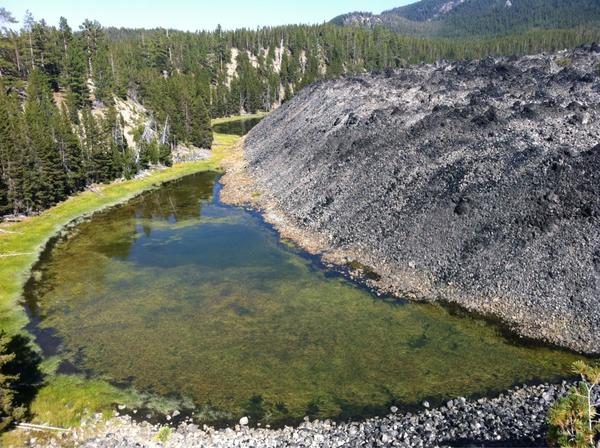
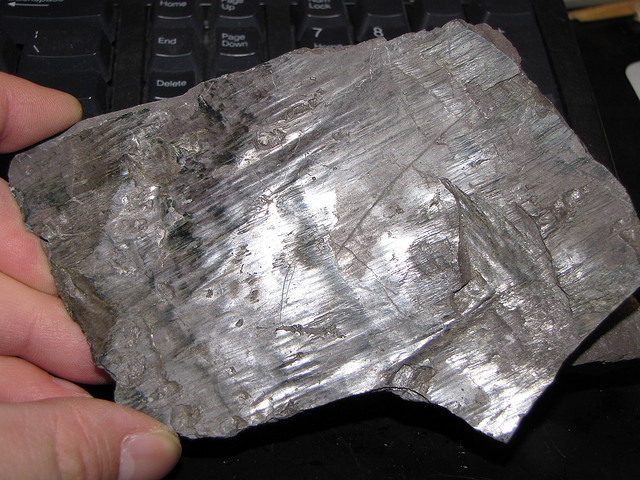
More vitreous obsidian. Photo courtesy of Maitri Erwin.Even more vitreous obsidian (small black clast). Photo courtesy of Lockwood Dewitt.An entire flow of vitreous obsidian. Photo courtesy of Cian Dawson.Slickensided slate (say that three times fast!) with vitreous luster. Photo courtesy of Ron Schott.Limestone covered by vitreous sandstone, which has been melted by lightning. Cool, huh?! Photo courtesy of David Bressan.Quartz and tourmaline, both of which have vitreous luster. Photo courtesy of Patrick Donohue.
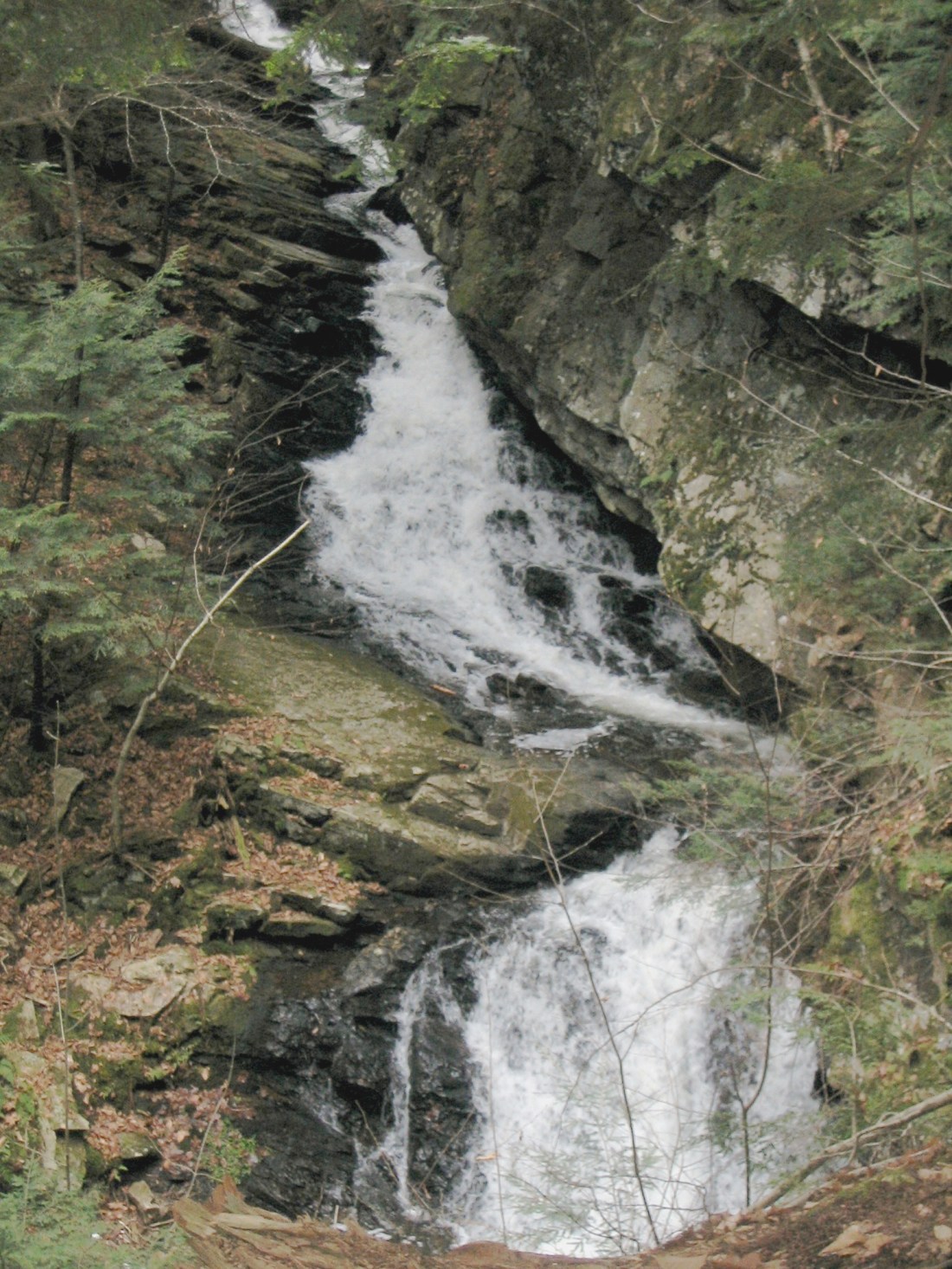
A waterfall along the fault, Chesterfield Gorge, New Hampshire.
This week’s geology picture was taken in the Chesterfield Gorge, which is located just a few minutes from my parents’ house in southern New Hampshire. I would often explore and play at the gorge as a child. I used to like to throw things into the gorge and watch them go over the waterfalls. I once duct-taped a Princess Leia figurine into a plastic toy kayak and watched her go over the falls. Miraculously, Leia made it over the falls, and I retrieved her. She did lose her stick paddle, though. Also, her arm was also falling off a little bit, but I managed to repair her with quick field surgery.
The gorge is an interesting place, geologically. I remember being fascinated when I first read, as a child, that the gorge was created quickly by movement along a fault, not by the slow carving of a stream. You can see the evidence of the fault very clearly in the photograph above. You can see that the tilted, offset layers still have sharp edges; they have not yet been worn away by many years of erosion by water.
I’m headed up to New Hampshire next week after I hand in my thesis revisions. Perhaps I’ll visit the gorge again and share more pictures and geological explanation. Sadly, my mother tells me that these days one must be careful when visiting the gorge. In my childhood, I could play there with my friends and be perfectly safe. Recently, however, the gorge has been the site of some illegal activities and dealings, so one has to be a little bit more careful when visiting, and children definitely shouldn’t play there alone. Nevertheless, the geology is so spectacular that I may bring Dana Hunter there when she visits me next week. I can’t wait for Dana to visit. You can expect some fun posts about her trip in the next few weeks!
def. Ulexite:
1. Hydrated sodium calcium borate hydroxide (formula: NaCaB5O6(OH)6•5(H2O) ), a silky, brittle, generally white evaporate mineral which often crystallizes in the form of densely-packed fibers that transmit light along the long axis of the mineral.
2. A party trick rock. Have any party guests who think that geology isn’t awesome? Just pull out your fibrous ulexite sample and say, “Hey look, I have a fiber optic rock.” Then watch the fun– the geology fun– begin.
Ulexite really does have remarkable optical properties, as the photos below demonstrate. Personally, I think that the fiber optic images produced by ulexite are even more fun and interesting than the double images caused by refraction in calcite.
Another picture of my ulexite sample, with keys for scale. The word "Hyundai "through ulexite. Dinosaur origami box, viewed through ulexite.A side (short axis) view of ulexite, showing the fibers but no optical transmission.
I bought my ulexite sample at a rock sale. Does anyone know of good places to collect ulexite in the field?
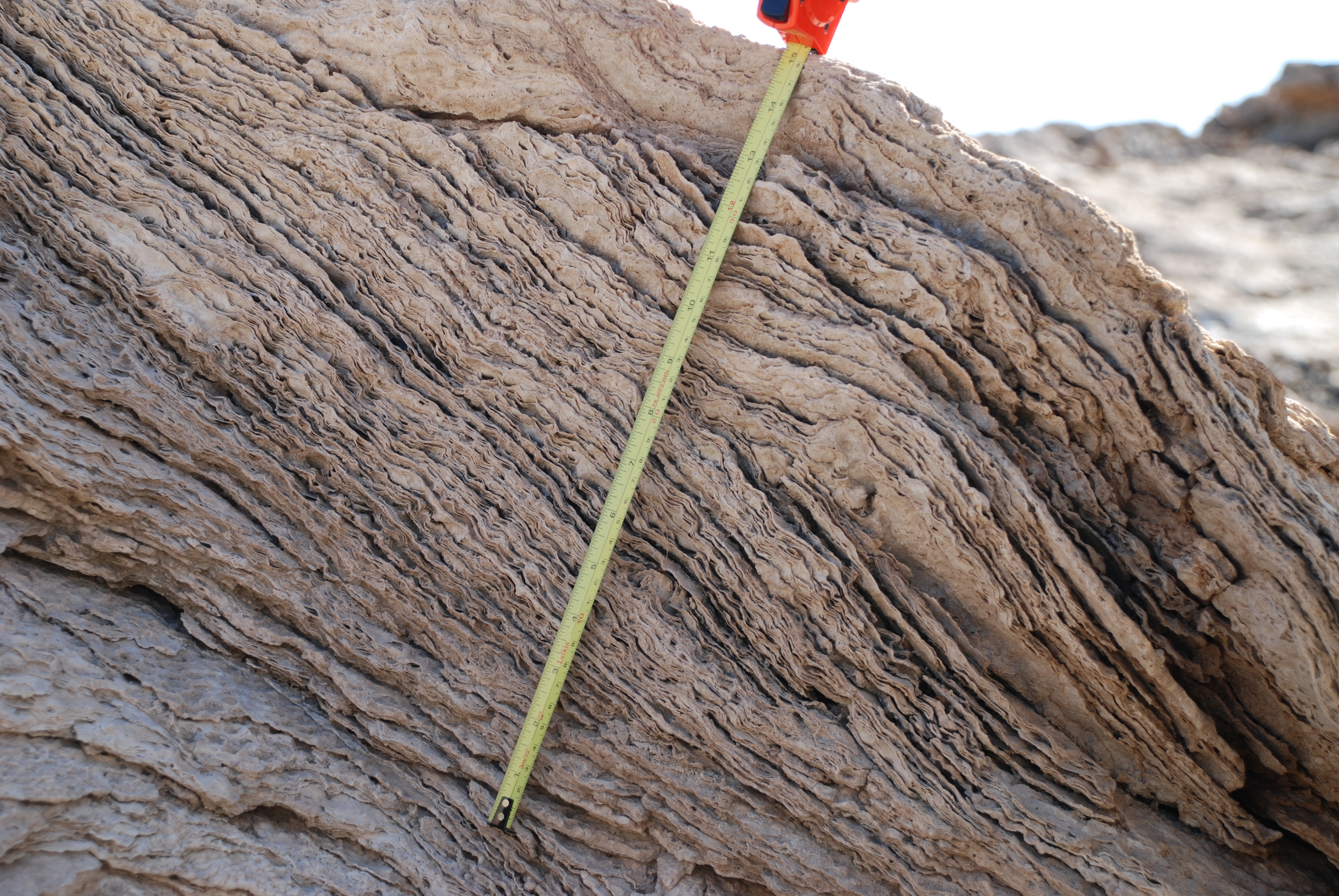
Layers of travertine deposition in the Sultanate of Oman, January 2009.
def. Time:
1. What the clock (or the cesium atom) measures.
2. “The indefinite continued progress of existence and events in the past, present, and future regarded as a whole.” (From Google Dictionary).
3. “A finite extent or stretch of continued existence, as the interval separating two successive events or actions, or the period during which an action, condition, or state continues; a finite portion of time; a period.” (From the Oxford English Dictionary).
4. One of four dimensions in the spacetime continuum.
I have not written a geology word of the week post for 5 months– about 150 days. My last geology word was S is for Syncline back in November. On a blogging timescale, 5 months is an eternity. In fact, a lack of posting for five months is what Ron Schott uses to classify a blog as “dormant” on his Geoblogosphere list. However, on a geologic timescale 5 months is no time at all. The Earth is 4.54 billion years old, and most geologists think on timescales of thousands or millions or even billions of years. To humans, of course, with our paltry lifespan of a hundred years or less, 5 months is a significant amount of time. Months, days, hours, and even seconds are important on human timescales.
However, geologists often use geologic time to put human events in perspective. For example, I’ve taken not quite six years to complete my PhD in geology. In my graduate program six year PhDs are common. When you’re struggling along through graduate school, six years seems like an eternity sometimes. To help relieve the stress, the geology graduate students joke with each other, “Well, on a geologic timescale, of course, this is nothing. Heck, I could take 10 years to complete my PhD and it would still be nothing, geologically speaking.” And then there’s the old stand-by joke: Never loan geologists money… because they’ll pay you back on a geologic timescale.
For those of you who are not familiar, under normal blog conditions I muse about a geology word every week here on Georneys. I first give a definition of the word, and then I explain a little about the importance of the word in geology. I often present a compilation of pictures that illustrate the geology word in action. For example, there were some impressive picture compilations in X is for Xenolith and M is for Migmatite. Pictures are often provided by Geoblogosphere members, by my geology colleagues, and by my twitter followers and blog readers. Geology words are also often proposed by my blog readers and twitter followers, so in a way the geology word of the week is a group effort, and I am merely the editor of an ongoing geologic encyclopedia.
Because humans like patterns and I need some way to focus a very, very long list of geologic words (scientists like words, and geologists are no exception), for my weekly words I work through the alphabet in order. Since the last geology word started with an S, that means this week’s word starts with a T. Next week’s word will begin with a U (feel free to start thinking of suggestions), and in two weeks the word will start with a V, and so on.
From November 2010 (when I started writing Georneys) to October 2011, I was rigorous about posting a geology word every week. However, last October I started to become somewhat busy. I put the geology word of the week on hold for a few weeks to prepare for my wedding at the end of October. I managed to post S is for Syncline in November, but after that I found that I simply didn’t have enough time for the weekly word. I consider blogging a fun (and important) hobby, but in the last few months of my PhD thesis writing, I didn’t have time for any hobbies… or for as much exercise, proper eating, or restful sleeping as I would have liked. Now that the thesis defense is over, I am bringing back the weekly geology word. Depending on travel and other circumstances, there may be a few weeks where I miss a word. However, I’ll do my best to post a word every week. You can help me with that by suggesting words as well as by providing information and pictures for the selected weekly words. I can often be bribed to write about a certain word if someone provides good pictures. As I mentioned above, the geology word of the week really is a team effort.
Although I considered other T words such as tafoni and tektite and tourmaline, after some musing I eventually decided that “time” is a fitting word for the resurrection of The Geology Word of the Week. Time seems an appropriate word because significant time has passed (on a human timescale, anyway) since I last posted a geology word. Also, I have spent much of the last few months thinking about time. Indeed, my PhD thesis even contains the word time. The title of my thesis is: Determining timescales of natural carbonation of Peridotite in the Samail ophiolite, Sultanate of Oman. My PhD is technically in Marine Geology, but if I were to describe my expertise in geology, I would probably describe myself as a geochronologist and geochemist who enjoys using isotopes and other geochemical tools to constrain ages of rocks and rates for various geologic processes.
Time is an interesting concept. Humans intuitively understand time, at least on a certain level. We fundamentally understand time and the passage of time through natural events which take time– the rising and setting of the sun, the rising and falling of the tides, the passage of patterns of stars in the sky, the waxing and waning of the moon. Long ago, time was measured by observing various periodic natural phenomena (such as the waxing and waning of the moon) as well as through use of devices such as sun dials and hourglasses filled with sand. Today, we primarily measure time with various mechanical and electronic devices. However, we also precisely define time and calibrate our artificial clocks by using atomic clocks. The official SI unit of a second is defined as “9,192,631,770 cycles of that radiation which corresponds to the transition between two electron spin energy levels of the ground state of the 133Cs atom.” (from Wikipedia’s article on Time). So, although we now wear various mechanical watches, we still base our understanding of time on the observation of periodic natural phenomena.
Time is a very important concept in geology. Understanding when and how quickly and in what order various geologic events and processes occur is key in understanding how our planet– and other planets– operate. Geologic time began as a relative concept– figuring out the order in which geologic layers were deposited, noting when certain fossil organisms lived and died, determining the order in which minerals crystallize and erode. The discovery of radioactivity in the late 1800s and the development of absolute geologic dating techniques in the 1900s (and continuing to today) revolutionized geology by providing absolute dates and rates for geologic events and processes. Geologists were able to determine the age of the Earth and to add dates to the previously-established (in a relative sense) geologic timescale.
The determination of geologic ages and rates continues to be very important for geologic research. As an example, in my PhD research I worked to better constrain rates of carbonate formation and erosion in the peridotite layer of the Samail ophiolite. Understanding timescales of peridotite carbonation is important because such carbonation represents a natural sink in the carbon cycle. Also, enhanced carbonation of peridotite is one proposed method for carbon sequestration that could offset anthropogenic emissions of carbon dioxide to the atmosphere. However, before scientists can figure out how much we have to speed up natural carbonation of peridotite to offset anthropogenic emissions, they first have to know how quickly peridotite carbonation occurs naturally.
I think about time and use the word time all the time (Example A). Time is an important term for geologists– and scientists in general– to understand and define carefully. I have a good understanding of time in my daily life and also of geologic time. However, when I think more deeply about time– for example, thinking about time as one of the four dimensions of spacetime– I wonder if I really understand time at all. I may have to read up on some theoretical physics and time now that I have a little extra time.
Certainly, there is a part of me that feels amazed that– finally– the time has passed, and I have defended my PhD. Along the way, I felt that my PhD research and progress crept along slow as molasses. Then– all of a sudden– I was ready to defend. Now, I look back and wonder where the time has gone.
About a month ago, I remember being in a state of high-stress and sleep deprivation and panic, wondering how I would survive the next few weeks. And I remember thinking back on other high-stress and important events– my competition in the Junior Olympics as a kayaker, my advanced placement examinations in high school, the SAT, the college admissions process, finals in college, the GRE, the graduate school admissions process, every single math test I took at MIT, my PhD qualifying exams, my wedding, and so on. Months of anticipation and worry and stress preceded each of these events. And yet, time passed, and I survived each event– thrived even, with some– and then afterwards I felt a strange sense of wonder: Was the event truly over? Had I truly survived? Was there nothing more to anticipate? How had the time passed? What now? Along with the wonder, I felt a surreal sense of calm, a satisfied sense of accomplishment. I would relax for awhile, returning to a more normal, less-stressed state. And then, after awhile, I would start anticipating the next event.
The anticipation of my PhD defense was more challenging, by far, than any of the previous important events mentioned in the list above. When I felt overly concerned over the last six months or so, I just took a deep breath and reminded myself of all those other difficult events. Time will pass, I told myself. Time will pass.
Well, time did pass. And I survived– thrived even– during my PhD defense. And now I feel that same surreal sense of wonder and calm. And now I find myself musing over time, for a time at least.
At my post-defense party in the WHOI student center.
On Friday the 13th I successfully defended my PhD in Marine Geology in the MIT/WHOI Joint Program. For this week’s geology picture, here I am on Friday with my co-advisors Susan Humphris and Ken Sims at my post-defense party.
Everyone has to call me Dr. Evelyn now… at least for a few days. Then everyone can call me just plain old Evelyn again.
Once I recover from post-thesis exhaustion and finish up my revisions, you can expect the pace of blogging to pick up here slightly. I even plan to resurrect the Geology Word of the Week, so stay tuned!
A syncline exposed in a roadcut at Hancock, Maryland. Photo courtesy of Ron Schott.
Finally, the Geology Word of the Week has returned! I took about six weeks off because I was very busy with my wedding and thesis. Six weeks ago, I had announced that the next Geology Word of the Week would be S is for Schist. However, I kept trying (and failing) to write the schist post. Schist is such an important and fun geology word, and I want to take the time to write up the post properly. When the letter “S” rolls around in 26 weeks, I should be finished with my thesis (fingers crossed) and have plenty of time to write up a proper post. So, schist has been moved to the next alphabet. For now, I present… S is for Syncline!
Note: I modified the definitions below after some discussion in the geoblogosphere.
def. Syncline:
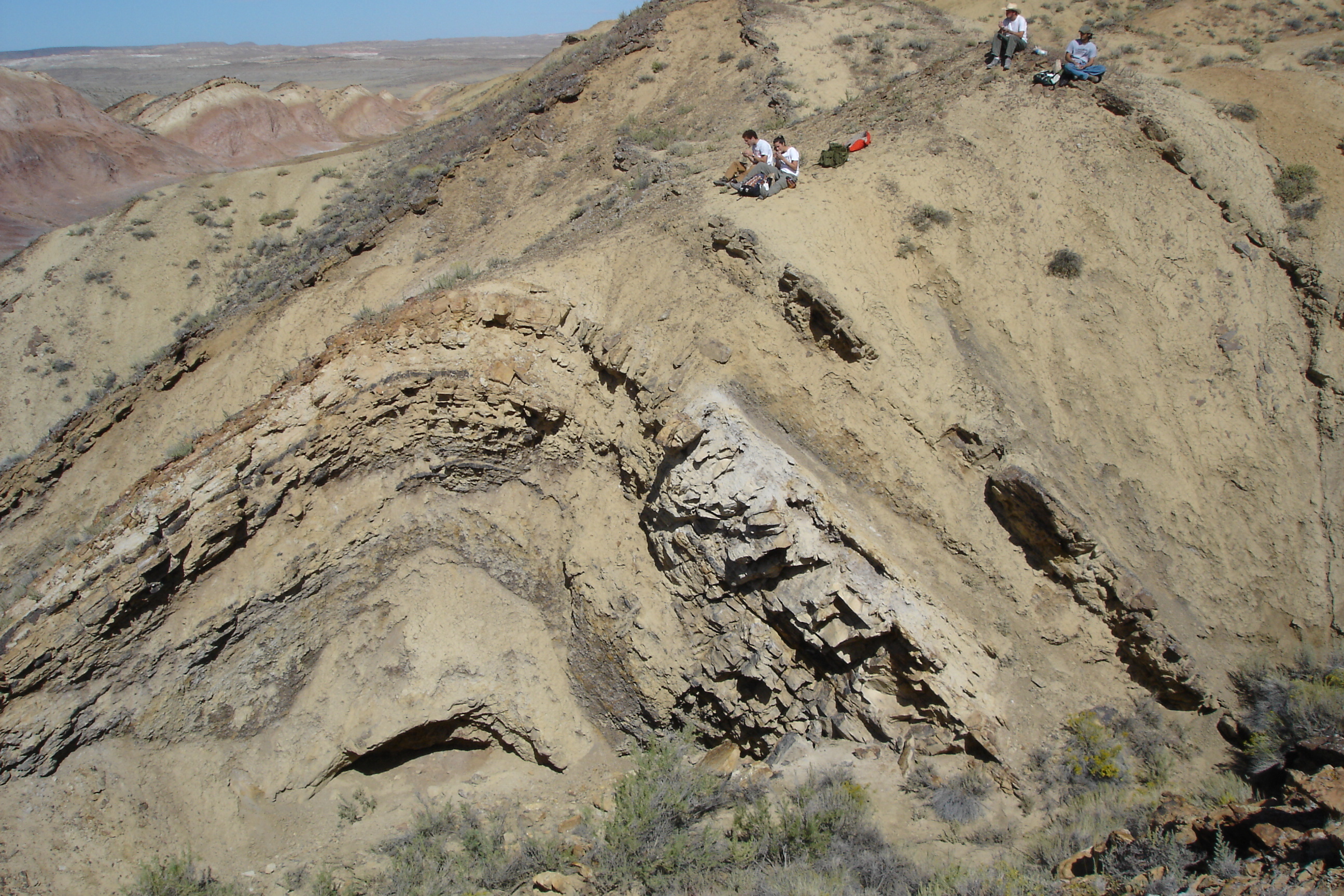
A fold in a sequence of rock layers in which the younger rock layers are found in the center (along the axis) of the fold. Syncline is closely related to the word anticline, which is a fold in a sequence of rock layers in which the older rock layers are found in the center (along the axis) of the fold.
def. Synform:
A concave upward (U-shaped) fold in a sequence of rock layers. The lower (and generally younger) rock layers are found at the center (along the axis) of the fold. Synform is closely related to the word antiform, which is a convex upward (upside-down U) fold in which the upper (and generally older) are found at the center (along the axis) of the fold. In the field, many synforms are also synclines. An overturned syncline is called an “antiformal syncline.”
The easiest way to understand synclines and anticlines is to look at a diagram, such as the one below:
Beginner geologists often confuse synclines and anticlines. Remember: A syn makes you grin!
Like many geological structures, synclines and anticlines form at various scales in the field. They can form over vast regions or within a single outcrop or hand sample. Sometimes, small folds are called “synclinal folds” rather than synclines.
Here’s a few more pictures of synclines:
A syncline in Calico, California. Photo courtesy of Ron Schott. A syncline in San Bernadino County, California. Photo courtesy of Ron Schott.A syncline in Fair Haven, Vermont. Photo courtesy of Ron Schott. The Vallecitos Syncline, central California. Photo courtesy of Timothy Sherry.A syncline in Torres del Paine National Park in Chile. The lake in the foreground is Lago Nordenskjöld. Photo courtesy of Ryan Anderson.
And here’s an anticline:
An anticline in Wyoming.
Finally, I have a question for the geoblogosphere: What is more important for distinguishing anticline vs. syncline: the general shape (right-side-up U or upside-down U) or the age of the rocks? What if there’s been overturn so that folds are forming in a sequence where the younger rocks are the lower layers and the older rocks are the upper layers? Please feel free to discuss this topic in the comments below.
Question answered. But please feel free to continue the discussion below.
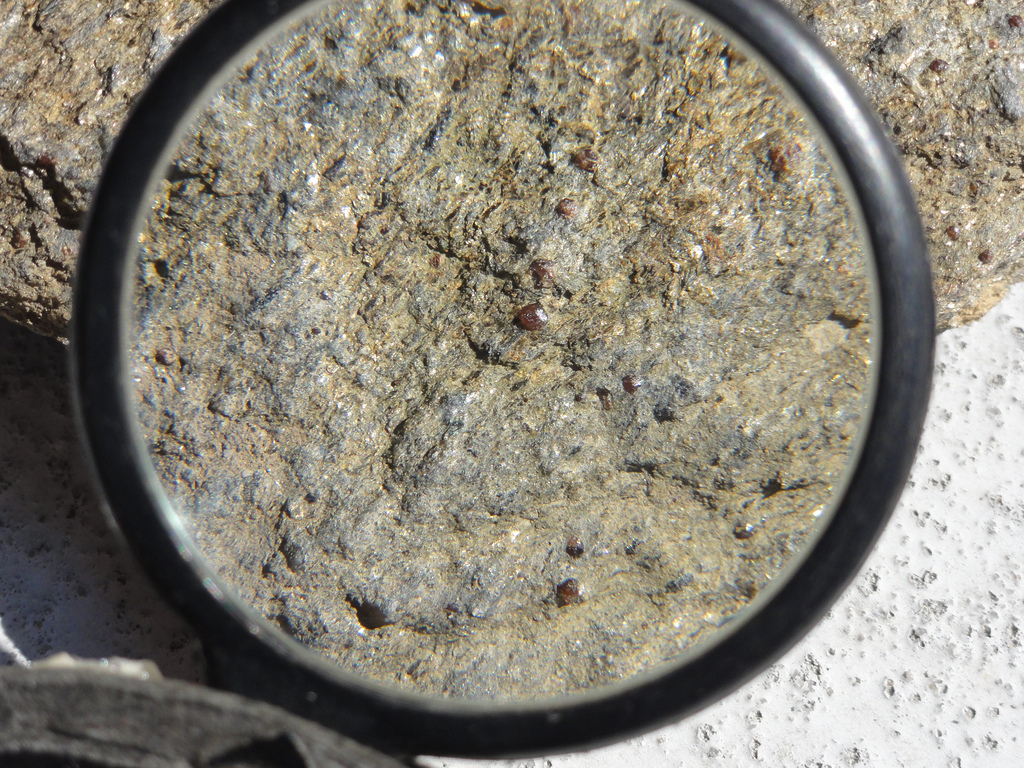
Gorgeous garnet mica schist. Photo courtesy of Dana Hunter.
So, I was hoping to post the Geology Word of the Week before flying back to South Africa in a few hours. However, I’ve been busy with work and also with a few last-minute wedding preparations (my wedding is in 12 days! Eek!). Now, the hour approaches 2am, and I need to finish packing… I hope the wedding favors and table placards survive the long trip. Worst case scenario, we’ll have some slightly-squashed wedding decor and a good story.
Anyway, this week we’re at the letter S in our geology alphabet, and I’ve selected the word schist! One of my favorite geology words! In fact, schist is such a fantastic word that I don’t want to write up a rushed post. So, I’m going to put the Geology Word of the Week on hold for a few weeks until after my wedding and the associated chaos of friends and family traveling to South Africa for the occasion. You can expect a return of the Geology Word of the Week in early November. In the meantime, I may sneak in a picture post or two.
By the way, I full expect many schist jokes and puns to be posted in the comments below.
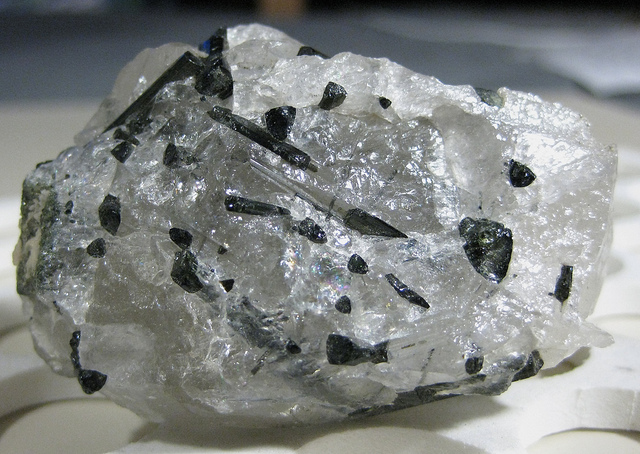
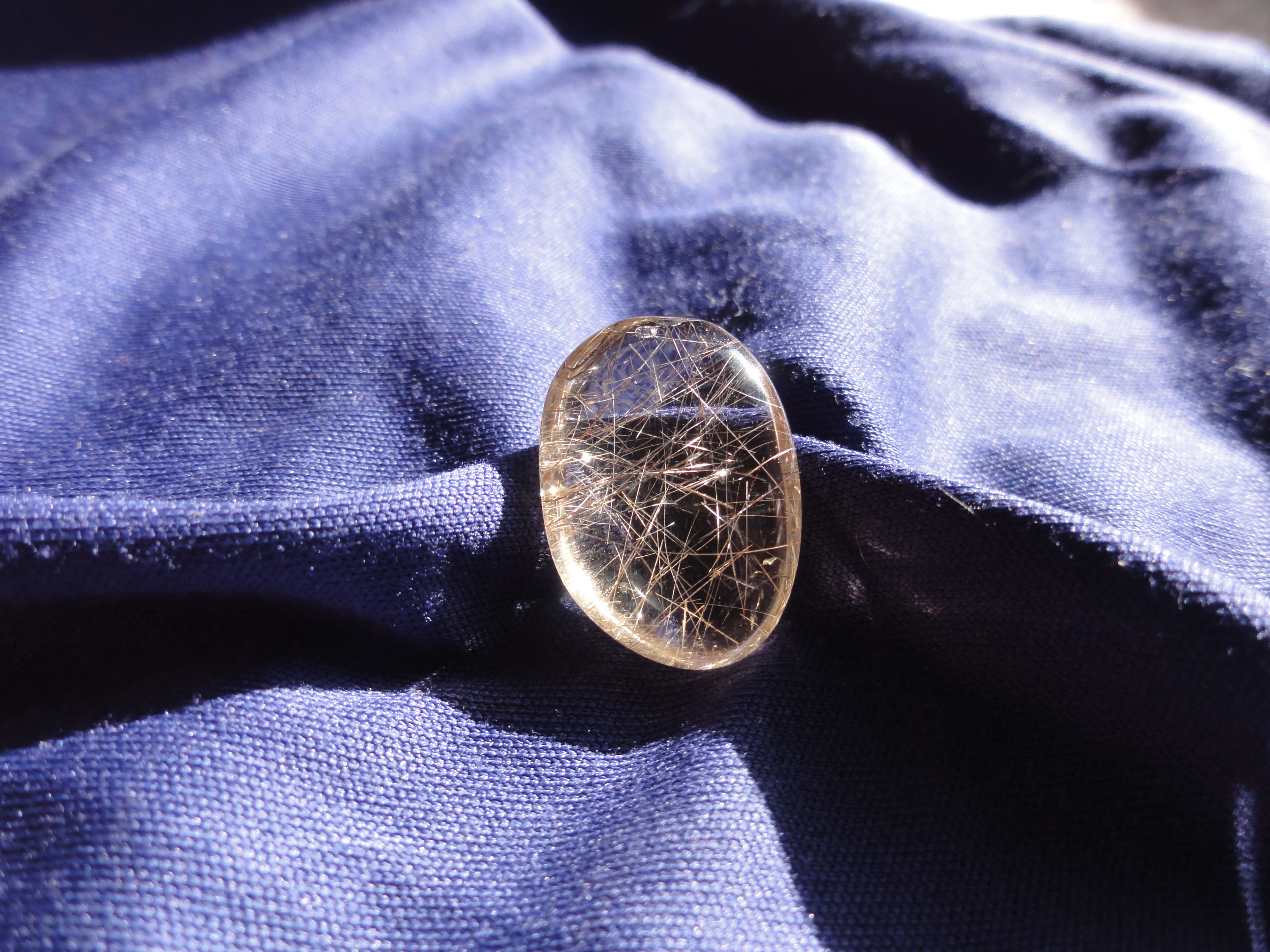
Thin, needle-like crystals of rutile in quartz. Photo courtesy of Dana Hunter.
def. Rutile:
A high-pressure, high-temperature mineral that is the most common form of titanium oxide (TiO2). Rutile is commonly found in metamorphic rocks, such as eclogite. Rutile is also found as an accessory mineral in igneous rocks, particularly in deeper-formed plutonic igneous rocks and also volcanic rocks with deep sources, such as kimberlites. Rutile is an important economic mineral that is mined for titanium. Rutile often forms as thin, needle-like crystals, which are commonly found as inclusions in minerals such as quartz and corundum. Rutile is commonly a brownish-red color due to the presence of iron impurities. Reflecting this characteristic color, the name rutile derives from the Latin word “rutilus,” which means “red.”
Rutile is often found in metamorphic rocks. For example, here are some thin section images showing rutile (red-colored mineral) in an ultra-high-temperature granulite:
Rutile in thin section in UHT granulite. Photo courtesy of Tanya Ewing.Rutile in thin section in UHT granulite. Photo courtesy of Tanya Ewing.
Rutile is also found as an accessory mineral in some igneous rocks. Most igneous rutiles are fairly small. However, when space and time permit, large igneous rutile crystals may form in pegmatites. For example, here’s a gigantic crystal of rutile that likely formed as a pegmatite mineral:
That's quite the rutile crystal! Photo courtesy of Paul Glasser.
Rutile can also be found as a secondary mineral in hydrothermal veins. Hydrothermal veins form when heated fluids circulate through a rock, picking up certain elements and concentrating them elsewhere. For example, gold is often concentrated through hydrothermal circulation. Since silica is a major component of many rocks, quartz is a very common hydrothermal mineral and can often be found as secondary veins in rocks which have experienced hydrothermal alteration. Hydrothermal minerals such as quartz are often deposited in cracks or spaces (such as vesicles or vugs) in a host rock. Sometimes, quartz contains thin, needle-like crystals of rutile. When this occurs, the quartz is named “rutile quartz” or “rutilated quartz.” The long rutile crystals found in rutilated quartz generally form in a cavity, such as a vug– a place where they have space to grow into long needles. Then, these rutile needles are incorporated into hydrothermally-deposited quartz. Some rutile inclusions in quartz may also form as a result of metamorphism, but most rutilated quartz forms through hydrothermal processes*.
Gemstones which contain inclusions are generally considered less-valuable than inclusion-free gemstones. However, rutile inclusions are desired in certain gemstones. For example, rutile inclusions make for some gorgeous quartz crystals (see pictures above and below). Rutile inclusions in corundum and other minerals are responsible for asterism, an optical phenomenon that creates “star gems” such as star sapphires.
Closer view of Dana's rutilated quartz. Photo courtesy of Dana Hunter.
As I discovered this evening when I was googleing rutilated quartz, there are many woo-woo pseudoscientific “properties” associated with rutilated quartz. In my google search, I was hoping to learn about the geologic properties of rutilated quartz. Unfortunately, many of the websites I found on google informed me about some other “properties” of rutilated quartz. For instance, one of these websites “informed me” that rutilated quartz:
Brings forth each person’s strengths, originality, aids sleep, relate to others.
Rutile is said to intensify the metaphysical properties of its host crystal and to enhance one’s understanding of difficult situations. It is also said to enhance creativity and to relieve depression and loneliness.
Rutilated quartz is said to slow down the aging process and is said to be a strong healer.
Well, I’m no doctor, but I have a feeling that placing rutilated quartz around my house is not going to help me sleep (I’ve had insomnia for years, and I mange it fine without woo-woo crystals) or prevent wrinkles. I suppose that placing rutilated quartz all over my house could help relieve depression. I do love pretty crystals.
My friend Dana Hunter agrees that the woo-woo properties of rutilated quartz are nonsense. When she sent me the two beautiful pictures of her piece of rutilated quartz, she also sent this delightful story:
I know you sometimes like to laugh at woo in these Word of the Week posts, and there’s definitely woo involved with rutilated quartz. This little piece was purchased at a crystal shop in Sedona, AZ, back when I was a wooful middleschooler. What you did was tie a string round its middle, dangle it like a pendulum, and ask it yes-or-no questions. It would swing in a circle or from side-to-side to answer (you had to ask first “What is yes?” and “What is no?” to determine which was which). Supposedly, then, it could predict the future. Freaky, watching something you were holding perfectly still start to move! I didn’t know then about the extremely subtle muscle movements that would set it in motion. I did try to test it by tying it to bits of furniture and seeing if it would move without a human touching the string (it would, but erratically, and probably had something to do with the air movements created as I shouted at it). Even back then, deep in the clutches of woo, there was apparently a scientific bit of my mind screaming to get out. It’s all a bunch of rubbish, of course – if it wasn’t, I would’ve died in July of 2008, according to it. So much for the stone’s power of prediction! But it’s gorgeous stuff, and its true nature is far more interesting than the woo we attached to it.
Thanks for the story, Dana!
Reference:
“rutile, n.” The Oxford English Dictionary. 2nd ed. 1989. OED Online. Oxford University Press. 2 October 2011.
*That’s the consensus we’ve reached on Twitter and Facebook, anyway… please let me know if you have additional information on rutilated quartz formation.
***Thanks to Chuck Magee for suggesting this week’s word. Thanks to Tanya Ewing, Paul Glasser, and Dana Hunter for providing pictures. Thanks also to Dana for her wonderful woo-woo rutilated quartz story. Thanks to Erik Klemetti, Matthew Garcia, and Christie Rowe for an interesting Twitter and Facebook discussion about the origins of rutilated quartz.***
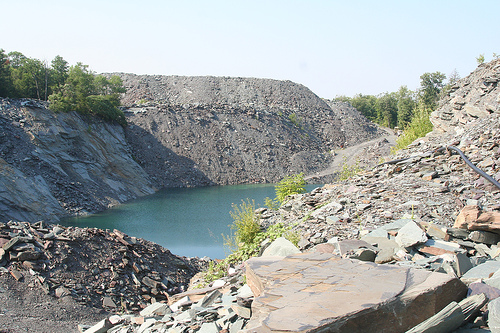
A slate quarry in Vermont. Photo courtesy of Ron Schott.
def. Quarry:
1. An open-pit mine from which rock is extracted, usually rock which is used as a building stone.
2. A place frequented by rock-hunting geologists.
3. A cold, deep body of water frequented by daring rock jumpers and divers.
4. (Obsolete, except in those old books I read sometimes): Game meat; something that is hunted or pursued.
Geologists often hunt for rocks* in quarries, which are found in a wide variety of rock types. Quarries often expose rocks that would otherwise be difficult to see because of weathering or cover by vegetation and soil. Quarries also often expose beautiful or unusual rocks that are valued as building stones or for some other purpose. Many quarries are no longer actively mined, and geologists may collect rocks in a semi-legal fashion from large, abandoned talus piles (bits of rock leftover from mining). Other quarries are still actively mined for building stones and other material. Some of these active quarries are closed to the general public. Other active quarries encourage visitors, and sometimes even make a small profit by allowing geotourists to collect samples. And sometimes– speaking purely hypothetically of course– a private, closed quarry may become “accessible” when a geology professor teaches his petrology class the stealth arts of scaling fences, sneaking over locked gates, and running very swiftly with wollastonite hand samples. Not that I would know anything about that purely hypothetical example, of course.
Geologists really enjoy visiting quarries. A few geologists even work for quarries, investigating the rock being extracted and identifying good places to extend or build a quarry.
*A geologist’s quarry. Get it?
Here’s a plethora of quarry pictures, illustrating the wide range of rocks in which quarries are found:
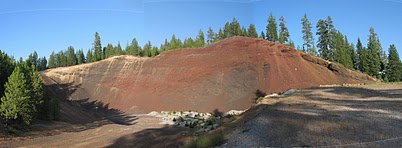
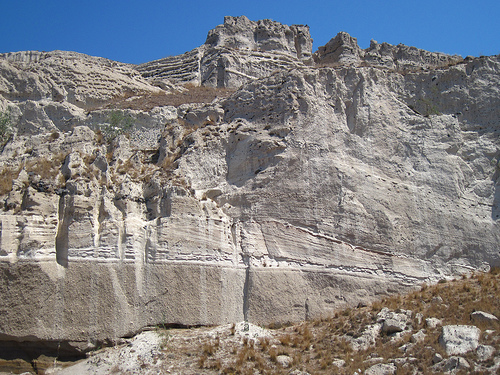
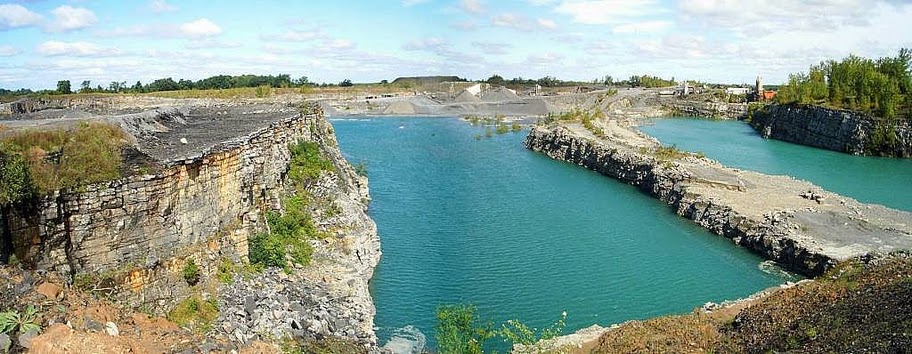
A dolomite quarry in Michigan. Photo courtesy of Ron Schott. A pumice quarry in California. Photo courtesy of Ron Schott. A trap rock (type of igneous rock) quarry in Ontario. Photo courtesy of Ron Schott.A cinder cone scoria quarry in Oregon. Photo courtesy of Ron Schott. A quarry exposing large-scale crossbedding in the base-surge deposits of the 3,600 ka Minoan eruption of Santorini. Photo courtesy of Gareth Fabbro.Loading piers in an old quarry in a volcanic crater in Greece. Photo courtesy of Gareth Fabbro.A limestone quarry in Washington. Photo courtesy of Dana Hunter.Folding exposed at a limestone quarry in Washington with a Dana for scale. Photo courtesy of Dana Hunter.Panoramic section of Honeoye Falls Quarry, New York. Photo courtesy of Patrick Donohue.Recently blasted stone at Honeoye Quarry, New York. Photo courtesy of Patrick Donohue.Seneca Stone Quarry, New York. Photo courtesy of Patrick Donohue.
















 Georneys

