 |
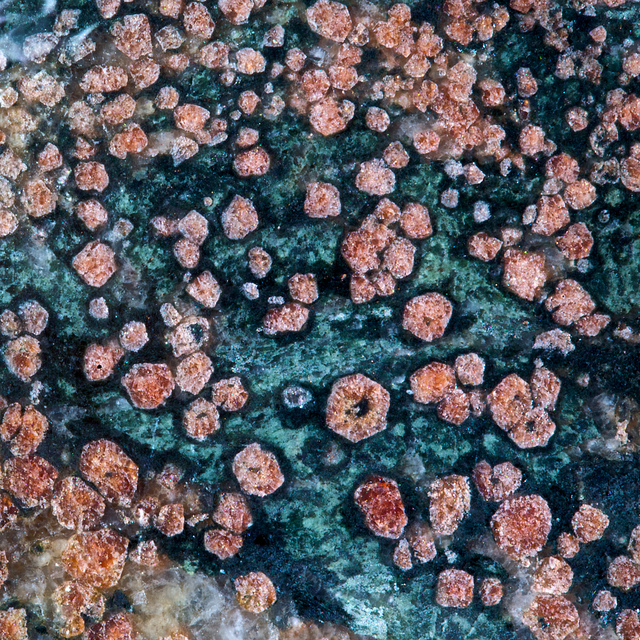
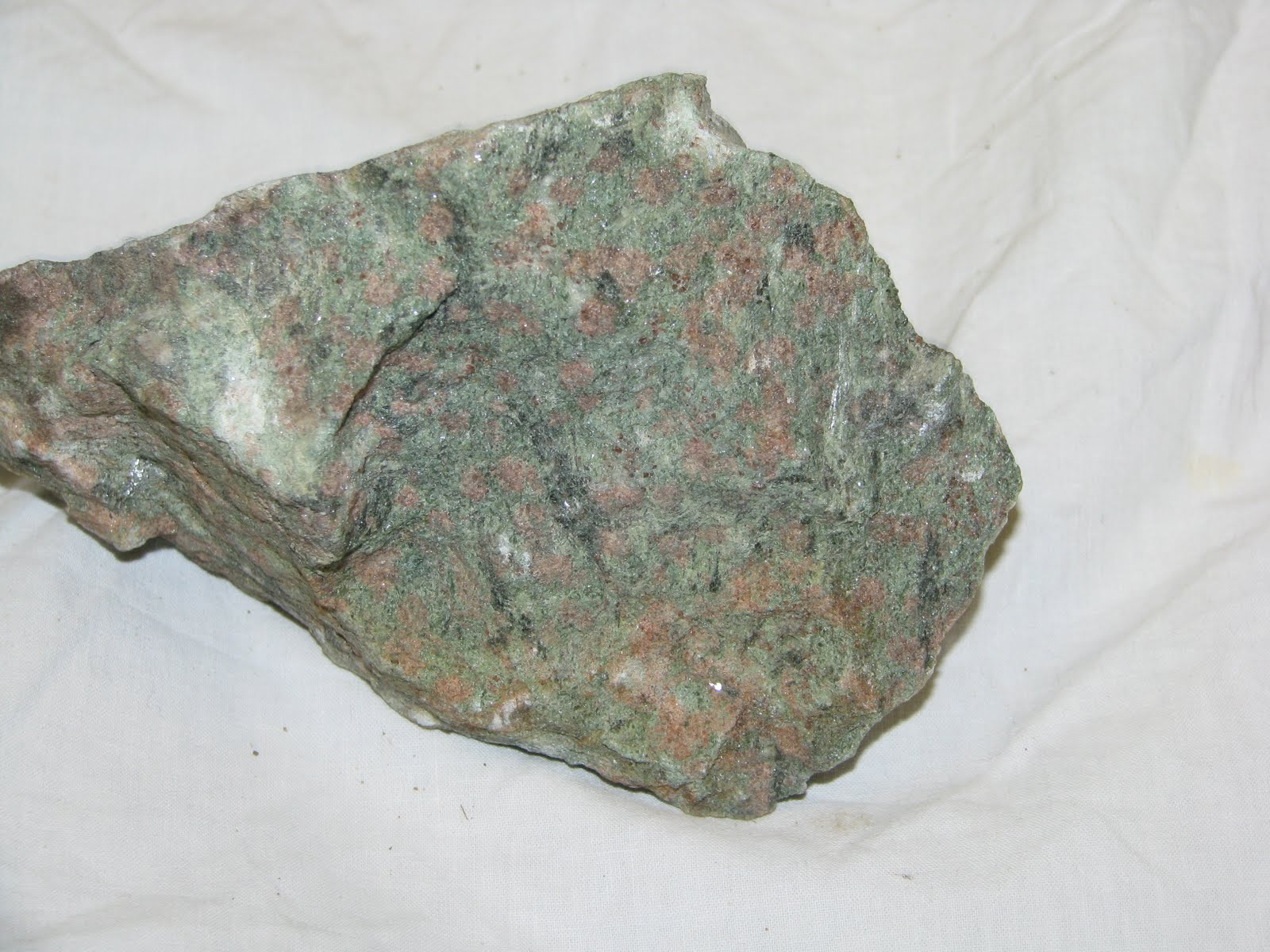
Eclogite from the Mariánské Lázně Complex in the west Czech Republic.
Keele collection. Check out those gorgeous pink garnets!
Photo courtesy of Ian Stimpson. |
def. Eclogite:
A high-pressure, high-temperature, coarse-grained metamorphic rock consisting primarily of pink-red garnet (almadine-pyrope variety) and green pyroxene (omphacite, a sodium-rich variety). Eclogites may also contain small amounts of other high-pressure minerals such as kyanite, quartz, hornblende, and zoisite. Eclogites form when mafic rock (basalt or gabbro) descends deep within the Earth, generally at a subduction zone. Mafic rocks consist primarily of pyroxene and plagioclase (along with some amphibole and olivine). At high pressures and temperatures, the original minerals in mafic rock are squished into the more compact (denser) minerals garnet and omphacite, and the mafic rock becomes eclogite. Eclogites form when mafic rock encounters temperatures greater than ~400 degrees Celsius and pressures greater than ~12 kbar (or ~1.2 GPa). These temperatures and pressures mean that eclogites form at a minimum depth of ~40 km; some eclogites may form as deep as ~150 km. As a reference, ocean crust (which is comprised primarily of basalt and gabbro) is generally only 6-10 km thick. Because they are very dense and inclined to descend even deeper into Earth’s mantle, eclogites are rarely brought to Earth’s surface. Eclogites may be exposed in ophiolite sequences and other places where deep mantle rocks are brought to Earth’s surface. Often, eclogites experience partial or full retrograde metamorphism as they are brought to Earth’s surface. That is, if eclogites are brought to the surface slowly, their minerals may change back into minerals that are stable at lower temperatures and pressures. Sometimes, higher-pressure minerals will have rims of lower-pressure minerals around them.
Eclogites are stunningly beautiful red-green rocks that represent what happens to black basalt and green gabbro when these crustal rocks descend deep into Earth’s mantle. Basalt, gabbro, and eclogite have identical chemical compositions. That is, if you crushed these three rocks and measured the proportion of different elements (for example, calcium, silicon, and iron) in these rocks, you would find that the chemical proportions of elements in these three rocks are nearly identical. However, these rocks look very different. Basalt is generally black or gray and fine-grained, meaning that the mineral crystals are very small, often too small to see with the naked eye. Sometimes, basalt may contain a few isolated, large crystals of a particular mineral, often plagioclase picked up from a magma chamber. Gabbro contains the same minerals as basalt, but because gabbro forms deeper in the crust, the mineral crystals are larger because the rock cooled more slowly, giving large crystals time to grow. Eclogite has the same chemistry as basalt and gabbro but has different minerals. Basically, the minerals in eclogite are squished (denser) forms of the minerals found in basalt and gabbro.
 |
Basalt boulder in a garden in Madiera, Portugal.
Photo courtesy of Ian Stimpson. |
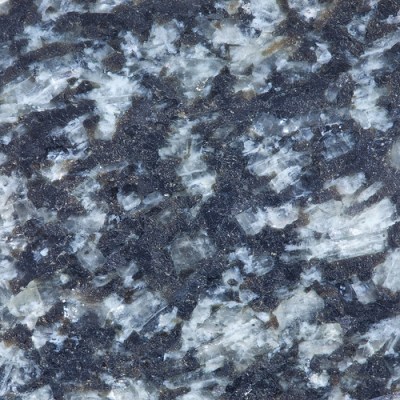 |
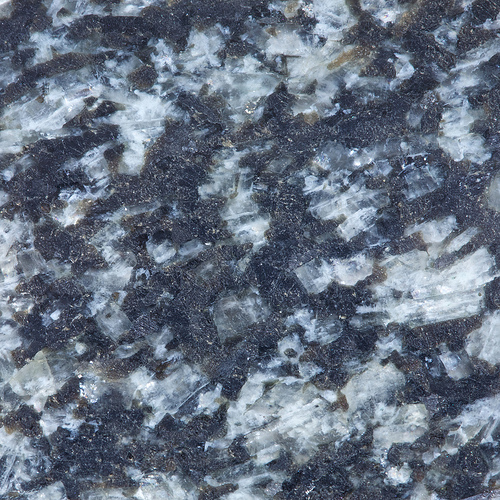
A gabbro from the Bushveld Complex, Central Transvaal, South Africa. Keele
collection. The white mineral is plagioclase and the green-black mineral is pyroxene.
Photo Courtesy of Ian Stimpson. |
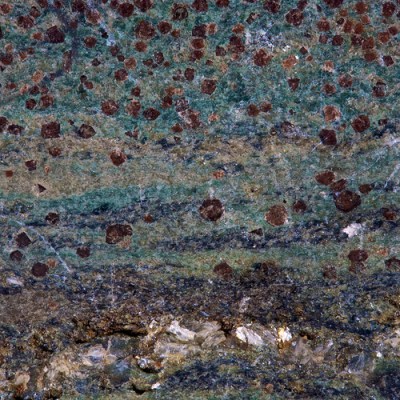 |
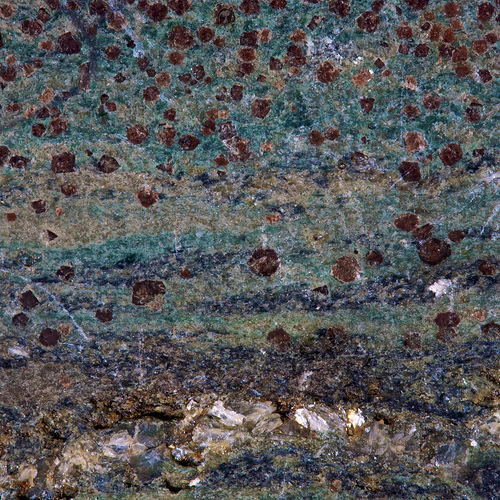
An eclogite from the lawsonite type locality, Reed Station on the Tiburon Peninsula,
Marin County, California. Keele collection. Photo courtesy of Ian Stimpson. |
Eclogite is a very interesting rock. Aside from being an absolutely gorgeous rock, eclogite is intriguing because it provides direct evidence that basalt and gabbro descend deep within the Earth. For a long time, geologists thought that perhaps a significant portion of Earth’s mantle was composed of eclogite and that melting of this eclogite might produce basalts and gabbros at or near Earth’s surface. Now, geologists understand that most of Earth’s mantle is composed of a rock called peridotite, which consists primarily of pyroxene and olivine. Geologists also now understand that rocks rarely melt 100%. So, partial melting of peridotite to produce basalt and gabbro makes much more sense than melting of eclogite to produce these rocks. You see, to produce a basalt or gabbro from an eclogite, you would have to melt that eclogite close to 100%, which just isn’t feasible on our Earth. However, eclogites still play a role in mantle melting processes (eclogite melts may mix with peridotite melts, for instance), and melting of eclogites can produce other crustal rocks, such as the somewhat unusual and weird-sounding rocks adakite and trondhjemite.
 |
A Scottish eclogite from the Lewisian inlier, Glen Beag, Glenelg.
Keele collection. Photo courtesy of Ian Stimpson. |
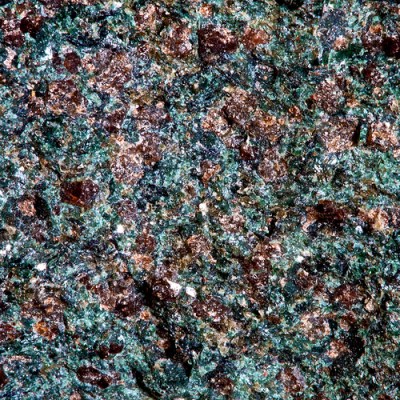 |
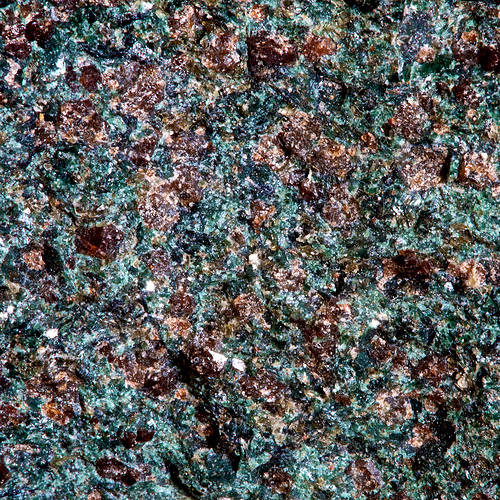
An eclogite from Lago Mucrone, Santuario Di Oropo, Italy.
Keele Collection. Photo courtesy of Ian Stimpson. |
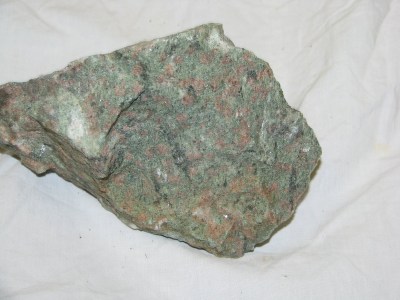 |
| Eclogite from Adula Nappe, The Alps. Photo courtesy of Ron Schott. |
Here is a GigaPan (a really neat picture which you can zoom in on) of an eclogite-blueschist facies mixed rock from California (GigaPan courtesy of Ron Schott):
When you look at the eclogite pictures in this post, just think: eclogites are rocks that used to be common basalts or gabbros, which then descended to incredibly great depths within the Earth, then returned to Earth’s surface against all odds. Study of eclogite rocks provides important information about what happens to ocean crust after it plunges into a subduction zone and thus provides insight into very deep mantle processes. What remarkable rocks!
 |
| Metamorphic facies. Figure taken from Wikipedia Commons here. Click to view larger. |
Eclogite is also the name of one of the metamorphic facies. A metamorphic facies is a region of pressure-temperature space in which characteristic metamorphic minerals form. Most eclogite facies are eclogites– that is, they are basalts or gabbros which have experienced metamorphism at eclogite facies pressures and temperatures. However, sometimes other rock types (notably, granodiorites and pelites) may experience eclogite facies metamorphism, but these rocks are not proper eclogites, just eclogite facies rocks.
***Thanks so much to Ian Stimpson (and his incredible Flickr rock photo set!) and Ron Schott for photos for this week’s geology word post.***








 Georneys
