35th International Geological Congress: Day #4

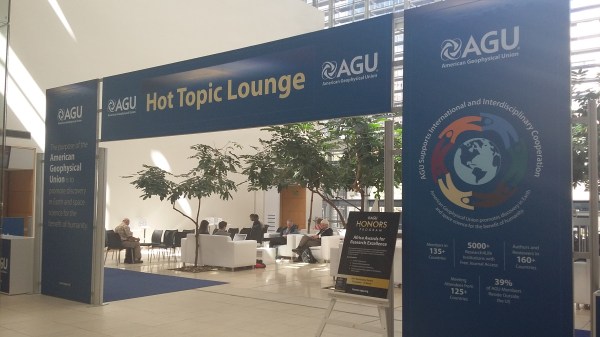
The AGU Hot Topic Lounge at the 35th IGC.

Today I’m blogging about Day #4 (Thursday) of the 35th International Geological Congress (IGC), which I attended last week in my home city of Cape Town, South Africa. You can also read my posts about Day #1, Day #2, and Day #3.

On Thursday I only spent the morning at IGC since in the afternoon I had some private meetings offsite. I spent most of the morning attending some more talks on gold, a continuation of the gold session that I started attending on Wednesday afternoon. I really enjoyed listening to the various gold talks — gold mineralization can be so complex and can occur in so many different types of environments!

I also spent a little more time wandering through the exhibition hall, and I checked out the AGU Hot Topic Lounge that was set up in one of the convention center hallways. The lounge provided a place for geoscientists to meet and have scientific discussions. There was also a schedule of focused discussion on various topics. For example, there was a discussion on kimberlites and diamonds on Wednesday afternoon, and there were various discussions on scientific publishing throughout the week. The conference center was crowded without too many places to sit and chat, so the lounge provided a great, relaxing environment for scientific discussions of various kinds.

That’s all for today… stay tuned for my post on Day #5!

The Big Pineapple in Bathurst, South Africa

Back in early April I traveled from my home in Cape Town, South Africa to the Eastern Cape, South Africa. I went for a long weekend to visit my husband in Grahamstown. My husband periodically spends several weeks in Grahamstown as he is working (part-time) on his masters degree in Exploration Geology at Rhodes University. I also visited the Eastern Cape back in December. I’m really enjoying exploring the Eastern Cape. I look forward to more visits there in the future and also to sharing some tidbits about my Eastern Cape travels with you here on Georneys. I’ll start by telling you about the giant pineapple. Yes, the giant pineapple.

Unfortunately, it poured down rain all weekend during my April visit to the Eastern Cape. However, my husband and I didn’t let the rain stop us from doing some sightseeing. On Saturday we drove from Grahamstown down to Port Alfred, and we stopped in the little agricultural town of Bathurst along the way.

Map showing the drive from Grahamstown to Port Alfred via Bathurst.

As we were driving along through Bathurst, I was quite surprised to hear my husband say, “Oh, look. There’s the giant pineapple.”

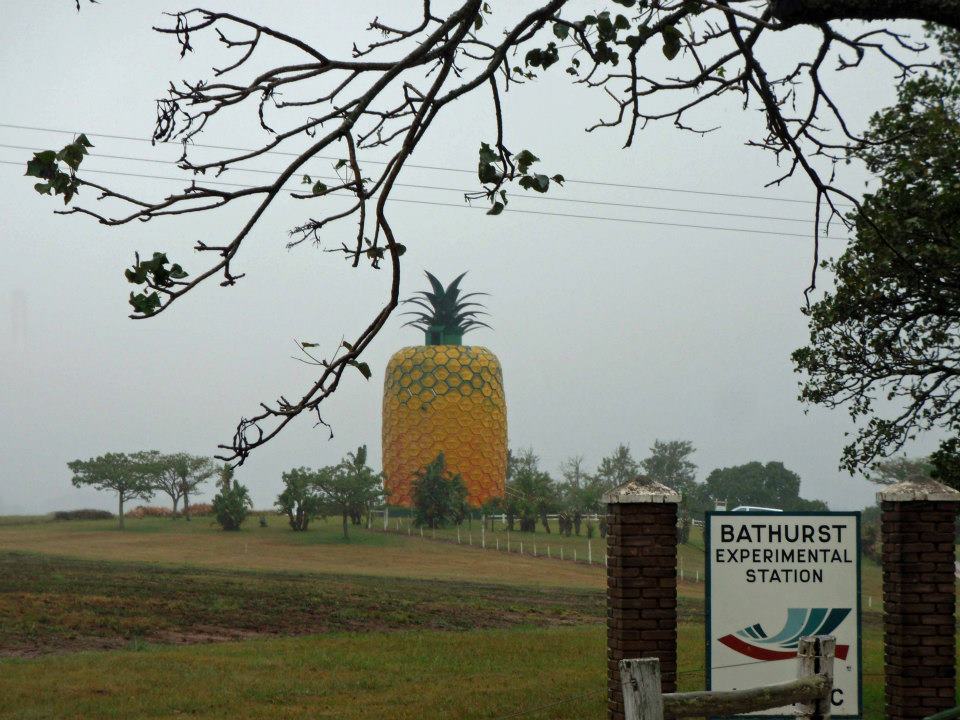
I said, “The what?” and then nearly drove off the road (not really, but my attention was diverted for a moment) when this giant pineapple came into view:

The Big Pineapple in Bathurst. Viewed from the road.

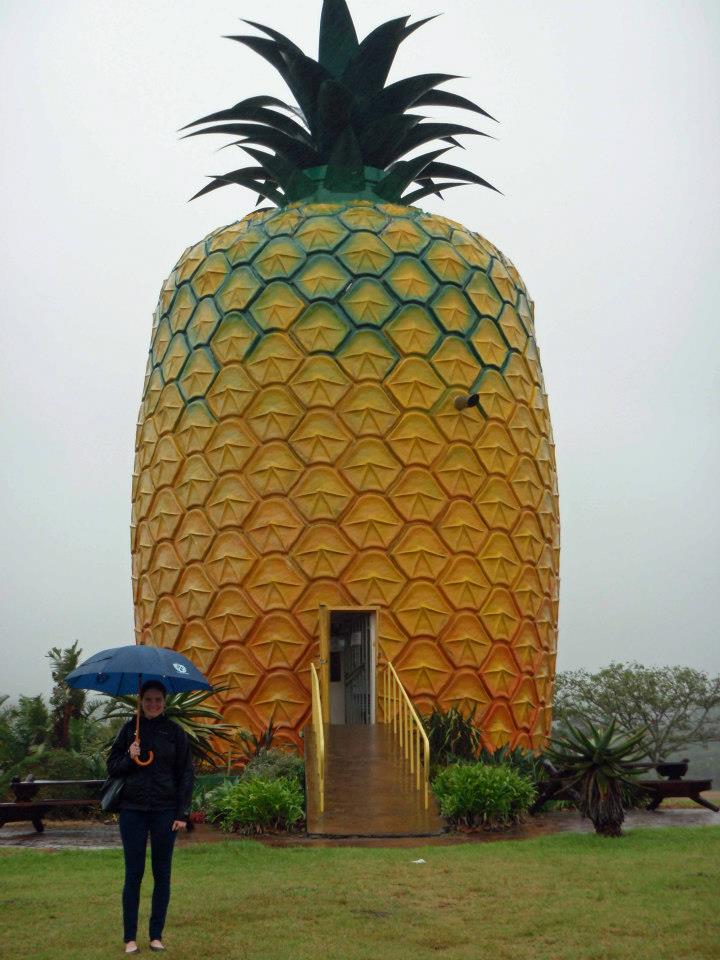
Of course, we had to stop and take a look at what is known as “The Big Pineapple”. Located on a pineapple farm and experimental station, The Big Pineapple is a 16.7 m tall pineapple-shaped building that has three floors. The first floor is a gift shop where you can buy pineapples, various pineapple food items (dried pineapples, jellies, chutneys, etc.), and all sorts of pineapple-themed souvenirs (t-shirts, bags, tea towels, figurines, etc.– we bought a pineapple-decorated sugar bowl). The second floor is a museum with some general information about pineapples and the history of pineapple farming in South Africa. The third floor has a TV showing a movie about pineapples and an observation deck, where you can enjoy the view, which includes fields of growing pineapples. On clear days, you can apparently see the Indian Ocean in the distance. On the cloudy day we visited, however, we couldn’t see beyond the closest fields.

The Bathurst pineapple building is actually a copy of the original “Big Pineapple” in Queensland, Australia. The Queensland pineapple building stands only 16 m tall– the Bathurst pineapple building is a slightly enlarged replica of the Queensland pineapple building. The Bathurst pineapple building was made larger so that Bathurst could claim that they have “the world’s biggest pineapple”.

Here are some more pictures of The Big Pineapple in Bathurst:

A closer view of The Big Pineapple in Bathurst.
The Big Pineapple in Bathurst with a car for scale.
The Big Pineapple in Bathurst with yours truly and an umbrella for scale.
Bathurst hosted The International Pineapple Symposium back in 2005.
Experimental pineapple growing is carried out in Bathurst.
Informational sign on the second floor of The Big Pineapple in Bathurst.
A sign about the building of The Big Pineapple in Bathurst.
An old article about the history of pineapple growing in South Africa.
A map showing the main areas where pineapples are grown.
The view from the top of The Big Pineapple in Bathurst.
Another view from the top of The Big Pineapple in Bathurst.

During my visit to The Big Pineapple in Bathurst, I learned two things. First, I learned that pineapples don’t grow in trees. I guess I never really thought about it too much, but I always assumed that pineapples grew in big trees, similar to the way coconuts grow in palm trees. Nope. Pineapples grow on the ground like this:

Pineapples growing on the ground in Bathurst.
Another view of pineapples growing on the ground in Bathurst.

The second thing I learned as a result of my visit to The Big Pineapple in Bathurst is that pictures of a giant pineapple building really confuse Facebook’s facial recognition software:

Facebook thinks that every single hexagon on the The Big Pineapple is someone's face. Facebook wanted me to tag dozens of pineapple face friends!

My husband and I enjoyed our visit to the strange and wonderful Big Pineapple in Bathurst. We hope to visit again another time– hopefully on a day when it’s not pouring down rain. Next time we visit, I plan to bring a SpongeBob doll. Or perhaps a SpongeBob costume, if I can find one.

AGU Wrap-Up

San Francisco sunset, December 2010. Picture taken by my friend Kyle.

I am currently in the San Francisco airport waiting to fly back from the American Geophysical Union Fall Meeting to my home base in Woods Hole. My flight back to Boston was supposed to leave an hour or so ago, but the flight has now been delayed by several hours due to “severe weather.” The weather didn’t look so bad when my fiance and I left our hotel this morning, but I guess that there are some bad clouds and high winds up where the airplanes fly. Looking outside the airport window now, the fog is producing pretty much white-out conditions.

Oh, well. Hopefully, we’ll be able to rebook our connection in Salt Lake City and make it to Boston sometime late late late this evening. I have the best fiance ever- he flew in from South Africa (about 30 hours of traveling) on Saturday night and left with me for AGU Monday afternoon (another 13 hours or so of travel). He sat patiently through a full day of AGU on Tuesday and partial AGU days on Wednesday and Thursday. Fortunately, since he’s also a geologist his company paid for him to attend AGU as well, so he was able to go off to some interesting sedimentary talks while I met up with colleagues and attended the CO2 sequestration talks which are related to my research. Now that we’re looking at a very long trip home, my fiance is still being very sweet. He’s been standing in line for about 30 minutes waiting to rebook our flight. I definitely have found myself a keeper.

On Wednesday morning at AGU, I presented a poster about my thesis research on dating carbonate alteration products forming in the mantle (ultramafic) section of the Samail Ophiolite in Oman. Formation of these carbonate alteration products is interesting because they naturally remove CO2 from the atmosphere and store it in solid mineral form. In my thesis, I want to understand how quickly (naturally) these carbonate alteration products form and, after they form, how quickly they erode. My poster session went well, I think. I certainly had plenty of visitors to my poster- I talked for about 3 hours straight before taking a break. I really enjoyed meeting all sorts of scientists interested in my research, including many people who work on carbonate formation in other ultramafic rocks and other environments, such as serpentine mines. 

In addition to attending sessions related to my research, I attended the AGU Sciences Meet Hollywood event, which was FANTASTIC. I’ll probably blog more about this event later, but the speakers were excellent and the room was packed full. Clearly, many scientists are very interested in how science in portrayed on TV and in the movies. Similarly, many Hollywood people are interested in meeting scientists- to “get the science right” as best as possible and also to be inspired by science. As one panelists put it, Hollywood needs some new plot ideas for science fiction movies and what better place to go than real science!  There was much discussion about “story verses science”, reasons to “get the science right” in movies & TV, and  ways for scientists and Hollywood types to interact. I think that everyone really enjoyed this session.

Overall, my first AGU meeting went very well. As I expected, I found the meeting somewhat overwhelming. With about 20,000 scientists and thousands of talks and posters, I was not able to see everything that I wanted to see. I had to choose the most important (relevant to my research) and interesting events, and I had to be okay with not seeing everything that I found interesting. A part of me wishes that I had been able to attend AGU Monday-Friday, but in some ways I’m glad that I only went to AGU for 3 days (really about 2 1/2 days). I was able to pace myself and really focus on the talks and posters that I considered most important. One thing that pleasantly surprised me was how well-organized the AGU meeting was. The meeting worked like a large but well-oiled, well-maintained machine. The conference facilities were very nice, and since many AGU attendees had been to AGU many (often countless) times before, most of the 20,000 attendees knew where they were going and what they were doing and were very helpful with directions.

If I attend AGU for the full week next year, I will be sure to take some time off here and there- I think trying to attend all 5 days of AGU is too much. In addition to talks and posters, there were all kinds of other activities such as lunches, drinks, and dinners with colleagues. I even attended a wedding reception on Thursday evening for two good geologist friends! Even with 20,000 or so attendees, I was surprised at how many people I knew and ran into in the exhibitor hall or on the street or in a poster session. I ran into old friends from undergrad, many friends from grad school, and even some geologists my fiance knew from South Africa! San Francisco, I have to say, is a wonderful city. Despite the risk of earthquakes, I think this is a great place to have an annual conference. I hope to attend many more AGU meetings here. And a geophysicist friend of me explained why AGU is held in earthquake-prone San Francisco every year: the geophysicists are all secretly hoping that there will be a big earthquake so they can run around and observe everything.

Okay, time to see if my fiance has managed to rebook our flights… I hope so!

Update: Looks like we will be spending the night in Salt Lake! Hope that we can find a hotel. I also hope that other AGU-goers have smoother journeys home. Now I guess we can see a little of Salt Lake, which is nice.

A Geology Conference in an Earthquake Zone

Hotel Earthquake Evacuation Guide, San Francisco, December 2010.

After a long day of travel yesterday, I arrived in San Francisco for the annual American Geophysical Union (AGU) Fall Conference. The conference is held here in San Francisco every year. This is my first time at AGU. I’m very excited to be here, if a little overwhelmed by all of the people! I have to wonder a little, though, about the choice of conference venue. San Francisco, as the above “Earthquake Procedures” emergency evacuation guide I found in my hotel room reminds me, is located along the San Andreas fault and is prone to Earthquakes.  Sure, there hasn’t been a major earthquake (as far as I know) during this or previous AGU conferences, but it’s only a matter of time. Hopefully, during this (and subsequent) AGU meetings there won’t be a repeat of the great 1906 San Francisco Earthquake. Perhaps AGU should consider moving their fall conference to a more geologically stable interior region- Kansas, for instance. Though I guess then you’d have to worry about tornadoes. And perhaps it wouldn’t be quite as scenic.

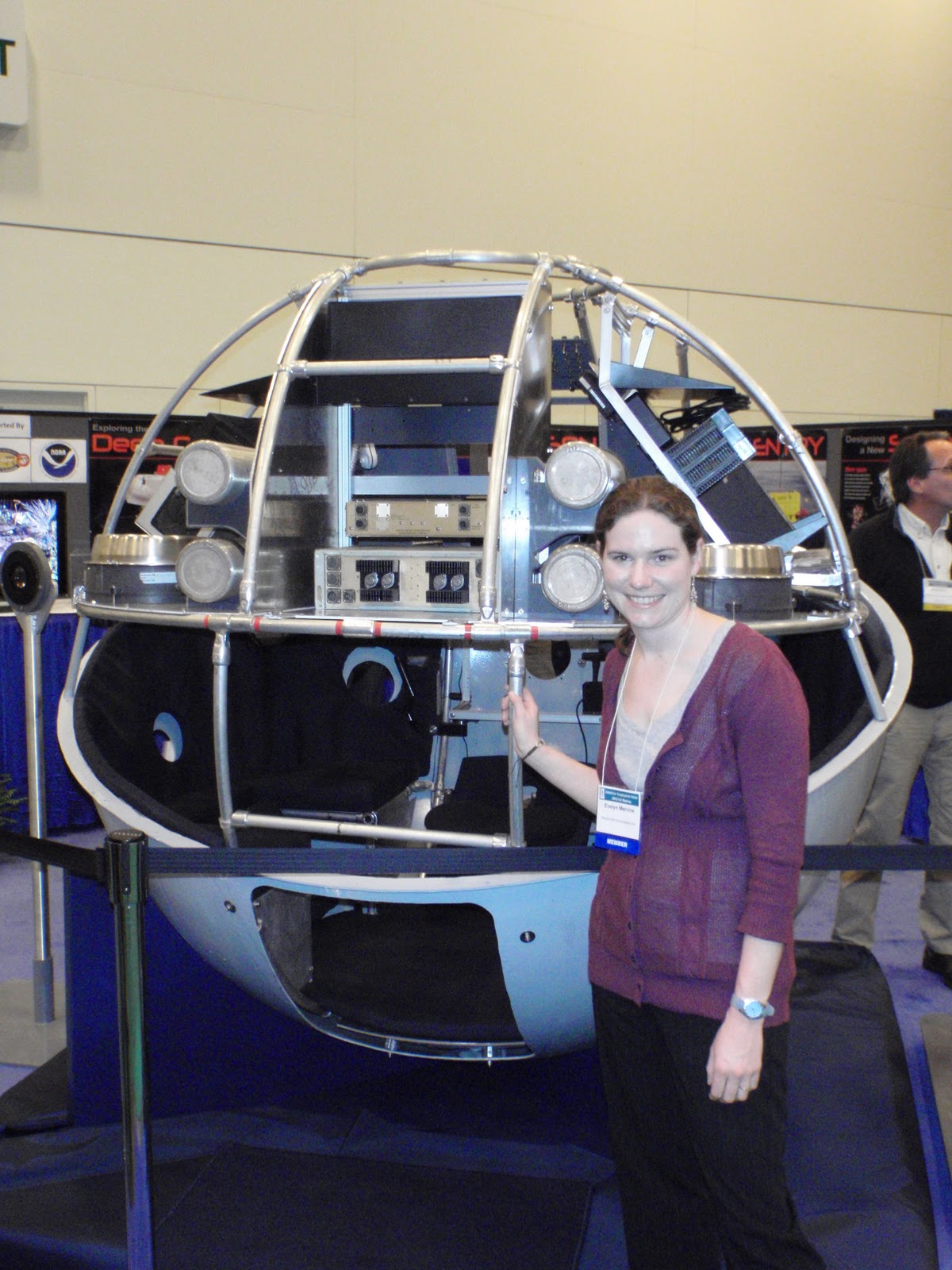
I’ve had a great conference so far- I spent the day meeting with colleagues and attending a session on geological carbon sequestration. I also visited the vendor’s hall and visited the life-size mock-up sphere of the Alvin deep-sea submersible, which was transported by truck from Woods Hole Oceanographic Institution (WHOI), my home base of operations. Be sure to stop by and visit the sphere- you can also enter a raffle to win a real Alvin porthole! WHOI, by the way, is an oceanographic institution located on ephemeral glacial till that will likely be underwater in the near future due to sea level rise…

Me and the Alvin Sphere Mock-Up, San Francisco, December 2010.

Okay, off to explore San Francisco a little! Hope to see some of you tonight at the AGU Movie Event!

AGU Movie Event

“The Core” movie poster. Image from wikipedia.com.

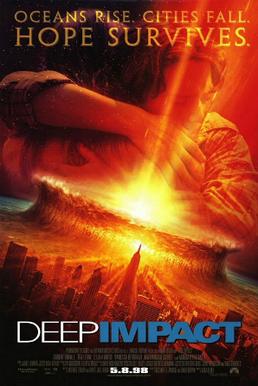
 “Deep Impact” movie poster. Image from wikipedia.com.

For those of you who like bad geology movies and who are attending the American Geophysical Union conference next week in San Francisco, I just wanted to advertise that there is an event called AGU Sciences Meet Hollywood.

The director of “The Core” and the screenwriter for “Deep Impact” will be there, among others. Sounds like fun!

This event takes place Tuesday night in Moscone Center South, Room 300. Hope to see some of you there!