Geology Word of the Week: Q is for Quartzite

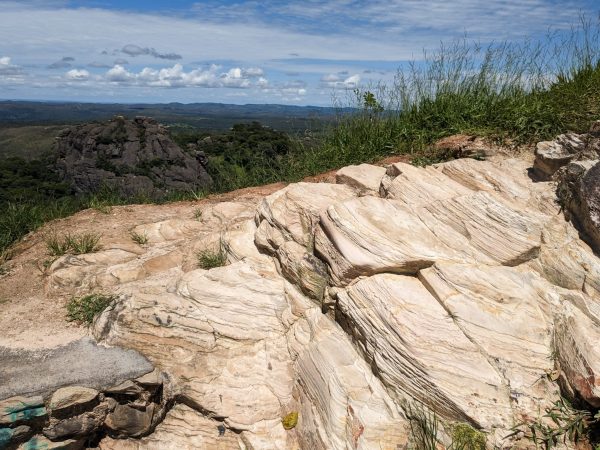
A quartzite outcrop in Minas Gerais state, Brazil. Picture taken by me in February 2023.

def. Quartzite:

A metamorphic rock that consists primarily of interlocking grains of the mineral quartz. Quartzite forms when quartz-rich sandstone undergoes metamorphism.


The term “quartzite” is an example of a geologic term that can be a little confusing. Most of the time, geologists use the term “quartzite” to refer to a metamorphic rock, which is the definition that I have provided above. Sometimes, geologists also use the term “quartzite” to refer to a sandstone that has quartz grains that are very well cemented together, but which has not been transformed in to a metamorphic rock. In my experience as a geologist, this second usage is much less common. I think it was more commonly used in the past. To distinguish between different types of quartzite, geologists can use the terms “metaquartzite” to refer to the metamorphic variety and the term “orthoquartzite” to refer to the sedimentary variety. For the rest of this post, I’ll focus on metaquartzite, which I will just call “quartzite”.

Quartzite is a beautiful metamorphic rock that, at first glance, sometimes looks like sandstone. Quartzite can even retain the original cross-bedding that can be seen in many sandstone rocks, for example as shown in the pictures of quartzite outcrops from Minas Gerais, Brazil, shown in this post.

A closer view of a quartzite outcrop in Minas Gerais, Brazil.  Picture taken by me in February 2023.

However, the quartz grains in a quartzite look different to those in a sandstone – they have recrystallized so that that are more or less equal in size. Compared to the original quartz grains that were in the sandstone, quartz grains in quartzite are larger and more polygonal in shape. The grains are tightly interlocked. A characteristic of quartzite is that when it breaks, it will break through grains, not just along grain boundaries.

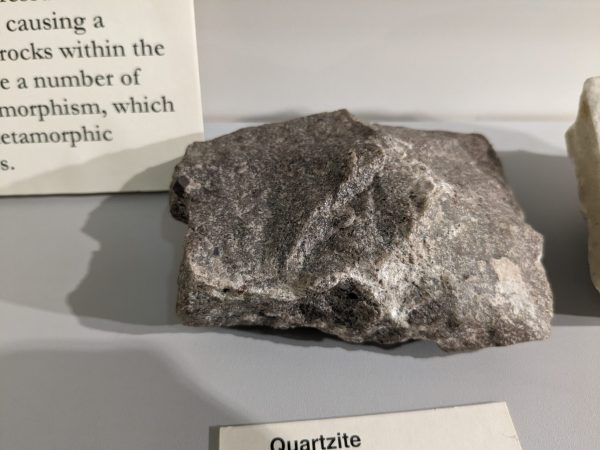
Here’s a closer view of a quartzite hand sample:

Quartzite hand sample in a museum display. Picture taken by me.


A closer view of the quartzite hand sample, giving a good view of the appearance of the quartz grains. Picture taken by me.


Quartzite is a very hard rock that is highly resistant to erosion. Thus, quartzite can often be found on ridges and on the tops of hills. From a distance, quartzite may look like sandstone – so you may need to look at it close up in order to identify it as quartzite. Quartzite is most commonly white or gray in color, but can also be other colors, such as tan, pink, and yellow.

That’s all for this week’s post – stay tuned for next week!

Geology Word of the Week: J is for Jasper

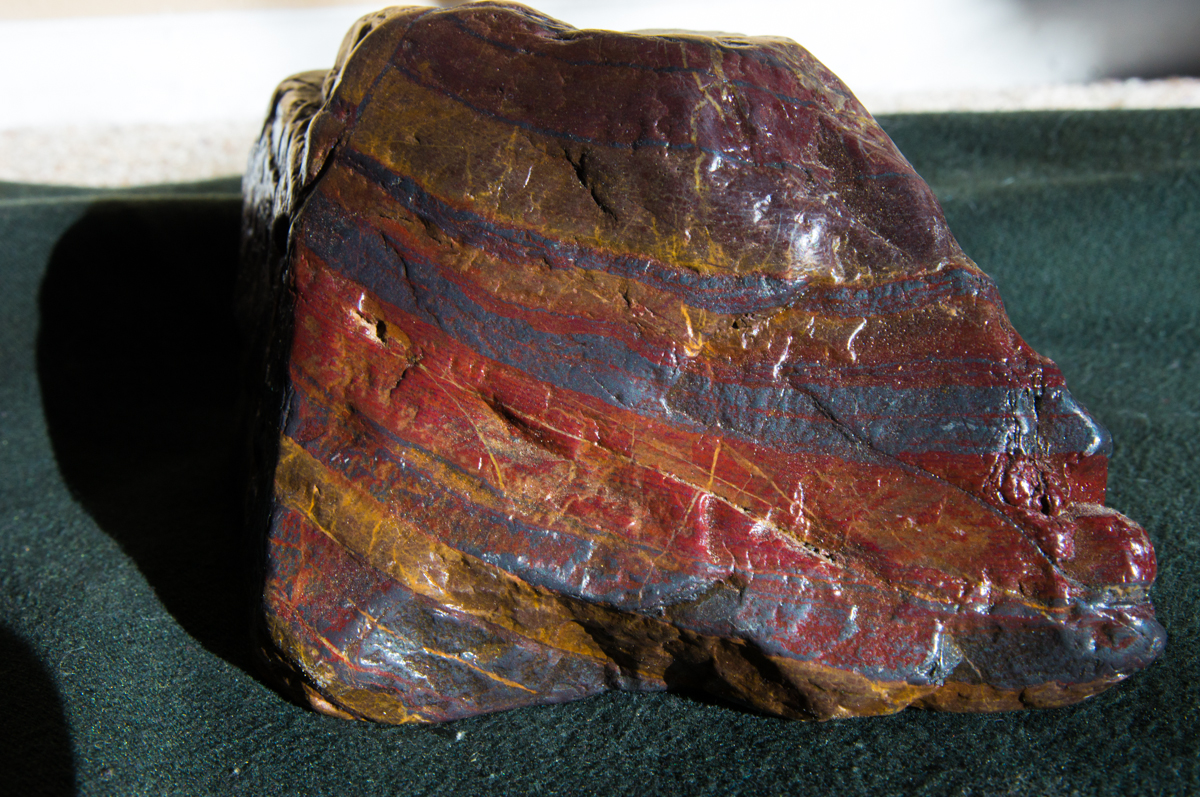
A jasper-rich rock from Minnesota. Picture courtesy of Ben Chorn.

def. Jasper:
A dense, opaque variety of chalcedony. Jasper is most often red in color but can also be yellow, brown, green, or gray.


For this week’s Geology Word of the Week post, we’re going to learn a little about silica, aka silicon dioxide or SiO2. More specifically, we’re going to learn about silica minerals. Silicon and oxygen are the two most common elements in the Earth’s crust and are found in many, many minerals. In fact, silicate minerals comprise ~90% of Earth’s crust. Silica minerals are silicate minerals with the chemical formula SiO2.

The most common silica mineral (and the second most common mineral in Earth’s crust, after feldspar) is quartz. Quartz is most commonly clear or opaque white in color but can also be purple (amethyst), pink (rose quartz), yellow (citrine), and brown or black (smoky quartz). The different colors of quartz are caused by impurities and crystal defects. Quartz is one of a few varities of crystalline SiO2. Under most pressure and temperature conditions present at Earth’s surface and in Earth’s crust, quartz will crystallize as the SiO2 mineral. However, under different temperature and pressure conditions, such as deep in Earth’s mantle or at a meteorite impact site,  SiOcan form as other minerals, such as cristobalite, coesite, tridymite, or stishovite.

When  SiO2 does not form with a large crystal structure but rather forms with a microcrystalline or cryptocrystalline structure, a mineral known as chalcedony forms. Like quartz, chalcedony comes in different varieties. Jasper is one common type of chalcedony. Another common type of chalcedony is agate, which has alternating clear and opaque banding. Other types of chalcedony include carnelian, chrysoprase, heliotrope, and onyx.

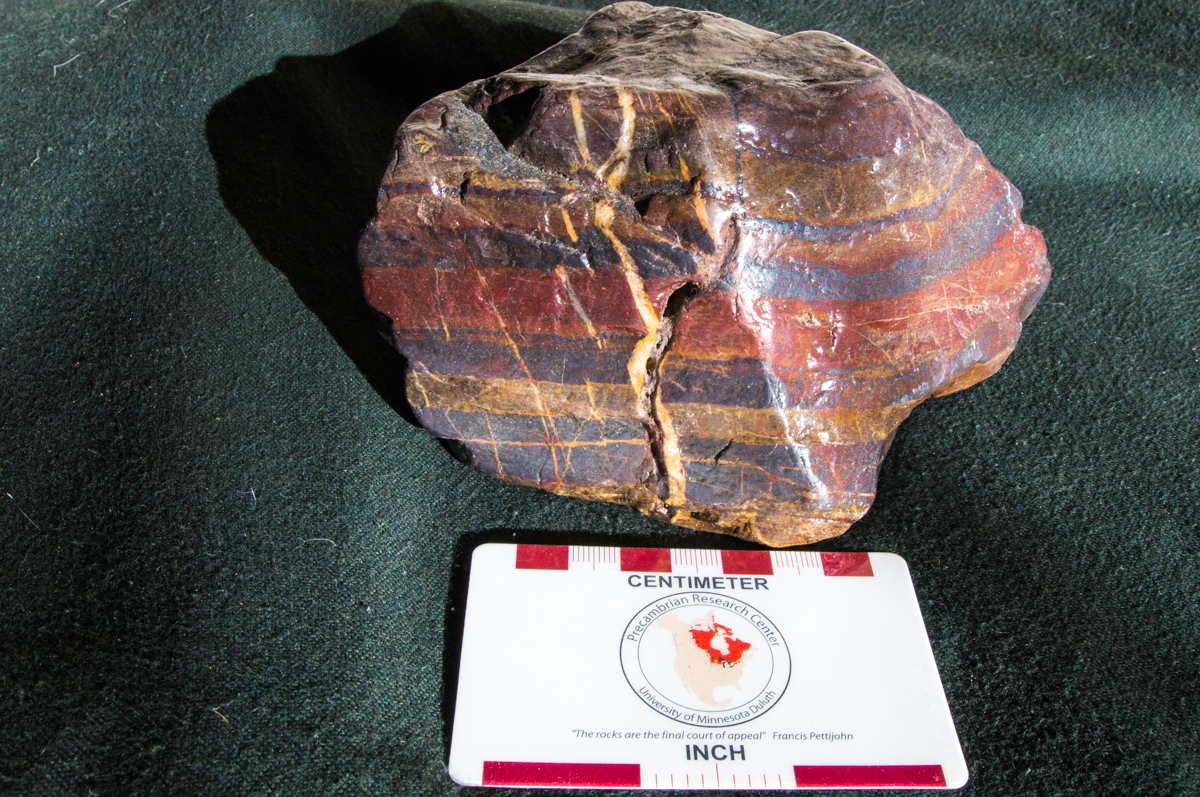
Here are a few more pictures of jasper rocks, courtesy of Ben Chorn:

Another jasper rock from Minnesota. Picture courtesy of Ben Chorn.
Another Jasper rock from Minnesota. Picture courtesy of Ben Chorn.
Yet another Jasper rock from Minnesota. Picture courtesy of Ben Chorn.
Jasper cobbles from Minnesota. Picture courtesy of Ben Chorn.
Two jasper cobbles from Minnesota. Picture courtesy of Ben Chorn.

And here’s a pretty agate that’s sitting on a shelf in my living room:

Agate rock.
Agate rock.

And here’s some quartz crystals on a rock that I picked up during a recent hike in South Africa:

A closer view of the vein of quartz crystals.
A rock with a vein of quartz crystals.