

I originally wrote this essay in Fall 2006. Revisiting these words, I sadly observe that my reading has degraded seriously since my first year of graduate school. As an enthusiastic first year, I would read isotope books for fun! Now I read mystery novels by the mass spectrometer. Oh, well. To be fair, though, I was really reading the isotope book for a homework assignment.
 |
| J.J. Thompson, the inventor of the mass spectrometer. Image taken from here. |
Last Saturday [Note: in December 2006], I met up with my friend Rebecca, and we took the train north of Boston to meet up with some friends for a Newtonmas Party hosted by a skeptic friend of ours. On the way out the door, I grabbed some light reading for the way as I wasn’t sure Rebecca and I would end up on the same train. Fortunately, Rebecca and I did meet up and ended up gossiping on the way. Rebecca also made fun of my “light reading for the train.” The book I selected was Geochemistry of Non-traditional Stable Isotopes, a fascinating little volume that I imagine I’ll read cover-to-cover before the year’s end. Really, though, Rebecca, it is light reading… I mean, it’s far better than other books I could have grabbed, such as, Reaction Mechanisms of Inorganic and Organometallic Systems or Thermodynamics of Minerals and Melts, for instance.
As I have a paper due tomorrow on lithium isotopes, my post today is going to have to be about isotopes. For those of you who need a quick review, isotopes of an element are produced because of differences in the numbers of neutrons in the nucleus. Thus, isotopes of an element have slightly different masses that can lead to small, but important, differences in the behavior of an element. For instance, water sitting in a glass will become isotopically heavy over time as lighter 16O and 2H evaporate preferentially over heavier 17O, 18O, and 3H.
Many physical, chemical, and biological processes can lead to isotopic fractionation. Studying ratios of both stable and radioactive isotopes can provide important constraints on these processes. The study of radioactive isotope systems, such as potassium-argon and uranium-thorium, can also be used in the dating of rocks and archaeological samples.
I started reading Geochemistry of Non-Traditional Stable Isotopes for my research paper on lithium isotopes, but I’ve found myself reading bits and pieces of the other sections of the book as well. This book is basically about all the new types of stable isotope systems (lithium, magnesium, zinc, selenium, et cetera) that are now able to be studied because of recent advances in mass spectrometry. The isotopes themselves aren’t really that interesting, but their applications are. Scientists will be able to learn so much more about paleoclimate, volcanology, ocean circulation, biological cycles, et cetera from studying these isotopes.
This little book on stable isotopes is opening my eyes to how recent developments mass spectrometry are revolutionizing isotope geochemistry. I could care less how my car works, but I care a great amount about how mass spectrometers work, for some reason. I’m weird that way. Basically, a mass spectrometer uses electric and magnetic fields to separate isotopes and measure their ratios and concentrations.
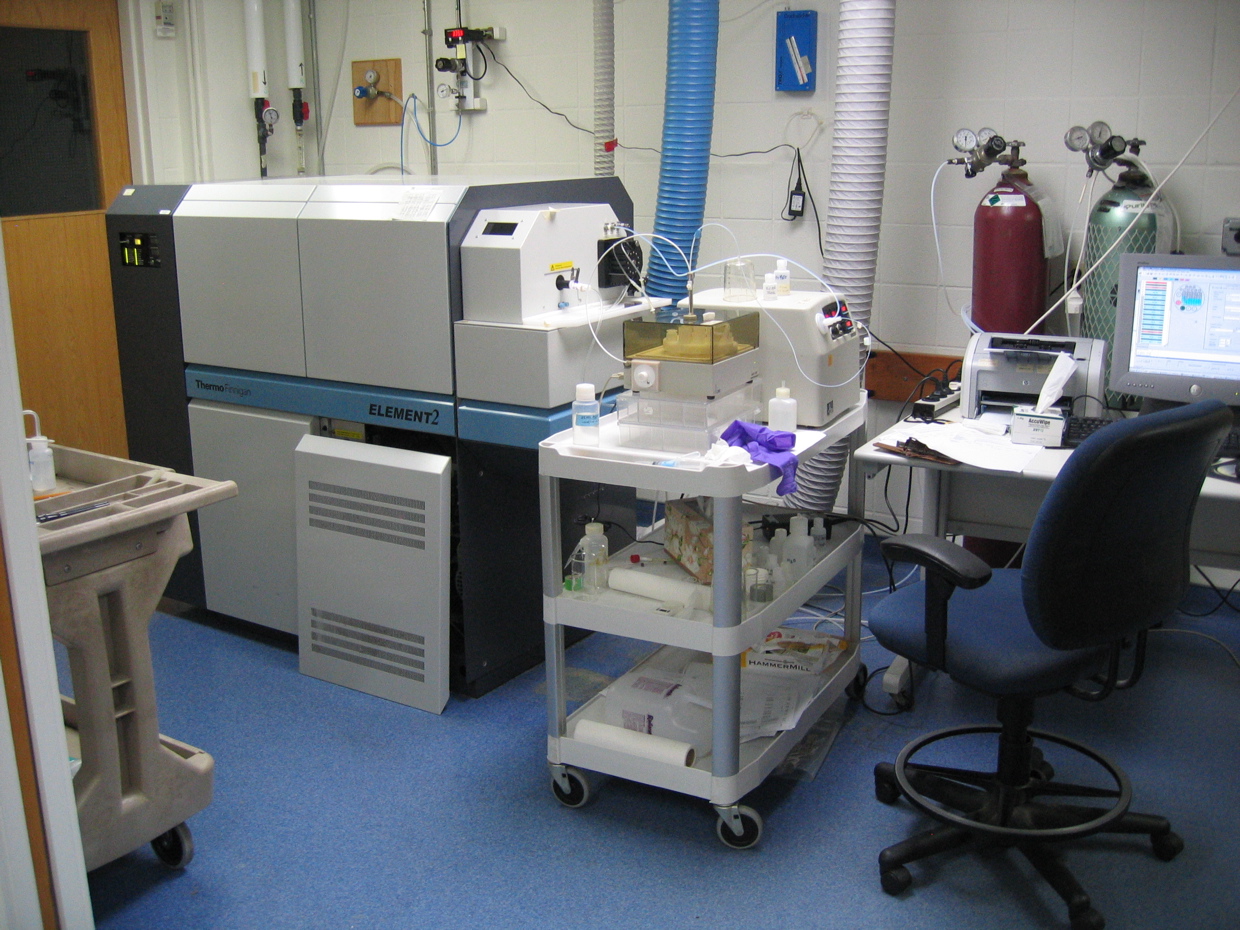
These days, the coolest mass spectrometer on the block is a multicollector inductively coupled mass spectrometer (ICP-MS). ICP-MS has many advantages, the greatest of which is that you often don’t have to go through the weeks of painstaking chemistry to separate out an element of interest from a sample. In the old days geochemists had to labor for days in the lab, slaving away over intricate glass columns and probably getting various cancers from the acids and other toxic stuff they used in their chemistry. These days, the modern geochemist can dissolve a rock powder or other sample, dilute the solution with some weak nitric acid, and use a cool flame torch to completely ionize the sample. No chemistry involved, often! Just simple dissolution.
To make life even easier, you can even hook up a laser to your ICP-MS. Besides saying that you “work” with lasers, which is always cool to say, the advantage is that you don’t even need to dissolve your sample! In many cases, you don’t need to prepare your sample at all. You can stick your rock, bone, wood, or even flesh/hair/skin sample in the little box with the laser, and the laser does all the work. Poof! Your sample is ionized. Turned into plasma. Twenty minutes later, you have constrained the chemical and isotopic composition of your sample. The analysis time for your sample has gone from twenty weeks, perhaps, to twenty minutes.
While I oversimplify the ease of laser ICP-MS (you have to worry about matrix effects, for instance), the technology is powerful. As a young geochemist, I marvel in this technology. Yet, I realize that some of the older geochemists are somewhat skeptical of this new technology.
Partly, I think, it’s a generation gap. Many geochemists claim that their old techniques of laborious, back-breaking, cancer-inducing chemistry and last generation mass spectrometers still produce better numbers. In a sense, that’s true. Many of the older techniques still do produce the best-precision numbers. Yet, for many problems you don’t need super high precision to answer your questions. Why do all the work, then? I think some of the older geochemists are just bitter they had to work for twenty weeks to get the same numbers their grad students get in twenty minutes. However, for the problems which do require high-precision resolution, the new mass spectrometers are catching up. There are still some tricky isotope systems which require laborious chemistry, but even these systems may become easier to measure with time.
For some researchers, I recognize there may also be financial restrictions. The new machines can easily approach a million dollars in cost, and not all labs can afford that. The old machines and techniques may have to do, in many cases.
While I am in general all for new technology and less labwork, I do have to agree with older geochemists I’ve spoken with that the ease with which isotopic data can be generated on these new machines is a little dangerous. These days, mass spectrometers are becoming like magic boxes which produce isotope numbers. You load your sample, press a button on the computer, and walk away. After your coffee break, you have your data, more or less. However, today’s graduate students do not necessarily appreciate the nuances and potential pitfalls of the technology, so troubleshooting is challenging.
Also, the rate at which data is being produced is somewhat dangerous. What good are a hundred numbers, after all, if you have no idea what they mean? Maybe they only had ten numbers in the old days, but they really thought about those ten numbers.
I talk about mass spectrometers because these are the toys which I play with, but there are many other examples of scientitific technology that is both world-changing and dangerous. As good scientists, we should embrace modern technology. But, as good skeptics, we should be careful about the magic boxes of the modern world. At the very least, we should appreciate that collaboration and clear communication between professionals in various specialties will become increasingly important as these magic boxes become fancier and fancier.
And speaking of magic boxes, I think it’s time to go and microwave my dinner in the magic box in the kitchen.



 Georneys