
3rd Interview with My Dad, a Nuclear Engineer, about the Fukushima Daiichi Nuclear Power Plant Disaster in Japan

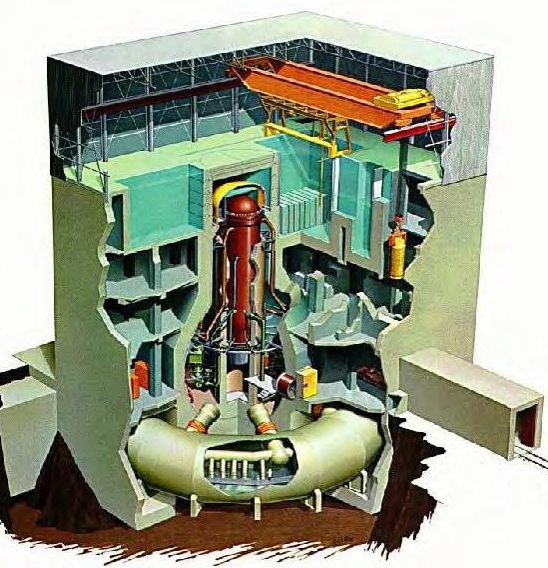
Picture of a Boiling Water Reactor Nuclear Power Plant like the Fukushima Plants.
My dad refers to this image in his interview.

Cross-posted on Skepchick.

Update: All the interviews are now available on a vimeo channel. Here’s the vimeo channel:

Update: Announcing Daily Updates from My Dad 

My dad refers to this article in today’s interview:

Here is a vimeo video of the interview:

Update: I have cleaned-up the original transcript.

Update: Thanks to Kirsten and Gregg for transcribing!

Interview 3: Monday Morning, March 14th, 2011
3 Days Since Tōhoku Earthquake and Tsunami

EM = Evelyn Mervine
MM = Mark Mervine
EM: Hello? Dad?

MM: Hello.

EM: Hello. Are you ready for Part III of our nuclear power interview?

MM: I am.

EM: Okay. Before I begin this interview, I just want to quickly say that this is the third in a series of interviews with my dad, who is a nuclear engineer. I encourage you, if you haven’t done so already, to listen to Interviews 1 and 2, which can be found at my geology blog Georneys (georneys.blogspot.com) or they can be found on the Skepchick blog (skepchick.org). I’m not going to introduce my father again. If you want to see his qualifications, please look at the first interview— listen to it or read the transcript— but I’m actually just going to start off, and I guess I’ll start with asking you to maybe give us an update on what’s going on at the Fukushima Nuclear Power Plant in Japan. There has been a second explosion, as I understand.

MM: So, let me give some good news first. The plant that we’ve all been focused on is the Fukushima 1 plant. There’s also a Fukushima 2 plant which is a few miles away which has 4 nuclear reactors. And the good news there is they’ve been able to completely cool down one of the reactors, and they’ve been able to restore normal cool-down to two others. So, the situation at that site has dramatically improved over the last 24 hours.

EM: Excellent. That’s very good news.

MM: Now, with respect to the Fukushima 1 site, the situation has gotten dramatically worse in the last 24 hours. So, as was seen in the news— and I’m sure people have seen the video or the photos— they had a similar explosion in Reactor 3 as to what they had in Reactor 1, due to the pressure that they were relieving from the containment, primary containment, into the secondary containment. As we explained yesterday, when the fuel cladding reaches 2200 degrees Fahrenheit, it will interact with water to form zirconium dioxide and H2O [water].

And the venting of the steam in order to reduce pressure in the reactor and in the containment obviously included enough hydrogen to set off an explosion which has destroyed the top of the Unit 3 reactor building.

EM: And the other thing that I read in the news— I don’t know if you can confirm this— is that that explosion actually damaged some of the cooling systems for another one of the reactors at Fukushima 1.

MM: Correct, and that’s where the situation has gotten dramatically worse, In Unit 2, which is adjacent really in between Units 1 and 3, they had been able to cool the reactor using their core isolation cooling system. Whether it was a result of the explosion in Unit 3 or just a coincidence of timing, shortly after that explosion, the core isolation cooling system failed for that unit, and they have been unable to maintain cooling or water levels in that unit. And it has been reported that the fuel in that unit has been exposed.

EM: Oh, it’s actually above the water level. And can you explain why that is bad?

MM: That’s bad because if you don’t have water to cool the fuel, it will heat up and start to melt.

EM: Now, from what I understand, they were actually using sort of one of their normal cooling systems for that Number 2 reactor?

MM: That’s correct, and they’ve now shifted to pumping seawater and boron into that reactor, but at the moment, according to the latest report I’ve seen, they are unable to do that because of the pressure buildup in the reactor and the valve that they need to open to relieve the pressure which would allow them to pump more water in there has failed.

EM: Yes. That doesn’t sound very good.

MM: They’re in a situation where the pressure needs to be relieved, and to explain a little bit, the pump that they would be using to pump the seawater in is a low pressure pump. So the pressure in the reactor has to be below the output pressure that that pump can produce in order for the water to flow.

If the pressure in the reactor is higher, then obviously you can’t pump water into the reactor. So, they need to relieve that pressure. And again, the latest news report that I just saw indicated that they’re having problems relieving the pressure in the reactor.

EM: So, I have two questions for you related to that. The first one is, if they are unable to get seawater in there—I know that, fortunately, in the explosions that have happened, the containment has, has stayed intact for the other two plants, which is very good because it means that there shouldn’t be a large radiation leak. In this case, with Reactor Number 2, is there any danger that if there is an explosion this might be different? That this actually might affect the containment? Or should that containment remain intact?

MM: They need to reduce the pressure in the reactor and in the containment in order to prevent damaging that primary containment structure.

EM: So, there is a risk— a potential risk— that that primary containment could be damaged?

MM: Correct.

EM: In your opinion?

MM: Normally there is a pump that would spray water into the containment that would reduce the temperature and pressure.  But those have not been available since about an hour after the earthquake. So, they need to be able to open these valves and release the pressure as they did in Units 1 and 3, and I’m sure they are furiously working on that as, as we speak.

EM: And so if that primary containment is breached, then the situation could become much more serious, in your opinion?

MM: It could, but at this point in the game, let us hope that they are successful in reducing the pressure and that we don’t have to go down that path as to what could happen.

EM: Okay. A follow-up question that I have for you, related to the same thing, is we’ve been seeing in the news that they’ve been pumping boron and seawater into Reactors 1 and 2, and clearly that didn’t work perfectly because there were explosions in these auxiliary buildings. The containment did stay intact, so that was good, but there were these explosions so clearly that strategy isn’t working perfectly. Can you comment on maybe why that we are having these explosions, why we had the explosion at Number 2 even though they were trying to provide the seawater and boron?

MM: Okay. So to clarify, the explosions have occurred at Units 1 and 3.

EM: Sorry. That was my error.

MM: Not Unit 2. And also they have been pumping seawater into all three of those units. And the seawater is working. What I explained yesterday is if the fuel gets partially uncovered, it’s going to heat up, and when it reaches 2200 degrees, it’ll interact with water to form zirconium and hydrogen. When they release the pressure— and they’ve got to keep the pressure down in order for these pumps to have enough pressure to pump water into the reactor.

So, when they relieve that pressure, which is primarily steam, they’re also releasing some hydrogen, and if there’s enough hydrogen, then the hydrogen will interact with oxygen in the secondary containment building and cause the explosion that we’ve seen in Units 1 and 3.

EM: I see. Do you have any other comments on the current situation?

MM: I do. I sent you a picture earlier this morning that I was hoping you would post instead of another picture of me.

EM: Sure.

MM: For two reasons. I wanted to clarify something that I said in the previous interview [note: in Interviews 1 and 2] where I referred to the building that exploded as the auxiliary building. Not technically correct. It would be correct in a typical pressurized water reactor and also a newer generation boiling water reactor. But in these, these generation boiling water reactors they have a Mark 1 containment structure. And, in fact, the reactor building and the auxiliary building are all combined into one. The correct term with respect to the buildings that have exploded are the “reactor buildings.”

EM: Okay.

MM: And the picture shows kind of the cut-away design of that building. The other reason I wanted to have that picture to talk about is something that really hasn’t been talked about too much in the press. While the containment buildings have held, we also need to keep in mind that outside of the primary containment building— and the secondary containment or reactor building which has been seriously damaged in both Units 1 and 3— is the spent fuel storage pool, where the fuel that had previously been in the reactor has been taken out and is stored longer term until it completely cools. So, one of the considerations that they have is that the heat exchangers and the pumps for the spent fuel pooling cool, pool, excuse me, [spent fuel cooling pool] probably have also not had any power for a significant period of time and could have been damaged in this explosion. And they’re going to have to take steps to make sure that they maintain water in those pools, in these buildings that are now exposed to the environment.

EM: Do you think that they should be providing fresh water to those pools? I know that they’ve been putting seawater into the reactors, and, and from what I’ve heard from you and from what I’ve heard on the news, that’s actually not a very good option because seawater and boron are corrosive. And basically they’re sort of giving up on those plants and saying, “Okay, we’re just trying to keep this from being a nuclear disaster. We’re not actually going to reopen these, these plants. We’re going to have to decommission them.” But in the case of, of a pool where you have long-term storage of nuclear fuel, would it be a problem to add seawater? Would that cause problems later on?

MM: So, the good news is the pools are fairly deep, and they have quite a bit of water over the top of, of the fuel. And it will take some period of time for— assuming the pool is not damaged— for that water to evaporate or boil away.

So, they have a lot more time, probably, than they do given the current situation with, with Unit 2. But at some point they’ll need to make sure that they do keep that covered. And if there is no freshwater, then they should absolutely use saltwater because water does two things: It helps cool the fuel; It also provides shielding against radiation. It’s not ideal to use saltwater, but if there is no other water, then that’s what they should use.

EM: If they do use saltwater— I mean, these pools from what I understand, they need to have the fuel sitting in them for quite a long time, and, I guess, that’s one of the big problems with nuclear power is what do you do with the spent fuel rods? So what sort of problems might this entail, not just tomorrow or next week, but sort of ten, twenty years in the future for those spent fuel rods? Should there be a problem if they add seawater or no?

MM: I think it’s going to, uh, I think it’s going to depend on the amount of water that’s added and the time before power is restored. Once power is restored and normal cooling and filtration systems can be restored, then they would be able to clean up the water in those pools and get the salinity out of them.

EM: Okay, so it doesn’t sound like that should be a major problem as long as the explosions are not damaging the pools themselves in any way.

MM: It’s a problem, but not, not an immediate problem.

EM: Okay. All right, now I’m going to ask some questions that have been sent in by email or by comments by some people who listened to the first two interviews. And please do continue to send in these comments and questions that you have. I am a graduate student with other obligations, and my dad also has a full-time job, so we may not be able to answer every question, but we will certainly do our best. So, to start off with, the first question was someone wanted me to ask my dad about the contamination that’s being reported by the U.S. Navy, and he wanted to know sort of how far away that is from the plant and he heard something about U.S. Navy sailors requiring some kind of decontamination. Can you speak about that? Do you know anything about that?

MM: No, I don’t know any direct details, only what I’ve seen in the news. And my understanding was that there were some military personnel that had gone inland on a helicopter, and when they returned to the Ronald Reagan [their ship] they were able to detect some radioactive contamination on those folks, and they had to be decontaminated.

EM: Okay. And do you think that— I mean that probably wasn’t any kind of major contamination because, as we’ve discussed the containment units for Fukishima number 1 and 3—although there have been explosions in this outside building, the containment has stayed intact, so there shouldn’t be any kind of major radiation, so this is probably a more minor radiation…

MM: Correct.

EM: …in your opinion or… okay.  I just wanted to confirm that; so it’s nothing we should panic about yet, but it is there, and it is a situation that Navy did have to deal with.


MM: So, as we talked about yesterday, that’s one of the indications that to me that they actually have a partial fuel failure in those reactors because of the fact that they were able to detect Cesium and Iodine in the environment. The levels, relatively speaking, will be low. These personnel have been decontaminated, and they should be fine. And the amount of contamination that can be expected probably is a lot dependent on the direction of the winds. Up until now, I think they’ve been relatively lucky that most of the winds have carried the exhaust from the plant out over the ocean. But there will be some found inland, no doubt.

EM: So, clearly the U.S. Navy is testing for this and they’re able to detect this contamination. I don’t know if you can comment on this; I don’t really know anything about it personally. I imagine there must be other people— civilians—who are affected by this as well, and hopefully the Japanese government is making an effort to actually detect that sort of contamination as well.

MM: They are. They’re constantly monitoring, and that’s why they’ve evacuated people in a radius around the plant of 20 kilometers.

EM: Excellent. Okay, a second question that I have was—well, there’s a lot of people who’ve been saying—actually I’ve gotten this from more than one listener—that they want to hear about your worst-case scenario. I don’t know if you want to discuss that; maybe that’s a bit premature?

MM: It’s really hard to speak to what a worst-case scenario would be. I think you mentioned it just in the last part of this interview that the worst-case scenario would be for one of the primary containment structures to fail.

EM: In that case, would we have more… I mean again it’s [crosstalk]

MM: Yeah, I’m sorry. If one of the primary containment structures was to fail then we would have a lot more radiation released to the environment.

As long as they’re able to maintain some water in the reactor vessels and in the containment area, then eventually the fuel that’s in there will cool, but any of the fuel that’s overheated can potentially blister or fail or even melt; and the more that that happens combined if a containment unit was to fail would cause a lot more release of radiation to the environment.

EM: Okay. So a last question that a listener sent in is there has been a study and I’ll post a link[1] to this—I guess it’s not really a study, it’s some thoughts from an MIT scientist who’s an engineer and whose dad worked quite a bit in nuclear power. There’s an article, and it’s been circulating around the internet, and some people asked me what your opinion was on this article, and I wonder if you can just comment on that.

MM: Yeah, I took a look at it and I think there’s a lot of good information there.I think he does a good job of—like we try to do—explain what’s going on.

It’s very difficult, I think, for a member of the public to understand what’s going on because the information is just scattered about in little pieces here or there or, you know, you’re only able to get a sound bite off of the television. So, if there’s somebody that’s really interested [in Fukushima and nuclear power], I would encourage them to go ahead and read that and, I think, combined with these interviews, [it] provides a pretty good picture.

EM: Okay. Thank you so much, Dad! That’s all for today and again, as I said, we both have other obligations so we may not do these interviews every day, but perhaps in a few days we can do a follow-up interview on the situation. And again please do send in any questions that you have. My dad seems happy to answer them. So, thanks, Dad.

MM: Okay, you’re welcome.

EM: Okay, bye.


[1] The MIT scientist is Josef Oehmen, who wrote a letter titled “Why I am not worried about Japan’s nuclear reactors”  to reassure his friends and family about Fukushima. The letter was intended for friends and family only, but went viral on the internet when a relative of Oehmen’s posted it on a blog. While the letter at first received much praise, particularly from pro-nuclear advocates, as the situation at the Fukushima reactors worsened, Oehmen and his letter were severely criticized. There were some errors in the original letter, which was moved to a site hosted by MIT, which was tried to carry out damage control.  Oehmen was also criticized for his background as he is not a nuclear scientist
Here are some relevant websites:
-Original blog website hosting Oehmen’s letter:
-MIT site hosting a corrected version of Oehmen’s letter:
-Joseph Oehmen’s website:
-Articles on the Oehmen fiasco:
New Scientist:
Salon.com:
Genius Now:

2nd Interview with My Dad, a Nuclear Engineer, about the Fukushima Daiichi Nuclear Power Plant Disaster in Japan

A recent photo of my Dad and one of his favorite trains– he is a high speed train buff.

Update: All the interviews are now available on a vimeo channel. Here’s the vimeo channel:

Update: Announcing Daily Updates from my Dad

Here is the audio file for today’s interview:

Here is a vimeo video of the interview:

Update: I have cleaned-up the original transcript.

Update: There is now a transcript for after the jump. Thank you, Chris!

Interview 2: Sunday Morning, March 13th, 2011
2 Days Since Tōhoku Earthquake and Tsunami
EM = Evelyn Mervine
MM = Mark Mervine
MM: Good morning.
EM: How are you, dad?
MM: Okay.
EM: Good. Are you ready for a second interview?
MM: I am.

EM:  Okay. Before we start on today’s interview, I just want to thank everyone who listened to yesterday’s interview. My dad and I are really happy that we could provide you with some basic information about nuclear power and also some specific information about the nuclear disaster in Japan. If you haven’t done so already, I encourage you to listen to yesterday’s interview. You can find it— with a full transcript— at my geology blog Georneys (georneys.blogspot.com) or you can find it on the Skepchick blog (skepchick.org). The purpose of today’s interview is for my dad to give an update on the situation in Japan, and also to answer some additional questions, including some questions that were sent in by people who listened to the first interview.

So, just to start off with, dad, could you just introduce yourself again, and very briefly describe some of your background in nuclear power. And I just want to mention that if you want to get a full description of my dad’s backgrounds, please listen to the interview from yesterday.

MM: Good morning. I graduated from the Naval Academy in 1981 and worked in the Navy nuclear power program. I worked at two different Navy nuclear power plants and was an instructor in the program. After seven years of active duty, I went into the Reserves and initially went to work for Wisconsin Electric, which at the time owned the point Beach Nuclear Plant, which is a Westinghouse two-unit plant in Two Rivers, Wisconsin. And after a few years there I went to work at Vermont Yankee, which is a boiling water reactor in Vernon, Vermont.

EM: Excellent. I think that’s enough for today. So, to start off with, could you please give us an update about what’s happening at the Fukushima nuclear power plant since you talked to us yesterday?

MM: Okay. Well, again, I have to rely on news, just like everyone else, either from reports from the internet, TEPCO [Tokyo Electric Power Company], their website, the International Atomic Energy Agency, and, of course, television. And what I’m able to piece together— I’m kind of doing an analysis of all the different reports— is, as we talked about yesterday, we have a serious problem at the Fukushima Nuclear Power Plant, Unit 1. And in taking some time to reflect on all the different reports after our conversation yesterday, it’s pretty clear that we’ve had a partial failure of the fuel rods in that reactor. And let me explain a little bit. So, as most everybody knows from the news now, there was an explosion at that plant yesterday, which destroyed the building surrounding the reactor, which is typically known as the auxiliary building[1]. What they were doing was they were venting pressure from the reactor into that building. And that steam also contained a mixture of hydrogen, which— when it interacted with the oxygen in the atmosphere— exploded.

Where would the hydrogen come from? Well, the fuel rods are – the fuel pellets, I should say— are encased in fuel rods which are made of zirconium. And zirconium, when it gets to approximately 2200 degrees Fahrenheit, will interact with water, or H2O, to form zirconium dioxide, and hydrogen is released. So, in order for there to be a significant amount of hydrogen, it’s pretty clear that at least a portion of the fuel had reached 2200 degrees, and we have zirconium oxide being formed and hydrogen being released.


Also, it has been reported that in the environment they’re able to detect cesium and iodine. Yesterday, I mentioned that when uranium fissions, it breaks apart into smaller elements and releases energy. A couple of the smaller elements that are formed are cesium and iodine. Normally, those would stay within the fuel rod, and the only way they would get out is if there was a failure of a fuel rod. That doesn’t mean that there was a complete failure, but— in conjunction with all the other things we know, the radiation readings, the fact that there’s cesium and iodine in the environment, the fact that we had hydrogen released— does indicate that we’ve got at least some fuel failure in that reactor.EM: So, does that mean that we’re in a meltdown situation? And, if so, can you please explain what a nuclear meltdown is?

MM: So, a meltdown, as it typically would be referred to, would be a complete meltdown of the reactor core. That’s probably not happening. In order for there to be hydrogen generated, then there was obviously some water. We know that they’ve been injecting seawater mixed with boron into that plant. So, there’s some water in there, and I would agree with most folks that a complete meltdown is probably not likely at this point. But again, it does appear that probably the upper part of the fuel was exposed, and some damage has occurred. And the release of iodine and cesium to the environment from those fuel rods has occurred.

EM: So yesterday we were mostly talking about the Fukushima Plant Number 1. And the news reports seem to be saying today that there are some additional reactors that are in trouble at Fukushima and perhaps other places. Do you have an update on that?

MM: So, if you recall yesterday, there are six nuclear reactors at the Fukushima 1 Site. Three of them were shut down for normal maintenance and had already cooled down substantially and are not an issue. Units 1, 2, and 3 were operating at the time of the earthquake and shut down automatically. What’s occurred in the last 24 hours is: at Unit 3, which is a newer plant and slightly larger than Unit 1, they have lost the normal shutdown cooling and emergency cooling systems, and they are also attempting to inject fire water [water sprayed from fire trucks], which I assume is seawater, and boron into that reactor as well. They are also saying that they’re going to need to or are venting pressure from that reactor, so again it does appear basically a very similar scenario to Unit 1, where they are going to be releasing steam. They probably had a partial uncover of that core [at Unit 3], and there probably is some fuel damage from that reactor [Unit 3] as well.

EM: Okay. But have they made progress, have they managed to get battery power and generators in there? It sounds like if they’re able to have some kind of cooling system, they’ve done that.

MM: It does sound like, even at the time that we spoke yesterday, that they had gotten power. The updates that I’ve seen indicate that they do have power at those sites, and that’s what they’re obviously using to pump the seawater and the boron into both of those reactors.

EM: Excellent. Another question I have for you is: yesterday there were reports that people were actually testing positive for radiation, and in the news I think there were people both over- and under-reacting to that. Can you give your perspective on that?

MM: So, it wasn’t 100% clear how many people, or whether these were workers from the plant or members of the public. Because they are releasing some radiation, even if there was no fuel failure, when they’re venting this steam from these reactors, there would be some small amounts of radioactivity. So, it would be possible for a worker from the plant to pick up some radioactive contamination from these particles. And of course they travel up into the atmosphere. They said generally the prevailing winds were taking it out over the ocean, but there may have been some members of the public before the evacuation that were in close proximity to the plant that may have had some of these particles fall on them from the atmosphere.

EM: Do you think that poses serious [radiation] exposure? I mean, there were some experts they were interviewing that said that it wasn’t really very bad, the level of exposure so far, do you think there could be any health problems from the exposure that’s happened?

MM: Hopefully not. Again, it’s very difficult to get exact details of what’s happening and what the actual readings are. But we know that the Japanese government has evacuated people approximately 20 kilometers from the plant. So, I would say that the concern for major health risk— assuming that the conditions at these reactors don’t get any worse— is probably very, very minimal.

EM: And presumably the people who are actually working there are wearing some kind of safety gear so that they’re minimizing their exposure?

MM: That would be correct.

EM: And also they were distributing iodine tablets to people as a precaution to help with radiation exposure, so hopefully that will reduce the exposure level as well, and I guess the cancer response to that level.

MM: So, let me explain that. So your thyroid will absorb iodine, and the purpose of the tablets is that you take those, and then your thiodine— I’m sorry— your thyroid absorbs that iodine. And then if there is radioactive iodine in the atmosphere from the nuclear power plant, if you’ve already taken the tablet, your thyroid has absorbed as much iodine as it can, and it won’t absorb the radioactive iodine. And that’s important because your thyroid is one of your more active glands, and if you can prevent that from absorbing any radioactive iodine that’s a real help in a situation like this.

EM: Excellent. So, the last question I want to ask you is something that I know you mentioned to me personally, is that many of the nuclear officials who are reporting on the nuclear disaster in Japan are using this so-called “safe language” when describing the disaster, and this is one of the keys to you that this situation might be more serious than at first they were revealing. What do you think this means? And also, you’re not currently in the nuclear power industry. Do you think that this enables you to speak a little more frankly about the situation?

MM: It’s really hard to determine whether information is being withheld or not. First off, in the media, I’ve just been kind of appalled at some of the reporting that I’ve seen.

EM: Me, too.

MM: I won’t mention the person or the network, but on a major news network, a so-called expert, who I watched last night, when was asked about the cesium, said cesium was used to control the reactor. Well, cesium is not used to control the reactor. Control rods are used to control the reactor. As I explained yesterday, boron can be injected to control the reactor. But cesium is a radioactive byproduct of uranium fissioning, and normally should not be in the reactor, or— I should say— not be in the reactor water; it should obviously be in the reactor fuel rods.

EM: It should not be in the atmosphere as well!

MM: It should not be in the atmosphere, but it’s not used to control the reactor. The other thing that was appalling to me was the pictures posted on the website of this news organization and shown on TV were of a pressurized water reactor, and this [Fukushima 1] was a boiling water reactor.

EM: Hah! That’s not even the right type of plant.

MM: Right. They’re similar, but they’re different, and if you’re going to be a quote “expert,” you need to get it right. Now with respect to public announcements, I think the biggest thing that I’ve seen is, they have this currently rated as a Category 4, which is one level below Three Mile Island. In my opinion, if we’ve got a partial core melt, and all— any, I think, engineer or scientist given all of the data that’s available, even as limited as it is, would conclude that here has been at least a partial core failure— then clearly this is in my opinion not less than Three Mile Island, it’s at least equal to. And the fact that we have multiple units at the same site involved, I would think really this is worse.

EM: Well, that’s good to know. Because people have been looking at that number and feeling relieved by it, but I think it’s too soon to really feel relief in this situation. They really need to get things under control.

MM: And I think the other thing to point out is, this is not something that’s going to go away tomorrow. This is going to be something for days. They’re going to— even if they’re able to get a significant amount of water in those containment buildings, it’s going to take days for these reactors to cool down.

EM: I wanted to ask you some questions that people had sent me either in comments or by email when I posted this interview yesterday. I was actually quite surprised at how many people listened to the first interview, and I’m very happy that we’re able to address some of their questions.

So, the first question I had from a reader was basically asking about the power, and they asked: “If the nuclear power plant is still generating steam after a shutdown, I assume that the steam is still turning the turbines. So why can’t or don’t they use the electricity that they’re generating to power the cooling pumps that they need?”

MM: Okay. Well, that’s a very good question. So, the turbines on these power plants are very large. And once the steam goes through these turbines, it goes into a condensing system, where water from a cooling tower or river or the ocean, which is much cooler, condenses the steam back into water, and then it’s pumped from there back into the reactor. So a couple things: first off, we had an automatic shutdown of the reactor and the control rods were inserted. So the heat that we’re talking about removing is not the full power heat. It’s the residual heat. Which is very substantial but not at the same level that’s required to turn the turbine.

The second thing is that since we don’t have any power, we don’t have any of the cool water to cool the steam, we don’t have any pumps to pump the water back into the reactor. So it would not be possible, in the situation that they were in, to continue generating electricity. The plant was shut down, there was no power, that wasn’t a possibility. There is an emergency system where they can use some of the steam from the reactor to turn a pump, so it’s a steam driven pump to pump water into the reactor, but that apparently failed.

EM: Okay. Well that’s good to know. And then a second reader actually had three questions. So I’ll ask those three questions. The first thing that he said is: “Your father mentioned the best-case scenario. What would he see as the worst case scenario? For example, could radioactivity possibly spread to Tokyo or even beyond Japan’s shores, to other parts of Asia?” or the Pacific, I guess.

MM: Okay, as far as a worst case scenario, as long as they’re able to continue to pump water and boron into these containment buildings and as long as they’re able to release the pressure in the containment buildings in small amounts then there should not be a lot of radiation released. With that being said, the radiation is going to go up into the atmosphere, and depending on which way the winds are blowing, it may be detectable as far away as Tokyo or other places. But the farther away you go, the more it’s going to disperse, and the levels will be much lower and again as long as the situation doesn’t get any worse, I would not expect any concern except for in the immediate vicinity of the plant.

EM: Okay, that’s excellent to know. The second question that this reader had is: “If your father were asked to advise on US energy policy, would he recommend that we continue building nuclear reactors?”
MM: That’s a good question. [Long pause] When we design nuclear reactors, and we design the safety systems for nuclear reactors, we calculate the probability of reactor accidents of the types that we’re seeing in Japan. And the systems have to be designed in such a way that that probability is extremely low. Clearly, what’s transpired here in Japan was beyond what was taken into account in design of the plants. And I think it has to be looked at— because if the probability of failure of a reactor is, you know, one in a million or one in a billion, the fact that we now have two, at the same time, at the same facility, probably calls some of those calculations into question. With that being said, these reactors are relatively old. The Unit 1 reactor is actually 40 years old. And the designs for nuclear power plants have been improved dramatically over the last 40 years, and the next generation that would probably be built [would] have a lot more passive safety systems that don’t require electricity and don’t require pumps.

EM: Isn’t that a problem in the US, for instance, that so many of our nuclear power plants are aging? And partly that’s maybe because of a fear of nuclear power— there hasn’t been a lot of motivation to build new ones— and so we’re relying on these older plants when really maybe we should have newer technology?

MM: Well, again, you know, I think you have to look at certain situations individually. What we had here was an 8.9 magnitude earthquake [later upgraded to 9.0 magnitude], which apparently the plants withstood and safety systems functioned correctly, the diesel generators came on, and everything was working as it should. Then we had a tsunami of anywhere from 20 to 30 foot waves. And the thing I think that has to be looked at is: is that possible for other power plants in the world, that if there was an earthquake and a subsequent tsunami, are any of those plants at risk?

EM: Okay. Well, even basic things. I mean, I’m not sure where the generators were located, but in a tsunami situation perhaps those should be located higher up on the building and not at ground level. Things like that maybe they could take into consideration when reviewing power plants that are located close to the ocean.

MM: Correct.

EM: All right, so a final question that we have is also from the same reader, Patrick: “Just out of curiosity, would nuclear reactors in US submarines have similar safety measures to the Fukushima plant in order to keep a core reactor from meltdown? Are there on a submarine additional power sources, some sort of containment unit, things like that?”

MM: All right. Well, I’m not going to be able to comment on the design of Navy nuclear reactors. The design of Navy nuclear reactors is classified. Let me just say that they are a different design than commercial nuclear power plants, and the Navy has never had a nuclear accident in all the years that they’ve been operating nuclear power plants. But the design I cannot speak to because it’s classified.

Q: All right. Thank  you very much, Dad, I think that’s all for today.

A: You’re welcome.

Q: Okay, I’ll talk to you later, bye.


[1] Actually, this building is called the “reactor building.” See Interview 3 for the correction and explanation.

Full Transcript Now Available for Interview with my Dad, a Nuclear Engineer, about the Japan Nuclear Disaster

I just wanted to post quickly that thanks to two kind and hard-working readers, there is now a full transcript for my interview with my dad, Commander Mark L. Mervine, US Navy, about the Fukushima Daiichi nuclear power plant disaster in Japan.

The transcript can be found here:
A Conversation with My Dad, a Nuclear Engineer, about the Fukushima Daiichi Nuclear Power Plant Disaster in Japan

I asked my dad if I could interview him later this week as more information about the nuclear disaster becomes available. He said he would be happy to be interviewed again. If you have any specific questions, please post them below and he will try to answer them.

And, just because I can, below is another adorable picture of my dad & me when I was a child. I’ve asked my mom to send some more recent pics of my dad & me as I don’t have any on my computer for some reason. The picture below was taken when I visited Scotland, where my dad was working on nuclear submarines.

My dad & I, circa 1987 or so.

A Conversation with My Dad, a Nuclear Engineer, about the Fukushima Daiichi Nuclear Power Plant Disaster in Japan

My dad and I, circa 1984.

Update: All the interviews are now available on a vimeo channel. Here’s the vimeo channel:

Update: Audio 1 is now corrected so that I sound much better (less high pitched). Thank you to Michael, a professional who volunteered his time to improve the audio.

Update: Announcing Daily Updates from my Dad

My dad does not usually swear. He’s usually a reserved man of few words. When my dad starts swearing and talking on and on about something, you know that he’s upset. All day yesterday, my dad kept saying “Ohhhh s&*t” when he heard the news about the Fukushima Daiichi nuclear power plant being hit by an earthquake and then a tsunami.When I interviewed my dad earlier today, he had much to say.

My dad- Commander Mark L. Mervine, USNR (Ret.)– is a nuclear expert who has worked on both nuclear submarines and nuclear power plants. I wanted to find out why my dad is so concerned about the Fukushima Daiichi power plant, so I called him up just a few minutes ago and recorded the call. I asked my dad all of the questions I had about the nuclear disaster. I hope this phone interview answers some of the questions you have. If you are at all concerned about the Fukushima Daiichi nuclear power plant disaster, you MUST listen to this conversation.

Here is the audio recording:

Here is a vimeo video of the interview:


Update: I have cleaned-up the original transcript.

Update: Transcription after the jump! Thanks to Ashlyn and Jesse who transcribed.

Interview 1: Saturday Morning, March 12th, 2011
1 Day Since Tōhoku Earthquake and Tsunami
EM  = Evelyn Mervine

MM = Mark Mervine

EM: Are you ready for the interview?

MM: I’m ready.

EM: All right.  I was hoping that we could start out— I know who you are, since you’re my dad— but if you could just introduce yourself quickly and describe some of your background in nuclear power.

MM: Sure, my name is Mark Mervine. I graduated from the US Naval Academy in 1981 and went into the Navy nuclear power program. I was in submarines, and while I was in the Navy I qualified on two different types of Navy nuclear power plants and served as an instructor in the  Navy nuclear power program.

EM: Okay, and then after you got out of the Navy?

EM: After seven years of active duty, I went into the Reserves, and I stayed in the Reserves, and I retired as a Commander in the Navy Reserves.  I went to work, initially, for Wisconsin Electric, which at that time had a 2-unit Westinghouse pressurized-water reactor in Two Rivers, Wisconsin.  While I was there, I completed my SRO [Senior Reactor Operator] certification, which allowed me to do senior review and oversight as a member of the plant management staff.  And I also qualified and served as a shift technical advisor, which is a position that was added in the nuclear power industry after Three Mile Island that is a degreed engineer position, that’s available to the on-shift crew on a 24-hour basis.  Some plants do it on an 8 hour watch. At that time, Wisconsin Electric did it on a 24 hour watch, so I would actually stay at the  plant for 24 hours. We had a place where we could sleep, and my job was to advise the crew whenever they needed advice on what was happening with the plant.

After a few years at Wisconsin Electric, I went to work for Vermont Yankee, where I also completed the SRO certification, Senior Reactor [Operator] Certification, which allowed me to do senior level reviews as a member of the plant management staff, and I also served on the Outside Review Committee, which is a very high-level committee for the Maine Yankee Nuclear Plant, until it closed, and also Vermont Yankee.

EM: Excellent. So, you’re qualified to talk a little bit about nuclear power, it sounds like.

MM: I can talk a little about nuclear power, yes.

EM: Okay, excellent. So, my first question for you is really basic— since maybe people are not familiar with this— but what, can you just describe quickly, what is a nuclear power plant?

MM: Yes, I can. Maybe what I should do first is explain what a power plant is.

EM: Sure.

MM: The vast majority of power plants in the world generate steam, by some method: some by burning oil, some by burning coal, and [they] heat up water, and make steam, that steam then powers a turbine, and attached to the turbine, you have a generator, and that generator generates electricity, and through transformers is connected to the electrical power grid.

So, in that respect, a nuclear power plant is a lot like other power  plants, in that you have this turbine, that’s steam driven, with a  generator, that’s attached to a transformer and then to the grid. The difference is, what a nuclear power plant does, is it generates,  depending on the type of the plant, hot water or steam, by the fissioning of uranium.

EM: Right. And that’s providing the power, basically.

MM: So, there are two major types of nuclear power plants in the Western world. One is a pressurized water reactor where the water’s kept at high pressure and doesn’t boil, and there’s a heat exchanger, and on the other side of the heat exchanger, that water is allowed to boil, which generates the steam. And then you have a boiling water reactor, where the water in the reactor actually boils and generates steam directly, and that steam is used to power the turbine.

EM: So, another question I have for you, is one of the main problems they’re having in Japan is that they’re not able to cool the power plant. So, can you explain why a nuclear power plant needs to be cooled?

MM: Absolutely. So, what happens in a nuclear power plant is the atoms fission or split in half, and that generates heat.  There’s also other materials that are created—I don’t want to get into too much detail and confuse people— that continue to decay and that also generate heat. So, for some period of time after you shut down a nuclear power plant you have to continue to cool the reactor core. Because you’re still— I mean, to begin with, it was very warm because you were generating either hot water under a lot of pressure or steam and it needs to be cooled, obviously, down and because of the decay of these materials in the fuel— they also continue to generate heat for some period of time until the decay trails off.

EM: So, they’ve actually shut down the plant in Japan, is what you’re saying, and they’re just trying to cool it?

MM: Okay, well if you’re talking specifics, the plant that we’re aware of that is in the most difficulty right now is the Fukushima Plant, Unit  One. That plant is a General Electric boiling water reactor. It first achieved criticality in 1970. It’s similar to a couple of other plants that we have here in New England. It’s very similar to Pilgrim, which is down in Massachusetts, and Vermont Yankee, in Vermont.

And, that plant was automatically shut down, when the earthquake occurred, and for about the first hour, they were running on their diesel generator. Once a plant shuts down, it has two ways to get electricity, one [way] is from the grid, and another [way] is from emergency diesel generators that they have on site. In this case, because of the magnitude of the earthquake, the grid basically went dark, so they were operating on their diesel generators, and everything was functioning as it should be. But then, based on news reports, about an hour after the  earthquake and the shutdown, the tsunami hit, and flooded the plant, where the diesel generators were, and that caused them to lose their diesel generator power and reduced them to their emergency battery backup power only.

EM: And that wasn’t quite enough to have the cooling capability that they needed?

MM: The emergency backup on the batteries gives them, you know, very, very limited capabilities, so they were having a very difficult time keeping the plant cool.

EM: Do they sort of have to go to a smaller cooling system, smaller pumps and that sort of thing, that can be run off the battery? Not their normal cooling system?

MM: I don’t know the specifics of that plant and what they might have done in Japan. Obviously, Japan— being in an earthquake zone— probably had additional requirements for the plant that we wouldn’t have to have in other places around the world. But, in any event, based on news reports, they did have some type of cooling capability using their battery power. The problem, of course, is the batteries are only good for a few hours.

EM: And the news reports said that the Japanese military was actually trying to get in replacement batteries to cool the plant, I’m sure they’ve continued that effort, but I haven’t heard any update on that in the news.


MM: So, the reports that I saw on the news said exactly that: they were trying to supply the plant with additional batteries and a portable diesel generator.

EM: Right. I hope they’re successful soon. So, how are nuclear power plants in general built to withstand earthquakes and tsunamis? You maybe don’t know about this, since you worked on power plants that are in more tectonically stable regions, but are there some specific requirements for natural disasters?

MM: There are, and, depending on what the worst case scenario would be anticipated for an earthquake, the requirements are different. So, probably the best example I could give is: I once participated in an inspection of the Trojan Nuclear Power Plant, which was in Oregon. That plant has been shut down now, but compared to the plants that I had worked in Wisconsin and in Vermont they had a lot more requirements on them for earthquake protection. So, the way you do that is there is a lot more supports for all the equipment, all kinds of hydraulic dampers which allow the equipment to move back and forth without breaking. I know in Japan they have a requirement that all the plants have to be built on bedrock, so, they actually have to go down to bedrock in order to begin to build the supports of the plant. So, yeah, there’s numerous precautions that are taken and, like I said, there were probably additional backup system requirements that were required by the Japanese government for those plants, being in an earthquake zone.

EM: But this was just such an enormous earthquake. I don’t  think they’ve [the US Geological Survey and other geology organizations] released the official report yet, but this is probably in the top five biggest earthquakes[1]. So even if they prepared for the absolute worst, this is something that really stressed all of their systems and backups, I imagine.

MM: Well, I think really the key here was not so much the earthquake. By all reports, the plants functioned exactly as they were supposed to do in the earthquake: they shut down automatically, when the grid was lost their diesel generators started, and everything was fine. What really put us in the situation we’re in now was the tsunami as a result of the earthquake, but not the earthquake itself.

EM: So, what happened with the explosion that occurred earlier today? Do you know anything about that?

MM: Well, I can only comment on what I’ve read in news reports and a little bit of speculation based on my knowledge of how nuclear power plants work.

So, again, in this case, this is a boiling water reactor. So, when it’s operating, normally the reactor is full of water to a certain point, and then above that, steam. So, the core is kept covered in water, but above that steam is generated, and that steam goes through pipes, normally, and turns the turbine, and then is cooled and returned back to the reactor.

Because they’re on a very limited backup capability, only to get,  probably, a small percentage of the water that they would normally be able to pump into the reactor to cool it, they were probably allowing the water to boil, which you wouldn’t do normally during a shut down.  But by allowing the water to boil, you’re taking heat away from the reactor and thereby cooling it.

Because of the lack of power, they wouldn’t be able to use their normal and backup systems to remove this steam and cool it and return it to the reactor, because there was no power. So, they were probably trying to vent this steam into the buildings at the plant. If they could vent a little bit of steam, add a little bit of cool water, they could keep the reactor cool enough to keep it from melting down.

EM: I see. And I guess the big question that everyone has today is: has the explosion or any of the damage— I guess there hasn’t been a lot of damage to the plant, it’s just overheating— do you think any of this is causing nuclear leakage and if so, is that a big problem?

MM: So, I’ve actually looked at the before and after picture from the explosion that’s available on the news, and, in my opinion, they have an extremely serious situation at this nuclear power plant. So, my speculation is they were venting the steam in order to try and cool the reactor. Unfortunately, without power they don’t have a lot of their normal instrumentation that they would have.

EM: So they can’t monitor things to the same degree—

MM: They don’t even have their backup power. I mean, they basically have the bare minimum instrumentation provided by whatever battery power they have left. My guess is— and it was reported in the news— that they had a hydrogen explosion. So, they obviously had hydrogen and other gases that were generated, that built up to an explosive level, and if you look at the photos the entire building surrounding the reactor, the only thing left of it is the steel frame. The entire building has collapsed.  That would normally be called the auxiliary building[2], and that building actually does house a lot of the emergency systems for the reactor. So, I think we have a very, very serious situation at this power plant where the entire auxiliary building has been destroyed.

According to the reports, the containment is intact, so if there has been any release of radioactivity, it has been very minor, to this point. But they have got to find a way to get some electricity and cool that reactor. And the last report I saw said that their plan was to use seawater. So, obviously, they’re going to get some temporary pumps, they’re going to use seawater, mixed with boron. Boron is a substance that will absorb neutrons— very similar to borax that you could go buy to wash your clothes with— that will keep the reactor from going critical again when they add the cold seawater. Even though the control  rods have been fully inserted, when you add cold water, cold water is  denser than warm water, and it can cause the neutrons that are still  bouncing around the reactor to moderate— so moderate means slow down— to a speed at which they could strike the fuel and cause a fission.

We obviously don’t want any more fission because that generates more heat, and we certainly don’t want the reactor to go critical because that generates a lot of heat. And critical is not the bad word that you see in the news, where you say “Oh, reactor’s going critical!” When it operates, it’s normally critical; all critical means is it has a self-sustaining reaction, which is what you need to operate. What we wouldn’t want it to do is to go to a terminology called super-critical, that would be really bad. But in any event, when you add the cold water— if you don’t add the boron, then you have the potential of causing the fission level to go up in the reactor and more heat to be generated, which you don’t want to do. This is beyond the last resort, to do this, at a nuclear plant.

EM: To use sea water to cool it—

MM: They’re basically down to their last option here.

EM: So, what do you think is the best case scenario for this plant? And added to that question, what is the worst case scenario?

MM: I think the best case is that the military gets the generators on-site with some emergency pumps, and they’re able to rig up a cooling system to cool that reactor, to keep it cool, and they’re going to have to cool it for several days before it gets to the point where the heat is decayed off.  Obviously, the plant is destroyed, and I’m sure it will have to be decommissioned. The question is: how much additional damage is there at the site? Because there’s actually six nuclear reactors at that same site, and two more that were planned or are under construction.


EM: I see. So, this is just one that’s been failing.

MM: This is just one of six reactors at that site that were in commercial operation.

EM: Oh, that’s scary. So, there could be trouble with the other ones.

MM: The question is: as a result of this explosion, has any damage occurred in any of the other, adjacent, reactors? And also what is the situation of the additional reactors?

EM: Right. If they don’t cool them, it seems like this same thing could happen to them.

MM: They would have the same problem. So, a couple of the plants were shut down for maintenance, so they’re probably less problematic because their cores would have cooled down. But the ones that were operating at the time that the earthquake occurred could all be a concern.

EM: So, I guess a final question I have for you is: do you think that nuclear power plants should be built in an earthquake prone area such as Japan?

MM: Well, I think it’s important for the nuclear industry to be unemotional about what has happened here. So, like I said, it does appear that all of the design features that were required for the earthquake functioned, and the plant was going through a normal shutdown sequence. Obviously, when the tsunami came, that was something that was not designed for because it flooded the location where the emergency diesel generators were and caused them to lose all power, and we’re now in a scenario that’s well beyond any design contingencies that were designed for that plant.


So, I think the nuclear industry has to take a serious look at what has occurred in Japan. And, although nuclear power is an important source of electricity, we have to seriously question any plants that are located next to the ocean and the worst case scenario for this type of event— an earthquake followed by a tsunami— as to the impact it would have on that plant and the emergency backup system.

Clearly, in this case, this was not taken into account, and the net result is we have a nuclear plant that appears to be very, very close to a core meltdown.

EM: And what would a core meltdown lead to? I mean, is this going to be contained? Is there any chance that this is going to be like a Chernobyl type situation? I mean, I know that’s a different scenario, but is there a potential for a large radiation leak here?

MM: So, you ask a good question, and probably one that is on the mind of the public. So, the first thing is, this is a different scenario from the one that happened at Chernobyl. And let me just explain a little bit. The Chernobyl reactor was a completely different type of design than those that we typically have in Western society. That was a graphite moderated reactor, and probably the big difference between either a pressurized water reactor or a boiling water reactor like we have in the West [and the Chernobyl plant], is that a water cooled reactor is what we call inherently stable.

So, in this boiling water reactor even though it’s not good that the core would not be cooled, as the water level drops, and you generate steam, the steam is less dense than the water, so that means that there’s less  molecules of water to moderate or slow down the neutrons. So, when a steam void forms, it actually causes the power level to drop in that vicinity, or the heat generation to drop in that vicinity. The problem you have, of course, is you do need to cool the reactor because you have all this residual heat, but a pressurized or boiling water reactor is  inherently stable as opposed to the Chernobyl design, which is  inherently unstable.

The other big difference is all Western reactors have to have a containment building. And so, according to the news reports, although the auxiliary building has been destroyed, the containment, or steel liner, has not been destroyed. So that’s still intact. So, in theory, as long as they can maintain the pressures in that [containment], and there should be relief valves on that, to maintain the pressure, even if the core was to melt, the vast majority of the radioactivity should be contained within that containment building. At Chernobyl we didn’t have that, so when the core melted and caught on fire, all the radioactivity was spread to the atmosphere and to the countryside. In this case, that should not occur. However, again we’re beyond the worst case scenario here, where the last resort now is to try to rig something up to use seawater to cool the plant and the auxiliary building, with all the safety systems having been destroyed.

EM: Well, we’ll just keep our fingers crossed, and I hope that there are a lot of nuclear engineers and military people really working hard to keep this from being an even worse disaster than it is already. Thank you very much Dad, for— Oh, sorry did you want to say something?

MM: Yeah, I was going to say it’s obviously a very grave situation. However, the one good thing is that Japan has many, many nuclear power plants, and they have a lot of nuclear experts in that country. So, in addition to the help and expertise that they can get from the US and other folks who have a lot of nuclear experience, they have a lot of their own people who have a lot of expertise. And I’m sure that they’re doing everything they can. But, again, I do have to emphasize that I think this is an extremely serious situation.

EM: Okay, thank you so much, Dad, for all of your insights.  I’m really glad I have a dial-a- nuclear engineer in my family.

MM: You’re welcome.

EM: I’ll get this posted, and hopefully this will answer some questions that some people have been having.

MM: You’re welcome. Thank you.
EM: Okay. Bye dad.

[1] According to the US Geological Survey, as of June 2011, the Tōhoku earthquake is the 4th largest earthquake recorded on Earth since 1900. The earthquake is a magnitude 9.0.
[2] Actually, this building is called the “reactor building.” See Interview 3 for the correction and explanation.