A Quick Note: Next Interview Scheduled for Evening of 3/22

My father and I were originally going to do another interview this evening. However, we’re both exhausted. Earlier today my dad had to make his way through a March snowstorm to fly out for a business trip, and he’s very tired. I’m also very tired– over the past few days, I have been doing hours upon hours of chemistry in lab in addition to the time I’ve been putting into these interviews. Thus, we are going to skip tonight’s interview so that we can both rest.

Tomorrow and Wednesday I am going to be measuring uranium and thorium isotopes (in uranium and thorium concentrates which I’ve extracted from rocks from Oman) on the NEPTUNE mass spectrometer here at Woods Hole Oceanographic Institution.  Since machine time on the NEPTUNE costs about $1300 per day, I will not be able to record tomorrow’s interview until the evening sometime. I need to make the best use of my time on the NEPTUNE. I’ll try to have Interview 10 posted by late evening tomorrow night (EDT). If you have any questions you want me to ask my dad tomorrow evening, please email them to georneysblog@gmail.com. Thanks!

9th Interview with My Dad, a Nuclear Engineer, about the Fukushima Daiichi Nuclear Power Plant Disaster in Japan

Update: Gerald has kindly hosted all of the new audio files. I will update all the audio links (some of which are broken) soon– tonight or tomorrow. DONE Meanwhile, you can listen to all the audio files on the new vimeo channel Brandon and I created. You can also listen to most of the interviews on Brad Go’s YouTube channel.

Here’s the vimeo channel:

Georneys Nuclear Engineer Dad Interview Series on vimeo

Brad Go’s YouTube channel: 
Here is the 9th interview I have conducted with my dad, a nuclear engineer. Please see the rest of the blog (sidebar) for previous interviews. Please keep sending questions and comments to georneysblog@gmail.com. You can also follow me on twitter @GeoEvelyn but please do not send questions via twitter.

In the interview today, we talked some about radioactivity and uranium isotopes. I actually study uranium-series isotope chemistry in rocks. A part of my PhD thesis research is using the decay of uranium-series isotopes found naturally in all rocks (at low, non-dangerous levels, in most cases) to determine ages of rocks and minerals. I am actually working on this chemistry today in lab. When I eventually return to blogging about geology, I promise to write more about my uranium-series research in geology.  For now, I though it would be good to talk briefly about uranium and its isotopes since this is relevant to nuclear power. My dad and I also discuss this topic in our interview. You can see my isotope discussion and some useful figures after the jump.

Because of work obligations, our next interview will not be posted until late tomorrow evening (EDT). 

Here is the audio link for today’s interview:

Here is today’s interview on vimeo: 
Please see the announcement page for more information about these interviews:

There is text on uranium and its isotopes after the jump. Please transcribe this interview if you have time and interest– just post a comment below so that others do not duplicate your effort.

Update: Thanks to Michelle, a transcript is now available after the jump.

What is an Isotope?
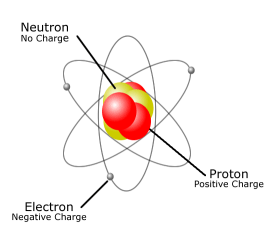
Most elements have more than one isotope. Isotopes are atoms that have the same number of protons but a different number of neutrons. For those of you who might be a little rusty on chemistry, protons and neutrons reside in the very small, densely-packed nucleus of an atom while electrons reside in orbitals around the nucleus. Electrons have negative charge, protons have positive charge, and neutrons have neutral charge. Electrons have very little mass while protons and electrons have about the same mass. 
Cartoon of an atom. Note that this cartoon is not to scale and the nucleus is very, very small. Cartoon taken from here.
Because electrons are charged and reside in the outer parts of the atom, they are responsible for the chemical properties of an atom. That is, the number and placement of electrons determines how an atom is able to interact with other atoms by forming chemical bonds. So, even though isotopes have different numbers of neutrons, because isotopes of an element have the same number of electrons, they behave in a chemically similar manner. 
Protons and neutrons, which reside in the nucleus of an atom, do not govern chemical properties. However, they do govern nuclear properties. Nuclear chemistry and physics is complex, but basically if you add or take away things from the nucleus– protons and neutrons and parts of these– you change the nuclear properties of the atom. If you just add or remove neutrons, you change from one isotope to another. If you add or remove protons, you change from one element to another.

Isotopes can affect the physical properties of atoms. Isotopes of an element have slightly different masses that can lead to small, but important, differences in the physical behavior of an element. A simple example is a glass of water that is allowed to evaporate.Water or H2O has two elements hydrogen (H) and oxygen (O). Hydrogen has two naturally-occurring isotopes (hydrogen-1 and hydrogen-2) while oxygen has three naturally-occurring isotopes (oxygen-16, oxygen-17, and oxygen-18).  After some time, water sitting in a glass will become isotopically heavy as lighter oxygen-16 and hydrogen-1 evaporate preferentially over heavier oxygen-17 , oxygen-18, and hydrogen-2. As Thorsten points out in a comment below (he caught a typo/error in the original post), there is also hydrogen-3. 
Uranium and its Isotopes:
Uranium always has 92 protons, but it can have different numbers of neutrons. Uranium has two main isotopes: uranium-238 and uranium-235. The number given in an isotope name is the number of protons + the number of neutrons. So, uranium-238 has 92 protons + 146 neutrons. Similarly, uranium-235 has 92 protons + 143 neutrons. There is also a very small amount of uranium-234 (92 protons, 142 neutrons) which is produced from the decay of uranium-238.
Almost all of the uranium in the world is uranium-238. The average, naturally-occurring distribution of uranium isotopes on Earth’s surface is as follows:
Uranium-238: 99.2745%
Uranium-235: 0.720%
Uranium-234: 0.0055%


Because uranium-235 is the fissionable isotope of uranium used in nuclear reactors, the uranium that is used in nuclear reactors is “enriched” uranium. As my dad mentioned, the uranium used in nuclear power plants generally has ~3% uranium-235, which is a significant increase over the ~0.7% uranium-235 found in nature. The uranium used in nuclear power plants must be artificially enriched in uranium-235 through complex processes that I won’t discuss here.
Radioactive Decay of Uranium-238 and Uranium-235:

Uranium-238 and uranium-235 are both radioactive. A radioactive atom is an atom that does not have a stable nucleus. Because its nucleus is not stable, a radioactive atom will eventually decay to a different atom that is stable. This decay occurs at a steady rate that depends on nuclear properties but which can be measured (and used to date rocks!). Some radioactive atoms just go through one decay because the first decay brings them to a stable nucleus. However, sometimes radioactive atoms have to decay through a whole series of other radioactive atoms until they finally reach an atom that is stable. This is the case with uranium-238 and uranium-235. Uranium-238 decays through a whole bunch of intermediate, also radioactive atoms until it reaches stable lead-206. Similarly, uranium-235 decays through a whole different bunch of intermediate, also radioactive atoms until it reaches stable lead-207.

Here is a figure showing the uranium-238 decay chain: 
Figure taken from Principles and Applications of Geochemistry by, Gunter Faure, 1998: pg.280. Click on the figure to view larger.
Types of Radioactive Decay: 
Uranium is affected by three types of radioactive decay. 
1. Beta Decay
In beta decay, a proton is converted to a neutron or vice-versa. There are actually three flavors of beta decay: 
netruon –> proton + a negative beta particle
proton –> neutron + a positive beta particle
proton + “captured” electron –> neutron 
A negative beta particle is like an electron. A positive beta particle is sort of like a positive electron. I am simplifying greatly, but that is the general idea behind beta decay. 
2. Alpha Decay: 
In alpha decay, an alpha particle is emitted from the nucleus. An alpha particle consists of two protons and neutrons and is thus identical to helium-4. 
3.Nuclear fission:
The nucleus breaks apart into two fragments, usually of unequal weight.
I hope that this explanation isn’t too simple for people. I just thought it would be good to go over isotopes and radioactive decay a little more since this is relevant to nuclear power and our interview today.

***********************
Transcript for Interview 9:

Q: Good afternoon, Dad.

A: Good afternoon.

Q: All right, we’re gonna continue with out interview series. My name is Evelyn
Mervine and this is the 9th in a series of interviews with my dad, Mark Mervine, who
is a nuclear engineer. If you would like to listen to any of the previous interviews,
you can find them on my geology blog, Georneys, which is G-E-O-R-N-E-Y-S.
Georneys.blogspot.com. And in today’s interview- sorry, before we get started, I’ve
been try to give the time and date so…. Today is the 20th of March and it’s currently
4PM Eastern Daylight Time.

And as I was saying, in today’s interview, there’s gonna be 3 parts – the first
part, my dad is going to give his usual update about what’s going on at Fukushima.
In the next part, in the previous interviews, my dad has promised that he would do a
little homework and talk a little bit more about radioactivity and radiation, so he
will do that. And then finally we’re gonna ask as many questions- I’m gonna ask as
many questions as I can and my dad will answer those. And then again, because we
are receiving so many emails, we can’t answer every single question. With that said,
Dad, would you like to start with your update?

A: OK. So just as a reminder, we’re talking about the Fukushima 1 nuclear power
plant in Japan. And this power plant actually consists of 6 boiling water reactors.
And the ones that we have been most concerned about is Units 1 through 4. Let me
just quickly give an update on Units 5 and 6. So as we indicated a couple days ago,
they have been able to get a diesel generator started at Unit 6 and run a cable, which
essentially is the equivalent of a long extension cord over to Unit 5, to be able to
begin to restore power to both of those units. They now have 2 diesel generators
up at Unit 6 and they are supplying power to Unit 5. And in both of those reactors,
they’ve been able to establish normal heat removal capabilities. And they’ve also-
the reports conflict a little bit – but either removed some panels from the reactor
building or drove some holes in the reactor building, but if there was a buildup of
hydrogen, they would allow it to escape before it became at a level that it would
be explosive. Given that they were able to restore power and cooling, and hoping
they don’t have any more issues with those diesel generators, that’s probably not a
concern and we should consider that those two units are stable. Another reminder,
those two units were shut down for maintenance at the time of the earthquake.

Units 1 through 3 were operating at the time of the earthquake, and Unit 4
was shut down. And all the fuel in Unit 4 had been moved to the spent fuel pool –
the entire core had been taken out, not just 1/3 of it, which is normally done for a
refueling outage. And the (?) there would be that they were doing some more
extensive repairs or inspections of the reactor vessel and they needed to remove all
of the fuel, but in any case, all of that fuel was moved to the spent fuel pool for Unit
4.

Over the past few days, I think most people are aware of, they’ve been
pumping seawater into reactors 1, 2 and 3 and maintaining a relatively low pressure
in those reactors, while venting steam. The reactor buildings of Units 1 and 3 were
severely damaged by hydrogen explosions, early- relatively early into this event.
There’s also been an explosion in Unit 2, but it was less significant and there is less
damage in the Unit 2 reactor building. And they have removed a couple of panels
from the Reactor 2 building, such that if there were more hydrogen to build up, it
would vent out and not become combustible or explosive. In Unit 4, even though
the reactor was not operating and all the fuel had been removed, there was a
buildup of hydrogen in the reactor building, which did cause an explosion and the
Unit 4 reactor building has been seriously damaged.

What’s been going on in the last 24 to 36 hours is it’s continued to inject
seawater into reactors 1, 2 and 3, and maintain pressure by venting. They put a
tremendous amount of water into the reactor 3 building by using fire equipment
and water cannons and in the past 24 hours, they’ve done the same with Unit 4. And
the purpose of doing that was to try to get water into the spent fuel pools at those
two buildings. They are also in the process of trying to run power from the grid to
those units and although I haven’t heard a lot about the progress today, the last
update from yesterday was that they had managed to bring that cable over to Units
1 and 2. And they’re in the process of- first, they’re gonna restore power to the
control room and then try to work their way through and see if they can get power
back to at least 1 cooling system. And they’re starting with Unit 2, because the
damage from the earthquake and from the explosions is less significant in Unit 2
and I think that’s a good strategy – when you’re trying to manage a situation like
this, where you have multiple things going on…they’ve got Units 5 and 6 stable, so
for the most part, from an operational perspective, that’s not something they have to
worry about in real-time. If they can restore power into Unit 2, which is the least
damaged, and get that one in a better condition, then they can focus on the
remaining problems at 1, 3 and 4.

So that’s the current status. Now we got a lot of questions and I have- I said
last time, and I copied you, Evelyn, that I would try to answer some questions about

radiation and radioactivity. I actually ended up talking a little bit about it in my
interview with Anthony. But I’ll just do a little bit of a recap. First off, I would
encourage people to take a look at Wikipedia. There’s actually been some great
information added in the past 24 hours, so if you take a look at Wikipedia for the
Fukushima 1 Nuclear accident, there’s a lot of good information there. And also, if
you do a search for “nuclear fission product”. There’s a good article there. And
they’re a little bit technical, and maybe a little bit hard to understand, but in
conjunction with what I’m about to explain, hopefully that will form a complete
picture for folks.

So we talked about this over the past week or so, but when fuel’s initially put
into the reactor, it’s Uranium. And it’s slightly enriched, so it’s approximately 96,
97% Uranium-238 and 3 or 4% Uranium-235. Now, Uranium is radioactive and-
naturally radioactive- and it decays by giving off alpha particles. But as I’ve talked
about, alpha particles don’t have a good penetrating range, and they can actually be
stopped by just a sheet of paper. So normally, alpha particles are not much of a
concern if you get them on you, because you’re outer layer of skin will stop them,
certainly your clothing will. But the big concern with alpha particles is if you ingest
them, or if they get in your eyes, so if you breathe them in or they’re on your hands
and you get them in your food, or if you get them in your eye, where your eye
doesn’t have the same protection your skin does, there’s concern about that. But
normally, a fuel rod, when it’s new, because the fuel is encased in zirconium, the
alpha particles won’t even penetrate that and you can really- other than you wanna
be wearing gloves, because you don’t want to damage the fuel or scratch it – you can
actually handle that without any concern. Once it’s in the reactor, though, it’s a
different story. So Uranium-235 will absorb a neutron and fission and break apart.
And when it does, it forms another- a number of, what we call, fission products. And
that’s where that article on Wikipedia comes in really handy if you wanna get into a
little bit of detail of what the different fission products are. But the most significant
ones that we talk about from a human health perspective are Iodine, Caesium,
Strontium. In particular, the reason that those three are significant is iodine can be
absorbed by your thyroid and your thyroid is one of your more active glands. So if
you get a lot of radioactive iodine in there is bad because radiation, or radioactivity
on your glands would have a tendency to cause more cell damage than, say you got
something on your skin, where the outer couple layers of your skin are normally
dead, so on your skin, it’s not gonna have that much of an impact. The two others,
Strontium and Caesium also replace what’s naturally in your body. So Strontium
will be absorbed by your body, similar to calcium. And so it gets into your bones
and bone marrow. And then Caesium is a lot like potassium to your body, and we all
know that we have a lot of potassium in our bodies, so the Caesium will be absorbed
instead of the potassium. So we talk about those a lot. And that’s why it’s a concern
when these things get into the environment. So I thought about the (?) particulates
that would be found in Uranium. The other thing that happens in nuclear fuel,

which we talked about is, the Uranium-238 does not fission, but it will also absorb a
neutron. It just doesn’t spit apart, it becomes Plutonium-230- I’m sorry, it becomes
Uranium-239. And after a couple decays, it becomes Plutonium-239. And
Plutonium has a very long half-life and will stay in the environment for a long period
of time and again, you have the decay that was- of Plutonium that would be very
dangerous to human health if it was ingested.

Q: And Dad, just to interject, that’s because it decays more quickly than the
Uranium? Is that why it’s more hazardous?

A: Well, it actually- for a given quantity, it has a very long half-life, which means it
actually decays less quickly.

Q: OK, I wasn’t sure what the decay rate was.

A: But if it becomes airborne or gets onto, y’know, food that you might ingest and it
gets into your body, then that’s problematic. So just like it would be problematic to
get Uranium in your body as well, because it’s an alpha-omitter and externally, your
skin is a good shield, but internally, you don’t have that skin, so it’ll get into your
lungs, your stomach, your intestines, those types of things.

Now, the fission product that we talked about, the Caesium and Iodine and
Strontium also are radioactive and they decay. And they decay by giving off a beta
particle. Again, external to your body, beta particles penetrate a little bit farther
than alpha particles, but again, they’re not as much of a concern outside the body,
it’s: “did I get it in my eye?” “Did I get it in my mouth?” “Did I breathe it in?” That’s
more of a concern. Or if it gets into the food chain, “did I ingest it because it was in
the food chain?” So the other type of radiation that we talk about are the gamma, or
the gamma rays, which are very, very similar to x-rays. The gamma radiation that
would be coming from the plant is not much of a concern except for at the plant,
because the farther you get away from it, the lower the levels. So certainly if you’re
outside of the 30 kilometer zone, the gamma radiation from the plant is not a
concern. Now, it is true that some of these particles that decay- and I mention ones
that give off alpha particles and beta particles, some of them will give off a gamma
particle, and again, if that gets inside of you, in a significant quantity, it won’t be
good for you because it’s inside your body. And could be damaging cells inside your
body. But the gamma radiation, people have seen, oh the levels at the plant are so
many millirems or other units, and that’s really not a concern to the general public,
the gamma radiation.

Q: That’s just close to the plant, that that’s a concern?

A: It would be at the plant itself or within- I don’t know what the levels are today,
but yesterday, it was reported that the levels at the plant boundary were 1 to 2
millirem per hour. That’s actually now fairly low, compared to what it’s been and
if you were to just go a little bit farther away from the plant boundary, it would
probably be almost undetectable from the gamma radiation.

Q: And that’s important because I know there’s been a lot of panic in the news about
your clothing doesn’t protect you from gamma radiation, as we said, but we’re not
actually gonna get that radiation unless you’re close to the plant, right?

A: Right, so that’s a concern for the workers at the plant. But for the general public,
the bigger concern is the alpha and beta emitters. So the fission products that were
in the fuel, but now may have gone into the environment. I shouldn’t say may have
gotten into the environment, I think it’s been shown that they have gone into the
environment. And the key is what is the amount, or the quantities, that have gotten
into the environment and if they’re at a level that would be dangerous or not. So
I don’t know if that’s cleared things up anymore. Again, I would refer people to a
couple of these articles, in conjunction to the explanations we’ve given, so it’ll form a
good picture.

Q: Sure, and I just wanna say something quickly that I think maybe isn’t clear. I
actually- for my thesis research, I actually study the uranium decay chain in rocks.
I don’t work with anything that’s super-radioactive, but I do study these things
in very trace quantities in rocks. And I know that we’ve been talking a lot about
Uranium being enriched and maybe some people don’t understand what that means.
And basically, in nature- and I actually just looked up on the table with nuclides,
and I’ll put a link to this table on the blog – in nature, on average, it varies a little
bit in the environments, the Uranium-238 isotope is normally about 99.27% and
the Uranium-235 is normally about .72% and so when you say that you have 2 to
3% of Uranium-235, that means that you’ve enriched it from that natural isotopic
distribution. So I just don’t know if we said that very clearly, so I just wanted to add
that.

A: Correct and that takes a lot of technology. It’s done in stages using (???) fusion,
so Uranium is actually converted to a gas and goes through a series of stages and

membranes, which is the way that we increase- not gonna go into a lot of detail,
that’s the way that we increase a percentage of Uranium-235 to the percentage of
Uranium-238.

Q: Anyway, I just wanted to make that clear, and this is something that I do study,
so I know a little bit about it, unlike most nuclear power, which I have to rely on my
father for. And I just wanna ask a question, now, before I move on to the general
questions, that I know many people are concerned about in Japan. There’s been
quite a bit of concern about the food supply in Japan and there have been reports –
some people have sent me questions – there are people very worried about whether
or not it is safe to consume food, in particular things like milk and fresh produce.
Can you comment on that? Is the food source at all contaminated with radiation?

A: Radioactivity.

Q: Radioactivity, sorry.

A: Well, there have been reports in the past day or so that they were able to detect
some of these fission products – so Iodine, Caesium – in some spinach and milk and
very, very trace amounts in the water in Tokyo. In the reports that I saw, I didn’t see
any report on what the levels are. And honestly, I personally don’t know what the
allowable limits are in Japan. So I don’t know if these- in the spinach and the milk –
whether these were below the allowable limit or above the allowable limit.

Q: Has the Japanese government made a statement on that at all, do you know?

A: They have, but I haven’t actually seen anything specifically.

Q: I just wanted to see if you knew.

A: So the answer is, it is something that people should be concerned about. But I
don’t think it’s something that people should be panicked about. And I think we
talked about this, either with yourself or with Anthony. That we’re getting more
organized, we’re getting more monitoring teams on the ground, to be able to take
more samples on a reoccurring basis. And I think that clearly, you’re gonna find
some detectable levels of these fission products in the countryside and in the food
chain. The question is, is it a level that is a concern? And hopefully with the
exception of the immediate area surrounding the plant, the answer will be no. And
we talked about that, for sure, I think a couple days ago – that definitely in the

immediate area around the plant, we’re gonna have to do a lot of sampling to ensure
that we don’t have any concern there. But the farther away you get – we’ve been
vary fortunately during the worst of the releases during this event, that the winds
were blowing from the west to the east and carrying the vast majority of these
particles out over the ocean. But some obviously did go inland and the question
now is what is the level? I think people have to be rational. All food has all kinds of
bad stuff in it all the time. Bacteria, fertilizer, I mean all kinds of stuff, and the key is
the levels are normally low, so it’s not anything that’s a hazard to human health. I
think it’s the case here, that as long as we do sampling and we’re sure that we’re not
exceeding any limits, that we shouldn’t panic. We should be concerned, but we
shouldn’t panic. And we’ll have to have a little faith in the people that are doing the
surveys and the government, that they’re gonna keep the food chain safe.
Obviously, they are doing sampling or they wouldn’t have determined that there
was these particles in the spinach and in the milk. So I think that’s a good thing, in
that the sampling is happening. I think it’s also good – although personally, I don’t
know know what the levels are – that they were transparent and they made the
announcement. And they have announced also that very, very low levels were
found in the water in Tokyo, but nothing to be concerned about.

Q: Well, that’s good and I think they should be concerned and as a- I just wanna
echo something that you said yesterday in your call with Anthony, that the nuclear
power industry is obviously concerned about the radiation and radioactivity and
you said sometimes in power plants, they do such a good job of shielding, that
actually the levels at the power plant are lower than in nature, I found that very
interesting that you said that. So they are aware of this and they’re used to dealing
with this, so hopefully they will continue to be more transparent and let people
know about what they should be concerned about and what they should not be
concerned about.

OK, do you have anything else to say before I go on to some questions, Dad?

A: No, I’ll take some questions.

Q: OK, so again, we can’t answer every question, but we’ll go on ahead with the
ones we’ve decided to answer today and we have answered many questions, so if
you don’t see an answer to your question, check out the previous interviews, plus
the interview with Anthony. There are transcripts up for everything, and actually,-
except for the interview with Anthony, but that transcript should hopefully be up
soon.

OK, the first question is… I know we’ve talked a little about this, but I think
some people are still confused. Can you explain a little bit more about how control
rods work?

A: Sort of, OK. So in a boiling water reactor, the control rods are shaped like a cross.
And there’ll be fuel rods that are put together into what’s called a fuel element,
or fuel assembly. Usually 7 by 7, so 49 fuel rods, although that can vary with the
reactor or the design, those are put together in an assembly and the control rods
will go up between 4 of those. So the fuel rods- the fuel rods are obviously spaced
a little bit and the control rod will go up between 4 of those. Control rod has boron
in it and boron will absorb a neutron, but it won’t fission. And we talked a couple
days ago about a reactor has to be self-sustaining, or order to be critical, in order
to generate enough energy to be a power plant. And if we don’t have – or I should
say, if the amount of, what we call, thermal neutrons in the core isn’t a constant
and it’s going down, then the power will go down. If it’s a little bit above constant,
then power will go up. And so what you do with the control rods is if you want to
increase power, you’ll move the control rods out of the core a little bit. And that will
– just because of the surface area of the control rods, by taking them out of the core
a little bit, then less neutrons will be absorbed in the control rods and more will be
available to fission with the fuel. And that will cause power to go up and a little bit
more energy to be generated. The opposite is true. If you wanna reduce power, you
can just move the control rods up into the core a little bit and – one of my references
is on a boiling water reactor, the control rods actually come up through the bottom
of the reactor vessel, up through the bottom of the core. So if you move them up
a little, then they’ll absorb more neutrons and cause power to go down. And then
of course, in the case of an automatic shutdown, or SCRAM, the control rods would
be fully inserted into the core. So all approximately 14 feet of the core would have
control rods in them, and then that would cause the reactor to go significantly sub-
critical and shut down. Does that explain what you were looking for?

Q: I hope so. I think that clears it up for me, hopefully that clears it up for some
listeners.

A: The key is, the control rod absorbs neutrons and if you have- if you don’t have
enough neutrons to keep a self-sustaining reaction, then power will go down. Or in
the case where you fully insert them, like on an automatic shutdown, you’ll cause a
large number of neutrons to be absorbed by the control rods and power will drop
dramatically and the reactor will go sub-critical.

Q: OK, I think that’s enough on that one. For the next question, this is another- I
think now we’re sort of clearing up some confusion from some people. Someone
was writing to me because I guess reading various sources on the internet, they
weren’t sure if at any point during the nuclear disaster, any of the fuel rods at any
of the reactors or any of the spent fuel pools were either or partially or completely
uncovered, meaning that they didn’t have any water on top of them. Can you
answer that question, or do you know?

A: So based on what we’ve seen happen, which is we’ve have hydrogen explosions
in Units 1, 2 and 3 and from the spent fuel pool of Unit 4, and the reports that we
have from the site, we do believe that part of the fuel rods have been uncovered at
reactors 1, 2 and 3 and also in the spent fuel pool at Unit 4. And why do we think
that? Well, we think that because in order to generate hydrogen, temperature had
to get beyond 2200 degrees Fahrenheit for the zirconium to interact with water and
form hydrogen. We had those explosions. The fact that they were able to detect
the fission products in the environment tells us that the fuel has to be damaged in
one or more of those reactors, otherwise, they would’ve been still encased in the
zirconium cladding. And then reports from the site itself have reported that they
think in Unit 2, once there was the explosion in Unit 3 and we lost cooling in Unit
2 for a period of time, they think the core there got uncovered twice. And they’ve
been trying to maintain with the seawater injection the cores in those three reactors
at least half-covered. What we don’t know is the extent of the fuel damage. And the-
probably the only way that will determine that is the same way it was at Three Mile
Island, that after years of cooling and having the radiation levels drop in the plant,
they’ll actually be able to either remove the head of the reactor or do a camera-
type inspection and determine how much of the fuel was actually damaged and how
severely damaged. As we talked about before, was it blistered, was it warped, or did
it really melt.

Q: Do you know what the extent of the damage was a Chernobyl?

A: Chernobyl was a completely different situation.

Q: Or not Chernobyl, sorry. I meant Three Mile Island.

A: Well, we know at – boy, it’s been a long time and I probably shouldn’t say without
going back and looking at some information, but we know there was definitely fuel
damage at Three Mile Island. I just don’t recall the extent of it.

Q: Alright, well, you have a homework assignment, as if you don’t already have
enough homework assignments.

A: Oh, thank you.

Q: My job is to deal with the internet, your job is to get the information. OK, so
I think we answered that question. Let’s go on. This is a question that I believe
you talked about with Anthony yesterday, but again, I don’t think everyone’s
heard that interview and there isn’t a transcript up yet, so um, this has come in
from many, many people. They wanna know why they just can’t build power
plants underground. And I guess they wanna know first, wouldn’t building them
underground provide good shielding and second, if that’s true, why don’t they put
them underground?

A: OK, well that’s an interesting question and it might not be obvious why that’s
probably not realistic. So obviously if they were underground and you could seal
that, that would provide a lot of shielding. And you could contain the radiation and
the radioactivity. But the problem is these power plants are huge. And usually
a power plant has two ratings. You have the Megawatt Thermal Rating and the
Megawatt Electric Rating. You need to probably have been an engineer or taken
thermodynamics to understand power cycle efficiencies, but it’s not possible today,
with any kind of power plant, whether it’s the engine in your car or a coal-power
plant or a nuclear power plant, to be 100% efficient. And typically, these plants are
somewhere on the order of 30 to 40% efficient, depending on the specific design of
the plant and the technology that we had at the time it was built. So what does that
mean? Well, that means that in the reactor, you have to generate approximately
three times more power than actually becomes electricity and leaves that plant. The
other approximately 60 to 70% has to be- is lost. That’s all of the power that that
ends up, in this case, ultimately ending up in the ocean. So one of the problems you
would have building a power plant underground is where do you get enough cooling
or enough water to remove the heat? When the steam comes through the turbine, a
good 60% of that power is still there and it has to be cooled to turn the steam back
into water and back into the power plant. And that just has to do with the principles
of thermodynamics, that with the technology we have today, we’re nowhere close
to being 100% efficient. And so we have a big cooling requirement, for any power
plant, not just a nuclear power plant. Whether it be gas or coal, they all need a lot of
cooling to condense the steam back into water. So that would be one concern.

The other concern, of course, is you gotta connect these power plants to the
grid, so you need a lot of space on-site for power lines and transmission lines, circuit
breakers, there’s usually a big, huge switch yard. And of course, you would have to
have a way to get the power out of wherever underground place this was, this

would not be an impossible thing to overcome, but again, I think it’s- in conjunction
with the need for cooling, you’d be talking about having to build a huge cavern,
which would probably make it, if not technically impossible, economically
impossible.

Q: OK, is that all you have to say on that question?

A: Well, I don’t know what else I can say, other than I’m trying to imagine a scenario
where you would have a big enough cavern, far enough down, and yet still have
access to enough water for cooling and those type of things and I just- I think it
would be difficult, if not impossible.

Q: Sounds like it would not be very economically feasible, either. OK. –

A: And you being the geologist can tell people there’s all kinds of issues with that,
in terms of trying to put something underground and having all the problems that
people have just building tunnels.

Q: Absolutely, it would be- y’know, if you think about what it takes to build just
something like the tunnel that goes from France to England and all the problems
they have with that, it would be an enormous task to try and put a power plant
underground and there’s also problems, I mean, just because something’s
underground doesn’t mean that it’s gonna be safe. A lot of our ground water, it’s
in permeable layers that are quite deep down and so you’d have a lot of concerns
about any kind of nuclear contamination getting into ground water. I mean, they
can try and line it and contain it, but just because it’s deep in the earth doesn’t mean
that it isn’t going to become a problem for us at the surface, I can definitely say that.

Alright, let’s move on to our last question for today. And this question is
again- actually all of these questions are ones that have come in from multiple
people, so it’s interesting that multiple people have the same questions. But this one
is….we’ve talked before about how if you add seawater to a nuclear power plant for
cooling, rather than using freshwater, that’s bad because seawater is more corrosive
and it causes damage. And also we know that the explosions that have happened
have caused damage. So the question is do you think any of the 6 nuclear power
plants at Fukushima can be reopened for power, or are they all going to have to be
decommissioned?

A: Well, I think it’s pretty safe to say that Units 1 through 4 will no longer be viable
power plants. And they’ll have to be decommissioned. Units 5 and 6 have not really
been damaged and, to my knowledge, they haven’t used seawater in either one

of those units. So it’s possible, depending on radiation levels and contamination
levels at the site, that Units 5 and 6 may be viable. The question is, y’know, given
what happened, with respect to the earthquake and the tsunami, are they viable
from that perspective? In other words, now that we know what we know, we can’t
allow it to happen again. So it may turn out that the location of the site is not viable
going forward. So I would think in theory, that Units 5 and 6 may be OK. I think the
question is, given what’s happened, would we want to use those 2 units again or
not. And that’s something that a bunch of- again, assuming that the radiation and
contamination levels would allow them to operate, would that be something where
we could modify the facility enough to have protection or not, I don’t know. That
would be something a lot of engineers and the Japanese government would have to
look at. My guess is probably not, but I can’t really say.

Q: Well, that’s probably- I’m sure those are questions that people, y’know, not just
involved in Japan, but people are asking that about power plants in geologically
active regions all over the world.

A: So 1 through 4, definitely not. 5 and 6, maybe, but I kinda doubt it, given that
this has turned out to be not a good location. But y’know, these power plants cost
billions of dollars to build and it may turn out that 5 and 6 are physically separate,
they are on the same site, but they’re some distance away, it might be possible
to build a big wall or some seawall or something to protect them, but again, that
would be something that I think the Japanese equivalent of the Nuclear Regulatory
Commission would have to take a look at. And we don’t know, specifically, how
badly damaged they were, in terms of their electrical systems. Apparently a lot less
damaged than the other ones. But we don’t know where all the systems are actually
located on the site and what they’re risk would be going forward.

Q: Alright, I think that that’s all for today.

A: OK.

Q: Do you have any last thoughts before we end?

A: I just wanna add one thing, we talked about radiation and radioactivity. And
I did see one news report that came out and corrected it, but even today, looking
in news reports, there was a lot of talk about Unit 3 today, because pressure was
building up in the containment, but that has stabilized out. They thought maybe
they would have to vent the containment there again, but they decided they didn’t
need to. And again, the news made a big deal of it, because that reactor has the mix
oxide fuel , which has both Uranium and Plutonium in it. As we discussed many,

many times, any fuel that’s been in a reactor has Plutonium in it.

Q: OK, Dad, that’s good for today.

A: OK.

Q: Take care, bye.

A: OK, bye.

Special Interview: My Dad, a Nuclear Engineer, Talks with a Japanese Citizen in Nagoya, Japan

In Interview 7 I mentioned how my dad was threatening to replace me as his interviewer because of the problems I was having with call quality (high-pitch and echo on my side). Fortunately, the call quality has improved (thanks again to the Skype PR representative!), and my new internet tech friends are helping to improve the quality of all of the audios. Mike is enhancing the call quality to the best of his ability. He improved the audio for Interview 1 significantly and is doing his best with other ones. The echos are difficult to fix, but he is trying. Since kiwi6 took down most of the audio files, I have decided to host them elsewhere. Gerald kindly offered to host him on his server, which has good bandwidth. By the end of the weekend or early next week, I hope to update all of the audio links to the permanently-hosted, improved audio files. For now, everything is still available on the vimeo channel. Brandon, who is helping me run the vimeo channel, also plans to update all the audio on the vimeo videos. I hope that Brad is able to update the audio on his YouTube channel.

Also, I am happy to announce that all 8 Interviews now have full transcripts. Thank you to all of the transcribers: Ashlyn, Jesse, Chris, Kirsten, Gregg, Michelle, Maria, and Sophie.

Finally, thank you to everyone who has posted comments and sent me emails. Your kind words mean a great amount to my dad and I, and we will continue to answer as many of your questions as possible. Thank you also for spreading the word. Please do continue to take these interviews and spread them far and wide on the internet.

Thank you so much for all of the help. Because of time constraints, when it comes to technical problems and the transcripts, I have been executing what my dad calls “3D Leadership” : Decide, Delegate, Disappear. I appreciate that I have many volunteers to whom I can delegate. Without the help of volunteers, my dad and I could not do what we do here.

As I was saying, my dad jokingly threatened to replace me because of the technical difficulties we were having for a couple of days. I didn’t think my dad was serious– I mean, I’m his daughter– but he was serious! For today’s interview, my dad is interviewed by a Japanese citizen currently living in Nagoya, Japan. My dad informs me that I am not permanently fired– tomorrow we will continue with our regular update in Interview 9. If you have questions for tomorrow, please send them in by tonight (georneysblog@gmail.com).

Late last night (EDT) my dad did an interview with Anthony Tatekawa, who is currently in Nagoya, Japan and very concerned about the nuclear disaster at Fukushima. Anthony is a Japanese citizen of mixed descent. His mother is Japanese and his father is Columbian. Impressively, Anthony is fluent in Japanese, Spanish, and English!

Late Thursday night, I received this facebook message from Anthony:

Hi Evelyn,

How are you?

My name is Anthony Tatekawa, Japanese citizen currently refuged in Nagoya city in south Japan. Due to the problems with the reactor in Fukushima I decided to go south mainland Japan for safety.

I have been following your interviews with your dad since day 1, and I think they are extremely valuable. Some of my foreign friends in Japan have commented and contacted you already.
However, I would like to see if there is a possibility we could have an interview with your father regarding the current situation in Fukushima.

We have several concerns we would like to discuss. Do you think that could be possible. If not, are you planning to interview your father in the future? Maybe we could talk and I could give you a direct account of what is happening here so you can ask your dad.

I believe what your dad has been doing has made many people understand the complexity of nuclear issues, and that further explanation about the risks could save lives here in Japan.

Anyways contact me if you have any questions.

I replied to Anthony right away and called my dad. My dad and I had just decided that we didn’t have time for the few media interview requests that were coming in. Much as we would love to accommodate these requests, we just don’t have time. I told my dad about Anthony’s facebook message, and my dad asked “This is a Japanese citizen?” I said yes, and my dad said to tell Anthony to email him to set up a time to talk.

Late last night, Anthony spoke with my dad for about an hour and recorded the call. You can find Anthony’s interview on YouTube and on the Georneys vimeo channel (also see below). You also might want to check out Anthony’s blog.

After the interview, Anthony send me another facebook message:

Hi Evelyn,

How are you doing?

I just had a conversation with your dad over yahoo messenger. It was over an hour! It was great to have first hand information about all the different issues we are concerned here. I am currently splitting the conversations to upload them to YouTube. I’ll send you a link when its finished.

I really appreciate the work you and your dad are doing bringing hope to all this people.

Do not feel sorry about this tragedy, with the work you are doing you are doing more than enough, this is what we need, first hand scientific information.

Thank you, Anthony, for your kind facebook messages. And thank you, Dad, for taking the time last night to talk to Anthony.

Update: vimeo fixed.

Update: One YouTube seems to be missing (I’ll have to ask Anthony) and the vimeo is still slow. We will fix the vimeo soon, but there is now a better link (much faster) for the audio below.

Update: Because the vimeo is having trouble, below is the audio (again hosted at kiwi6, will move it soon). I’ve asked my tech team volunteers to look into this matter. The slow loading problem might be  because this is in podcast format with chapters and such.

Here is their conversation on vimeo:

Please see the announcement page for more information about these interviews:

Thanks to Kirsten and Gregg, there is now a transcript below:
Transcript for Special Interview:
Part I from Kirsten:
Q: Hello?A: Yeah, I’m here.

Q: Okay, sorry. Yeah, so, so we were on, uh, this information that is, this information that is going on in, in Tokyo, and uh, and uh the stuff that the, the media, the Japanese media, is not saying. What kind of information do you think that they have been withholding? Or they are afraid of …

A: No, I don’t know that… I don’t know that the media is necessarily withholding the information.

Q: Yeah.

A: Uh, I think, I think moreso the *inaudible* needs to be more forthcoming with the data.

Q: Yeah.

A: So the, the fire that was in the, the spent fuel pool of Reactor 4 was 2 or 3 days ago.

Q: Yeah.

A: And, and that was when they had the explosion…

Q: Yeah.

A: …that damaged that building.

Q: Yeah.

A: To my knowledge, there hasn’t been a fire since then.

Q: Yeah.

A: But the concern is that they’ve lost water…

Q: Mmmhmmm.

A: …in both the Number 3 and Number 4 spent fuel cooling pools.

Q: Yeah.

A: And that’s why you’ve seen on the news the attempts to drop water by helicopter…

Q: Yeah.

A: …and the use of the water cannons.

Q: Yeah.

A: So they, they’ve put a lot of water on the Number 3 reactor building today…

Q: Yeah. That’s true.

A: …um, in order to try to get, get uh, enough water, uh, in the pool to, to cool some of that spent fuel.

Q: Yeah, but that area…

A: And yesterday…  Go ahead. I’m sorry.

Q: Yeah, in that area, the people that are working there are basically risking their lives. I mean, they’re, they’re going to die from radiation sickness or something like that. Do you think so?

A: Well, there’s no doubt that the people that are there are, are risking their lives.

Q: Mmmhmm.

A: It’s hard for me to speculate whether, um, any of them are at risk of either getting very sick or, or death.

Q: Yeah.

A: Hopefully, hopefully they are rotating those people enough…

Q: Mmmhmm.

A: …that their radiation exposure is kept…

Q: Yeah.

A: …below a reasonable number, but the, the radiation levels at the plant are definitely limiting what they are able to do. That’s why the helicopters had to fly so high.

Q: Yeah.

A: And that’s why they wanted to use the water cannons…

Q: Yeah.

A: …so that they could, they could be farther away because it would not be possible for someone to go directly up there with a firehose.

Q: Mmmhmm. Yeah.

A: But, but, but that type of radiation, um, would be gamma radiation…

Q: Yeah.

A: …and, uh, the reports today say that the radiation levels at the site boundary are only 2-3 millirem…

Q: Mmmhmm.

A: …which, which, uh, is quite, quite good *inaudbile* a couple days ago…

Q: Yeah.

A: …where there were reports of 35-40 millirem at the site boundary. But if you were to go a kilometer or so away from there…

Q: Yeah.

A: …you would not be picking up any radiation.

Q: But you, you mentioned before there were 3 types of radiation, right? How dangerous are those?

A: Right. So, so that’s the gamma radiation.

Q: Mmmhmm.

A: Um, if you are outside of the 30 kilometer evacuation area…

Q: Yeah.

A: …there’s absolutely no concern whatsoever.

Q: At the moment.

A: Right.

Q: But the worst case scenario? Even in the worst case scenario?

A: Worst case *inaudible* even at that distance should not be a problem.

Q: In the worst case.

A: The, the bigger concern is the particulate radioactivity.

Q: Yeah.

A: So, cesium, iodine, strontium, and, and others that would be released, uh, in larger quantities if there was more fuel damage or if there was more damage to the spent fuel pools.

Q: Yeah.

A: That, that can be carried by the wind and, and even though, uh, it’s a geometric expansion- in other words, the farther away you get, the…

Q: Yeah.

A: …the more volume there is and the concentrations are lower-

Q: Yeah, but the area is bigger.

A: *inaudible*

Q: The area of the damage is bigger.

A: Well, no, when, if you have a certain amount of radioactive particles released…

Q: Yeah.

A: …as it travels…

Q: Yeah.

A: …it, it expands…

Q: Uh, huh.

A: …right, to a larger and larger volume of air, so…

Q: Ah, okay.

A: …the, the concentration…

Q: Yeah.

A: …will be lower. So, so for instance, today they were able to detect some of the radiation in California…

Q: Oh.

A: …that came from Japan.

Q: Oh, really?

A: But the levels are so, so low that it’s of no concern.

Q: Oh, right. Right.

A: In… A couple of days ago in Tokyo, they were able to detect increased levels.

Q: Yeah.

A: But, but the levels were relatively low, and today they are even lower.

Q: That is…

A: But…

Q: *inaudible*

A: The particles are more of a concern…

Q: Mmmhmm. Yeah.

A: The particles are of more concern because they can travel distances…

Q: Yeah.

A: …and, and generally speaking, if they were, um, to get on your clothes or on, on your skin, it’s not really so much of a problem.

Q: Yeah.

A: The problem is if you were to breathe them in or ingest them or if some of them were to get in your eyes where you don’t have as much protection, because on your skin, of course…

Q: Yeah.

A: …you know you have several layers of skin…

Q: Yeah.

A: …and the first couple layers are actually dead, right…

Q: Yeah.

A: They’re, we’re, we’re at- You know, you don’t notice it so much but your outer layer of skin is always flaking off.

Q: Yeah. Yeah.

A: So those, those particles are not so much of a concern, um, except for breathing them in and ingesting them. That’s where *inaudible* because inside of you, you don’t have your, your skin to protect you.

Q: Ah, okay. That’s why they recommend to use soap?

A: Well, so that’s why, that’s why, often times they’ll be, people will be told, within a certain distance you should evacuate and then at a farther distance out you should shelter in place…

Q: Yes.

A: …where they will tell you to go in your house, close all your doors and windows…

Q: Yeah.

A: …and, and, because that will help keep the vast majority of the radioactivity out.

Q: Okay.

A: Um, again, um, where you’re at there’s really no concern whatsoever…

Q: Mmmhmm. Yeah, um, the other thing is like, uh, these part- particles, when they spread out, how long is the lifetime of these particles? I mean how long are they going to be around, right, radioactively speaking?

A: So, uh, a lot of these, uh, half lives on these materials are, are quite long.

Q: Yeah.

A: Many, many years, and in some cases, uh, you know, thousands of years…

Q: Oh, right.

A: …so again, the, the levels, you know, outside of the plant area, have, have, have not been of, of much concern, and again we have been very fortunate because of the winds.

Q: Oh, right. Yes.

A: …so the, the problem of course is, um, while, while the situation at the plant, um, hasn’t been getting any worse over the last day…

Q: Yeah.

A: …there is still, you know, much, much work to be done, and there is still the potential that something else could go wrong…

Q: Yeah.

A: …and, you know, the worst, the worst case scenario, obviously would be for there to be a, a major release of radiation in con-

Q: Mmmhmm.

A: …in conjunction with the wind shifting inland.

Q: Yeah. Okay.

A: And certainly, um, in the, in the area of the plant…

Q: Yes.

A: …uh, they, when this, when this is all done and they’ve finally been able to get water and cool things off, they will have many, many years of dismantling and decontamination…

Q: Yeah.

A: … because these, there will be a lot of these particles, of course, right in the plant area.

Q: I understand. Uh…

A: But again, as far away as you are, um, I don’t think there’ll be any concern, like I said, unless there were some additional major release of radiation and the wind shifted and carried that all inland.

Q: Which is possible.

A: It’s possible, but, um, they are making progress so… I don’t know if you’ve seen the latest news report, but they have, they now have electricity to Units 1 and 2…

Q: Yeah.

A: …and they are now in the process of slowly trying to *inaudible* some of the equipment in those plants.

Q: Yeah.

A: And, um, if you heard the, the last couple of my updates…

Q: Yeah.

A: …they had restored, uh, power…

Q: Yeah.

A: …from a diesel generator…

Q: Yeah.

A: …to both Units 5 and 6. So Units 5 and 6 are stable, which is good news. I also saw a report that the, that the, the shared spent fuel pool is stable and the water level is stable so that’s good because there had been no news on that all week. So although we have a very, very serious situation, it’s at least not getting any worse. And, and as you know, everyday for the last week, it got worse everyday.

Q: Yeah, yeah.

A: So, so, and, you know, today, I don’t think we have any great news, but we have news that it’s not getting any worse.

Q: Where are you getting the news? What kind of source?

A: So, I, I have to take a lot of time to look at a lot of different websites.

Q: Yeah.

A: Um, the internet community has been great in, in keeping, uh, Wikipedia updated.

Q: Yeah.

A: Um, there’s actually information that is posted by, actually I would have to look, uh, the, the Japanese equivalent of the NRC has a website…

Q: Mmmhmm.

A: …and they post information.

Q: Yes.

A: Um, the Nuclear Energy Institute here…

Q: Mmmhmm.

A: …the International Atomic Energy Agency…

Q: Okay.

A: …in Vienna. So… And then, of course, the normal news, um, Yahoo, CNN…

Q: Okay.

A: Um, Associated Press.

Q: Yes.

A: And, I take all these little bits and pieces…

Q: Mmmhmm.

A: …and, and try to put them together…

Q: Yes.

A: …um, so that I can do the updates everyday. It, it takes me normally about an hour, hour and a half, to, to collect all this information and then, uh, be ready to talk to Evelyn and give her an update.

Q: All right. Well, I’m really-

A: That’s, I think, frustrating because…

Q: Mmmhmm.

A: …because there, there should be one place…

Q: Yeah.

A: …that people can go for information. And I will, I will say I think that after some days now…

Q: Yeah.

A: …more and more good information is out there, so today, or I should say in the past 24 hours, and I was, I’ll bring this up on the update tomorrow…

Q: Yeah.

A: …the, the Nuclear Energy Institute has posted a lot of good information. They’ve posted some YouTube videos…

Q: Yeah.

A: …that help explain things, and, uh, and I, I think that that’s really helpful and hopefully, you know, one of two things are going to happen. Either, either in a couple of days, uh, we’ll get, get power back and the situation will be better…

Q: Yeah.

A: …and the, there’ll be more information available on the internet so that my updates won’t be needed. The only concern I have is, um, once the immediate crisis passes…

Q: Yeah.

A: …then there’s no news anymore because it’s not, it, it’s nothing that they want to show on TV.

Q: I understand.

A: And, of course, this is going to be something that will take weeks and months to actually bring to a completely safe situation.

Q: I understand. We were speaking-

A: So we’ll have, we’ll have to judge how long we continue to do these updates because…

Q: Mmmhmm.

A: …um, I think there is getting to be some good, good news out there, but on the other hand, I’m, I’m afraid that once it’s no longer…

Part II from Gregg:
[from part I] MM: We’ll have to judge how long we do these updates…[starts] MM: Because..

AT: Mm-hmm.

MM: I think there’s getting to be some good–good news out there, but on the other hand I’m afraid that, once it’s no longer sensational….

AT: Yeah.

MM: that the regular news will disappear; and, so, tonight….

AT: Yeah.

MM: I watched the news here…

AT: Yeah.

MM: and most of it was about Libya and…

AT: Mm-hmm.

MM: They only had like one minute….

AT: Yeah.

MM: On the nuclear power plants in Japan, so…

AT: So, it’s cooling down?

MM: It’s not, you know–unfortunately, I don’t know if the news in Japan is the same way, but here it’s, you know, whatever is the most sensational and then they move on to something else.

AT: Yeah, I think that in Japan the best source of information at the moment is the TV, but I haven’t seen the TV for the last two days because the place I moved there is no TV and…

MM: Okay.

AT: the internet is a little bit limited. Yeah, I wanted to ask you two more things. Continue with the radiation topic and a little bit about Chernobyl, okay? But the radiation–you were talking about the three types, right? So we’ve spoken so far about gamma radiation, the particulate radiation, and the other one would be?

MM: So there’s–well there’s two types of particulate radiation.

AT: Okay.

MM: There’s alpha and beta.

AT: Mm-hmm.

MM: And I’m actually going to do a little bit of studying because it’s been a long time for me. And give a more complete update this weekend on Evelyn’s blog,

AT: Yeah.

MM: But the alpha particulate is essentially not much of a concern unless it’s inhaled or ingested because it will not penetrate the skin.

AT: Yes. Okay.

MM: So I had mentioned in one of the updates that in the U.S. we–in our houses–we normally have basements.

AT: Yes.

MM: And radon is a radioactive gas that is naturally occurring that comes out of the rocks here in the U.S.

AT: All right.

MM: And it’s normal when you buy a house to have it tested for radon.

AT: Uh-huh. Oh.

MM: And, if there’s too much, you have to install a ventilation system to remove it. And why that’s such a big concern is radon is an alpha emitter…

AT: Mm-hmm.

MM: And, although it can’t hurt you on your skin because it won’t even go through the first layer,

AT: Yeah.

MM: If you breathe it in, it gets in your lungs.

AT: All right.

MM: And you don’t have that protection.
AT: Okay. I see.

MM: And the concern about all types of–

AT: But it’s like a gas?

MM: particulate radiation.

AT: It’s like a gas or …?

MM: It’s a gas.

AT: It’s a gas. Okay.

MM: It’s a gas.

AT: Mm. Okay.

MM: And the concern about that is the long-term exposure of breathing that in could cause cancer.

AT: I see. But the…

MM: So it’s not going to kill–it’s not going–it’s not like you’re going to breathe it in and you’re going to die

AT: Mm-hmm.

MM: It’s a long-term, cumulative effect.

AT: Oh, the–

MM: The–

AT: Yes, you were saying?

MM: The beta [particle]…

AT: Mm-hmm.

MM:  is similar.

AT: Yeah.

MM: Except it does penetrate a little bit deeper. So it will go through the outer layer of your skin.

AT: Mm-hmm.

MM:  But, generally speaking, if you have clothing on and skin, again it’s not so much a big concern; it’s did you get it in your eyes or did you
ingest it or did you inhale it…

AT: Yeah.

MM: that makes it a concern. And, again, that’s why there would be one recommendation normally to evacuate up to a certain distance…

AT: Mm-hmm.

MM: [and] shelter in place a little bit farther out.

AT: Oh. I understand. The…

MM:  And like I said, I’m going to do a little reading….

AT: Mm-hmm.

MM: over the next day and give a more comprehensive update on Evelyn’s blog because it’s been many, many years.

AT: I see.

MM: I’ve actually had to do a lot of homework in the last week. (Laughs).

AT: (Laughs). That’s great. Thanks. So the Fukushima reactors are sources–are sources of these types of radiation–all three, right?

MM: They are. Yes.

AT: I understand. So the–for example, the radioactive iodine and cesium, it’s traveling through particles that it gets impregnating dust or something or it’s just like, you know, the…

MM: So some of the radioactivity will release in gaseous form…

AT: Uh-huh.

MM: Some of it is microscopic particles.

AT: Mm-hmm.

MM: But all of it would be picked up by the wind and carried…

AT: Mm-hmm.

MM: you know, some distance.

AT: Yeah.

MM: And, of course, the farther it goes, the volume increases, so the concentration…

AT: Mm-hmm.

MM: becomes lower.

AT: I understand. So I understand–I believe that these airborne particles they land somewhere in time due to gravity…

MM: Yep.

AT: And then they will pollute, like, the land and crops and everything, right? Within that thir–

MM: Right.

AT: Thirty-kilometer radius?

MM: Correct. So, so you were going to ask about Chernobyl, so…

AT: Yeah.

MM: You probably know that for the area surrounding that plant…

AT: Yeah.

MM: it’s still very contaminated…

AT: Yeah.

MM: and it’s not possible for human beings to live there on a long-term basis.

AT: Yeah.

MM: And, again, in this instance, the release of radiation and radioactivity has been much lower….

AT: Yeah.

MM: the winds have been very favorable…

AT: Mm-hmm.

MM: So, without knowing any specific details, …

AT: Yeah.

MM: I think the amount of land…

AT: Yeah.

MM: that will be problematic is probably relatively small.

AT: I understand. But you think…

MM: It may turn out that it’s only, you know, the immediate area around the plant, but…

AT: Okay.

MM: we’ll have to ….

AT: Mm-hmm.

MM: we’ll have to see, you know, if we get some data that we can look at.

AT: Is there–is there a way for another country to see the radiation levels through a satellite or, you know, some type of instrument that can measure radiation through, like, hundreds of kilometers of distance?

MM: So it’s my understand that the United States has actively supplied a specialized aircraft to do exactly that.

AT: Ah, okay. But there is–is there like…

MM: [unintelligible]

AT: Are they publishing or releasing results or measurements on this information?

MM: I have not seen anyone that’s put out a comprehensive report, but…

AT: Mm-hmm.

MM: my guess is that will be coming in the next few days

AT: Mm-hmm.

MM: because resources from other countries are starting to arrive…

AT: Mm-hmm.

MM: to help with the sampling and the data; I know that we now have this aircraft available from the United States.

AT: Yes.

MM: I know that the International Atomic Agency

AT: Yeah.

MM: excuse me, Energy Agency has air teams that are arriving in Japan; so, there will be a lot more teams that will be able to collect samples
and do monitoring and I’m confident that in the next week or so…

AT: Yeah.

MM: that we’ll start to get those findings published. As you know, I mean, we can criticize TEPCO and the government and I think fairly so…

AT: Yeah.

MM: but part of the problem is, you know, it’s not just the nuclear catastrophe; we have extreme devastation in those areas so…

AT: Yeah.

MM: it’s very difficult to even move around as you know.

AT: Yeah, I know.

MM: which is–and, of course, a lot of resources have been lost with respect to telephone lines

AT: Mm-hmm.

MM: And cellular telephone towers.

AT: Yeah.

MM: So it’s–I think that’s making it extra difficult…

AT: Yeah.

MM: for the response teams to get organized and for this data to be made available.

AT: Yeah. And there’s a little bit of panic for the misunderstanding about the harmlessness at the moment of this radiation. That’s why people, they, like, they don’t want to get involved in many cases.

MM: Well, and I think part of the problem is if you feel like–if you feel like the company or the government are not being transparent…

AT: Mm-hmm.

MM: then you think they’re hiding something. So what happens is they actually hurt themselves because, when they tell the truth, people don’t believe it.

AT: Yeah, that’s true. (Laughs). That’s true.

MM: But again, my–you know, for your friends that are in Tokyo…

AT: Yeah.

MM: and, like I said, certainly where you’re located…

AT: Mm-hmm.

MM: to the best of my ability from the data that I have seen–what limited data is out there

AT: Yeah.

MM: there’s no concern at the moment.

AT: Okay, one concern and one question I have about the design of these reactors is why do they make them at ground level? Why don’t they make them, like, 200 feet underground or something like that, it could be safer, easier to contain because this is like…

MM: Yeah, that I don’t honestly–can’t explain. I mean I, you know, didn’t really have any familiarity with this power plant until this happened. And…

AT: Yeah.

MM: And it is quite puzzling…

AT: Yeah.

MM: to see a lot of the infrastructure so low.

AT: Yeah.

MM: I mean, I know this tsunami was quite a large one, but it didn’t even look like the plant would survive a small one.

AT: Yeah. (Laughs.) Yeah, it’s true.

MM: So I think that’s–you know, as a citizen, I think that’s a fair question…

AT: Yeah.

MM: to ask the government.

AT: Yeah.

MM: And I would think that it should be a requirement…

AT: Yeah.

MM: that any other plant that is in a similar situation

AT: Mm-hmm.

MM: would either be shut down or not allowed to restart…

AT: Yeah.

MM: until there were changes made…

AT: Yeah.

MM: to protect the plant, either through construction of seawall barriers or by moving some of the more critical systems higher up.

AT: Or lower–underground.

MM: Well, underground might be problematic as well, depending on how well you’re able to seal things. The problem, of course, is diesels need exhaust

AT: Oh.

MM: You know, things need cooling. But, you know, clearly, if you look at the location of this plant

AT: Uh-huh.

MM: and where some key components are…

AT: Yes.

MM: it doesn’t look like it could survive much of a tsunami at all.

AT: Yeah.

MM: Much less, the one that we had.

AT: Yeah, the problem is in the design of the structure that, you know, created the whole problem too. [?? That’s my best guess] About the radiation, well the radiation now is pointing to the sea–right?–to the Pacific, it’s-is it going?– it’s going to definitely affect sea life, right?

MM: Somebody asked that question, which we tried to answer today, and again without any data it’s, you know, hard to give an exact answer.

AT: Mm-hmm.

MM: But, again, my feeling would be, except in the immediate vicinity of the plant…

AT: Yeah.

MM: that because of the geometric expansion…

AT: Yeah.

MM: And how much water’s in the ocean and the fact that the currents cause the water to move….

AT: Mm-hmm.

MM: I don’t think the concentration in the water…

AT: Yeah.

MM: is going to be of any concern. So I would, I would doubt that there would be any impact whatsoever beyond the immediate vicinity of the plant.

AT: I understand. Going back to Chernobyl, I–from a report I read, it said that the reactor meltdown provoked an explosion that launched radiation up to 3000 feet. What–how did that explosion occur?

MM: Well, there were–there were a couple of factors with Chernobyl. First, that was a graphite-moderated reactor.

AT: Yeah.

MM: And all of the power plants in the western world are water-cooled, water-moderated reactors.

AT: Yes.

MM: And I gave a brief explanation in one of the other interviews, but

AT: Yeah.

MM: In the RMBK reactor, which is what Chernobyl was, it’s inherently unstable.

AT: Yeah.

MM: And in a water-cooled reactor, it’s inherently stable. So–or I should say a water-moderated reactor is inherently stable.

AT: Yeah.

MM: And the way that works is–in order–when you have a fission, the neutrons that are generated– [end Part II]

[Beg of Part III ***Note: just a fragment to join up with next transcript correctly***]
MM: they can cause a fission.

AT: I understand.

MM: So when a water-cooled reactor [ed: water-moderated?] starts to heat up

MM: We would not be in the situation that we’re in, but these–there are no plants to my knowledge in operation in Japan…AT: Yeah.

MM: that would not require electricity for cooling. There are none of the new generation in existence yet except for some under construction in China, I believe.

AT: I see. Uh, Mr. Mervine, how…

MM: So what needs to be done–all, you know, is all the plants along the coast need to look at their protection against the ocean.

AT: Yeah. Especially in these, you know, earthquake-prone regions.

MM: Right and I don’t think that we can say “Well, it’s a newer plant, so it’s not a problem.” So every single plant in Japan that’s on the ocean needs to be looked at as well as every single plant around the world that’s on the ocean needs to be looked at because none of them are yet these–what they call Generation 3-plus plants that don’t require any cooling or electricity for, I think, the Westinghouse design for three days after an accident, they can run without any additional water or electricity.

AT: I understand. There’s another inquiry I have about the fuel content of the rods–I mean, I heard that there’s uranium and there’s also, like, plutonium. Is that true?

MM:  All fuel rods that have been in a nuclear reactor…

AT: Yeah

MM:  have both uranium and plutonium.

AT: Why is–

MM: as well as iodine, cesium, strontium, et cetera.

AT: So plutonium is part of the fuel mixture of this reactor.

MM: So a conventional fuel rod when it’s new…

AT: Yeah

MM: is uranium and it’s normally enriched to 3 or 4%. And what that means is that normally, natural uranium is about 1% uranium-235 …

AT: Yeah

MM: and 99% uranium-238.

AT: Yes

MM: And, in order to make it useful for a reactor, it’s enriched to, say, 96% uranium-238 and 4% uranium-235.

MM: And the reason why is in a reactor uranium-238 does not fission. Only the uranium-235 does. So only the uranium-235 percentage is used as a reactor fuel. But what does happen is uranium-238 will absorb a neutron…

AT: Yeah

MM: And it becomes uranium-239 and then after a couple of decays…

AT: Yep.

MM: it becomes plutonium-239.

AT: Okay.

MM: Plutonium-239 will fission. And so, in a normal commercial reactor, about 30-40% of the power generated actually comes from the fissioning of plutonium.

AT: Yes.

MM: And all spend fuel rods contain plutonium because it’s created as the neutrons bombard the uranium-238.

AT: Okay. So is plutonium more dangerous in terms of, like, radiation?

MM: Plutonium is considered more dangerous because it has more health impacts on human beings and–again, I have to do a little homework–but, from my memory, plutonium has a much longer half-life. So it will stick around  in the environment much longer.**
AT: I see. Yesterday there was an announcement from the U.S. space here in Yusuka, the area close to the disaster area. They ordered the evacuation of all the personnel–all U.S. personnel–at the embassy from the U.S. Do you think this is a sign of–that things are not going to progress or the Americans are going to give up on Japan situation?

MM: I think that that was a result of one or two things. Either that was the result of a very, very conservative call…

AT: Yeah.

MM: Or it reflects the lack of confidence in getting good information from the Japanese government.

AT: Yes. Okay.

MM: So…but again, based on any information or data that’s seen, you know, outside of the recommended evacuation zone and even the expanded one from the U.S. of 50 miles or 80 kilometers, there doesn’t seem to be any concern. So I think it’s a very conservative call, but it also may have been a move to demonstrate to Japan the lack of confidence that we had….

AT: Uh huh.

MM: in how they were performing. You know, it may have been to make a very strong political statement.

AT: All right, I understand. I also thought that–you know, I was talking with a friend  about that, that it was more political with the current situation anything it was not justifiable to make such a…

MM: Yeah, I’m only hypothesizing because the data doesn’t support evacuating anybody from Tokyo.

AT: I see. In the case of Chernobyl, the area was–the maximum area–I mean the area of evacuation was about also the same, like 30 kilometers, right, I heard?

MM: I honestly don’t remember it’s been so long.

AT: Okay.

MM: I do know that the released level of radioactivity was much higher…

AT: I see

MM: and, you know, could be detected in many countries around Europe.

AT: Is there some type of radiation that cannot be detected by the normal instruments? I mean, like the–for example, the instruments that are sold to the normal population and these Geiger counters and radiation meters that are about $300. Is there some type of…

MM: I’m really not familiar with those, so I couldn’t tell you. I can tell you that different types of radiation require different types of detectors.

AT: Yeah.

MM: So, I would speculate that, if it’s something that’s available to the general public and low cost, that it’s certainly not of the quality that would be used by a professional monitoring team and probably cannot detect all the different types of radiation and radioactivity.

AT: So I guess an instrument that’s very reliable would cost thousands of dollars.

MM: Correct.

AT: I see. Which type of radiation should I be most concerned about in this case?

MM: Well, again, at your distance, it’s really the particulates, the radiation…

AT: All right

MM: because it’s the alpha and beta particles that would be carried on the….

AT: Uh huh.

MM: Or it’s not so much that the alpha and beta particles are being carried, it’s the elements that decay and would release these particles.
Right?

AT: Should it be useful to start taking, like, potassium iodide pills?

MM: No.

AT: No?

MM: No. No. So what potassium iodide does is it will be absorbed in your thyroid

AT: Yeah

MM: and the principle is that it will absorb the iodine from those pills

AT: Yeah

MM: so that your thyroid can’t absorb any more iodine.

AT: Yeah

MM: So it’s the timing of when you take that is critical.

AT: uh huh.

MM: If you take it too early…

AT: Uh huh.

MM:  it will come out of your body. And then, when bad radioactive iodine is there…

AT: Mm-hmm.

MM: your thyroid will absorb it anyway.

AT: Ah, okay.

MM: If you take it too late…

AT: Yeah

MM: then you’ve already absorbed the radioactive iodine–then it does no good either. So, again, based on the data, there would be no reason to take that.

AT: Uh huh.

MM: And you wouldn’t want to take it until directed by your government because the timing is so critical.

AT: Yeah. It could be dangerous for your health too.

MM: Well, it wouldn’t be dangerous for your health to take the pills

AT: Uh huh.

MM: It’s just if you take it at the wrong time–you take it either too early or too late

AT: Mm-hmm.

MM: It won’t have the effect to block the radioactive iodine.

AT: I understand. Is there any other pill or any other medication to avoid the particulate radiation?

MM: Well, you–No. So, in that case, you don’t really avoid it, you just avoid it being absorbed into your thyroid…and the reason why the thyroid is because it’s one of your most active glands in your body.

AT: Ah. I understand. So, during your career as a nuclear engineer, were you ever at risk of radiation sickness and contamination, or anything like that? I mean, were you ever exposed to a lot of radiation?

MM: So in my career I was never exposed to a significant amount of radiation. And, in some cases, we do such a good job during normal operations that the radiation levels are oftentimes lower than they are  in the natural environment.

AT: Ha ha.

MM: You know some of the workers that receive the most radiation every year…

AT: Yeah

MM: Are people that work on airplanes.

AT: Yeah.

MM: Pilots and flight attendants.

AT: Yeah.

MM: Because they fly so far up in the atmosphere

AT: Mm-hmm.

MM: The atmosphere is a very good shield against cosmic radiation.

AT: Yeah.

MM: And airline crews get a lot more radiation than nuclear power plant workers normally.

AT: Ha ha. That’s interesting.

MM: But I did work around places where there was a lot of radiation and radioactivity. And when we go and work on and open up systems where there would be radioactivity, of course, we have to wear the suits–depending on whether it was dry or wet, you might have a different suit–and there’s parts of plant in which you could expect contamination then you have to wear the suits, and then when you leave there you take the suits off and you have to be scanned.

AT: Yeah.

MM: But for myself, you know, personally no. Of course, a lot of the other people, the operators, and in particular the maintenance workers that had to do a lot of work during the outages would, of course, be exposed to a lot more radiation and radioactivity than I was.

AT: I see. So the suits are quite effective, right?

MM: They’re effective against getting particulates in your body or on your body.

AT: And the gamma radiation?

MM: They will have no effect against gamma rays, which are very similar to x-rays.

AT: They can [can’t?] stop that, right?

MM: They cannot stop that. The only thing that can stop that is either only working in that area for a short period of time…

AT: Uh huh.

MM: So that the amount you receive is less.

AT: Uh huh.

MM: Or sometimes, if we have to work in an area, we’ll install temporary shielding.

AT: Uh huh.

MM: Either lead sheets or concrete blocks that will attenuate the radiation.

AT: Uh huh. I understand.

MM: Or maybe it’s a job that takes an hour

AT: Mm-hmm.

MM: If it’s a very, very high radiation area…

AT: Yeah.

MM: You might have to split that against three people so that each individual person doesn’t get too much radiation.

AT: I understand. Okay, sir, I think I covered most of the information and the issues I was concerned about. I–if I have your permission, I would like to publish this interview–which, I think, it’s really valuable information and very critical at the moment. So, once again, I would like to thank you for your time and your patience and really this information could truly save lives here. Okay?

MM: Well, most importantly, I hope it gets people more information and …

AT: Yeah.

MM: helps them understand what’s going on.

AT: Okay. And yeah, I mean I’m also working with another friend and it’s Ruben. So he also helped me draft the questions for this interview. So, yeah, also thanks on behalf of my friend, okay?

MM: Okay. Thank you.

AT: Okay, thanks. Thanks to Evelyn too. Bye. Have a good night.

MM: Good night

AT: Bye.

8th Interview with My Dad, a Nuclear Engineer, about the Fukushima Daiichi Nuclear Power Plant Disaster in Japan

Update: Overnight kiwi6 took down some of my audio files because (I think) they thought I was plagarizing myself. I am working on hosting all audio on another website. DONE- all audio files now kindly hosted by Gerald. Efforts are still underway by a volunteer to improve some of the earlier audios which were bad. Interview 1 has already been fixed. Meanwhile, you can listen to all the interviews on the new vimeo channel Brandon and I created. Here’s the vimeo channel:

Note: The audio still isn’t perfect, but I think it’s a big improvement over previous days. Unfortunately, I had to split this video into 4 parts (for now), but Brandon will fix this as soon as he can and turn it into 1 video. I’ve paid for the vimeo pro version, so we will be able to continue to upload long interviews.

Here is the 8th interview I have conducted with my dad, a nuclear engineer. Please see the rest of the blog (sidebar) for previous interviews.

Please keep sending questions and comments to georneysblog@gmail.com. You can also follow me on twitter @GeoEvelyn but please do not send questions via twitter.

Here is the audio file:

And here is the vimeo:

Please see the announcement page for more information about these interviews:
Announcement Page

Update: Thanks to my friend Sophie, there is now a transcript for Interview 8 after the jump.

Transcript for Interview 8:
E: Good morning Dad.

M: Hello, how are you?

E: I’m good.

M: It’s in the(?) afternoon.

E: Oh, is it afteroon? OK. It’s actually afternoon. Well, we’re gonna give the time in a minute. I just wanna first say, my name is Evelyn Mervine and this is an interview with my dad, Mark Mervine, who is a nuclear engineer. This is the 8th in a series of interviews that I’m doing with my dad. If you would like to see the rest of the interviews, either listen to them or-or read the transcripts, for the ones that have transcripts, you can find them on my geology blog, Georneys, which is G-E-O-R-N-E-Y-S, georneys dot blogspot dot com. And I, I would just like to thank, again, all the people who have been transcribing these interviews. There are still a few that have yet to be transcribed, if you have time and interest, and you could transcribe those, I know that would be very useful for those who prefer to read, rather than listen to these interviews. Before we begin, since we are doing many of these interviews, I just want to state that today is March 18th and it is 12:30 PM Eastern Daylight time.

And to start off with, Dad, I would like you to please, um, give an, give us an update about what is happening at Fukushima.

M: OK, again, we’re talking about the Fukushima I nuclear power plant, which consists six reactors. Now, we did a pretty comprehensive update yesterday evening, but I know you had some technical problems posting the files and they just got posted this morning. So, a lot of people probably haven’t had a, had the chance to listen to them. But, um, I’m gonna not go into quite as much detail, so I’m gonna encourage people to at least listen to the first part of, I guess, interview seven?

E: Yes, it’s interview seven.

M: To get a-a pretty comprehensive view of the status. But, anyways, let me jump in and first let me address the-the two plants that are in, um, the least, um, problematic situation and that’s units five and six. Those are the two newest units on the site and they’re physically separated, somewhat, from units one through four. And a couple of days ago, we had reported that they had been able to get a diesel generator started in unit six and that they were attempting to run the equivalent of a long extension cord from unit six to unit five, to be able to get some power back in unit 5. And, in my update last night, I reported that they had been successful, in that and that they were now working on getting cooling systems restored, and waterflow restored in both units five and six.

Now, turning our attention to the units that are of the most concern, which are units one, two, three and four. One through three were operating at the time of the earthquake and shut down automatically, and lost power approximately an hour after the earthquake, when the tsunami hit. Unit four had been in the, uh, process of doing a maintenance outage and all of the core for unit four had been offloaded into the spent fuel pool. In the past few days, we’ve seen, uh, a number of escalating problems at these units. And in the case of units one, two and three, uh, based on information that we have and various different releases, it’s confirmed that there is some fuel damage in each one of those three reactors. And also, we’ve had concern about the spent fuel pools at units three and four. One of the things that-that has been a concern, was that, perhaps the primary containment structure around the reactor, itself, might have been damaged in one or more of these units. And the latest reports that I’ve seen indicate that they believe that the primary containments for these three units are still in tact. So, despite some reports, that they may not be, the latest reports are indicating that the three containment units are holding and they’re holding some pressure, so that’s, obviously, good news.

The other good news is the situation with the three reactors has not gotten any worse in the, in the past forty-eight hours. So, they’ve been able to continue pumping, uh, seawater in, venting the steam off to reduce the pressure, which allows more seawater to be pumped in. The cores are not completely covered, but, they do have seawater in there and some cooling is taking place. And the situation is not substantially degrading, uh, on a, on an hourly or daily basis as it seemed that it was, um, uh, early on in this, um, situation, in the past week.

So, some of the bigger concerns that we’ve had, in the past couple of days, have been the loss of water from the unit three and four spent fuel pools and, uh, as a refresher, for everybody, there are seven spent fuel pools at this site, one for each power plant and then one common pool that they can all, um, share, uh, ‘share’ is maybe not a-a good word, but a common pool where fuel rods can be taken and stored. Um, in this, in this seventh pool. And all of the spent fuel pools are of concern. They all need to have water, they all need to have cooling, but three and four have been the most problematic, in that, um, the-they have lost a substantial amount of water and unit four, we believe, uh, lost enough water that, that some of the fuel there was damaged and we’ve discussed, a number of times, what can happen when the zirconium cladding around the fuel reaches a high temperature and causes the formation of hydrogen and we had a hydrogen explosion in unit four and that, since the core has been completely unloaded, that had to have come from the spent fuel pool. And in the past forty-eight hours, they have been trying a number of different methods to get water into those pools. They’ve been trying to use military helicopters to drop water similar to what you would do to stop a forest fire, they have brought in, uh, large water cannon trucks and fire trucks to pour water onto these buildings in the hopes that they can get some of it to go into the spent fuel pools. And they’ve been somewhat successful, but it’s difficult to measure how successful. The reason we know they’re somewhat successful is you can see steam rising, um, especially from unit four, um, after they added this water. So, clearly they were able to get some water, um, onto the fuel.

But there is a concern about the unit four spent fuel pool, in that, um, there was quite a bit of damage to that reactor building when this explosion happened. And it’s, ah, from the photos it looks as if a portion of the concrete wall of the refueling pool has collapsed, but it did look like the fuel liner was intact. Now, the latest reports that I’ve seen today indicate that they, they’re losing more water from that pool than they should based on evaporation rates and they think there might be a small leak, uh, in that pool as well. So, obviously it’s really important that they continue their efforts to drop or pump water into those pools. And I also saw that they’re starting to get concerned about the water level in the unit one spent fuel pool as well.

Now the other, um, news that’s very important is there, it’s taking longer than they had hoped, but they are very close to restoring electrical power to unit two from the grid. And, um, the big change in news, from last night to today, is that they’ve also, they’re also working to, um, to get power back to unit one. And once they’re able to restore power to both units one and two then they’ll be looking, this weekend, to also begin the work to restore power to unit three and four. Now, when power’s restored, that’s a very, very good thing. But, but, we’re not out of the woods. And, in fact, we, with all the damage to all these buildings, we don’t know the status of all of the pumps and valves and heat exchangers that woul-would be needed to restore normal cooling to these units. So, getting electrical power back is the first step, but, there may be quite a bit of challenges and quite a bit of work ahead in order to get pumps working. My hope is, because we have, um, a number of redundancies built in these plants that, at least, we would be able to piece together one workable cooling system in each unit, but, anybody that’s taken a look at the photos that are available on TV or on the internet, you can see with your own eyes the amount of damage that has been a-has been incurred to these reactor buildings due to the hydrogen explosions that have taken place during the past week. So, Evelyn, that’s my current update, um, I just wanna add one thing, before we …

M: turn to questions and that is, Evelyn has had a number of requests for us to, to do interviews for uh-a number of people and, we’re going to have to respectfully decline. We’ll, um, try to answer as many questions as we can, here, but this is taking several hours of our, of our time each day and, uh, we, we just don’t have the time to put, uh, more into it than, than we already are, so, we apologize, but, um, we’ll-we’ll have to confine ourselves to doing these updates and Evelyn has made these freely available. I know they’ve been replicated to many sites around the internet and-and unfortunately, that’s going to have to suffice just-just from a factor of how much time that we have.

E: OK, thank you, Dad. And I’ll echo that as much as we-we want this information out there, we really can’t do more than these interviews but as I, as I said, and if you don’t know this already, um, I encourage you to take these intervies and the transcripts and share them with as many people as possible. Put links on facebook or on your website and (??) and really, really do spread this information, but, as my dad said, unfortunately, this is all that we can commit to, right now.

so, I’m gonna ask a few questions, today, and, again I’ve been receiving many, many emails, um, almost more emails than I really have time to read, so if we miss your question, I’m very sorry. We are trying to answer as many questions as we have time for. SO, to start off with, I’m gonna paraphrase a question from someon who, who’s very concerned about the possible, I guess, sortof, long-lasting effects of radiation on the environment. And, in particular, on the fisheries industry in Japan, because I know that-how Japan does rely quite a bit on the fisheries industry. I know that you’re not a biologist, dad, but could you just comment on that, a little bit?

M: OK, uh, that’s a good question and, uh, anybody that’s watched the, um, news or looked at pictures on the internet, you can see that a number of the towns and villages that have been destroyed a-along the Northwest coast of Japan um, are, um, villages and towns that-that count a lot of the fishing industry. There’s a lot of fishing boats that are stranded on dry land, in these photos, so I think, I think it’s a really good question. Um, I wish I could give a really good answer. But, I-I’m just gonna have to give a general answer because, um, you know I-I don’t have the information as to how much radiation and radio activity has been released and, you know, since the situation is ongoing, we certainly hope that it doesn’t get any worse. I mean, it does appear that in the last 24 hours, or so, that, um, at least the situation is not getting dramatically worse. as it was every day in the past week. But, by no means, are we out of the woods, so, you know, we could have something, um, go wrong or get even worse and have more radiation and radio activity released to the environment, so, we don’t have a complete picture, today. Um, I know that th-th-the Japanese government and they’re being helped by a number of other governments and agencies to-to measure the radiation and radio activity, Will, certainly, as the immediate crisis winds down, make that a priority. Um, obviously, *clears throat* and, I think, I think the mainstream media has-has done a good job of this, of indicating that the, the biggest concern is the area immediately adjacent to the plant. Um, although, we’ve had very good luck on the wind going from the east to the west and, actually, I tihnk a couple days ago, I made a mistake and said west to east. But, in fact, in Japan, they’re very lucky that the wind’s been blowing from the east to the west, which takes a large amount of radiation or (??) radio activity, um, over water, but, since the plant is right on the water, um, you know, more than half of that radio activity is going into the atmosphere above the water and some of it is certainly settling and-and going into the water. Now, as we’ve described, um, it’s a volumetric expansion, so, as we get farther and farther away, the the-the density of radioactivity and any volume that you measure it will be constantly decreasing. And you’ll have the same result in the ocean. So, once this event is finally under control and we’re confident that we’re not going to have any significant additional release of radiation, um, they’ll be able to do samples and they’ll be able to estimate the amount of radioactivity released and be able to give a be-a better estimate. I would, I would say that, you know, for sure, in that, uh, 30 Kilometer, uh, evacuation zone, that, you probably wouldn’t wanna be fishing in that area. But, the farther away you get, the concentration would be so diluted that it probably would have no impact.

So, I know that’s not a very good answer, but it’s the best answer that I think that anybody could give, right now. That, it should definitely be a concern, it should be definitely something that people should be worried about but, um, the farther away you get, the less of a concern it is, and if we can stop the release of radiation, you know, get these plants cooled down and stop the rdiation, then we’ll be able to calculate what actually was, or, probably not calculate, but estimate, how much radiation and radio activity were released. And, um, what the potential impact would be, but, with the exception of that imediate viscinity of the plant and perhaps the water in the immediate viscinity of the plant, um, I don’t, I don’t think there will be a long-term consequence.

E: OK, excellent. Moving on to a second question, this is actually a question from some-from someone in Japan, and before I ask this question, I first want to say that in, I guess over the past couple of days, I have been receiving, um, emails and comments from people who are actually in Japan, many expatriots and even some Japanese people and so that means that this information is reaching Japan and people have said ‘thank you,’ um, and have been, I think those people have been most grateful because they’re right there and they’re dealing with this situation and they say that even in Japan it’s difficult to get information, so, I first wanna say, um, thank you, if you’re listening in Japan, and please pass this on and I hope that this continues to be useful for people and Japan and also elsewhere, in the World. So, I’m just gonna read this question ’cause I think this is maybe a question many people in Japan have, this is from Mike in Tokyo, he says, “Hi, I’m based in Tokyo and I thank you and your dad for all of your hard work. It’s a relief to both my wife and I to get some well-informed perspective on the issue. I wonder if your dad could go into some more detail regarding radiation types that can and cannot be sheilded with clothes and face masks. For example, I understand that workers in close proximity to gamma rays receive no protection with their clothes. On the other hand, people between the 20 KM and 30 KM radius, as instructed by the Japanese government (that’s the evacuation zone), are being instructed to stay inside for protection from radioactive materials in the air. It has also been stated that wearing face masks and body washing after being outside can help remove radioactive material.” Um, and he basically wants you to comment on this and give advice for anybody who isn’t in that area and might be affected by radiation.

M: OK, That’s a very good question and I’m sure one that a lot of people are interested in and, um, what I’m gonna do is give a, uh, um, a partial answer now and, um, I will do a little bit more more homework and w-we’ll address this a little bit more in a follow-up interview. But, there’s, um, generally three types of radiation that we’re concerned with it’s, uh, alpha decay, beta decay and then gamma radiation. So as, as the, um, as this person indicated in their email gamma radiation is primarily only of concern in the immediate viscinity of the plant. Um, and certianly somebody as far away as Tokyo does not have to be concerned about gamma radiation coming from the plant, because, we talked about the advantage of unit five and six being physically separated and um, the farther away you get from a-a gamma ray source, the more that radiation is attenuated and, um, yesterday, I don’t have the days numbered, yesterday evening, they said that the radiation level at the plant boundary was at 1-2 millirem per hour. So, once you get, you know, just a little bit farther away from that, you’re gonna be back down to very low levels of-of radiation. Their concern, for people in Japan is, the, um, particulates also get carried up in the steam and go into the atmosphere from either the venting of the reactors or from the spent fuel pools. And their, um, definitely, a concern. And the biggest concern you have is breathing in, uh, these particulates, because, um, in the case of, uh, alpha uh, radioactivity or decay, um, it, the, uh, it has a very low penetrating ability. So, normally, your skin, or certainly your clothing would, would stop that from being a concern. But if you breathe it in, it is a concern, and that’s why I mentioned I think it, I don’t know if it was yesterday or the day before, that in here, in the US, it’s very common when you buy a house to have it tested for radon. Uh, radon is a naturally occurring, uh, radioactivity from the rocks and the ground here, in the US, and it’s-it’s gaseous, so the concern is you breathe it in and, and if you breathe in, um, material containing alpha particles, um, it has a different effect because then you don’t have your skin or your clothes to protect you, even though it only penetrates a small distance, it’s going right inside your body. And to a similar extent, um, you have to worry about beta particulates, they will penetrate a little bit farther, but, again, the bigger concern is, uh, inhalation. So, for the, for the most part, uh, normal clothing, uh, face masks, will make a big difference if there are elevated levels of radioactive particulates in the atmosphere.

Again, I’d like to ephasize, at this point, that there’s no indication that there’s any concern, um, that the radioactivity levels in Tokyo have risen above normal background levels, but the levels they’re at there’s no concern and there should be no panic at this point. I encourage people to, you know follow the directions of the government and not panic or not be overly concerned. But, in the event that the situation got worse and the wind shifted it and there was a concern, um, the concern would be mostly from the particulates that are in the atmosphere and there are very good ways to protect yourself from that. And that’s why, oftentimes you’ll hear a request from the government rather to evacuate that you should shelter in place and you should seal all your doors and windows. Because, if you do that, then it’s not gonna get in your house, and if it doesn’t get in your house, you won’t get it on you, you won’t be able to breathe it in, or, at least, it will minimize it, no house, obviously, is completely air-tight, but, um, it will definitely minimize it. So, like I said, I’ll do a little bit more homework and try to give a little bit, uh, better overview of that in a subsequent interview, but, ah, right now, you know, outside of-of the evacuation areas, um, the levels are not such that there should be a concern for human health. And, certianly, um, all the way to Tokyo, there, there’s no concern, at the moment.

E: Thanks, Dad. I’m gonna go on to another question, and this one comes from Alberto, who’s actually in Chile and he asks a very good question he says, “I have one question, giving your father’s knowledge. Chile, a country in South America, as you might know, was devastated with an earthquake and a tsunami last year of somewhat similar intensity. Today, the Chile is evaluating the construction of nuclear plants and since this disaster struck in Japan, many citizens are fearing something similar could occur if one was built. knowing that, the question would be, how are the newer designs, existing today, better equipped to handle both an earthquake and a tsunami of this scale or bigger and would your father consider it dangerous to build them in a place such as Chile. Um, please remember that the biggest earthquake registered in the World was registered in Chile some 50 years ago.

M: OK, so that’s a good question, not just for people in Chile, but, I think, all over the World, because there are fault lines and earthquakes of different magnetudes all over the world. And, I-I think we actually talked about this in one of the interviews, already, but, um, so, you know, typically, typical way that this is done, when a nuclear power plant is built, is that there’s a requirement based on worst case scenario for an earthquake for the plant to be built to withstand that. And, um, here, in the US, I’ve gone to plants that are relatively stable areas and worked in some of those, I’ve gone to plants that are in more active areas. And the difference in the construction of the plants is, um, very interesting, actually. The plants that are in the more, uh, geographic, uh, sorry …

E: Geological, dad, this is my field now.

M: Geological, thank you,

(they laugh)

M: Um, areas, have to have a lot more supports for the piping, they use a lot of hydrolic dampers, which will allow things to move without breaking, um, there may be, uh, expansion-height systems built so that, uh, systems can, can move, uh, without breaking. So there’s a lot of different design requirements, and then, of course, things have to be built stronger so you might have to use more steel reinforcement in your concrete, uh, and those type of things, when you look at, at building a plant. Or, really, um, any structure. So, for instance, uh, in-in Tokyo the requirements for the building, uh, for the construction of a building are much more rigorous than they would be in another country that may only expect to have an of two or three on the richter scale. An-and the way they do that is the foundations are sunk much deeper, they normally need to go to bedrock. Um, they use a lot more concrete, a lot more steel reinforcements. Um, so, uh, obviously you have to go to more of an extent at a nuclear power plant, but, um, all buildings, you know, have to have, um, adaptations for when you’re in an area that is more prone to earthquakes than, uh, than another. Now, with respect to some of the newer designs, um, I think, I think it’s a good question. And, what I promise to do, is, is do a little bit of homework, because, my information would be a little bit out of date, since I haven’t been, actually been active in the industry for a few years. Um, and, and I know the designs have been updated substantially in the past few years. if I do a little homework, and I come back to this audience and give them a little perspective of some of the design changes that are being (??) into the new design for if you were to build a power plant now, versus, the plants that were built, um, in the 60s 70s and 80s.

E: OK, so we’ll return to that question.

M: Yeah, I’ll come back to that question, I mean i-in generality there’s been a lot of improvements. The designs have been simplified, there’s a lot more passive systems that don’t require, uh, operator intervention, that don’t require pumps. I know that some of the designs used, you know, significantly fewer, uh, moving pieces. Significantly fewer pumps, significantly fewer valves and, of course, the simpler you can make it, and, and, the more, uh, you can rely on the principles of, uh, passive cooling and those types of things, uh, the better you are, as evidenced by what we’ve seen in the past week. But, let me do a little bit of homework and come back some more up-to-date details for people.

E: Sounds great, dad. The last question that we have time for, today, this question is actually coming from several people, and I think that this is because, um, many people have seen this and been concerned by it, basically, there has been some footage that has been released to the general public from one of the helicopters that was dropping water on, I-I presume it was the pool, uh, the spent fuel rod pool at reactor number four. And, I think, um, people were, were quite shocked, um, when they saw this video, just at the extent of the damage and people wanted to know if you could comment on that, and also, if you learned anything new from that video that you didn’t know, already.

M: Well, I think that’s a good question, and, I think I had actually commented that, yesterday or the day before, that I’d finally gotten to see some close-up pictures of the damage and I was, uh, pretty surprised at what I saw. We were told, originally, that there’d been a hydrogen explosion in unit four and a couple of 8 ft. by 8 ft. square panels had been knocked out. But, when we saw the photos with our own eyes, we saw massive a-amounts of damage to the-the unit four reactor building. Um, and, if you, um, look at the photos you can see that there’s some fairly substantial amounts of damage to the units one, three and four reactor buildings. And, then, some of the questions that people have asked, we address that in some of our interviews, people asked about would it be possible to move the fuel and we said, well, because of the damage to the reactor building, no, because all the equipment that would be used to, to move it would be des-would be, would have beend damaged. And, I think my concern, which is shared by, by other people, um, I think, again, the main (??) media’s trying to do a better job, the soundbytes are a little bit longer, they’ve had a few more true experts, um, that they’ve been talking to. Have addressed concerns that it’s great that we’re gonna be getting power back, absolutely is a huge, huge step forward, but, given the photographs, given the amount of damage, given the radiation levels, it’s gonna be a long and difficult journey to get enough pumps and valves and heat exchangers functioning to truely cool these plants down and put them in a safe state. And, I think that’s a thing that concerns me the most about the photographs, is, um, how much, how much damage is there below what we can see. Because the, the systems that they’re gonna need to restore, in order to cool these reactors, would have been a couple levels down from what we can see in the photographs, so, my sincere hope is that the-the damage we see confined to what we can see and that, below that, there’s less damage. So, um, it is, um, pretty amazing to see those photographs, I must admit. And, the biggest concern about the damage that we see in those photographs is the concern for the spent fuel pools, which are in that rubble, uh, of those three reactors.

E: OK, uh, well that’s quite sobering to hear, but, thank you for commenting on that, Dad. Before we end, I just wanna say, I have been receiving so many emails and questions, please do keep sending those in. At first, I was replying to every person and then saying ‘thank you,’ um, if I don’t reply to you, I’m sorry, a-at this point, I’m just receiving so many emails that I-I can’t reply to every single one, but, but I do appreciate them, and, um, I am planning on going through all of them and showing them to my dad, at some point, so please do keep sending in your, your comments and your-your questions, um, we will look at them, and, um, we do appreciate them. That’s all, do you have anything else, Dad, before we end?

M: I don’t, I, again, I hope that this is helping people. I-I do wish that, you know, we could accomodate all the questions, and, um, all the requests that-that folks have had to talk with them, but they’re just, there isn’t enough time in the day, um, we’re each putting somewhere between three or four hours into this every day, in order to do the homework and-and be able to, um, maintain the site, and-and post these interviews. And, uh, both of us are also trying to do our day jobs, as well, so, um, we’ll keep doing it as long as we can and as long as there’s a need, but, um, again, apologies that we can’t respond to everybody.

E: Alright, thanks very much, dad, I’m gonna go try and get this posted right away.

M: OK, thank you.

E: Take care.

7th Interview with My Dad, a Nuclear Engineer, about the Fukushima Daiichi Nuclear Power Plant Disaster in Japan

Update: There is a little bit of background static and a couple of hiccups in this recording, but I think this is an improvement over simkl (which sped up my voice) and Pamela (which echoed). I am now using VodBurner. Sorry to take awhile to post this. I had to fix some problems with Skype, but hopefully this audio  is better. Thanks so much to Brandon for staying up late last night and chatting with me on Skype to help me with my technical problems! My dad and I will be doing another update around lunchtime EDT today. The interview below was conducted around 7pm EDT on Thursday, March 17th.

Here is the 7th interview I have conducted with my dad, a nuclear engineer. Please see the rest of the blog (sidebar) for previous interviews.

Please keep sending questions and comments to georneysblog@gmail.com. You can also follow me on twitter @GeoEvelyn but please do not send questions via twitter.

Here is the audio file:

 Here is the vimeo video:

Please see the announcement page for more information about these interviews:
Announcement Page

Update: Thanks to Michelle, there is now a transcript after the jump. 

Transcript for Interview 7:
Q: We usually talk in the morning, but we decided that there was so much
information going around, we should do an evening call. Before we begin, let me
just say that my name is Evelyn Mervine, and I am interviewing my dad, Mark
Mervine, who is a nuclear engineer. This is the 7th in a series of interviews that
I’m doing with my father, about the Fukushima nuclear power plant disaster in
Japan. And I’m just gonna make a couple comments, first I really want to think a PR
representative from Skype, who is trying to provide me with support for clearing
up the call quality and some of the issues that we’ve been having with that. He said
he’ll continue to support me on trying new software, hopefully there are fewer
problems with this one. And my dad says if I don’t get my act together soon, that
he might replace me, so I really need to get going on the call quality. And I also
really want to thank all the people who have been transcribing the interviews, in
particular, Michelle, who has done several of these transcriptions. If you’d like to
help out with transcribing as well, maybe give Michelle a break, send an email or
just post a comment and let me know, thank you very much.

With that said, Dad, could you please give us an update about what’s going on
in Japan?

A: OK, there’s been a lot of activity today. And, just as a reminder for everybody,
at the Fukushima 1 nuclear power plant, there are actually 6 reactors. 3 of which
were operating at the time of the earthquake and 3 which were shut down for
maintenance. The 3 that were operating were Units 1, 2 and 3 and Units 4, 5 and 6
were shut down. So we’ve mainly talked about Units 1 through 4 because those are
the ones that have been the biggest concern. And I think it was yesterday, I talked a
little bit about Units 5 and 6. So although these plants are all in the same area, Units
1 through 4 are very close to each other, and Units 5 and 6 are very close to each
other. But there’s quite a distance between Units 1 through 4 and Units 5 and 6.

Units 5 and 6 were also affected in that they lost power, but they were able to
regain one of the diesel generators at Unit 6. When we talked before, we said that
they were trying to run the equivalent of a long extension cable from the diesel
generator at Unit 6, over to Unit 5, to get some power over there. And I’m happy to
report that they’ve been successful in doing that. And so now we have some power
at both Unit 5 and Unit 6. And with that power, they hope to be able to pump
enough water to keep the reactors and the spent fuel pools in those two units
covered and safe. So that’s quite a bit of good news.

Q: Can I ask a quick question, Dad, maybe you can comment on this. Are some of
the workers that are doing this work, are they really risking their own health doing
this? Are there people really going in there – I know that they’ve reduced the staff,
but clearly, there’s still some people working in the vicinity of the power plant?

A: So most of the problems are coming from Units 1, 2, 3 and 4. And because
there are a fair amount of separation between those and Units 5 and 6, I think
anybody working over at 5 and 6, it’s probably a little bit better off. Because the
way radiation works is the farther you get away from it, the more it attenuates and
the lower the dose will be. So we always used to say in the business, in dealing with
radiation, it’s Time, Distance and Shielding. So it’s how much time you spend in the
radiation field, it’s how close or how far away you are, and it’s how much shielding
you have. So it’s very good for those two units, they have some physical separation,
which means the radiation levels will be lower over at those units and I think that
that’s why they’ve been able to be more successful in getting a diesel generator
running, maybe it was less damage, but in any event, very good news to have some
power to both of those units.

I think the other good news is with respect to the reactors in Units 1, 2 and 3.
They’ve been pretty stable today. They’re continuing to pump in seawater, they’re
continuing to periodically vent to keep the pressure down, to allow the seawater to
flow in. They still don’t have the cores completely covered in those three reactors,
but the situation is not getting any worse. It’s at least stable.

Q: And there are people- I guess the radiation levels, other than at that one pool,
which you can mention again, that’s having trouble – people are actually able to get
in there and do things like release steam and monitor the pumps. There are actually
workers in there?

A: So I don’t have any details on the actual radiation levels within the plant. But
I think it would be safe to say that the radiation levels are elevated, due to the fact
that we know that there’s been damage to the fuel in all three of those reactors.

Q: So if there are people working in those – obviously we don’t have information
about the radiation levels, but their health risk is higher, and those people- I mean
in my opinion, if there are people in there working, they really are heroes, to go in
there and to try and get things under control there. At risk of radiation, so OK, go
ahead, Dad, sorry.

A: So we don’t know exactly what the radiation levels are, but we know 48 hours
ago, they had to temporarily evacuate the plant, because the radiation levels had
spiked. We know that the helicopters can only fly so low because of the concern
for the radiation coming from some of those units. So we know there are definitely
places where the radiation is very high and definitely we have people that are
risking their lives to try to bring the situation under control and keep all of us safe.

In any event, let me continue with the status. So the water level and
condition units of 1, 2 and 3 are stable, compared to yesterday. They’re certainly
not where we like them to be, the cores are not completely covered, but the
situation has not gotten any worse in the 24 hours. And I think that’s important,
because up until now, it seemed like the situation was getting worse. Today, we
have improvements – we’re stable in 5 and 6, we have some power to both of those
plants, we have stable water levels in 1, 2 and 3. We don’t worry about Unit 4
reactor because all of the fuel was removed from that one. What we do have
concerns about, obviously, is the spent fuel pools. And the ones that have been of
the most concern have been Unit 3 and Unit 4 spent fuel pools. And we had
reported that the NRC- the United States NRC – has stated that they believe that all
of the water was gone from the Unit 4 spent fuel pool. So there’s some good news
and there’s some bad news, with respect to that pool. The good news is they we
able to see by camera today, that there is still some water in that pool. The bad
news is the side of that pool, the concrete side of it, has collapsed. Fortunately, the
pool has a steel liner, and the steel liner is intact. But that’s obviously a very close
call, to have basically that huge section of concrete, to have collapsed around that
pool. But the good news is that there’s still some water in there and today, they did
two things – they dropped water from helicopters, which was, from the photos
looked to be fairly ineffective, in that because they have to fly so high, most of the
water was carried away by the wind. But they also used those water cannons we
talked about to shoot water into both Units 3 and 4. And when they determined
there was still water in the Unit 4 pool, they turned more of their attention to Unit 3.

Some other good news is they completed running a cable from the electric
power grid over to Unit 2. And according to news reports, they were waiting to
finish spraying water on Unit 3 before they made the final connection on that cable.
And that would allow us to get electric power from the grid to Unit 2.

Q: Only to Unit 2? Now that the electricity has come so far, will it now be quicker to
restore electricity to the other ones or is it only going to be for Unit 2?

A: Well, that was going to be what I was going to say is hopefully that they’ll also
be able to restore electrical power to Units 1, 3 and 4 as well in the next day or so.
So I think it’s very good news because the reason why it’s taken so long is because
of the damage from the quake and the tsunami, they had to rebuild the electric
transmission lines to the plant and then run these news cables over to these reactor
units. So the fact that they’re making this much progress, I think, is a very good sign
and I hope maybe by the morning update, we’ll be able to report that they’ve been
successful – or very close to successful – to getting some power back in Unit 2.

One they get power back to these units, then hopefully, they’ll be able to
work to restore some of the normal and backup pumping systems, to pump water
into the reactor vessels and the spent fuel pools.

Q: Just quickly Dad, and I forgot to do this earlier and I have been trying to do this
at the beginning of the interviews. Today is March 17th and it is currently 7 PM,
Eastern Daylight time.

A: OK. So that’s the update. Like I said, quite a bit of activity, quite a bit of news
from this morning and I wanted to take a few minutes and give people that update.
Hopefully, maybe this evening on the news, there will be even more information, but
that’s the update that I have as of 7 o’clock, Eastern Daylight Time.

Q: The other thing is that we’re going to continue doing these, the daily updates as
necessary, for a couple more days, until things get under control, but we’re really
hoping that the situation stabilizes there. And the other thing that we mentioned
this morning is that we really do think the media is starting to do a better job about
communicating things. Can you expand on that?

A: They’re doing a better job. The one thing that I pointed out in one of our
interviews, and I’d like to point out again, because I see the same comment being
made over and over again – that we should be more concerned about the Unit 3 pool
than any of the others, because of the fact that that unit had mix oxide fuel. And we
explained what that was. That’s a fuel that has a mixture of both Plutonium and
Uranium and the concern is that since the Plutonium is more harmful to humans,
that that is a more significant risk. But as I explained, all reactor fuel that’s been in
the reactor for a period of time has Plutonium in it, because reactor fuel is normally
96% or 97% – the percentage will vary a little bit, depending on the design of the
core and the where that bundle is placed in the core, but approximately 96% of
Uranium-238 and 4% Uranium-235. And only the 235 can be used for reactor
fuel. But what happens in a reactor is the Uranium-238 will absorb a neutron and
become Uranium-239, and then after a couple of decays, it will become Plutonium-
239. And Plutonium will fission and, just like Uranium-235, it’ll release energy. And
so in fact, when a commercial reactor’s operating, a good percentage of the power,
it comes from the fissioning of Plutonium. And any fuel rod that’s been in a reactor
for any period of time, it’s gonna have a significant quantity of Plutonium built up in
it. It may be true that the fuel rods in Unit 3 that had the MOX fuel in it has a higher
percentage of Plutonium, but the point is, all fuel rods that have been in a reactor
have Plutonium. The other thing, I think, to point out is – and the reports that I saw
said that they have only been using that mix oxide fuel since last October. So not the
entire core contains mix oxide fuel, only about a third of it, which would’ve occurred
at the refueling, which apparently they did last October. So I just wanted to clarify
that, a lot has been made in the media of that and I’m just kinda surprised that none
of the commentators and the nuclear experts that they’ve brought in – either on the
news or on the written media – have corrected that point, or made that clarification.
That, in my opinion, there may be slightly more concern about Unit 3, but in reality,
all of that fuel has Plutonium in it and I would consider it all dangerous.

Q: Can you just clarify again, so not all of the pools are in trouble? It’s just pool 3
and pool 4, is that correct?

A: Well, we don’t have the information. As we commented before, we need
the Tokyo Electric Power Company to be more transparent. We don’t have any
information on the spent fuel pools at Units 1 or 2 or the shared one, I think I
explained this morning, there’s actually 7- there’s 6 reactors, but there’s 7 fuel
pools. There’s one in each reactor and there’s a common one. And we’ve only been
provided information on 5 and 6 and then we were provided information on 3 and
4, not because they provided information, but because they became problematic
and started to boil off. And we believe that enough had boiled off on Unit 4 that
hydrogen was formed, which caused the hydrogen explosion. It couldn’t have come
from the reactor because the reactor didn’t have any fuel in it. So they still need to
be more forthcoming and provide more comprehensive information. I would hope
that if conditions allow, that they continue to monitor and check on the spent fuel
pools in Unit 1 and 2, so that they don’t become problematic as well.

Q: So how many explosions have there been now? There’s been so many, I can’t
keep track, have there been 4 major explosions?

A: To my knowledge, there have been 4 explosions. In reactors 1, 2 and 3, it
was caused by the venting of the reactor vessel, in order to lower pressure. We
explained how if the fuel had gotten too hot, it would- the cladding of the zirconium
would interact with water to form zirconium dioxide and hydrogen. And when they
vented steam in the reactor, to reduce pressure to allow the seawater to be pumped
in, they were venting steam plus some radiation particles plus hydrogen, and
apparently there was enough hydrogen that when they vented that into the reactor
building, there was an explosive combination and when that hydrogen mixed with
the oxygen in the air, it exploded. The only possible explanation for the explosion in
Unit 4 would’ve been that hydrogen coming from fuel in the spent fuel pool, because
the reactor itself had had all the fuel removed.

Q: Can you comment on something that you just mentioned to me in a private call,
about the concern that you have about the radioactivity of the water that they’re
using now?

A: I’m sorry, what’s that?

Q: You were mentioning to me that normally, the water systems in the spent fuel
pools, it’s a recycled system, and it goes through piping and normally that water has
a relatively low level of radio activity, but now you’re concerned that that level has
increased?

A: So normally in order to keep the reactor cool when it’s shut down and the spent
fuel pools cool, water is pumped from them through a heat exchanger, and cooled by
a cooler water. It could be the ocean water, or maybe a second closed loop, but any
event, through a heat exchanger, which cools it, and brings it back into either the
reactor or – in the case of the spent fuel pool, back into the spent fuel pool. And
since we have had fuel damage in the reactors – let’s take example of Reactor 2. If
they’re able to get power back to that reactor, and if we can get the pumps working,
we’re gonna take water from the reactor, put it through heat exchangers, put it back
in the reactor. And normally, that water going into those pipes would only be
slightly radioactive. But because we’ve had the fuel damage, and we’ve had the
release of the radionuculides from the fuel, the radiation levels, as the water flows
through those pipes, around those pipes will be much, much higher than normal. So
we’re kinda getting ahead of ourselves, in terms of them being able to restore the
plant. But if they were able to restore cooling, they would have to be concerned for
people working the vicinity of that piping and pumps, because the radiation levels
would be much, much higher than normal. But again, we’re a little bit ahead of
ourselves. They first need to get power back and hopefully, they’ll be able to get
some pumps back and initially, they won’t be circulating the water, they’ll be
pumping in as much as possible to get everything back up. Once they have
everything back up, then they’ll have the consideration for now reforming that
closed loop and cooling the water. And they’ll have to be careful because the
radiation levels will be much higher in those areas.

And that would not be a concern to anybody off-site, that wouldn’t only be a
concern right there, at the plant. I mean, it would be very, very good news if they
got the power back, to get the reactor vessel and the pool- fuel pools filled back up
and be in a situation where we now could restore some of the normal shut down
cooling systems. We’re not there yet, we’re probably a long way from there, so…

The only other thing that I would like to point out is yesterday, the radiation
levels at the site boundary were quite high. Again, it’s difficult to piece all the
information together, but the news report that I saw said they were between-
somewhere between 30 and 40 millirem per hour. Today, they reported as being
between 2 and 3 millirem per hour. So to me, that means that some of the work
that’s being done in the 24 hours has been effective. Even though it didn’t look
like we got a lot of water on those pools from the helicopters. Hopefully, the
combination of helicopters and water cannons were effective in getting a little more
water in those pools, which apparently has knocked down the radiation levels.
And that’s very, very good news. 2 to 3 millrem per hour is certainly well-above
normal – it should normally be barely detectable, but those are quite tolerable
levels. Now obviously as you get closer to the actual damaged power plant, those
radiation levels are going to go up. But the fact that those went down by a factor of
10 hopefully means that also, within the plant, the radiation levels have dropped
substantially. Maybe not by a factor of 10, but maybe at least a factor of 2.

Q: That’s very good news. So I’m gonna ask this question, and I know I keep asking,
but the situation keeps changing. I know this morning, you had mentioned that the
US was preparing to evacuate US citizens, just in case. Do you recommend at this
point, that US citizens, if they can, if they have any means, should they try and leave
Japan still or do you think that this situation is stabilizing?

A: Well, I’m not in the position of making a recommendation as to what people
should do. I’ll go back and- because I don’t have the information. The Japanese
government has an order in for people to evacuate up to 30 kilometers. The US
government yesterday made a recommendation that people should evacuate for a
distance of 50 miles, or approximately 80 kilometers. And they based that
information on the information that they had, and they believed that there was
absolutely no water in the number 4 reactor spent fuel pool. Photographic evidence
today indicates that there is still water in there, so maybe that was a bit of a over-
estimate on the part of the NRC, but as we discussed this morning, part of the
problem has been the lack of information and I- there may be people that point to
our government and say that we did an overreaction, but the purpose of the
government is to protect its people. And they made, I’m sure, what they felt was the
best recommendation, based on the information that they had or based on the fact
that they didn’t have information. We also know that they’ve recommended people
to evacuate- Americans evacuate from Japan – and they’re offering flights to
evacuate. But as we talked about this morning, the radiation levels, outside of that
immediate plant area- I should say outside of the 30 kilometer zone, have not been
high enough to cause concern from a human health perspective. And certainly the
levels in Tokyo, although there has been some elevated levels, are not to the point
where any kind of evacuation or panic should be taking place. And the biggest
concern and panic, I think, was just coming from the fact that there’s no
information. But in terms with the recommendation, my advice is follow the
recommendation of the government. If you’re an American citizen and where
you’re at, the government is recommending that you move out of that area or
evacuate, then I would follow that advice and if you’re a Japanese citizen, I would
follow the advice of your government. And I’m just gonna leave it at that, because I
don’t have access to that information.

Q: Thanks very much. And again, just to point out, there’s not an immediate risk in
the United States, there’s still many people panicking about possible radioactivity
being in the US, but-

A: I’ve only heard a small portion, because I was driving, but the president made a
statement today and he said what we said this morning, which is the- there is no risk
right now, unless the situation becomes a lot worse, to anybody in the United States
of America. There’s no reason to be concerned, there’s no reason to panic, there’s
not reason to be hoarding batches of iodide pills, there’s no reason for any of that.
We’re 5 thousand miles away and there’s absolutely no concern whatsoever.

Q: I’m glad that we can echo our president and I’m glad that that information is
getting out there to the American people from a source that I’m sure has many
more listeners than we do. So I’m just gonna end- we’re actually just gonna ask
one question tonight, and I’ve been receiving many questions and many emails and
I want to thank you for those emails, they do mean a lot to my dad and I, there’s a
lot of people who’ve been saying thank you and we really appreciate those emails,
and keep sending them. We have been receiving a lot of questions. Many of those
questions we’ve received we already answered, so if we don’t answer your question,
maybe check some of the previous recordings and transcripts, we’re not gonna
duplicate questions and we can’t answer every question, so we apologize if we don’t
answer your question. The one that I wanna to address tonight is a question that
came in from a few different listeners. And they wanted to know about shielding,
because I guess people always think that things like lead and concrete can shield
radioactivity. And they wanted to know why you couldn’t just go pour concrete over
things to keep the radioactivity from affecting humans?

A: OK, well, that’s a good question. And the problem that we have right now is the
radiation levels around the damaged plants have been quite high and anybody that’s
had a chance to watch the pictures on TV of the helicopter dropping the water could
see that they’re having to fly fairly high, which if they could fly a little bit lower, they
would’ve been able to be a little more accurate with the water drop and the wind
would’ve carried less of it away. But they were flying the height that they were in
order to protect themselves from the radiation that were coming from those plants.
And the reason why they brought in water cannons, instead of normal fire trucks is
because of the power of the water cannons and the ability of them to shoot the
water farther, so they could be father away from the plant. And again, for the same
reason, the radiation levels around the plant were really too high for them to get any
closer. Again, it’s time, distance and shielding. You want to minimize the time
you’re exposed to radiation, you want to maximize the shielding and maximize the
distance. So the question about shielding is a really good suggestion. The problem
you’d have is, in the case – say if somebody wanted to say, “why don’t we put up
some lead or whatever?” Lead is very heavy and you would need heavy equipment
to move it, and you would have to get very close, and so that would be a problem
right now. The same problem would be to pour concrete. In order to pour concrete,
we’d have to put up some forms and usually installing forms is a fairly manual
process, and then you’d pour the concrete and then you remove the forms. We just
wouldn’t be able to get close enough right now to be able to do anything like that.
The best solution is water. If we can refill those pools, which are apparently intact.
The side of Unit 4 pool is damaged, the concrete has fallen away, but the steel liner
is still in place and that should still- it is holding water. So our best solution is to
refill those pools and water is the other really good radiation shield. And if we can
refill those pools, the radiation levels will certainly be higher than they normally
are, because of the damage to the fuel, but the water will do an excellent job
attenuating that radiation and bringing the radiation levels down. And then,
depending on the long-term situation of the plant, and what they’re able to do and
how much the damage was, it would become necessary to do any type of radiation
shielding construction, they would be in a better position to do that because the
water would be attenuating a lot of the radiation and the dose rates would be much
lower, which would allow people to do two things – get closer and also spend more
time in close proximity to the plant.

So, I think those are really longer-term solutions and not solutions that could
be put in place in the short-term. And that would be- y’know, you asked the
question about water flowing through the pipes, once we’re able to get cooling
restored. Those are the type of things that they would do in the areas of the plant
where the water’s flowing, but the radiation levels are maybe very high. They
would bring in some additional lead shielding or some additional concrete blocks in
order to attenuate that radiation and allow people to get a little bit closer to that
area.

Q: Just to clarify a point that maybe I’m a little bit confused on, so even though I
know you’ve explained this before. It’s important to add not just water, but water
plus boron, is that right? I mean, if you just pour plain water on it, that is not
necessarily the best thing to do, is that right?

A: So normally, you would not have to add Boron, you would just be able to add
water. But what we explained- and again, this is starting to run together, we’ve
done so many interviews – I think we explained it this morning, but- ‘cause there
was a question about would the fuel pool achieve criticality. The- in the reactor and
in the spent fuel pool, the geometry is really important. So in the spent fuel pool,
the rods are- the spent rods are kept- and actually in this type of plan, it would be a
fuel assembly – are kept separated at specific distances in a grid pattern. And that
spacing is important because we don’t want to have enough neutrons to actually
cause any type of fission or reaction. We want everything to be, what’s called “sub-
critical”. The same in a shutdown reactor, we insert the control rods and the
control rods in this type of reactor go up in a cross-shape fashion, in between 4
fuel bundles. And they absorb the neutron and shut down the self-sustaining chain
reaction. What can happen when the fuel is damaged – and we don’t know the
extent of the damage, because we’re not able to get inside the reactors, of course,
and we’re not able to get to the spent fuel pools at this point in the game, to see the
actual condition of the fuel. But if it’s very damaged, it could be losing its shape,
it could be melting, essentially. And when you melt, you could lose the geometry
and therefore, they haven’t just been adding water, they’ve been adding water with
boron. Boron is a good absorber of neutrons and all that is to make sure that if you
have lost geometry of the fuel, in either the spent fuel pool or the reactors, that the
boron would absorb the neutrons and prevent a self-sustaining chain reaction, or
criticality.

Q: OK, I think that that’s all for this evening. And we plan another update around
lunchtime, maybe early afternoon tomorrow. And as I’ve said, we’ll continue to do
these updates on a regular basis as the information comes in, as there’s something
important to discuss. And hopefully, it sounds like they’re getting the situation
under control now, so hopefully in a few days, we will be able to- we won’t have
to do as many of these, certainly not every day. And I know that, Dad, you have a
business trip coming up, so in a few days, we probably won’t be able to do these
anyway. But we will continue, even after this, to try and update you on a regular
basis, we might just switch to every few days instead of every day.

A: The only comment that I would add is in the case of most of these types of
things, as long as there is something happening and it’s fairly sensational, it gets a
lot of attention in the news. The situation we have at the plants is something that
hopefully in the next few days, can be brought under control. But there will be many
days, many weeks, many months of work ahead to completely stabilize and restore
power and cooling at these plants. So probably long after the cameras and the news
crews are gone, there will still be a lot of work and a lot of concern going on at these
plants. And the only reason I say that is I don’t want everybody to think, oh, they’re
gonna get power back tomorrow and then everything’s gonna be OK. They’re going
to get power back and that’s going to improve the situation. And then hopefully
they can get some higher-pressure pumps and completely fill those reactor vessels.
But because of the radiation levels, because of the difficult working environments,
because of the damage to the plant from the explosions, from the tsunami, there’s
probably many days, many weeks of work ahead before they’re able to restore
enough systems to actually be completely bring the situation at these plants under
control.

6th Interview with My Dad, a Nuclear Engineer, about the Fukushima Daiichi Nuclear Power Plant Disaster in Japan

Update: Again, there is an echo starting partway into the recording. Not sure how to fix- I am using Pamela Call Record to record skype-to-landline. I have tried two different call recorders, and I do NOT recommend either simkl or Pamela Call Record. However, I am happy to announce that a PR representative from Skype just contacted me and is providing me with free software and trying to help me. Thank you, Skype! I cannot recommend Skype enough. Unfortunately, we were not able to set up the new software for the call today, but tomorrow should go better hopefully. Fortunately, my dad does most of the talking and he does not echo. Please volunteer to transcribe if you are able. If you can transcribe everything except where I echo, I will fix the transcript when I have time.

Here is the 6th interview I have conducted with my dad, a nuclear engineer. Please see the rest of the blog (sidebar) for previous interviews.

In the interview today, we address many questions from listeners. Please keep sending questions and comments to georneysblog@gmail.com. You can also follow me on twitter @GeoEvelyn but please do not send questions via twitter.

Please see the announcement page for more information about these interviews:
Announcement Page

Update: Thanks to Maria, there is now a transcript after the jump. Because of the echo, the transcript isn’t perfect. I will try to fix it when I have time.  

Transcript for Interview 6: 
Q: Good morning Dad. My name is Evelyn Mervine and this is a series of interviews with my Dad, Mark Mervine, who is a nuclear engineer. This is the sixth in a series of interviews, and if you’d like to listen to any of the previous interviews, I encourage you to do so, on my geology blog, Georneys. That’s G-E-O-R-N-E-Y-S, georneys.blogspot.com. And because this is a series of interviews, I would like to state that it is currently the 17th of March, and it is 9:15 AM, Eastern Daylight Time.
So to start off with, Dad, can you please give us an update about what’s going on at the Fukushima nuclear power plant in Japan?
A: OK, so, we’re talking about the Fukushima One Nuclear Power Plant, which consists of six separate reactors. And in the interest of time, because I’m a little bit limited on time today, I’m only going to cover the difference between the status from yesterday and today. So I would encourage people to at least listen to the first part of yesterday’s interview, where we had a little bit more time to give a more comprehensive status.
So in the past 24 hours, to the best of my knowledge the actual condition at the plant hasn’t changed a lot. They’re still in the process of trying to get outside electrical power to the site. And today’s report I saw said that TEPCO, Tokyo Electric Power Company, hopes to be able to do that at some point today. But given their track record so far, I guess we’ll have to say that we’ll believe it when we see it. What they have been doing in the past 24 hours is using military helicopters to drop water on top of reactors 3 and 4. Unfortunately, it appears from the videos that they were having to fly quite high, probably due to the radiation levels, and as they tried to drop the water most of it was carried away by the wind and very, very little of it actually was dropped on the reactors buildings.
I normally try not to make a statement unless I’ve gotten it from a couple different sources but they were in the process of bringing at least ten or eleven police water cannons to the site. And I saw one report where they indicated that they had used those water cannons to put water onto the building. Again they were limited as to how close they could get, and how much time they could pour the water on because of the radiation levels.
Probably one of the biggest news items was that the US nuclear regulatory commission announced that they believe that there was no water in the number 4 spent fuel cooling pool and they recommended that the evacuation zone be extended to 50 miles, which is significantly larger than the 30 km evacuation zone that the Japanese authorities had recommended.
Q: Just to check, that’s 50 miles not 50 km, right?
A: 50 miles, that’s correct. That would be something on the order of 75-plus km. About 80 km.
Q: OK.
A: The other, I think, very interesting news item this morning is that the US government is chartering flights to fly American citizens out of Japan. I’m not sure that because they have more data than the rest of us relative to radiation levels in the environment, or whether like the rest of us they’re growing concerned with the lack of information that’s being provided and they’re taking the conservative route of just getting American citizens out of there given the loss of confidence in the data that’s being reported from this event.
I was happy to see that the mainstream media has stepped up their coverage. Their coverage is more comprehensive, and in particular I was glad to see Anderson Cooper really take the Japanese government to task yesterday evening for the lack of information that’s being provided. It’s, again, I think important to be transparent, to treat people as if they’re intelligent and given the information upon which they can make decisions and this is not happening in this case. And I realize that there’s obviously a lot of chaos and the status is probably changing hour by hour, but nonetheless it seems like they could do a better job with the information. With that being said I think it’s important that we keep in mind that that’s not a reflection in the people who are actually on that site, who at great risk to their own lives are trying to keep that site as safe as possible and bring this horrible situation to an end. I think we owe those folks a debt of gratitude.
Q: OK. So it sounds like there’s a couple of different things that have changed that we have been talking about over the past few days. I asked a few days ago if you would recommend that American citizens leave Japan. And now it sounds like the United States government is recommending that people ???. It probably sounds like if you can leave it isn’t a bad idea. Would you agree with that statement?
A: Well it’s a difficult question to answer in that the data that we have is just not comprehensive. You know, based on the data that was provided it wouldn’t seem that that was necessary. But like I said my assumption at this point is either the US government has more information, or in the absence of information have decided to be conservative. And as we talked yesterday, people asked the question about, should we be concerned about California? I made the statement that I thought our government would be more forthcoming, more transparent. And I think that’s the case here. You know, given the information they have, or the lack of information, they’re being very conservative. There have been no reported numbers of radiation levels in Tokyo that would cause I think a significant alarm, but I think this is a very conservative action. Again, my recommendation is to do what the government asks you to do
Q: The United States government in particular.
A: In particular, if you are an American citizen I would do what the American government asks you to do.
Q: OK. Is there anything else you want to say before we move on to some questions?
A: No, I’m ready for some questions.
Q: Alright. We have received many questions, probably more than we can answer, particularly because we are also have so little time. We’ll ask as many as we can, and you just let me know when you need to go. And I encourage you, if you would like to send in questions. Again, we may not be able to answer all of them but we really will try because I feel that it’s important for people just to get some answers to their questions. If we can provide those answers we’ll be happy to do so. ??? that the mainstream media is doing a better job, because maybe we won’t have to keep doing this. Because it is a lot of work for us and it’s tiring. The first question was actually ???????? MIT??? Can you comment on where you go for information and where you would recommend that people go to get some good reliable information?
A: Well again that’s a difficult question to answer because although there’s a lot of information out there, it’s in bits and pieces. I’m not aware of any one site that’s comprehensive enough for people to go look at, unless they have some engineering expertise in this area. So in particular I think there’s been an excellent effort by the world community to keep the Wikipedia article for the accident up to date. but it’s, as Wikipedia is, it’s a collection of little bits and pieces that people have put together, and if you are, I think, an average citizen without a lot of knowledge of nuclear power, you would have a difficult time of reading that article and putting together a status. But I do look at that article. Also, obviously look at any press releases from TEPCO, which are few and far between, I would add. Releases from the Nuclear Energy Institute. The International Atomic Energy Agency. Obviously the news reports: CNN, MSNBC and other places that do a pretty good job at least providing some real time information. And again, with my background then I’m able to assimilate all that, and put together as best as possible a more comprehensive picture of what’s going on. But it is difficult for the average person.
Q: And I like what you said there, ??? you try not to answer things here unless you’ve seen it in multiple locations, because you know, although people are trying to do a good job of reporting information, there will be errors, so if you see something in multiple places that is more likely to be true.
A: Yeah, as you know sometimes people copy reports from other places so you may see it in more than one place and it may not be correct. One advantage we have here is we’re not in real time, so I have the opportunity to get up early in the morning and spend time looking at all these different reports. We’re not obviously live, so we have a bit of advantage over a live news report in that we have some time to assimilate the information and put a more complete picture together. But the mainstream media is doing a better job. There are still some mistakes being made. I saw a very well respected journalist last night make a pretty big mistake. They held up a ??tiebeck?? like radiation suit and claimed that it would prevent people from receiving gamma rays. A gamma ray is like an x-ray, so we all know that an x-ray will go right through your clothing. That suit is very good at preventing particulates from getting on your skin and that kind of stuff, but it’s not going to stop a gamma ray.
Q: Ok. Let’s move on to the next question. I’m going to paraphrase the question actually. Basically the person was commenting that many of these power plants were built ??? during a war. Basically there was a concern about a bomb attack. And this person was wondering if a bomb attack could inflict damage to a nuclear power plant, and you know, basically what would it take to inflict damage to a nuclear power plant?
A: ok that’s an interesting question, and I think the answer is pretty apparent that if you look at what’s happened to the secondary containment for these reactor buildings, with these internal hydrogen explosions you can see that they can be pretty easily damaged, and then the spent fuel would be exposed to the environment. And once the water drains on the spent fuel then begins to heat up, release radiation to the environment. But I think the big thing there is if you had a nuclear bomb explode, that in and of itself would release radiation and contaminate the environment so any effect that you would get from a nuclear power plant that was within that radius, I don’t think really would matter. It’s a good question, but clearly the outer buildings would not survive that, assuming it was in close proximity, but again I think the impact of the nuclear bomb itself would far exceed any additional that would be added from the nuclear power plant
Q: Alright. Moving on a few people have asked about radiation and radioactivity. Yesterday we decided we didn’t want to go into this because it is sort of a longer explanation. I don’t know if there’s a good place in the internet that ??????
A: Well just briefly, you know radiation. For instance the gamma rays, or x-rays when you go to the doctor and you get an x-ray. That radiation exposure is cumulative, and there are limits as to how much you should get in a year. And radioactivity is more in reference to a material that would be decaying off. So there are a number of commonly occurring radioactive materials like Uranium. People have become aware obviously of Radon, and it’s not uncommon when you buy a house to have the house you’re buying tested for Radon, because it’s a naturally occurring gas that comes out of the rocks on the ground in the US. So, again we don’t have time to go into a lot of detail, but hopefully that helps a little bit.
Q: Thanks dad. Here’s a question that I actually received from a few people. They were wondering if it was possible for engineers??? to use an ROV, remotely operated vehicle, like those used by bomb squads for instance, to deliver some water to the reactors. It sounds like that may be sort of a complicated procedure, but is that the sort of thing that might work, and perhaps, I don’t know, if you could speculate about something that could be designed ???? nuclear plants.
A: That’s a good question, and I think the problem we would have is in navigating the path that it would take to get up to where the spent fuel pool is. From the drawing you see that it’s quite high up in the building, and so there would be a series of doors and stairs that would have to be navigated and of course you would need to bring a fire hose with you. So given the state of robotic technology today, I would say that would probably not be realistic.
Q: OK. And this is a question we ???don’t have time for today, but again please keep sending questions and  you really want to know the answer send it again??? This, actually this person sent in two questions, and we’ll answer both of them. And this is related to the spent fuel pools again. Now it sounds like there is no water in one spent fuel pool. I wanted to know, what would happen if they can’t get water?? And it would be sort of a worst case scenario. Would there be a chain reaction? Would there be a big explosion? Or would there just be a massive and long lasting release of radioactivity? What would happen?
A: OK. Let me clarify. It was the US Nuclear Regulatory Commission that stated they didn’t believe there was any water in that pool. The Japanese authorities have refuted that, and on the International Atomic Energy Association website they have reported that the temperatures in some of those spent fuel pools… So it’s not clear whether there is, how much water is in those pools, but it’s also not certain that there’s none. So again that goes back to, I think you need to corroborate more than one source. But to answer the question, the way the fuel is installed in those pools, it’s kind of similar to the question that I asked about the fuel melting, the geometry is important. If you were to damage the fuel to the extent that it begins to melt, and the geometry changes, and you were able to get enough Uranium together in one place without any of the materials that are designed to remove the neutrons, then it would be possible for that blob to go critical. Again, the goal here obviously is to prevent that from happening, and you know the water that they’re adding is a water-boron mix, and the boron would absorb neutrons and hopefully keep that from happening.
Q: And, critical just means that it’s a self-sustained reaction, and that’s how the power plant normally operates. Obviously you don’t want that to be happening in a spent fuel pool, where you’re storing, you’re not meant to be controlling a nuclear reaction.
A: That’s correct, that would be something that you definitely don’t want to have happened. Again, the way fuel pools are designed and the way the fuel rods are placed, there’s spacing and geometry that would prevent that from happening. But when you lose that, it… obviously then that becomes a concern. I don’t personally know what the probability would be, but I think the answer that was given was the probability is not zero. So it’s not, certainly not a hundred percent, but it’s not zero, and it’s important to have water and boron to prevent that.
Q: OK and actually I wasn’t going to ask this question, but it think I will because it relates. Also about the spent fuel pools. I was wondering ??? Spent fuel pools in a larger earthquake. I’m wondering if the water ??? like it’s a swimming pool. Is water ??? flush out? If there is an earthquake and would an earthquake, would you expect that to cause any sort of cracks, ??? leak the pool?
A: So, I guess depending on the exact height of the water, I guess it would be possible if the ground shook enough, or maybe if because of one of the explosions the building shook enough that a little bit of water  could have flushed out. But if it was that full then – there’s something like fourteen feet of water above the fuel rods, and I don’t think that would be too much of a concern. A bigger concern might be if there was some damage to the fuel pools. Again, these are designed to survive the maximum expected earthquake for that plant. You know, it does not appear that any of these pools were cracked or damaged, that the loss of water is due to the heating up and evaporating, and not because there’s a crack in it. So I would say that that reflects a pretty good design, because the earthquake was indeed larger than the plant was designed for. It’s good design, good quality workmanship, and hopefully we can get some electricity back, we can get some water in there, and get these pools cooled back off, and covered back up.
Q: And I think we’ve said this before but these pools are not affected by the initial earthquake, they are actually being affected by the explosions. And correct me if I’m wrong Dad, but there have been three explosions now that were pretty serious, and I think we don’t know what effect those might have had on any of the spent fuel pools. And correct me if I’m wrong, there are spent fuel pools at each of the reactors. Is that right?
A: There are actually seven spent fuel pools at that site. One at each of the reactors, and then there’s a common one that they all share that is located in a separate building. So there are a total of seven spent fuel pools that ultimately we need to make sure get water and cooling.
Q: OK, that’s all we have time for today, unfortunately we do have some work constraints today, you may notice that we’re doing this interview earlier. But we will ???continue to do these daily interview updates at least through the weekend and hopefully at that point  ???should be under control. Hopefully also the mainstream media will start to do a better job so perhaps we won’t need to do these updates every day. After that maybe we can do an update every few days or so. Do you have anything else you want to say before we end?
A: I think one last comment that I would have is that the work that’s being done to get outside electrical power into that plant is probably the most important thing that needs to be accomplished. There may be other issues that arise when individual plants are reconnected to electricity there. Obviously from the photograph there’s a lot of damage, and there may be things that don’t work, but hopefully… I shouldn’t say hopefully, there are multiple redundant systems that were build at these plants, and my hope, my sincere hope is that once they get electricity back, that we can at least get enough pieces and parts from the various different redundant systems functioning to get water and cooling back to these plants. And that, in my opinion, is the most important thing, getting power back to be able to begin to restore some of these systems.
Q: OK, actually I just want to ask a question again. You know, we talked about Japan, but in terms of the US there really ??? are precautions that we should be taking. I know that people are panicking, but I think it’s really encouraging that the US government is taking an active role in this. Please make a final comment about what US citizens, since we are from the United States, should be concerned about?
A: I don’t think anybody in the US should be concerned at this point in time. There’s approximately 5000 miles distance between Japan and the United States, as we explained yesterday. As any radiation that would be released travels it disperses geometrically, and therefore the amount that you would see in any given volume decreases the farther that it travels. It’s very heartening to see our government being proactive, and the one precaution that they have taken is we have a number of portable environmental monitoring stations, and some of those have been moved to California, and they’re setting up additional stations to monitor just in case. But I think any scientist would tell you that at this point in time the probability of having any detectable radioactivity is very, very, very slim, and there’s no concern. But it’s very heartening to see our government being proactive and I’m absolutely positive that if there was a concern that they would let us know, and again we have the luxury of time. It will take some time for the winds to carry that to the United States, so we don’t have that concern that you have in Japan, where if the winds were to shift and the radiation release was to get larger, that they would only have an hour or two, we should have many, many hours, if not days, to take care of any precautions that we’d need to take care of. But again, I think the probability is extremely low, but it’s very heartening to see our government step up.
Q: I agree with that. I feel certainly comforted by that. I’m also comforted by talking to you dad, even though this situation ??? it makes me feel a lot better to actually get the facts, and get them all in some sort of a cohesive story, and get some questions answered, and I hope this makes our listeners feel better too.
A: I hope it does. I wish there were more information available so we could do a little bit better job, but were trying to do the best that we can with the information that we have and with the time that we have.
Q: Alright thanks dad, I know you have to go to some meetings so I’ll let you go.
A: Alright, thank you!
Q: Alright, bye.

A Quick Note: Please Take My Dad’s Interview Transcripts & Audio

I just wanted to make a quick note here that although my geology blog Georneys is copyright protected, I really want people to take the information in my dad’s interviews and distribute it as widely as possible.

People are already posting links and taking excerpts, which is great. If you want to take the audio files & full transcripts and post them anywhere else– on your website or blog– please do so. If you can link back to this blog and send me an email (georneysblog@gmail.com), that would be great. But don’t wait to hear back from me– just take away.

These interviews are not about me or my dad or this blog– they’re about providing, to the best of our ability, information to the general public about the nuclear disaster. 

Also, I am very sorry about the echos in today’s interview. When I tested the software, everything worked great. I don’t know what happened. Hopefully this won’t happen tomorrow. Again, the transcript will be up later today.

5th Interview with My Dad, a Nuclear Engineer, about the Fukushima Daiichi Nuclear Power Plant Disaster in Japan

Picture of a Boiling Water Reactor Nuclear Power Plant like the Fukushima Plants. My dad refers to this image in his interview.

Update: All the interviews are now available on a vimeo channel. Here’s the vimeo channel:

Update: Announcing Daily Updates from My Dad

Update: Sorry about the echo starting partway into the recording. Not sure how to fix– I am using Pamela Call Record to record skype-to-landline. Fortunately, my dad does most of the talking and he does not echo.

Here is the 5th interview I have conducted with my dad, a nuclear engineer. Please see the rest of the blog (sidebar) for previous interviews.

In the interview today, we address many questions from listeners. Please keep sending questions and comments to georneysblog@gmail.com. You can also follow me on twitter @GeoEvelyn but please do not send questions via twitter.

Link to vimeo:

Announcement: Daily Updates from My Dad, a Nuclear Engineer

Update: All the interviews are now available on a vimeo channel:

For those who do not know, on the morning of Saturday, March 12th I decided to interview my dad Mark Mervine about the Fukushima nuclear disaster because he is a US Navy Commander (USNR, Ret.) and nuclear engineer with decades of experience on both nuclear submarines and nuclear power plants, including a plant very similar to the Fukushima plant. My dad doesn't have specific involvement with the Japan disaster, but I think he has good insights. You can find a full description of my dad's qualifications here. Please note that my dad is retired from nuclear power, so he can speak freely about the matter. Over the past four days, we have conducted four interviews about the Fukushima Nuclear Disaster: 

Interview 1: Morning of Saturday, March 12th, 2011 
Interview 2: Morning of Sunday, March 13th, 2011

 
When I first asked my dad if I could interview him on the morning of Saturday, March 12th he was extremely reluctant. He said no at first, then after some coaxing by my mom and myself, he agreed. He said, "Oh, all right. But only because you're my daughter."

As some of you know, this is normally a geology blog where I talk about rocks, my thesis research, fieldwork, geology books, geology words, and so on. When my dad and I did our first interview, we thought that my usual readers– generally 100-200 pageviews per day– would be the only people who would listen to the interview. Well, the traffic on my little blog has increased significantly since I started doing these interviews with my dad. For that, I thank you. My dad and I are both honored that you want to listen to us. We hope that this is a place where you can find scientific, honest, clear, and neutral information about the nuclear disaster in Japan and expert analysis of this information by a very experienced nuclear engineer– my dad.

Originally, after the first interview my dad said he would not do any more. But something happened that changed his mind: he watched the mainstream media coverage of the nuclear disaster on Saturday night. He was appalled at the coverage. He found the coverage full of inaccuracies. And he noticed that even when nuclear experts were interviewed, many of them were very biased– often they were very pro-nuclear. Other people interviewed were very anti-nuclear. Other people interviewed had dubious qualifications to discuss the disaster as so-called “nuclear experts.” Very few reports have been politically neutral, which is understandable since this is an emotionally-charged issue. However, we believe that reporters should strive to be neutral and avoid sensation, even on an emotional issue such as this.

My dad and I have also noticed that much of the information on the nuclear disaster comes in soundbites. We believe that this nuclear disaster is too complex to be discussed in soundbites. We also believe that the general public is smart enough to be given the facts and to make their own decisions about the nuclear disaster. To be fully informed about this situation, you need more than a soundbite. We realize that our interviews are somewhat long, but you need more time to understand this situation properly. Thank you for having the patience and dedication to read and listen to these lengthy interviews.

We are also disturbed at the lack of cohesive information being provided– my dad discusses this more in Interview 4. There are so many bits and pieces of information flying around, it’s difficult even for my dad– a nuclear expert– to figure out exactly what’s going on. It must be extremely difficult for the general public to make sense of what’s going on. When good information is not available, false rumors abound. False information is dangerous– people need the correct information, at the correct time, to make informed decisions so that they do not under- or over-react to the nuclear disaster.

Our goal with the interviews on this blog is to provide information and expert analysis of this information in close to real time– on a daily basis. We will strive to present the information in simple English that makes nuclear engineering accessible to the general public. Of course, no reporter can avoid all bias, but we will strive to stick to the facts. We will remain committed to answering as many questions from listeners as possible. When my dad is not qualified to answer a question, he will say so and will not answer it. If we or any of our listeners find an error in anything that we have reported, we will strive to post a quick, honest correction.

To the best of our ability, we commit to this: 

Until the mainstream media is able to do a better job, we will continue to provide daily interview updates about the nuclear disaster. We will take a break from our regular jobs around lunchtime each day (this may be a little flexible depending on work obligations) to become citizen journalists and to record these interviews and post them here. You can look for an interview here every day around lunchtime (Eastern Daylight Time), until announced otherwise. I am officially taking a break from my normal geology-themed posts, which will resume in a few weeks.

One final note: my dad and I are not professional journalists or media experts. I am a busy graduate student and my dad has a full-time job (in private industry, but not nuclear power). We will do our best. We appreciate your suggestions for improvement and your help. I am working on improving the audio– I realize that I am too loud and high-pitched and my dad is too quiet in some of the audio. We will try to get these uploaded to YouTube as well. We do not have time transcribe the interviews, but we will continue to post transcriptions done by readers. I will send pretty rocks to everyone who has transcribed so far, but I’m afraid I will not be able to send rocks to future transcribers. All that my dad and I can commit is to keep reading the news and to take a lunchtime break– every day– to update you to the best of our ability. We appreciate your patience when this site is less-than-perfect.

My dad has also agreed to be interviewed on some podcasts– we will keep you updated about that as well.

If you would like to help our effort, I have a list of tasks below. To those who have already offered help, thank you.

Ways to Help Us: 
-Continue to send us your questions, comments, and news links. Email these to georneysblog@gmail.com. You can follow me on twitter @GeoEvelyn.


-Volunteer to transcribe an interview. Post a comment below the interview that you are transcribing so that there are not duplicate efforts. 


-Upload videos to YouTube. Brad Go has been doing this so far. Perhaps he would like help?


-Improve sound quality. I have received a zillion suggestions for improving interview sound quality. I am currently working with a professional on this. 

-Make a better website for my blog? I think I need a better website. A professional may be willing to do this already, but shout out if you’d like to help as well.

-Advertise these interviews, if you find them helpful. Post links on twitter, Facebook, your blog, your website.  Email your friends and family. Suggest the interviews to news outlets you believe are doing a poor job of covering the news on the nuclear disaster.

4th Interview with My Dad, a Nuclear Engineer, about the Fukushima Daiichi Nuclear Power Plant Disaster in Japan

Update: All the interviews are now available on a vimeo channel. Here’s the vimeo channel:

Update: Announcing Daily Updates from My Dad 

Here is a vimeo video of the interview:

Update: I have cleaned-up the original transcript.

Update: Thanks to Michelle, transcript is now available after the jump. 

Interview 4: Tuesday Morning, March 15th, 2011
4 Days Since Tōhoku Earthquake and Tsunami

EM= Evelyn Mervine
MM = Mark Mervine

EM: Good morning, dad.

MM: Morning.

EM: All right, are you ready for Interview Number 4?

MM: I hope so.

EM: Okay. We’ve got our work cut out for us with all these interviews. So before we begin, I just want to let people know, who might not know, that this is actually the 4th in a series of interviews that I’ve done with my dad, who’s a nuclear engineer. I am not going to go into his credentials again in this interview, but if you would like to see what his credentials are and listen to the previous interviews, I encourage you to do that. They’re located, the previous interviews – both audio files and actually, now transcripts, thanks to some listeners— they’re located on my geology blog, Georneys (georneys.blogspot.com). You can also find them on the Skepchick website (skepchick.org).

So, I’m just going start right out because there have been quite a few developments in the last 24 hours or so since we’ve spoken. And I was wondering if you could just give us an update on what’s going on in Fukushima.

MM: I’ll do my best. It’s extremely difficult because information is very hard to come by, and there are different bits and pieces available from different sources. But it’s very difficult to put together a complete picture.

EM: Okay.

MM: Let me start first with a little bit of good news, which is that, as we explained yesterday, there’s actually two sets of power plants: Fukushima 1, which has been the one that’s really been in the news, that has the serious issues that we’ll talk about in a few minutes, and Fukushima 2, which is a few miles away to the south. That site [Fukushima 2] has 4 reactors. They were also experiencing difficulties with loss of power. But the latest report from the Tokyo Electric Power Company website indicates that all 4 units there are now in cold shutdown. So that’s very good.

EM: That’s very relieving news. Do you know how far away the two plants are? Are they sort of close together and affected by the tsunami similarly?

MM: They’re about 7 miles apart.

EM: Okay.

MM: Now, with respect to Fukushima 1— which again, to remind everybody, has 6 nuclear power plants— it’s been a very challenging 24 hours. As best can be determined from the various different news reports, there was an explosion in the Number 2 reactor building, which, according to some reports, may have caused some damage within the primary containment of the reactor, in the suppression pool, at the bottom of the reactor. So, if you look at that picture that you posted yesterday, there’s kind of a doughnut-shaped tube that goes around the bottom of the reactor that holds water.

The purpose of that pool of water is to condense any steam that’s in the containment building and release the pressure. And, again, reportedly, there may be some damage to that suppression pool. The reports indicated that before the explosion, the containment building had about 3 psi [pounds per square inch, a unit of pressure] and afterwards, it was 1 psi.

EM: And yesterday you said that there was a possibility that there actually might be an explosion that could affect the containment itself. And you were saying that was because of the type of pump that they had to use? Is that what happened? Were they not able to actually get the normal pump running or do we not know?

MM: Well, what they’re trying to do, which is what they did at the 1 and 3 Reactors, is pump seawater into the core, to try to recover the core. In order to do that, because these pumps that they would be using for pumping seawater would be relatively low-pressure pumps, they would need to reduce the pressure in the reactor by venting the steam— initially, to the containment building and then, obviously, they have to worry about pressure in containment building, so eventually, whether they do it into the containment building or directly to the atmosphere, it’s going to get into the atmosphere of the reactor building.

And, as we saw in Units 1 and 3, based on indications that we have of cesium and iodine being in the atmosphere, based on the fact that we had an explosion, it was probably a hydrogen explosion, which was created by the overheating of the fuel, and H2O, or water, interacting with the zirconium cladding of the fuel and causing zirconium dioxide to be formed and hydrogen gas.

So, they had an explosion in Reactor 2, but the news reports are very scattered, and it’s very difficult to get any kind of complete information as to the extent of the damage.

EM: Okay. So, maybe this is something that we’ll have to continue and update on a little bit later, when information is more available.

MM: The other thing that’s happened is there was a fire in Unit 4.

EM: Yes.

MM: Unit 4 was shut down for maintenance at the time of the tsunami and earthquake and had not been experiencing any problems cooling the core because they were already shut down and in cold shut down.

 But, if you remember yesterday— and part of the reason I asked you to put the picture of the Mark 1 Containment up is because of the potential that lots of water [could have been lost from] the spent fuel pools. And again, it’s very difficult to determine exactly what’s happening because the reports are very scattered. One report I’ve seen said that the fire was in the spent fuel pool, that potentially it was caused because the water level had lowered and fuel had started to melt and hydrogen had formed, which caused an explosion, which tore two holes in the building. Another report I saw said that the fire was in a lubricating oil system.

But then I also saw a report that they’d been unable to get water to the spent fuel pool. So it’s really unclear exactly what’s happening. And I think this is an important point that—you know, obviously these folks at these plants are under a lot of pressure and I’m sure a lot of people are working real hard and doing the best that they can, but the transparency, with respect to the communication to the public, is terrible. I mean they’re not providing any kind of real-time updates and the updates are not very detailed. So, it’s difficult for anyone to determine what’s actually going on at this plant.
And if, in fact, they did allow the water level of the spent fuel pooling cool— excuse me, the spent fuel cooling pool at Unit 4 to get below the top of the pool, in my opinion, that’s inexcusable. There should have been an operator that toured that building once an hour; at first that they noticed that they were having troubles, they should’ve gotten water up there and covered it, as we talked about, just with a fire hose, if necessary, yesterday. So, they really need to work on the transparency, and I think that the Japanese government has got to ensure that that happens and [that] they’re transparent with the general public.

EM: Well, I think that’s especially important. Because if you’re not transparent, then there’s going to be all sorts of false information that’s circulating around, and you don’t want that, because you don’t want people either to under- or over-react to a situation. You want them to have the proper information so that they can make an informed decision. Wouldn’t you agree with that, Dad?

MM: I think if there’s someone like myself, that has, you know, a significant understanding of how these plants work and you’re having difficulty piecing together the different pieces of information that are available, then I don’t know how you would expect someone in the general public to be able to know what’s going on. So again, I think that there’s got to be more transparency and more communication relative to this event that’s occurring at the Fukushima Plant.

EM: Okay. So, this question actually is perhaps somewhat related to this, this concept of the media and somewhat transparency. I don’t know. I know that you’re not really on Facebook or Twitter or anything, but maybe you have some idea of what Twitter is, Dad. So Twitter is this- basically this sort of social media, short messaging site, where you can—

MM: I’m fully aware what Twitter is, I just—

EM: Okay, I don’t know, you don’t even have Facebook, so—


MM: I just don’t have the time everyday to Twitter, so—

EM: Okay. Well, anyway, there was a Twitter user, and he actually, I believe, is a nuclear engineer. And he went on Twitter, which is kind of interesting that we can do this now on Twitter. His username is “arclight,” and he actually went on Twitter, and he was giving people these short updates about what was happening at Fukushima and his perspective on it and trying to inform them a little bit about nuclear power and basically just give people information because a lot of people go to Twitter for information these days. And he actually was given a Cease and Desist order from his employer, which is presumably a nuclear power plant. And they actually said that he cannot continue with Twitter, or they would threaten to terminate his employment. And so he actually had to stop posting his updates, which I think was disappointing for the public, and for people who were relying on him for some information. And I can’t comment on the accuracy of the information, but he was trying and he was a nuclear engineer.

Do you have any comments on that? Do you think that if you were currently in nuclear power, if you weren’t retired from nuclear power, would you be able to conduct an interview such as this?

MM: Well, obviously I can’t comment on what may have, or may not have transpired there. I’ll just go back and say that there needs to be more information provided, more often about what’s happening at Fukushima. And I think that the Nuclear Industry Organizations, such as the Institute of Nuclear Power Operations, the Nuclear Energy Institute, and the International Atomic Energy Agency, need to also be more transparent and provide more updates on their websites as to what’s
happening.

EM: Okay. Thank you for commenting on that. Do you have any other comments about the current situation today in Fukushima?

MM: I basically told you everything that I can. I think that today has been one of the more difficult days to pull any information together. Ee do know that, either due to the event at Unit 2 or the event at Unit 4, there was a fairly significant release of radiation to the environment. And it caused the radiation levels at the plant to go up significantly. And, again, I can only rely on the reports that I saw, but the radiation levels within the plant were to the point where they evacuated most of the workers at the plant.

And they were also— I saw one report that the [radiation] levels spiked quite high at the site
boundary and then came down. And even after— a couple of hours after the events yesterday, they were around 240 millirems per hour.

EM: Can you explain what that means?

MM:  That’s about as much radiation as the average person would get in an entire year from just normal background sources.

EM: Okay, but to get that all at once, does that pose a health risk?

MM: Well, at that level, if you were there for an hour, it would not. The disconcerting fact would be if it stayed at that level and you were there for a longer period of time. The dosage is cumulative. So, after 4 hours, you would’ve received almost a thousand millirems. And after 20 hours, or less than a day, you would exceed the limit for a radiation worker in the US.


EM: For what time period? For a year?

MM: For a whole year.

EM: Okay, so that’s quite serious, because if those radiation levels continue to stay that high, if they actually are that high, then the workers can’t even get in there to really deal with the situation, is that correct?

MM: Right. I believe the radiation levels have come back down. The fact that they went up that high does indicate that there had to be a fairly significant event that occurred.

EM: All right, so now I’m going to be asking you some questions and I’ve actually—as I said yesterday, I’ve been really surprised at how many people are listening to these interviews. I hope that they’re helpful to people. If people have any feedback on them, please let us know. If you have questions, send them in.  So, I have been receiving lots of questions and comments from different places. So, if I miss your question, I’m sorry, send it again. But we’ll just do our best.

MM: And a comment from my side is I hope the information that we provide is helping people. We’re trying to do it in a neutral way, just trying to explain what’s happening to people. And I hope we’re able to answer your questions this morning.

EM: And I just want to say thank you so much, Dad, for doing this and taking the time to do this, and I feel very fortunate that I can call you up and I can get my questions answered. And rather than just have you answer my questions, I thought it would be great if you can answer other people’s questions as well.

So, let’s start in on this. So, one question that I had from a few people, particularly people who are living in Tokyo, is people, especially [people] who are foreigners, are wondering if it would be an overreaction to actually consider leaving Japan for a couple of days, to actually get out of the country, in case there is more of a problem with the nuclear power plant. Do you have some advice on that?

MM: So, if somebody was in Tokyo, I would not be too alarmed. After yesterday evening’s events— US time, that is; it was morning obviously in Japan— the radiation levels, according to the government, did go up in Tokyo, but not anything that would be of any concern whatsoever. They were just maybe double the normal background levels. And we do know that a few hours after these events of the radiation levels around the plant have dropped. And I would not be overly concerned to be as far away as Tokyo. Now, of course, if you were closer to the plant, it may be more of a concern, but I think the destruction of the infrastructure due to the tsunami is probably more significant than any, any threat of radiation today. Now, the caveat is the unclarity with respect to what’s happening to the spent fuel pool in Reactor 4. The big concern, obviously, there is if they’re not able to keep that covered and if that melts, then releases radiation to the environment, there’s no containment to keep that in.

EM: So, how far could that potentially spread, if that were to happen?

MM: That depends…

EM: Okay. But that could be a serious concern?

MM: …on the amount of radiation released. But this point in the game, there haven’t been radiation levels in Tokyo that would cause any alarm.

EM: And they have evacuated, as you said, or they’ve tried to evacuate—

MM: They’ve asked people to either shelter or evacuate at a distance of 30vkilometers from the plant.

EM: Right. And there are still a few people within that zone. I’m not sure if they’re forcing people to evacuate, but at least yesterday when I read one news report—so this is from the news— there were some people who were refusing to evacuate, so I don’t know if any of those people are listening to this, but please, please do evacuate if you are close to the plant and the Japanese government has requested it.

MM: I would follow the request of the authorities to either evacuate or shelter.

EM: Okay. Let’s continue. So another— I think we’ve sort of addressed the radiation levels— another reader was wondering, sort of how long Japan is going to still need to be worrying about this and the nuclear disaster. And, again, I think it depends on what’s actually happened. But as you mentioned yesterday, this is something that is not just going to be today or next week, this is something that’s going to be weeks and perhaps years to actually deal with this. How long do you think it’s going to take them to actually fully clean up and decommission and decontaminate everything?

MM: Well, to fully clean up and decommission and decontaminate the site, you’re talking years and years. I think what we’re more concerned about is how long until the situation is stable, and can we be assured that no more explosions or meltdowns— partial meltdowns or radiation leaks— are going to occur? And that’s a hard question to answer because if the radiation levels at the plant are such that they have to evacuate most of the workers, then until they can get that under control, they can’t even do any work.

EM: So, how do they do that? How do they bring radiation levels down when they cannot bring workers close to the plant?

MM: The way to do that is to make sure that the cores of these reactors are completely covered and to make sure that the spent fuel pools stay completely covered. Water  will cool; it’s also an excellent shield of radiation.

EM: So, they need to get water on these as quickly as possible?

MM: And so I think the most critical thing that they need to accomplish at these plants, beyond making sure that all of the fuel is covered by water and that all of the spent fuel is covered by water, is to try to restore power, so that they can begin to restore cooling and water flow to all of the 6 spent fuel pools[1] at this site. Because there’s 6 reactors, And obviously if they get power back, then they would be able to use more systems, which will help them control the situation at these plants.

EM: And they’ll have better monitoring equipment as well, so they’ll be able to have more warning when something’s going on, presumably. And, I mean, the good news is that Fukushima 2, as you said, is under control. Are they [Fukushima 2] operating? Is part of the problem here that there’s a power shortage— I mean, somehow, they must be able to get power to this Fukushima 1 site from a different power plant.

MM: As far as I can determine, the power that they have is from generators. I think that’s because of the damage to the electrical grid.

EM: Okay. All right, so I’m going to move on to another question. This one’s a little bit complicated, so hopefully my dad can help me interpret the question. So, a reader sent in something that he had read, and I’ll try to post the link up here, it’s from something called- it’s a commenter on something called “Next Big Future[2]”.

And the question was: “Someone cited a Sandia report, the GE BWR MK1 containment design has been estimated as having a potential 40% failure rate in the event of a full core meltdown. With pooling fuel having the capability to melt through the sides of the reactor containment walls.”
Can you, first of all, translate that question into English and [then] answer it?

MM: Okay. So, what he’s talking about is the Mark 1 Containment Design, which you posted the picture of on your website yesterday. And 5 of the 6 reactors at the Fukushima 1 site have a Mark 1 containment. Um, the first 5 units – 1 through 5. Six is a newer plant and has a little bit newer design. And what he’s saying is in the event of a full core melt that the core would melt through the reactor vessel and would have a 40% chance of melting through the containment structure, which in the case of this plant is a concrete and steel liner that surrounds the reactor. As long as they’re able to continue to get water into these reactor vessels, then that’s not going to happen. This would only happen in the event of not being able to get any water whatsoever into either the reactor vessel or the containment building.

EM: So, I guess a good point here is that although we should be reassured by the containment buildings, to a degree, they’re not magical boxes that contain all radioactivity. You do have to monitor the pressure in them, you do have to add water. There are some controls that are really important in making sure that those containments stay secure. Would you agree with what I just said, Dad?

MM: I agree. And, therefore, I go back to what I said a couple minutes ago that the priority needs to be on getting electrical power back to these units, so they can restore some of these systems that will allow them to better control what’s happening. I’m sure it’s a very difficult task, because the seawater, obviously, from the tsunami, flooded where the diesel generators were, which is also probably where a lot of electrical switch gear is. Seawater and electrical switch gear do not mix well. So, there’s probably a lot of work to restore the electrical switch gear and other things, but again, that would be, I think, a top priority, to try to get power back. You don’t need to repower the whole plant; you need to try to get it back to the most critical pumping systems.

EM: I see. Okay, moving on to the next question. This is actually a question that I’ve seen circulating around the internet, and someone did send this into me. They wanted to know if you could comment on the possible danger to US residents and if there’s any precautions that a reasonable person might take in the United States at this point.

MM: At this point in time, I don’t think there’s a concern, unless the situation gets worse. I think our biggest risk, based on what’s happened in the past 24 hours—and again, what we commented on yesterday— was making sure that the spent fuel pools stay covered at these site, so that would include the 6 spent fuel pools[3] at Fukushima 1 and also Fukushima 2. If they’re still struggling with electrical power there [at Fukushima 2], they would have the same issues with respect to cooling and water for the spent fuel pools there.

EM: Can you, can you give me an idea, Dad, because, I mean, my idea of one of these pools is kind of a giant swimming pool. How much water do you have to add to one of these pool— say, on an hourly basis, or a daily basis— to keep that [water] level at a good level to make sure that things are safe?

MM: So, that’s a good question. And the answer is: it’s going to depend. So, these reactors are refueled—and I don’t know the specifics of the refueling schedule at these particular plants— anywhere from every 12 months to every 24 months. So, depending on when it [the reactor] was last refueled will depend on how much heat generation there is in the spent fuel pool. So, for instance, at Unit 4, which was in an outage, they might have just recently removed the spent fuel from the reactor in the spent fuel pool, which means it’s still quite warm and generating quite a bit of heat. So, you could expect that, in that particular case, that you would have to provide more cooling to that spent fuel pool than you might for a reactor that, you know, last time it was refueled was 18 months ago, and the fuel has cooled way down already.

So, you can’t answer the question specifically, unless you know the specifics of when the last refueling was, how many fuel bundles were taken out of the reactor and put in the spent fuel pool, because they don’t replace all of the fuel all at the same time. They’ll replace approximately a third of the fuel every refueling outage. But depending on any other work that was going on, they might have been doing other work, either inspections or repairs to the reactor vessel. They might have taken all the fuel out, temporarily, from Unit 4, to do this work, and planned on putting two-thirds of it back, along with one-third of new fuel. So, without knowing the details, it’s hard to answer the question.

EM: I guess in over the past few days, we’ve [felt] sort of relieved that some of these plants were shut down for maintenance, but, actually, if there were a number of spent fuel rods in the pools, it sounds like that could actually be a problem and that may be what contributed to the fire.

MM: Well, [it would be a concern if there were] a large number of spent fuel modules that had recently been in the reactor. That  spent fuel [pool] could be full, but if all the fuel is 10 years old, it’s already pretty much cooled off. It’s really a function of how many of those fuel bundles were in the reactor most recently.

EM: Okay, I think that those are all the questions for today. Actually, Grandma had one question, but I’m about to run out of time, so I might have to call you back[4]; we’ll see if we make it. Grandma— my Grandma— wanted to know: Why do we build nuclear power plants next to the ocean? Is that necessary? Is that because we need, we need water? Can you answer that really quickly?

MM: So, as the steam goes through the turbine, it then needs to be cooled and turned back into water. You have three ways of doing that: either from a river or a lake, from an ocean, or from cooling towers. And in a lot of cases, power plants of all kinds— not just nuclear power plants— are built next to large bodies of water, because we need a lot of cooling to get the steam back into the water and pump it back into the boiler or the reactor, depending on the type of plant that it is. So, in this case, these plants were built along the coast. A lot of the nuclear power plants in Japan are built along the coast.


[1] As my dad discusses in subsequent interviews, there are actually 7 spent fuel pools at Fukushima 1: one for each reactor and also a large, common spent fuel pool.
[2] Look for this reference when going through past emails & comments.
[3] Again, there are actually 7 spent fuel pools at Fukushima 1.
[4] Originally, I used free recording software with a time limit. Shortly after this interview, a representative from Skype contacted me and generously gave me free recording software with no time limits.