Mount Coot-tha Building Stones


Meta-sedimentary building stone sourced from Mount Coot-tha Quarry.

A few weeks ago, I put up a blog post about a Gold Mine Hike at Mount Coot-tha in Brisbane, Australia.  I wrote that the gold was found in meta-sedimentary rocks, but I didn’t show any good pictures of the rocks. This is because the rocks are highly weathered and also mostly covered with vegetation in the area where the hike is located.

This morning I went with my family to the Brisbane Botanic Gardens at Mount Coot-tha and noticed that many of the building stones used throughout the gardens are blue-gray meta-sedimentary rocks that are locally sourced from Mount Coot-tha Quarry. You can still make out the original sedimentary layers in many of these rocks, which are hornfels metamorphic grade. They were cooked by the intrusion of the Enoggera Granite. The meta-sedimentary rocks make lovely and also very durable building stones. They also make good road aggregate. Here are a couple of pictures of them in use in the gardens:

Decorative wall made out of meta-sedimentary rocks from Mount Coot-tha Quarry.


Another picture of the deocrative wall leading to the Tropical Display Dome building.

Building stones sourced from Mount Coot-tha Quarry are used as decorative building stones in many places throughout Brisbane. I’ll share more pictures in another blog post in future.

What about the gold associated with these rocks? Well, I bet that if you analyzed the rocks in the above wall they would have elevated gold concentrations compared to typical meta-sedimentary rocks. However, their gold concentrations would not be that elevated. The gold grades in these Mount Coot-tha rocks are known to be low and patchy — that’s why gold mining was intermittent and relatively small-scale on the mountain. And that’s why the rocks are sold as building stones and road aggregate — they have value there, even if they’re not worth processing for gold.

Gold Mine Hike at Mount Coot-tha, Brisbane, Australia

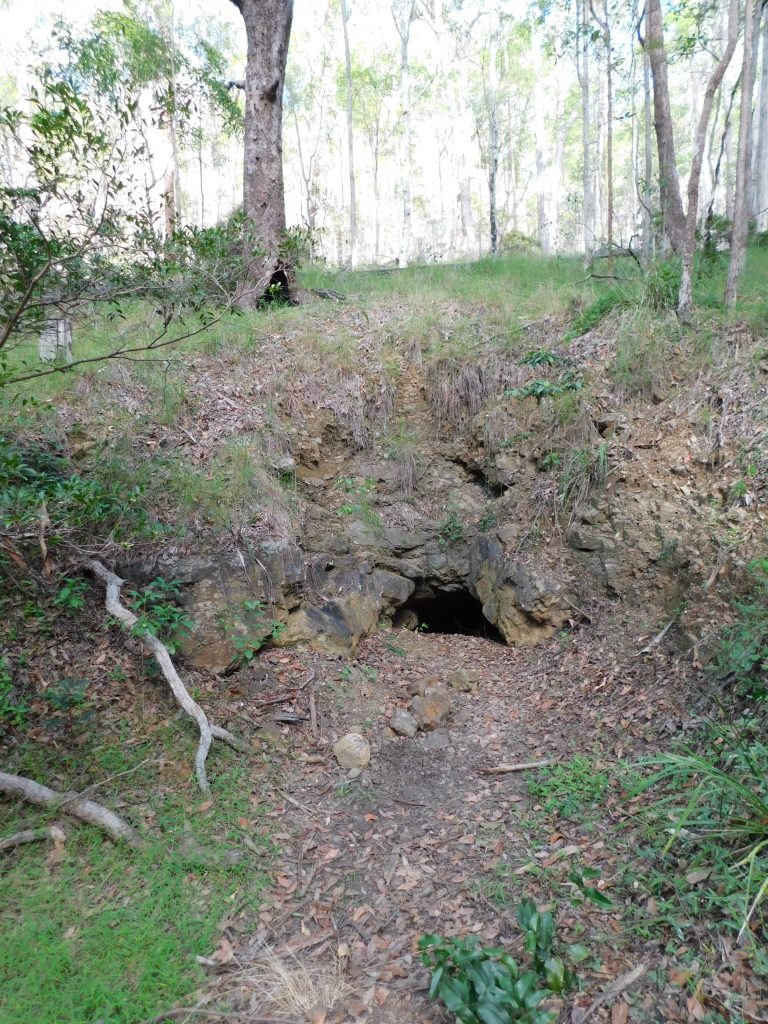
An old gold mining shaft at Mount Coot-tha.

Considering the COVID-19 travel restrictions at the moment, my ability to go on georneys (geological journeys) is very limited at the moment. However, here in Australia we are fortunate that we can still go outside for some recreation, as long as we stay close to home. We live close to Mount Coot-tha, a mountain with a beautiful forest reserve and botanic garden. Most weekends, I go for a hike with my husband and son on Mount Coot-tha. My son is 2 1/2, so we go on short hikes that are somewhere between 2 km and 5 km in total distance. Fortunately, there are plenty of great easy, short hiking trails at Mount Coot-tha.

One of our favorite hikes at Mount Coot-tha is along the Ghost Hole Track, which takes you past some old gold mine workings. At Mount Coot-tha, there is gold mineralization is located in small quartz-rich lenses that are located in meta-sedimentary rocks, specifically in the Bunya Phyllite and the Neranleigh-Fernvale Beds. The gold mineralization at Mount Coot-tha is not spectacular. However, there was intermittent gold mining on the mountain from the 1890s to the 1950s. Today, no gold prospecting or mining is permitted in the forest, but you can take a walk along an easy hiking trail to see an old gold mining shaft and some remnants of mining infrastructure. You can even have a picnic at the “Gold Mine Picnic Area”.

We really enjoy our little hikes through the former gold mining area. The forest is beautiful, and the remnants of gold mining and associated informational signs are interesting. The hike is perfect if you want an easy, but interesting, hike to go on with a toddler.

Below are some pictures of the hiking trail. Click on any of the pictures below to enlarge them.

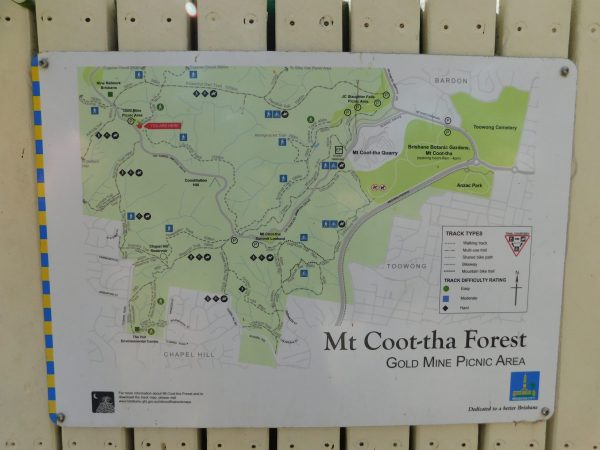
Map showing the location of the picnic area and hiking trail.


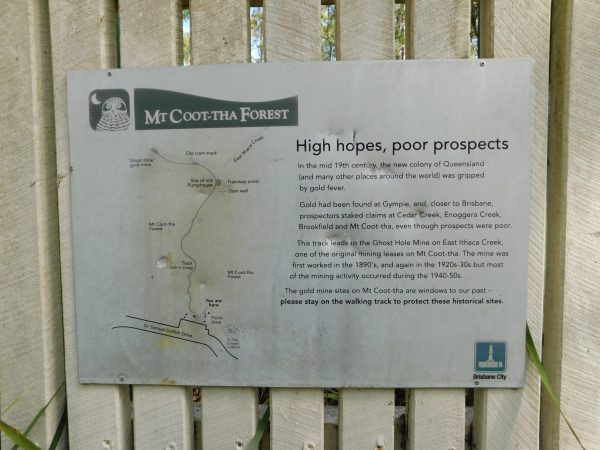
A general informational sign.


A view of the trail through beautiful open eucalypt forest.


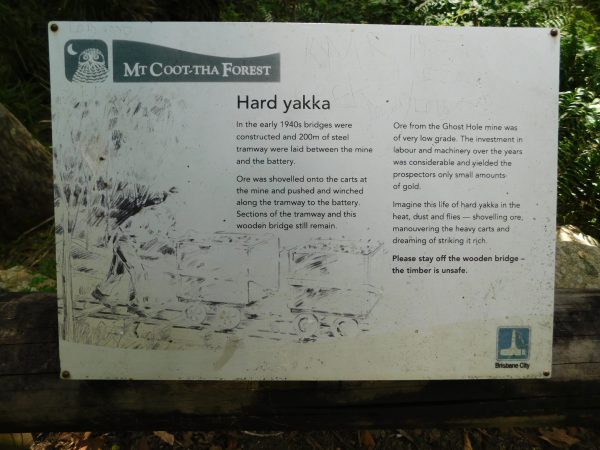
A second informational sign.


Remnants of a dam used for processing gold.


Another informational sign. Note that “yakka” is Australian slang for “hard work”.  This mining certainly sounds like hard work!


Remnants of a wooden bridge used for trams.


Another view of the bridge remnants.


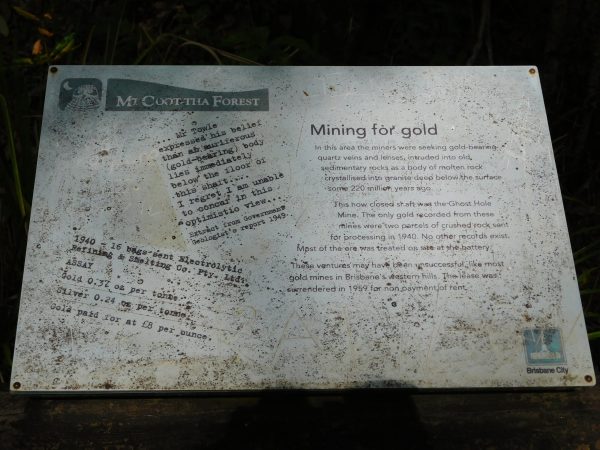
The last informational sign.


An old gold mining shaft.


Another view of the trail.


The forest is really beautiful at Mount Coot-tha.


If you look up, there are sulphur-crested cockatoos in many of the trees.


Another cockatoo.


You can see some lovely butterflies at Mount Coot-tha at certain times of year. Here’s a Blue Tiger Butterfly.

Admittedly, the gold mining infrastructure is not the most spectacular — there’s not much left. However, with the signs it nevertheless makes for an interesting little hike through a beautiful forest. I highly recommend it for a family hike.