Earlier today I noticed an unusual comment on my blog post Blast from the Past: Carbon Cycle Story. In the blog post I share a story that I wrote about the carbon cycle when I was 10 years old as part of a school unit on atoms at my Montessori school.
Here is the unusual comment, which is from a “Mrs. Kim”:
Please delete this post. I am a biology teacher at Thomas Jefferson High School for Science and Technology. Two students were caught plagiarizing this article for a carbon cycle assignment. The issue has been resolved, but we need to guarantee this does not occur in the future. Thank you.
I replied to “Mrs. Kim”:
Hi Mrs. Kim, Thanks for your concern– I’m sorry to hear that students were plagiarizing this assignment, but I’m not going to delete it. There will always be things out on the internet to plagiarize, and schools need to learn how to resolve these issues. I find it sad that students felt the need to plagiarize this assignment, which was one of my favorite school assignments ever :-).
I then asked my twitter followers, many of whom are geoscientists and/or teachers, what they thought about the comment and my response. Here’s the tweet:
Please excuse the typo. "aksed" should be "asked."
Overwhelmingly, my twitter followers agreed that I should not take down the blog post and that requesting that primary sources be taken down from the internet is an inappropriate way to handle plagiarism. Here is a sample of the many, many replies I received on twitter:
A sample of the replies to my twitter inquiry.
Wanting to make sure that the teacher saw my response to her request, I tried sending a message to the email which “Mrs. Kim” provided. The email was returned because the address didn’t exist. I thought that possibly “Mrs. Kim” had entered her email address incorrectly, so I did some sleuthing and looked up the Thomas Jefferson High School for Science and Technology. Guess what? From 2007 to 2011 this high school was ranked as the best public high school in the United States.
Now, I found it somewhat strange that a teacher at one of the best high schools in the United States would be so naive about how to handle plagiarism. I also found it strange that high school students would be plagiarizing a story I wrote when I was 10. So, I decided to write to Dr. Evan Glazer, who is the principal of the Thomas Jefferson High School for Science and Technology. Boy, that school name is sure a mouthful! From now on, I’ll refer to the school as TJHSST. Dr. Glazer kindly wrote back to me and informed me that there is no biology teacher named Mrs. Kim at TJHSST. Furthermore, the TJHSST email provided by “Mrs. Kim” is fake.
Quite honestly, I now find myself puzzled and somewhat discombobulated by the “Mrs. Kim” comment. I find myself worried over who “Mrs. Kim” could possibly be. Is “she” a teacher at another school? Could “she” be a student trying to convince me to remove my post so that “she” can plagiarize my content for a school assignment? I have no idea. However, I do feel relieved that the comment does not come from a biology teacher at TJHSST.
However, I’m happy to see that my twitter followers and blog readers are so passionate about issues regarding the internet and plagiarism. Please feel free to comment (productively and politely– I reserve the right to remove comments) about plagiarism and the internet below.
“Mrs. Kim”: please don’t post here again under a false name! And “Mrs. Kim”: if you are a student with a carbon cycle assignment, I’d be happy to answer any questions you may have about the carbon cycle… though you’ll have to write the assignment yourself!
Phil and I at Red Rock Canyon (outside Las Vegas), circa January 2006.
I feel very fortunate to have known Phil Plait aka “The Bad Astronomer” for many years, primarily through our involvement with the James Randi Educational Foundation (JREF). I twice worked as an intern for the JREF, and Phil used to be president of the JREF. Over the years, Phil has been very encouraging and supportive of my scientific studies.
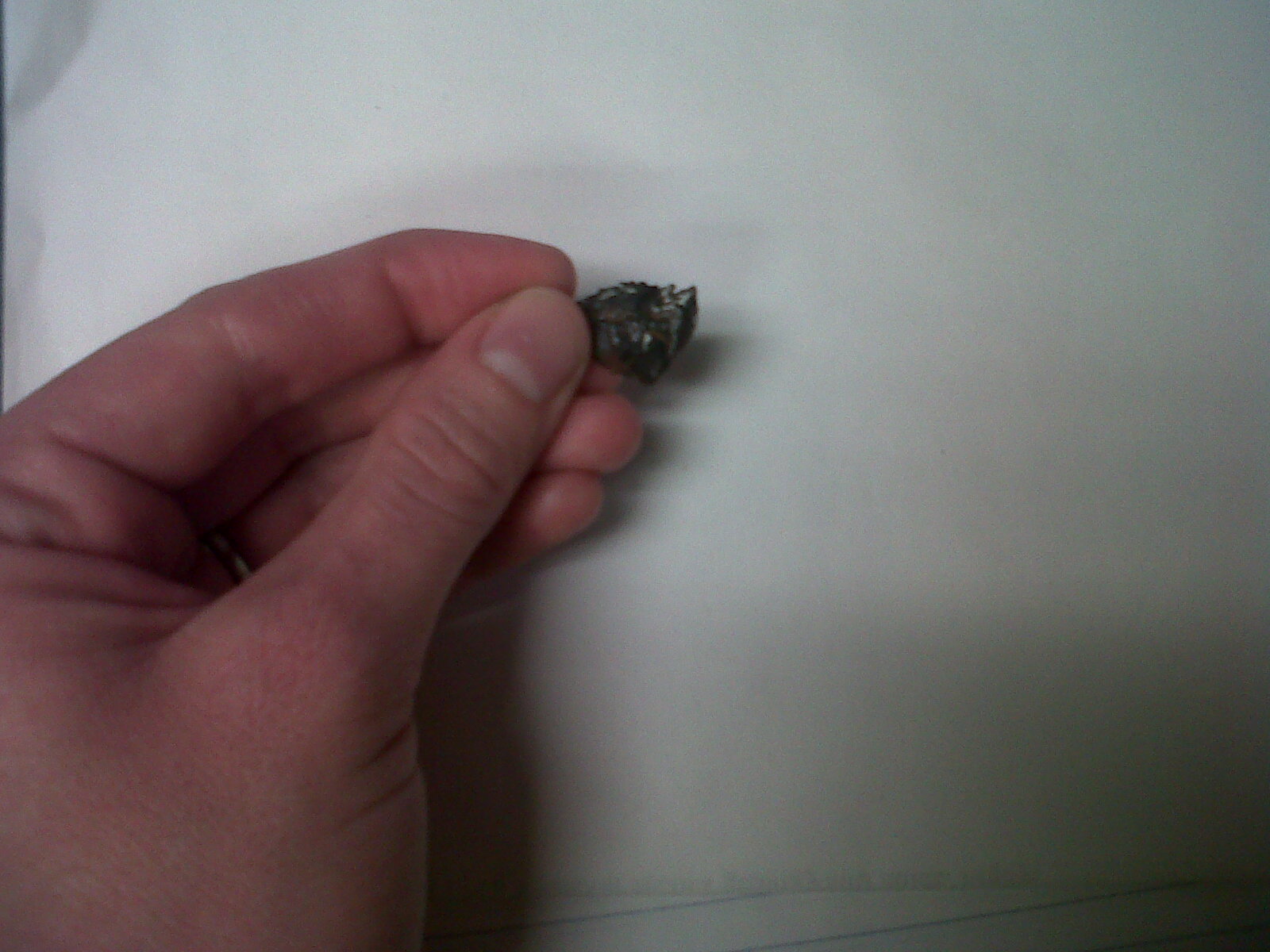
I’m currently packing up my office as I prepare to depart from MIT/WHOI, where I’ve been a student for the past six years. When I was sorting through various office items yesterday, I came across a graduation present from Phil. When I graduated from Dartmouth College back in 2006, Phil sent me a wonderful letter and a meteorite. Best. Graduation. Present. Ever.
I thought I would share Phil’s letter and a picture of the meteorite. By the way, the reason Phil calls me Kitten/Evelyn is because my mom’s name is “Kitty,” and she used to refer to my sister and I as “Kitten 1” and “Kitten 2” on the JREF’s online forum. So, when I joined the JREF forum (back in 2003, I believe), I used “Kitten” as my forum name.
Phil, thanks again for the meteorite and, more importantly, for being enthusiastic about science and supportive of my scientific studies. Just so you know, my PhD graduation is in early June… just in case there are any other space rocks you’d like to send me.
I’m still super busy preparing for my move to South Africa on Monday, so here’s another quick “Blast from the Past” post to keep my blog readers entertained. Enjoy!
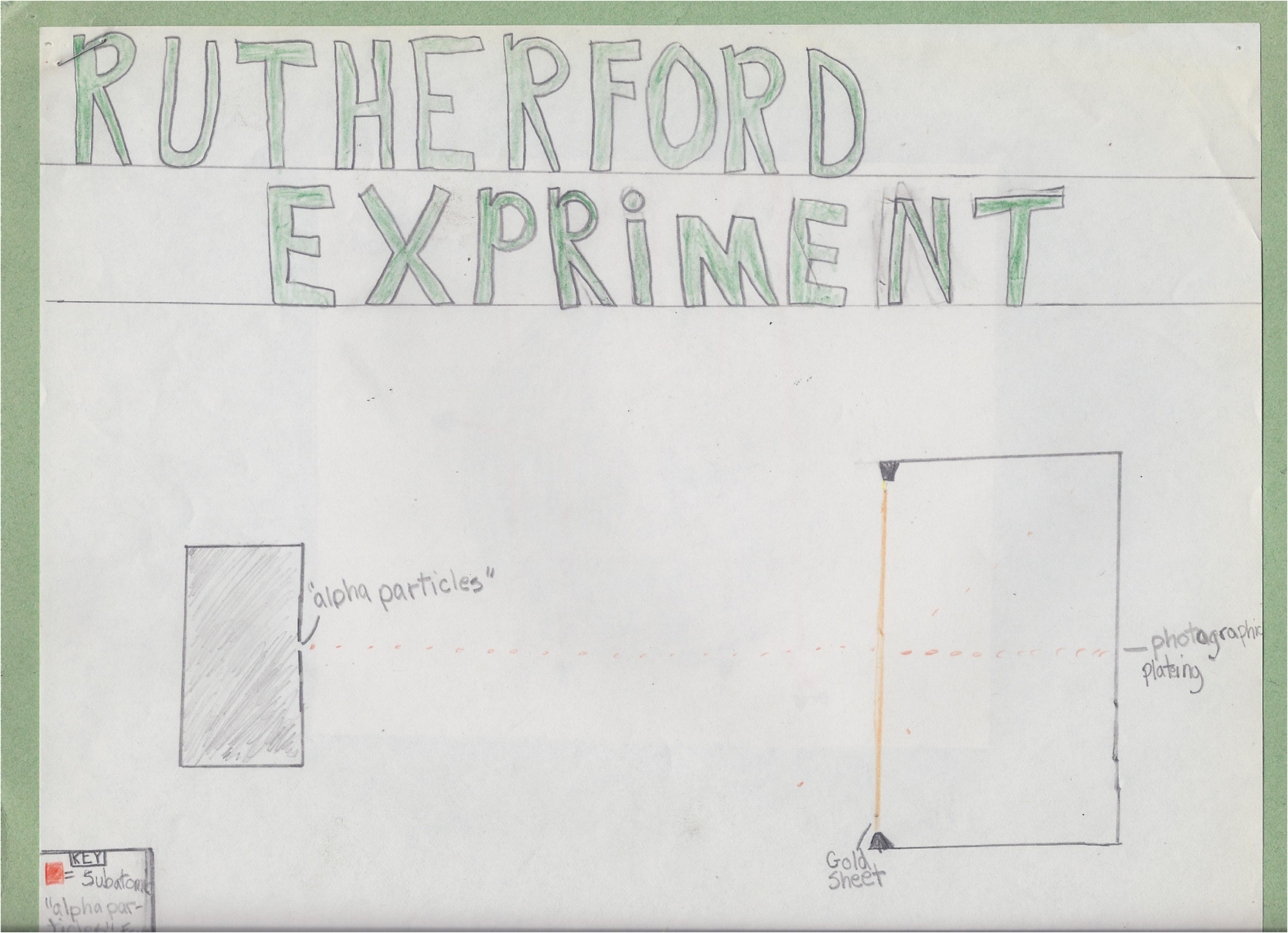
Normal children draw pictures of rainbows, flowers, ponies, ninjas, and so on. When I was about 10 years old, I drew these pictures of the Rutherford Gold Foil Experiment. Well, technically of the “Rutherford Expriment.” My spelling never was very good.
"Rutherford Expriment" drawing, circa 1994.Click to view larger.Drawing of Alpha particles interacting with a gold atom, circa 1994.Click to view larger.
The next few weeks are going to be crazy busy for me since I’m moving to Cape Town, South Africa. I’ve arranged with my thesis supervisors to finish up some of my thesis writing from over there, where my fiance lives full-time and where we share a flat. Over the next year, I’ll periodically be back on Cape Cod (and perhaps Wyoming, where one of my supervisors is based) for meetings and ultimately for my PhD defense. However, I’m very happy that I will soon be able to live (mostly) full-time with my soon-to-be husband and to do some of my thesis work remotely. Thank goodness for Skype!
Anyway, I have a zillion things to do related to work, packing, and immigration before I fly to South Africa in two weeks… with my two cats! So, the next few weeks may be somewhat light for blog posts. Never fear, though. I will at least keep you entertained with the Geology Word of the Week and the occasional quick post such as the below.
Remember those high school “most likely” awards?
What was my high school “most likely” award?
Most Likely To Be Crushed By Falling Rocks While Examining Them.
My high school "most likely" award. Click to enlarge.
Someone even made up this little drawing for me. I think this “most likely” award may have actually been a sports award from when I did “Outdoor,” a semester of outdoor activities such as kayaking, rock climbing, and hiking. However, I believe my yearbook “most likely” award was very similar. My yearbooks are all packed away, but when I unearth them eventually I’ll scan the yearbook page.
As for avoiding the rock crushing? So far, so good. But I suppose geology is a somewhat dangerous profession what with hammering on rock outcrops and all.
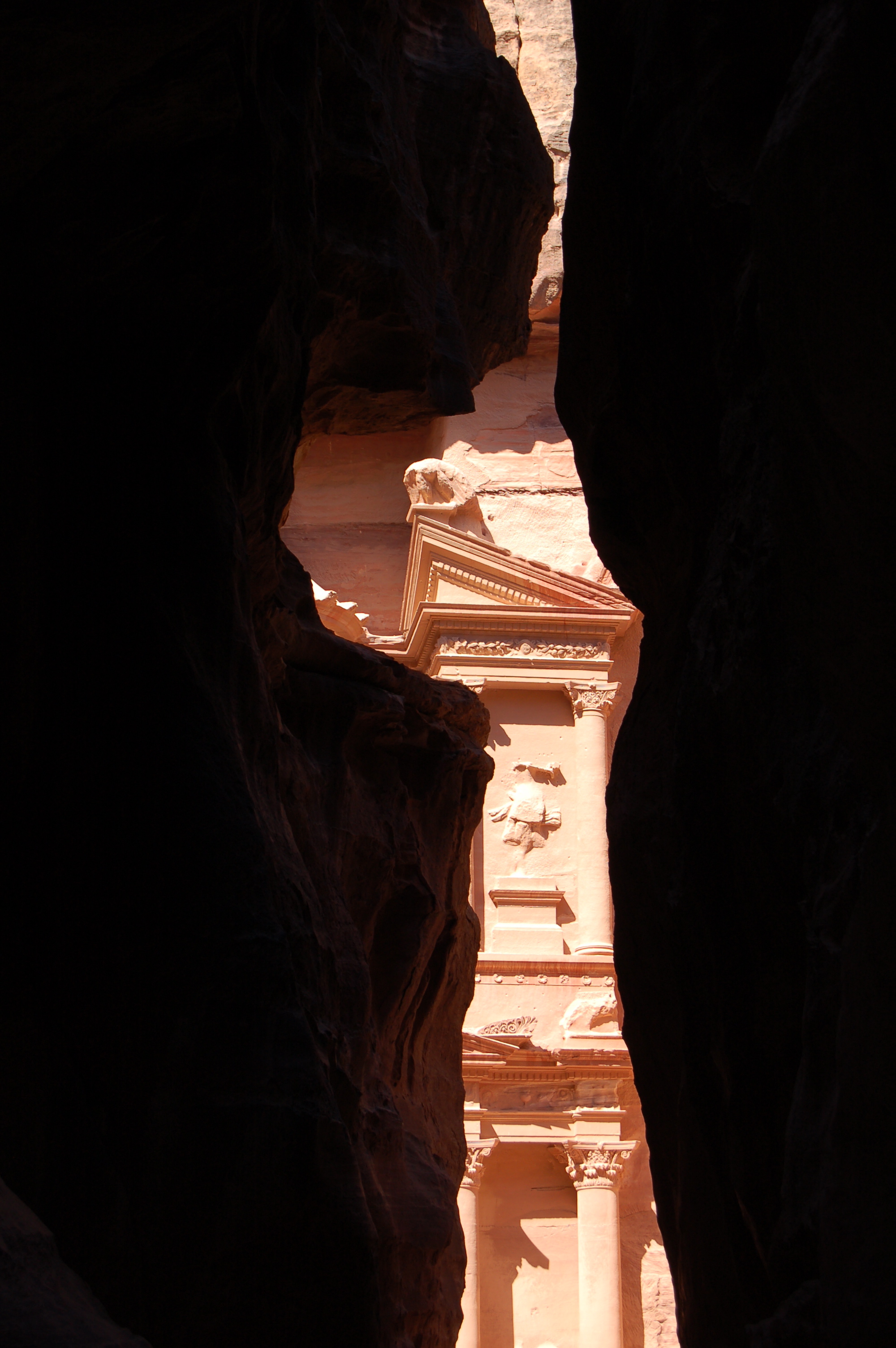
Al-Khasnah viewed through The Siq. Petra, Jordan, August 2007.
For those of you who are not familiar, in my “Blast from the Past” posts I share– for better or for worse– interesting tidbits from my past (pictures, childhood drawings, old school essays, etc.). Below is a Chapel Speech that I gave at Westover School (the wonderful all-girls’ boarding school I attended… yes, I went to fancy shmancy boarding school) back in April 2000 when I was sixteen years old. I ran across a paper version of the speech a couple of months ago when I was packing, and I’ve typed it up for you here. The speech is about the Fall 1999 semester I spent living in Amman, Jordan and attending the Ahliyyah School for Girls. The writing is a bit silly, immature, and ethnocentric at times, but keep in mind that I was very young and just starting to explore the world. I thought this would be interesting to share since my time in Jordan, particularly my visits to Petra, inspired me to study both geology and Arabic. In the text below I’ve interspersed a few pictures taken during my time in Jordan. There are also some 2011 footnotes. Enjoy!
If you want to see more pictures of Jordan, I have two “…in Pictures” albums of Jordan so far:
I had only slept three hours before I was awoken by a loud, howling chant. I sat bolt upright on my cot, scared to death, not realizing entirely where I was, and looking everywhere for something familiar. My sleep-deprived eyes finally rested on my large, khaki-colored duffel bag, and instantly I felt a sort of calm relief. My senses clearing, I realized I was hearing for the very first time in my life a Muslim call to prayer with its origin at a nearby mosque. The sound, enchanting and mystical, vibrated through the dusty streets of a Middle Eastern metropolis.
Disentangling myself from the thin sheets that were plastered to my legs with sweat, I stumbled to the window. My watch revealed that the hour was only five am, but already a pink light was piercing the sky, and I soaked in deeply the first sight of Amman, Jordan, the city that would be my home for the next four months. The street below revealed nothing in particular: only a few sand-colored houses with white or green painted bars on the windows. Here and there a vine or a pitiful little shrub made a brave stand against the desert heat. However, as I looked between the roofs of the nearby buildings and into the distance, I had my breath taken away. Row upon row of buildings, all beige or sand-colored and seeming almost mirages out of the desert, tiled the softly-rolling hillsides. Three or four mosque towers (1) rose high into the sky. I soon realized why the chanting had startled me so: black speakers dotted the very tops of the mosque towers and blared forth the call to prayer. If three or four mosques were visible out of this one small window alone, who knew how many mosques were blaring the exact same chant all over the city! No wonder the noise had awoken me.
As the chanting slowly died down, I became aware of other noises. In the room next to mine I could hear the sound of prayer rugs being tucked back into closets or under beds. Down below in the street, two men were walking slowly and speaking in guttural-yet-melodic Arabic, a language I had heard for the first time only the evening before. In the far distance I heard small horns, which I assumed to be those of taxi drivers already embarking on another day of business. Having stood there gazing out the window for quite some time, I suddenly realized my legs were wobbling, my head spinning, and my back aching. And so, with a new, exciting world awaiting me, I crawled back on the cot, pushed the sticky sheets aside onto the floor, and immediately fell back asleep.
With my first host family in downtown Amman, Jordan. Fall 1999.
A week later as I sat sipping a soda at the top of an ancient Roman amphitheater in downtown Amman, I reflected on how quickly I was adjusting to life in Jordan. The last seven days had been a whirlwind of new experiences. That first morning when the mosque towers awoke me, I fell back asleep and slept until eleven. I probably would have slept longer had not Mrs. Awqati entered bearing a breakfast tray heaped high with fried eggs, soft cheeses, leban (a sort of sour yogurt), tomatoes, pickles, olives, toasted pita bread, and the first of many cups of sweet, soothing tea.
The next day I began my role as a student. All of the girls at the Ahliyyah School were very welcoming but bombarded me with a thousand questions about my life, home, family, and country. The girls wanted to know everything about my life in America. Girls who did not know me yet would often approach by asking questions such as, “Have you ever been to Disney World?” or “Have you ever seen Leonardo DiCaprio?” or “Do you like Nike?” Yes, I have. No, I have not. And, no, I do not.
The schoolwork not being very difficult, I had plenty of time to explore and reflect while I was in Jordan. I jumped at every opportunity to go anywhere, meet anyone, try any new food, and try any new experience. To tell of every excitement and wonder I encountered while in Jordan would probably take me the entire weekend. Thus, for the sake of time, I shall recount only a few of my many spectacular experiences.
A posed photo at a shop in Amman, Jordan. I’m wearing traditional bedouin clothing. Fall 1999.A second posed photo in Bedouin clothing. Amman, Jordan, Fall 1999.
One of my first outings led to my gazing upon the holy city of Jerusalem. About an hour’s drive from Amman is the slightly more rural city of Madaba. At times I was not quite sure what made Madaba any more rural than places in Amman. In both cities herds of sheep can be seen grazing next to shopping centers, and Bedouin tents are often pitched next to five-star hotels (2). However, I was quickly told that in Amman the slaughter of chickens is prohibited. In Madaba, however, the front of every grocery shop is piled high with wooden cages containing live chickens. Customers simply indicate which bird they like, and the shopkeeper takes the bird to the back of the store to meet its death. A customer receives first the noise of frantic squawking in her ears, then a freshly decapitated bird in her hands. The banishment of “street chicken slaughter” seemed to be a primary distinguishing characteristic of Amman’s worldly sophistication (3).
Anyway, I had been staying at my friend Rawan’s house for the weekend and, to speak truthfully, not particularly enjoying the experience. Rawan’s five younger sisters were constantly running through the four rooms of the small apartment whining and screaming, and Rawan’s mother kept trying to prepare Western dishes for me, all of which turned out terribly. I would have much preferred a traditional rice dish or even a pita and cheese sandwich, but not wanting to seem rude, I gulped down the charred hamburgers and burnt onion rings and forced myself to smile. I was greatly relieved when Rawan’s parents offered to take me on a trip to Madaba. I had heard of the many beautiful mosaics there and also would have gone anywhere to get away from the screams of Rawan’s youngest sister. As I skipped down the stairwell and into the car, I realized that the entire family was trooping out the door behind me. Apparently, all nine of us– Rawan’s parents, Rawan and her five sisters, and I– were all going to pile into the family’s ancient two-door Toyota.
Despite having a nine-year-old piled on top of me and Rawan’s elbow in my stomach, the drive passed quickly. Because all of the museums in Madaba had closed earlier in the day, Rawan’s parents instead drove us past the town of Madaba to Mt. Nebo. Mt. Nebo is of great Christian importance as religious scholars believe that this is the final resting place of Moses, who gazed upon the Holy Land of Israel from the mountaintop just before he died.
One of the most mystical, beautiful churches I have ever entered is built upon Mt. Nebo. The church, called Siyaga, was was built in the IV century and then enlarged in Byzantium times. Inside are crumbling, yet somehow holy (4), columns; intricate, colorful mosaics depicting everything from saints to camels; and a few simple wooden benches. There is also an ancient cross-shaped basin once used for baptism, a small sandpit near the altar where candles lit for loved ones may be stuck into the holy soil, and a small tourist shop in the back where one might buy a Mt. Nebo postcard or an “I’ve been to Mt. Nebo 2000” t-shirt.
However, the view of the valley below is what really makes one feel holy. Except for the modern-looking iron cross which has been erected at the top of the mountain, I found myself looking at the very same view Moses himself must have seen so many centuries before. I stood on the rocky mountaintop and gazed below at the small Israeli towns– so close, and yet politically so far away– and at the distant, glorious city I knew to be Jerusalem. Never had I gazed upon hills such as those that then surrounded me. The sand-covered hills, covering the land like a wrinkled skin, were almost devoid of vegetation. On and on stretched the sand, here diving into valleys, here darkened by shadow, here lit brilliantly by the setting sun. As vivid pinks and purples began to fill the sky, I turned to leave and, this time, smiled as Rawan’s sister again crawled into my lap in the overstuffed Toyota.
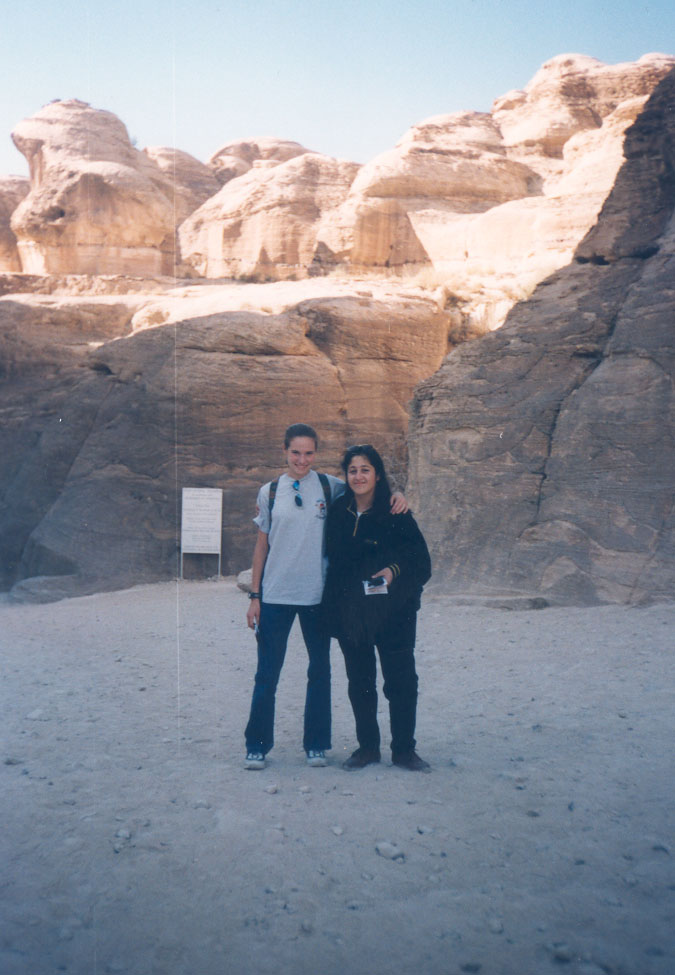
With a classmate in Petra, Jordan. Fall 1999.Hanging out with some sandstone in Petra, Jordan. Fall 1999.
The second place worth describing is the ancient Nabatean city of Petra, a sandy, monotonous, three-hour drive from Amman. The ancient city is at first hidden by gigantic rock mountains, and only the modern city of Wadi Musa can be seen. However, a short horseback ride to The Siq, or the tiny crack in the mountainside which is the only entrance to Petra, and immediately one is transported into another world. Petra is entirely encased in tall rock mountains, which form a sort of valley through which a river once flowed. The Siq alone would be enough to draw me as a tourist. The towering cliff faces are lined with strips of color that look very similar to the rock patterns found in America’s Grand Canyon (5). The countless murals and decorations, painstakingly carved out of the rock so many centuries ago, enhance the natural beauty of The Siq walls. Just before reaching the city of Petra, The Siq narrows, turns sharply, and suddenly a thin strip of what must be one of the most awe-inspiring temples in the world becomes visible. When I saw the pink facade of Al-Khasneh before me, I did not know whether to run forward or stand still forever in the hope that I might one day die with such an extraordinary view before me (6). For those of you who have seen “Indiana Jones and the Last Crusade,” you probably remember the temple where the Holy Grail was finally found. That temple was no movie set; it was Al-Khasneh.
Although I found no Holy Grail in Petra, I certainly found something else. Something more abstract, something more personal, something more valuable. In a way I found myself. Being surrounded by not only Al-Khasneh but also by hundreds of similar facades and carvings seemed to breathe life and hope and spirit into every moving, working cell in my body. I could almost feel my mitochondria doubling their efforts (7). I was once told while in Jordan that to see Petra thoroughly takes sixteen days. I was blessed to spend three days in Petra and could spent three years describing my short experience. However, I will stop at Al-Khasneh. Transform this robe (8) I am wearing into jeans, a T-shirt, and hiking boots (10), put me on the top of camel surrounded by men wearing their hattah (9) headdresses, put the Al-Khasneh facade at my back, The Siq before me, and you have what, to this date, is one of the most satisfactory moments of my life (11).
Jordan brought me not only this thrilling moment, but also many others. Jordan also brought me new ways in which to observe and judge the world around me. Although I still believe that I harbor a great amount of American ethnocentrism, I believe that my trip to Jordan helped me shed at least a few of my cultural biases and, perhaps, helped me realize that American is often not as bad or as wonderful as I think it is. For four months I was immersed in an environment with a culture and society so different from my own. Under such circumstances, how could I not adapt, change, and acquire new knowledge? Impossible. Thus, I tried to accept the task wholeheartedly. Many days were far from easy. However, what I learned from these more difficult days is just as important as what I learned from my more pleasant experiences. When I recount some of my more trying experiences, some people ask why I bothered to go to Jordan at all if I knew this sort of thing might happen to me. Usually I smile and say something difficult to argue such as, “I didn’t go to Jordan to be in America. I went to Jordan to be in Jordan.” This is not really a complete explanation. I think I would be more truthful if I said I was driven by adventure and wanderlust. However, reflecting back on my experience I realize that satiating these two desires was only a minute piece of my unusual trip. What I learned about life and the world is much more permanent and satisfying. I imagine that my wanderlust and sense of adventure will lead to many more travels. I can only hope that I am able to glean as much knowledge and insight from my future travels as I have from this one short stay in Jordan.
2011 Footnotes:
(1) Mosque towers are known as “minarets.”
(2) I wonder if this is still true in 2011.
(3) This passage sounds horribly condescending, now that I am reading it years later.
(4) When I was sixteen, I considered myself a Christian. I now consider myself an atheist of Episcopalian heritage. I no longer believe in holy things, but I still enjoy visiting historical churches.
(5) I must be speculating here since I did not visit the Grand Canyon until 2005.
(6) Don’t worry- I’m just being a melodramatic 16-year-old here.
(7) Science metaphor for the win.
(8) Robe? Maybe they made me wear something special for Chapel. Normally, we went in our dress class clothes, which were formal Laura Ashley-style sailor uniforms (I kid you not. If you ask nicely, maybe I will post a picture).
(9) Definitely my preferred outfit, especially compared with Chapel robes and sailor uniforms!
(10) A hattah is also known as a kuffiyah.
(11) Definitely still up there on the list, though I’ve seen many more amazing places.
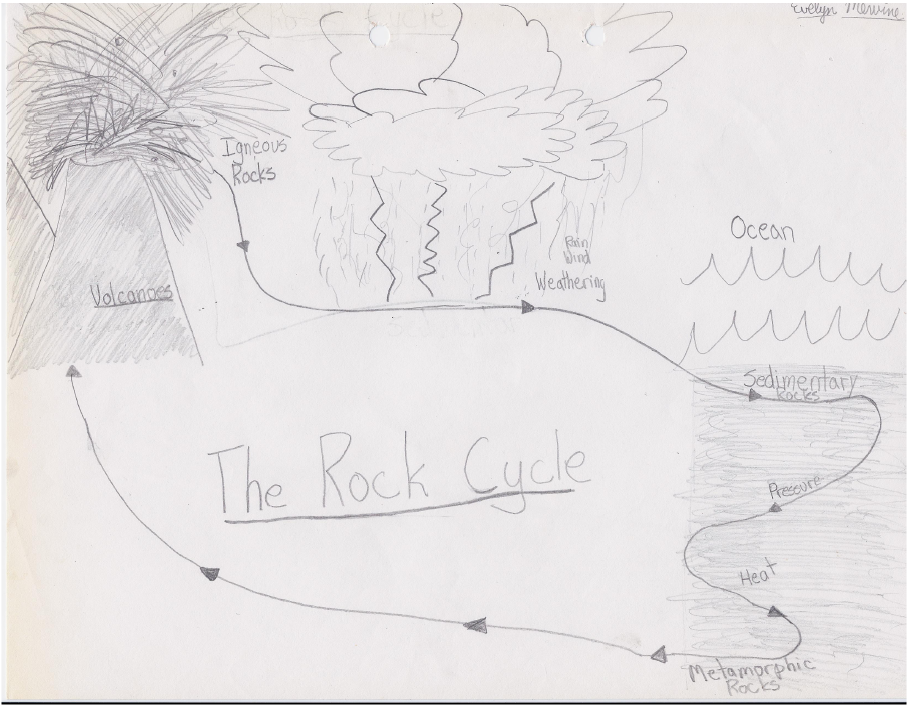
Rock Cycle drawing, circa 1993 or so. Click to view larger.
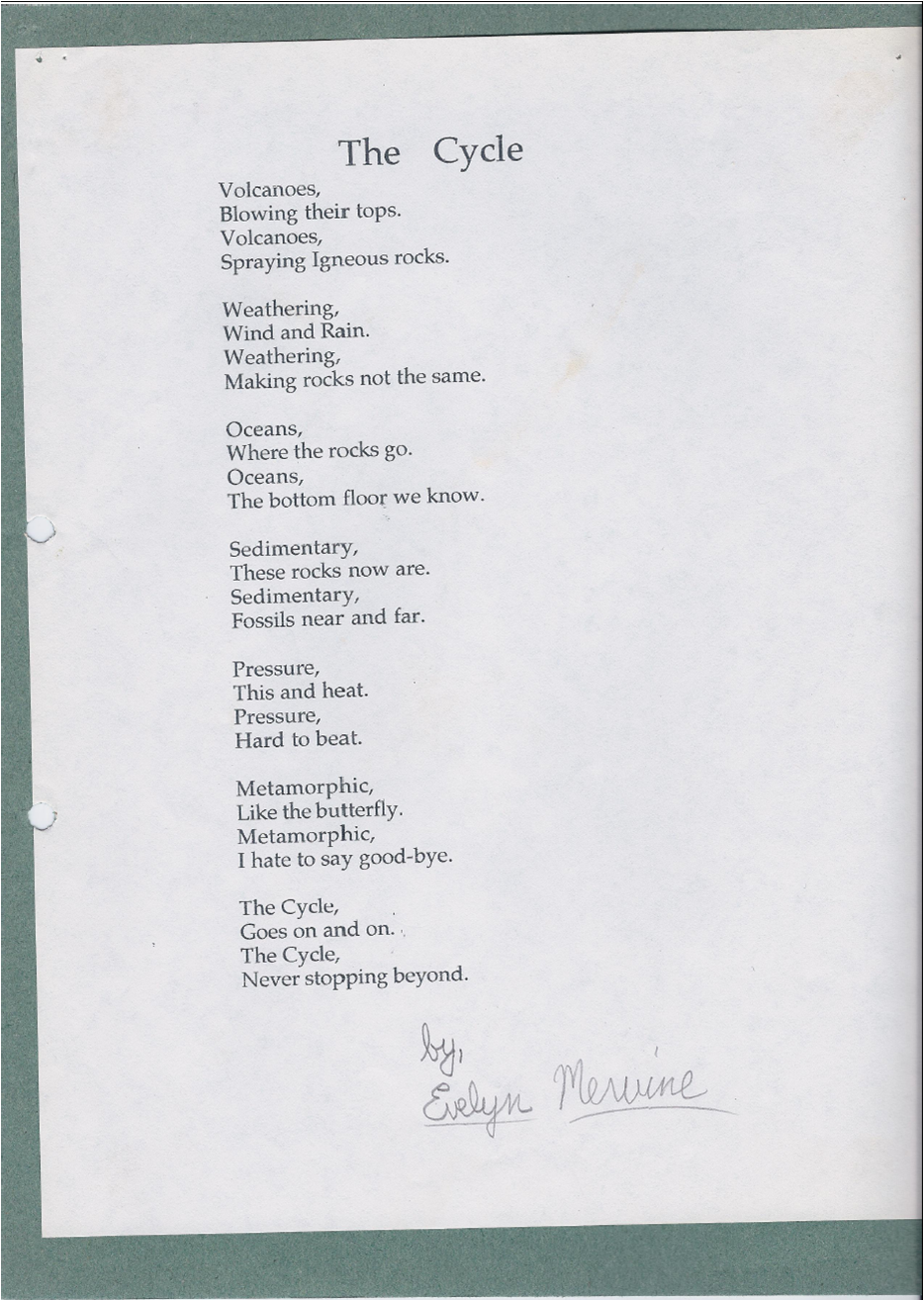
I’m trying to finish up my packing today, so here’s one last gem (for now) from the past: a poem that I wrote in third or fourth grade about the rock cycle. There is also an accompanying drawing (see above). Enjoy! The Cycle
Volcanoes, Blowing their tops. Volcanoes, Spraying igneous rocks.
Weathering, Wind and rain. Weathering, Making rocks not the same.
Oceans, Where the rocks go. Oceans, The bottom floor we know.
Sedimentary, These rocks now are. Sedimentary, Fossils near and far.
Pressure, This and heat. Pressure, Hard to beat.
Metamorphic, Like the butterfly. Metamorphic, I hate to say goodbye.
The Cycle, Goes on and on. The Cycle, Never stopping beyond.
Rock Cycle poem, mounted on stylish (but faded) construction paper. Click to view larger.
I think my understanding of the rock cycle was pretty good for a 9-year-old, but in reality the cycle is a little more complex. In addition to the cycle of igneous to sedimentary to metamorphic to igneous, there are other pathways for rock transformation. Igneous rocks can go directly to metamorphic rocks and sedimentary rocks can go directly to igneous rocks. Metamorphic rocks can also become part of sedimentary rocks. The cycle is complex with rocks taking different transformation pathways depending on environmental conditions.
A more realistic rock cycle diagram. Figure taken from here.
Earth, the Goldilocks Planet. Click to view larger.
On Saturday I am leaving Woods Hole to spend the summer in Laramie, Wyoming. Between now and then I have a zillion things to do. I pretty much have to work constantly prepping samples in lab, running the mass spectrometer, packing, and cleaning out my apartment. Oh, and maybe remembering to eat and sleep now and again.
I’m pretty tired as aside from my trip to South Africa to visit my fiance back in April and a weekend trip to go wedding dress shopping, I haven’t taken any time off since December. I work every weekend and many evenings. Grad school is hard work, that’s for sure! However, there are many benefits to being a grad student. I am paid to explore and travel and do fun things, like go spend the summer in beautiful Laramie. I need to work on data interpretation and writing, but I should be able to take a weekend day off here and there to explore some of the beautiful Wyoming countryside. And there will be NO labwork! I love the lab, but frankly I’m a bit sick of labwork after the last six months of grueling lab labor.
Despite the recent long months of labwork, I love working as a geologist because through my geology work I am able to explore the amazing planet on which we live. Earth is pretty amazing, don’t you know? As my 9-year-old self put it in the drawing above, Earth is the Goldilocks planet– it’s not too hot, it’s not too cold. It’s just right*.
The Goldilocks drawing came from my school report “Space Unit” from 1993.
*Though Carl Sagan might say that Earth only feels like a Goldilocks planet to us because we evolved to live on it. If life exists on other planets, that life probably thinks their planets are pretty perfect, too. Even if those planets are very different from our Earth.
I’m finishing up my packing this weekend, so that means it’s time for another “Blast from the Past” post. This is a story narrated by a carbon atom going through the carbon cycle. This story comes from my “Atom Unit” report booklet. Last week I shared a story called “Element Talk Show” with you from this same booklet. Just this evening I noticed that I wrote the date on the back of the booklet. I wrote this booklet in 1994 when I was ten years old and in either 4th or 5th grade.
This is another nerdy, weird story, but at least I had a pretty good understanding of the carbon cycle for a ten-year-old. All spelling, grammar, and punctuation are original.
The Life of a Carbon Atom:
The Atmosphere: My life started out easy, in the air. I had the pleasure of being in a molecule with two extremely nice oxygen atoms. I just drifted in the air, happy that I had my full supply of electrons. Perhaps I should introduce myself. I am a typical carbon atom with six electrons. I now am in a carbon dioxide molecule and am just drifting. I waved to my friends, oxygen gas, a molecule of two oxygen atoms (I find oxygen the nicest atom), and nitrogen gas, a molecule of two nitrogen atoms. All of us are in our gas form. I’ve heard stories of becoming solids and many different things, but now I just like the aaaaaaaaaaaaair*. I was being sucked in by something, I was leaving the air. “Goodbye!” my friends yelled, “you’ll like being a solid. Good luck.”
The Plant: It turned out I was being breathed in by an eggplant. It wasn’t bad being an eggplant, but I prefer being in the air much better. I was in the eggplant for several days. One day the eggplant was picked. I was relieved because it was turning into cold weather and at night frost reached its arms over the eggplant. I remember being put in an icebox and staying there for a day or so. This cold was not like the cold of the frost, but a more gentle concentrated cold.
“Ray, get some eggplants out, Marilyn is going to have company tonight.”
“Not eggplant tonight, Martha. You know Marilyn doesn’t favor eggplant,” he replied.
“I never asked her to eat any. Will you just get ’em out?”
The icebox door opened and I was lifted out and set on a table. The eggplant was cut up into little slices, myself being part of the smallest slice. I was placed on the table with some parsley and the rest of the eggplant. There was not just eggplant on the large white table, but turkey, corn, rolls, butter, salad, potatoes, salt, pepper, napkins, plates, spoons, forks, knives, salad forks, roast beef, and some other things that I haven’t any idea what they are. One of the best things on the table was fried yams.
“Martha! Martha! Where is that producer I invited for dinner? He’s Late! I’m eager to sign that contract,” Marilyn complained.
“Hello,” a famous hollywood producer walked into the dinning** hall, “this must be Marilyn, Marilyn Monroe.”
“Of course I’m Marilyn Monroe. Who do you think I am? Now what about that contract? Pass the eggplant please.”
I felt the eggplant being bumped around on the platter. A fork was lifted and the eggplant was eaten by Marilyn Monroe!
The Human Body: Shining white sharp teeth chewed the eggplant and then Gulp! A long dark passage led straight downward into a larger space called the stomach. I was bumped around and jumbled about. I was not in the human body for long. It was just a couple of hours***. Just as Marilyn Monroe was about to turn out the light for the night, eager to start work on her new movie she took a deep breath, and I caught sight of two very nice oxygen atoms. I had been a bit cranky without my full eight electrons and I was eager to join them. So I did and Marilyn Monroe breathed me out as carbon dioxide.
The Atmosphere Again: I was free! Happy, in the atmosphere again. I came to know my two oxygen atoms and was very happy in my new molecule. I stayed in this molecule for a few years, floating around and having the time of my life. My molecule rested near the ground, maybe too close because sooner than I knew it I was being sucked up by the roots of some plant.
Rain Forest: The roots belonged to some berries. These berries nested in the middle of a vast rain forest. I heard some birds tweeting around me. A leopard pounced on something, catching his prey. I stayed in this plant for a million years or so (I really just lost count) until eventually it was pressed and compacted so much that I turned into a different substance altogether. I still lay in the rain forest until I heard the noise of shovels digging up the ground above me. Finally after such a long time light shone around. For the first time I saw what I was.
Coal: “This is is it Ricky, coal. We’ll haul in a good bundle for this lot.”
“Would you be quiet? You’re forgetting we have to use some of this in our own research. We’ll sell the rest though. Help me get this out of here.”
I felt bits of coal being lifted up and put into a weird carrier type thing. It was really a compartment of their space mobile used for storing items that were not needed until their next stop.
“What should we try now?” a strange voice asked.
I had been in the coal that had not been sold and now scientists were staring at me through advanced equipment.
“Lets try burning the coal. Ancient Americans often used this process to heat things, but it was most commonly used for cooking things. We are going to take this recreation of what they called bacon and try to cook it in coal and in order to do that we must burn the coal.”
And so I was burned and set free by it. I mixed with oxygen and became carbon dioxide. I was free for the present, but soon I would be in a human or plant. I would never be free from the carbon cycle.
*I think I transcribed the correct number of “a”s here.
**Hee hee first “dinner” now “dinning hall.”
***Not sure about the science of this, but since this is a story narrated by a sentient carbon atom, I’ll roll with it.
My interest in the carbon cycle has continued to adulthood. For my PhD thesis, I study the formation of carbonate rocks in mantle peridotite in the Samail Ophiolite in Oman. These carbonates form when mantle peridotite interacts with carbon dioxide (CO2) and alters to form solid carbonate minerals. Alteration of mantle peridotites to carbonates is a process that naturally removes CO2 from the atmosphere and hydrosphere and stores this CO2 in solid mineral form. So, we call this process a natural “carbon sink” or natural “carbon sequestration.” Understanding natural CO2 storage in carbonate rocks may help geologists and engineers figure ways to artificially store CO2 in carbonate rocks as a way of offsetting anthropogenic CO2 emissions. Today, my understanding of the carbon cycle is slightly more sophisticated than my understanding when I was ten, but, hey, you have to start somewhere.
The carbon cycle is a little more complex than the above story indicates. Perhaps I should write a new story in which the carbon atom cycles through even more reservoirs. For instance, the carbon atom could spend some time in an ocean foram and in a carbonate vein in one of my Oman peridotites. If the carbon atom goes through every possible reservoir, the story could be very long indeed.
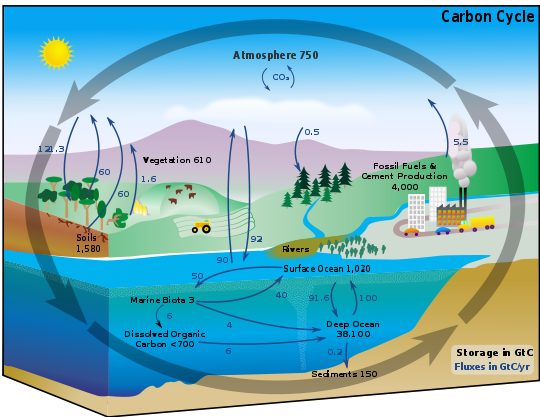
Here are a couple of figures showing the carbon cycle:
First, a pretty one from wikipedia:
The carbon cycle. Taken from Wikipedia Commons here. Click to enlarge.
Second, a boring but precise (though slightly dated) carbon cycle drawing (and associated table) that I like:
Carbon cycle. From Holser et al. (1988). Click to enlarge.
Data table for above cycle. From Holser et al. (1988). Click to enlarge.
Element Talk Show page. Note volcano lamp, James Randi picture, and artwork (by Randi’s talented partner) in the background. Click to enlarge.
I’ve been sorting through more boxes today (trying to finally pack up all my books and notes!), and I’ve found a box that contains reports, drawings, and other assignments from my elementary school days. I can’t date most of these reports exactly, but they are definitely from my 2nd through 6th grade days. I was a student at a Montessori school in Vermont back then. I actually attended Montessori schools from pre-K through 8th grade. Montessori schools encourage creativity, among other things, and boy did I have some creative assignments. In Montessori school students tend to work on themed units, which can last a week to a few months. During this time, students study and produce work related to that theme.
Here’s a gem of a story, from my report booklet on the “Atom Unit.” I believe that I wrote this story (with my friend Joy) in 4th grade. I was (still am) *such* a weirdo and nerd, even back in elementary school. All punctuation, spelling, and grammar are original. Enjoy!
Update: I just noticed that I wrote the year (1994) on the back of the report. So, I was 10 years old and in either 4th or 5th grade when I wrote this report.
Element Talk Show
Interviewer: Today on E.T.S. we are going to interview Miss Fluorine and here she comes now.
Fluorine: Hello all you fans I’m Fluorine. Any Hydrogens out there? I’m a little jumpy I only have seven electrons. (sits down)
Interviewer: So what exactly are you?
Fluorine: I’m a gas. They use me in toothpaste as SnF2, stannous fluoride.
Interviewer: So you mean I brushed with you this morning. You are inside this little tube? (holds up toothpaste tube)
Fluorine: It’s a tight fit, but that’s right.
Interviewer: How nice. What else are you used for? (Takes a sip of water)
Fluorine: They use me in water for your teeth.
(Interviewer spits out water) Interviewer: What! I think I just drank your cousin!
Fluorine: That’s all right. I’ve got to go. Ta! Ta!
Interviewer: Now it’s time to have your star reporter Joy with her weekly report. Take it away Joy.
Reporter: Thank you, Evelyn. Mr. Neon was spotted by our cameras at Bob’s Dinner* in the window. He was last seen advertising foods the dinner serves. Let’s see if we can get a word with Mr. Neon.
Neon: It’s Miss Neon.
Reporter: How does it feel to be a light?
Neon: Well it’s a tight fit in this glass tube, but I enjoy giving off my glow.
Reporter: What are you Mr. Neon.
Neon: A Miss Neon, I’m a Miss Neon.
Reporter: No, I mean what element are you?
Neon: Well, I’m a gas. If I didn’t have an electrical current running through me I’d be colorless, odorless, and tasteless.
Reporter: Anything else? Where are your friends? Perhaps we can get one on our show.
Neon: I’m happy by myself. My outside shell is full of electrons. I don’t make any compounds.
That’s it. If there was another page, it was unfortunately (or maybe fortunately?) lost.
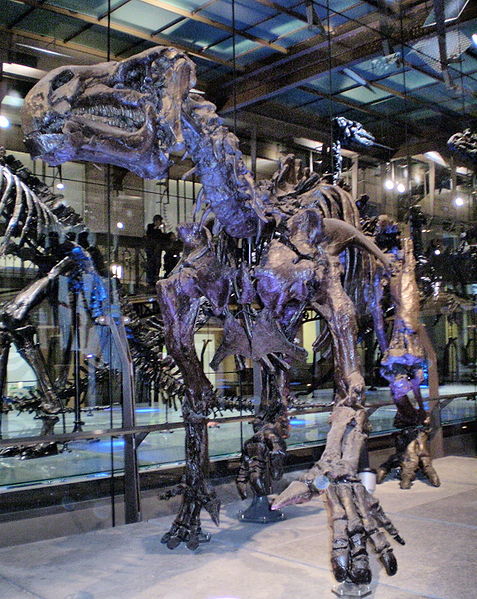
Iguanodon skeleton. Picture taken from Wikipedia here.
I have decided to introduce a new, semi-regular feature to this blog, at least for the next little while. “Blast from the Past” will feature past items from my life: pictures, geology-themed childhood sketches, old school essays, etc.
I am currently in the process of packing up my apartment so that I can move to Wyoming this summer and then to South Africa later in the year. I have been sorting through some boxes of high school and college notes and letters and have been finding some interesting tidbits from years ago. I think some of these tidbits are worth sharing on this blog as they are records of my budding and developing interest in science, travel, and other topics– or simply because they are entertaining.
For the first “Blast from the Past,” let me share with you a poem I wrote for a high school English class. We could chose any topic we wanted for the poem and I chose… dinosaurs. I guess in English class I was daydreaming about geology. Enjoy!
Attack of the Fossils
Pit-fallen Iguanodons.
Not false white casts
But black Belgian dinosaurs
Glasscaged, pinheld.
Too quiet.
Dimly lit, temperature-controlled.
Sunlight fading
Between great windowbarshadows,
Clawshadows,
Tallteethshadows, lengthening.
Nighthunters.
Blood spattering out, blue to red.
Cascading down white plaster molding,
Fingering across green marble tile,
Slowing then stopping,
Cesspooling.
Do not touch, merci.
Grasseaters, cow dinosaurs,
Flat teeth displayed intact,
Wide round skulls uncracked.
Predators mired.
Running lizards,
Hunters: tripped, tricked,
Falling, roaring,
At then escaping prey,
Now centuries fossil-trapped.
The above poem was inspired by my visit to the Royal Belgian Institute of Natural Sciences Museum in Brussels. My dad lived in Brussels for two years when I was in high school, and I went to visit him during school holidays. The Natural Sciences Museum was my favorite place to visit in the city.
I’m afraid the above poem is misleading scientifically. I think Iguanodons were actually large herbivores, so they probably wouldn’t hunt or harm humans if they suddenly came to life in a museum. Well, maybe they would. I mean, they are still very large compared to humans.There are also other, predator dinosaurs displayed in the museum, so perhaps I was actually talking about those ones coming to life. Who knows– poetry is vague and suggestive, not literal.
My English teacher liked the poem, despite the dinosaur theme. She did tell me, though, that the last line of the poem was “too abrupt and literal.” Oh, well. I have never been very good at poetry. Any suggestions for a better last line?













 Georneys


